Largest Common Divisor | PRMO-2014 | Problem 11

Try this beautiful problem from Algebra based on Largest Common Divisor .

Largest Common Divisor | PRMO | Problem 11


For natural numbers x and y,let (x,y) denote the largest common divisor of x and y. How many pairs of natural numbers x and y with xy satisfy the equation xy=x+y+(x,y)?

Check the Answer


Answer:$3$

PRMO-2018, Problem 21

Pre College Mathematics

Try with Hints


At first we have to find out the divisors that satisfy the equation \( xy=x+y+(x,y)\) .so we assume that \(x\)=ak and \(y\)=bk and try to find out the divisors

Can you now finish the problem ....

Let \(x\) =ak and \(y\)=bk, then (x,y)=k and (a,b)=1

Therefore \(xy=x+y+(x,y)\)

\(\Rightarrow abk^2=ka+kb+k\)

\(\Rightarrow kab=a+b+1\)

Can you finish the problem...

\(k=1\Rightarrow ab=a+b+1\Rightarrow a=1=\frac{2}{b-1}\)

For \(a\in \mathbb N\), then (b-1) divides 2

\(\Rightarrow b-1=1,2\)

\(\Rightarrow b=2,3\)

Therefore a=1+2=3 and a=1+1=2

\(\Rightarrow (x,y)=(3,2) or (2,3)\)

Now for \(x=y\Rightarrow(x,y)=x\)

so \(xy=x+y(x<y)\)

\(\Rightarrow x^2=3x\)

\(\Rightarrow x^2 -3x=0\)

\(\Rightarrow x(x-3)=0\)

\(\Rightarrow x=3 or 0\)

Therefore \(x\in \mathbb N\Rightarrow x=3,y=3\)

Therefore \((x,y)=(3,3)\)

Hence total number of pairs =3

Subscribe to Cheenta at Youtube


Lengths of Rectangle Problem | AMC-10A, 2009 | Problem 14

Try this beautiful problem from geometry based on Lengths of Rectangle Problem.

Lengths of Rectangle Problem - AMC-10A, 2009- Problem 14


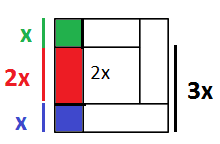
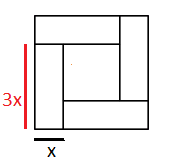
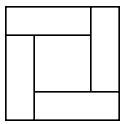
Four congruent rectangles are placed as shown. The area of the outer square is $4$ times that of the inner square. What is the ratio of the length of the longer side of each rectangle to the length of its shorter side?

length of rectangle problem
  • \(3\)
  • \(\sqrt 10\)
  • \(2+\sqrt 2\)
  • \(2\sqrt 3\)
  • \(4\)

Key Concepts


Geometry

Square

Rectangle

Check the Answer


Answer: \(3\)

AMC-10A (2009) Problem 14

Pre College Mathematics

Try with Hints


length of rectangle

Given that The area of the outer square is $4$ times that of the inner square.therefore we can say that Therefore the side of the outer square is $\sqrt 4 = 2$ times that of the inner square.Can you find out length of the longer side of each rectangle?

Can you now finish the problem ..........

breaking the figure

Let the side length of the outer square is \(4x\) then the side length of the inner square be \(2x\).Hence the side length of the red region is \(2x\) .As the rectangles are congruent ,therefore side length of green shaded region and the side length of blue shaded region will be x

understanding the figure

Therefore the length of the longer side of each rectangle be \(3x\) and length of the shoter side will be \(x\)

finding the ratio of length of rectangles

Therefore the ratio of the length of the longer side of each rectangle to the length of its shorter side will be \(\frac{3x}{x}=3\)

Subscribe to Cheenta at Youtube


Reflection Problem | AIME I, 1988 | Question 14

Try this beautiful problem from the American Invitational Mathematics Examination I, AIME I, 1988, Question 14, based on Reflection.

Reflection Problem - AIME I, 1988


Let C be the graph of xy=1 and denote by C' the reflection of C in the line y=2x. let the equation of C' be written in the form \(12x^{2}+bxy +cy^{2}+d=0\), find the product bc.

  • is 107
  • is 84
  • is 840
  • cannot be determined from the given information

Key Concepts


Geometry

Equation

Algebra

Check the Answer


Answer: is 84.

AIME I, 1988, Question 14

Coordinate Geometry by Loney

Try with Hints


Let P(x,y) on C such that P'(x',y') on C' where both points lie on the line perpendicular to y=2x

slope of PP'=\(\frac{-1}{2}\), then \(\frac{y'-y}{x'-x}\)=\(\frac{-1}{2}\)

or, x'+2y'=x+2y

also midpoint of PP', \((\frac{x+x'}{2},\frac{y+y'}{2})\) lies on y=2x

or, \(\frac{y+y'}{2}=x+x'\)

or, 2x'-y'=y-2x

solving these two equations, x=\(\frac{-3x'+4y'}{5}\) and \(y=\frac{4x'+3y'}{5}\)

putting these points into the equation C \(\frac{(-3x'+4y')(4x'+3y')}{25}\)=1

which when expanded becomes

\(12x'^{2}-7x'y'-12y'^{2}+25=0\)

or, bc=(-7)(-12)=84.

Subscribe to Cheenta at Youtube


Maximum area | PRMO-2019 | Problem 23

Try this beautiful problem from PRMO, 2019 based on Maximum area

Maximum area | PRMO-2019 | Problem-23


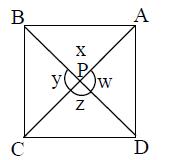
Let $\mathrm{ABCD}$ be a convex cyclic quadrilateral. Suppose $\mathrm{P}$ is a point in the plane of the quadrilateral such that the sum of its distances from the vertices of ABCD is the least. If ${\mathrm{PA}, \mathrm{PB}, \mathrm{PC}, \mathrm{PD}}={3,4,6,8} .$ What is the maximum possible area of ABCD?

  • $20$
  • $55$
  • $13$
  • \(23\)

Key Concepts


Geometry

Triangle

Area

Check the Answer


Answer:\(55\)

PRMO-2019, Problem 23

Pre College Mathematics

Try with Hints


problem figure

Given that $\mathrm{PA}=\mathrm{a}, \mathrm{PB}=\mathrm{b}, \mathrm{PC}=\mathrm{c}, \mathrm{PD}=\mathrm{d}$
Now from the above picture area of quadrilateral ABCD
Area=$[\mathrm{APB}]+[\mathrm{BPC}]+[\mathrm{CPD}]+[\mathrm{DPA}]$

finding the maximum area

Therefore area $\Delta=\frac{1}{2} \mathrm{ab} \sin \mathrm{x}+\frac{1}{2} \mathrm{bc} \sin \mathrm{y}+\frac{1}{2} \mathrm{cd} \sin \mathrm{z}+\frac{1}{2}$ da $\sin \mathrm{w}$
$\Delta_{\max }$ when $x=y=z=w=90^{\circ}$
$\Delta_{\max }=\frac{1}{2}(\mathrm{a}+\mathrm{c})(\mathrm{b}+\mathrm{d})$
Now ac $=$ bd (cyclic quadrilateral) As $(a, b, c, d)=(3,4,6,8)$
$\Rightarrow{(a, c)(b, d)}={(3,8)(4,6)}$

So $\Delta_{\max }=\frac{1}{2} \times 11 \times 10=55$

Subscribe to Cheenta at Youtube


Rectangle Pattern | AMC-10A, 2016 | Problem 10

Try this beautiful problem from Geometry based on Rectangle Pattern from AMC 10A, 2016, Problem 10.

Rectangle Pattern- AMC-10A, 2016- Problem 10


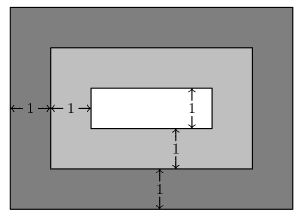
A rug is made with three different colors as shown. The areas of the three differently colored regions form an arithmetic progression. The inner rectangle is one foot wide, and each of the two shaded regions is $1$ foot wide on all four sides. What is the length in feet of the inner rectangle?

Rectangle Pattern Problem
  • \(1\)
  • \(2\)
  • \(4\)
  • \(6\)
  • \(8\)

Key Concepts


Geometry

Rectangle

square

Check the Answer


Answer: \(2\)

AMC-10A (2016) Problem 10

Pre College Mathematics

Try with Hints


Rectangle Pattern Problem figure

Given that length of the inner rectangle be $x$. Therefore the area of that rectangle is $x \cdot 1=x$
The second largest rectangle has dimensions of $x+2$ and 3 , Therefore area $3 x+6$. Now area of the second shaded rectangle= $3 x+6-x=2 x+6$

can you finish the problem........

Rectangle Pattern Problem figure

Now the dimension of the largest rectangle is $x+4$ and 5 , and the area= $5 x+20$. The area of the largest shaded region is the largest rectangle- the second largest rectangle, which is $(5 x+20)-(3 x+6)=2 x+14$

can you finish the problem........

Now The problem states that $x, 2 x+6,2 x+14$ is an arithmetic progression,i.e the common difference will be same . So we can say $(2 x+6)-(x)=(2 x+14)-(2 x+6) \Longrightarrow x+6=8 \Longrightarrow x=2$

Therefore the side length =\(2\)

Subscribe to Cheenta at Youtube


Ratio of Circles | AMC-10A, 2009 | Problem 21

Try this beautiful problem from Geometry based on ratio of Circles from AMC 10A, 2009, Problem 21.

Ratio of Circles - AMC-10A, 2009- Problem 21


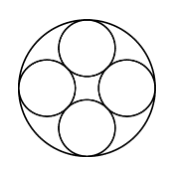
Many Gothic cathedrals have windows with portions containing a ring of congruent circles that are circumscribed by a larger circle, In the figure shown, the number of smaller circles is four. What is the ratio of the sum of the areas of the four smaller circles to the area of the larger circle?

Figure of the problem
  • $3-2 \sqrt{2}$
  • $2-\sqrt{2}$
  • $4(3-2 \sqrt{2})$
  • $\frac{1}{2}(3-\sqrt{2})$
  • $2 \sqrt{2}-2$

Key Concepts


Geometry

Circle

Pythagoras

Check the Answer


Answer: \(4(3-2 \sqrt{2})\)

AMC-10A (2009) Problem 21

Pre College Mathematics

Try with Hints


Circles in Circle

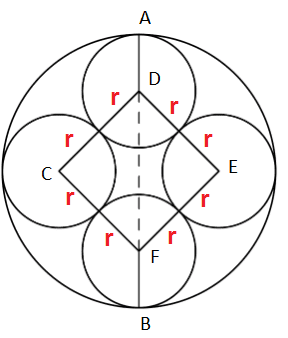
We have to find out the ratio of the sum of the areas of the four smaller circles to the area of the larger circle. To find out the area any circle,we need radius.so at first we have to find out radius of two types circle.Can you find out the radius of two type circle i.e small circle and big circle..................

Can you now finish the problem ..........

finding ratio of area of circles

Let the radius of the Four small circles be \(r\).Therfore from the above diagram we can say \(CD=DE=EF=CF=2r\). Now the quadrilateral \(CDEF\) in the center must be a square. Therefore from Pythagoras theorm we can say \(DF=\sqrt{(2r)^2 + (2r)^2}=2r\sqrt 2\). So \(AB=AD+DF+BF=r+2r\sqrt 2+r=2r+2r\sqrt 2\)

Therefore radius of the small circle is \(r\) and big circle is\(R=r+r \sqrt{2}=r(1+\sqrt{2})\)

Can you now finish the problem ..........

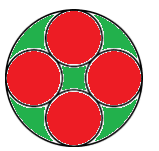
shaded circles

Therefore the area of the large circle is \(L=\pi R^{2}=\pi r^{2}(1+\sqrt{2})^{2}=\pi r^{2}(3+2 \sqrt{2}) \)and the The area of four small circles is \(S=4 \pi r^{2}\)

The ratio of the area will be \(\frac{S}{L}=\frac{4 \pi r^{2}}{\pi r^{2}(3+2 \sqrt{2})}\)

=\(\frac{4}{3+2 \sqrt{2}}\)

=\(\frac{4}{3+2 \sqrt{2}} \cdot \frac{3-2 \sqrt{2}}{3-2 \sqrt{2}}\)

=\(\frac{4(3-2 \sqrt{2})}{3^{2}-(2 \sqrt{2})^{2}}\)

=\(\frac{4(3-2 \sqrt{2})}{1}\)

=\(4(3-2 \sqrt{2})\)

Subscribe to Cheenta at Youtube


Area of the Inner Square | AMC-10A, 2005 | Problem 8

Try this beautiful problem from Geometry: Area of the inner square

Area of Inner Square - AMC-10A, 2005- Problem 8


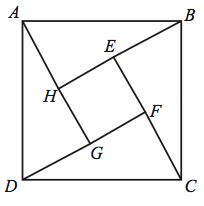
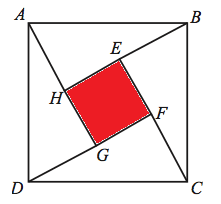
In the figure, the length of side $AB$ of square $ABCD$ is $\sqrt{50}$ and $BE=1$. What is the area of the inner square $EFGH$?

Area of the Inner Square - Problem Figure
  • \(25\)
  • \(32\)
  • \(36\)
  • \(42\)
  • \(40\)

Key Concepts


Geometry

Square

similarity

Check the Answer


Answer: \(36\)

AMC-10A (2005) Problem 8

Pre College Mathematics

Try with Hints


Area of the Inner Square - Shaded Figure

We have to find out the area of the region \(EFGH\) Which is a square shape .so if we can find out one of it's side length then we can easily find out the area of \(EFGH\). Now given that \(BE=1\) i.e \(BE=CF=DG=AH=1\) and side length of the square \(ABCD=\sqrt {50}\).Therefore \((AB)^2=(\sqrt {50})^2=50\).so using this information can you find out the length of \(EH\)?

Can you find out the required area.....?

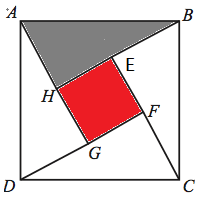
Explanatory Shading of the figure

Since \(EFGH\) is a square,therefore \(ABH\) is a Right -angle Triangle.

Therefore,\((AH)^2+(BH)^2=(AB)^2\)

\(\Rightarrow (AH)^2+(HE+EB)^2=(AB)^2\)

\(\Rightarrow (1)^2+(HE+1)^2=50\)

\(\Rightarrow (HE+1)^2=49\)

\(\Rightarrow (HE+1)=7\)

\(\Rightarrow HE=6\)

Therefore area of the inner square (red shaded region) =\({6}^2=36\)

Subscribe to Cheenta at Youtube


Triangle and Quadrilateral | AMC-10A, 2005 | Problem 25

Try this beautiful problem from Geometry: Area of Triangle and Quadrilateral

Ratios of the areas of Triangle and Quadrilateral - AMC-10A, 2005- Problem 25


In $ABC$ we have $AB = 25$, $BC = 39$, and $AC=42$. Points $D$ and $E$ are on $AB$ and $AC$ respectively, with $AD = 19$ and $AE = 14$. What is the ratio of the area of triangle $ADE$ to the area of the quadrilateral $BCED$?

  • \(\frac{19}{56}\)
  • \(\frac{19}{66}\)
  • \(\frac{17}{56}\)
  • \(\frac{11}{56}\)
  • \(\frac{19}{37}\)

Key Concepts


Geometry

Triangle

quadrilateral

Check the Answer


Answer: \(\frac{19}{56}\)

AMC-10A (2005) Problem 25

Pre College Mathematics

Try with Hints


Triangle and Rectangle Figure

Given that $AB = 25$, $BC = 39$, and $AC=42$.we have to find out Ratios of the areas of Triangle\(\triangle ADE\) and the quadrilateral \(CBED\).So if we can find out the area the \(\triangle ADE\) and area of the \(\triangle ABC\) ,and subtract \(\triangle ADE\) from \(\triangle ABC\) then we will get area of the region \(CBDE\).Can you find out the area of \(CBDE\)?

Can you find out the required area.....?

Triangle and Rectangle Figure

Now \(\frac{\triangle ADE}{\triangle ABC}=\frac{AD}{AB}.\frac{AE}{AC}=\frac{19}{25}.\frac{14}{42}=\frac{19}{75}\)

Therefore area of \(BCED\)=area of \(\triangle ABC\)-area of \(\triangle ADE\).Now can you find out Ratios of the areas of Triangle and the quadrilateral?

can you finish the problem........

Now \(\frac{\triangle ADE}{quad.BCED}\)=\(\frac{\triangle ADE}{{\triangle ABC}-{\triangle ADE}}\)=\(\frac{1}{\frac{\triangle ABC}{\triangle ADE}-1}=\frac{1}{\frac{75}{19}-1}=\frac{19}{56}\)

Subscribe to Cheenta at Youtube


Ratio of the areas | PRMO-2019 | Problem 19

Try this beautiful problem from PRMO, 2019 based on Ratio of the areas.

Ratio of the areas | PRMO | Problem-19


Let $\mathrm{AB}$ be a diameter of a circle and let $\mathrm{C}$ be a point on the segment $\mathrm{AB}$ such that $\mathrm{AC}: \mathrm{CB}=6: 7 .$ Let $\mathrm{D}$ be a point on the circle such that $\mathrm{DC}$ is perpendicular to $\mathrm{AB}$. Let DE be the diameter through $\mathrm{D}$. If $[\mathrm{XYZ}]$ denotes the area of the triangle XYZ. Find [ABD] / $[\mathrm{CDE}]$ to the nearest integer.

  • $20$
  • $91$
  • $13$
  • \(23\)

Key Concepts


Geometry

Triangle

Area

Check the Answer


Answer:\(13\)

PRMO-2019, Problem 19

Pre College Mathematics

Try with Hints


ratio of the areas problem figure

\(\angle \mathrm{AOC} \quad=\frac{6 \pi}{13}, \angle \mathrm{BOC}=\frac{7 \pi}{13}\)

$\mathrm{Ar} \Delta \mathrm{ABD}=\mathrm{Ar} \Delta \mathrm{ABC}=\frac{1}{2} \mathrm{AB} \times \mathrm{OC} \sin \frac{6 \pi}{13}$

$\mathrm{Ar} \Delta \mathrm{CDE}=\frac{1}{2} \mathrm{DE} \times \mathrm{OC} \sin \left(\frac{7 \pi}{13}-\frac{6 \pi}{13}\right)$

figure

$\frac{[\mathrm{ABD}]}{[\mathrm{CDE}]}=\frac{\sin \frac{6 \pi}{13}}{\sin \frac{\pi}{13}}=\frac{1}{2 \sin \frac{\pi}{26}}=\mathrm{p}$

because $\sin \theta \cong \theta$ if $\theta$ is small
$\Rightarrow \sin \frac{\pi}{26} \cong \frac{\pi}{26}$

$\mathrm{p}=\frac{13}{\pi} \Rightarrow$ Nearest integer to $\mathrm{p}$ is 4

Subscribe to Cheenta at Youtube


Pentagon & Square Pattern | AMC-10A, 2001 | Problem 18

Try this beautiful problem from Geometry based on Pentagon and square Pattern.

Pentagon & Square Pattern - AMC-10A, 2001- Problem 18


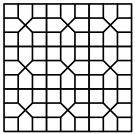
The plane is tiled by congruent squares and congruent pentagons as indicated. The percent of the plane that is enclosed by the pentagons is closest to

pentagon and square pattern
  • \(50\)
  • \(58\)
  • \(60\)
  • \(56\)
  • \(64\)

Key Concepts


Geometry

Pentagon

square

Check the Answer


Answer: \(56\)

AMC-10A (2001) Problem 18

Pre College Mathematics

Try with Hints


pentagon and square pattern

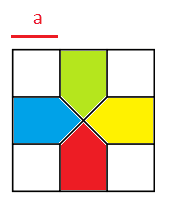
The given square is the above square.we have to find out The percent of the plane that is enclosed by the pentagons.Notice that there are \(9\) tiles in the square box.so if we can find out the area of pentagon and small square in single tile,then we can find out the total area of the pentagon in the total big square......

can you finish the problem........

Shaded pattern

Now consider a single tile from the big square,Let us take the side of the small square is $a$.There are four squares which is in the area \(4a^2\) and there are five pentagons which are in areas \(5a^2\).Then the area of the single tile is $9a^2$

Therefore we can say that exactly $5/9$ of any tile are covered by pentagons, and therefore pentagons cover $5/9$ of the plane also

can you finish the problem........

pattern

Therefore for the whole square, expressed as a percentage,it becomes $55.\overline{5}\%$, and the closest integer to this value is \(56\)

Subscribe to Cheenta at Youtube