Australian Mathematics Competition - 2019 - Senior years 11 -12 Questions and Solutions

Problem 1:

What is the value of \(201 \times 9\)?
(A) 189
(B) 1809
(C) 1818
(D) 2001
(E) 2019
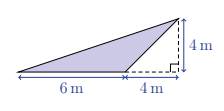
Problem 2:

What is the area of the shaded triangle?
(A) \(8 \mathrm{~m}^2\)
(B) \(12 \mathrm{~m}^2\)
(C) \(14 \mathrm{~m}^2\)
(D) \(20 \mathrm{~m}^2\)
(E) \(24 \mathrm{~m}^2\)

Problem 3:

What is \(19 \%\) of \(\$ 20\)?
(A) \(\$ 20.19\)
(B) \(\$ 1.90\)
(C) \(\$ 0.19\)
(D) \(\$ 3.80\)
(E) \(\$ 0.38\)

Problem 4:

What is the value of \(z\)?
(A) 30
(B) 35
(C) 45
(D) 50
(E) 55

Problem 5:

The value of \(2^0+1^9\) is
(A) 1
(B) 2
(C) 3
(D) 10
(E) 11

Problem 6:

Let \(f(x)=3 x^2-2 x\). Then \(f(-2)=\)
(A) -32
(B) -8
(C) 16
(D) 32
(E) 40

Problem 7:

This kite has angles \(\theta, \theta, \theta\) and \(\frac{\theta}{3}\). What is the size of the angle \(\theta\)?
(A) \(120^{\circ}\)
(B) \(105^{\circ}\)
(C) \(90^{\circ}\)
(D) \(112^{\circ}\)
(E) \(108^{\circ}\)

Problem 8:

Consider the undulating number sequence

$$
1,4,7,4,1,4,7,4,1,4, \ldots,
$$

which repeats every four terms. The running total of the first 3 terms is 12. The running total of the first 7 terms is 28.
Which one of the following is also a running total of this sequence?
(A) 61
(B) 62
(C) 67
(D) 66
(E) 65

Problem 9:

Mia walks at 1.5 metres per second. Her friend Crystal walks at 2 metres per second. They walk in opposite directions around their favourite bush track, starting together from the same point. They first meet again after 20 minutes. How long, in kilometres, is the track?
(A) 3.5
(B) 4.2
(C) 6
(D) 7
(E) 8.4

Problem 10:

$$
\frac{1^1+2^2+3^3+4^4}{1^1+2^2+3^3}=
$$

(A) \(2^3\)
(B) \(3^2\)
(C) 11
(D) \(4^3\)
(E) 259

Problem 11:

The 5-digit number \(P 679 Q\) is divisible by 72. The digit \(P\) is equal to
(A) 1
(B) 2
(C) 3
(D) 4
(E) 5

Problem 12:

The altitude of a right-angled triangle divides the hypotenuse into lengths of 4 and 6. What is the area of the triangle?
(A) \(10 \sqrt{6}\)
(B) 24
(C) 25
(D) 12
(E) \(6 \sqrt{10}\)

Problem 13:

In a box of apples, \(\frac{3}{7}\) of the apples are red and the rest are green. Five more green apples are added to the box. Now \(\frac{5}{8}\) of the apples are green. How many apples are there now in the box?
(A) 32
(B) 33
(C) 38
(D) 40
(E) 48

Problem 14:

Which number exceeds its square by the greatest possible amount?
(A) \(\frac{1}{2}\)
(B) \(\frac{2}{3}\)
(C) \(\frac{1}{4}\)
(D) \(\frac{3}{4}\)
(E) \(\frac{\sqrt{2}}{2}\)

Problem 15:

A regular nonagram is a nine-pointed star drawn as shown. What is the angle at each of the nine points?
(A) \(100^{\circ}\)
(B) \(110^{\circ}\)
(C) \(120^{\circ}\)
(D) \(130^{\circ}\)
(E) \(140^{\circ}\)

Problem 16:

Two sequences are constructed, each with 900 terms:
\(5,8,11,14, \ldots \quad\) increasing by 3
\(3,7,11,15, \ldots \quad\) increasing by 4
How many terms do these two sequences have in common?
(A) 400
(B) 300
(C) 275
(D) 225
(E) 75

Problem 17:

A circular steel gateway surrounding a rectangular gate is designed as shown. The total height of the gateway is divided into 10 equal intervals by equally-spaced horizontal bars.
The rectangular gate is what fraction of the area of the entire circular gateway?
(A) \(\frac{48}{25 \pi}\)
(B) \(\frac{\sqrt{3}}{\pi}\)
(C) \(\frac{2}{\pi}\)
(D) \(\frac{8 \sqrt{2}}{25 \pi}\)
(E) \(\frac{8}{5 \pi}\)
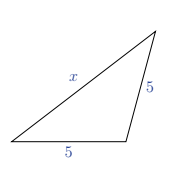
Problem 18:

For what values of \(x\) does the triangle with side lengths 5, 5 and \(x\) have an obtuse angle?
(A) \(0<x \leq 5 \sqrt{2}\)
(B) \(5<x \leq 5 \sqrt{2}\)
(C) \(5<x<10\)
(D) \(0<x<10\)
(E) \(5 \sqrt{2}<x<10\)

Problem 19:

A rectangle has area 20 and perimeter 22. How long is each of its diagonals?
(A) \(4 \sqrt{5}\)
(B) 10
(C) \(\sqrt{29}\)
(D) \(2 \sqrt{26}\)
(E) 9

Problem 20:
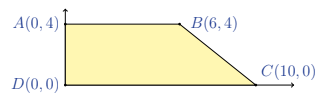
The line \(y=m x\) divides quadrilateral \(A B C D\) into two equal areas.
The value of \(m\) is \(A\) 1
(B) \(\frac{2}{3}\)
(C) \(\frac{8}{17}\)
(D) \(\frac{8}{15}\)
(E) \(\frac{8}{25}\)

Problem 21:

Manny has three ways to travel the 8 kilometres from home to work: driving his car takes 12 minutes, riding his bike takes 24 minutes and walking takes 1 hour and 44 minutes. He wants to know how to get to work as quickly as possible in the event that he is riding his bike and gets a flat tyre.
He has three strategies:
(i) If he is close to home, walk back home and then drive his car.
(ii) If he is close to work, just walk the rest of the way.
(iii) For some intermediate distances, spend 20 minutes fixing the tyre and then continue riding his bike.
He knows there are two locations along the route to work where the strategy should change. How far apart are they?
(A) 2 km
(B) 3 km
(C) 4 km
(D) 5 km
(E) 6 km

Problem 22:

A circular coin of radius 1 cm rolls around the inside of a square without slipping, always touching the boundary of the square. When it returns to where it started, the coin has performed exactly one whole revolution. In centimetres, what is the side length of the square?

(A) \(\pi\)
(B) 3.5
(C) \(1+\pi\)
(D) 4
(E) \(2+\frac{\pi}{2}\)

Problem 23:

A passenger train 200 m long and travelling at \(80 \mathrm{~km} / \mathrm{h}\) passes a goods train 2 km long travelling in the opposite direction at \(20 \mathrm{~km} / \mathrm{h}\). What is the distance, measured along one of the tracks, between the point at which the fronts of the trains pass each other and the point at which their back ends pass each other?
(A) 1.28 km
(B) 1.4 km
(C) 1.56 km
(D) 1.8 km
(E) 1.88 km

Problem 24:

A circle \(C\) and a regular hexagon \(H\) have equal area. A regular hexagon \(H^{\prime}\) is inscribed in \(C\), and a circle \(C^{\prime}\) is inscribed in \(H\).
What is the ratio of the area of \(H^{\prime}\) to the area of \(C^{\prime}\) ?

(A) \(1: 1\)
(B) \(3: \pi\)
(C) \(9: \pi^2\)
(D) \(3: 4\)
(E) \(3 \sqrt{3}: 2 \pi\)

Problem 25:

A cube of side length 1 is cut into three pieces of equal volume by two planes passing through the diagonal of the top face. One plane cuts the edge \(\overline{U V}\) at the point \(P\). What is the length \(P V\) ?
(A) \(\frac{1}{2}\)
(B) \(\frac{1}{3}\)
(C) \(\frac{\sqrt{2}}{2}\)
(D) \(\sqrt{3}-1\)
(E) \(\frac{\sqrt{5}-1}{2}\)

Problem 26:

The number 35 has the property that when its digits are both increased by 2 , and then multiplied, the result is \(5 \times 7=35\), equal to the original number.
Find the sum of all two-digit numbers such that when you increase both digits by 2 , and then multiply these numbers, the product is equal to the original number.

Problem 27:

In a list of numbers, an odd-sum triple is a group of three numbers in a row that add to an odd number. For instance, if we write the numbers from 1 to 6 in this order,

6
4
2
1
3
5
then there are exactly two odd-sum triples: \((4,2,1)\) and \((1,3,5)\).
What is the greatest number of odd-sum triples that can be made by writing the numbers from 1 to 1000 in some order?

Problem 28:

Terry has a solid shape that has four triangular faces. Three of these faces are at right angles to each other, while the fourth face has side lengths 11,20 and 21 . What is the volume of the solid shape?

Problem 29:

The diagram shows one way in which a \(3 \times 10\) rectangle can be tiled by 15 rectangles of size \(1 \times 2\).
Since this tiling has no symmetry, we count rotations and reflections of this tiling as different tilings. How many different tilings of this \(3 \times 10\) rectangle are possible?

Problem 30:

A function (f), defined on the set of positive integers, has \(f(1)=2\) and \(f(2)=3\). Also \(f(f(f(n)))=n+2\) if \(n\) is even and \(f(f(f(n)))=n+4\) if \(n\) is odd. What is \(f(777) \)?

Australian Mathematics Competition - 2020 - Senior years 11 -12 Questions and Solutions

Problem 1:

What is the value of \(2020 \div 20\) ?
(A) 2000
(B) 2040
(C) 11
(D) 101
(E) 1001

Problem 2:

In the diagram provided, find the sum of \(x\) and \(y\).
(A) 30
(B) 75
(C) 95
(D) 105
(E) 180

Problem 3:

Evaluate \(\sqrt{7+18 \div\left(10-1^5\right)}\)
(A) \(\frac{5}{3}\)
(B) 9
(C) 3
(D) 5
(E) \(\frac{1}{27}\)

Problem 4:

Sebastien is thinking of two numbers whose sum is 26 and whose difference is 14. The product of Sebastien's two numbers is
(A) 80
(B) 96
(C) 105
(D) 120
(E) 132

Problem 5:

If \(\frac{4}{5}\) of \(\frac{5}{6}\) of \(\frac{\star}{7}\) of \(\frac{7}{8}\) is equal to 1 , then the value of \(\star\) is
(A) 6
(B) 8
(C) 10
(D) 12
(E) 14

Problem 6:

A square garden of area \(10000 \mathrm{~m}^2\) is to be enlarged by increasing both its length and width by \(10 \%\). The increase in area, in square metres, is
(A) 1000
(B) 2000
(C) 2100
(D) 2400
(E) 4000

Problem 7:

Given that \(f(x)=2 x^2-3 x+c\) and \(f(2)=6\), then \(c\) is equal to
(A) 4
(B) 3
(C) 6
(D) 8
(E) 12

Problem 8:

An equilateral triangle is subdivided into a number of smaller equilateral triangles, as shown. The shaded triangle has side length 2. What is the perimeter of the large triangle?
(A) 24
(B) 27
(C) 30
(D) 33
(E) 36

Problem 9:

If \(a \neq 0\), then \(\frac{a^{x+y}}{a^x}\) is equivalent to
(A) \(a^y\)
(B) \(\frac{1}{a^y}\)
(C) \(-a^y\)
(D) \(a^{1+y}\)
(E) \(1+a^y\)

Problem 10:

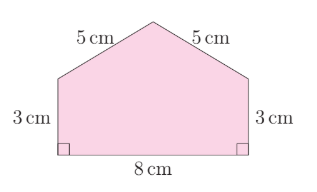
What is the area of the pentagon shown?
(A) \(32 \mathrm{~cm}^2\)
(B) \(36 \mathrm{~cm}^2\)
(C) \(42 \mathrm{~cm}^2\)
(D) \(56 \mathrm{~cm}^2\)
(E) \(64 \mathrm{~cm}^2\)

Problem 11:

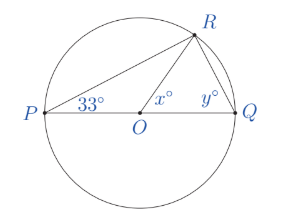
In the diagram, \(P Q\) is a diameter of the circle, \(O R\) is a radius, and \(\angle O P R=33^{\circ}\).
The value of \(x+y\) is
(A) 99
(B) 113
(C) 115
(D) 123
(E) 137

Problem 12:

This diagram is composed entirely of semicircles. The diameter of each of the eight smallest semicircles is exactly one-quarter of the diameter of the two biggest semicircles.
What fraction of the large circle is shaded?
(A) \(\frac{9}{16}\)
(B) \(\frac{2}{3}\)
(C) \(\frac{3}{4}\)
(D) \(\frac{1}{2}\)
(E) \(\frac{5}{8}\)

Problem 13:

In Paradise, all days are either fine or wet.
If today is fine, the probability of tomorrow being fine is \(\frac{3}{4}\).
If today is wet, the probability of tomorrow being fine is \(\frac{1}{3}\).
Today is Friday and it is fine. I am having a BBQ on Sunday. What is the probability that it will be fine on Sunday?
(A) \(\frac{25}{48}\)
(B) \(\frac{29}{48}\)
(C) \(\frac{2}{3}\)
(D) \(\frac{3}{4}\)
(E) \(\frac{31}{48}\)

Problem 14:

Given that \(x\) and \(y\) are both integers and \(2^{x+1}+2^x=3^{y+2}-3^y\), the value of \(x+y\) is
(A) 0
(B) 1
(C) 4
(D) 7
(E) 9

Problem 15:

A bag contains exactly 50 coins. The coins are either worth 10 cents, 20 cents or 50 cents, and there is at least one of each. The total value of the coins is \(\$ 10\).
How many different ways can this occur?
(A) 2
(B) 4
(C) 8
(D) 12
(E) 16

Problem 16:

A regular hexagon is partially covered by six right-angled triangles, as shown.
What fraction of the hexagon is not covered?
(A) \(\frac{1}{4}\)
(B) \(\frac{1}{3}\)
(C) \(\frac{2}{5}\)
(D) \(\frac{4}{9}\)
(E) \(\frac{1}{2}\)

Problem 17:

In a paddock of sheep, there are 4 times as many male sheep as female sheep. In another paddock, there are 5 times as many females as males. When the two flocks of sheep are combined, there are equal numbers of males and females. What is the smallest possible total number of sheep?
(A) 20
(B) 26
(C) 30
(D) 38
(E) 42

Problem 18:

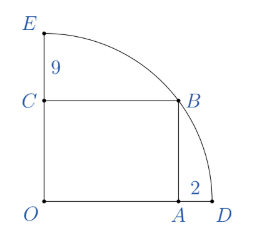
The rectangle \(O A B C\) is drawn in the quadrant of a circle \(O D E\), so that \(A D=2\) and \(C E=9\). What is the radius of the circle?
(A) 11
(B) 13
(C) 15
(D) 17
(E) 20

Problem 19:

The minimum value of the function \(f(x)=2^{x^2-2 x-3}\) is
(A) 1
(B) \(\frac{1}{2}\)
(C) \(\frac{1}{4}\)
(D) \(\frac{1}{8}\)
(E) \(\frac{1}{16}\)

Problem 20:

Two sides of a regular pentagon are extended to create a triangle. Inside this triangle, a smaller regular pentagon is drawn, as shown. In area, how many times bigger is the larger pentagon than the smaller pentagon?
(A) 4
(B) \(2 \sqrt{5}\)
(C) 5
(D) \(\frac{\sqrt{5}+3}{2}\)
(E) \(\sqrt{5}\)

Problem 21:

For \(n \geq 1, s_n\) is defined to be the number consisting of \(n\) consecutive ones, so \(s_1=1\), \(s_2=11, s_3=111\), and so on.
Which one of the following numbers is divisible by 7 ?
(A) \(s_{902}\)
(B) \(s_{903}\)
(C) \(s_{904}\)
(D) \(s_{905}\)
(E) \(s_{906}\)

Problem 22:

A circle is inscribed in the quadrilateral \(A B C D\) so that it touches all four sides, as shown. Sides \(A B\) and \(D C\) are parallel with lengths 2 cm and 4 cm , respectively, and sides \(A D\) and \(B C\) have equal length.
What, in centimetres, is the length of \(A C\) ?
(A) \(\sqrt{17}\)
(B) \(2 \sqrt{5}\)
(C) \(\sqrt{13}\)
(D) 5
(E) \(3 \sqrt{2}\)

Problem 23:

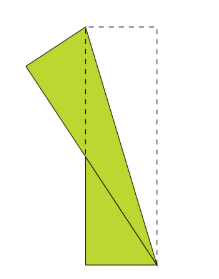
A rectangular sheet of paper that is three times as tall as it is wide is folded along one diagonal, making the pentagon shown.
What is the ratio of the area of this pentagon to the area of the original rectangle?
(A) \(13: 18\)
(B) \(3: 4\)
(C) \(7: 12\)
(D) \(2: 3\)
(E) \(\sqrt{10}: 4\)

Problem 24:

Alex writes down the value of the following sum, where the final term is the number consisting of 2020 consecutive nines:

How many times does the digit 1 appear in the answer?
(A) 0
(B) 2016
(C) 2018
(D) 2020
(E) 2021

Problem 25:

Three real numbers \(a, b\) and \(c\) are such that

\[
a+b+c=4 \quad \text { and } \quad \frac{1}{a+b}+\frac{1}{b+c}+\frac{1}{c+a}=5
\]

Then, \(\frac{c}{a+b}+\frac{a}{b+c}+\frac{b}{c+a}\) is equal to
(A) \(\frac{3}{2}\)
(B) \(\frac{4}{5}\)
(C) 2
(D) 20
(E) 17

Problem 26:

A different integer from 1 to 10 is placed on each of the faces of a cube. Each vertex is then assigned a number which is the sum of the numbers on the three faces which touch that vertex.

Only the vertex numbers are shown here. What is the product of the 4 smallest face numbers?

Problem 27:

The coefficients of a polynomial function \(P(x)\) are all non-negative integers. Given that \(P(2)=40\) and \(P(40)=2688008\), what is the value of \(P(3)\) ?

Problem 28:

This circle has 18 equally spaced points marked. There are 816 ways of joining 3 of these points to form a triangle.
How many of these triangles have a pair of angles that differ by \(30^{\circ}\) ?

Problem 29:

Starting with a \(9 \times 9 \times 9\) cube, Steve mined out nine square tunnels through each face so that the resulting solid shape had front view, top view and side view all the same, as shown.
Going from the original cube to the perforated cube, how much did the surface area increase?

Problem 30:

When I drive to school every day, I pass eight traffic lights, each either green, yellow, or red. I find that, because of synchronization, a green light is always followed immediately by a yellow, and a red light is never immediately followed by a red. Thus a sequence of lights may start with GYRY, but not RRGG. How many possible sequences of the eight lights are there?

Australian Mathematics Competition - 2023 - Senior years 11 -12 Questions and Solutions

Problem 1:

What is the value of \(2023-3202\) ?
(A) -1221
(B) -1179
(C) 1179
(D) 1221
(E) 5225

Problem 2:

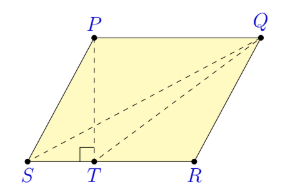
A parallelogram \(P Q R S\) has an area of \(60 \mathrm{~cm}^2\) and side \(P Q\) of length 10 cm .
Which length is 6 cm ?
(A) \(R Q\)
(B) \(R S\)
(C) \(Q T\)
(D) \(P T\)
(E) \(Q S\)

Problem 3:

Which one of these is equal to \(57 \times 953\) ?
(A) 321
(B) 4321
(C) 54321
(D) 654321
(E) 7654321

Problem 4:

What is the difference between \(2^5\) and \(5^2\) ?
(A) 0
(B) 1
(C) 3
(D) 5
(E) 7

Problem 5:

What is the value of the angle \(\theta^{\circ}\) in the diagram?
(A) \(100^{\circ}\)
(B) \(110^{\circ}\)
(C) \(120^{\circ}\)
(D) \(130^{\circ}\)
(E) \(140^{\circ}\)

Problem 6:

The shaded square is inscribed in the larger square as shown.
What is the ratio of shaded to unshaded area in the diagram?
(A) \(5: 4\)
(B) \(25: 24\)
(C) \(3: 2\)
(D) \(7: 4\)
(E) \(12: 7\)

Problem 7:

Jemmy multiplies together all the integers from 1 to 18 . What are the last three digits of the result?
(A) 000
(B) 020
(C) 200
(D) 080
(E) 800

Problem 8:

A fuel tank is \(40 \%\) empty. Then 40 litres of fuel is removed. The tank is now \(40 \%\) full. How many litres are in a full tank?
(A) 40
(B) 100
(C) 160
(D) 200
(E) 400

Problem 9:

The volume \(V\) of a sphere of radius \(r\) is given by \(V=\frac{4}{3} \pi r^3\). For a sphere of volume \(V=100 \mathrm{~cm}^3\), which of the following is closest to the radius?
(A) 2.9 cm
(B) 3.5 cm
(C) 5 cm
(D) 5.8 cm
(E) 10 cm

Problem 10:

If I add 3 consecutive odd integers, I get a total of \(9 m+3\). The largest of these 3 integers is
(A) \(3 m-3\)
(B) \(3 m-1\)
(C) 3 m
(D) \(3 m+1\)
(E) \(3 m+3\)

Problem 11:

The value of \(\left(\sqrt{24} + \sqrt{54}\right)^2\) is
(A) 140
(B) 150
(C) 160
(D) 170
(E) 180

Problem 12:

In a group of 6 people there are 3 pairs of twins. How many 3 -member committees can be chosen that do not contain any pair of twins?
(A) 0
(B) 8
(C) 12
(D) 24
(E) 48

Problem 13:

Assuming \(a>b>0\), the expression \(\frac{a^{-1}-b^{-1}}{a^{-2}-b^{-2}}\) can be written as
(A) \(\frac{b-a}{a b}\)
(B) \(\frac{b+a}{a b}\)
(C) \(\frac{a b}{b+a}\)
(D) \(\frac{a^2-b^2}{a-b}\)
(E) \(a-b\)

Problem 14:

A bag contains red and yellow balls such that the ratio red : yellow is (5: 7). Then 10 balls of each colour are removed and the ratio changes to (5: 8). How many balls were originally in the bag?
(A) 48
(B) 60
(C) 72
(D) 84
(E) 96

Problem 15:

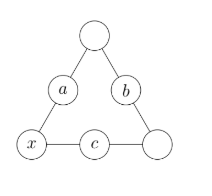
In the solution to this number puzzle, whenever there are three numbers in a straight line, the middle number is the sum of the other two.
What is the value of \(x\) ?
(A) \(\frac{1}{2}(a+b+c)\)
(B) \(\frac{1}{2}(b-a-c)\)
(C) \(\frac{1}{2}(a+b-c)\)
(D) \(\frac{1}{2}(a-b+c)\)
(E) \(\frac{1}{2}(b+c-a)\)

Problem 16:

If \(f(x)=5+x\) and \(g(x)=7-x\), then \(f(g(x))-g(f(x))\) equals
(A) \(10-x\)
(B) 7
(C) \(x+2\)
(D) 10
(E) \(2 x-2\)

Problem 17:

The hypotenuse of a right-angled triangle has length 6 cm . The perimeter of the triangle is 14 cm .
What is the area of the triangle in square centimetres?
(A) 7
(B) 12
(C) 14
(D) 21
(E) 24

Problem 18:

I have two identical dice, each with faces
\(1, \frac{1}{2}, \sqrt{3}, \frac{1}{\sqrt{3}}, \frac{1}{\sqrt{2}}\) and \(\frac{\sqrt{3}}{2}\).
I roll both dice and multiply the two numbers rolled, then simplify my answer. What is the probability that this product is rational?
(A) \(\frac{1}{9}\)
(B) \(\frac{1}{6}\)
(C) \(\frac{1}{2}\)
(D) \(\frac{5}{18}\)
(E) \(\frac{7}{18}\)

Problem 19:

How many distinct pairs \((x, y)\) satisfy \(x^2+y^2<50\) if \(x\) and \(y\) are both positive integers with \(x>y\) ?
(A) 15
(B) 13
(C) 11
(D) 9
(E) 8

Problem 20:

A \(15 \mathrm{~cm} \times 20 \mathrm{~cm}\) rectangle is cut into two triangles. One triangle is rotated and placed on top of the other triangle as shown to form a concave pentagon.
What is the perimeter of the pentagon?
(A) 80 cm
(B) 84 cm
(C) 93 cm
(D) 96 cm
(E) 105 cm

Problem 21:

I have four numbers. When I add 3 to the first number, subtract 3 from the second number, multiply the third number by 3 and divide the fourth number by 3 , my four answers are all equal.
My original 4 numbers added to 32 . What is the sum of the largest two of these?
(A) 24
(B) 25
(C) 26
(D) 27
(E) 28

Problem 22:

Antonio walked 11.5 km to his cousin Maria's house.
At first he walked uphill, then along a flat part of the road and the final part was downhill. The trip took 2 hours 54 minutes. The next day his walk back home took 3 hours 6 minutes. Antonio walks uphill at a constant speed of \(3 \mathrm{~km} / \mathrm{h}\), on the flat at \(4 \mathrm{~km} / \mathrm{h}\) and downhill at \(5 \mathrm{~km} / \mathrm{h}\).
What is the length, in kilometres, of the flat part of the road?
(A) 4
(B) 4.5
(C) 5
(D) 5.5
(E) 6

Problem 23:

I think of two positive integers and call their sum \(S\) and their product \(P\). Which one of the following could not be the value of \(S+P\) ?
(A) 84
(B) 86
(C) 88
(D) 90
(E) 92

Problem 24:

A solid regular tetrahedron has 4 faces, each an equilateral triangle. It is suspended in the entomology laboratory. There are two food sources on the tetrahedron, one at a vertex \(V\) and the other at \(X\), the centre of the opposite face. When a geodesic grub is placed anywhere upon the tetrahedron, it instinctively crawls along the shortest possible path over the surface to the closest food source.
What fraction of the surface area is closer to \(V\) than to \(X\), in terms of paths along the surface?
(A) \(\frac{1}{4}\)
(B) \(\frac{1}{3}\)
(C) \(\frac{1}{2}\)
(D) \(\frac{2}{3}\)
(E) \(\frac{3}{4}\)

Problem 25:

Three spheres of radius 2 sit on a flat surface touching one another. A smaller sphere sits on the same surface, in the middle and touching all three of the bigger spheres. What is its radius?
(A) \(2 \sqrt{3}-2 \sqrt{2}\)
(B) \(2 \sqrt{\sqrt{3}-\sqrt{2}}\)
(C) \(\sqrt{3}\)
(D) \(\frac{3}{2}\)
(E) \(\frac{2}{3}\)

Problem 26:

How many ways can you select four distinct equally spaced numbers from the set \({1, \ldots, 40} ?\)

Problem 27:

Digits \(a, b\) and \(c\) are chosen and then two six-digit numbers are formed, \(M\) with digits \(a b c a b c\) and \(N\) with digits ababab. The ratio \(M: N) is (55: 54\). What is the 3-digit number \(a b c\) ?

Problem 28:

Two wheels are fixed to an axle as shown. Due to their different sizes, the two wheels trace two concentric circles when rolled on level ground.
In centimetres, what is the radius of the circle traced on the ground by the larger wheel?

Problem 29:

Martin the gardener has 3 new vegetable beds, near the kitchen, laundry and shed. Each year he will plant one bed with tomatoes, one with beans, and one with carrots. He needs a schedule for planting that goes for 8 summers. To balance the disease risk and soil nutrients, his schedule must follow these rules:

In how many ways can he schedule his vegetable planting for these 8 summers?

Problem 30:

A percussionist is practising patterns within an 11-beat bar of music. To visualise this, she arranges 11 dots around a circle, with black dots representing a drum hit. She reads this pattern of dots clockwise, starting at the top.
Her patterns have at least one black dot, no two adjacent black dots and two patterns only count as the same if they are the same in every detail, including where the pattern starts in the circle and the direction it is read.
For instance, patterns \(A\) and \(B\) below are two of her patterns, and they count as different, even though \(B\) can be thought of as \(A\) starting on a different beat. Pattern \(C\) is not one of her patterns, since it has two adjacent black dots.
How many drumming patterns like this are possible?

Announcement of Australian Maths Competition:

Easy Guide to Prepare for MathCounts Competition 2021 - 2022

What is Mathcounts?

MATHCOUNTS is a national middle school mathematics contest held in different places in the U.S. states and territories. It is established in 1983, which provides engaging mathematics programs to the US middle school students of different ability levels to grow their confidence and improve the attitudes about mathematics and problem solving.

Who are the founders of Mathcounts?

This nation-wide math competition's founding sponsors are the CNA Foundation, the National Society of Professionals Engineers and the National Council of Teachers of Mathematics. The MATHCOUNTS foundation is a non-profitable organization which encourages students in grade 6-8 in all the US states and territories.

Who can appear for Mathcounts Competition?

Students of US in grades 6-8 are eligible to participate in MATHCOUNTS competitions.

The student has to attend a school located in a U.S. state or territory or it can be an overseas school that is affiliated with the U.S. Departments of Defense or State.

Maximum 12 NSCs from the same school can register for the Competition. Registration eligibility will be on a first-come, first-served basis.

Home schools and home school groups in agreement with the home school laws of the state in which they are located are entitled to join in MATHCOUNTS competitions in accordance with all other policies.

Mathcounts Competition Format 2021-22

The Mathcounts Competition Series has 4 levels—school, chapter, state and national. Each level contains four rounds- Sprint Round, Target Round, Team Round and Countdown Round.

Scoring system of the Examination

The score of a team is equal to the average of the total of its participants' individual scores plus twice the number of questions answered accurately on the team round. With the individual scores of a maximum of 46 each and team-round scores a maximum of 20, 66 is a perfect team score.

What is a good score for Mathcounts?

A perfect score is 46. It depends on the state or chapter. The ranking is determined by either raw individual score or by the results of the Countdown Round at the Chapter and State Levels.

Important dates for Mathcounts Competition, 2021- 22

Why is Mathcounts Competition important?

MATHCOUNTS enables the critical thinking and problem-solving skills essential for success. In an independent research, more than 85% of MATHCOUNTS students said their self-confidence in their STEM abilities enhanced after participating in the Competition Series. 

What does the winner of Mathcounts get?

Every year, the top team and the participants in the Countdown Round mostly win a trip to White House to meet the current president of the United States followed by a scholarship offering the sponsors.

How to prepare for Mathcounts Competition 2021-2022


Resources to prepare for Mathcounts : Curriculum at Cheenta

Preparation Tips

All the best!

What is AMC 10 | How to prepare for AMC 10, 2022 ?

What is AMC 10?

American Mathematics Contest 10 (AMC 10) is the 2nd stage of the Math Olympiad Contest in the US after AMC 8. The contest is in multiple-choice format and aims to develop problem-solving abilities. The difficulty of the problems dynamically varies and is based on important mathematical principles. These contests have lasting educational value.

Who can appear for AMC10 2022 ?

Students in grade 10 or below and under 17.5 years of age on the day of the contest are eligible to participate in the AMC 10.

How can one appear for AMC 10 2022 from India?

Cheenta can help you register for American Mathematics Competition (AMC) 10, 2022. Interested Students can email us at support@cheenta.com.

Watch this to know why Indian Students should register for AMC.

AMC 10 Exam Format 2021

The format of the tests is multiple choice type. It is a 75-minute test with 25 questions. The exams are held on two dates under the names AMC 10A and 10B for AMC 10.

Is there any difference in the A and B (AMC10 A and AMC10 B) versions of the examinations?

Yes! There are some differences in the A and B versions. The differences are the competition dates and that each version has a distinct set of questions, although the two examinations are equal in difficulty level and distribution of topics. 

Can a Student take both of the AMC 10A and AMC 10B?

 A 10th grader or below can take both the AMC 10 A and the AMC 10 B. In that case, one has to order for both the competitions.

AMC 10 Exam Syllabus 2022

The syllabus for AMC 10 include:

  • Elementary Algebra
  • Basic Geometry Knowledge like Pythagorean Theorem, area and volume formulas
  • Elementary Number Theory
  • Elementary Probability

The syllabus for AMC 10 excludes:

  • Trigonometry
  • Advanced Algebra
  • Advanced Geometry

The difficulty of the problem increases with the question numbers in the question paper.

Important dates for AMC10, 2022

For AMC 1OA:

For AMC 1OB:

Scoring system of the Examination

After the exam takes place in November, the MAA AMC office will begin emailing official scores and reports in early to mid-December. It takes roughly 3-4 weeks to finish reporting.

What after AMC 10?

The students with high scores in AMC 10, get an invitation to participate in the AIME (American Invitational Mathematics Examinations).

How to prepare for AMC 10, 2022


Resources to prepare for AMC 10: Curriculum at Cheenta

Preparation Tips

All the best!

External Tangent | AMC 10A, 2018 | Problem 15

Try this beautiful Problem on Geometry based on External Tangent from AMC 10 A, 2018. You may use sequential hints to solve the problem.

External Tangent - AMC-10A, 2018- Problem 15


Two circles of radius 5 are externally tangent to each other and are internally tangent to a circle of radius 13 at points $A$ and $B$, as shown in the diagram. The distance $A B$ can be written in the form $\frac{m}{n}$, where $m$ and $n$ are relatively prime positive integers. What is $m+n ?$

,

  • $21$
  • $29$
  • $58$
  • $69$
  • $93$

Key Concepts

Geometry

Triangle

Pythagoras

Suggested Book | Source | Answer

Suggested Reading

Pre College Mathematics

Source of the problem

AMC-10A, 2018 Problem-15

Check the answer here, but try the problem first

$69$

Try with Hints

First Hint

Given that two circles of radius 5 are externally tangent to each other and are internally tangent to a circle of radius 13 at points $A$ and $B$. we have to find out the length \(AB\).

Now join \(A\) & \(B\) and the points \(Y\) & \(Z\). If we can show that \(\triangle XYZ \sim \triangle XAB\) then we can find out the length of \(AB\).

Now can you finish the problem?

Second Hint

now the length of \(YZ=5+5=10\) (as the length of the radius of smaller circle is $5$) and \(XY=XA-AY=13-5=8\). Now \(YZ|| AB\).therefore we can say that \(\triangle XYZ \sim \triangle XAB\). therefore we can write $\frac{X Y}{X A}=\frac{Y Z}{A B}$

Now Can you finish the Problem?

Third Hint

From the relation we can say that $\frac{X Y}{X A}=\frac{Y Z}{A B}$

\(\Rightarrow \frac{8}{13}=\frac{10}{AB}\)

\(\Rightarrow AB=\frac{13\times 10}{8}\)

\(\Rightarrow AB=\frac{65}{4}\) which is equal to \(\frac{m}{n}\)

Therefore \(m+n=65+4=69\)

Subscribe to Cheenta at Youtube

Dice Problem | AMC 10A, 2014| Problem No 17

Try this beautiful Problem on Probability based on Dice from AMC 10 A, 2014. You may use sequential hints to solve the problem.

Dice Problem - AMC-10A, 2014 - Problem 17


Three fair six-sided dice are rolled. What is the probability that the values shown on two of the dice sum to the value shown on the remaining die?

,

  • $\frac{1}{6}$
  • $\frac{13}{72}$
  • $\frac{7}{36}$
  • $\frac{5}{24}$
  • $\frac{2}{9}$

Key Concepts


combinatorics

Dice-problem

Probability

Suggested Book | Source | Answer


Suggested Reading

Pre College Mathematics

Source of the problem

AMC-10A, 2014 Problem-17

Check the answer here, but try the problem first

$\frac{5}{24}$

Try with Hints


First Hint

Total number of dice is \(3\) and each dice \(6\) possibility. therefore there are total $6^{3}=216$ total possible rolls. we have to find out the probability that the values shown on two of the dice sum to the value shown on the remaining die.

Without cosidering any order of the die , the possible pairs are $(1,1,2),(1,2,3),(1,3,4)$,$(1,4,5),(1,5,6),(2,2,4),(2,3,5)$,$(2,4,6),(3,3,6)$

Now can you finish the problem?

Second Hint

Clearly $(1,1,1).(2,2,4),(3,3,6)$ this will happen in $\frac{3 !}{2}=3$ way

$(1,2,3),(1,3,4)$,$(1,4,5),(1,5,6),(2,3,5)$,$(2,4,6),$this will happen in $3 !=6$ ways

Now Can you finish the Problem?

Third Hint

Therefore, total number of ways $3\times3+6\times6=45$ so that sum of the two dice will be the third dice

Therefore the required answer is $\frac{45}{216}$=$\frac{5}{24}$

Subscribe to Cheenta at Youtube


Problem on Curve | AMC 10A, 2018 | Problem 21

Try this beautiful Problem on Algebra based on Problem on Curve from AMC 10 A, 2018. You may use sequential hints to solve the problem.

Curve- AMC 10A, 2018- Problem 21


Which of the following describes the set of values of $a$ for which the curves $x^{2}+y^{2}=a^{2}$ and $y=x^{2}-a$ in the real $x y$ -plane intersect at
exactly 3 points?

  • $a=\frac{1}{4}$
  • $\frac{1}{4}<a<\frac{1}{2}$
  • $a>\frac{1}{4}$
  • $a=\frac{1}{2}$
  • $a>\frac{1}{2}$

Key Concepts


Algebra

greatest integer

Suggested Book | Source | Answer


Suggested Reading

Pre College Mathematics

Source of the problem

AMC-10A, 2018 Problem-14

Check the answer here, but try the problem first

$a>\frac{1}{2}$

Try with Hints


First Hint

We have to find out the value of \(a\)

Given that $y=x^{2}-a$ . now if we Substitute this value in $x^{2}+y^{2}=a^{2}$ we will get a quadratic equation of $x$ and \(a\). if you solve this equation you will get the value of \(a\)

Now can you finish the problem?

Second Hint

After substituting we will get $x^{2}+\left(x^{2}-a\right)^{2}$=$a^{2} \Longrightarrow x^{2}+x^{4}-2 a x^{2}=0 \Longrightarrow x^{2}\left(x^{2}-(2 a-1)\right)=0$

therefore we can say that either \(x^2=0\Rightarrow x=0\) or \(x^2-(2a-1)=0\)

\(\Rightarrow x=\pm \sqrt {2a-1}\). Therefore

Now Can you finish the Problem?

Third Hint

Therefore \(\sqrt {2a-1} > 0\)

\(\Rightarrow a>\frac{1}{2}\)

Subscribe to Cheenta at Youtube


Right-angled Triangle | AMC 10A, 2018 | Problem No 16

Try this beautiful Problem on Geometry based on Right-angled triangle from AMC 10 A, 2018. You may use sequential hints to solve the problem.

Right-angled triangle - AMC-10A, 2018- Problem 16


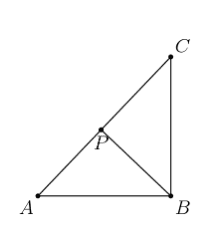
Right triangle $A B C$ has leg lengths $A B=20$ and $B C=21$. Including $\overline{A B}$ and $\overline{B C}$, how many line segments with integer length can be drawn from vertex $B$ to a point on hypotenuse $\overline{A C} ?$

,

  • $5$
  • $8$
  • $12$
  • $13$
  • $15$

Key Concepts


Geometry

Triangle

Pythagoras

Suggested Book | Source | Answer


Suggested Reading

Pre College Mathematics

Source of the problem

AMC-10A, 2018 Problem-16

Check the answer here, but try the problem first

\(13\)

Try with Hints


First Hint

Given that \(\triangle ABC\) is a Right-angle triangle and $AB=20$ and $BC=21$. we have to find out how many line segments with integer length can be drawn from vertex $B$ to a point on hypotenuse $\overline{AC}$?

Let $P$ be the foot of the altitude from $B$ to $AC$. therefore \(BP\) is the shortest legth . $B P=\frac{20 \cdot 21}{29}$ which is between $14$ and $15$.

Now can you finish the problem?

Second Hint

let us assume a line segment \(BY\) with \(Y\) on \(AC\)which is starts from $A$ to $P$ . So if we move this line segment the length will be decreases and the values will be look like as \(20,.....,15\). similarly if we moving this line segment $Y$ from $P$ to $C$ hits all the integer values from $15, 16, \dots, 21$.

Now Can you finish the Problem?

Third Hint

Therefore numbers of total line segments will be \(13\)

Subscribe to Cheenta at Youtube