Try this beautiful problem from Algebra based on sum of digits
Sum of digits - AMC-10A, 2020- Problem 8
What is the value nof
\(1+2+3-4+5+6+7-8+......+197+198+199-200\)?
\(9800\)
\(9900\)
\(10000\)
\(10100\)
\(10200\)
Key Concepts
Algebra
Arithmetic Progression
Series
Check the Answer
Answer: \(9900\)
AMC-10A (2020) Problem 8
Pre College Mathematics
Try with Hints
The given sequence is \(1+2+3-4+5+6+7-8+......+197+198+199-200\). if we look very carefully then notice that \(1+2+3-4\)=\(2\), \(5+6+7-8=10\),\(9+10+11-12=18\).....so on.so \(2,10,18......\) which is in A.P with common difference \(8\). can you find out the total sum which is given....
can you finish the problem........
we take four numbers in a group i.e \((1+2+3-4)\),\((5+6+7-8)\),\((9+10+11-12)\)......,\((197+198+199-200)\). so there are \(\frac{200}{4}=50\) groups. Therefore first term is\((a)\)= \(2\) ,common difference\((d)\)=\(8\) and numbers(n)=\(50\). the sum formula of AP is \(\frac{n}{2}\{2a+(n-1)d\}\)
Try this beautiful problem from AMC 10A, 2007 based on Numbers on cube.
Numbers on cube - AMC-10A, 2007- Problem 11
The numbers from \(1\) to \(8\) are placed at the vertices of a cube in such a manner that the sum of the four numbers on each face is the same. What is this common sum?
\(16\)
\(18\)
\(20\)
Key Concepts
Number system
adition
Cube
Check the Answer
Answer: \(18\)
AMC-10A (2007) Problem 11
Pre College Mathematics
Try with Hints
Given condition is "The numbers from \(1\) to \(8\) are placed at the vertices of a cube in such a manner that the sum of the four numbers on each face is the same".so we may say that if we think there is a number on the vertex then it will be counted in different faces also.
can you finish the problem........
Therefore we have to count the numbers \(3\) times so the total sum will be \(3(1+2+....+8)\)=\(108\)
can you finish the problem........
Now there are \(6\) faces in a Cube.....so the common sum will be \(\frac{108}{6}\)=\(18\)
Divisibility Problem from AMC 10A, 2003 | Problem 25
Try this beautiful problem from Number theory based on divisibility from AMC 10A, 2003.
Number theory in Divisibility - AMC-10A, 2003- Problem 25
Let \(n\) be a \(5\)-digit number, and let \(q\) and \(r\) be the quotient and the remainder, respectively, when \(n\) is divided by \(100\). For how many values of \(n\) is \(q+r\) divisible by \(11\)?
\(8180\)
\(8181\)
\(8182\)
\(9190\)
\(9000\)
Key Concepts
Number system
Probability
divisibility
Check the Answer
Answer: \(8181\)
AMC-10A (2003) Problem 25
Pre College Mathematics
Try with Hints
Since \(11\) divides \(q+r\) so may say that \(11\) divides \(100 q+r\). Since \(n\) is a \(5\) digit number ...soTherefore, \(q\) can be any integer from \(100\) to \(999\) inclusive, and \(r\) can be any integer from \(0\) to \(99\) inclusive.
can you finish the problem........
Since \(n\) is a five digit number then and \(11 | 100q+r\) then \(n\) must start from \(10010\) and count up to \(99990\)
can you finish the problem........
Therefore, the number of possible values of \(n\) such that \(900 \times 9 +81 \times 1=8181\)
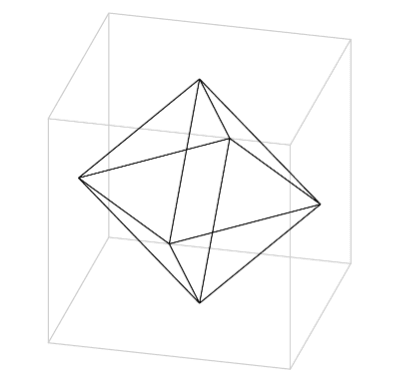
Try this beautiful problem from Geometry based on Octahedron
Octahedron - AMC-10A, 2006- Problem 24
Centers of adjacent faces of a unit cube are joined to form a regular octahedron. What is the volume of this octahedron?
\(\frac{1}{3}\)
\(\frac{1}{6}\)
\(\frac{3}{4}\)
Key Concepts
Geometry
Octahedron
pyramid
Check the Answer
Answer: \(\frac{1}{6}\)
AMC-10A (2006) Problem 24
Pre College Mathematics
Try with Hints
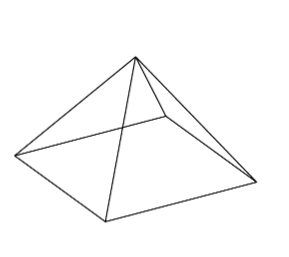
Now we have to find out the volume of the octahedron.given that Centers of adjacent faces of a unit cube are joined to form a regular octahedron.so if we divide the octahedron two square pyramids by cutting it along a plane perpendicular to one of its internal diagonals the we will get two pyramids .Now if we can find out the area of Pyramids them we can find out the volume of Octahedron.can you find out the volume of the Pyramids?
Can you now finish the problem ..........
Given that side length of a cube is \(1\).Therefore length of all edges of the regular octahedron =\(\frac{\sqrt 2}{2}\).Now the base of the pyramids is a square are will be \((\frac{\sqrt 2}{2})^2\)=\(\frac{1}{2}\).Now clearly the height of the pyramid is half the height of the cube, i.e \(\frac{1}{2}\).So volume of the Pyramid will be \(\frac{1}{3} \times\) (Base area) \(\times\) (height)=\(\frac{1}{3} \times \frac{1}{2} \times \frac{1}{2}\)=\(\frac{1}{12}\)
can you finish the problem........
Therefore the aree of the octahedron= 2 \(\times\) area of Pyramid= 2 \(\times \frac{1}{12}\)=\(\frac{1}{6}\)
Area of the Trapezium | AMC-10A, 2018 | Problem 24
Try this beautiful problem from Geometry based on the Area of the Trapezium.
Area of the Trapezium - AMC-10A, 2018- Problem 24
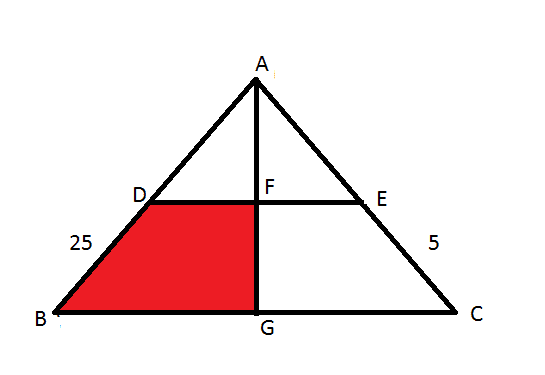
Triangle $ABC$ with $AB=50$ and $AC=10$ has area $120$. Let $D$ be the midpoint of $\overline{AB}$, and let $E$ be the midpoint of $\overline{AC}$. The angle bisector of $\angle BAC$ intersects $\overline{DE}$ and $\overline{BC}$ at $F$ and $G$, respectively. What is the area of quadrilateral $FDBG$?
$79$
$ 75$
$82$
Key Concepts
Geometry
Triangle
Trapezium
Check the Answer
Answer: $75$
AMC-10A (2018) Problem 24
Pre College Mathematics
Try with Hints
We have to find out the area of BGFD.Given that AG is the angle bisector of \(\angle BAC\) ,\(D\) and \(E\) are the mid points of \(AB\) and \(AC\). so we may say that \(DE ||BC\) by mid point theorm...
So clearly BGFD is a Trapezium.now area of the trapezium=\(\frac{1}{2} (BG+DF) \times height betwween DF and BG\)
can you find out the value of \(BG,DF \) and height between them....?
Can you now finish the problem ..........
Let $BC = a$, $BG = x$, $GC = y$, and the length of the perpendicular to $BC$ through $A$ be $h$.
Therefore area of \(\triangle ABC\)=\(\frac{ah}{2}\)=\(120\)....................(1)
From the angle bisector theorem, we have that\(\frac{50}{x} = \frac{10}{y}\) i.e \(\frac{x}{y}=5\)
Let \(BC\)=\(a\) then \(BG\)=\(\frac{5a}{6}\) and \(DF\)=\(\frac{1}{2 } \times BG\) i.e \(\frac{5a}{12}\)
now can you find out the area of Trapezium and area of Triangle?
can you finish the problem........
Therefore area of the Trapezium=\(\frac{1}{2} (BG+DF) \times FG\)=\(\frac{1}{2} (\frac{5a}{6}+\frac{5a}{12}) \times \frac{h}{2}\)=\(\frac{ah}{2} \times \frac{15}{24}\)=\(120 \times \frac{15}{24}\)=\(75\) \((from ........(1))\)
Arithmetic Progression | AMC-10B, 2004 | Problem 21
Try this beautiful problem from Algebra based on Arithmetic Progression.
Arithmetic Progression - AMC-10B, 2004- Problem 21
Let $1$; $4$; $\ldots$ and $9$; $16$; $\ldots$ be two arithmetic progressions. The set $S$ is the union of the first $2004$ terms of each sequence. How many distinct numbers are in $S$?
\(3478\)
\(3722\)
\(3378\)
Key Concepts
algebra
AP
Divisior
Check the Answer
Answer: \(3722\)
AMC-10B (2004) Problem 21
Pre College Mathematics
Try with Hints
There are two AP series .....
Let A=\(\{1,4,7,10,13........\}\) and B=\(\{9,16,23,30.....\}\).Now we have to find out a set \(S\) which is the union of first $2004$ terms of each sequence.so if we construct a set form i.e \(A=\{3K+1,where 0\leq k <2004\}\) and B=\(\{7m+9, where 0\leq m< 2004\}\).Now in A and B total elements=4008.
Now \(S=A \cup B\) and \(|S|=|A \cup B|=|A|+|B|-|A \cap B|=4008-|A \cap B|\)
Now we have to find out \(|A \cap B|\)
Can you now finish the problem ..........
To find out \(|A \cap B|\) :
Given set A=\(\{1,4,7,10,13........\}\) and B=\(\{9,16,23,30.....\}\).Clearly in the set A \(1\) is the first term and common difference \(3\).and second set i.e B first term is \(9\) and common difference is \(7\).
Now \(|A \cap B|\) means there are some terms of \(B\) which are also in \(A\).Therefore \(7m+9 \in A\) \(\Rightarrow\) \(1\leq 7m+9 \leq 3\cdot 2003 + 1\), and \(7m+9\equiv 1\pmod 3\)".
The first condition gives $0\leq m\leq 857$, the second one gives $m\equiv 1\pmod 3$.
Therefore \(m\)= \(\{1,4,7,\dots,856\}\), and number of digits in \(m\)= \(858/3 = 286\).
Area of Triangle Problem | AMC-10A, 2009 | Problem 10
Try this beautiful problem from Geometry: Area of triangle
Area of the Triangle- AMC-10A, 2009- Problem 10
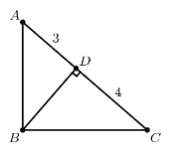
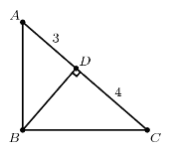
Triangle $ABC$ has a right angle at $B$. Point $D$ is the foot of the altitude from $B$, $AD=3$, and $DC=4$. What is the area of $\triangle ABC$?
\(8\)
\(7\sqrt 3\)
\(8\sqrt 3\)
Key Concepts
Geometry
Triangle
similarity
Check the Answer
Answer: \(7\sqrt 3\)
AMC-10A (2009) Problem 10
Pre College Mathematics
Try with Hints
We have to find out the area of \(\triangle ABC\).now the given that \(BD\) perpendicular on \(AC\).now area of \(\triangle ABC\) =\(\frac{1}{2} \times base \times height\). but we don't know the value of \(AB\) & \(BC\).
Given \(AC=AD+DC=3+4=7\) and \(BD\) is perpendicular on \(AC\).So if you find out the value of \(BD\) then you can find out the area .can you find out the length of \(BD\)?
Can you now finish the problem ..........
If we proof that \(\triangle ABD \sim \triangle BDC\), then we can find out the value of \(BD\)
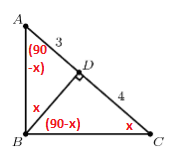
Let \(\angle C =x\) \(\Rightarrow DBA=(90-X)\) and \(\angle BAD=(90-x)\),so \(\angle ABD=x\) (as sum of the angles of a triangle is 180)
In Triangle \(\triangle ABD\) & \(\triangle BDC\) we have...
\(\angle BDA=\angle BDC=90\)
\(\angle ABD=\angle BCD=x\)
\(\angle BAD=\angle DBC=(90-x)\)
So we can say that \(\triangle ABD \sim \triangle BDC\)
Sequence | Arithmetic and Geometric | Learn with Problems
What we say is definition:
Sequence : A sequence is an arrangement of objects or a set of numbers in a particular order followed by some rule . In other words we can say that each sequence has a definite pattern. For example :
Example 1 : {1,2,3,4,5,..............................} - here if we add 1 with the previous term then we are getting the next term as 1 , 1+1 = 2 , 2+1 = 3, and so on.
Again in a sequence the terms can repeat itself such as :
{0,1, 0, 1 , 0 , 1 ,...............} - here 1's and 0's are alternately repeating itselves.
Series : A "series" is what you get when you add up all the terms of a sequence; the addition, and also the resulting value, are called the "sum" or the "summation".
For an example if we say there is a sequence of {1,2,3,4} then the corresponding series is {1+2+3+4} and the sum of this series is 10.
Know Something More About Sequence :
In a sequence each number is called TERM or ELEMENT or MEMBER .
Sequences can be of two types (primarily ) :
(1) Finite Sequences : These are the sequences where the last term is defined in other words. We can say it has a finite number of terms . For an example we can say :
{1,2,3,4,5} - here the last term is already defined so this is a finite sequence .
{4,3,2,1} - We can apply the same logic and can say this is a finite sequence as well (only its in backward )
(2) Infinite Sequences : Thee are the sequences where the last term is not defined .In other words we can say it has an infinite number of terms. For example :
{1,2,3,4,.........................} - here we have used some dots after 4 instead of any number . The only reason for this is to tell you it can continue till infinity. Huh! funny.......
For this reason these types of sequences are called infinite sequences.
Apart from these two there are some commonly used sequences we have :
Arithmetic Sequences: In these sequences every term is created by adding or subtracting a definite number to the preceding number. Example : {1,5,9,13,17,21,25,...} - where the difference of (5-1) = 4 , (9-5) = 4 and so on...
Geometric Sequences : In these sequences every term is obtained by multiplying or dividing a definite number with the preceding number. Example : { 6, 12, 24, 48 ,...} -where if we divide the next term by the previous term then \(\frac {12}{6} = 2\) again \(\frac {24}{12} = 2 \) and so on......................
Some examples for better understanding :
Before starting with an example lets try to find the importance of formula to represent one sequence :
Let's start with a sequence : {3,5,7,9,.......................}
Now from this sequence we can understand that
1st term is = 3
2nd term is = 5
3rd term is = 7
4th term is = 9 and so on .
So if I tell you to find the 10 th term (lets say each term has a general name which is 'n') of this sequence then it will be easy for us to find i.e we can continue counting the terms and we can say the 10th term is 21 (HUH - that's easy) but if I tell you to find the 100th term from this sequence then ???????????????????
Its not impossible to find but it will be a waste of time , page , ink and energy. For this if we can generate a formula from one sequence we can work at ease.
So from the above sequence {3,5,7,9,................}
Lets draw a table and lets start considering n as the general formula for the given sequence:
[Note = We have to match the (we want to get) column and the (reality) column ]
Now again considering the formula as 2n such that :
So gain the two columns are not matching but one thing we say that the gaps between two terms are same as given in the sequence {3,5,7,9,....................................}.So we are not far from the correct answer.
Now its perfectly matches with the columns. So the desire formula of the sequence is {3,5,7,9, .....} = 2n + 1.
I hope we can generate some more formula with this method. Try to do ........
Sequence Problems :
Calculate 4th term of the sequence :
\( a_{n} = (-n)^{n} \)
\(a_{1} = - 1^{1} \) = -1
\( a_{2} = (- 2 )^{2} \) = 4
\( a_{3} = (- 3 )^{3} \) = -27
\( a_{4} = (- 4 )^{4} \) = 256 (Answer )
For the sequence defined by \(a_{n} = n^{2} - 5n + 2 \) , what is the smallest value of n for which \(a_{n}\) is positive ?
Triangular Number Sequence | Explanation with Application
Triangular Number Sequence: Definition
In Triangular Number Sequence, the numbers are in the form of an equilateral triangle arranged in a series or sequence. These numbers are in the sequence of 1,3,6,10,15,21 and so on. In this representation, the numbers are represented by dots. So using the sequence notation we can write {1,3,6,10,15,21,28,............}.
Something More ..............
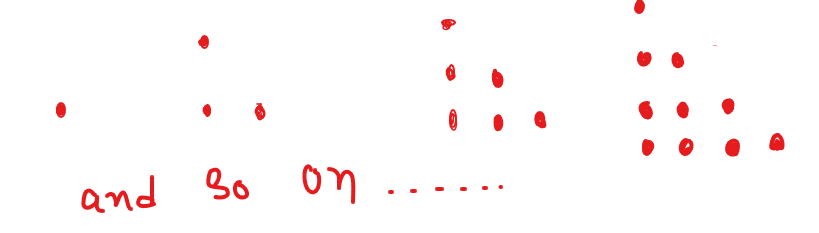
As in definition, it is mentioned that these numbers are represented using equilateral triangles with dots. So we will start with a single dot at first then there will be a triangle and in each vertex, there will be one dot so total 3 dots will be there and then there will be a triangle with 3 dots at vertices and three dots in the middle of each side of the triangle and so on.
Let's see with a picture :
Thus we can understand what I mentioned above .
1)The very first picture only one dot is there,
2)In 2nd picture a row is added with 2 dots to the 1st picture,
3)in 3rd picture a row is added with 3 dots to the 2nd picture and so on ........
So the pattern is , 1 -> 1+2 --> 1+2+3 ---> 1+2+3+4 ----> 1+2+3+4+5 -----> ..........................
If we rearrange all the dots :
Now doubling each number of dots in each representation we get :
Now depending on the number dots in rows and columns in each presentation we can easily generate the general formula for this sequence using " n " where " n " represents the number of dots we are using in each presentation.
The formula can be : \( T _{n} = \frac {n \times (n+1)}{2} \)
As we have taken each number twice so to generate the formula for the actual Triangular Number Sequence we have to divide it by 2.
Some Application of Triangular Number Sequence:
Find the 10th term in the triangular number sequence.
Here our generated formula will work
\(T_{10} = \frac {10 \times (10+1)}{2} \)
\(T_{10} = \frac {10 \times 11}{2}\)
\(T_{10} = \frac {110}{2}\)
\(T_{10} = 55 \) (Answer )
Find the 99 th term in triangular number sequence .
\(T_{99} = \frac {99 \times (99+1)}{2} \)
\(T_{99} = \frac {99 \times 100}{2} \)
\(T_{99} = 99 \times 50 \)
\(T_{99} = 4950 \) (Answer)
Now Learn to find the nth term without any Formula