American Mathematics Contest 12B (AMC 12B) 2024 - Problems and Solution

The American Mathematics Contest 12 (AMC 12) is the first exam in the series of exams used to challenge bright students, grades 12 and below, on the path towards choosing the team that represents the United States at the International Mathematics Olympiad (IMO).

High scoring AMC 12 students are invited to take the more challenging American Invitational Mathematics Examination (AIME).

The AMC 12 is administered by the American Mathematics Competitions (AMC).

In this post we have added the problems and solutions from the AMC 12B 2024.

Do you have an idea? Join the discussion in Cheenta Software Panini8: https://panini8.com/newuser/ask

Problem 1

In a long line of people arranged left to right, the 1013th person from the left is also the 1010th person from the right. How many people are in line?
(A) 2021
(B) 2022
(C) 2023
(D) 2024
(E) 2025

Solution

Problem 2

What is $10!-7!\cdot 6!?$
(A) -120
(B) 0
(C) 120
(D) 600
(E) 720

Solution

Problem 3

For how many integer values of $x$ is $|2 x| \leq 7 \pi ?$
(A) 16
(B) 17
(C) 19
(D) 20
(E) 21

Solution

Problem 4

Balls numbered $1,2,3, \ldots$ are deposited in 5 bins, labeled $A, B, C, D$, and $E$, using the following procedure. Ball 1 is deposited in bin $A$, and balls 2 and 3 are deposited in $B$. The next three balls are deposited in bin $C$, the next 4 in bin $D$, and so on, cycling back to bin $A$ after balls are deposited in bin $E$. (For example, 22, 23, . . , 28 are deposited in bin $B$ at step 7 of this process.) In which bin is ball 2024 deposited?
(A) $A$
(B) $B$
(C) $C$
(D) $D$
(E) $E$

Solution

Problem 5

In the following expression, Melanie changed some of the plus signs to minus signs:

$$
1+3+5+7+\cdots+97+99
$$

When the new expression was evaluated, it was negative. What is the least number of plus signs that Melanie could have changed to minus signs?
(A) 14
(B) 15
(C) 16
(D) 17
(E) 18

Solution

Problem 6

The national debt of the United States is on track to reach $5 \cdot 10^{13}$ dollars by 2033 . How many digits does this number of dollars have when written as a numeral in base 5 ? (The approximation of $\log _{10} 5$ as 0.7 is sufficient for this problem.)
(A) 18
(B) 20
(C) 22
(D) 24
(E) 26

Solution

Problem 7

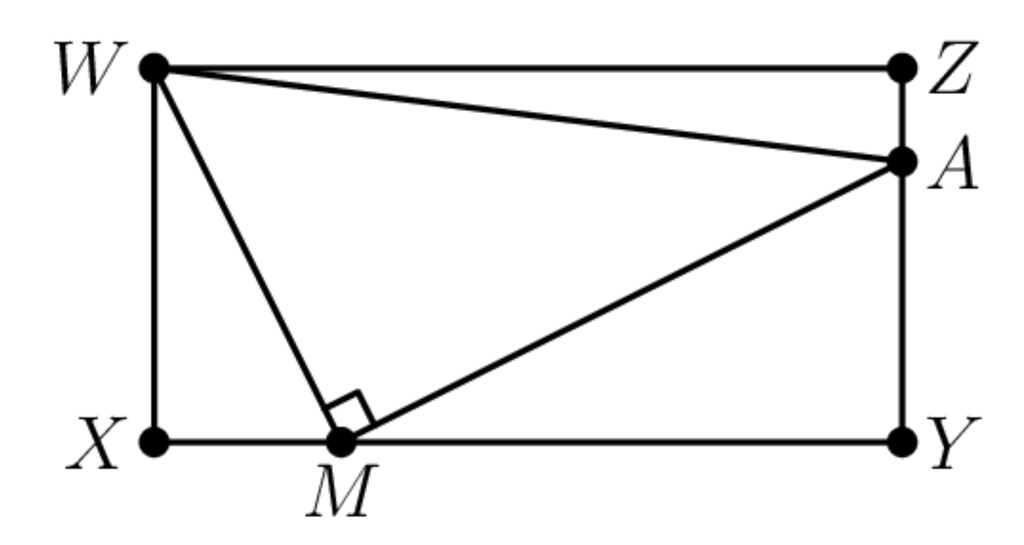
In the figure below $W X Y Z$ is a rectangle with $W X=4$ and $W Z=8$. Point $M$ lies $\overline{X Y}$, point $A$ lies on $\overline{Y Z}$, and $\angle W M A$ is a right angle. The areas of $\triangle W X M$ and $\triangle W A Z$ are equal. What is the area of $\triangle W M A$ ?
(A) 13
(B) 14
(C) 15
(D) 16
(E) 17

Solution

Problem 8

What value of $x$ satisfies

$$
\frac{\log _2 x \cdot \log _3 x}{\log _2 x+\log _3 x}=2 ?
$$

(A) 25
(B) 32
(C) 36
(D) 42
(E) 48

Solution

Problem 9

A dartboard is the region B in the coordinate plane consisting of points $(x, y)$ such that $|x|+|y| \leq 8$. A target T is the region where $\left(x^2+y^2-25\right)^2 \leq 49$. A dart is thrown at a random point in B . The probability that the dart lands in T can be expressed as $\frac{m}{n} \pi$, where $m$ and $n$ are relatively prime positive integers. What is $m+n$ ?
(A) 39
(B) 71
(C) 73
(D) 75
(E) 135

Solution

Problem 10

A list of 9 real numbers consists of $1,2.2,3.2,5.2,6.2,7$, as well as $x, y, z$ with $x \leq y \leq z$. The range of the list is 7 , and the mean and median are both positive integers. How many ordered triples $(x, y, z)$ are possible?
(A) 1
(B) 2
(C) 3
(D) 4
(E) infinitely many

Solution

Problem 11

Let $x_n=\sin ^2\left(n^{\circ}\right)$. What is the mean of $x_1, x_2, x_3, \cdots, x_{90}$ ?
(A) $\frac{11}{45}$
(B) $\frac{22}{45}$
(C) $\frac{89}{180}$
(D) $\frac{1}{2}$
(E) $\frac{91}{180}$

Solution

Problem 12

Suppose $z$ is a complex number with positive imaginary part, with real part greater than 1 , and with $|z|=2$. In the complex plane, the four points $0, z, z^2$, and $z^3$ are the vertices of a quadrilateral with area 15 . What is the imaginary part of $z$ ?
(A) $\frac{3}{4}$
(B) 1
(C) $\frac{4}{3}$
(D) $\frac{3}{2}$
(E) $\frac{5}{3}$

Solution

Problem 13

There are real numbers $x, y, h$ and $k$ that satisfy the system of equations

$x^2+y^2-6 x-8 y=h$
$x^2+y^2-10 x+4 y=k$

What is the minimum possible value of $h+k$ ?
(A) -54
(B) -46
(C) -34
(D) -16
(E) 16

Solution

Problem 14

How many different remainders can result when the 100 th power of an integer is divided by $125 ?$
(A) 1
(B) 2
(C) 5
(D) 25
(E) 125

Solution

Problem 15

A triangle in the coordinate plane has vertices $A\left(\log _2 1, \log _2 2\right), B\left(\log _2 3, \log _2 4\right)$, and $C\left(\log _2 7, \log _2 8\right)$. What is the area of $\triangle A B C$ ?
(A) $\log _2 \frac{\sqrt{3}}{7}$
(B) $\log _2 \frac{3}{\sqrt{7}}$
(C) $\log _2 \frac{7}{\sqrt{3}}$
(D) $\log _2 \frac{11}{\sqrt{7}}$
(E) $\log _2 \frac{11}{\sqrt{3}}$

Solution

Problem 16

A group of 16 people will be partitioned into 4 indistinguishable 4 -person committees. Each committee will have one chairperson and one secretary. The number of different ways to make these assignments can be written as $3^r M$, where $r$ and $M$ are positive integers and $M$ is not divisible by 3 . What is $r$ ?
(A) 5
(B) 6
(C) 7
(D) 8
(E) 9

Solution

Problem 17

Integers $a$ and $b$ are randomly chosen without replacement from the set of integers with absolute value not exceeding 10 . What is the probability that the polynomial $x^3+a x^2+b x+6$ has 3 distinct integer roots?
(A) $\frac{1}{240}$
(B) $\frac{1}{221}$
(C) $\frac{1}{105}$
(D) $\frac{1}{84}$
(E) $\frac{1}{63}$.

Solution

Problem 18

The Fibonacci numbers are defined by $F_1=1, F_2=1$, and $F_n=F_{n-1}+F_{n-2}$ for $n \geq 3$. What is $\frac{F_2}{F_1}+\frac{F_4}{F_2}+\frac{F_6}{F_3}+\cdots+\frac{F_{20}}{F_{10}} ?$
(A) 318
(B) 319
(C) 320
(D) 321
(E) 322

(A) 318
(B) 319
(C) 320
(D) 321
(E) 322

Solution

Problem 19

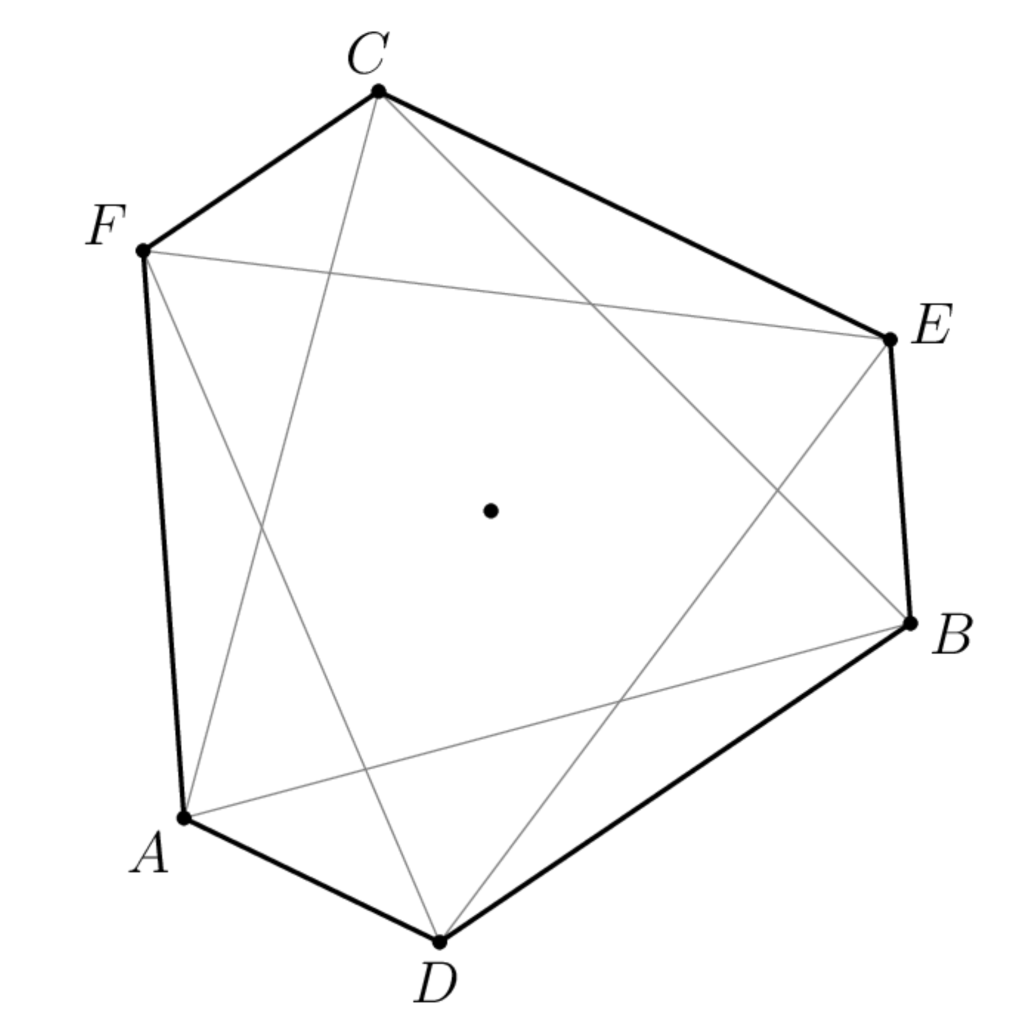
Equilateral $\triangle A B C$ with side length 14 is rotated about its center by angle $\theta$, where $0<\theta<60^{\circ}$, to form $\triangle D E F$. See the figure. The area of hexagon $A D B E C F$ is $91 \sqrt{3}$. What is $\tan \theta$ ?
(A) $\frac{3}{4}$
(B) $\frac{5 \sqrt{3}}{11}$
(C) $\frac{4}{5}$
(D) $\frac{11}{13}$
(E) $\frac{7 \sqrt{3}}{13}$

Solution

Problem 20

Suppose $A, B$, and $C$ are points in the plane with $A B=40$ and $A C=42$, and let $x$ be the length of the line segment from $A$ to the midpoint of $\overline{B C}$. Define a function $f$ by letting $f(x)$ be the area of $\triangle A B C$. Then the domain of $f$ is an open interval $(p, q)$, and the maximum value $r$ of $f(x)$ occurs at $x=s$. What is $p+q+r+s$ ?
(A) 909
(B) 910
(C) 911
(D) 912
(E) 913

Solution

Problem 21

The measures of the smallest angles of three different right triangles sum to $90^{\circ}$. All three triangles have side lengths that are primitive Pythagorean triples. Two of them are $3-4-5$ and $5-12-13$. What is the perimeter of the third triangle?
(A) 40
(B) 126
(C) 154
(D) 176
(E) 208

Solution

Problem 22

Let $\triangle A B C$ be a triangle with integer side lengths and the property that $\angle B=2 \angle A$. What is the least possible perimeter of such a triangle?
(A) 13
(B) 14
(C) 15
(D) 16
(E) 17

Solution

Problem 23

A right pyramid has regular octagon $A B C D E F G H$ with side length 1 as its base and apex $V$. Segments $\overline{A V}$ and $\overline{D V}$ are perpendicular. What is the square of the height of the pyramid?
(A) 1
(B) $\frac{1+\sqrt{2}}{2}$
(C) $\sqrt{2}$
(D) $\frac{3}{2}$
(E) $\frac{2+\sqrt{2}}{3}$

Solution

Problem 24

What is the number of ordered triples $(a, b, c)$ of positive integers, with $a \leq b \leq c \leq 9$, such that there exists a (non-degenerate) triangle $\triangle A B C$ with an integer inradius for which $a, b$, and $c$ are the lengths of the altitudes from $A$ to $\overline{B C}, B$ to $\overline{A C}$, and $C$ to $\overline{A B}$, respectively? (Recall that the inradius of a triangle is the radius of the largest possible circle that can be inscribed in the triangle.)
(A) 2
(B) 3
(C) 4
(D) 5
(E) 6

Solution

Problem 25

Pablo will decorate each of 6 identical white balls with either a striped or a dotted pattern, using either red or blue paint. He will decide on the color and pattern for each ball by flipping a fair coin for each of the 12 decisions he must make. After the paint dries, he will place the 6 balls in an urn. Frida will randomly select one ball from the urn and note its color and pattern. The events "the ball Frida selects is red" and "the ball Frida selects is striped" may or may not be independent, depending on the outcome of Pablo's coin flips. The probability that these two events are independent can be written as $\frac{m}{n}$, where $m$ and $n$ are relatively prime positive integers. What is $m$ ? (Recall that two events $A$ and $B$ are independent if $P(A$ and $B)=P(A) \cdot P(B)$.
(A) 243
(B) 245
(C) 247
(D) 249
(E) 251
Solution

American Mathematics Contest 12A (AMC 12A) 2024 - Problems and Solution

The American Mathematics Contest 12 (AMC 12) is the first exam in the series of exams used to challenge bright students, grades 12 and below, on the path towards choosing the team that represents the United States at the International Mathematics Olympiad (IMO).

High scoring AMC 12 students are invited to take the more challenging American Invitational Mathematics Examination (AIME).

The AMC 12 is administered by the American Mathematics Competitions (AMC).

In this post we have added the problems and solutions from the AMC 12A 2024.

Do you have an idea? Join the discussion in Cheenta Software Panini8: https://panini8.com/newuser/ask

Problem 1

What is the value of $9901 \cdot 101-99 \cdot 10101 ?$
(A) 2
(B) 20
(C) 200
(D) 202
(E) 2020

Solution

Problem 2

A model used to estimate the time it will take to hike to the top of the mountain on a trail is of the form $T=a L+b G$, where $a$ and $b$ are constants, $T$ is the time in minutes, $L$ is the length of the trail in miles, and $G$ is the altitude gain in feet. The model estimates that it will take 69 minutes to hike to the top if a trail is 1.5 miles long and ascends 800 feet, as well as if a trail is 1.2 miles long and ascends 1100 feet. How many minutes does the model estimates it will take to hike to the top if the trail is 4.2 miles long and ascends 4000 feet?
(A) 240
(B) 246
(C) 252
(D) 258
(E) 264

Solution

Problem 3

The number 2024 is written as the sum of not necessarily distinct two-digit numbers. What is the least number of two-digit numbers needed to write this sum?
(A) 20
(B) 21
(C) 22
(D) 23
(E) 24

Solution

Problem 4

What is the least value of $n$ such that $n$ ! is a multiple of $2024 ?$
(A) 11
(B) 21
(C) 22
(D) 23
(E) 253

Solution

Problem 5

A data set containing 20 numbers, some of which are 6 , has mean 45 . When all the 6 s are removed, the data set has mean 66 . How many 6 s were in the original data set?
(A) 4
(B) 5
(C) 6
(D) 7
(E) 8

Solution

Problem 6

The product of three integers is 60. What is the least possible positive sum of the three integers?
(A) 2
(B) 3
(C) 5
(D) 6
(E) 13

Solution

Problem 7

In $\triangle A B C, \angle A B C=90^{\circ}$ and $B A=B C=\sqrt{2}$. Points $P_1, P_2, \ldots, P_{2024}$ lie on hypotenuse $\overline{A C}$ so that $A P_1=P_1 P_2=P_2 P_3=\cdots=$

$P_{2023} P_{2024}=P_{2024} C$. What is the length of the vector sum

$\overrightarrow{B P_1}+\overrightarrow{B P_2}+\overrightarrow{B P_3}+\cdots+\overrightarrow{B P_{2024}}?$

(A) 1011
(B) 1012
(C) 2023
(D) 2024
(E) 2025

Solution

Problem 8

How many angles $\theta$ with $0 \leq \theta \leq 2 \pi$ satisfy $\log (\sin (3 \theta))+\log (\cos (2 \theta))=0$ ?
(A) 0
(B) 1
(C) 2
(D) 3
(E) 4

Solution

Problem 9

Let $M$ be the greatest integer such that both $M+1213$ and $M+3773$ are perfect squares. What is the units digit of $M$ ?
(A) 1
(B) 2
(C) 3
(D) 6
(E) 8

Solution

Problem 10

Let $\alpha$ be the radian measure of the smallest angle in a $3-4-5$ right triangle. Let $\beta$ be the radian measure of the smallest angle in a 7-24-25 right triangle. In terms of $\alpha$, what is $\beta$ ?
(A) $\frac{\alpha}{3}$
(B) $\alpha-\frac{\pi}{8}$
(C) $\frac{\pi}{2}-2 \alpha$
(D) $\frac{\alpha}{2}$
(E) $\pi-4 \alpha$

Solution

Problem 11

There are exactly $K$ positive integers $b$ with $5 \leq b \leq 2024$ such that the base- $b$ integer $2024_b$ is divisible by 16 (where 16 is in base ten). What is the sum of the digits of $K$ ?
(A) 16
(B) 17
(C) 18
(D) 20
(E) 21

Problem 12

The first three terms of a geometric sequence are the integers $a, 720$, and $b$, where $a<720<b$. What is the sum of the digits of the least possible value of $b$ ?
(A) 9
(B) 12
(C) 16
(D) 18
(E) 21

Solution

Problem 13

The graph of $y=e^{x+1}+e^{-x}-2$ has an axis of symmetry. What is the reflection of the point $\left(-1, \frac{1}{2}\right)$ over this axis?
(A) $\left(-1,-\frac{3}{2}\right)$
(B) $(-1,0)$
(C) $\left(-1, \frac{1}{2}\right)$
(D) $\left(0, \frac{1}{2}\right)$
(E) $\left(3, \frac{1}{2}\right)$

Solution

Problem 14

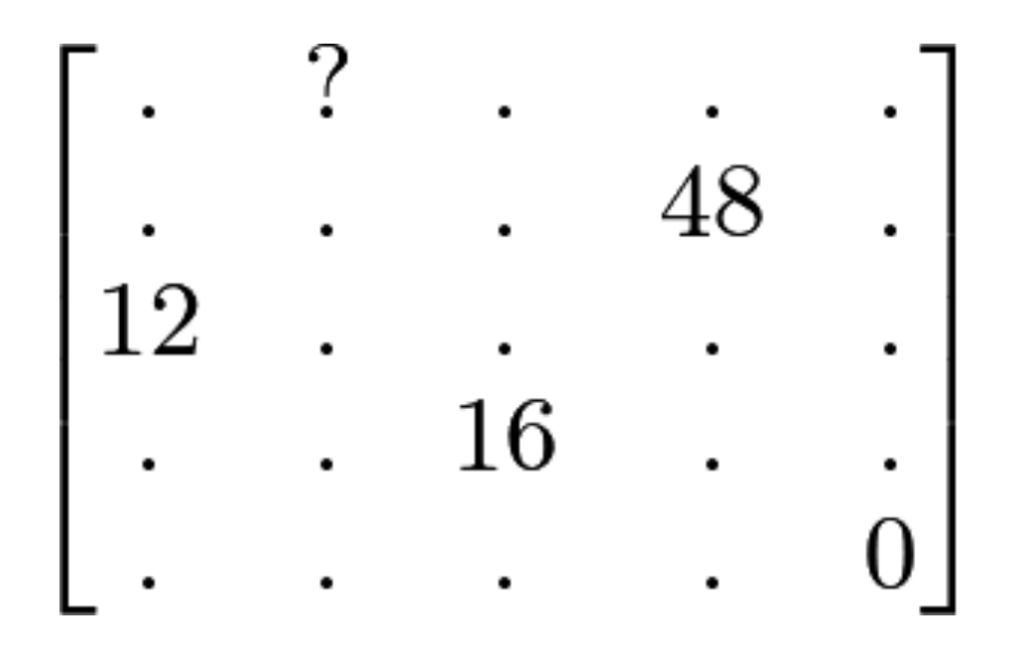
The numbers, in order, of each row and the numbers, in order, of each column of a $5 \times 5$ array of integers form an arithmetic progression of length 5 . The numbers in positions $(5,5),(2,4),(4,3)$, and $(3,1)$ are $0,48,16$, and 12 , respectively. What number is in position $(1,2) ?$

(A) 19
(B) 24
(C) 29
(D) 34
(E) 39

Solution

Problem 15

The roots of $x^3+2 x^2-x+3$ are $p, q$, and $r$. What is the value of

$$
\left(p^2+4\right)\left(q^2+4\right)\left(r^2+4\right) ?
$$

(A) 64
(B) 75
(C) 100
(D) 125
(E) 144

Solution

Problem 16

A set of 12 tokens ---3 red, 2 white, 1 blue, and 6 black --- is to be distributed at random to 3 game players, 4 tokens per player. The probability that some player gets all the red tokens, another gets all the white tokens, and the remaining player gets the blue token can be written as $\frac{m}{n}$, where $m$ and $n$ are relatively prime positive integers. What is $m+n$ ?
(A) 387
(B) 388
(C) 389
(D) 390
(E) 391

Solution

Problem 17

Integers $a, b$, and $c$ satisfy $a b+c=100, b c+a=87$, and $c a+b=60$. What is $a b+b c+c a$ ?
(A) 212
(B) 247
(C) 258
(D) 276
(E) 284

Solution

Problem 18

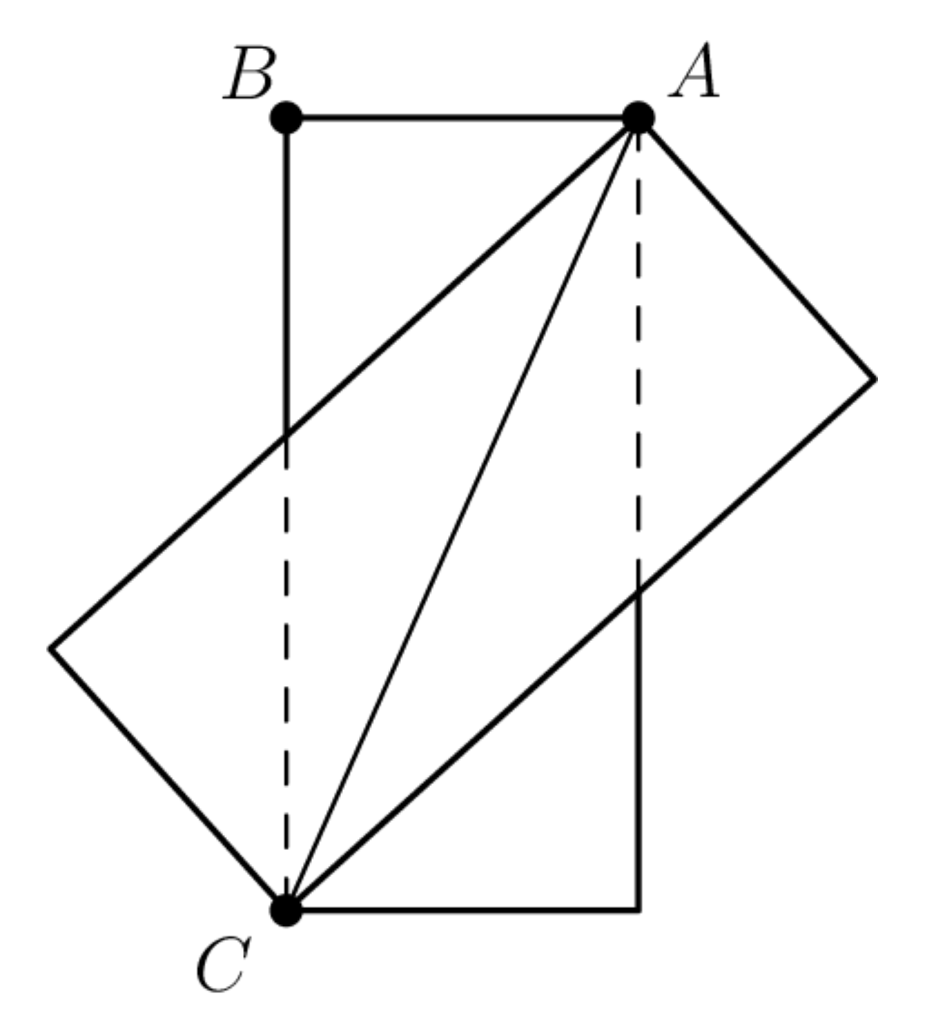
On top of a rectangular card with sides of length 1 and $2+\sqrt{3}$, an identical card is placed so that two of their diagonals line up, as shown ( $\overline{A C}$, in this case $)$.

Continue the process, adding a third card to the second, and so on, lining up successive diagonals after rotating clockwise. In total, how many cards must be used until a vertex of a new card lands exactly on the vertex labeled $B$ in the figure?
(A) 6
(B) 8
(C) 10
(D) 12
(E) No new vertex will land on $B$.

Solution

Problem 19

Cyclic quadrilateral $A B C D$ has lengths $B C=C D=3$ and $D A=5$ with $\angle C D A=120^{\circ}$. What is the length of the shorter diagonal of $A B C D$ ?
(A) $\frac{31}{7}$
(B) $\frac{33}{7}$
(C) 5
(D) $\frac{39}{7}$
(E) $\frac{41}{7}$

Solution

Problem 20

Points $P$ and $Q$ are chosen uniformly and independently at random on sides $\overline{A B}$ and $\overline{A C}$, respectively, of equilateral triangle $\triangle A B C$. Which of the following intervals contains the probability that the area of $\triangle A P Q$ is less than half the area of $\triangle A B C ?$
(A) $\left[\frac{3}{8}, \frac{1}{2}\right]$
(B) $\left(\frac{1}{2}, \frac{2}{3}\right]$
(C) $\left(\frac{2}{3}, \frac{3}{4}\right]$
(D) $\left(\frac{3}{4}, \frac{7}{8}\right]$
(E) $\left(\frac{7}{8}, 1\right]$

Solution

Problem 21

Suppose that $a_1=2$ and the sequence $\left(a_n\right)$ satisfies the recurrence relation

$\frac{a_n-1}{n-1}=\frac{a_{n-1}+1}{(n-1)+1}$

for all $n \geq 2$. What is the greatest integer less than or equal to

$$
\sum_{n=1}^{100} a_n^2 ?
$$

(A) 338,550
(B) 338,551
(C) 338,552
(D) 338,553
(E) 338,554

Solution

Problem 22

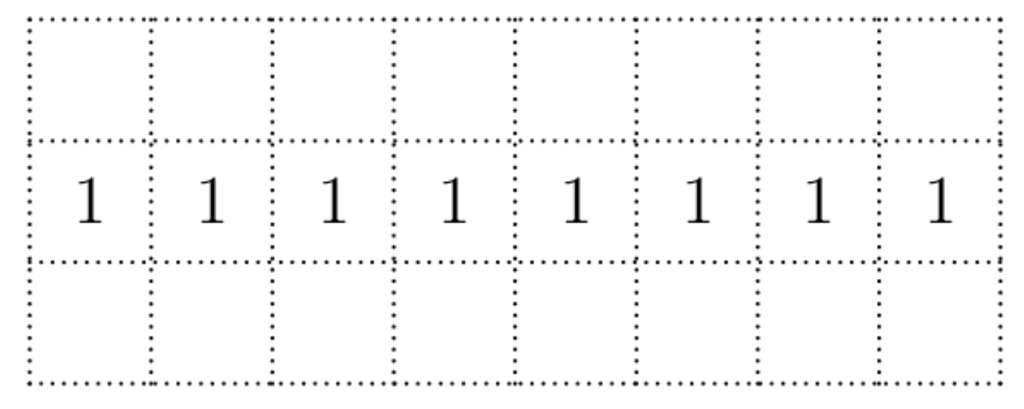
The figure below shows a dotted grid 8 cells wide and 3 cells tall consisting of $1^{\prime \prime} \times 1^{\prime \prime}$ squares. Carl places 1 -inch toothpicks along some of the sides of the squares to create a closed loop that does not intersect itself. The numbers in the cells indicate the number of sides of that square that are to be covered by toothpicks, and any number of toothpicks are allowed if no number is written. In how many ways can Carl place the toothpicks?

Solution

Problem 23

What is the value of


$\tan ^2 \frac{\pi}{16} \cdot \tan ^2 \frac{3 \pi}{16}+\tan ^2 \frac{\pi}{16} \cdot \tan ^2 \frac{5 \pi}{16}+$

$\tan ^2 \frac{3 \pi}{16} \cdot \tan ^2 \frac{7 \pi}{16}+\tan ^2 \frac{5 \pi}{16} \cdot \tan ^2 \frac{7 \pi}{16}$?

(A) 28
(B) 68
(C) 70
(D) 72
(E) 84

Solution

Problem 24

A disphenoid is a tetrahedron whose triangular faces are congruent to one another. What is the least total surface area of a disphenoid whose faces are scalene triangles with integer side lengths?
(A) $\sqrt{3}$
(B) $3 \sqrt{15}$
(C) 15
(D) $15 \sqrt{7}$
(E) $24 \sqrt{6}$

Solution

Problem 25

A graph is symmetric about a line if the graph remains unchanged after reflection in that line. For how many quadruples of integers $(a, b, c, d)$, where $|a|,|b|,|c|,|d| \leq 5$ and $c$ and $d$ are not both 0 , is the graph of

$$
y=\frac{a x+b}{c x+d}
$$

symmetric about the line $y=x$ ?
(A) 1282
(B) 1292
(C) 1310
(D) 1320
(E) 1330

Solution

New AMC 10 & 12 Review Course

Cheenta is offering a 36-hour program on AMC 10 & 12. In this short review course, we will cover concepts from Number Theory, Geometry, Algebra, and Combinatorics. This course is problem-driven in nature, in the sense concepts will be introduced and taught using relevant problems.

Schedule

The program starts on September 9th. The online live class Group A meets on Saturday and Sunday at 6 AM IST. The Group B meets on Saturday and Sunday at 5:30 PM IST. That is we have two time slots. You may choose any one.

Curriculum and Other Details

Apply for Trial Class

Pigeonhole Principle

“The Pigeonhole principle” ~ Students who have never heard may think that it is a joke. The pigeonhole principle is one of the simplest but most useful ideas in mathematics. Let’s learn the Pigeonhole Principle with some applications.

Pigeonhole Principle Definition:

In Discrete Mathematics, the pigeonhole principle states that if we must put $N + 1$ or more pigeons into N Pigeon Holes, then some pigeonholes must contain two or more pigeons.

Example:

If $Kn+ 1$ (where k is a positive integer) pigeons are distributed among n holes than some hole contains at least $k + 1$ pigeons.

Applications of Pigeonhole Principle:

This principle is applicable in many fields like Number Theory, Probability, Algorithms, Geometry, etc.

Problems and Solutions:

Problem 1

A bag contains beads of two colours: black and white. What is the smallest number of beads which must be drawn from the bag, without looking so that among these beads, two are of the same colour?

Solution: We can draw three beads from bags. If there were no more than one bead of each colour among these, then there would be no more than two beads altogether. This is obvious and contradicts the fact that we have chosen their beads. On the other hand, it is clear that choosing two beads is not enough. Here the beads play the role of pigeons, and the colours (black and white) play the role of pigeonhole.

Problem 2

Find the minimum number of students in a class such that three of them are born in the same month?

Solution: Number of month $n =12$

According to the given condition,

$K+1 = 3$

$K = 2$

$M = kn +1 = 2×12 + 1 = 25$.

Problem 3

Show that from any three integers, one can always choose two so that $a^3$b – a$b^3$ is divisible by 10.

Solution: We can factories the term $a^3$b – a$b^3$ = $ab(a + b)(a - b)$, which is always even, irrespective of the pair of integers we choose.

If one of three integers from the above factors is in the form of 5k, which is a multiple of 5, then our result is proved.

If none of the integers is a multiple of 5 then the chosen integers should be in the form of $(5k)+-(1)$ and $(5k)+-(2)$ respectively.

Clearly, two of these three numbers in the above factors from the given expression should lie in one of the above two, which follows by the virtue of this principle.

These two integers are the ones such that their sum and difference is always divisible by 5. Hence, our result is proved.

Problem 4

If n is a positive integer not divisible by 2 or 5 then n has a multiple made up of 1's.

Problem 5

Let $X \subseteq{1,2, \ldots, 99}$ and $|X|=10$. Show that it is possible to select two disjoint nonempty proper subsets $Y, Z$ of $X$ such that $\sum(y \mid y \in Y)=\sum(z \mid z \in Z)$.

Problem 6

Let $A_{1} B_{1} C_{1} D_{1} E_{1}$ be a regular pentagon. For $2 \leq n \leq 11$,
let $A_{n} B_{n} C_{n} D_{n} E_{n}$ be the pentagon whose vertices are the midpoints of the sides of the pentagon $A_{n-1} B_{n-1} C_{n-1} D_{n-1} E_{n-1}$. All the 5 vertices of each of the 11 pentagons are arbitrarily coloured red or blue. Prove that four points among these 55 points have the same colour and form the vertices of a cyclic quadrilateral.

Some Useful links:

Area of Trapezoid | AMC 10A, 2018 | Problem 9

Try this beautiful problem from AMC 10A, 2018 based on area of trapezoid.

Area of Trapezoid | AMC 10A


All of the triangles in the diagram below are similar to isosceles triangle ABC , in which AB = AC . Each of the 7 smallest triangles has area 1 and \(\triangle {ABC}\) has area 40.  What is the area of trapezoid DBCE ?

  • 24
  • 25
  • 26
  • 20

Key Concepts


2D - Geometry

Isosceles Triangle

Area of Triangle

Check the Answer


Answer: 24

American Mathematics Competition, 2018 Problem 9

Challenges and Thrills - Pre - College Mathematics

Try with Hints


We can try this problem using this hint :

Let the base length of the small triangle be  x :

Then, there is a triangle ADE encompassing the 7 small triangles and sharing the top angle with a base length of 4x.

Try the rest of the sum .............................

Continuing from the last hint:

Because the area is proportional to the square of the side, let the base BC be \(\sqrt {40}x\). Then triangle ADE  has an area of 16. So the area is 40 - 16 = 24(Answer).

Subscribe to Cheenta at Youtube


Triangle Inequality Problem - AMC 12B, 2014 - Problem 13

Try this beautiful problem from American Mathematics Competition - 12B ,2014, Problem Number - 13 based on Triangle inequality

Problem - Triangle Inequality


Real numbers a and b are chosen with 1 < a < b such that no triangle with positive area has side lengths 1,a and b or \(\frac {1}{b},\frac {1}{a}\) and 1. What is the smallest possible value of b?

  • $\frac{3+\sqrt{3}}{2}$
  • $\frac{5}{2}$
  • $\frac{3+\sqrt{5}}{2}$
  • $\frac{3+\sqrt{6}}{2}$

Key Concepts


Triangle Inequality

Inequality

Geometry

Check the Answer


Answer: \(\frac {3+\sqrt 5}{2}\)

Try with Hints


It is given $1>\frac{1}{a}>\frac{1}{b}$. Use Triangle Inequality here :

$$
\begin{aligned}
& a+1>b \
& a>b-1 \
& \frac{1}{a}+\frac{1}{b}>1
\end{aligned}
$$

If we want to find the lowest possible value of $b$, we create we try to create two degenerate triangles where the sum of the smallest two sides equals the largest side. Thus we get : $a=b-1$

Now try to do the rest of the sum……………………

$$
2 b-1=b^2-b
$$

Now Solving for $\mathbf{b}$ using the quadratic equation, we get

$$
\begin{aligned}
& b^2-3 b+1=0 \
& b=\frac{3+\sqrt{5}}{2} \text { (Answer) }
\end{aligned}
$$


Subscribe to Cheenta at Youtube


Can we prove that the length of any side of a triangle is not more than half of its perimeter?

Can we Prove that ........


The length of any side of a triangle is not more than half of its perimeter

Key Concepts


Triangle Inequality

Perimeter

Geometry

Check the Answer


Answer: Yes we can definitely prove that by Triangle Inequality

Mathematical Circles - Chapter 6 - Inequalities Problem 3

Mathematical Circles by Dmitri Fomin , Sergey Genkin , Llia Itenberg

Try with Hints


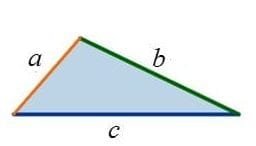
We can start this sum by using this picture below

The length of the three sides of this triangle are a,b and c. So if we apply triangle inequality which implies that the length of one side of a triangle is less than the sum of the lengths of the two sides of that triangle. In reference to the theorem

b + c > a

Proof based on triangle

So can you try to do the rest of the sum ????????

According to the question we have to find the perimeter at first

Perimeter is the sum of the length of all sides of the triangle = a + b + c

And the length of each side is a or b or c.

We have to prove : a + b + c > length of any one side

This can be one of the most important hint for this problem. Try to do the rest of the sum ................................

Here is the rest of the sum :

As stated above if we use triangle inequality :

b + c > a

Lets add a to both the sides

a + b + c > a + a

a + b + c > 2 a

The left hand side of the above inequality is the perimeter of this triangle.

perimeter > 2 a

So , \(\frac {perimeter}{2} > a \)

\(\frac {perimeter}{2} \) = semi perimeter

Hence this is proved that the length of one side of a triangle is less than half of its perimeter.

Subscribe to Cheenta at Youtube


AMC10/12 Combinatorics Problem

Combinatorics is one of the most important topic for the preparation of Mathematics Olympiad culture as well as American Mathematical Contest(also known as AMC). AMC10/12 Combinatorics Problem which is composed of selected problems from previous year.

AMC 10

[Q.1]A scanning code consists of a $latex 7 \times 7$ grid of squares, with some of
its squares colored black and the rest colored white. There must be
at least one square of each color in this grid of $latex 49$ squares. A
scanning code is called $latex \text{symmetric}$ if its look does not change when
the entire square is rotated by a multiple of $latex 90 ^{\circ}$ counterclockwise
around its center, nor when it is reflected across a line joining
opposite corners or a line joining midpoints of opposite sides. What
is the total number of possible
symmetric scanning codes?
$latex \textbf{(A)} \text{ 510} \qquad \textbf{(B)} \text{ 1022} \qquad \textbf{(C)} \text{ 8190} \qquad \textbf{(D)} \text{ 8192} \qquad \textbf{(E)} \text{ 65,534}$
[Q.2]In the expression $latex \left(\underline{\qquad}\times\underline{\qquad}\right)+\left(\underline{\qquad}\times\underline{\qquad}\right)$ each blank is to be
filled in with one of the digits $latex 1,2,3,$ or $latex 4,$ with each digit being
used once. How many different values can be obtained?
$latex \textbf{(A) }2 \qquad \textbf{(B) }3\qquad \textbf{(C) }4 \qquad \textbf{(D) }6 \qquad \textbf{(E) }24 \qquad$
[Q.3]How many subsets of $latex \{2,3,4,5,6,7,8,9\}$ contain at least one prime
number?
$latex \textbf{(A)} \text{ 128} \qquad \textbf{(B)} \text{ 192} \qquad \textbf{(C)} \text{ 224} \qquad \textbf{(D)} \text{ 240} \qquad \textbf{(E)} \text{ 256}$
[Q.4]A list of $latex 2018$ positive integers has a unique mode, which occurs
exactly $latex 10$ times. What is the least number of distinct values that
can occur in the list?
$latex \textbf{(A)}\ 202\qquad\textbf{(B)}\ 223\qquad\textbf{(C)}\ 224\qquad\textbf{(D)}\ 225\qquad\textbf{(E)}\ 234$
[Q.5]At a gathering of $latex 30$ people, there are $latex 20$ people who all know each
other and $latex 10$ people who know no one. People who know each other
hug, and people who do not know each other shake hands. How many
handshakes occur within the group?
$latex \textbf{(A)}\ 240\qquad\textbf{(B)}\ 245\qquad\textbf{(C)}\ 290\qquad\textbf{(D)}\ 480\qquad\textbf{(E)}\ 490$
[Q.6]Alice refuses to sit next to either Bob or Carla. Derek refuses
to sit next to Eric. How many ways are there for the five of them to
sit in a row of 5 chairs under these conditions?
$latex \textbf{(A)}\ 12\qquad\textbf{(B)}\ 16\qquad\textbf{(C)}\ 28\qquad\textbf{(D)}\ 32\qquad\textbf{(E)}\ 40$
[Q.7]How many integers between $latex 100$ and $latex 999$, inclusive, have the
property that some permutation of its digits is a multiple of $latex 11$
between $latex 100$ and $latex 999$?
For example, both $latex 121$ and $latex 211$ have this property.
$latex \mathrm{\textbf{(A)} \ }226\qquad \mathrm{\textbf{(B)} \ } 243 \qquad \mathrm{\textbf{(C)} \ } 270 \qquad \mathrm{\textbf{(D)} \ }469\qquad \mathrm{\textbf{(E)} \ } 486$
[Q.8]There are $latex 20$ students participating in an after-school program
offering classes in yoga, bridge, and painting. Each student must
take at least one of these three classes, but may take two or all
three. There are $latex 10$ students taking yoga, $latex 13$ taking bridge, and $latex 9$
taking painting. There are $9$ students taking at least two classes.
How many students are taking all three classes?
$latex \textbf{(A)}\ 1\qquad\textbf{(B)}\ 2\qquad\textbf{(C)}\ 3\qquad\textbf{(D)}\ 4\qquad\textbf{(E)}\ 5 $
[Q.9]How many of the base-ten numerals for the positive integers less
than or equal to $latex 2017$ contain the digit $latex 0$?
$latex \textbf{(A)}\ 469\qquad\textbf{(B)}\ 471\qquad\textbf{(C)}\ 475\qquad\textbf{(D)}\ 478\qquad\textbf{(E)}\ 481 $
[Q.10]In the figure below, $latex 3$ of the $latex 6$ disks are to be painted blue, $latex 2$ 
are to be painted red, and $latex 1$ is to be painted green. Two paintings
that can be obtained from one another by a rotation or a reflection
of the entire figure are considered the same. How many different
paintings are possible?
$latex \textbf{(A)}\ 6\qquad\textbf{(B)}\ 8\qquad\textbf{(C)}\ 9\qquad\textbf{(D)}\ 12\qquad\textbf{(E)}\ 15 $
[Q.11]How many of the base-ten numerals for the positive integers less
than or equal to $latex 2017$ contain the digit $latex 0$?
$latex \textbf{(A)}\ 1024\qquad\textbf{(B)}\ 1524\qquad\textbf{(C)}\ 1533\qquad\textbf{(D)}\ 1536\qquad\textbf{(E)}\ 2048 $
[Q.12]Each vertex of a cube is to be labeled with an integer $latex 1$ through
$latex 8$,with each integer being used once, in such a way that the sum of
the four numbers on the vertices of a face is the same for each face.
Arrangements that can be obtained from each other through rotations
of the cube are considered to be the same. How many different
arrangements are possible?
$latex \textbf{(A) } 1\qquad\textbf{(B) } 3\qquad\textbf{(C) }6 \qquad\textbf{(D) }12 \qquad\textbf{(E) }24 $
[Q.13]Five friends sat in a movie theater in a row containing $latex 5$ seats,
numbered $latex 1$ to $5$ from left to right. (The directions "left" and
"right" are from the point of view of the people as they sit in the
seats.) During the movie Ada went to the lobby to get some popcorn.
When she returned, she found that Bea had moved two seats to the
right, Ceci had moved one seat to the left, and Dee and Edie had
switched seats, leaving an end seat for Ada. In which seat had Ada
been sitting before she got up?
$latex \textbf{(A) }1 \qquad \textbf{(B) } 2 \qquad \textbf{(C) } 3 \qquad \textbf{(D) } 4\qquad \textbf{(E) } 5 $
[Q.14]Erin the ant starts at a given corner of a cube and crawls along
exactly $latex 7$ edges in such a way that she visits every corner exactly
once. and then finds that she is unable to return along an edge to her
starting point. How many paths are there meeting these conditions?
$latex \textbf{(A) }\text{6}\qquad\textbf{(B) }\text{9}\qquad\textbf{(C) }\text{12}\qquad\textbf{(D) }\text{18}\qquad\textbf{(E) }\text{24} $
[Q.15]Walking down Jane Street, Ralph passed four houses in a row,
each painted a different color. He passed the orange house before the
red house, and he passed the blue house before the yellow house. The
blue house was not next to the yellow house. How many orderings
of the colored houses are possible?
$latex \textbf{(A)}\ 2\qquad\textbf{(B)}\ 3\qquad\textbf{(C)}\ 4\qquad\textbf{(D)}\ 5\qquad\textbf{(E)}\ 6 $
[Q.16]The numbers $latex 1, 2, 3, 4, 5$ are to be arranged in a circle.
An arrangement is $latex \textit{bad}$ if it is not true that for every $latex n$ from
$latex 1$ to $latex 15$ one can find a subset of the numbers that appear
consecutively on the circle that sum to $latex n$. Arrangements that
differ only by a rotation or a reflection are considered the same.
How many different bad arrangements are there?
$latex \textbf {(A) } 1 \qquad \textbf {(B) } 2 \qquad \textbf {(C) } 3 \qquad \textbf {(D) } 4 \qquad \textbf {(E) } 5 $
[Q.17]A student must choose a program of four courses from a menu of
courses consisting of English, Algebra, Geometry, History, Art, and
Latin. This program must contain English and at least one
mathematics course. In how many ways can this program be chosen?
$latex \textbf{(A)}\ 6\qquad\textbf{(B)}\ 8\qquad\textbf{(C)}\ 9\qquad\textbf{(D)}\ 12\qquad\textbf{(E)}\ 16 $
[Q.18]A student council must select a two-person welcoming committee
and a three-person planning committee from among its members. There
are exactly $latex 10$ ways to select a two-person team for the welcoming
committee. It is possible for students to serve on both committees.
In how many different ways can a three-person planning committee be
selected?
$latex \textbf{(A)}\ 10\qquad\textbf{(B)}\ 12\qquad\textbf{(C)}\ 15\qquad\textbf{(D)}\ 18\qquad\textbf{(E)}\ 25 $
[Q.19]Central High School is competing against Northern High School
in a backgammon match. Each school has three players, and the contest
rules require that each player play two games against each of the
other school's players. The match takes place in six rounds, with
three games played simultaneously in each round. In how many different
ways can the match be scheduled?
$latex \textbf{(A)}\ 540\qquad\textbf{(B)}\ 600\qquad\textbf{(C)}\ 720\qquad\textbf{(D)}\ 810\qquad\textbf{(E)}\ 900 $
[Q.20]All $latex 20$ diagonals are drawn in a regular octagon. At how many
distinct points in the interior of the octagon (not on the boundary)
do two or more diagonals intersect?
$latex \textbf{(A)}\ 49\qquad\textbf{(B)}\ 65\qquad\textbf{(C)}\ 70\qquad\textbf{(D)}\ 96\qquad\textbf{(E)}\ 128 $
[Q.21]Chubby makes nonstandard checkerboards that have $31$ squares on
each side. The checkerboards have a black square in every corner and
alternate red and black squares along every row and column. How many
black squares are there on such a checkerboard?
$latex \textbf{(A)}\ 480 \qquad\textbf{(B)}\ 481 \qquad\textbf{(C)}\ 482 \qquad\textbf{(D)}\ 483 \qquad\textbf{(E)}\ 484 $
[Q.22]Adam, Benin, Chiang, Deshawn, Esther, and Fiona have internet
accounts. Some, but not all, of them are internet friends with each
other, and none of them has an internet friend outside this group.
Each of them has the same number of internet friends. In how many
different ways can this happen?
$latex \text{(A)}\ 60\qquad\text{(B)}\ 170\qquad\text{(C)}\ 290\qquad\text{(D)}\ 320\qquad\text{(E)}\ 660 $
[Q.23]A dessert chef prepares the dessert for every day of a week
starting with Sunday. The dessert each day is either cake, pie, ice
cream, or pudding. The same dessert may not be served two days in a
row. There must be cake on Friday because of a birthday. How many
different dessert menus for the week are possible?
$latex \textbf{(A)}\ 729\qquad\textbf{(B)}\ 972\qquad\textbf{(C)}\ 1024\qquad\textbf{(D)}\ 2187\qquad\textbf{(E)}\ 2304 $
[Q.24]In a round-robin tournament with 6 teams, each team plays one
game against each other team, and each game results in one team
winning and one team losing. At the end of the tournament, the teams
are ranked by the number of games won. What is the maximum number of
teams that could be tied for the most wins at the end on the
tournament?
$latex \textbf{(A)}\ 2\qquad\textbf{(B)}\ 3\qquad\textbf{(C)}\ 4\qquad\textbf{(D)}\ 5\qquad\textbf{(E)}\ 6 $
[Q.25]Let ($latex a_1$, $a_2$, ... $a_{10}$) be a list of the first 10 positive
integers such that for each $latex 2\le$ $latex i$ $latex \le10$ either
$latex a_i + 1$ or $latex a_i-1$ or
both appear somewhere before
$latex a_i$ in the list. How many such lists are there?
$latex \textbf{(A)}\ \ 120\qquad\textbf{(B)}\ 512\qquad\textbf{(C)}\ \ 1024\qquad\textbf{(D)}\ 181,440\qquad\textbf{(E)}\ \ 362,880 $
[Q.26]Amy, Beth, and Jo listen to four different songs and discuss
which ones they like. No song is liked by all three. Furthermore, for
each of the three pairs of the girls, there is at least one song
liked by those two girls but disliked by the third. In how many
different ways is this possible?
$latex \textbf{(A)}\ 108\qquad\textbf{(B)}\ 132\qquad\textbf{(C)}\ 671\qquad\textbf{(D)}\ 846\qquad\textbf{(E)}\ 1105 $
[Q.27]How many even integers are there between 200 and 700 whose
digits are all different and come from the set $latex \{1,2,5,7,8,9\}$ ?
$latex \text{(A)}\,12 \qquad\text{(B)}\,20 \qquad\text{(C)}\,72 \qquad\text{(D)}\,120 \qquad\text{(E)}\,200 $
[Q.28]Each vertex of convex pentagon $latex ABCDE$ is to be assigned a
color. There are $latex 6$ colors to choose from, and the ends of each
diagonal must have different colors. How many different colorings are
possible?
$latex \textbf{(A)}\ 2520\qquad\textbf{(B)}\ 2880\qquad\textbf{(C)}\ 3120\qquad\textbf{(D)}\ 3250\qquad\textbf{(E)}\ 3750 $
[Q.29]Seven distinct pieces of candy are to be distributed among three
bags. The red bag and the blue bag must each receive at least one piece
of candy; the white bag may remain empty. How many arrangements are
possible?
$latex \textbf{(A)}\ 1930 \qquad \textbf{(B)}\ 1931 \qquad \textbf{(C)}\ 1932 \qquad \textbf{(D)}\ 1933 \qquad \textbf{(E)}\ 1934 $
[Q.30]Two subsets of the set $latex S=\lbrace a,b,c,d,e\rbrace$ are to be chosen so that
their union is $latex S$ and their intersection contains exactly two
elements. In how many ways can this be done, assuming that the order
in which the subsets are chosen does not matter?
$latex \mathrm{(A)}\ 20\qquad\mathrm{(B)}\ 40\qquad\mathrm{(C)}\ 60\qquad\mathrm{(D)}\ 160\qquad\mathrm{(E)}\ 320 $
[Q.31]Ten chairs are evenly spaced around a round table and numbered
clockwise from $latex 1$ through $latex 10$. Five married couples are to sit in the
chairs with men and women alternating, and no one is to sit either
next to or across from his/her spouse. How many seating
arrangements are possible?
$latex \mathrm{(A)}\ 240\qquad\mathrm{(B)}\ 360\qquad\mathrm{(C)}\ 480\qquad\mathrm{(D)}\ 540\qquad\mathrm{(E)}\ 720 $

Also Visit: Math Olympiad Program

AMC 12

[Q.32]How many subsets of  $latex \{2,3,4,5,6,7,8,9\}$ contain at least one prime
number?
$latex (\text{A}) \indent 128 \qquad (\text{B}) \indent 192  \qquad (\text{C}) \indent 224  \qquad (\text{D}) \indent 240 \qquad (\text{E}) \indent 256 $
[Q.33]A set of $latex n$ people participate in an online video basketball
tournament. Each person may be a member of any number of $latex 5$-player
teams, but no two teams may have exactly the same $latex 5$ members. The site
statistics show a curious fact: The average, over all subsets
of size< $latex 9$ of the set of $latex n$ participants, of the number of complete
teams whose members are among those $latex 9$ people is equal to the
reciprocal of the average, over all subsets of size $latex 8$ of the
set of $latex n$ participants, of the number of complete teams whose members
are among those $latex 8$ people. How many values $latex n$, $latex 9\leq n\leq 2017$, can
be the number of participants?
$latex \textbf{(A) } 477 \qquad \textbf{(B) } 482 \qquad \textbf{(C) } 487 \qquad \textbf{(D) } 557 \qquad \textbf{(E) } 562$
[Q.34]A set of teams held a round-robin tournament in which every team
played every other team exactly once. Every team won $latex 10$ games and
lost $latex 10$ games; there were no ties. How many sets of three teams
$latex \{A, B, C\}$ were there in which $latex A$ beat $latex B$, $latex B$ beat $latex C$, and $latex C$ beat $latex A?$
$latex \textbf{(A)}\ 385 \qquad \textbf{(B)}\ 665 \qquad \textbf{(C)}\ 945 \qquad \textbf{(D)}\ 1140 \qquad \textbf{(E)}\ 1330$
[Q.35]Six chairs are evenly spaced around a circular table. One person
is seated in each chair. Each person gets up and sits down in a chair
that is not the same chair and is not adjacent to the chair he or she
originally occupied, so that again one person is seated in each chair.
In how many ways can this be done?$
$latex \textbf{(A)}\; 14 \qquad\textbf{(B)}\; 16 \qquad\textbf{(C)}\; 18 \qquad\textbf{(D)}\; 20 \qquad\textbf{(E)}\; 24$
[Q.36]A fancy bed and breakfast inn has $latex 5$ rooms, each with a
distinctive color-coded decor. One day $latex 5$ friends arrive to spend
the night. There are no other guests that night. The friends can room in
any combination they wish, but with no more than $latex 2$ friends per room.
In how many ways can the innkeeper assign the guests to the rooms?$
$latex \textbf{(A) }2100\qquad \textbf{(B) }2220\qquad \textbf{(C) }3000\qquad \textbf{(D) }3120\qquad \textbf{(E) }3125\qquad$
[Q.37]Rabbits Peter and Pauline have three offspring—Flopsie, Mopsie,
and Cotton-tail. These five rabbits are to be distributed to four
different pet stores so that no store gets both a parent and a child.
It is not required that every store gets a rabbit. In how many
different ways can this be done?$
$latex \textbf{(A)} \ 96 \qquad  \textbf{(B)} \ 108 \qquad  \textbf{(C)} \ 156 \qquad  \textbf{(D)} \ 204 \qquad  \textbf{(E)} \ 372$
[Q.38]Let $latex (a_1,a_2, \dots ,a_{10})$ be a list of the first 10 positive integers
such that for each $latex 2 \le i \le 10$ either $latex a_i+1$ or $latex a_i-1$ or both
appear somewhere before $latex a_i$ in the list. How many such lists are there$ ?
$latex \textbf{(A)}\ 120\qquad\textbf{(B)}\ 512\qquad\textbf{(C)}\ 1024\qquad\textbf{(D)}\ 181,440\qquad\textbf{(E)}\ 362,880$
[Q.39]How many positive integers less than $latex 1000$ are $latex 6$ times the sum of
their digits$ ?
$latex \textbf{(A)}\ 0 \qquad \textbf{(B)}\ 1 \qquad \textbf{(C)}\ 2 \qquad \textbf{(D)}\ 4 \qquad \textbf{(E)}\ 12$
[Q.40]Ten women sit in $latex 10$ seats in a line. All of the $latex 10$ get up and
then reseat themselves using all $latex 10$ seats, each sitting in the
seat she was in before or a seat next to the one she occupied before.
In how many ways can the women be reseated$ ?
$latex \textbf{(A)}\ 89\qquad \textbf{(B)}\ 90\qquad \textbf{(C)}\ 120\qquad \textbf{(D)}\ 2^{10}\qquad \textbf{(E)}\ 2^2 3^8$