ISI 2019 Subjective Problem 2 | Removable Discontinuity
Try this beautiful Subjective Calculus Problem appeared in ISI Entrance - 2019.
Problem
Let \(f:(0, \infty) \rightarrow \mathbb{R}\) be defined by \[ f(x)=\lim _{n \rightarrow \infty} \cos ^{n}\left(\frac{1}{n^{x}}\right) \] (a) Show that \(f\) has exactly one point of discontinuity. (b) Evaluate \(f\) at its point of discontinuity.
Key Concepts
Calculus
Limit , Continuity
Suggested Book | Source | Answer
Suggested Reading: IIT mathematics by Asit Das Gupta
Source of the Problem: ISI UG Entrance - 2019 , Subjective problem number - 2
Try with Hints
Hint 1:
Observe that,
we have \(\frac{1}{n^x} \rightarrow 0 \)
as x∈(0,∞) and n→∞.
So the indeterminate form of the given limit is \(1^{\infty}.\)
ISI 2018 Objective Problem 8 | A Problem from Sequence
Try this beautiful Objective Sequence Problem appeared in ISI Entrance - 2018.
Problem
Consider the real valued function \(h:\{0,1,2, \ldots, 100\} \longrightarrow \mathbb{R}\) such that \(h(0)=5, h(100)=20\) and satisfying \(h(i)=\frac{1}{2}(h(i+1)+h(i-1))\), for every \(i=1,2, \ldots, 99\). Then the value of \(h(1)\) is:
(A) \(5.15\) (B) \(5.5\) (C) \(6\) (D) \(6.15.\)
Key Concepts
Sequence
Arithmetic Progression
Suggested Book | Source | Answer
IIT mathematics by Asit Das Gupta
ISI UG Entrance - 2018 , Objective problem number - 8
(B) \(5.15\)
Try with Hints
Observe the following,
\(2 h(i)=h(i-1)+h(i+1)\)
\(2h(1) = h(0) + h(2) \)
\(2h(2) = h(1) + h(3) \)
and so on.
Therefore we have the following,
\(h(i+1)-h(i)=h(i)-h(i-1).\)
Means
\(h(0) , h(1) , h(2) , \ldots \ldots ,h(100) \) are in Arithmetic Progression.
\(h(0) \) and \( h(100)\) are the first and last terms of the AP.
CMI BSc Math Entrance 2022 - Question Paper and Solutions
This collection of problems and solutions from CMI Entrance 2022 is a work in progress. If you remember the problems, let us know in the comment section.
Part A (indicate if each statement is true or false)
Problem A1
Let $a_0 , a_1, a_2…..$ be an arithmetic progression such that $a_0$ and $a_1$ are positive integers. Let $g_1, g_2, g_3,…$ be a geometric progression such that $g_0=a_0$ and $g_1=a_1$. (i) $(a_5)^2 \geq a_0 a_{10}$ (ii) the sum $a_0+a_1+a_2+….+a_{10}$ is an integer multiple of $a_5$. (iii) If $\sum_{i=0}^{\infty} a_i \to \infty $ then $\sum_{i=0}^{\infty} g_i \to \infty $ (iv) If $\sum_{i=0}^{\infty} g_i $ is finite , then $\sum_{i=0}^{\infty} a_i \to -\infty $
Problem (?)
Let $A = \begin{bmatrix} 1 & 2 & 3\\ 10 & 20 & 30 \\ 11 & 22 & k \end{bmatrix}$ and $V = \begin{bmatrix} x\\ y \\ z \end{bmatrix}$. (i) Matrix $A$ is not going be invertible regardless of the value of $k$. (iii) $Av=\begin{bmatrix} 0\\ 0 \\0 \end{bmatrix} $ then the locus is a line or a plane containing the origin. (iv) If $Av=\begin{bmatrix} p\\ q \\r \end{bmatrix}$ then $q=10p$
Let $f(x)$ be a function whose domain is $[0,1]$. I. $f $ is differentiable at each point in $[0,1]$ II. $f$ is continuous at each point in $[0,1]$. III. The set $\{f(x) | x \in [0,1]\}$ has a minimum and a maximum element.
(i) I implies II (ii) II implies III (iii) Something something (iv) No two statements are equivalent
Problem A10
We have the cards numbered from 1 to 9 arranged in a certain order. A move is defined as interchanging a numbered cardx with the card labelled 1. An arrangement is said to be rectifiable if it is possible to arrange the cards in descending order by a sequence of moves.
(1) Consider the premutation $9,1,2,3,4,5,6,7,8$. Atleast 8 or more moves required to get in the orginal order. (IV) There exists a sequence of $1, 2, …, 9$ which is not rectifiable?
Problem A11
Let $z=a+ib$ ($a$, $b$ real number). Define $f(z)=z^{222}+ \frac{1}{z^{222}}$.
i) If $|z| =1$ then $f(z)$ real.
ii) If $z+ \frac{1}{z}=1$ then $f(z)=2$
Part B (Write detailed solutions)
Problem B1
If $\frac{WZ}{XY} = \frac{QZ}{YQ} = \frac{WP}{XP} = k$ show that $XP = XR$.
Problem B2
In $XY$ plane , grids are drawn.
i)A line $L$ is drawn from $(0,0)$ to $(m,n)$ then find the number of small squares $(1 \times 1)$ line $L$ will intersect. For example $(2,3)$ will intersect in $4$ squares.
ii) In a $n \times n$ square what is the maximum possible number of squares can be intersected by a line segment.
Problem B3
Consider $f(x)= 1 + x + x^2 + …. + x^n$ Find the number of local minima of $f$. For each $c$ such that $(c,f(c))$ is a point of maximum or minimum, specify the integer $k$ such that $k \leq c < (k + 1) $
Problem B4
$(r,s)$ is said to be a good pair if $r$ and $s$ are distinct and $r^3+s^2=s^3+r^2$. (i) Find good pair $(a,l)$ for the largest possible value of $l$. Also , find good pair $(s,b)$ for the smallest possible value of $s$. Also, prove that for every good pair $(c,d)$ other than the two mentioned above , there exists $e$ such that $(c,e)$ and $(d,e)$ are good pairs. (ii) Show that there are infinitely many good pairs $(r,s)$ such that $r$ and $s$ are rational.
Problem B6
(i) Prove that $f(n)=n^2+n-1$ can have at most 2 roots modulo p. Where p is prime (ii) Find the number of roots of f(n) mod 121 (iii) What can you tell about the cardinality of the set of roots of $f(n) \mod p^2$
ISI 2021 Objective Problem 23 I A Problem from Limit
Try this beautiful Objective Limit Problem appeared in ISI Entrance - 2021.
Problem
Let us denote the fractional part of
a real number \(x\) by \(\{x\}.\)
(Note \({x}=x-[x]\) where \([x]\)
is the integer part of \(x\).)
Then \[ \lim _{n \rightarrow \infty}{(3+2 \sqrt{2})^{n}}. \]
(A) equals 0 (B) equals 1 (C) equals \(\frac{1}{2}\) (D) does not exist
Key Concepts
Fractional part of a real number
Greatest Integer function
Suggested Book | Source | Answer
IIT mathematics by Asit Das Gupta
ISI UG Entrance - 2021 , Objective problem number - 23
(B) equals 1
Try with Hints
Try to find the fractional part of \((3+2 \sqrt{2})^{n} = N \)(Let) .
\(\bullet \) Observe \((3+2 \sqrt{2})^{n} + (3-2 \sqrt{2})^{n}\) is an integer.
ISI 2021 Subjective Problem 5 I A Problem from Polynomials
Try this beautiful Subjective Problem from Polynomials appeared in ISI Entrance - 2021.
Problem
Let \(a_{0}, a_{1}, \ldots, a_{19} \in \mathbb{R}\) and \[ P(x)=x^{20}+\sum_{i=0}^{19} a_{i} x^{i} x \in \mathbb{R} \] If \(P(x)=P(-x)\) for all \(x \in \mathbb{R}\) and
\(P(k)=k^{2}\), for all \(k=0,1,2, \ldots, 9\)
then find \[ \lim _{x \rightarrow 0} \frac{P(x)}{\sin ^{2} x}.\]
Key Concepts
Monic Polynomial
Even Polynomial
Degree of a Polynomial
Suggested Book | Source | Answer
An Excursion in Mathematics (Chapter - 2.1)
ISI Entrance - 2021 , Subjective problem number - 5
\(1-(9 !)^{2}\)
Try with Hints
\(\bullet \) Recall the Fundamental Theorem of Algebra i.e. every polynomial \(P(z)\) of degree \(n\) has \(n\) values \(z_{i}\) (some of them possibly degenerate) for which \(P\left(z_{i}\right)=0\).
\(\bullet \) And apply it to construct the polynomial.
\(\bullet \) Observe \(P(0) =0\) i.e. \(0\) is a root of \(P(x) .\)
Use \(P(x)=P(-x)\) to observe \(P(\pm k)=k^{2}\) for every \(k=1,2, \ldots, 9\).
Define a new polynomial \(Q(x)\) \[ Q(x)=P(x)-x^{2} \]
And see constructing \(Q(x)\) is easier . Hence find \(Q(x)\) and eventually \(P(x)\).
To construct \(Q(x)\) use followings:
\(Q(x)\) has 19 roots and those are 0 and \(\pm 1, \pm 2, \ldots, \pm 9\).
As \(P(x)\) is monic and of degree 20 , so \(Q(x)\) is also. Hence all factors of \(Q(x)\) are like \((x+a)\).
Therefore, \[Q(x)=x(x-1)(x+1)(x-2) \]
\[\ldots (x-9)(x+9) \times(x+c) \] (Observe extra \((x+c)\) is multiplied to make the degree of \(Q(x)\) to be 20 .)
\(\bullet\) As
\[Q(x)=x(x-1)(x+1)(x-2) \]
\[\ldots (x-9)(x+9) \times(x+c)\]
\(\bullet \)
\[ P(x)=x(x-1)(x+1)(x-2) \]
\[\ldots (x-9)(x+9) \times(x+c)+x^{2} .\]
\[\Rightarrow P(x)=x^{2}(x^{2}-1)(x^{2}-4) \]
\[\ldots (x^{2}-81)+x^{2}\]
\(\bullet \) Have you noticed the coefficients of all odd exponents of \(x\) in \(P(x) \) are \(0?\)
\(\bullet \) Recall we are given that \(P(x)=P(-x)\) for all \(x \in R\) means that \(P(x)\) is an even function and so all odd degree coefficients are 0 . That is, \(a_{i}=0\) for \(i=1,3,5, \ldots, 17,19\).
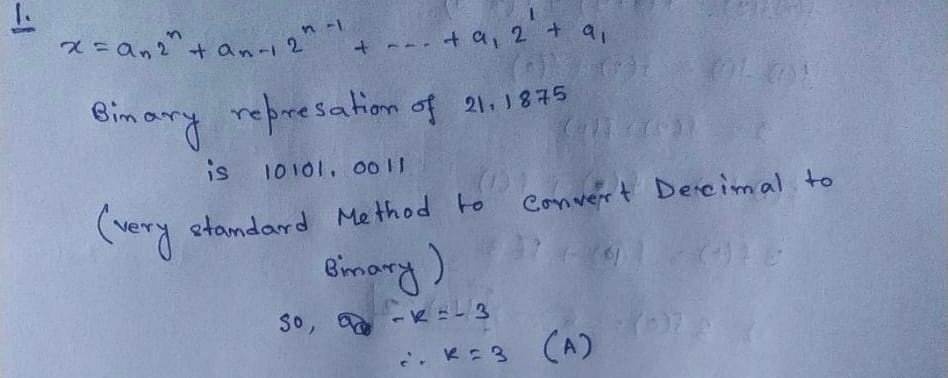
for some \(n \geq 0\), where each $a_{i} \in{0,1}$. In the above-described expansion of $21.1875$, the smallest positive integer $k$ such that $a_{-k} \neq 0$ is:
So we got, $\cot 3 \theta \tan \theta=\frac{1}{7}$ (D)
Problem 3
The locus of points $z$ in the complex plane satisfying $z^{2}+|z|^{2}=0$ is (A) a straight line (B) a pair of straight lines (C) a circle (D) a parabola
Solution
Problem 4
Amongst all polynomials $p(x)=c_{0}+c_{1} x+\cdots+c_{10} x^{10}$ with real coefficients satisfying $|p(x)| \leq|x|$ for all $x \in[-1,1]$, what is the maximum possible value of $\left(2 c_{0}+c_{1}\right)^{10}$ ? (A) $4^{10}$ (B) $3^{10}$ (C) $2^{10}$ (D) 1
Solution
Problem 5
Let $\mathbb{Z}$ denote the set of integers. Let $f: \mathbb{Z} \rightarrow \mathbb{Z}$ be such that $f(x) f(y)=f(x+y)+f(x-y)$ for all $x, y \in \mathbb{Z}$. If $f(1)=3$, then $f(7)$ equals (A) 840 (B) 844 (C) 843 <— Answer (D) 842
Let $A$ and $B$ be two $3 \times 3$ matrices such that $(A+B)^{2}=A^{2}+B^{2}$. Which of the following must be true? (A) $A$ and $B$ are zero matrices. (B) $A B$ is the zero matrix. (C) $(A-B)^{2}=A^{2}-B^{2}$ (D) $(A-B)^{2}=A^{2}+B^{2}$ <— Answer
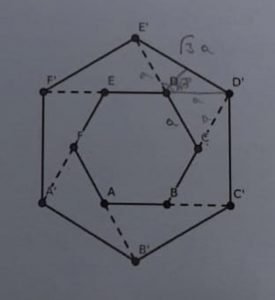
The sides of a regular hexagon $A B C D E F$ is extended by doubling them to form a bigger hexagon $A^{\prime} B^{\prime} C^{\prime} D^{\prime} E^{\prime} F^{\prime}$ as in the figure below.
Then the ratio of the areas of the bigger to the smaller hexagon is: (A) $\sqrt{3}$ (B) 3 (C) $2 \sqrt{3}$ (D) 4
Problem 9
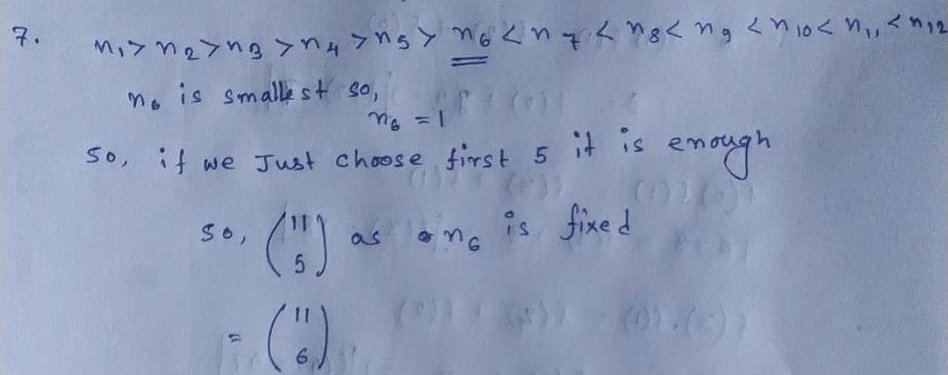
In how many ways can we choose $a_{1}<a_{2}<a_{3}<a_{4}$ from the set ${1,2, \ldots, 30}$ such that $a_{1}, a_{2}, a_{3}, a_{4}$ are in arithmetic progression? (A) 135 (B) 145 (C) 155 (D) 165
Problem 10
Suppose the numbers 71,104 and 159 leave the same remainder $r$ when divided by a certain number $N>1$. Then, the value of $3 N+4 r$ must equal: (A) 53 (B) 48 (C) 37 (D) 23
Problem 11
If $x, y$ are positive real numbers such that $3 x+4 y<72$, then the maximum possible value of $12 x y(72-3 x-4 y)$ is: (A) 12240 (D) 13824 (C) 10656 (D) 8640
Problem 12
What is the minimum value of the function $|x-3|+|x+2|+|x+1|+|x|$ for real $x$ ? (A) 3 (B) 5 (C) 6 (D) 8
Problem 13
Consider a differentiable function $u:[0,1] \rightarrow \mathbb{R}$. Assume the function $u$ satisfies $u(a)=\frac{1}{2 r} \int_{a-r}^{a+r} u(x) d x, \quad$ for all $a \in(0,1)$ and all $r<\min (a, 1-a)$. (A) $u$ attains its maximum but not its minimum on the set ${0,1}$. (B) $u$ attains its minimum but not maximum on the set ${0,1}$. (C) If $u$ attains either its maximum or its minimum on the set ${0,1}$, then it must be constant. (D) $u$ attains both its maximum and its minimum on the set ${0,1}$.
Problem 14
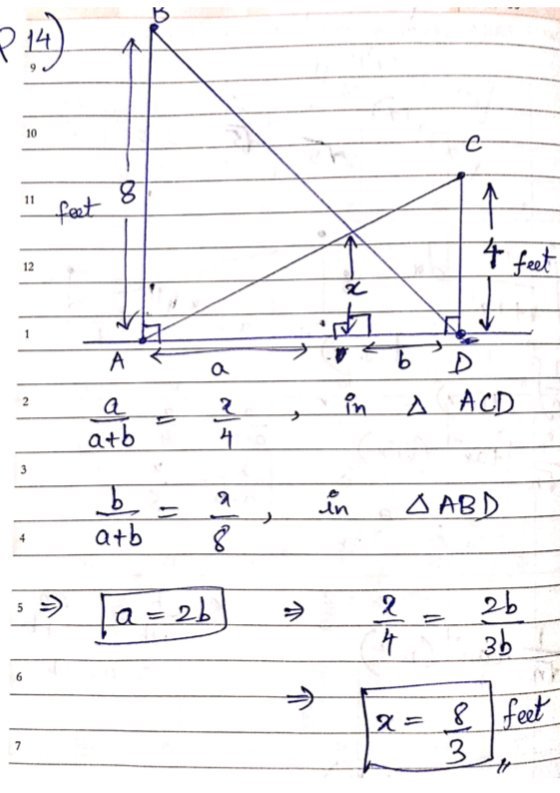
A straight road has walls on both sides of height 8 feet and 4 feet respectively. Two ladders are placed from the top of one wall to the foot of the other as in the figure below. What is the height (in feet) of the maximum clearance $x$ below the ladders? (A) 3 (B) $2 \sqrt{2}$ (C) $\frac{8}{3}$ <— Answer (D) $2 \sqrt{3}$
Solution
$\frac{a}{a+b}=\frac{x}{4}$, in $\triangle A C D$
$\frac{b}{a+b}=\frac{x}{8}$, in $\triangle A B D$
So, from the previous relations we get, $a=2 b$.
So, $\frac{x}{4}=\frac{2 b}{3 b}$ $\Rightarrow x=\frac{8}{3}$ feet (C)
Problem 15
Let $y=x+c_{1}, y=x+c_{2}$ be the two tangents to the ellipse $x^{2}+4 y^{2}=1$. What is the value of $\left|c_{1}-c_{2}\right| ?$ (A) $\sqrt{2}$ (B) $\sqrt{5}$ <— Answer (C) $\frac{\sqrt{5}}{2}$ (D) 1
Solution
$x^{2}+4 y^{2}=1 \rightarrow(1)$
We want $\frac{d y}{d x}=1$
So differentiating $(1)$ with respect of $x$ we get
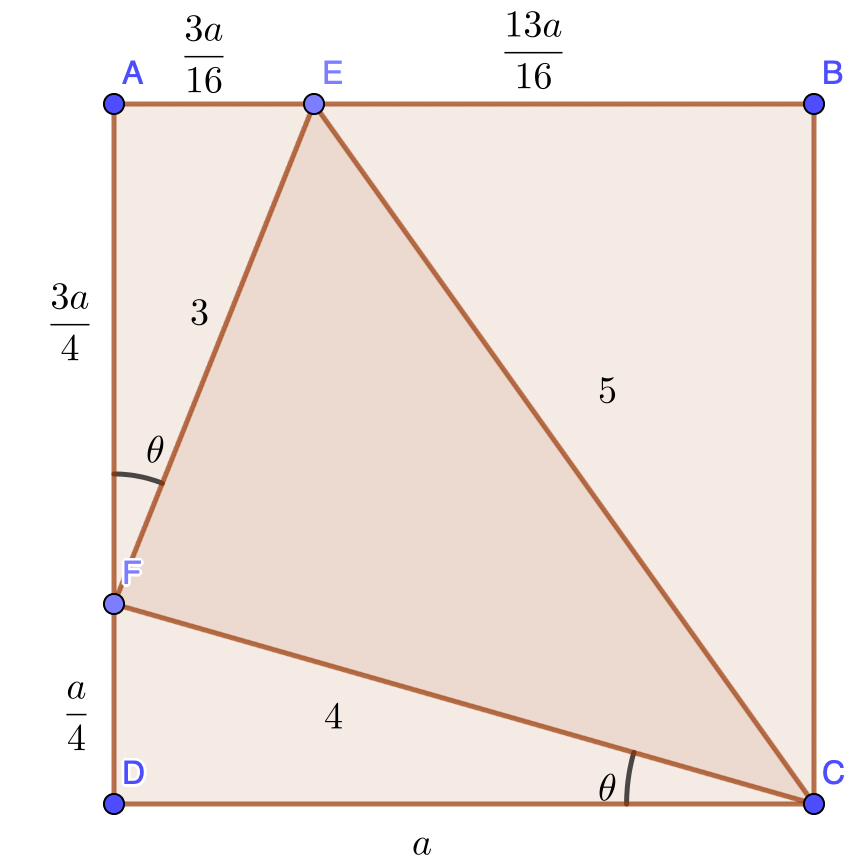
$B E =\frac{13 a}{16}$ $B E =\frac{13}{\sqrt{17}}$ (A)
Problem 17
Let $p$ and $q$ be two non-zero polynomials such that the degree of $p$ is less than or equal to the degree of $q$, and $p(a) q(a)=0$ for $a=0,1,2, \ldots, 10$. Which of the following must be true? (A) degree of $q \neq 10$ (B) degree of $p \neq 10$ (C) degree of $q \neq 5$ <— Answer (D) degree of $p \neq 5$
Solution
$p(a) q(a)=0$, for $a=0,1,2, \cdots, 10$
Hence the polynonial, $P(x) q(x)$ has at least 11 roots as so $deg(p(x) q(x)) \geq 11$
Now, if $deg(q(x))=5$, then $deg(p(x)) \leq 5 \Rightarrow deg(p(x) q(x)) \leq 10$ which is a contradiction.
Degree of $q \neq 5$
Problem 18
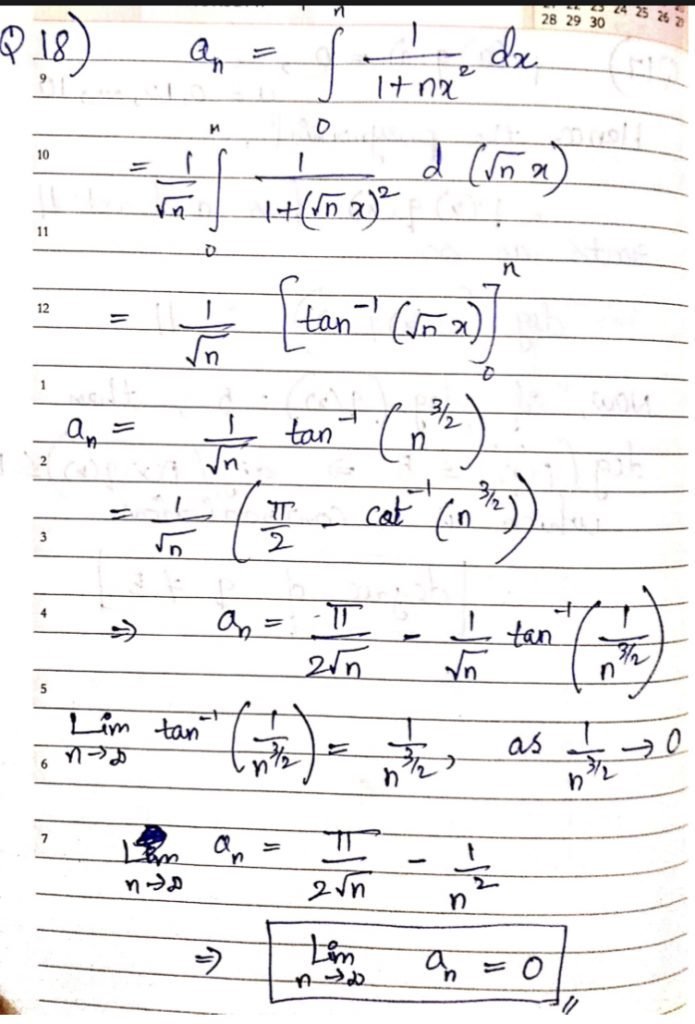
For $n \in \mathbb{N}$, let $a_{n}$ be defined
𝑎𝑛=∫𝑛011+𝑛𝑥2𝑑𝑥
Then $\lim {n \rightarrow \infty} a{n}$
(A) equals 0 <— Answer (B) equals $\frac{\pi}{4}$ (C) equals $\frac{\pi}{2}$ (D) does not exist
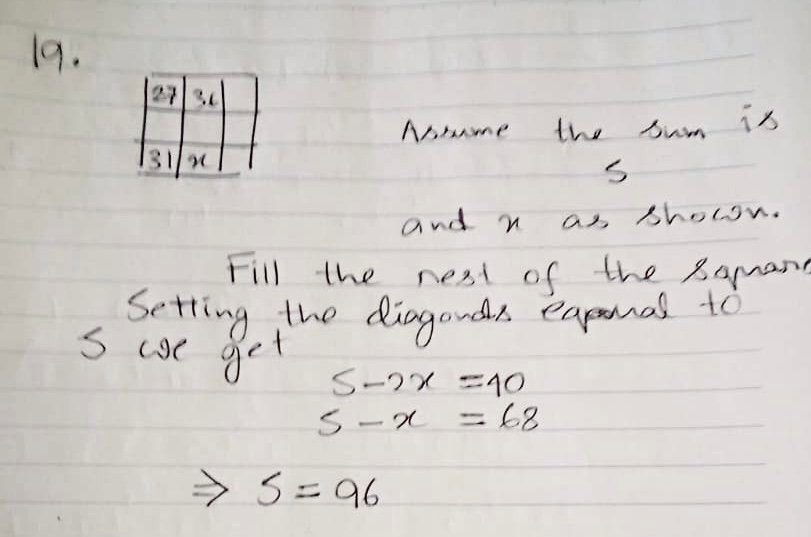
A $3 \times 3$ magic square is a $3 \times 3$ rectangular array of positive integers such that the sum of the three numbers in any row, any column or any of the two major diagonals, is the same. For the following incomplete magic square (A) 90 (B) 96 <— Answer (C) 94 (D) 99
Solution
Asrume the sum is $s$ and $x$ as shown. Fill the rest of the square setting the diagonals equal to $s$ we get.
$s-2x=40$
$s-x=68$
So we get that $s=96$
Problem 20
The number of positive integers $n$ less than or equal to 22 such that 7 divides $n^{5}+4 n^{4}+3 n^{3}+2022$ is (A) 7 (B) 8 (C) 9 (D) 10 <— Answer
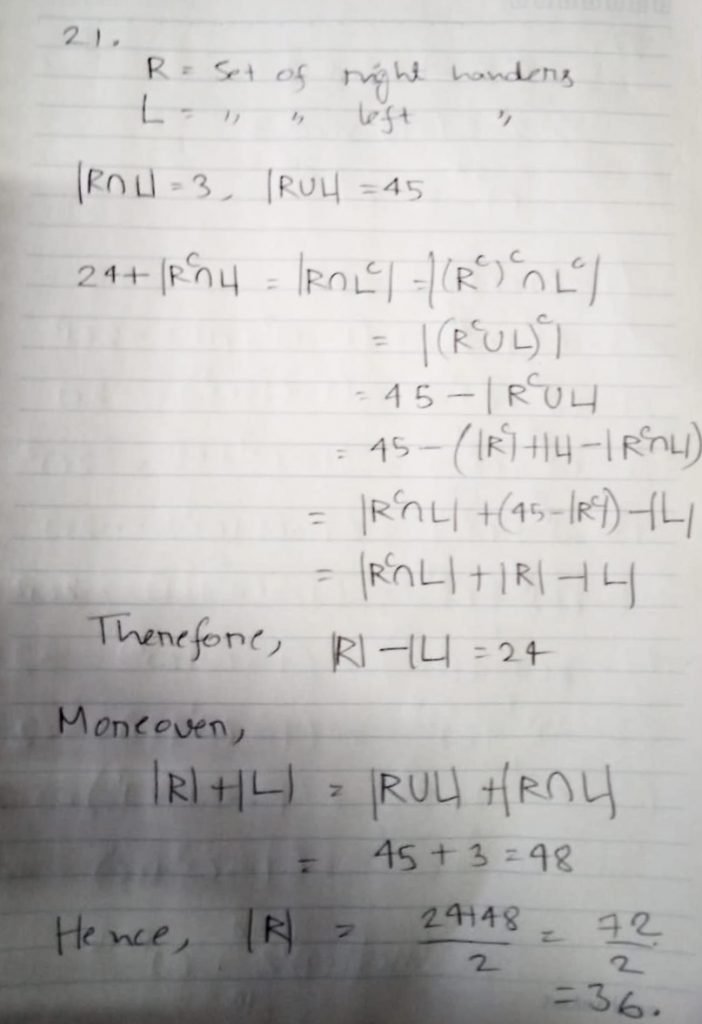
In a class of 45 students, three students can write well using either hand. The number of students who can write well only with the right hand is 24 more than the number of those who write well only with the left hand. Then, the number of students who can write well with the right hand is: (A) 33 (B) 36 <— Answer (C) 39 (D) 41
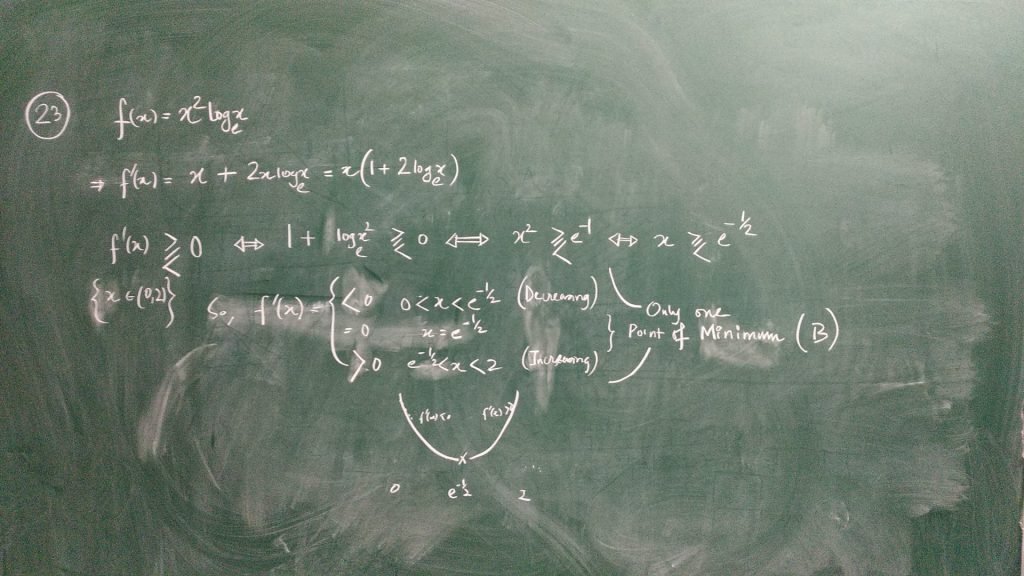
The function $x^{2} \log {e} x$ in the interval $(0,2)$
(A) exactly one point of local maximum and no points of local minimum. (B) exactly one point of local minimum and no points of local maximum. <— Answer (C) points of local maximum as well as local minimum. (D) neither a point of local maximum nor a point of local minimum.
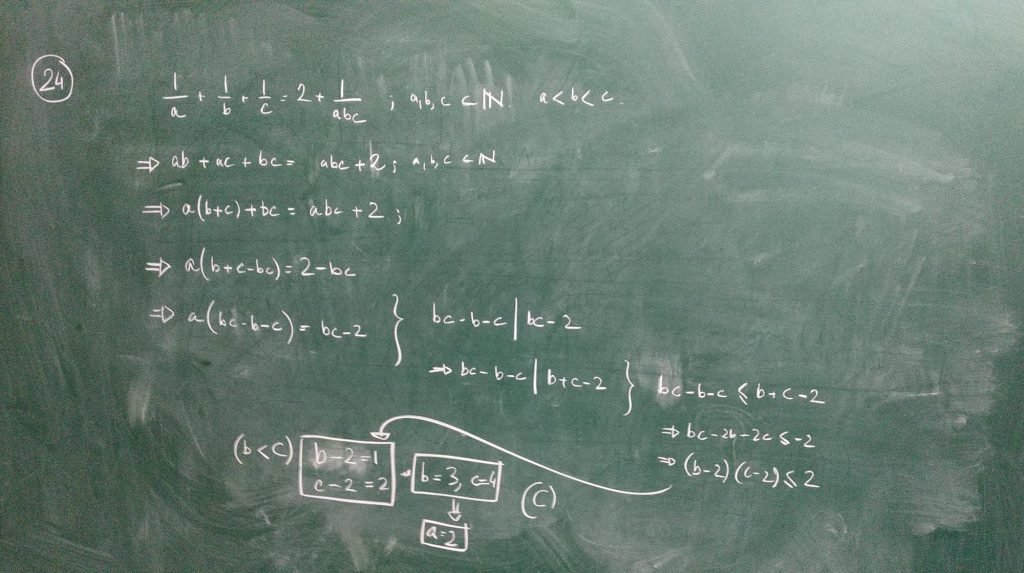
The number of triples $(a, b, c)$ of positive integers satisfying the equation $(2,3,4) \quad \frac{1}{a}+\frac{1}{b}+\frac{1}{c}=1+\frac{2}{a b c}$ and such that $a<b<c$, equals: (A) 3 (B) 2 (C) 1 <— Answer (D) 0
$b c-b-c \mid b c-2$ $\Rightarrow b c-b-c \mid b+c-2$
$b c-b-c \leq b+c-2$ $\Rightarrow b c-2 b-2 c \leq-2$ $\Rightarrow(b-2)(c-2) \leq 2$
$b-2=1$, $c-2=2$
So, $b=3, c=4$
So, $a=2$ (C)
Problem 25
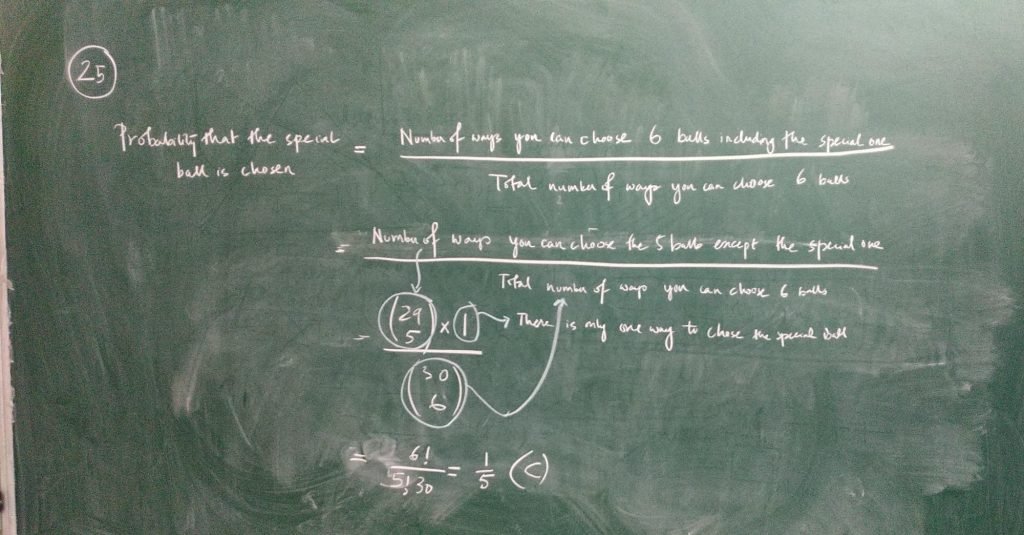
An urn contains 30 balls out of which one is special. If 6 of these balls are taken out at random, what is the probability that the special ball is chosen? (A) $\frac{1}{30}$ (B) $\frac{1}{6}$ (C) $\frac{1}{5}$ <— Answer (D) $\frac{1}{15}$
Solution
Problem 26
A triangle has sides of lengths $\sqrt{5}, 2 \sqrt{2}, \sqrt{3}$ units. Then, the radius of its inscribed circle is : (A) $\frac{\sqrt{5}+\sqrt{3}+2 \sqrt{2}}{2}$ (B) $\frac{\sqrt{5}+\sqrt{3}+2 \sqrt{2}}{3}$ (C) $\sqrt{5}+\sqrt{3}+2 \sqrt{2}$ (D) $\frac{\sqrt{5}+\sqrt{3}-2 \sqrt{2}}{2}$ <— Answer
Solution
$r_{\Delta}=\frac{2 \times {\text {Area in }} \Delta \triangle A B C}{\text { perimeter of } \triangle A B C}$ $\Rightarrow r_{\Delta}=2 \times \frac{\frac{1}{2} \times \sqrt{3} \times \sqrt{5}}{\sqrt{3}+\sqrt{5}+2 \sqrt{2}}$ $\Rightarrow r_{\Delta}=\frac{\sqrt{3} \times \sqrt{5}(\sqrt{3}+\sqrt{5}-2 \sqrt{2})}{(\sqrt{3}+\sqrt{5})^{2}-(2 \sqrt{2})^{2}}$ $\frac{\sqrt{3} \times \sqrt{5} \times(\sqrt{3}+\sqrt{5}-2 \sqrt{2})}{2 \times \sqrt{3} \times \sqrt{5}}=\frac{\sqrt{3}+\sqrt{5}-2 \sqrt{2}}{2}(D)$
Problem 27
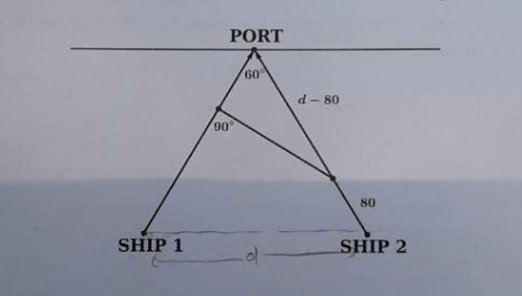
Two ships are approaching a port along straight routes at constant velocities. Initially, the two ships and the port formed an equilateral triangle. After the second ship travelled $80 \mathrm{~km}$, the triangle became right-angled.
When the first ship reaches the port, the second ship was still $120 \mathrm{~km}$ from the port. Find the initial distance of the ships from the port. (A) $240 \mathrm{~km}$ <— Answer (B) $300 \mathrm{~km}$ (C) $360 \mathrm{~km}$ (D) $180 \mathrm{~km}$
Solution
Let $P=Port$ $S_{1}=$ Ship 1 $S_{2}=$ Ship 2
When $S_{1}$ travelled $x$ km, $S_{2}$ travelled $80 km$ \& when $S_{1}$ travelled $d$ km, $S_{2}$ travelled $d-120 km$. Since they we moving at constant velocites.
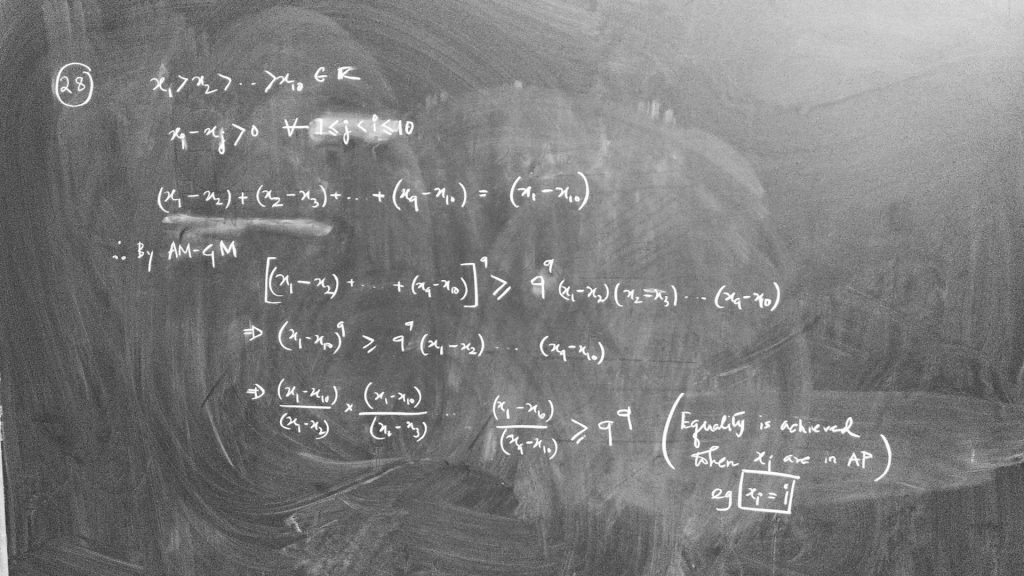
If $x_{1}>x_{2}>\cdots>x_{10}$ are real numbers, what is the least possible value of $\left(\frac{x_{1}-x_{10}}{x_{1}-x_{2}}\right)\left(\frac{x_{1}-x_{10}}{x_{2}-x_{3}}\right) \cdots\left(\frac{x_{1}-x_{10}}{x_{9}-x_{10}}\right)$
Equality is achieved when $x_{i}$ are in AP eg $x_{i}=i$(C)
Problem 29
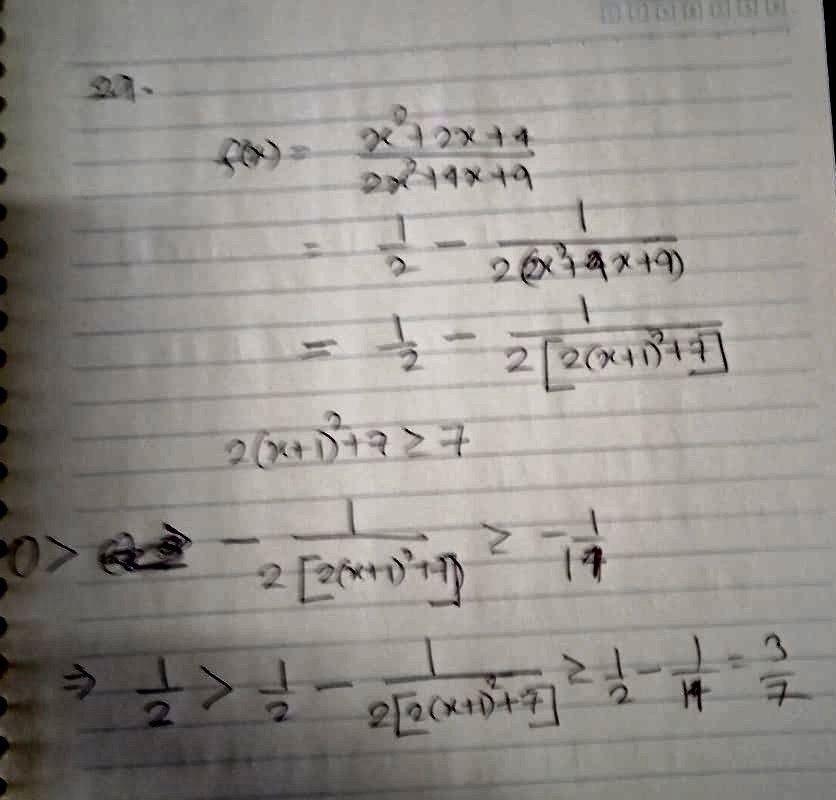
The range of values that the function
𝑓(𝑥)=𝑥2+2𝑥+42𝑥2+4𝑥+9=12
takes as $x$ varies over all real numbers in the domain of $f$ is: (A) $\frac{3}{7}<f(x) \leq \frac{1}{2}$ (B) $\frac{3}{7} \leq f(x)<\frac{1}{2}$ (C) $\frac{3}{7}<f(x) \leq \frac{4}{9}$ (D) $\frac{3}{7} \leq f(x) \leq \frac{1}{2}$
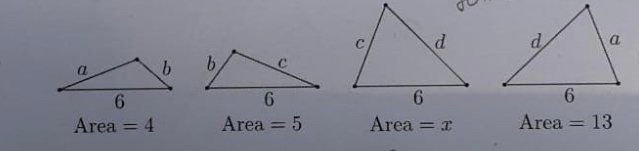
In the following diagram, four triangles and their sides are given. Areas of three of them are also given. Find the area $x$ of the remaining triangle.
(B) 13 (C) 14 orms a squole of (A) 12 (D) 15
Subjective Section
Note. In this question-paper, $\mathbb{R}$ denotes the set of real numbers.
Problem 1
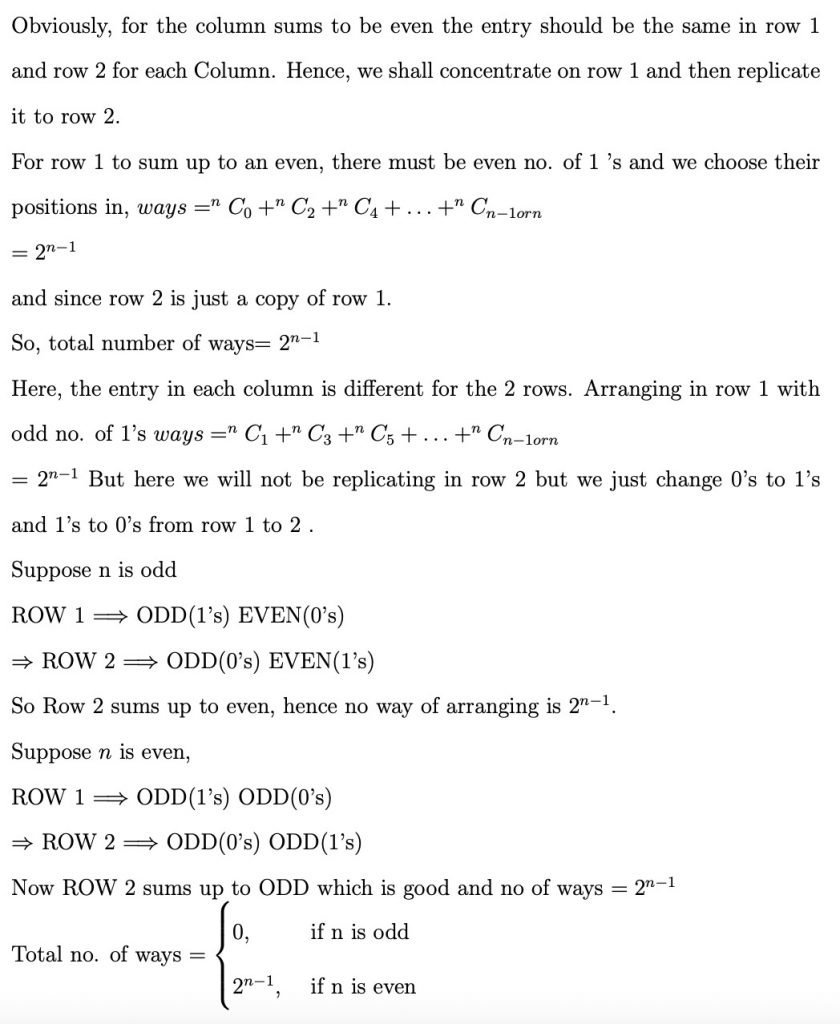
Consider a board having 2 rows and $n$ columns. Thus there are $2 n$ cells in the board. Each cell is to be filled in by 0 or 1 . (a) In how many ways can this be done such that each row sum and each column sum is even? (b) In how many ways can this be done such that each row sum and each column sum is odd?
Solution
Problem 2
Consider the function
𝑓(𝑥)=∑𝑘=1𝑚(𝑥−𝑘)4,𝑥∈ℝ,
where $m>1$ is an integer. Show that $f$ has a unique minimum and find the point where the minimum is attained.
Solution
Problem 3
Consider the parabola $C: y^{2}=4 x$ and the straight line $L$ : $y=x+2$. Let $P$ be a variable point on $L$. Draw the two tangents from $P$ to $C$ and let $Q_{1}$ and $Q_{2}$ denote the two points of contact on $C$. Let $Q$ be the mid-point of the line segment joining $Q_{1}$ and $Q_{2}$. Find the locus of $Q$ as $P$ moves along $L$.
Solution
Problem 4
Let $P(x)$ be an odd degree polynomial in $x$ with real coefficients. Show that the equation $P(P(x))=0$ has at least as many distinct real roots as the equation $P(x)=0$.
Solution
Since $P(x)$ and $P(P(x))$ both are odd degree polynomial it must have at least one real root.
Suppose, the distinct real roots of $P(x)$ be $\alpha_{1}, \alpha_{2,}, \ldots, \alpha_{k}$
Roots of $P(P(x))$ happens for all $x$ such that $p(x)=\alpha_{1}, \alpha_{2}, \ldots, \alpha_{k}$
Now, $P(x)=\alpha_{1}, \alpha_{2}, \cdots, \alpha_{k}$ are $k$ different odd degree polynomials therefore there shoul we at least $K$ distinct real roots of $P(P(x))$. They should be distinct because $\alpha_{1}, \alpha_{2}, \cdots, \alpha_{k}$ are themselves distinct.
Problem 5
For any positive integer $n$, and $i=1,2$, let $f_{i}(n)$ denote the number of divisors of $n$ of the form $3 k+i$ (including 1 and $n$ ). Define, for any positive integer $n$.
𝑓(𝑛)=𝑓1(𝑛)−𝑓2(𝑛).
Find the values of $f\left(5^{2022}\right)$ and $f\left(21^{2022}\right)$.
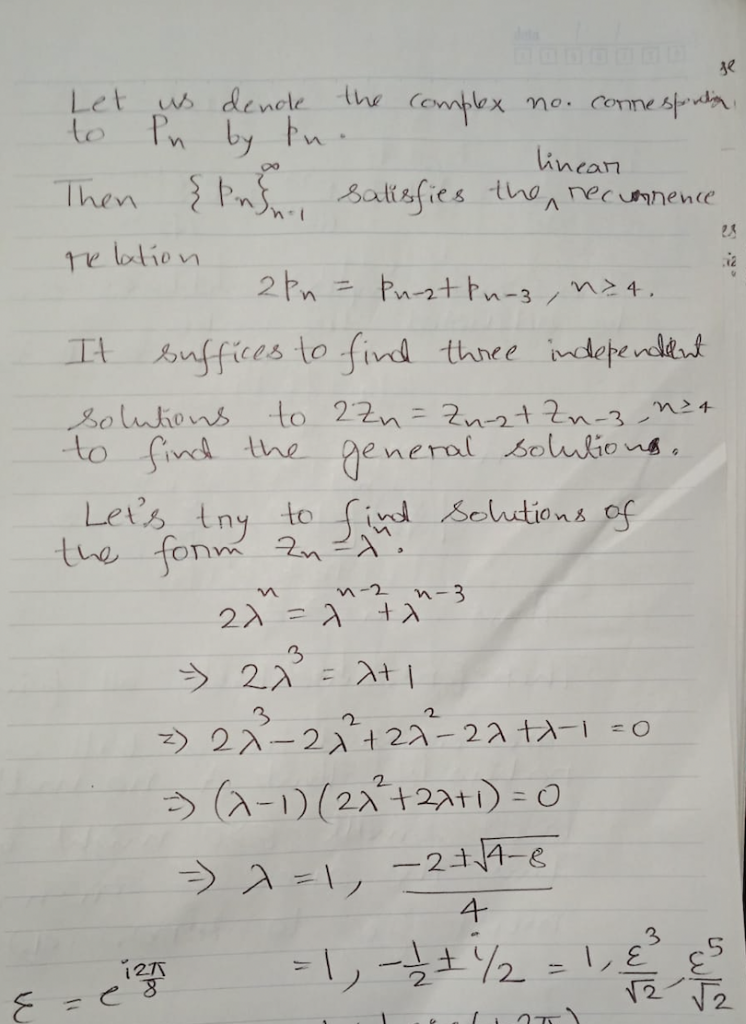
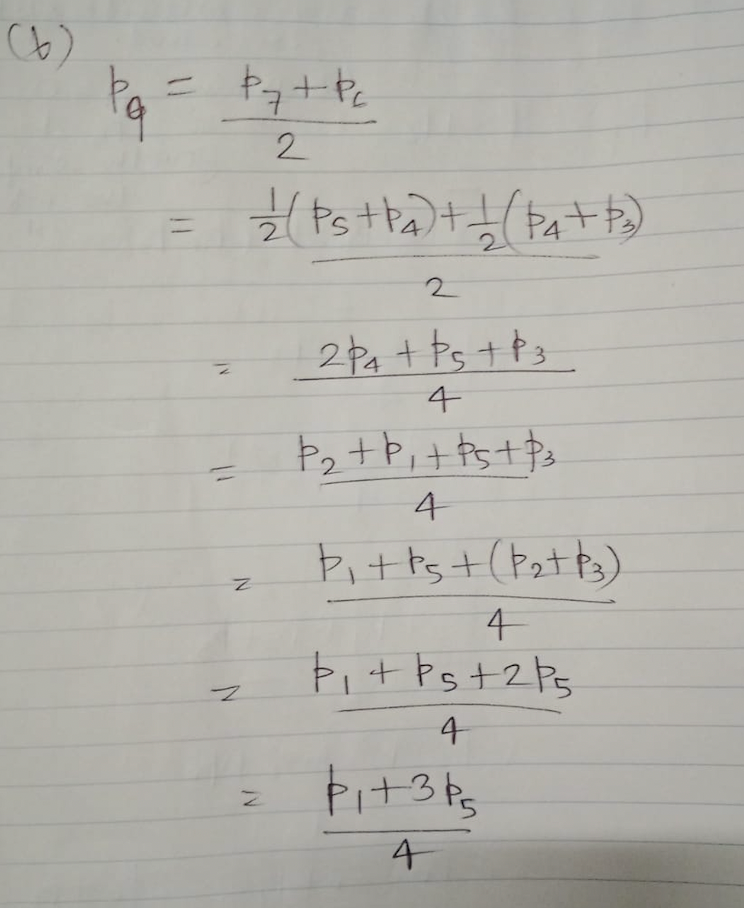
Consider a sequence $P_{1}, P_{2}, \ldots$ of points in the plane such that $P_{1}, P_{2}, P_{3}$ are non-collinear and for every $n \geq 4, P_{n}$ is the midpoint of the line segment joining $P_{n-2}$ and $P_{n-3}$. Let $L$ denote the line segment joining $P_{1}$ and $P_{5}$. Prove the following: (a) The area of the triangle formed by the points $P_{n}, P_{n-1,} P_{n-2}$ converges to zero as $n$ goes to infinity. (b) The point $P_{9}$ lies on $L$.
Solution
(a) Let us denole the complex no. connespida to $P_{n}$ by $p_{n}$. Then
satisfies the recurrence relation $2 p_{n}=p_{n-2}+p_{n-3}, n \geq 4 $
It suffices to find three independent solutions to $2 z_{n}=z_{n-2}+z_{n-3}, n \geq 4$ to find the genenal solution. Let's try to find solutions of the form $z_{n}=\lambda^{n}$.
$2 \lambda^{n}=\lambda^{n-2}+\lambda^{n-3}$ $\Rightarrow 2 \lambda^{3}=\lambda+1$ $\Rightarrow 2 \lambda^{3}-2 \lambda^{2}+2 \lambda^{2}-2 \lambda+\lambda-1=0$ $\Rightarrow (\lambda-1)\left(2 \lambda^{2}+2 \lambda+1\right)=0$ $\Rightarrow \lambda=1, \frac{-2 \pm \sqrt{4-8}}{4}$ $=1,-\frac{1}{2} \pm 1 / 2$ Let $\varepsilon=e^\frac{i2 \pi}{8}$ So the roots are $1,\frac{\varepsilon^{3}}{\sqrt{2}} \frac{\varepsilon^{5}}{\sqrt{2}}$
Thenefone, the general sol is $$ Z_{n}=A+B \frac{\varepsilon^{3 n}}{(\sqrt{2})^{n}}+C \frac{\varepsilon^{5 n}}{(\sqrt{2})^{n}} $$ The (complex) constants can be adjusted to make $$ z_{1}=p_{1}, z_{2}=p_{2}, z_{3}=p_{3} . $$ As $n \rightarrow \infty$ $$ \left|\left(\frac{\varepsilon^{3}}{\sqrt{2}}\right)^{n}\right| \rightarrow 0, \left|\left(\frac{\varepsilon^{5}}{\sqrt{2}}\right)^{n}\right| \rightarrow 0 $$ Thus $Z n \rightarrow A$ Thenefore, eventually all points are contained in a ball of radius $\varepsilon$ about $A$, no matter how small $\varepsilon>0$ might be. Thus, the anea of $z_{n} z_{n-1} z_{n-2}$ must go to zero.
Find the smallest positive real number $k$ such that the following inequality holds
ISI B.Stat and B.Math Entrance - How to prepare, curriculum, paper pattern and topicwise weightage
The BStat and BMath Entrance of ISI Entrance is ‘different’ from IIT JEE or other engineering entrances. It tests creativity and ingenuity of the problem solver that requires more than mechanical application of formulae. Many of these problems are inspired from erstwhile Soviet Union math contests and other math olympiads.
The entrance has two sections:
Objective section containing 30 problems to be solved in 120 minutes.
Subjective section containing 10 problems to be solved in 120 minutes
Cut off for ISI Entrance
The cut off varies every year. However 80 out of 120 in objective section and 50 out of 100 in subjective section should put you in a comfortable position.
Interview for ISI Entrance
If you do well in the entrance then you will be invited for the interview. Several Cheenta students have supplied problems from past interviews which you may find in this link.
ISI has an official curriculum for this entrance. It can be found in the problem compilation that the institute publishes every year. The topics are similar to high school curriculum but also includes some extra ideas from elementary number theory, geometry and combinatorics. Moreover the so called ‘regular school topics’ are tested in highly unusual way. This is the main challenge of the entrance.
Cheenta has a free toolbox that you may use. Our paid programs can also be useful for long term preparation.
Topicwise Weightage
At Cheenta, we have unofficially complied a topic-wise weightage. It is based on past year papers. Please use this information carefully as all years are note the same.
Geometry - 10%
Number Theory - 10%
Combinatorics - 10%
Mathematical Games - 3%
Mensuration - 3%
Theory of Equation - 10%
Complex Number - 10%
Binomial Theorem - 3%
Inequality - 3%
Logarithmic expressions - 3%
Function - 7%
Sequences - 3%
Limit, Continuity - 10%
Differentiation - 3%
Integration - 3%
Trigonometric expression - 6%
Coordinate Geometry - 3%
Please note that there are huge overlaps between these topics. For example there are problems in complex numbers that may be regarded as pure geometry problems and so on. Similarly tools such as coordinate geometry, trigonometry or vectors, logarithms can be used in a variety problems in calculus.
Books
Challenge and Thrill of Pre-College Mathematics by C. R. Pranesachar and V Krishnamurthy
Problems in Calculus of One Variable: (with Elements of Theory by Isaak Abramovich Maron
Test of Mathematics at 10+2 Level by East West Press
NMTC Combinatorics Problems and Solutions
NMTC 2010 Primary Stage 1 Question 1
$\mathrm{n}, \mathrm{a}$ are natural numbers each greater than 1 . If $a+a+a+a+\ldots+a=2010$, and there are $n$ terms on the left hand side, then the number of ordered pairs $(a, n)$ is
Value of $a$ will be greater than 1. So, first we can find out the factors of 2010.
So,$ 2010= 2\times 3 \times 5\times 67$
When the value of a is 2, value of n is 1005 and
when the value of a is 3, then the value of n is 670 and vice versa.
So, the numbered of ordered pair $(a,n)$ is 14
NMTC 2019 Primary Stage 1 Question 10
Sum of the odd numbers from 1 to 2019 both inclusive, is divisible by
This can be solved using Arithmetic progression
Where $S= 1+3+5+7+\dots+ 2019 $
Then use the formula of sum of Arithmetic Progression
As for example, $Sum$= $101\times 101 \times 100$
Divisible by both 100 and 101
NMTC 2019 Primary Stage 1 Question 4
$X$ is a 5 digit number. Let $Y$ be the sum of the digits of $X$. Let $Z$ be the sum of the digits of $Y$. Then the maximum possible value that $Z$ can have is
If $x$= 99999
$y$= 9+9+9+9+9=45
$z$= 4+5=9 That is not maximum
$Y$ must have a digit 9, to get the maximum value of z
By Trial method $x$= 99993
So the answer is 12
NMTC 2019 Primary Stage 1 Question 6
Look at the set of numbers ${2,3,5,7,8,10,12}$. Four numbers are selected from this and made into two pairs. The pairs are added and the resulting two numbers are multiplied. The smallest such product is
For smallest product , we need to select smallest four numbers
From the set $\{2,3,5,7,8,10,12\}$
The smallest numbers are $\{2,3,5,7\}$
Pairs may be $\{2,3\}$ & $\{5,7\}$
$\{2,5\}$ & $\{3,7\}$ ..............etc
So smallest such product is 60
NMTC 2019 Primary Stage 1 Question 12
A calendar for 2019 is made using 4 sheets, each sheet having 3 months. The total number of days shown in each of the four sheets $\left(1^{\text {st }}, 2^{\text {nd }}, 3^{\text {red }}, 4^{\text {th }}\right)$ respectively is
Four sheets are made like this
1st sheet $\{ Jan, Feb, March\}$
Now add the numbers of days of four sheets
For 1st sheet $\{Jan, Feb, March\}$
$\{31+28+31\}$= $\{90\}$
Now adding total no of days shown in each of the four sheets
we get the answer $\{90,91,92,92\}$
NMTC 2019 Primary Stage 1 Question 13
Triples of odd numbers $(a, b, c)$ with $a<b<c$, with $a, b, c$ from 1 to 10 are generated such that $a+b+c$ is prime number. The number of such triple is
Find the odd numbers from 1 to 10
Then add any three numbers from the set of odd numbers and check the result is
prime or not.
Now by trial method, we get 6 number of such triple
NMTC 2019 Primary Stage 1 Question 17
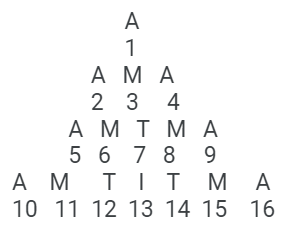
Given below is the triangular form of AMTI.
$\mathrm{A}$ A M A A M TM A A M T I T M A
The number of ways you can spell AMTI, top to bottom, right to left or left to right or a combination of these is
Hints and solutions are coming up soon.
We can read AMTI by following ways
$\{1,3,7,13\}$ $\{5,6,12,13\}$............etc
Thus total no of ways we get is 15
NMTC 2019 Primary Stage 1 Question 25
A string of beads has a recurring pattern as follows: 5 blue, 4 black, 4 white, 5 blue, 4 black, 4 white ……….. and so on. The colour of the $321^{\text {st }}$ bead is
Pattern is 5 Blue, 4 Black, 4 White
$ 5+4+4 = 13 $
Now, $321= 13\times 24+ 9$
As 9= 5+4
So $321^{\text{st}}$ bead is Black
NMTC 2019 Sub Junior Stage 1 Question 6
In a $5 \times 5$ grid having 25 cells, Janani has to enter 0 or 1 in each cell such that each sub square grid of size $2 \times 2$ has exactly three equal numbers. What is the maximum possible sum of the numbers in all the 25 cells put together?
For maximum possible sum, we need to enter more 1 less 0
In $2\times 2$, square has exactly three 1 and one 0
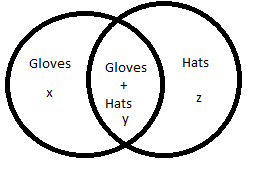
In a room, $50 \%$ of the people are wearing gloves, and $80 \%$ of the people are wearing hats. The minimum percentage of people in the room wearing both a hat and a glove is
Hints and solutions are coming up soon.
$x+y= 50%\dots$ (i)
$y+z=80%\dots$(ii)
$x+y+z=100%\dots$(iii)
From (i)+(ii)-(iii), we get the answer is 30%
NMTC 2019 Junior Stage 1 Question 12
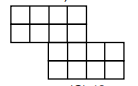
Given a sheet of 16 stamps as shown, the number of ways of choosing three connected stamps (two adjacent stamps must have an edge in common) is
For each $2\times 2 $ block , we can select 3 stamps by 4 ways
Now, $1\times 3$ block, we can select 3 stamps by 1 way
Required no of ways= 28+12+2=42
NMTC 2019 Junior Stage 1 Question 18
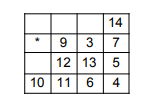
A $4 \times 4$ anti-magic square is an arrangement of the numbers 1 to 16 in a square so that the totals of each of the four rows, four columns and the two diagonals are ten consecutive numbers in some order. The diagram shows an incomplete anti magic square. When it is completed, the number in the position of ${ }^{*}$ is
Sum would be 30 to 39 ( 10 consecutive no)
Remaining sums are $\{32, 33, 34, 35, 36, 37, 38\}$
Remaining numbers to be filled are 1, 2, 8, 15, 16
So the number is 16
NMTC 2019 Junior Stage 1 Question 20
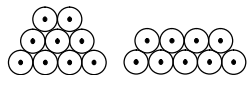
In a stack of coins, each row has exactly one coin less than the row below. If we have nine coins, two such towers are possible. Of these, the tower on the left is the tallest. If you have 2015 coins, the height of the tallest towers is
Take a possibility such that the topmost row will start with 2 coins.
Take a variable which represents that height of the tower
Use the sum of A.P. series to find the height of the tower.
So the answer is 62.
NMTC 2019 Junior Stage 1 Question 23
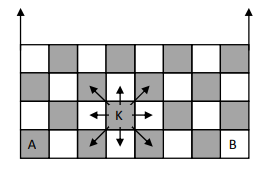
In a single move a King $\mathrm{K}$ is allowed to move to any of the squares touching the square it is on, including diagonals, as indicated in the figure. The number of different paths using exactly seven moves to go from $A$ to $B$ is
First find the minimum no of moves to go from A to B
King can move to at most 3 square from the previous square
Find all the possible square the king can move if the king has to complete it in exactly
7 moves.
The answer is 127
NMTC Algebra Problems and Solutions
NMTC 2019 Stage 1 Sub junior Question 10
How many positive integers smaller than 400 can you get as a sum of eleven consecutive positive integers?
Number are $1+2+3+\ldots \ldots +11=66 $ $2+3+4+\ldots \ldots \ldots +12=77 $ $3+4+5+\ldots \ldots \ldots +13=88$
So number are $66,77,88 \ldots \ldots$ These number are multiple of 11 from 6th multiple. So largest number which is multiple of $11$ & less than $400$ is $396$ .
$396$ is 36th multiple of $11 .$ So required no's are $36-5=31$ ( $5$ for first $5$ multiples)
NMTC 2019 Stage 1 Sub junior Question 11
Let $x, y$ and $z$ be positive real numbers and let $x \geq y \geq z$ so that $x+y+z=20.1$. Which of the following statements is true ?
(A) Always xy < 99
(B) Always $x y>1$ (C) Always $x y \neq 75$ (D) Always yz $\neq 49$
$x+y+z=20.1$ In option (A) If we take $x=y=10 \& z=.1$ $x y=100>99$ So option (A) is wrong
In option $(B)$ if we take, $x=20.050, y=00.049, z=.001$ $x y=0.98245<1$ So option (B) is also wrong
In option (C) If we take $x=15, y=5, \& z=.1$ $x y=75$ Option (C) is also wrong
In option (D) Minimum value of $x=\frac{20.1}{3}=6 \cdot 7$ maximum value of $z=\frac{20.1}{3}=6 \cdot 7$ If $x=6.7 \& z=6.7 \quad y$ is also $6.7$ So maximum product of $y z=6.7 \times 6.7=44.89$ So $\mathrm{yz}$ is never equal to 49 . Option (D) is correct.
NMTC 2019 Stage 1 Sub junior Question 12
A sequence $a_{n}$ is generated by the rule, $a_{n}$=$a_{n-1}-a_{n-2}$ for $n \geq 3$. Given $a_{1}=2$ and $a_{2}$=$4$, then sum of the first 2019 terms of the sequence is given by
A sequence of all natural numbers whose second digit (from left to right) is 1 , is written in strictly increasing order without repetition as follows: $11$, $21$, $31$, $41$, $51$, $61$, $71$, $81$, $91$, $110$, $111$, $\ldots$ Note that the first term of the sequence is 11 . The third term is 31 , eighth term is 81 and tenth term is 110. The 100th term of the sequence will be
Keep in mind that in this question it is mentioned that the second digit is 1, so just count the numbers contain 1 as second digit in strictly increasing order.
Total $99$ no's upto $919$ So next $100$ no is $1100$.
NMTC 2019 Stage 1 Sub junior Question 18
Given $a, b, c$ are real numbers such that $9 a+b+8 c$=$12$ and $8 a+12 b+9 c$=$1$. Then $a^{2}-b^{2}+c^{2}=$
From the 2 equation, we can take one variable to R.H.S to simplify the equations.
$\mathrm{m}$ and $\mathrm{n}$ are positive integer $\mathrm{mn}>0$ from option $a, b, c$ $m n<0$ therefore $m+n=16$.
NMTC 2019 Stage 1 Junior Question 15
$\mathrm{A}, \mathrm{M}, \mathrm{T}, \mathrm{I}$ are positive integers such that $\mathrm{A}+\mathrm{M}+\mathrm{T}+\mathrm{I}$=$10$. The maximum possible value of $A \times M \times T \times 1$ + $A \times M \times T$ + $A \times M \times I$ + $A \times T \times I$ + $M \times T \times I$ + $A \times M$ + $A \times T$ + $A \times 1$ + $M \times T$ + $M \times I$ + $T \times I$ is
$A \times M \times T \times I+A \times M \times T+A \times M \times I+A \times T \times I+M \times T \times I+A \times M+A \times T+A \times I+M \times T+M \times I$ $+T \times I$ this expression is maximum if we take A=M $=3, T=I=2 .$
$A \times M \times T \times I$ + $A \times M \times T$ + $A \times M \times I$ + $A \times T \times I$ + $M \times T \times I$ + $A \times M$ + $A \times T$ + $A \times I$ + $M \times T$ + $M \times I$ + $T \times I$ =$(1+A)(1+M)(1+T)(1+I)$-$1$-$(A+M+T+I)$ $=(1+3)(1+3)(1+2)(1+2)-1-10$ $=144-11=133 .$
NMTC 2019 Stage 1 Junior Question 22
The number of different integers $x$ that satisfy the equation $\left(x^{2}-5 x+5\right)^{\left(x^{2}-11 x+30\right)}=1$ is
Case - III $x^{2}-5 x+5=-1$ and $x^{2}-11 x+30=$ even $x^{2}-5 x+6=0$ $x^{2}-3 x-2 x+6=0$ $x(x-3)-2(x-3)=0$ $(x-3)(x-2)=0$ $x=2,3$ at $x=2$ and 3 $x^{2}-11 x+30=$ even therefore $x=2,3$ are solutions. 6 answer.
NMTC 2019 Stage 1 Junior Question 25
Let $x$ and $y$ be real numbers satisfying $x^{4} y^{5}$+$y^{4} x^{5}=810$ and $x^{3} y^{6}$+$y^{3} x^{6}$=$945$. Then the value of $2 x^{3}+$ $x^{3} y^{3}$+$2 y^{3}$ is
$\{a_{k}\}$ is a sequence of integers, with $a_{1}=-2$ and $a_{m+n}=a_{m}+a_{n}+m n$, for all positive integers $m$, $n$. Then the value of $\mathrm{a}_{8}=$
Coefficient of $x^{90}$ in $\left(\frac{1-x^{61}}{1-x}\right)\left(\frac{1-x^{121}}{1-x}\right)$ $=\left(1-x^{61}\right)\left(1-x^{121}\right)(1-x)^{-2}$
Now, coefficient of $x^{90}$ in $(1-x)^{-2}-$ coefficient of $x^{29}$ in $(1-x)^{-2}$ $={ }^{90+2-1} C_{2-1}-{ }^{29+2-1} C_{2-1}$ $={ }^{91} C_{1}-{ }^{30} C_{1}=91-30=61$
NMTC 2019 Stage 1 Inter Question 3
The number of values of a for which the function $f(x)=\cos 2 x+2 a(1+\cos x)$ has a minimum value $\frac{1}{2}$ is :
$f(x)=2 \cos ^{2} x-1+2 a+2 a \cos x$ $=2 \cos ^{2} x+2 a \cos x+2 a-1$ $\min f(x)=\frac{1}{2} \quad$
$\Rightarrow \min \left(2 \cos ^{2} x+2 a \cos x+2 a-1\right)$=$\frac{1}{2}$ $\Rightarrow \min \left(2 t^{2}+2 a t+2 a-1\right)$=$\frac{1}{2}$ where $t \in[-1,1]$
Case-I $-1 \leq \frac{-2 a}{4} \leq 1 \quad$ then min value $=-\frac{\left(4 a^{2}-4 \times 2(2 a-1)\right)}{4 \times 2}=\frac{1}{2}$ $\Rightarrow a=1,3$ (rejected) Case-II $\frac{-2 a}{4}>1 \quad$
then min value is $2+2 a+2 a-1$=$\frac{1}{2}$ $\Rightarrow 4 a=-\frac{1}{2} \quad$
$\Rightarrow \quad a=-\frac{1}{8}($ rejected $)$
Case-III $\frac{-2 a}{4}<-1 \quad$ then min value is $2-2 a+2 a-1=\frac{1}{2}$ $$ \begin{aligned} &\Rightarrow \quad a \in \phi \ &\Rightarrow \quad a \in{1} \end{aligned} $$
NMTC 2019 Stage 1 Inter Question 4
Let $f(x)=\frac{x}{\sqrt{x^{2}-1}} \cdot$.
If $f^{2}(x)$=$f(f(x)), f^{3}(x)$=$f\left(f^{2}(x)\right), \ldots \ldots, f^{n+1}(x)$=$f\left(f^{n}(x)\right)$, then $f^{2019}(\sqrt{2})$ is :
Similarly $f^{2019}(x)=f(x)=\frac{x}{\sqrt{x^{2}-1}}$ $$ f^{2019}(\sqrt{2})=\frac{\sqrt{2}}{\sqrt{2-1}}=\sqrt{2} \text { Ans. } $$
NMTC 2019 Stage 1 Inter Question 8
Let $a, b$ and $c$ be real numbers such that $2 a^{2}-b c-9 a+10$=$0$ and $4 b^{2}+c^{2}+b c-7 a-8$=$0$. Then the set of real values that a can take is given by
$\mathrm{n}, \mathrm{a}$ are natural numbers each greater than 1 . If $a+a+a+a+\ldots+a=2010$, and there are $n$ terms on the left hand side, then the number of ordered pairs $(a, n)$ is
Value of $a$ will be greater than $1$. So first we can find out the factors of $2010$.
So, $2010= 2\times 3 \times 5\times 67$
When the value of $a$ is $2$, value of $n$ is $1005$ and when the value of $a$ is 3 then the value of n is $670$ and vice versa.
So the ordered pairs will be, $(2,1005), (3,670), (5, 402), (6, 335), (10, 201), (15, 134), (30, 67), (67,30), (134, 15), (201, 10), (6, 335), (402, 5), (670, 3), (1005, 2)$
So the number of ordered pairs $(a, n)$ is $14$.
NMTC 2019 Inter Stage 1 Question 17
The number of times the digit occurs in the result of $1+11+111+\ldots .+111$ 111 (100digits) is $\ldots \ldots .$
sum is $(123456790) (123456790)\ldots (123456790) (1234567890)$
there are $11$ brackets so $1$ comes $11$ times
NMTC 2019 Inter Stage 1 Question 20
Let us call a sum of integers a cool sum if the first and last terms are 1 and each term differs from its neighbours by at most. For example, $1+2+2+3+3+2+1$ and $1+2+3+4+3+2+1$ are cool sums. The minimum number of terms required to write 2019 as a cool sum is ……
$f(n)$ is prime $\Rightarrow n^{2}-3 n+3=1 \Rightarrow n=1,2$ $f(1)=7, f(2)=13$
sum of values $=7+13=20$
NMTC 2019 Inter Stage 1 Question 30
The product of four positive integers $a, b, c$ and $d$ is 9 ! The number $a, b, c, d$ satisfy $a b+a+b=$ 1224, $b c+b+c=549$ and $c d+c+d=351$. The $a+b+c+d=\ldots \ldots$
So $1+a=49,1+b=25,1+c=22,1+d=16$ $$ a=48, b=24, c=21, d=15 $$
NMTC 2019 Junior Stage 1 Question 1
The number of 6 digit numbers of the form "ABCABC", which are divisible by 13 , where $A, B$ and $C$ are distinct digits, $A$ and $C$ being even digits is
$1001 \times \mathrm{ABC}=\mathrm{ABCABC}$ where $1001=13 \times 7 \times 11$ Now $\mathrm{A}$ and $\mathrm{C}$ are even digits and $\mathrm{A}, \mathrm{B}, \mathrm{C}$ are different digits .
Case-I: When $\mathrm{C}$ is zero
Case-II : When $\mathrm{C}$ is not zero
Total number of $6$ digits
Number possible $= 32 + 96 = 128$
NMTC 2019 Junior Stage 1 Question 6
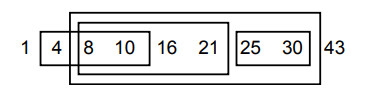
In the sequence $1,4,8,10,16,21,25,30$ and 43 , the number of blocks of consecutive terms whose sums are divisible by 11 is
In the subtraction below, what is the sum of the digits in the result ? $111 \ldots \ldots \ldots . .111$ (100 digits) $-222 \ldots . . .222$ (50 digits)
49 times 1,49 times 8 and 1 times 0 and 9 Sum $=49 \times 1+8 \times 49+9$
Therefore
$\Rightarrow \quad 49+392+9=450 .$
NMTC 2019 Junior Stage 1 Question 26
The least odd prime factor of $2019^{8}+1$ is
Let $P$ be an odd prime which divides $2019^{8}+1$ So $2019^{8} \equiv-1(\bmod P)$ $\Rightarrow \quad 2019^{16} \equiv 1(\bmod P)$ Now by Euler's theorem $2019^{P-1} \equiv 1(\bmod \mathrm{P})$
So $P-1$ should be divisible by $16$ Where $P$ is a prime First two prime numbers which gives remainder $1$ when divided by $16$ is $17$ and $97$ Case-1 $\quad \mathrm{P}=17$ $2019^{8}+1 \equiv 13^{8}+1 \equiv 4^{8}+1 \equiv 16^{4}+1 \equiv 2 $(mode $17$)
While $2019^{8}+1=79^{8}+1=18^{8}+1=324^{4}+1=33^{4}+1=1089^{2}+1=22^{2}+1=485=0$ (mod $97$) So the answer is $97$ .
NMTC 2019 Junior Stage 1 Question 27
Let $a, b, c$ be positive integers each less than 50 , such that $a^{2}-b^{2}=100 c$. The number of such triples $(a, b, c)$ is
$a^{2}-b^{2}=100 c$
As $a^{2}-b^{2}$ is a multiple of $100 .$
So it means the last $2$ digit of $a^{2}$ and $b^{2}$ is same.
So $(a, b)$ can be $(49,1)(48,2)(47,3) \ldots \ldots \ldots \ldots .(26,24)$ .
So there are $24$ such pairs .
One more pair for $(a, b)$ is $(25,15)$ .
So total $25$ pairs are possible.
NMTC 2019 Sub Junior Stage 1 Question 1
If $4921 \times D=A B B B D$, then the sum of the digits of $A B B B D \times D$ is
4-digit no. (4921) is multiplied by a single digit no. (D) \& result is five digit no., so definitely $D>2$
So by hit \& trial we put the values of D from 3 to 9 . at $\mathrm{D}=7$ $4921 \times 7=34447$ $(\mathrm{ABBBD})$ So $\mathrm{A}=3, \quad \mathrm{~B}=4, \mathrm{D}=7$
Now ABBBD $(34447) \times 7=241129$ Sum of digits $=2+4+1+1+2+9=19$
NMTC 2019 Primary Stage 1 Question 2
What is the $2019^{\text {th }}$ digit to the right of the decimal point, in the decimal representation of $\frac{5}{28}$ ?
$$ \frac{5}{28}=\cdot 17 \overline{857142} $$ $\Rightarrow \quad 2019=2+336 \times 6+1$ [2 for $17 \& 336$ pairs of 6 repeating number]
$2019^{\text {th }}$ digit from right side to decimal is first digit in repetition
So correct answer is $8$.
NMTC 2019 Sub Junior Stage 1 Question 3
If $\mathrm{X}$ is a 1000 digit number, $Y$ is the sum of its digits, $Z$ the sum of the digits of $Y$ and $W$ the sum of the digits of $Z$, then the maximum possible value of $W$ is
$\mathrm{X} \rightarrow 1000$ digit no. If all digit are ' 9 ' so that maximum sum of digit of ' $\mathrm{X}$ ' is 9000 So maximum value of $Y$ is 9000
But for maximum sum of digit of $Y$ is 35 for number (8999) So $Z$ is maximum 35 .
Now for maximum sum of digit of $Z$ is 11 for number $29 .$ So $W=11$. Practical example: if $\quad X=\underbrace{99 \ldots 9}_{333 \text { times }} \quad \underbrace{000 \ldots 0}_{666 \text { times }} 2$ Sum of digit of $X=Y=2999$ Sum of digit of $Y=Z=29$ Sum of digit of $Z=W=11$
NMTC 2019 Sub Junior Stage 1 Question 4
Let $x$ be the number $0.000$. 001 which has 2019 zeroes after the decimal point. Then which of the following numbers is the greatest?
$$ x=\cdot 000 \ldots 01=10^{-2020} $$ From option $(A)=10000+x=1000+10^{-2020}=10000 \cdot \underbrace{000 \ldots .01}_{2019 \text { times }}$
From option $(\mathrm{B})=10000 \times \mathrm{x}=10^{4} \times 10^{-2020}=10^{-2016}$ From option $(C)=\frac{10000}{x}=\frac{10^{4}}{10^{-2020}}=10^{2024}$
From option $(D)=\frac{1}{x^{2}}=\frac{1}{\left(10^{-2020}\right)^{2}}=10^{4040}$ So from options $\frac{1}{x^{2}}$ is greatest.
NMTC 2019 Sub Junior Stage 1 Question 5
$A B C$ then the number of possible values for $A, B, C, D, E$ satisfying this equation where If $\frac{C \mathrm{CBA}}{\mathrm{DEDD}}$ then the number of $\mathrm{A}, \mathrm{B}, \mathrm{C}, \mathrm{D}$ and $\mathrm{E}$ are distinct digits is
$\quad \quad ABC$ $+\quad CBA$ _________
$\quad DEDD$ $D \rightarrow$ must be $1$ Means $C+A=1$ or 11 $So \quad$ Sum of $B+B$ is even $\& D$ is $1 .$ So possible values of B is 0 or 5 .
But if we take $B$ as ' 0 ' so there is no carry forward \& Sum of $A \& C$, did not get different digit from D. So B must be 5 . Sum is convert into
$A 5 C$ $C 5 A$
_____ $1211$
Now possible pairs of $(A, C)$ are $(3,8)(4,7)(7,4)(8,3)$ So total 4 possible solutions are there.
NMTC 2019 Sub Junior Stage 1 Question 9
$\mathrm{R} A \mathrm{~T}$ If $+\mathrm{MAC}$ and each alphabet represents a different digit, what is the maximum possible value $+\frac{\mathrm{VAT}}{\mathrm{FLAT}}$ of FLAT?
T should be 0 or 5 But if we take $T$ as ' 5 ' sum is $15 \& 1$ carry is forward and sum of 3 'A' and '1' never give unit digit 'A' So T must be '0'
Now again possible values of $A$ are $' 0 ' \& 5$ but alphabet represents different digits so $\mathrm{A}$ is 5 . For maximum value of FLAT, we take maximum value of $R, M \& V$ as $9,8 \& 7$, but sum is $25 \& 5$ is repeat.
So by taking $R, M \& V$ as $9,8 \& 6$. We get maximum value of FLAT. $$
$\ \ 9 5 0 $ $\ \ 8 5 0 $ $\ \ 6 5 0 $
______ $ 2 4 5 0 $
$FLAT \Rightarrow 2450$
NMTC 2019 Sub Junior Stage 1 Question 13
There are exactly 5 prime numbers between 2000 and 2030 . Note: $2021=43 \times 47$ is not a prime number. The difference between the largest and the smallest among these is
Prime no's between $2000 \& 2030$ are $2003,2011,2017,2027,2029$
Difference between $2029 \& 2003$ is $$ 2029-2003=26 $$
NMTC 2019 Sub Junior Stage 1 Question 23
A teacher asks 10 of her students to guess her age. They guessed it as $34,38,40,42,46,48,51$, 54,57 and 59 . Teacher said "At least half of you guessed it too low and two of you are off by one. Also my age is a prime number". The teacher's age is
Age of teacher is greater than $46$ . Again according to questions two of them are off by one.
So there are two possibilities $47 \&\ 58$ $47$ from $(46 \&\ 48)$ $58$ from $(57 \&\ 59)$
But $58$ is not a prime so age of teacher in $47$ .
NMTC 2019 Sub Junior Stage 1 Question 24
The sum of 8 positive integers is 22 and their LCM is 9 . The number of integers among these that are less than 4 is
L.C.M. is 9 , so all numbers are from $1,3 \&\ 9$. If we take 2 times 9 sum as 22 is not possible so, 9 will come only one time $\&$ remaining 7 numbers are from $1 \&\ 3$.
So 4 times $1 \&\ 3$ times 3 will come. $$ 1+1+1+1+3+3+3+9=22 $$ So numbers less than 4 is 7
NMTC 2019 Sub Junior Stage 1 Question 25
The number of natural numbers $n \leq 2019$ such that $\sqrt[3]{48 n}$ is an integer is
So $\mathrm{n}$ should be multiple of $2^{2} \times 3^{2}=36$ for integer value. $\mathrm{n} \leq 2019$ $\sqrt[3]{48 \mathrm{n}}=$ integer $\sqrt[3]{2^{4} \times 3 \times n}=$ integer $2 \times \sqrt[3]{2 \times 3 n}=$ integer.
So $\mathrm{n}$ should be multiple of $2^{2} \times 3^{2}=36$ for intege So, possible 'n' are $=2^{2} \times 3^{2}=36<2019$