Every Rectangle Wants to Be a Square | Concepts from Math Olympiad Geometry | AMC, IOQM, ISI-CMI
In this video we are introducing students to the concept of maximizing area within a fixed perimeter, using the example of rectangles and squares. There will be illustrative description of how alteration of the dimensions of a rectangle can significantly impact its area.
There is an algebraic approach to maximize the area of a rectangle with a given perimeter which includes derivation of the formula for the area of a rectangle in terms of one side length. The relationship between maximizing the area of a rectangle and it becoming closer to a square in shape.
Watch this exciting video
Story of Hyperbolicity: a journey from geometry to solvability of word problems in non-technical terms
The word 'hyperbolic' is fascinating. What does it even mean? Like many other words in mathematical science, its meaning has evolved over time. In this article, in layman's language, we will take a tour of hyperbolicity through geometry, algebra and their wonderful reunion. No more than middle school mathematics is needed to carefully follow this story.
What is a hyperbolic space?
In the context of geometry, 'hyperbolicity' had a very specific meaning.
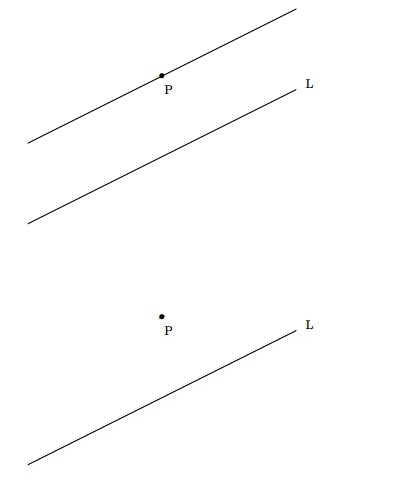
Consider a straight line L and a point P outside the straight line. How many lines can you draw through P that will never meet L (that is parallel to L)? If you are drawing this on a piece of paper then the answer is 1.
1 Parallel (photo from internet)
However it is possible to think about spaces where the answer is 0 (can you think of one such space? You know it for sure!)
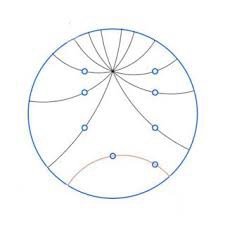
Yet another leap of reasoning will take you to another type of space where the answer is infinity. That is, given a line L and point P outside the line L, we can draw infinitely many lines through P parallel to L.
A model of a space where infinitely many lines (arcs in the picture) does not meet a given line. (Photo from internet)
This type of space, however hard it is to imagine, theoretically exists. Such spaces are called hyperbolic spaces and this property (of having infinitely many parallel lines) is called hyperbolicity.
The way I think about it is, the space itself 'bends away' too quickly thus making a tonne of lines on it to bend away from the given line L. This sort of 'imagination' has its problems. In fact, a theorem of Hilbert roughly says, that such a space cannot be 'imagined' using our intuition of three dimensional space.
This meaning of hyperbolicity was conceived in 1830s by Gauss and later by Bolyai and Lobachevsky. But that was just the starting point of the journey of the word 'hyperbolicity'.
What are groups and how Dehn studied them?
About 70 years later, Dehn used the (evolved) strategy of hyperbolicity in a completely new context: to solve word problems in certain groups. Actually Gromov 'uncovered' this strategy embedded in Dehn's methods about another 70 years later. Notice that I mentioned 'hyperbolicity' as a strategy for solving problems instead of a concept. The meaning of this will be clear shortly.
A group is basically a set where you can combine (add) elements to create a new element of the same set. You could also substract one element from another. Though I am saying 'add', this operation can be some other rule of combination.
For example, the set of integers can be regarded as a group. In this 'set' one can 'add' two integers to get another integer.
In any group, we can specify an important subset S called 'generators' of the group. The generators, 'generate' the group, in the sense, you may repeatedly combine the generators to create all the elements of the set. For example, in the group of integers, {1, -1} is a set of generators.
Groups are important for a variety of reasons. They are among the most elementary algebraic structures that one can study (elementary does not mean 'simple'; group theorists know that even simple groups may not be 'simple''!
Another reason might be this: groups are used to model symmetries of objects. Since symmetries are important in physics and in many other sciences, therefore groups are important.
At any rate, given a group (a set) G, we can create 'words'. Here we are thinking about elements of the set G as 'letters'. One can combine (or add) several letters to form a new element of the same group. This combination of several letters is referred to as a 'word' which is also an element of G.
Word problem for a group
How do we tell if two words (created by combining letters) represent the same element of the group or not? This is known as the word problem of a group. It is, in general, very hard to figure this out.
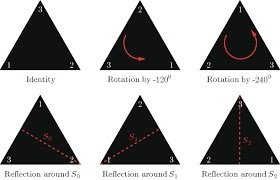
Here is an example. Consider the set of symmetries of an equilateral triangle: three reflections (about each median) and three rotations (0, 120, 240 degrees) about the centroid. Lets write the elements as {R1, R2, R3, Rot1, Rot2, Rot3}. They form a group. You can check this. For example combining any two elements this set, you will get another element of the same set.
Symmetries of Equilateral triangle (photo from internet)
You can actually combine two symmetries. Lets use * instead of 'add' for this sort of rule of combination of group elements.
For example R1*Rot2 means: first do a rotation by 120 degrees about centroid and the do a reflection about the first median. In this way, you can combine several elements to create a 'word'. But that word is again an element of the group (as combining elements of a group, by definition, gives another element of a group). In fact the same element can be written in many ways (in many words).
R1*R1 = Rot1 as two times reflection brings the triangle back to its original position which is same as Rot1 (that is rotating by 0 degrees).
Rot2*Rot2*Rot2 = Rot1 as thrice rotating by 120 degrees is rotating by 360 degrees which is same as rotating by 0 degrees.
Hence the same element Rot1 is represented by two different words
Now lets write down two weird looking words:
Word1 = R1*Rot1*R2*R1*Rot1*R2*R1*Rot1*R2
Word1 = R3*Rot1*R2*R1*Rot1*R3
Do Word1 and Word2, represent the same element of the group? As I mentioned before, this is hard to check in general. However for certain types of groups, there are short algorithms to check this.
Group of Loops
There is an important class of groups that was studied by Dehn. This class, for the sake of simplicity, is known as group of loops. Here is how you can think about it.
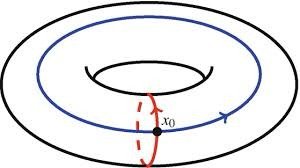
Given a space X, fix a point P in X and draw all loops starting and ending at P. This set (after doing some stuff) can be regarded as group. For example you can combine two loops by simply travelling along the first one first and then the second one.
Two loops on a torus (photo from internet)
For certain types of spaces, these Group of Loops has a beautiful property called D- hyperbolicity. These groups have a solvable word problem. That is, given two words using letters of the group, you can check if they represent the same element of the group using an algorithm (that does the job in a 'small' amount of time.)
What is D-hyperbolicity?
To understand the notion of D-hyperbolicity one should think of a group (a set of elements whose members can be combined to produce other members of the same set) as dots and segments. Represent each element of the group by a dot (make sure to label it the name of the group member). Join two dots g1 and g2 if g2 - g1 is a generator of the group G.
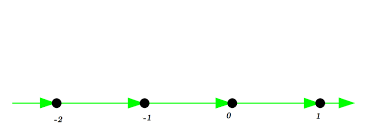
This creates a 'Cayley graph' of the group G. It contains bunch of dots and line segments known as edges. For example the Cayley graph of the group of integers with respect to the generating set {1, -1} looks like a straight line.
Cayley Graph of integers (Photo from internet)
You can draw triangles on the Cayley Graph. To do that, pick three points A, B, C in the graph. Suppose each edge is 1 unit long. Then you can find paths (possibly consisting of several edges) joining A to B, B to C, and C to A. Some of these paths can be long winding. However some of them can be 'as small as possible. These shortest possible paths are known as geodesics. We can form a triangle ABC inside the graph by choosing geodesic paths in the graph connecting AB, BC and CA.
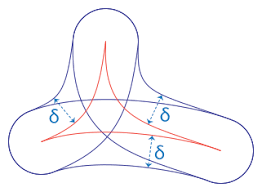
What Dehn found is interesting. Let G be a group and S be a generating set of the group. Let C be the Cayley graph of G. Suppose there their exists a magic number D, such that whenever you draw a triangle (having geodesic sides), any point on AC is within D unit distance from some point in AB or BC.
Here D is denoted by the Greek Letter delta
It does not matter how big the triangle is. The same magic number D must work for it.
This clearly does not happen in a piece of paper. Lets say you are guessing D = 5 (for flat piece of paper). But then you can create a large enough right triangle such that the midpoint of the hypotenuse is more than 5 units away from both the legs of the right triangle. In fact, from the stand point of geometry, a magic number D can only exists for hyperbolic spaces! This is that hyperbolicity that we discussed a while ago.
Dehn found that if such a magic number D exists for a Cayley Graph of a group , then the word problem for that group is solvable. This is a remarkable point where geometry meets algebra through hyperbolicity!
Subsequently, all spaces, where such a magic number D exists, are known as D-hyperbolic spaces. This considerably expanded the meaning of hyperbolicity and led to the rise of geometric group theory in the later part of 20th century.
AMC 8 2020 Problem 9 | Cube Problem
Try this beautiful problem based on cube from AMC 8, 2020.
Cube Problem - AMC 8 2020 Problem 9
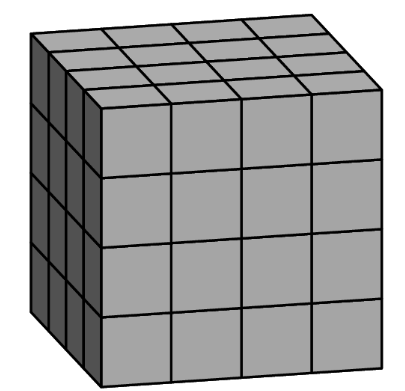
Samuel's birthday cake is in the form of a $4 \times 4 \times 4$ inch cube. The cake has icing on the top and the four side faces, and no icing on the bottom. Suppose the cake is cut into 64 smaller cubes, each measuring $1 \times 1 \times 1$ inch, as shown below. How many of the small pieces will have icing on exactly two sides?
12
16
18
20
24
Key Concepts
Game problem
Cube
combination
Suggested Book | Source | Answer
AMC 8 2020 Problem 9
20
Try with Hints
See that, small cube which is in base all the cubes have icing in only one side expect the corner cubes,
Notice the same thing happens for the second and third layer.
For the first layer, only the cubes which are not in corner they have icing in two face.
Diameter of Incircle Lemma and Dilation of Incircle
Suppose we have a triangle $ABC$. Let us extend the sides $BA$ and $BC$. We will draw the incircle of this triangle.
How to draw the incircle?
Here is the construction.
Draw any two angle bisectors, say of angle $A$ and angle $B$
Mark the intersection point $I$.
Drop a perpendicular line from I to one of the sides, say $AC$ in this picture.
Suppose the perpendicular intersects $AC$ at $E$.
The incircle is drawn centred at $I$ and with radius $IE$
Suppose EI intersects the incircle at F.
How to draw the excircle?
Now let us draw the excircle.
To do that we will need the angle bisector of external angle A and external angle C. Suppose they intersect at $I_A$. Drop a perpendicular from $I_A $ to extended $BA$ or extended $BC$ or $AC$. In this picture we drop it on extended $BA$ Suppose $J$ is the point of intersection of extended $BA$ and the perpendicular.
Draw a circle centred at $I_A$ and radius $I_A J$. This is the excircle.
Dilating the incircle to excircle
The incircle can be dilated or blown up with respect to point $B$ into the excircle. The center $I$ is sent to the center $I_A$ under dilation $FE$ which is perpendicular to $AC$ is sent to another segment perpendicular to $AC$ as angles are preserved under dilation
Questions:
What is the ratio of dilation?
How can you rigorously show that the center $I$ goes to the center $I_A$ under this dilation?
Where do the point $F$ go under this dilation?
Show that $AN = CE$
Geogebra workbook
Pigeonhole Principle
“The Pigeonhole principle” ~ Students who have never heard may think that it is a joke. The pigeonhole principle is one of the simplest but most useful ideas in mathematics. Let’s learn the Pigeonhole Principle with some applications.
Pigeonhole Principle Definition:
In Discrete Mathematics, the pigeonhole principle states that if we must put $N + 1$ or more pigeons into N Pigeon Holes, then some pigeonholes must contain two or more pigeons.
Example:
If $Kn+ 1$ (where k is a positive integer) pigeons are distributed among n holes than some hole contains at least $k + 1$ pigeons.
Applications of Pigeonhole Principle:
This principle is applicable in many fields like Number Theory, Probability, Algorithms, Geometry, etc.
Problems and Solutions:
Problem 1
A bag contains beads of two colours: black and white. What is the smallest number of beads which must be drawn from the bag, without looking so that among these beads, two are of the same colour?
Solution: We can draw three beads from bags. If there were no more than one bead of each colour among these, then there would be no more than two beads altogether. This is obvious and contradicts the fact that we have chosen their beads. On the other hand, it is clear that choosing two beads is not enough. Here the beads play the role of pigeons, and the colours (black and white) play the role of pigeonhole.
Problem 2
Find the minimum number of students in a class such that three of them are born in the same month?
Solution: Number of month $n =12$
According to the given condition,
$K+1 = 3$
$K = 2$
$M = kn +1 = 2×12 + 1 = 25$.
Problem 3
Show that from any three integers, one can always choose two so that $a^3$b – a$b^3$ is divisible by 10.
Solution: We can factories the term $a^3$b – a$b^3$ = $ab(a + b)(a - b)$, which is always even, irrespective of the pair of integers we choose.
If one of three integers from the above factors is in the form of 5k, which is a multiple of 5, then our result is proved.
If none of the integers is a multiple of 5 then the chosen integers should be in the form of $(5k)+-(1)$ and $(5k)+-(2)$ respectively.
Clearly, two of these three numbers in the above factors from the given expression should lie in one of the above two, which follows by the virtue of this principle.
These two integers are the ones such that their sum and difference is always divisible by 5. Hence, our result is proved.
Problem 4
If n is a positive integer not divisible by 2 or 5 then n has a multiple made up of 1's.
Problem 5
Let $X \subseteq{1,2, \ldots, 99}$ and $|X|=10$. Show that it is possible to select two disjoint nonempty proper subsets $Y, Z$ of $X$ such that $\sum(y \mid y \in Y)=\sum(z \mid z \in Z)$.
Problem 6
Let $A_{1} B_{1} C_{1} D_{1} E_{1}$ be a regular pentagon. For $2 \leq n \leq 11$, let $A_{n} B_{n} C_{n} D_{n} E_{n}$ be the pentagon whose vertices are the midpoints of the sides of the pentagon $A_{n-1} B_{n-1} C_{n-1} D_{n-1} E_{n-1}$. All the 5 vertices of each of the 11 pentagons are arbitrarily coloured red or blue. Prove that four points among these 55 points have the same colour and form the vertices of a cyclic quadrilateral.
The National Mathematics Talent Contest or NMTC is a national-level mathematics contest conducted by the Association of Mathematics Teachers of India (AMTI).
Aim of the contest:
To find and encourage students who have the ability for original and creative thinking, preparedness to tackle unknown and non-routine problems having a general mathematical ability suitable to their level.
Who can appear for NMTC 2022?
The contest is for students of different levels. Here is the breakdown for the same:
Primary - Gauss Contest-V and VI Standards
Sub-Junior - Kaprekar Contest-VII and VIII Standards
Junior - Bhaskara Contest-IX and X Standards
Inter - Ramanujan Contest-XI and XII Standards
Senior - Aryabhata Contest-Degree Classes in Arts, Science &Technical Institutions
The contest is available in English only.
Exam fee (2022):
Rs.150/- per candidate (Out of this, Rs.125/- only per candidate should be sent to AMTI, institution retaining Rs.25/- only per candidate for all expenses)
The amount paid once is not refundable on any account.
Syllabus
The syllabus of the National Mathematics Talent Contest (NMTC) is similar to the syllabus of the Mathematics Olympiad (Regional, National and International level). It includes:
For Primary:
Algebra
Geometry
Arithmetic
Mensuration
For Sub-Junior:
Algebra
Geometry
Arithmetic
Mensuration
Number Theory
For Junior:
Algebra
Geometry
Number Theory
Combinatorics
For Inter:
Algebra
Geometry
Number Theory
Combinatorics
For Senior:
It is a three hours long examination containing subjective questions and it is based on the syllabus of B.Sc. mathematics course.
Important Dates, NMTC 2022:
Last Date for entries: 1st October 2022
Stage-1 Preliminary Test
15th October 2022 (Saturday) 2 p.m. to 4 p.m.
Declaration of results- 25th November 2022
Stage-2 Final Test
7th January 2023 (Saturday) 1 p.m. to 4 p.m.
Announcement of Results by the end of April 2023.
What does the winner of NMTC get?
There will be cash awards for the top three winners in each level at the final followed by merit certificates for them and others selected at the final level.
1st position- Rs. 5000/-
2nd position- Rs. 2500/-
3rd position- Rs. 1250/-
Books required to prepare for NMTC:
Since the exam require preparation for Math Olympiad level, you can click on this link and get all the books necessary for NMTC.
For more information about the exam, you may visit the official website: https://zurl.co/AsSO
How to Prepare for NMTC 2022?
The students are encouraged to practice non-routine problems, asked in exams like PRMO, RMO, INMO and IMO.
Cheenta is teaching outstanding kids for Math Olympiads from 4 continents since 10 years now. So, we got the expertise and we want you to utilize it for your benefit.
Here is a video solution for a Problem based on Carpet Strategy in Geometry. This problem is helpful for Math Olympiad, ISI & CMI Entrance, and other math contests. Watch and Learn!
Here goes the question…
Suppose ABCD is a square and X is a point on BC such that AX and DX are joined to form a triangle AXD. Similarly, there is a point Y on AB such that DY and CY are joined to form the triangle DYC. Compare the area of the triangles to the area of the square.
We will recommend you to try the problem yourself.
Try this beautiful Problem on Geometry based on External Tangent from AMC 10 A, 2018. You may use sequential hints to solve the problem.
External Tangent - AMC-10A, 2018- Problem 15
Two circles of radius 5 are externally tangent to each other and are internally tangent to a circle of radius 13 at points $A$ and $B$, as shown in the diagram. The distance $A B$ can be written in the form $\frac{m}{n}$, where $m$ and $n$ are relatively prime positive integers. What is $m+n ?$
,
$21$
$29$
$58$
$69$
$93$
Key Concepts
Geometry
Triangle
Pythagoras
Suggested Book | Source | Answer
Suggested Reading
Pre College Mathematics
Source of the problem
AMC-10A, 2018 Problem-15
Check the answer here, but try the problem first
$69$
Try with Hints
First Hint
Given that two circles of radius 5 are externally tangent to each other and are internally tangent to a circle of radius 13 at points $A$ and $B$. we have to find out the length \(AB\).
Now join \(A\) & \(B\) and the points \(Y\) & \(Z\). If we can show that \(\triangle XYZ \sim \triangle XAB\) then we can find out the length of \(AB\).
Now can you finish the problem?
Second Hint
now the length of \(YZ=5+5=10\) (as the length of the radius of smaller circle is $5$) and \(XY=XA-AY=13-5=8\). Now \(YZ|| AB\).therefore we can say that \(\triangle XYZ \sim \triangle XAB\). therefore we can write $\frac{X Y}{X A}=\frac{Y Z}{A B}$
Now Can you finish the Problem?
Third Hint
From the relation we can say that $\frac{X Y}{X A}=\frac{Y Z}{A B}$
\(\Rightarrow \frac{8}{13}=\frac{10}{AB}\)
\(\Rightarrow AB=\frac{13\times 10}{8}\)
\(\Rightarrow AB=\frac{65}{4}\) which is equal to \(\frac{m}{n}\)
Right-angled Triangle | AMC 10A, 2018 | Problem No 16
Try this beautiful Problem on Geometry based on Right-angled triangle from AMC 10 A, 2018. You may use sequential hints to solve the problem.
Right-angled triangle - AMC-10A, 2018- Problem 16
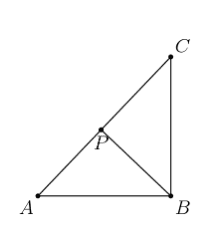
Right triangle $A B C$ has leg lengths $A B=20$ and $B C=21$. Including $\overline{A B}$ and $\overline{B C}$, how many line segments with integer length can be drawn from vertex $B$ to a point on hypotenuse $\overline{A C} ?$
,
$5$
$8$
$12$
$13$
$15$
Key Concepts
Geometry
Triangle
Pythagoras
Suggested Book | Source | Answer
Suggested Reading
Pre College Mathematics
Source of the problem
AMC-10A, 2018 Problem-16
Check the answer here, but try the problem first
\(13\)
Try with Hints
First Hint
Given that \(\triangle ABC\) is a Right-angle triangle and $AB=20$ and $BC=21$. we have to find out how many line segments with integer length can be drawn from vertex $B$ to a point on hypotenuse $\overline{AC}$?
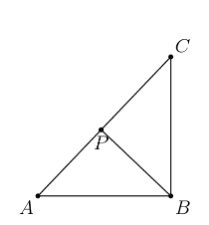
Let $P$ be the foot of the altitude from $B$ to $AC$. therefore \(BP\) is the shortest legth . $B P=\frac{20 \cdot 21}{29}$ which is between $14$ and $15$.
Now can you finish the problem?
Second Hint
let us assume a line segment \(BY\) with \(Y\) on \(AC\)which is starts from $A$ to $P$ . So if we move this line segment the length will be decreases and the values will be look like as \(20,.....,15\). similarly if we moving this line segment $Y$ from $P$ to $C$ hits all the integer values from $15, 16, \dots, 21$.
Now Can you finish the Problem?
Third Hint
Therefore numbers of total line segments will be \(13\)
Length of the crease | AMC 10A, 2018 | Problem No 13
Try this beautiful Problem on Geometry based on Length of the crease from AMC 10 A, 2018. You may use sequential hints to solve the problem.
Length of the crease- AMC-10A, 2018- Problem 13
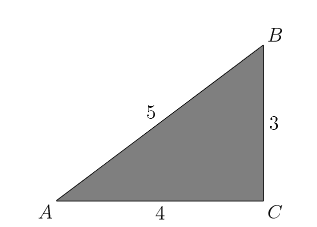
A paper triangle with sides of lengths $3,4,$ and 5 inches, as shown, is folded so that point $A$ falls on point $B$. What is the length in inches of the crease?
,
$1+\frac{1}{2} \sqrt{2}$
$\sqrt 3$
$\frac{7}{4}$
$\frac{15}{8}$
$2$
Key Concepts
Geometry
Triangle
Pythagoras
Suggested Book | Source | Answer
Suggested Reading
Pre College Mathematics
Source of the problem
AMC-10A, 2018 Problem-13
Check the answer here, but try the problem first
$\frac{15}{8}$
Try with Hints
First Hint
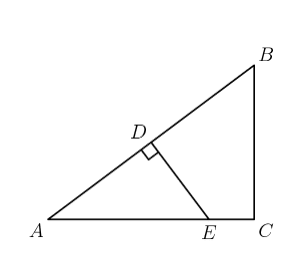
Given that ABC is a right-angle triangle shape paper. Now by the problem the point \(A\) move on point \(B\) . Therefore a crease will be create i.e \(DE\) . noe we have to find out the length of \(DE\)?
If you notice very carefully then \(DE\) is the perpendicular bisector of the line \(AB\). Therefore the \(\triangle ADE\) is Right-angle triangle. Now the side lengths of \(AC\),\(AB\),\(BC\) are given. so if we can so that the \(\triangle ADE\) \(\sim\) \(\triangle ABC\) then we can find out the side length of \(DE\)?
Now can you finish the problem?
Second Hint
In \(\triangle ABC\) and \(\triangle ADE\) we have ...
\(\angle A=\angle A\)( common angle)
\(\angle C=\angle ADE\) (Right angle)
Therefore the remain angle will be equal ....
Therefore we can say that \(\triangle ADE\) \(\sim\) \(\triangle ABC\)
Now Can you finish the Problem?
Third Hint
As \(\triangle ADE\) \(\sim\) \(\triangle ABC\) therefore we can write