Story of Hyperbolicity: a journey from geometry to solvability of word problems in non-technical terms

The word 'hyperbolic' is fascinating. What does it even mean? Like many other words in mathematical science, its meaning has evolved over time. In this article, in layman's language, we will take a tour of hyperbolicity through geometry, algebra and their wonderful reunion. No more than middle school mathematics is needed to carefully follow this story.

What is a hyperbolic space?

In the context of geometry, 'hyperbolicity' had a very specific meaning.

Consider a straight line L and a point P outside the straight line. How many lines can you draw through P that will never meet L (that is parallel to L)? If you are drawing this on a piece of paper then the answer is 1.
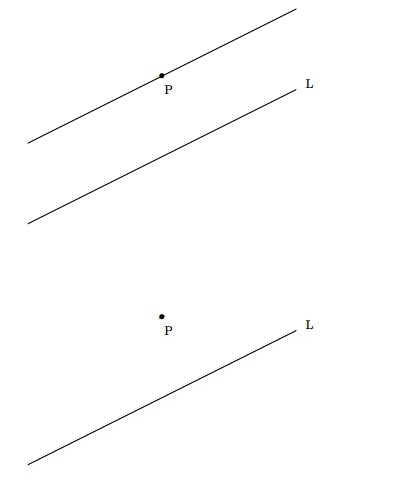
1 Parallel (photo from internet)

However it is possible to think about spaces where the answer is 0 (can you think of one such space? You know it for sure!)

Yet another leap of reasoning will take you to another type of space where the answer is infinity. That is, given a line L and point P outside the line L, we can draw infinitely many lines through P parallel to L.
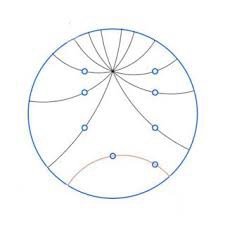
A model of a space where infinitely many lines (arcs in the picture) does not meet a given line. (Photo from internet)

This type of space, however hard it is to imagine, theoretically exists. Such spaces are called hyperbolic spaces and this property (of having infinitely many parallel lines) is called hyperbolicity.

The way I think about it is, the space itself 'bends away' too quickly thus making a tonne of lines on it to bend away from the given line L. This sort of 'imagination' has its problems. In fact, a theorem of Hilbert roughly says, that such a space cannot be 'imagined' using our intuition of three dimensional space.

This meaning of hyperbolicity was conceived in 1830s by Gauss and later by Bolyai and Lobachevsky. But that was just the starting point of the journey of the word 'hyperbolicity'.

What are groups and how Dehn studied them?

About 70 years later, Dehn used the (evolved) strategy of hyperbolicity in a completely new context: to solve word problems in certain groups. Actually Gromov 'uncovered' this strategy embedded in Dehn's methods about another 70 years later. Notice that I mentioned 'hyperbolicity' as a strategy for solving problems instead of a concept. The meaning of this will be clear shortly.

A group is basically a set where you can combine (add) elements to create a new element of the same set. You could also substract one element from another. Though I am saying 'add', this operation can be some other rule of combination.

For example, the set of integers can be regarded as a group. In this 'set' one can 'add' two integers to get another integer.

In any group, we can specify an important subset S called 'generators' of the group. The generators, 'generate' the group, in the sense, you may repeatedly combine the generators to create all the elements of the set. For example, in the group of integers, {1, -1} is a set of generators.

Groups are important for a variety of reasons. They are among the most elementary algebraic structures that one can study (elementary does not mean 'simple'; group theorists know that even simple groups may not be 'simple''!

Another reason might be this: groups are used to model symmetries of objects. Since symmetries are important in physics and in many other sciences, therefore groups are important.

At any rate, given a group (a set) G, we can create 'words'. Here we are thinking about elements of the set G as 'letters'. One can combine (or add) several letters to form a new element of the same group. This combination of several letters is referred to as a 'word' which is also an element of G.

Word problem for a group

How do we tell if two words (created by combining letters) represent the same element of the group or not? This is known as the word problem of a group. It is, in general, very hard to figure this out.

Here is an example. Consider the set of symmetries of an equilateral triangle: three reflections (about each median) and three rotations (0, 120, 240 degrees) about the centroid. Lets write the elements as {R1, R2, R3, Rot1, Rot2, Rot3}. They form a group. You can check this. For example combining any two elements this set, you will get another element of the same set.
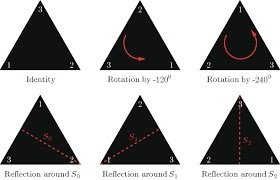
Symmetries of Equilateral triangle (photo from internet)

You can actually combine two symmetries. Lets use * instead of 'add' for this sort of rule of combination of group elements.

For example R1*Rot2 means: first do a rotation by 120 degrees about centroid and the do a reflection about the first median. In this way, you can combine several elements to create a 'word'. But that word is again an element of the group (as combining elements of a group, by definition, gives another element of a group). In fact the same element can be written in many ways (in many words).

Now lets write down two weird looking words:

Word1 = R1*Rot1*R2*R1*Rot1*R2*R1*Rot1*R2

Word1 = R3*Rot1*R2*R1*Rot1*R3

Do Word1 and Word2, represent the same element of the group? As I mentioned before, this is hard to check in general. However for certain types of groups, there are short algorithms to check this.

Group of Loops

There is an important class of groups that was studied by Dehn. This class, for the sake of simplicity, is known as group of loops. Here is how you can think about it.

Given a space X, fix a point P in X and draw all loops starting and ending at P. This set (after doing some stuff) can be regarded as group. For example you can combine two loops by simply travelling along the first one first and then the second one.
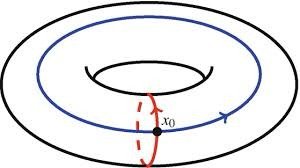
Two loops on a torus (photo from internet)

For certain types of spaces, these Group of Loops has a beautiful property called D- hyperbolicity. These groups have a solvable word problem. That is, given two words using letters of the group, you can check if they represent the same element of the group using an algorithm (that does the job in a 'small' amount of time.)

What is D-hyperbolicity?

To understand the notion of D-hyperbolicity one should think of a group (a set of elements whose members can be combined to produce other members of the same set) as dots and segments. Represent each element of the group by a dot (make sure to label it the name of the group member). Join two dots g1 and g2 if g2 - g1 is a generator of the group G.

This creates a 'Cayley graph' of the group G. It contains bunch of dots and line segments known as edges. For example the Cayley graph of the group of integers with respect to the generating set {1, -1} looks like a straight line.
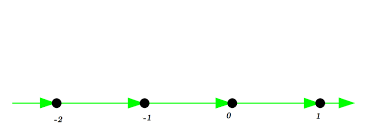
Cayley Graph of integers (Photo from internet)

You can draw triangles on the Cayley Graph. To do that, pick three points A, B, C in the graph. Suppose each edge is 1 unit long. Then you can find paths (possibly consisting of several edges) joining A to B, B to C, and C to A. Some of these paths can be long winding. However some of them can be 'as small as possible. These shortest possible paths are known as geodesics. We can form a triangle ABC inside the graph by choosing geodesic paths in the graph connecting AB, BC and CA.

What Dehn found is interesting. Let G be a group and S be a generating set of the group. Let C be the Cayley graph of G. Suppose there their exists a magic number D, such that whenever you draw a triangle (having geodesic sides), any point on AC is within D unit distance from some point in AB or BC.
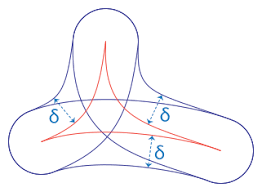
Here D is denoted by the Greek Letter delta

It does not matter how big the triangle is. The same magic number D must work for it.

This clearly does not happen in a piece of paper. Lets say you are guessing D = 5 (for flat piece of paper). But then you can create a large enough right triangle such that the midpoint of the hypotenuse is more than 5 units away from both the legs of the right triangle. In fact, from the stand point of geometry, a magic number D can only exists for hyperbolic spaces! This is that hyperbolicity that we discussed a while ago.

Dehn found that if such a magic number D exists for a Cayley Graph of a group , then the word problem for that group is solvable. This is a remarkable point where geometry meets algebra through hyperbolicity!

Subsequently, all spaces, where such a magic number D exists, are known as D-hyperbolic spaces. This considerably expanded the meaning of hyperbolicity and led to the rise of geometric group theory in the later part of 20th century.
Research Seminar: Searching for giants and dwarves: searches for compact objects

Schedule

Saturday, 27th January, 2024.
10:15 PM IST

About Speaker
Dr. Debnandini Mukherjee
Dr. Debnandini Mukherjee | NASA

Dr. Debnandini Mukherjee is a postdoctoral researcher at the Center of Space Plasma and Aeronomic Research (CSPAR). She works in NASA's Marshall Space Flight Center in Huntsville Alabama, with Tyson Littenberg's group. She works in the area of gravitational wave data analysis and astrophysics. Her work involves looking for gravitational waves from inspiralling compact object binaries comprising neutron stars, black holes or both. She has been working with the LIGO-VIrgo-KAGRA (LVK) Collaboration and using data collected by the same to look for signatures of gravitational waves and gleaning astrophysical implications of such observations. Her focus has been on the search for intermediate-mass black-hole (IMBH) binaries which is an interesting astrophysical source for the LISA mission as well. She is also involved in developing searches for gravitational waves for the LISA mission. In particular, she is interested in developing early warning (pre-merger) searches, aimed at sending out early alerts for gravitational waves. Debnandini completed her PhD from the University of Wisconsin Milwaukee in 2018. Before joining CSPAR, she was a postdoctoral scholar at the Pennsylvania State University.

Abstract

The discovery of gravitational waves in 2015, added a new channel for multi-messenger observations of powerful astrophysical phenomena. Besides telescope observations using the pre-existing electromagnetic channels like X-rays, Gamma rays and Optical light, many such observations can also be supplemented and corroborated using gravitational waves. On the more massive end of the mass spectrum of compact objects, the intermediate mass black holes (IMBHs) are expected to have masses in the range of 100 to 100,000 solar masses, making up the mass space between the stellar mass and the supermassive black holes. GW190521, the heaviest black hole binary coalescence seen by the end of the last observation run in data from LIGO-Virgo, with its total mass being about 150 solar masses, has been the first clear observation of an IMBH. The rates of observation of gravitational wave sources with at least one IMBH component, to which the detectors are currently sensitive, would help constrain their formation channel, which so far remains uncertain. Their observations could also point to a missing link between stellar mass and super massive black holes. On the other end of the mass spectrum, GW170817 was not only the first observed binary neutron star (BNS) event in gravitational waves but it also started a new-era in multi-messenger astronomy through its observation and detection in other channels. Such multi-channel observations can lead to a more robust understanding of the physics that can be gleaned from BNS mergers. Such BNSs are expected to spend several minutes before merging in LIGO-Virgo's sensitive band, at design sensitivity. This can be leveraged to send out early alerts to multi-messenger partners, to enable observation of such events in multiple bands.

The space based laser interferometer LISA, expected to be operational in the next decades, will be able to probe the millihertz frequency band. This will make it sensitive to a vast array of compact object mergers, including the massive black holes or MBHs. These black holes, straddling the intermediate and supermassive types of black holes, have masses extending above a minimum of 1000 M. They are expected to be observable within the LISA band for several weeks to months before they merge. This makes them excellent candidates for low latency, pre-merger observations. Also, some mergers of MBHs are expected to have electromagnetic counterparts due to the presence of gas or disks. Pre-merger alerts with sky location information from LISA data analysis sent out to the astronomy community, would enable early detections of such mergers in electromagnetic bands. Such multi-messenger observations stand to further our knowledge of astrophysics, including that of black hole formation and evolution. 

In my talk I will discuss the search for the presently observable gravitational wave sources in LIGO-Virgo data and the possibility of future observations of more massive sources using LISA and explore the possibility of sending out pre-merger alerts for electromagnetically observable sources, to enable multi-messenger observations.

Sign Up for the Live Session

Journals for High School Researchers

High School students may pursue research projects due to a variety of reasons. They are great learning opportunities for talented young scientists. They are also great additions to university application packets. A research project usually results in a paper that can be either published in peer reviewed journals or can be submitted as additional material during university application.

Typically, at Cheenta, students may take 8 months to 1 year to complete a research project. However some projects may take multiple years. They work individually or in a team with seasoned professionals. The key focus areas of research at Cheenta are:

  1. Mathematics
  2. Computer Science, Artificial Intelligence, Machine Learning
  3. Statistics

Usually Cheenta students are required to attend the Math Olympiad program in Cheenta for at least six months before they are admitted to any research program.

Here are some journals which accept high quality research papers from school students in Mathematical Sciences. Some of these journals have a publication fee attached to it.

Learn more about research at Cheenta in this link.

Introduction to Geometry for Olympiads

Cheenta is conducting an open short course on Geometry for Math Olympiads. Any student who is interested in the fascinating world of mathematics may join it. However it will be most suitable for kids who are in Grades 6 to 9 (though others are welcome to join).

Faculty

Ashani Dasgupta

Dr. Ashani Dasgupta

PhD in Mathematics from University of Wisconsin-Milwaukee
Faculty of Mathematics at Cheenta Academy

Dr. Dasgupta has been training students for Mathematical Olympiads since 2010. Many of his students have performed brilliantly in national and international level olympiads. Several of his students went on to pursue academic careers at leading universities such as Harvard, MIT and Oxford.

DayContent
Day 1Class Notes
Day 2Class Notes
Homework
Day 3Class Notes
Day 4Class Notes
Day 5Class Notes

How to teach mathematics : an experiment with triangular numbers and splitting of plane

Mathematics is all about the beauty of patterns and their reasonable connections. How about connecting patterns from seemingly different domains of the subject? This is a note borne out of a Geometry workshop at Cheenta where we tried exactly that. The audience comprised of 9 to 11 years old students.

The purpose of this note is to share some teaching methods in mathematics. A detailed discussion on this method is available in another note.


We begin the discussion with triangular numbers.

One dot gives the number 1. We may have think of this as the 1-dotted triangle. The shape of this triangle is still not very triangular.

Next we add a 2-dotted row to make a 3-dotted triangle. Thus the second triangle has 3 dots. Now it looks like a triangle!

Next step makes the evolution of the triangular shape apparent. We add 3-dot row beneath in the 3-dotted triangle to get the 6-dotted triangle. Thus the third triangle has 6 dots.

Can you guess how to create the next triangle?

Obviously we add a 4-dot row beneath the 6-dotted triangle. This gives us the fourth triangle in the sequence which is a 10-dotted triangle.

Students quickly catch on and they create fifth triangle which is 15-dotted, sixth triangle which is 21-dotted and seventh triangle which is 28-dotted. By this time, the process of designing the next triangle is understood by most students. It takes only one more indulgence to expose the series form of the number of dots.

Can you find the number of dots in the 20th triangle? Well it must be 1+2+3+…+20 dots. How do we sum these numbers quickly and efficiently?

At this juncture we let the cat out of the bag and introduce the students to the genius of Carl Freidrich Gauss. Write the sum backward beneath the original sum. Each column adds up to 21. There are 20 columns. Hence the sum of twenty 21’s is 420. But we added each number twice hence the sum we are looking for is 210!

As the kids get marvelled by this little trick, we quickly switch gears and look at a more geometric problem.

If you put 1 line in the plane how many regions do we have? Clearly two.

Next put another line in the plane. This second line must cut through the first line. How many regions do we have now? Four.

Let us put another line in the plane. This line must cut the other two lines and must not pass through the previous intersection point. How many regions do we have now? Students take a little time to label the regions and come up with the right answer: seven.

We continue the process of drawing by adding the fourth, fifth and the sixth line. Each time we ensure that the new line cuts all previous line. Moreover the new line must not pass through any of the old intersection points. How many regions are produced in each step?

Students quickly notice that 5th line produces 5 new regions, 6th line produces 6 new regions and so on.

The punch line is this: total number of regions produced by n lines is exactly 1 more than the nth triangular number.

The splitting of the plane by lines (which is of more universal appeal) has this striking connection with a sequence of integers related to dotted triangles.

The spirit of the discussion should be experimental in nature. We constantly ask the students questions like:

  1. Can you draw the next dotted triangle?
  2. How many dots are there in the 10th dotted triangle?
  3. Can you observe a pattern?
  4. Can you find the number of regions created by four lines?

Draw draw draw… observe observe observe… analyze and conclude.

Geometry workshop for Math Olympiad - Thanksgiving 2022

In the Thanksgiving break, 2022, join Cheenta for an outstanding Geometry workshop for Math Olympiads. In this online workshop students will explore the beauty of geometric thinking and problem solving.

Ashani-Dasgupta

Trainer:

Dr. Ashani Dasgupta
PhD in Mathematics from University of Wisconsin-Milwaukee
Math Olympiad coach at Cheenta since 2010

For high school

(Grades 9 to 12)

Thursday - 8 AM PST
Friday - 8 AM PST
Saturday - 8 AM PST

For middle school

(Grades 6 to 8)

Thursday - 9 AM PST
Friday - 9 AM PST
Saturday - 9 AM PST

For elementary school (upto Grade 5)

Thursday - 10 AM PST
Friday - 10 AM PST
Saturday - 10 AM PST

How to Join?

Join for free using the whatsapp group. If you like the short workshop you may pay US$ 49 at the end of it.

Sword does not need to remember how the whetstone looks

Imagine sharpening your sword with a whetstone. The job of the stone is to sharpen the sword. It does not matter what color the stone is.

Cheenta programs are designed like whetstones. They are supposed to sharpen the creativity and problem solving skills through a slow but sure process. They involve thousands of thought provoking problems, hands-on exercises and long term projects. This is perhaps one of the reasons why so many Cheenta students do well in the national and international level olympiads.

It is in fact unimportant to remember how the whetstone looks; that is it’s unnecessary for children to remember the details of the content. This is particularly true in the elementary school level olympiad programs. This content is not designed to be remembered as tools for they not. They are designed to sharpen the mind, excite the imagination and improve creative problem solving.

Take for example the module on Spatial patterns in elementary school olympiad program. One of the modules involve platonic solids such as dodecahedron, icosahedron etc. Students draw wireframe diagrams of these solids in paper, draw projection diagrams, implement it in Geogebra, draw dual solids using adjacency relations and so on. The point to note here is that platonic solids themselves are not that important. The things kids do with them is important. For example they learn about perspectivity (a visualization skill fundamental to geometry). They indirectly learn about duality, another important fundamental notion that runs through entire mathematics. As they walk through projection diagrams, their geometric visualization and spatial sense improve and get organized. These are very useful in the long run for problem solving. They also learn how to draw, redraw and think and rethink. They learn patience.

The Cheenta programs for elementary school kids are developed over the last 12 years with immense care. They incorporate findings of celebrated mathematician Cedric Villani, work of Rabindranath Thakur in Shikkhasotro, problems of Math circle experience in erstwhile Soviet Union and many other people who have worked tirelessly to improve mathematics education in elementary school. Let us know your thoughts as well.

Cross Ratio - an accidental discovery

If we know nothing about this world, we should know about cross ratio. It is one of those accidents of nature that is so unbelievable, unimaginable, that we need mathematics to accept it.

Imagine that physicist telling you: if there was no air, a feather and an iron ball would hit the ground at the same time (falling from a height).

Until and unless someone takes you to Michigan’s NASA lab, and actually creates a near-vacuum chamber and actually drops a feather and an iron ball, and they actually hit the ground at the same time, you won’t be able to accept it. Seeing is believing.

This is also true about cross ratio. Geometers may think about it as the devil’s concoction. Algebrists may think about it as their victory. But no one really knows.

Choose a point of observation O and a line L outside the point. Suppose A, B, C, D are four points in the line L. We think about OA, OB, OC and OD as lines of sight from the observer point O to the observed line L. Pappus of Alexandria, about 300 years after Christ, observed something peculiar:

(AC/AD) ÷ (BC/BD) remains invariant no matter what.

This means, if another line L’ cuts the lines of sight OA, OB, OC, OD at A’, B’, C’, D’ respectively then we will have

(AC/AD) ÷ (BC/BD) = (A’C’/A’D’) ÷ (B’C’/B’D’).

(Actually one may argue that Desargues looked into this explicitly; however Pappus certainly played with these ideas first).

This is remarkable for a variety of reasons. You do not need the concept of an angle here. No matter what the inclination of L’ is with respect to L, this ratio of ratios will be preserved. Moreover it is also tied with how our brain sees things. If A, B, C, D are equally spaced on L, it will appear to the observer that A’, B’, C’, D’ are equally spaced on L’. In a way, the invariance of this cross ratio holds the secret of how are brain works!

Indeed architects and painters during the renaissance used cross ratio and allied concept of projectivity to transform their craft. Painters used it draw realistic three dimsensional painting with lines of sight meeting at infinity.

One can compare contemporary Mughal art and Italian art to observe the difference. To illustrate this I have attached two sample pieces; one of which has lines of sight meeting at an observer point. Can you tell which one it is?

A simple addition of observer point, with lines of sight meeting at it, makes all the difference. One of them appears to be flat in our brain. The other one appears to be three dimensional.

How to prepare for Olympiads and other contests in Middle School?

Middle schools (grades 5 to 8) are formative years for children. At this age two important things happen:

Therefore, in middle school, it is extremely important to structure learning around curiosity, love for the subject matter and open-ended enquiry. The Mathematics and Science Olympiads usually help this process. But they alone are not sufficient.

Here are some of the tools that you may use for children in the middle school and help them succeed in the long run.

(Beautiful) Books for Middle School

Thanks to the internet, we have an over-flow of information. This creates a lot of noise, unnecessary screen time and confusion. It is important to introduce children to the right resources early on. We try to do that in our math and science olympiad programs at Cheenta. Parents and teachers may do that at home and school as well.

Books written by true masters can change the life of children. They ask thought-provoking questions and provide powerful intuitions for fundamental ideas. Some of these books also have ‘how-to-teach’ sections. Here are some good titles for middle school mathematics and science.

Hands-on experiments in middle school

It is useful to have hands-on interaction with mathematical sciences. Our years of work with students taught us a very important lesson: if students are allowed to ‘do stuff’ they will begin to ‘teach themselves’. Here are some good softwares to do hands-on math and science experiments.

You may also set-up small labs at your home. A good telescope and some elementary tools can take you a long way. Here is a good book to get started with it:

Peer groups in middle school for non-routine mathematical science

It is very important to have a strong peer group. Kids need to see other children who are excited about the subject. At Cheenta we endorse group activities such as math circles to promote such a culture.

Join a math circle or create one in your locality to inculcate a culture of critical thinking and problem solving in your child. Let us know if you need help.

Teaching at Middle School

At Cheenta we ask our students to teach as well (yes, even the kids in middle school). This process has an incredible effect on motivation and self-propelled learning. For example some of Cheenta kids teach rural school students, slum-area students from remote corners of India.

This process keeps the children grounded, alert about their own learning and engaged with the real world.

Non-routine tools

Cheenta programs use a lot of non-routine tools for Middle School Olympiad programs. You may also use them at home. They are useful for nurturing the mind and keeping motivation level high.

Non-routine contests

Non-routine contests such as science and math olympiads can be useful motivating for the children. However we should be very careful about this. Nowadays there are lot of contests with un-interesting problems that promote rote-learning. They may have negative impact on children. Here are a few contests that are useful for middle school kids.

Cheenta Math and Science Olympiad Programs for Middle Schools

Cheenta has outstanding math and science olympiad programs developed over a decade. Let us know if you need more information on curriculum and work-flow. Learn more about the success stories here:

ISI B.Stat and B.Math Entrance - How to prepare, curriculum, paper pattern and topicwise weightage

The BStat and BMath Entrance of ISI Entrance is ‘different’ from IIT JEE or other engineering entrances. It tests creativity and ingenuity of the problem solver that requires more than mechanical application of formulae. Many of these problems are inspired from erstwhile Soviet Union math contests and other math olympiads.

The entrance has two sections:

Cut off for ISI Entrance

The cut off varies every year. However 80 out of 120 in objective section and 50 out of 100 in subjective section should put you in a comfortable position.

Interview for ISI Entrance

If you do well in the entrance then you will be invited for the interview. Several Cheenta students have supplied problems from past interviews which you may find in this link.

Curriculum for ISI Entrance

ISI has an official curriculum for this entrance. It can be found in the problem compilation that the institute publishes every year. The topics are similar to high school curriculum but also includes some extra ideas from elementary number theory, geometry and combinatorics. Moreover the so called ‘regular school topics’ are tested in highly unusual way. This is the main challenge of the entrance.

Cheenta has a free toolbox that you may use. Our paid programs can also be useful for long term preparation.

Topicwise Weightage

At Cheenta, we have unofficially complied a topic-wise weightage. It is based on past year papers. Please use this information carefully as all years are note the same.

Please note that there are huge overlaps between these topics. For example there are problems in complex numbers that may be regarded as pure geometry problems and so on. Similarly tools such as coordinate geometry, trigonometry or vectors, logarithms can be used in a variety problems in calculus.

Books