Unlocking the Curious Combination of Number Theory and Algebra: ISI Entrance Problem, TOMATO Subjective 17

Lets dive into a captivating problem that unites algebra and number theory, creating a compelling challenge. This puzzle revolves around a particular type of mathematical equation. The ultimate aim is to prove that the solutions to this equation cannot be expressed as straightforward fractions like 1/2 or 3/4.

Here is the question we solve:

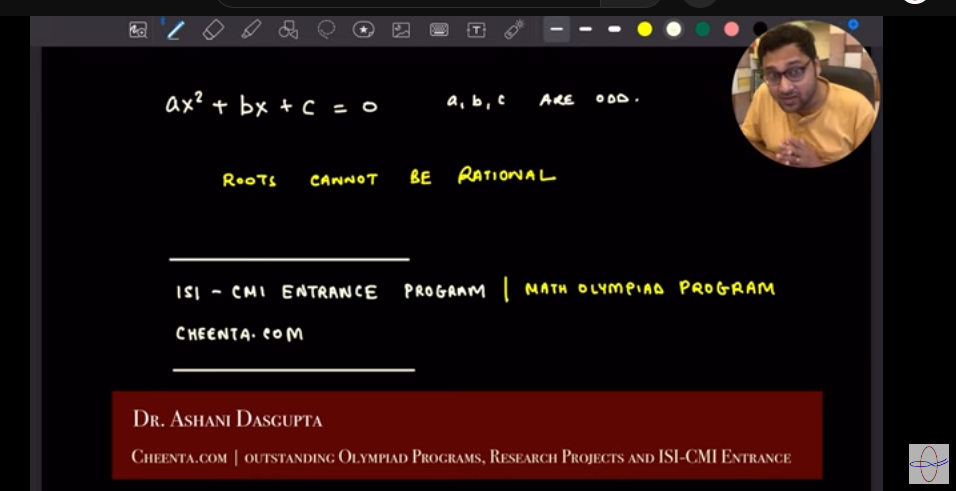
If the coefficients of a quadratic equation 

ax^2 + bx + c = 0 (a \neq 0 )

are all odd integers, show that the roots cannot be rational.

To solve this problem we use the quadratic formula and a clever concept known as "parity check." At the heart of the matter is demonstrating that the discriminant, b² - 4ac, doesn't fit the definition of a "perfect square."

Now, let's delve into the parity check. Regardless of the interplay between even and odd numbers, the left side of the equation consistently maintains an even quality, while the right side remains steadfastly odd. This leads to a conclusion: the solutions do not exist

Click here to watch the video

ISI B.STAT PAPPER 2018 |SUBJECTIVE

Problem

Let $f$:$\mathbb{R} \rightarrow \mathbb{R}$ be a continous function such that for all$x \in \mathbb{R}$ and all $t\geq 0$

f(x)=f(ktx)
where $k>1$ is a fixed constant

Hint

Case-1


choose any 2 arbitary nos $x,y$ using the functional relationship prove that $f(x)=f(y)$

Case-2


when $x,y$ are of opposite signs then show that $$f(x)=f(\frac{x}{2})=f(\frac{x}{4})\dots$$
use continuity to show that $f(x)=f(0)$

Solution


Let us take any $2$ real nos $x$ and $y$.

Case-1

$x$ and $y$ are of same sign . WLG $0<x<y$

Then$\frac{y}{x}>1$
so there is a no $t\geq 0$ such that
$\frac{y}{x}=k^t$
$f(y)=f(k^tx)=f(x)$ [using$f(x)=f(k^tx)$]

case-2

$x,y$ are of opposite sign. WLG $x<0<y$
Then $f(x)=f(k^tx)$

$\Rightarrow f(k^tx)=f(k^t2\frac{1}{2}x)$


$\Rightarrow f(k^t2\frac{1}{2}x)=f(k^tk^{log_k2}\frac{x}{2})$


$\Rightarrow f(k^tk^{log_k2}\frac{x}{2})=f(k^{t+log_k2}\frac{x}{2})$

$\Rightarrow f(k^{t+log_k2}\frac{x}{2})=f(\frac{x}{2})$


Using this logic repeatedly we get


$f(x)=f(\frac{x}{2})=f(\frac{x}{4})\dots =f(\frac{x}{2^n})$


Now $\frac{x}{2^n}\rightarrow0$ and $f$ is a continous function hence $\lim_{n\to\infty}f(\frac{x}{2^n})=f(0)$.


[Because we know if $f$ is a continous function and $x_n$ is a sequence that converges to $x$ then $\lim_{n\to\infty}f(x_n)=f(x)$]


using similar logic we can show that $f(y)=f(0)$ so $f(x)=f(y)$ for any $x,y\in \mathbb{R}$


I.S.I B.STAT 2018 | SUBJECTIVE -4

PROBLEM

Let $f (0,\infty)\rightarrow \mathbb{R}$ be a continous function such that for all $x \in (0,\infty)$ $f(x)=f(3x)$ Define $g(x)= \int_{x}^{3x} \frac{f(t)}{t}dt$ for $x \in (0,\infty)$ is a constant function

HINT

Use leibniz rule for differentiation under integral sign

SOLUTION

using leibniz rule for differentiation under integral sign we get
$g'(x)=f(3x)-f(x)$

$\Rightarrow g'(x)=0$ [ Because f(3x)=f(x)]
Since the derivative of $g(x)$ is $0$ for all $x$, Hence $g(x)$ is a constant function

Test of Mathematics Solution Subjective 188 - The Numbered Chessboard

Test of Mathematics at the 10+2 Level

This is a Test of Mathematics Solution Subjective 188 (from ISI Entrance). The book, Test of Mathematics at 10+2 Level is Published by East West Press. This problem book is indispensable for the preparation of I.S.I. B.Stat and B.Math Entrance.


Problem

Consider the squares of an $ 8 X 8 $ chessboard filled with the numbers 1 to 64 as in the figure below. If we choose 8 squares with the property that there is exactly one from each row and exactly one from each column, and add up the numbers in the chosen squares, show that the sum always adds up to 260.

Untitled


Solution

The problem asks us to choose numbers selectively such that they are from unique rows and columns. We write the numbers in the table in such a manner that helps us in our calculations. This is how it will be done:

Let the number in the $ i^{th} $ row and $ j^{th}$ column be $ x$. If we carefully observe the table we find an intuitive way of representing $ x$ as follows:

$ x = 8*(i-1) + j $ if $ x$ is the element in the $ i^{th} $ row and $ j^{th}$ column. Now all that is left to do is sum up all such numbers such that no two $ j^{t} $ or $ i^{th}$ value is same. There for the total sum is: $ (8*(i_1-1)+ j_1) + (8*(i_2-1) + j_2) + . . . + (8*(i_8-1) + j_8) $

that means Sum (S) = $ (8*(i_1 - 1 + i_2 - 1 + . . . + i_8 - 1)) + (j_1 + j_2 + . . . + j_8) $

$ => S = 8*(i_1 + i_2 + i_3 + ... + i_8 - 8) +  (j_1 + j_2 + . . . + j_8)$

We know that as all the $ i$ and $ j$ values are different and range from 1 to 8 we can ascertain that

the sum of the $ i$ values $ = $ sum of $ j$ values = $ 1+2+3+...+8 = \frac{8*(8+1)}{2}$

Therefore S = $ 8*(\frac{8*(8+1)}{2} - 8) + \frac{8*(8+1)}{2} $ = $ 8*(36-8) +36 = 260 $

Hence the sum of all the values taken from unique rows and columns is 260.

Hence Proved.


Chatuspathi:

Test of Mathematics Solution Subjective 181 - Diagonal Moves

Test of Mathematics at the 10+2 Level

This is a Test of Mathematics Solution Subjective 181 (from ISI Entrance). The book, Test of Mathematics at 10+2 Level is Published by East West Press. This problem book is indispensable for the preparation of I.S.I. B.Stat and B.Math Entrance.


Also visit: I.S.I. & C.M.I. Entrance Course of Cheenta

Problem

Suppose that one moves along the points (m, n ) in the plane where m and n are integers in such a way that each move is a diagonal step, that is, consists of one unit to the right or left followed by one unit either up or down.

(a) Which point (p, q) can be reached from the origin.

(b) What is the minimum number of moves needed to reach such a point (p, q)?


Discussion

For each horizontal movement (right or left) there is one vertical movement (up or down). Suppose there are R right moves, L left moves. Also there be U upward move and D downward move. Since number of horizontal movement equals number of vertical movements hence we have

R+L = U+D = k (say)

The final coordinate reached is (R - L , U - D) (as each right move counts as +1 and left move counts as -1, and similarly for vertical movements),

L = k -R

D = k -U

Hence the final coordinate is (2R - k, 2U - k)

Therefore both the coordinates are of same parity (that is either both are even or both are odd).

So we have shown that the final point that can be reached has both x and y coordinate of the same parity. Now we show the converse. That is all the points whose x and y coordinates are of same parity can be reached.

Say P be a point whose both coordinates are even. Without loss of generality we may say P = (2m, 2n) where $ 2m \ge 2n $ and both coordinates are positive.

1. 2(m-n) moves of the form Right-Up followed by Left-down is performed to reach the point (2(m-n) , 0)

2. Next 2n moves of the form Right-Up is performed to reach the point (2m, 2n)

So in total 2(m-n) + 2n = 2m moves are performed to reach the point (2m, 2n)

Similarly to reach a point whose both coordinates are odd, say (2j+1, 2l + 1),  we first reach the point (2j, 2l) and then move one more unit diagonally upward.

This same algorithm will work for all the quadrants.

Also if (p, q) is the final coordinate with p > q, we have taken p steps to reach the point. It is not possible to reach the point in less than p steps, because we must cover at least p boxes in at least one direction and in one step exactly one box can be covered.

Therefore we have found the answer:

(1) All the points (p, q) can be reached where $ p \equiv q \text{mod} 2 $

(2) If $ p \ge q$ , minimum number of steps required is p. If $ q \ge p $, the minimum number of steps required is q.

Test of Mathematics Solution Subjective 177 -The Famous Doors Problem

Test of Mathematics at the 10+2 Level

This is a Test of Mathematics Solution Subjective 177 (from ISI Entrance). The book, Test of Mathematics at 10+2 Level is Published by East West Press. This problem book is indispensable for the preparation of I.S.I. B.Stat and B.Math Entrance.


Also visit: I.S.I. & C.M.I. Entrance Course of Cheenta

Problem

 There are 1000 doors $ D_1, D_2, . . . , D_{1000}$ and 1000 persons $ P_1, P_2, . . ., P_{1000}$. Initially all the doors were closed. Person $ P_1$ goes and opens all doors. Then person $ P_2$ closes doors $ D_2, D_4, . . ., D_{1000}$ and leaves all odd numbered doors open. Next, $ P_3$ changes the state of every third door, that is, $ D_3, D_6, . . ., D_{999}$ by closing a door if it is open or opening a door if it is closed. Similarly, $ P_m$ changes the state of the doors $ D_m, D_{2m}, . . ., D_{nm}$, while leaving the other doors untouched. Finally, $ P_{1000}$ opens $ D_{1000}$ if it is closed or closes it if it is open. At the end how many doors remain open?


Solution

This particular problem requires careful analysis of the problem statements and decide what the problem is exactly asking us to solve.

Basically there are two possible states of the door, namely Open (denote by 'o') and Close (denote by 'c'), and initially all doors are in state 'c'.  Let us define the operation of changing the state of the door by  'F'. So if 'F' can be seen as a function where the variables are 'o' and 'c'  and we have:

F(o) = c

F(c) = o

So if a door is operated on 'n' times we represent it by $ F^n(c)$ as initially all the doors were closed. It is very trivial to state that if the door is operated even number of times it returns to the 'c' state and if it's operated odd number of times then it has a change to 'o' state.

Therefore, $ F^n(c)$ = c, if n is even, else $ F^n(c)$ = o, if n is odd.       ......(i)

As 'n' represents the number of times the operation has been performed on a particular door, as we understand from the problem that a door $ D_m$ is only operated by a person $ P_k$ iff k divides m. So whenever we have an divisor of 'm', we increment the value of 'n' by 1. Thus finally after all the counting the value of 'n' will be nothing but the number of divisors of 'm'.

We are to find which doors will remain in state 'o' after the whole procedure and for a door to be in state 'o' it has to be operated odd number of times (from (i)). Which implies that 'n' has to be odd. So all those doors which have odd number of divisors will be open after the process.

Now it can be shown very trivially that a number has odd number of divisors iff it is a perfect square. (Think!!)

So our solution will be all those doors that are marked with perfect square numbers ranging from 1 to 1000.

Solution Set: {$ D_1, D_4, D_9, D_{16}, D_{25}, . . ., D_{900}, D_{961}$}

Test of Mathematics Solution Subjective 176 - Value of a Polynomial at x = n+1

Test of Mathematics at the 10+2 Level

This is a Test of Mathematics Solution Subjective 176 (from ISI Entrance). The book, Test of Mathematics at 10+2 Level is Published by East West Press. This problem book is indispensable for the preparation of I.S.I. B.Stat and B.Math Entrance.


Also visit: I.S.I. & C.M.I. Entrance Course of Cheenta

Problem

Suppose that P(x) is a polynomial of degree n such that $ P(k) = \frac {k}{k+1} $ for k = 0, 1, 2, ..., n . Find the value of P(n+1).


Solution

Consider an auxiliary polynomial g(x) = (x+1)P(x) - x . g(x) is an n+1 degree polynomial (as P(x) is n degree and we multiply (x+1) with it). We note that g(0) = g(1) = ... = g(n) = 0  (as the given condition allows (k+1) P(k) - k = 0 for all k from 0 to n). Hence 0, 1, 2, ... , n are the n+1 roots of g(x).

Therefore we may write g(x) = (x+1)P(x) - x = C(x)(x-1)(x-2)...(x-n) where C is a constant. Put x = -1. We get g(-1) = (-1+1)P(-1) - (-1) = C(-1)(-1-1)(-1-2)...(-1-n).

Thus 1 = C $ (-1)^{(n+1) } (n+1)! $ gives us the value of C. We put the value of C in the equation (x+1)P(x) - x = C(x)(x-1)(x-2)...(x-n) and replace x by n+1 to get the value of P(n+1).

$ (n+2)P(n+1) - (n+1) = \frac { (-1)^{(n+1)}}{(n+1)!} (n+1)(n)(n-1) ... (1) $ implying $ P(n+1) = \frac { (-1)^{(n+1)} + (n+1)}{(n+2)} $

Test of Mathematics Solution Subjective 175 - Integer Roots

Test of Mathematics at the 10+2 Level

This is a Test of Mathematics Solution Subjective 175 (from ISI Entrance). The book, Test of Mathematics at 10+2 Level is Published by East West Press. This problem book is indispensable for the preparation of I.S.I. B.Stat and B.Math Entrance.


Also visit: I.S.I. & C.M.I. Entrance Course of Cheenta

Problem

 Let \(\text{P(x)}=x^n+a_{n-1}x^{n-1}+a_{n-2}x^{n-2}+\dots+a_{1}x+a_{0}\) be a polynomial with integer coefficients,such that,\(\text{P(0) and P(1)}\)  are odd integers.Show that

(a)\(\text{P(x)}\) does not have any even integer roots. 

(b)\(\text{P(x)}\) does not have any odd integer roots.


Solution

Given the two statements (a) and (b)  above it is clear that if we can prove that \(\text{P(x)}\) has no integer roots,then we are done.

 Let us assume \(\text{P(x)}\) has an integer root \(\text{ a}\).

Then we can write,

$$ \text{P(x)=(x-a)Q(x)}\dots(1)$$

where,\(\text{Q}\)is any function of \(\text{ x}\).

Now ,putting \(\text{x=0,1}\) in \(\text{ 1}\),we get

$$\text{P(0)=(-a)Q(0)}\dots(2)$$

and,

$$\text{P(1)=(1-a)Q(1)}\dots(3)$$

now as \(\text{(1-a)}\) and \(\ \text{(-a)}\),are consecutive integers \( \text{(2)}\) and \(\text{(3)}\)

cannot be both odd,

which means that \(\text{P(0),P(1)}\) cannot be both odd,given whatever \(\text{Q(0) and Q(1)}\) are.

So,it is a contradiction!!.

So,we can conclude that there exists no integer solution of \(\text{P(x)}\).

Hence,we are done.

Test of Mathematics Solution Subjective 170 - Infinite Circles

Test of Mathematics at the 10+2 Level

This is a Test of Mathematics Solution Subjective 170 (from ISI Entrance). The book, Test of Mathematics at 10+2 Level is Published by East West Press. This problem book is indispensable for the preparation of I.S.I. B.Stat and B.Math Entrance.


Also visit: I.S.I. & C.M.I. Entrance Course of Cheenta

Problem

Let \({C_n}\) be an infinite sequence of circles lying in the positive quadrant of the \(XY\)-plane, with strictly decreasing radii and satisfying the following conditions. Each \(C_n\) touches both the \(X\)-axis and the \(Y\)-axis. Further, for all \(n\geq 1\), the circle \(C_{n+1}\) touches the circle \(C_n\) externally. If \(C_1\) has radius \(10\: cm\), then show that the sum of the areas of all these circles is \(\frac{25\pi}{3\sqrt{2}-4} \: cm^2\).


Solution

Consider the following diagram where the Green line segment is \(R_n\), the radius of the \(n^{th}\) circle, and the Yellow line segment is \(R_{n+1}\).

As we are told about the symmetricity of the figure in the problem we can say that:

\(\sqrt{2}R_{n+1} + R_{n+1} + R_n = \sqrt{2} R_n\)

\(=> R_{n+1}(\sqrt{2}+1)=R_n(\sqrt{2}-1)\)

\(=> R_{n+1}= (3-2\sqrt{2})R_n\)

Let's say \(=> R_{n+1}= \alpha.R_n\).

Now the total sum of the areas of the circles is:

\((\pi R_1^2 + \pi R_2^2 + \cdots ) = \pi (R_1^2 + R_2^2 + R_3^2 + \cdots )\)

Now as \(R_{n+1}= \alpha.R_n\), we can say that:

\(\pi (R_1^2 + R_2^2 + R_3^2 + \cdots ) = \pi (R_1^2 + \alpha^2 R_1^2 + \alpha^4 R_1^2 + \cdots ) = \pi \frac{R_1^2}{1-\alpha^2}\) as \(\alpha^2 < 1\).

Substituting the value of \(\alpha = 3-2\sqrt{2}\) and \(R_1 = 10 \: cm\)we have,

Sum = \(\frac{25\pi}{3\sqrt{2}-4} \: cm^2\).

Hence Proved.

Test of Mathematics Solution Subjective 166 -The Grazing Field

Test of Mathematics at the 10+2 Level

This is a Test of Mathematics Solution Subjective 166 (from ISI Entrance). The book, Test of Mathematics at 10+2 Level is Published by East West Press. This problem book is indispensable for the preparation of I.S.I. B.Stat and B.Math Entrance.


Also visit: I.S.I. & C.M.I. Entrance Course of Cheenta

Problem

A cow is grazing with a rope around its neck and the other end of the rope is tied to a pol. The length of the rope is 10 metres. There are two boundary walls perpendicular to each other, one at a distance of 5 metres to the east of the pole and another at a distance of $ 5 \sqrt{2}$ metres to the north of the pole. Find the area the cow can graze on.


Solution

First we need to analyse the question and draw a diagram.

We have a circle with centre P and radius 10m. Let AC and AB be the boundary walls present. The striped region shows the area available for grazing. Now if we see carefully we can see that area of the shaded region is nothing but the sum of the areas of the rectangle AEPC, the two right angled triangles EPB and DPC and the sector BPC.

PB = PC = radius of the circle = 10m

PE = $ 5\sqrt{2}$m

AS $ PE^2 + EB^2 = PB^2$      (Pythagorean property of a right angled triangle)

From here, we get $ EB = 5\sqrt{2}$m

Similarly, as PD = 5m, PC = 10m

$ CD = 5\sqrt{3}$m              (pythagorean property)

Therefore,

Area of rectangle AEPC = $ (5\sqrt{2} *5) m^2 = 25\sqrt{2}m^2$

Area of triangle PEB = $\frac{1}{2} * 5\sqrt{2} * 5\sqrt{2} = 25m^2$

Area of triangle PDC = $ \frac{1}{2} * 5 * 5\sqrt{3} = \frac{25\sqrt{3}}{2} m^2$

Area of sector BPC = $ \pi(10)^2 * \frac {\angle BPC}{360^0}$

Now $ \angle BPC = 360^0 - (\angle BPE + \angle CPD + \angle EPD)$

$ => \angle BPC = 360^0 - (tan^{-1}\frac{BE}{EP} + tan^{-1}\frac{CD}{DP} + 90^0)$

$ => \angle BPC = 360^0 - (tan^{-1}\frac{5\sqrt{2}}{5\sqrt{2}} + tan^{-1}\frac{5\sqrt{3}}{5} + 90^0)$

$ => \angle BPC = 360^0 - (tan^{-1}1 + tan^{-1}\sqrt{3} + 90^0)$

$ => \angle BPC = 360^0 - (45^0 + 60^0 + 90^0)$

$ => \angle BPC = 165^0$

Therefore area of sector BPC = $ \pi(10)^2 * \frac {165^0}{360^0} = \pi * 100 * \frac{11}{24} = \frac{275}{6}\pi$

Thus Total area of the Grazing Field = $ (25\sqrt{2} + 25 + \frac{25\sqrt{3}}{2} + \frac{275}{6}\pi) m^2$

or to simplify Total Area = $ \frac{25}{6}(6\sqrt{2} + 6 + 3\sqrt{3} + 11) m^2$