Time Period of a Rolling Cylinder
In this post, we have discussed a problem based on the time period of a rolling cylinder. Try the problem yourself first, then read the solution.
The Problem: Time Period of a Rolling Cylinder
A solid uniform cylinder of radius (r) rolls without sliding along the inside the surface of a hollow cylinder of radius (R), performing small oscillations. Determine time period.
Solution:
Translational kinetic energy + rotational kinetic energy + potential energy= constant
$$ \frac{1}{2}mv^2+{\frac{1}{2}I\omega^2+mg(R-r)(1-cos\theta)}=C$$
Now $$ I=1/2mr^2$$
$$ 3/4m(dx/dt)^2+mg(R-r)\theta^2/2=C$$
Differentiating with respect to time,
$$ \frac{3}{2}m(\frac{d{^2}x}{dt{^2}})^+mg(R-r)\theta\frac{d\theta}{dt} $$
Now, $$ x=(R-r)\theta$$
$$ \frac{3}{2} d^2x/dt^2(R-r)d\theta/dt+gxd\theta/dt=0$$
Cancelling (\frac{d\theta}{dt}) throughout
$$ \frac{d^2x}{dt^2}+\frac{2}{3}\frac{gx}{R-r}=0$$
this is the equation for SHM, with
$$ \omega^2=\frac{2}{3}\frac{g}{R-r}
$$
$$ T=\frac{2\pi}{\omega}=2\pi\sqrt{\frac{3(R-r)}{2g}}$$
Some useful links:
The cosmonauts who landed at the pole found that the force of gravity there is (0.01) of that on the Earth, while the duration of the day on the planet is the same as that on Earth. It turned out that besides that the force of gravity on the equator is zero. Find the radius (R) of the planet.
Discussion:
For a body of mass (m) resting on the equator of a planet of radius (R), which rotates at an angular velocity (\omega), the equation of motion has the form $$ m\omega^2R=mg'-N$$ where (N) is the normal reaction of the planet surface, and (g'=0.001g) is the free-fall acceleration on the planet.
The bodies on the equator are assumed to be weightless i.e. (N=0).
We know, (w=2\frac{\pi}{T}), where (T) is the period of revolution of the planet.
Hence we obtain $$ R=\frac{T^2}{4\pi^2}g'$$
Substituting the value of (T=8.610^4s) and (g'=0.1m/s^2), we get $$ R=1.810^7 Km$$
Time Periods of Revolution of Two Stars
Let's discuss a problem where we find out the time periods of revolution of two stars.
The problem: Time Periods of Revolution of Two Stars
The masses of two stars are (m_1) and (m_2) and their separation is (l). Determine the period (T) of their revolution in circular orbits about a common centre.
Since the system is closed, the stars will rotate about their common centre of mass in concentric circles. The equation of motion for the stars will have the form $$ m_1\omega_1^2l_1=F$$ and $$ m_2\omega_2^2l_2=F......(1)$$
Here (\omega_1) and (\omega_2) are the angular velocities of rotation of the stars, (l_1) and (l_2) are the radii of their orbits, (F) is the force of interaction between the stars, equal to (\frac{Gm_1m_2}{l^2}) where (l) is the seperation between the stars and (G) is the gravitational constant.
By the definition of centre of mass,
$$ m_1l_1=m_2l_2$$
$$l_1+l_2=l...... (2)$$
Solving equations 1 and 2 together, we get
$$ \omega_1=\omega_2=\sqrt{\frac{G(m_1+m_2)}{l^3}}$$
The required period of revolution of these stars is $$ T=2\pi l\sqrt{\frac{l}{G(m_1+m_2)}}$$
Four small spheres, each of which you can regard as a point of mass (0.2)Kg are arranged in a square (0.4)m on a side and connected by extremely light rods. Find the moment of inertia of the system about an axis through the centre of the square.
Discussion:
The length of each side of a square is (0.4)m. Thus, the perpendicular bisector is at (0.2)m. The length of the bisector dropped from the point of intersection of the diagonals is (0.2)m. Therefore, the distance of the vertices from the point of intersection of diagonals is $$ r=\sqrt{(0.2)^2+(0.2^2)}=0.2828m$$
The moment of inertia $$ I=MR^2= 4(0.2)(0.2828)$$=$$0.0640kg m^2$$
Tangential and Radial Acceleration
A flywheel with a radius of (0.3)m starts from rest and accelerates with a constant angular acceleration of (0.6 rads^{-2}). Compute the magnitude of the tangential, radial acceleration of a point on its rim at the start.
Solution:
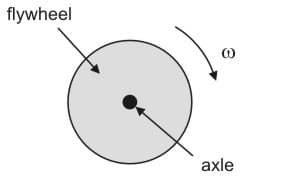
The flywheel has radius (0.3)m and starts from rest and accelerates with a constant angular acceleration of (0.6 rads^{-2}).
The tangential acceleration $$ a_{tan}=r\alpha=(0.3)(0.6)=0.18m/s^2$$
Radial acceleration $$a_{rad}=0$$ since the flywheel starts from zero.
A child is pushing a merry-go-round. The angle through which the merry-go-round has turned varies with time according to $$\theta(t)=\gamma t+\beta t^3$$ where (\gamma=0.4rad/s) and (\beta=0.0120 rad/s^3). What is the initial value of the angular velocity?
Discussion:
The angle through which the merry-go-round has turned varies with time according to $$\theta(t)=\gamma t+\beta t^3$$ where (\gamma=0.4rad/s) and (\beta=0.0120 rad/s^3).
$$ \omega=\frac{d\theta}{dt}$$
At (t=0) $$ \omega=\gamma=0.4 rad/s$$
Angular Velocity and Acceleration
Try this problem based on Angular Velocity and Acceleration, useful for Physics Olympiad.
The Problem:
A fan blade rotates with angular velocity given by $$ \omega=\gamma-\beta t^2$$ where (\gamma=5)rad/s and (\beta=0.800)rad/s. Calculate the angular acceleration as a function of time.
Solution:
The angular acceleration is given by $$\alpha=\frac{d\omega}{dt}=-2Bt=(-1.60)t $$
The unit of angular acceleration will be (rad/s^3).
Try this problem, useful for Physics Olympiad, based on the propeller's angular velocity.
The Problem:
An airplane propeller is rotating at (1900)rpm (rev/min).
(a)Compute the propeller's angular velocity in rad/s.
(b) How many seconds does it take for the propeller to run through (35^\circ)?
Solution:
An airplane propeller is rotating at (1900)rpm (rev/min).
(1)rpm = (2\pi /60)$$ \omega=(1900)(2\pi /60)=199 $$Hence, the propeller's angular velocity (\omega)=(199)rad/s.
b) (35^\circ)(\pi/180^\circ)=(0.611)rad.
Since angular velocity (\omega)=199rad/s, the time required for the propeller to run through (35^\circ)=$$ \frac{0.611}{199}=3.1\times10^{-3}s$$
 et's travel back 2 Millenia to the Land of the Greeks where Plato, Pythagoras, Archimedes devoted their life to Math and Science to understand and enjoy nature. Math was a Puzzle to them and they enjoyed doing it as we do it now. Pythagoras gave birth to the beautiful proof of Pythagoras Theorem just using pictures.