AMERICAN MATHEMATICS COMPETITION 8 - 2023

PROBLEM 1 :

What is the value of $(8 \times 4+2)-(8+4 \times 2)$ ?
(A) 0
(B) 6
(C) 10
(D) 18
(E) 24

ANSWER :

(D) 18

PROBLEM 2 :

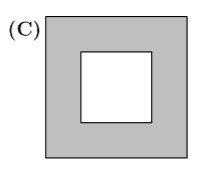
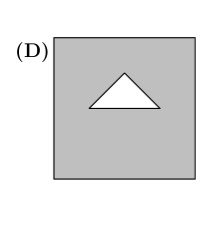
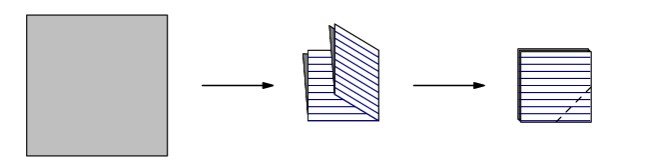
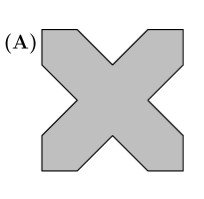
A square piece of paper is folded twice into four equal quarters, as shown below, then cut along the dashed line. When unfolded, the paper will match which of the following figures?
ANSWER :

(E)

PROBLEM 3 :

Wind chill is a measure of how cold people feel when exposed to wind outside. A good estimate for wind chill can be found using this calculation

$$
(\text { wind chill })=(\text { air temperature })-0.7 \times(\text { wind speed }),
$$

where temperature is measured in degrees Fahrenheit ( ${ }^{\circ} \mathrm{F}$ ) and the wind speed is measured in miles per hour (mph). Suppose the air temperature is $36^{\circ} \mathrm{F}$ and the wind speed is 18 mph . Which of the following is closest to the approximate wind chill?
(A) 18
(B) 23
(C) 28
(D) 32
(E) 35

ANSWER :

(B) 23

PROBLEM 4 :

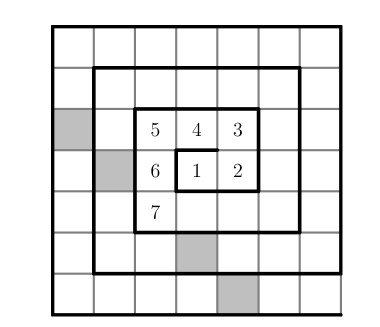
The numbers from 1 to 49 are arranged in a spiral pattern on a square grid, beginning at the center. The first few numbers have been entered into the grid below. Consider the four numbers that will appear in the shaded squares, on the same diagonal as the number 7 . How many of these four numbers are prime?
(A) 0
(B) 1
(C) 2
(D) 3
(E) 4

ANSWER :

(D) 3

PROBLEM 5 :

A lake contains 250 trout, along with a variety of other fish. When a marine biologist catches and releases a sample of 180 fish from the lake, 30 are identified as trout. Assume that the ratio of trout to the total number of fish is the same in both the sample and the lake. How many fish are there in the lake?
(A) 1250
(B) 1500
(C) 1750
(D) 1800
(E) 2000

ANSWER :

(B) 1500

PROBLEM 6 :

The digits $2,0,2$, and 3 are placed in the expression below, one digit per box. What is the maximum possible value of the expression?

(A) 0
(B) 8
(C) 9
(D) 16
(E) 18

ANSWER :

(C) 9

PROBLEM 7 :

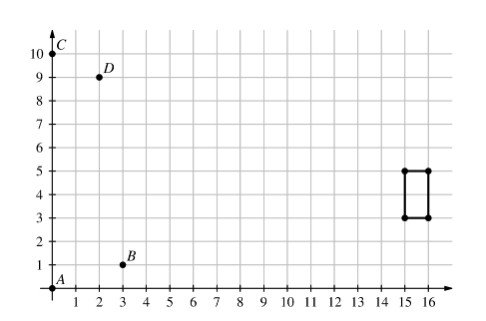
A rectangle, with sides parallel to the $x$-axis and $y$-axis, has opposite vertices located at $(15,3)$ and $(16,5)$. A line is drawn through points $A(0,0)$ and $B(3,1)$. Another line is drawn through points $C(0,10)$ and $D(2,9)$. How many points on the rectangle lie on at least one of the two lines?
(A) 0
(B) 1
(C) 2
(D) 3
(E) 4

ANSWER :

(B) 1

PROBLEM 8 :

Lola, Lolo, Tiya, and Tiyo participated in a ping pong tournament. Each player competed against each of the other three players exactly twice. Shown below are the win-loss records for the players. The numbers 1 and 0 represent a win or loss, respectively. For example, Lola won five matches and lost the fourth match. What was Tiyo's win-loss record?

(A) 000101
(B) 001001
(C) 010000
(D) 010101
(E) 011000

SOLUTION :

(A) 000101

PROBLEM 9 :

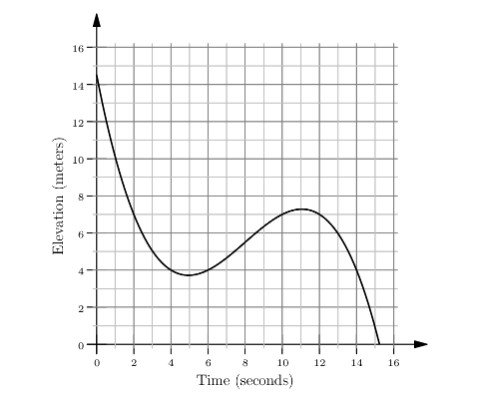
Malaika is skiing on a mountain. The graph below shows her elevation, in meters, above the base of the mountain as she skis along a trail. In total, how many seconds does she spend at an elevation between 4 and 7 meters?
(A) 6
(B) 8
(C) 10
(D) 12
(E) 14

ANSWER :

(B) 8

PROBLEM 10 :

Harold made a plum pie to take on a picnic. He was able to eat only $\frac{1}{4}$ of the pie, and he left the rest for his friends. A moose came by and ate $\frac{1}{3}$ of what Harold left behind. After that, a porcupine ate $\frac{1}{3}$ of what the moose left behind. How much of the original pie still remained after the porcupine left?
(A) $\frac{1}{12}$
(B) $\frac{1}{6}$
(C) $\frac{1}{4}$
(D) $\frac{1}{3}$
(E) $\frac{5}{12}$

ANSWER :

(D) $\frac{1}{3}$

PROBLEM 11 :

NASA's Perseverance Rover was launched on July 30 , 2020. After traveling $292,526,838$ miles, it landed on Mars in Jezero Crater about 6.5 months later. Which of the following is closest to the Rover's average interplanetary speed in miles per hour?
(A) 6,000
(B) 12,000
(C) 60,000
(D) 120,000
(E) 600,000

ANSWER :

(C) 60,000

PROBLEM 12 :

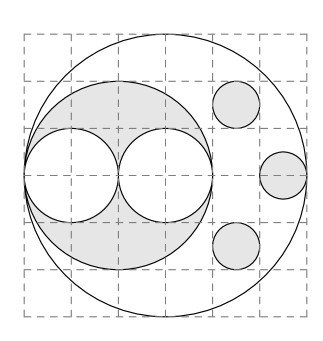
The figure below shows a large white circle with a number of smaller white and shaded circles in its interior. What fraction of the interior of the large white circle is shaded?
(A) $\frac{1}{4}$
(B) $\frac{11}{36}$
(C) $\frac{1}{3}$
(D) $\frac{19}{36}$
(E) $\frac{5}{9}$

ANSWER :

(B) $\frac{11}{36}$

PROBLEM 13 :

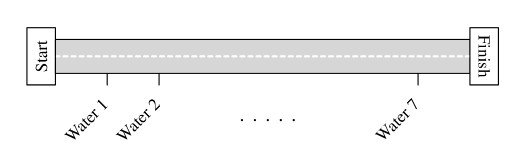
Along the route of a bicycle race, 7 water stations are evenly spaced between the start and finish lines, as shown in the figure below. There are also 2 repair stations evenly spaced between the start and finish lines. The 3 rd water station is located 2 miles after the 1 st repair station. How long is the race in miles?
(A) 8
(B) 16
(C) 24
(D) 48
(E) 96

ANSWER :

(D) 48

PROBLEM 14 :

Nicolas is planning to send a package to his friend Anton, who is a stamp collector. To pay for the postage, Nicolas would like to cover the package with a large number of stamps. Suppose he has a collection of 5 -cent, 10 -cent, and 25 -cent stamps, with exactly 20 of each type. What is the greatest number of stamps Nicolas can use to make exactly $\$ 7.10$ in postage? (Note: The amount $\$ 7.10$ corresponds to 7 dollars and 10 cents. One dollar is worth 100 cents.)
(A) 45
(B) 46
(C) 51
(D) 54
(E) 55

ANSWER :

(E) 55

PROBLEM 15 :

Viswam walks half a mile to get to school each day. His route consists of 10 city blocks of equal length and he takes 1 minute to walk each block. Today, after walking 5 blocks, Viswam discovers he has to make a detour, walking 3 blocks of equal length instead of 1 block to reach the next corner. From the time he starts his detour, at what speed, in mph, must he walk, in order to get to school at his usual time? Here's a hint… if you aren't correct, think about using conversions, maybe that's why you're wrong! -RyanZ4552

(A) 4
(B) 4.2
(C) 4.5
(D) 4.8
(E) 5

ANSWER :

(B) 4.2


PROBLEM 16 :

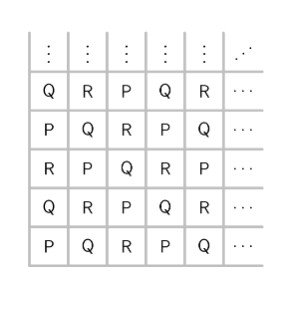
The letters $\mathrm{P}, \mathrm{Q}$, and R are entered into a $20 \times 20$ table according to the pattern shown below. How many Ps, Qs, and Rs will appear in the completed table?
(A) 132 Ps, $134 \mathrm{Qs}, 134 \mathrm{Rs}$
(B) $133 \mathrm{Ps}, 133 \mathrm{Qs}, 134 \mathrm{Rs}$
(C) $133 \mathrm{Ps}, 134 \mathrm{Qs}, 133 \mathrm{Rs}$
(D) $134 \mathrm{Ps}, 132 \mathrm{Qs}, 134 \mathrm{Rs}$
(E) $134 \mathrm{Ps}, 133 \mathrm{Qs}, 133 \mathrm{Rs}$

ANSWER :

(C) $133 \mathrm{Ps}, 134 \mathrm{Qs}, 133 \mathrm{Rs}$

PROBLEM 17 :

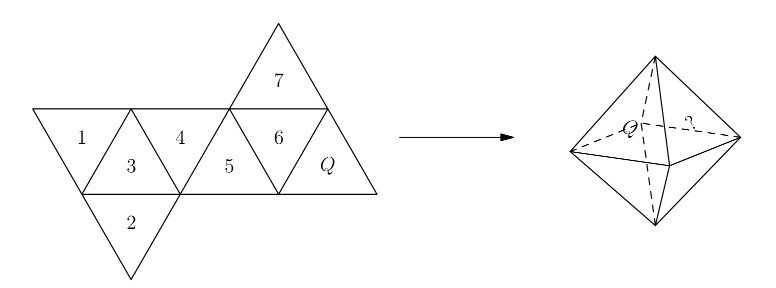
A regular octahedron has eight equilateral triangle faces with four faces meeting at each vertex. Jun will make the regular octahedron shown on the right by folding the piece of paper shown on the left. Which numbered face will end up to the right of $Q$ ?
(A) 1
(B) 2
(C) 3
(D) 4
(E) 5

ANSWER :

(A) 1

PROBLEM 18 :

Greta Grasshopper sits on a long line of lily pads in a pond. From any lily pad, Greta can jump 5 pads to the right or 3 pads to the left. What is the fewest number of jumps Greta must make to reach the lily pad located 2023 pads to the right of her starting position?
(A) 405
(B) 407
(C) 409
(D) 411
(E) 413

ANSWER :

(D) 411

PROBLEM 19 :

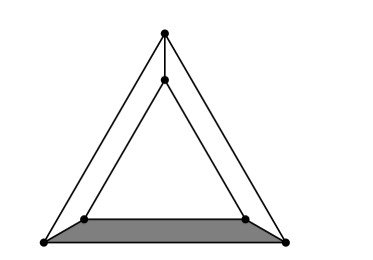
An equilateral triangle is placed inside a larger equilateral triangle so that the region between them can be divided into three congruent trapezoids, as shown below. The side length of the inner triangle is $\frac{2}{3}$ the side length of the larger triangle. What is the ratio of the area of one trapezoid to the area of the inner triangle?
(A) $1: 3$
(B) $3: 8$
(C) $5: 12$
(D) $7: 16$
(E) $4: 9$

ANSWER :

(C) $5: 12$

PROBLEM 20 :

Two integers are inserted into the list $3,3,8,11,28$ to double its range. The mode and median remain unchanged. What is the maximum possible sum of the two additional numbers?
(A) 56
(B) 57
(C) 58
(D) 60
(E) 61

ANSWER :

(D) 60

PROBLEM 21 :

Alina writes the numbers $1,2, \ldots, 9$ on separate cards, one number per card. She wishes to divide the cards into 3 groups of 3 cards so that the sum of the numbers in each group will be the same. In how many ways can this be done?
(A) 0
(B) 1
(C) 2
(D) 3
(E) 4

ANSWER :

(C) 2

PROBLEM 22 :

In a sequence of positive integers, each term after the second is the product of the previous two terms. The sixth term is 4000 . What is the first term?
(A) 1
(B) 2
(C) 4
(D) 5
(E) 10

ANSWER :

(D) 5

PROBLEM 23 :

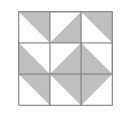
Each square in a $3 \times 3$ grid is randomly filled with one of the 4 gray and white tiles shown below on the right.
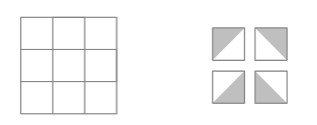
What is the probability that the tiling will contain a large gray diamond in one of the smaller $2 \times 2$ grids? Below is an example of such tiling.
(A) $\frac{1}{1024}$
(B) $\frac{1}{256}$
(C) $\frac{1}{64}$
(D) $\frac{1}{16}$
(E) $\frac{1}{4}$

ANSWER :

(C) $\frac{1}{64}$

PROBLEM 24 :

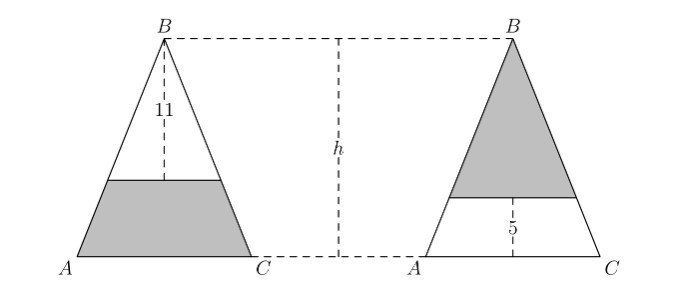
Isosceles $\triangle A B C$ has equal side lengths $A B$ and $B C$. In the figure below, segments are drawn parallel to $\overline{A C}$ so that the shaded portions of $\triangle A B C$ have the same area. The heights of the two unshaded portions are 11 and 5 units, respectively. What is the height of $h$ of $\triangle A B C$ ? (Diagram not drawn to scale.)
(A) 14.6
(B) 14.8
(C) 15
(D) 15.2
(E) 15.4

ANSWER :

(A) 14.6

PROBLEM 25 :

Fifteen integers $a_1, a_2, a_3, \ldots, a_{15}$ are arranged in order on a number line. The integers are equally spaced and have the property that

$$
1 \leq a_1 \leq 10,13 \leq a_2 \leq 20, \text { and } 241 \leq a_{15} \leq 250 .
$$

What is the sum of digits of $a_{14}$ ?
(A) 8
(B) 9
(C) 10
(D) 11
(E) 12

SOLUTION :

(A) 8

8 Cheenta students cracked the Regional Math Olympiad 2025 

In 2025, 8 students from Cheenta Academy cracked the prestigious Regional Math Olympiad. In this post, we will share some of their success stories and learning strategies.

The Regional Mathematics Olympiad (RMO) and the Indian National Mathematics Olympiad (INMO) are two most important mathematics contests in India.These two contests are for the students who are below 20 years of age.
These contests help find students with strong mathematical talent. INMO is the higher stage after RMO. It recognises the best problem solvers in the country.

In RMO the top performers may get chances for further training.They may also get opportunities to represent India in international competitions like the International Mathematical Olympiad (IMO). 

Achieving success in the Regional Mathematics Olympiad (RMO) and aiming for the Indian National Mathematics Olympiad (INMO) is a remarkable feat, requiring dedication, strategic preparation, and a strong foundation in mathematical problem-solving.

In this post, we share RMO success stories of Ayan kalra & Adhiraj Singh Anand. They performed excellently in RMO. Through their experiences, we learn about their journey, study methods, and useful tips for students who are preparing for RMO and INMO. 

IOQM 2025 Questions, Answer Key, Solutions

Answer Key

Answer 1
40
Answer 2
17
Answer 3
18
Answer 4
5
Answer 5
36
Answer 6
18
Answer 7
576
Answer 8
44
Answer 9
28
Answer 10
15
Answer 11
80
Answer 12
38
Answer 13
13
Answer 14
11
Answer 15
75
Answer 16
8
Answer 17
8
Answer 18
1
Answer 19
72
Answer 20
42
Answer 21
80
Answer 22
7
Answer 23
19
Answer 24
66
Answer 25
9
Answer 26
6
Answer 27
37
Answer 28
12
Answer 29
33
Answer 30
97

Problem 1

If $60 \%$ of a number $x$ is 40 , then what is $x \%$ of 60 ?

Problem 2

Find the number of positive integers $n$ less than or equal to 100 , which are divisible by 3 but are not divisible by 2.

Problem 3

The area of an integer-sided rectangle is 20 . What is the minimum possible value of its perimeter?

Problem 4

How many isosceles integer-sided triangles are there with perimeter 23?

Problem 5

How many 3 -digit numbers $a b c$ in base 10 are there with $a \neq 0$ and $c=a+b$ ?

Problem 6

The height and the base radius of a closed right circular cylinder are positive integers and its total surface area is numerically equal to its volume. If its volume is $k \pi$ where $k$ is a positive integer, what is the smallest possible value of $k$ ?

Problem 7

A quadrilateral has four vertices $A, B, C, D$. We want to colour each vertex in one of the four colours red, blue, green or yellow, so that every side of the quadrilateral and the diagonal $A C$ have end points of different colours. In how many ways can we do this?

Problem 8

The sum of two real numbers is a positive integer $n$ and the sum of their squares is $n+1012$. Find the maximum possible value of $n$.

Problem 9

Four sides and a diagonal of a quadrilateral are of lengths $10, 20, 28, 50, 75$, not necessarily in that order. Which amongst them is the only possible length of the diagonal?

Problem 10

The age of a person (in years) in 2025 is a perfect square. His age (in years) was also a perfect square in 2012. His age (in years) will be a perfect cube $m$ years after 2025. Determine the smallest value of $m .=15$

Problem 11

There are six coupons numbered 1 to 6 and six envelopes, also numbered 1 to 6 . The first two coupons are placed together in any one envelope. Similarly, the third and the fourth are placed together in a different envelope, and the last two are placed together in yet another different envelope. How many ways can this be done if no coupon is placed in the envelope having the same number as the coupon?

Problem 12

Consider five-digit positive integers of the form $\overline{a b c a b}$ that are divisible by the two digit number $a b$ but not divisible by 13 . What is the largest possible sum of the digits of such a number?

Problem 13

A function $f$ is defined on the set of integers such that for any two integers $m$ and $n$,

$$
f(m n+1)=f(m) f(n)-f(n)-m+2
$$

holds and $f(0)=1$. Determine the largest positive integer $N$ such that $\sum_{k=1}^N f(k)<100$ .

Problem 14

Consider a fraction $\frac{a}{b} \neq \frac{3}{4}$, where $a, b$ are positive integers with $\operatorname{gcd}(a, b)=1$ and $b \leq 15$. If this fraction is chosen closest to $\frac{3}{4}$ amongst all such fractions, then what is the value of $a+b$ ?

Problem 15

Three sides of a quadrilateral are $a=4 \sqrt{3}, b=9$ and $c=\sqrt{3}$. The sides $a$ and $b$ enclose an angle of $30^{\circ}$, and the sides $b$ and $c$ enclose an angle of $90^{\circ}$. If the acute angle between the diagonals is $x^{\circ}$, what is the value of $x$ ?

Problem 16

$f(x)$ and $g(x)$ be two polynomials of degree 2 such that

$$
\frac{f(-2)}{g(-2)}=\frac{f(3)}{g(3)}=4
$$

If $g(5)=2, f(7)=12, g(7)=-6$, what is the value of $f(5)$ ?

Problem 17

The triangle $A B C, \angle B=90^{\circ}, A B=1$ and $B C=2$. On the side $B C$ there are two points $D$ and $E$ such that $E$ lies between $C$ and $D$ and $D E F G$ is a square, where $F$ lies on $A C$ and $G$ lies on the circle through $B$ with centre $A$. If the area of $D E F G$ is $\frac{m}{n}$ where $m$ and $n$ are positive integers with $\operatorname{gcd}(m, n)=1$, what is the value of $m+n$ ?

Problem 18

$M T A I$ is a parallelogram of area $\frac{40}{41}$ square units such that $M I=1 / M T$. If $d$ is the least possible length of the diagonal $M A$, and $d^2=\frac{a}{b}$, where $a, b$ are positive integers with $\operatorname{gcd}(a, b)=1$, find $|a-b|$.

Problem 19

Let $N$ be the number of nine-digit integers that can be obtained by permuting the digits of 223334444 and which have at least one 3 to the right of the right-most occurrence of 4 . What is the remainder when $N$ is divided by $100$?

Problem 20

Let $f$ be the function defined by

$$
f(n)=\text { remainder when } n^n \text { is divided by } 7,
$$

for all positive integers $n$. Find the smallest positive integer $T$ such that $f(n+T)=f(n)$ for all positive integers $n$.

Problem 21

Let $P(x)=x^{2025}, Q(x)=x^4+x^3+2 x^2+x+1$. Let $R(x)$ be the polynomial remainder when the polynomial $P(x)$ is divided by the polynomial $Q(x)$. Find $R(3)$.

Problem 22

Let $A B C D$ be a rectangle and let $M, N$ be points lying on sides $A B$ and $B C$, respectively. Assume that $M C= C D$ and $M D=M N$, and that points $C, D, M, N$ lic on a circle. If $(A B / B C)^2=m / n$ where $m$ and $n$ are positive integers with $\operatorname{gcd}(m, n)=1$, what is the value of $m+n$ ?

Problem 23

Let \(A B C D\) be a rectangle and let \(M, N\) be points lying on sides \(A B\) and \(B C\), respectively. Assume that \(M C= C D\) and \(M D=M N\), and that points \(C, D, M, N\) lie on a circle. If \((A B / B C)^2=m / n\) where \(m\) and \(n\) are positive integers with \(\operatorname{gcd}(m, n)=1\), what is the value of \(m+n\) ?

Problem 24

There are $m$ blue marbles and $n$ red marbles on a table. Armaan and Babita play a game by taking turns. In each turn the player has to pick a marble of the colour of his/her choice. Armaan starts first, and the player who picks the last red marble wins. For how many choices of $(m, n)$ with $1 \leq m, n \leq 11$ can Armaan force a win?

Problem 25

For some real numbers $m, n$ and a positive integer $a$, the list $(a+1) n^2, m^2, a(n+1)^2$ consists of three consecutive integers written in increasing order. What is the largest possible value of $m^2$ ?

Problem 26

Let $S$ be a circle of radius 10 with centre $O$. Suppose $S_1$ and $S_2$ are two circles which touch $S$ internally and intersect each other at two distinct points $A$ and $B$. If $\angle O A B=90^{\circ}$ what is the sum of the radii of $S_1$ and $S_2$ ?

Solution

Problem 27

A regular polygon with $n \geq 5$ vertices is said to be colourful if it is possible to colour the vertices using at most 6 colours such that each vertex is coloured with exactly one colour, and such that any 5 consecutive vertices have different colours. Find the largest number $n$ for which a regular polygon with $n$ vertices is not colourful.

Solution

Problem 28

Find the number of ordered triples $(a, b, c)$ of positive integers such that $1 \leq a, b, c \leq 50$ which satisfy the relation

$$
\frac{\operatorname{lcm}(a, c)+\operatorname{lcm}(b, c)}{a+b}=\frac{26 c}{27}
$$

Here, by $\operatorname{lcm}(x, y)$ we mean the LCM, that is, least common multiple of $x$ and $y$.

Problem 29

Consider a sequence of real numbers of finite length. Consecutive four term averages of this sequence are strictly increasing, but consecutive seven term averages are strictly decreasing. What is the maximum possible length of such a sequence?

Problem 30

Assume $a$ is a positive integer which is not a perfect square. Let $x, y$ be non-negative integers such that $\sqrt{x-\sqrt{x+a}}=\sqrt{a}-y$. What is the largest possible value of $a$ such that $a<100 ?$

NMTC - Screening Test – Ramanujan Contest 2025

PART – A

Problem 1

If four different positive integers \(m, n, p, q\) satisfy the equation
\(7-m)(7-n)(7-p)(7-q)=4\)

then the sum \(m+n+p+q\) is equal to

A. 10
B. 24
C. 28
D. 36

Problem 2

A three member sequence \(a, b, c\) is said to be a up-down sequence if \(ac\). For example \(1,3,2\) is a up-down sequence. The sequence 1342 contains three up-down sequences: \((1,3,2),(1,4,2)\) and \((3,4,2)\). How many up-down sequences are contained in the sequence 132597684?

A. 32
B. 34
C. 36
D. 38

Problem 3

For a positive integer \(n\), let \(P(n)\) denote the product of the digits of \(n\) when \(n\) is written in base 10. For example, \(P(123)=6\) and \(P(788)=448\). If \(N\) is the smallest positive integer such that \(P(N)>1000\), and \(N\) is written as \(100 x+y\) where \(x, y\) are integers with \(0 \leq x, y<100\), then \(x+y\) equals

A. 112
B. 114
C. 116
D. 118

Problem 4

The sum of 2025 consecutive odd integers is \(2025^{2025}\). The largest of these off numbers is

A. \(2025^{2024}+2024\)
B. \(2025^{2024}-2024\)
C. \(2025^{2023}+2024\)
D. \(2025^{2023}-2024\)

Problem 5

\(A B C\) is an equilateral triangle with side length 6. \(P, Q, R\) are points on the sides \(A B, B C, C A\) respectively such that \(A P=B Q=C R=1\). The ratio of the area of the triangle \(A B C\) to the area of the triangle \(P Q R\) is

A. \(36: 25\)
B. \(12: 5\)
C. \(6: 5\)
D. \(12: 7\)

Problem 6

How many three-digit positive integers are there if the digits are the side lengths of some isosceles or equilateral triangle?

A. 45
B. 81
C. 165
D. 216

Problem 7

All the positive integers whose sum of digits is 7 are written in the increasing order. The first few are \(7,16,25,34,43, \ldots\). What is the 125 th number in this list?

A. 7000
B. 10006
C. 10024
D. 10042

Problem 8

The bisectors of the angles \(A, B, C\) of the triangle \(A B C\) meet the circum circle of the triangle again at the points \(D, E, F\) respectively. What is the value of
\(\frac{A D \cos \frac{A}{2}+B E \cos \frac{B}{2}+C F \cos \frac{C}{2}}{\sin A+\sin B+\sin C}\)

if the circum radius of \(A B C\) is 1 ?

A. 2
B. 4
C. 6
D. 8

Problem 9

For a real number \(x\), let \(\lfloor x\rfloor\) be the greatest integer less than or equal to \(x\). For example, \([1.7]=1\) and \([\sqrt{2}]=1\). Let \(N=\left\lfloor\frac{10^{93}}{10^{31}+3}\right\rfloor\). Find the remainder when \(N\) is divided by 100.

A. 1
B. 8
C. 22
D. 31

Problem 10

A point \((x, y)\) in the plane is called a lattice point if both its coordinates \(x, y\) are integers. The number of lattice points that lie on the circle with center at \((199,0)\) and radius 199 is

A. 4
B. 8
C. 12
D. 16

Problem 11

The sum of all real numbers \(p\) such that the equation

\(5 x^3-5(p+1) x^2+(71 p-1) x-(66 p-1)=0\)

has all its three roots positive integers.

A. 70
B. 74
C. 76
D. 88

Problem 12

If \(1-x+x^2-x^3+\cdots+x^{20}\) is rewritten in the form

\(a_0+a_1(x-4)+a_2(x-4)^2+\cdots+a_{20}(x-4)^{20}\), where \(a_0, a_1, \ldots, a_{20}\)

are all real numbers, the value of \(a_0+a_1+a_2+\cdots+a_{20}\) is

A. \(\frac{5^{21}+1}{6}\)
B. \(\frac{5^{21}-1}{6}\)
C. \(\frac{5^{20}+1}{6}\)
D. \(\frac{5^{20}-1}{6}\)

Problem 13

For a positive integer \(n\), a distinct 3-partition of \(n\) is a triple \( (a, b, c) \) of positive integers such that \(a<b<c\) and \(a+b+c=n\). For example, \((1,2,4)\) is a distinct 3 -partition of 7 . The number of distinct 3-partitions of 15 is

A. 10
B. 12
C. 13
D. 15

Problem 14

If \(m\) and \(n\) are positive integers such that \(30 m n-6 m-5 n=2019\), what is the value of \(30 m n-5 m-6 n ?\)

A. 1900
B. 2020
C. 1939
D. Can not be found from the given information

Problem 15

A class of 100 students takes a six question exam. For the first question, a student receives 1 point for answering correctly, -1 point for answering incorrectly or not answering at all. For the second question, the student receives 2 points for answering correctly and -2 points for answering incorrectly or not answering at all and so on. What is the minimum number of students having the same scores?

A. 6
B. 5
C. 0
D. Can not be found from the given information

Part B

Problem 16

The value of

\(\frac{1}{2}+\frac{1^2+2^2}{6}+\frac{1^2+2^2+3^2}{12}+\frac{1^2+2^2+3^2+4^2}{20}+\cdots+\frac{1^2+2^2+\cdots+60^2}{3660}\)

is ________ .

Problem 17

The largest prime divisor of \(3^{21}+1\) is _________

Problem 18

A circular garden divided into 10 equal sectors needs to be planted with flower plants that yield flowers of 3 different colors, in such a way that no two adjacent sectors will have flowers of the same color. The number of ways in which this can be done is _________

Problem 19

We call an integer special if it is positive and we do not need to use the digit 0 to write it down in base 10. For example, 2126 is special whereas 2025 is not. The first 10 special numbers are \(1,2,3,4,5,6,7,8,9,11\). The 2025th special number is _________ .

Problem 20

Let \(a, b, c\) be non zero real numbers such that \(a+b+c=0\) and \(a^3+b^3+c^3=a^5+b^5+c^5\). The value of \(\frac{5}{a^2+b^2+c^2}\) is _________ .

Problem 21

The equation \(x^3-\frac{1}{x}=4\) has two real roots \(\alpha, \beta\). The value of \((\alpha+\beta)^2\) is _________

Problem 22

If \(x, y, z\) are positive integers satisfying the system of equations

\(\begin{aligned} x y+y z+z x & =2024 \ x y z+x+y+z & =2025\end{aligned}\)

find \(\max (x, y, z)\) . ________

Problem 23

If \(p, q, r\) are primes such that \(p q+q r+r p=p q r-2025\), find \(p+q+r .\). __________

Problem 24

A cyclic quadrilateral has side lengths \(3,5,5,8\) in this order. If \(R\) is its circumradius, find \(3 R^2\). __________

Problem 25

Consider the sequence of numbers \(24,2534,253534,25353534, \ldots\). Let \(N\) be the first number in the sequence that is divisible by 99 . Find the number of digits in the base 10 representation of \(N\). _____________

Problem 26

An isosceles triangle has integer sides and has perimeter 16. Find the largest possible area of the triangle. ____________

Problem 27

Suppose that \(a, b, c\) are positive real numbers such that \(a^2+b^2=c^2\) and \(a b=c\). Find the value of

\(\frac{(a+b+c)(a-b+c)(a+b-c)(a-b-c)}{c^2}\) ______________

Problem 28

In a right angled triangle with integer sides, the radius of the inscribed circle is 12. Compute the largest possible length of the hypotenuse. _______________

Problem 29

Points \(C\) and \(D\) lie on opposite sides of the line \(A B\). Let \(M\) and \(N\) be the centroids of the triangles \(A B C\) and \(A B D\) respectively. If \(A B=25, B C=24, A C=7, A D=20\) and \(B D=15\), find \(M N\). __________

Problem 30

Let \(a_0=1\) and for \(n \geq 1\), define \(a_n=3 a_{n-1}+1\). Find the remainder when \(a_{11}\) is divided by 97. ___________

NMTC - Screening Test – KAPREKAR Contest - 2025

Part 1

Problem 1

\(A B\) is a straight road of length 400 metres. From \(A\), Samrud runs at a speed of \(6 \mathrm{~m} / \mathrm{s}\) towards \(B\) and at the same time Saket starts from \(B\) and runs towards \(A\) at a speed of \(5 \mathrm{~m} / \mathrm{s}\). After reaching their destinations, they return with the same speeds. They repeat it again and again. How many times do they meet each other in 15 minutes?

A) 25
B) 23
C) 24
D) 20

Problem 2

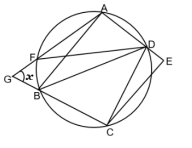
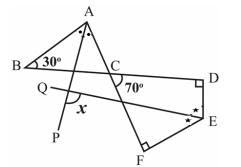
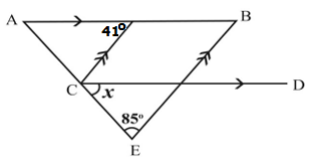
In the adjoining figure, the measure of the angle \(x\) is

A) \(84^{\circ}\)
B) \(44^{\circ}\)
C) \(64^{\circ}\)
D) \(54^{\circ}\)

Problem 3

The value of \(x\) which satisfies \(\frac{1}{x+a}+\frac{1}{x+b}=\frac{1}{x+a+b}+\frac{1}{x}\) is

A) \(\frac{a+b}{2}\)
B) \(\frac{a-b}{2}\)
C) \(\frac{b-a}{2}\)
D) \(\frac{-(a+b)}{2}\)

Problem 4

Two sides of an isosceles triangle are 23 cm and 17 cm respectively. The perimeter of the triangle (in cm ) is

A) 63
В) 57
C) 63 or 57
D) 40

Problem 5

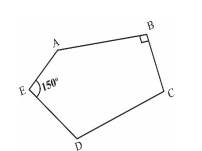
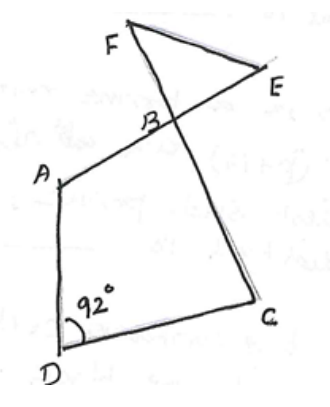
\(A B C D E\) is a pentagon with \(\angle B=90^{\circ}\) and \(\angle E=150^{\circ}\).
If \(\angle C+\angle D=180^{\circ}\) and \(\angle A+\angle D=180^{\circ}\), then the external angle \(\angle D\) is

A) \(120^{\circ}\)
B) \(110^{\circ}\)
C) \(105^{\circ}\)
D) \(115^{\circ}\)

Problem 6

The unit's digit of the product \(3^{2025} \times 7^{2024}\) is

A) 1
B) 2
C) 3
D) 6

Problem 7

The smallest positive integer \(n\) for which \(18900 \times n\) is a perfect cube is

A) 1
B) 2
C) 3
D) 6

Problem 8

Two numbers \(a\) and \(b\) are respectively \(20 \%\) and \(50 \%\) more of a third number \(c\). The percentage of \(a\) to \(b\) is

A) 120 %
В) 80 %
C) 75 %
D) 110 %

Problem 9

If \(a+b=2, \frac{1}{a}+\frac{1}{b}=18\), then \(a^3+b^3\) lies between

A) 7 and 8
B) 6 and 7
C) 8 and 9
D) 5 and 6

Problem 10

If \(\sqrt{12+\sqrt[3]{x}}=\frac{7}{2}\) and \(x=\frac{p}{q^{\prime}}, p, \mathrm{q}\) are natural numbers with G.C.D. \((p, q)=1\), then \(p+q\) is

A) 65
В) 56
C) 45
D) 54

Problem 11

The smallest number of 4-digits leaving a remainder 1 when divided by 2 or

A) 5 as its unit digit
B) Only one zero as one of the digits
C) Exactly two zeroes as its digits
D) 7 as its unit digit

Problem 12

If \(a: b=2: 3, b: c=4: 5\) and \(a+c=736\), then the value of \(b\) is

A) 392
B) 378
C) 384
D) 386

Problem 13

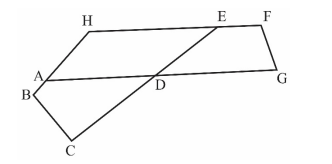
In the given figure,

\[
\begin{aligned}
& \angle B=110^{\circ} ; \quad \angle C=80^{\circ} ; \
& \angle F=120^{\circ} ; \quad \angle A D C=30^{\circ} \
& 2 \angle D G F=\angle D E F .
\end{aligned}
\]

The measure of \(\angle B H F\) is

A) \(115^{\circ}\)
B) \(135^{\circ}\)
C) \(100^{\circ}\)
D) \(130^{\circ}\)

Problem 14

If \(\frac{1}{b+c}+\frac{1}{c+a}=\frac{2}{a+b}\), then the value of \(\frac{a^2+b^2}{c^2}\) is

A) 2
B) 1
C) 1 / 2
D) 3

Problem 15

If 3 men or 4 women can do a job in 43 days, the number of days the same job is done by 7 men and 5 women is

A) 12
B) 10
C) 11
D) 13

Part B

Problem 16

The expression \(49(a+b)^2-46(a-b)^2\) is factorized into \((l a+m b)(n a+p b)\), then the numerical value of \((l+m+n+p)\) is _________________

Problem 17

The integer part of the solution of the equation in \(x\), \(\frac{1}{3}(x-3)-\frac{1}{4}(x-8)=\frac{1}{5}(x-5)\) is ______________

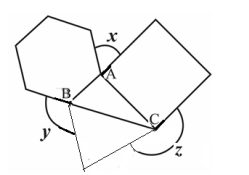
Problem 18

In the adjoining figure, \(A B C\) is a triangle in which \(\angle B A C=100^{\circ}\), \(\angle A C B=30^{\circ}\). An equilateral triangle, a square and a regular hexagon are drawn as shown in the figure. The measure (in degrees) of \((x+y+z)\) is ____________

Problem 19

The mean of 5 numbers is 105 . The first number is \(\frac{2}{5}\) times the sum of the other 4 numbers. The first number is ____________

Problem 20

\(P Q R S\) is a square. The sides \(P Q\) and \(R S\) are increased by 30 % each and the sides \(Q R\) and \(P S\) are increased by 20 % each. The area of the quadrilateral thus obtained exceeds the area of the square by ___________ %.

Problem 21

If \(x^2+(2+\sqrt{3}) x-1=0\) and \(x^2+\frac{1}{x^2}=a+b \sqrt{c}\), then \((a+b+c)\) is _____________

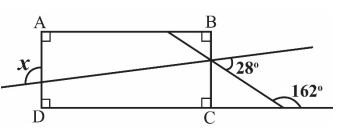
Problem 22

In the given figure, \(A B C D\) is a rectangle.

The measure of angle \(x\) is _________________ degrees.

Problem 23

The sum of all positive integers \(m, n\) which satisfy \(m^2+2 m n+n=44\) is __________________

Problem 24

Given \(a=2025, b=2024\), the numerical value of \(\left(a+b-\frac{4 a b}{a+b}\right) \div\left(\frac{a}{a+b}-\frac{b}{b-a}+\frac{2 a b}{b^2-a^2}\right)\) is _________________

Problem 25

In the sequence \(0,7,26,63,124, \ldots \ldots \ldots\) the \(6^{\text {th }}\) term is _____________

Problem 26

\[
\text { If } A=\sqrt{281+\sqrt{53+\sqrt{112+\sqrt{81}}}}, B=\sqrt{92+\sqrt{55+\sqrt{75+\sqrt{36}}}}
\]

then \(A-B\) is _______________________

Problem 27

The average of the numbers \(a, b, c, d\) is \((b+4)\). The average of pairs \((a, b),(b, c)\) and \((c, a)\) are respectively 16,26 and 25 . Then the average of \(d\) and 67 is ___________________

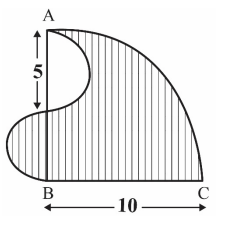
Problem 28

\(A B C\) is a quadrant of a circle of radius 10 cm . Two semicircles are drawn as in the figure.

The area of the shaded portion is \(k \pi\), where \(k\) is a positive integer.

The value of \(k\) is __________________

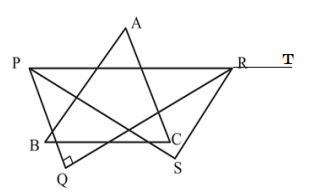
Problem 29

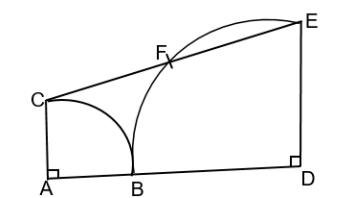
In the figure, \(A B C\) and \(P Q R\) are two triangles such that \(\angle \mathrm{A}: \angle \mathrm{B}: \angle \mathrm{C}=5: 6: 7\) and \(\angle P R Q=\angle B\). \(P S\) makes an angle \(\frac{\angle P}{3}\) with \(P Q\) and \(R S\) makes an angle \(\frac{\angle S R T}{5}\) with \(R Q\). Then the measure of \(\angle S\) is ______________________

Problem 30

In a two-digit positive integer, the units digit is one less than the tens digit. The product of one less than the units digit and one more than the tens digit is 40. The number of such two-digit integers is _______________

BHASKARA Contest - NMTC - Screening Test – 2025

Problem 1

The greatest 4 -digit number such that when divided by 16,24 and 36 leaves 4 as remainder in each case is
А) 9994
B) 9940
C) 9094
D) 9904

Problem 2

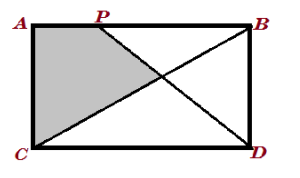
\(A B C D\) is a rectangle whose length \(A B\) is 20 units and breadth is 10 units. Also, given \(A P=8\) units. The area of the shaded region is \(\frac{p}{q}\) sq unit, where \(p, q\) are natural numbers with no common factors other than 1 . The value of \(p+q\) is
A) 167
В) 147
C) 157
D) 137

Problem 3

The solution of \(\frac{\sqrt[7]{12+x}}{x}+\frac{\sqrt[7]{12+x}}{12}=\frac{64}{3}(\sqrt[7]{x})\) is of the form \(\frac{a}{b}\) where \(a, b\) are natural numbers with \(\operatorname{GCD}(a, b)=1\); then \((b-a)\) is equal to
A) 115
B) 114
C) 113
D) 125

Problem 4

The value of \((52+6 \sqrt{43})^{3 / 2}-(52-6 \sqrt{43})^{3 / 2}\) is
A) 858
В) 918
C) 758
D) 828

Problem 5

In the adjoining figure \(\angle D C E=10^{\circ}\), \(\angle C E D=98^{\circ}, \angle B D F=28^{\circ}\)
Then the measure of angle \(x\) is
A) \(72^{\circ}\)
B) \(76^{\circ}\)
C) \(44^{\circ}\)
D) \(82^{\circ}\)

Problem 6

\(A B C\) is a right triangle in which \(\angle \mathrm{B}=90^{\circ}\). The inradius of the triangle is \(r\) and the circumradius of the triangle is R . If \(\mathrm{R}: r=5: 2\), then the value of \(\cot ^2 \frac{A}{2}+\cot ^2 \frac{C}{2}\) is
A) \(\frac{25}{4}\)
B) 17
C) 13
D) 14

Problem 7

If \((\alpha, \beta)\) and \((\gamma, \beta)\) are the roots of the simultaneous equations:

\[
|x-1|+|y-5|=1 ; \quad y=5+|x-1|
\]

then the value of \(\alpha+\beta+\gamma\) is
A) \(\frac{15}{2}\)
B) \(\frac{17}{2}\)
C) \(\frac{14}{3}\)
D) \(\frac{19}{2}\)

Problem 8

Three persons Ram, Ali and Peter were to be hired to paint a house. Ram and Ali can paint the whole house in 30 days, Ali and Peter in 40 days while Peter and Ram can do it in 60 days. If all of them were hired together, in how many days can they all three complete $50 \%$ of the work?
A) $24 \frac{1}{3}$
B) $25 \frac{1}{2}$
C) $26 \frac{1}{3}$
D) $26 \frac{2}{3}$

Problem 9

$\frac{\sqrt{a+3 b}+\sqrt{a-3 b}}{\sqrt{a+3 b}-\sqrt{a-3 b}}=x$, then the value of $\frac{3 b x^2+3 b}{a x}$ is
A) 1
B) 2
C) 3
D) 4

Problem 10

The number of integral solutions of the inequation $\left|\frac{2}{x-13}\right|>\frac{8}{9}$ is
A) 1
B) 2
C) 3
D) 4

Problem 11

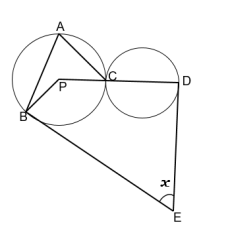
In the adjoining figure, $P$ is the centre of the first circle, which touches the other circle in C . PCD is along the diameter of the second circle. $\angle \mathrm{PBA}=20^{\circ}$ and $\angle \mathrm{PCA}=30^{\circ}$.

The tangents at B and D meet at E . The measure of the angle $x$ is
A) $75^{\circ}$
B) $80^{\circ}$
C) $70^{\circ}$
D) $85^{\circ}$

Problem 12

If $\alpha, \beta$ are the values of $x$ satisfying the equation $3 \sqrt{\log _2 x}-\log _2 8 x+1=0$, where $\alpha<\beta$, then the value of $\left(\frac{\beta}{\alpha}\right)$ is
A) 2
B) 4
C) 6
D) 8

Problem 13

When a natural number is divided by 11 , the remainder is 4 . When the square of this number is divided by 11 , the remainder is
A) 4
B) 5
C) 7
D) 9

Problem 14

The unit's digit of a 2-digit number is twice the ten's digit. When the number is multiplied by the sum of the digits the result is 144 . For another 2-digit number, the ten's digit is twice the unit's digit and the product of the number with the sum of its digits is 567 . Then the sum of the two 2 -digit numbers is
A) 68
В) 86
C) 98
D) 87

Problem 15

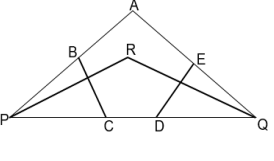
$A B C D E$ is a pentagon. $\angle A E D=126^{\circ}, \angle B A E=\angle C D E$ and $\angle A B C$ is $4^{\circ}$ less than $\angle B A E$ and $\angle B C D$ is $6^{\circ}$ less than $\angle C D E . P R, Q R$ the bisectors of $\angle B P C, \angle E Q D$ respectively, meet at $R$. Points $\mathrm{P}, \mathrm{C}, \mathrm{D}, \mathrm{Q}$ are collinear. Then measure of $\angle P R Q$ is
A) $151^{\circ}$
B) $137^{\circ}$
C) $141^{\circ}$
D) $143^{\circ}$

Problem 16

$a, b, c$ are real numbers such that $b-c=8$ and $b c+a^2+16=0$.
The numerical value of $a^{2025}+b^{2025}+c^{2025}$ is $\rule{2cm}{0.2mm}$.

Problem 17

Given $f(x)=\frac{2025 x}{x+1}$ where $x \neq-1$. Then the value of $x$ for which $f(f(x))=(2025)^2$ is $\rule{2cm}{0.2mm}$.

Problem 18

The sum of all the roots of the equation $\sqrt[3]{16-x^3}=4-x$ is $\rule{2cm}{0.2mm}$.

Problem 19

In the adjoining figure, two
Quadrants are touching at $B$.
$C E$ is joined by a straight line, whose mid-point is $F$.

The measure of $\angle C E D$ is $\rule{2cm}{0.2mm}$.

Problem 20

The value of $k$ for which the equation $x^3-6 x^2+11 x+(6-k)=0$ has exactly three positive integer solutions is $\rule{2cm}{0.2mm}$.

Problem 21

The number of 3-digit numbers of the form $a b 5$ (where $a, b$ are digits) which are divisible by 9 is $\rule{2cm}{0.2mm}$.

Problem 22

If $a=\sqrt{(2025)^3-(2023)^3}$, the value of $\sqrt{\frac{a^2-2}{6}}$ is $\rule{2cm}{0.2mm}$.

Problem 23

In a math Olympiad examination, $12 \%$ of the students who appeared from a class did not solve any problem; $32 \%$ solved with some mistakes. The remaining 14 students solved the paper fully and correctly. The number of students in the class is $\rule{2cm}{0.2mm}$.

Problem 24

When $a=2025$, the numerical value of
$\left|2 a^3-3 a^2-2 a+1\right|-\left|2 a^3-3 a^2-3 a-2025\right|$ is $\rule{2cm}{0.2mm}$.

Problem 25

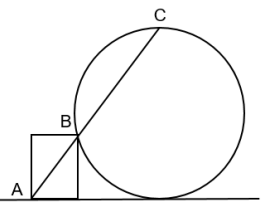
A circular hoop and a rectangular frame are standing on the level ground as shown. The diagonal $A B$ is extended to meet the circular hoop at the highest point $C$. If $A B=18 \mathrm{~cm}, B C=32 \mathrm{~cm}$, the radius of the hoop (in cm ) is $\rule{2cm}{0.2mm}$.

Problem 26

' $n$ ' is a natural number. The number of ' $n$ ' for which $\frac{16\left(n^2-n-1\right)^2}{2 n-1}$ is a natural number is $\rule{2cm}{0.2mm}$.

Problem 27

The number of solutions $(x, y)$ of the simultaneous equations $\log _4 x-\log _2 y=0, \quad x^2=8+2 y^2$ is $\rule{2cm}{0.2mm}$.

Problem 28

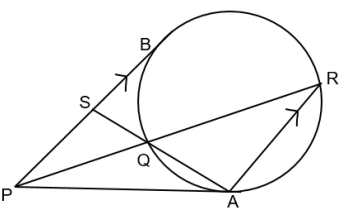
In the adjoining figure,
$P A, P B$ are tangents.
$A R$ is parallel to $P B$

$P Q=6 ; Q R=18 .$

Length $S B= \rule{2cm}{0.2mm}$.

Problem 29

A large watermelon weighs 20 kg with $98 \%$ of its weight being water. It is left outside in the sunshine for some time. Some water evaporated and the water content in the watermelon is now $95 \%$ of its weight in water. The reduced weight in kg is $\rule{2cm}{0.2mm}$.

Problem 30

In a geometric progression, the fourth term exceeds the third term by 24 and the sum of the second and third term is 6 . Then, the sum of the second, third and fourth terms is $\rule{2cm}{0.2mm}$.

NMTC - Screening Test – GAUSS Contest - 2025

Problem 1

The value of $\frac{9999+7777+5555}{8888+6666+4444}$ is
A) 1
B) $\frac{755}{448}$
C) $\frac{7}{6}$
D) $\frac{1}{6}$

Problem 2

The sum of three prime numbers is 30 . How many such sets of prime numbers are there?
A) 1
B) 2
C) 3
D) 0

Problem 3

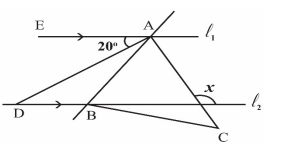
In the adjoining figure, lines $\ell_1, \ell_2$ are parallel lines. $A B C$ is an equilateral triangle.
$A D$ bisects $\angle E A B$.
Then $x=$ ?
A) $100^{\circ}$
B) $95^{\circ}$
C) $105^{\circ}$
D) $110^{\circ}$

Problem 4

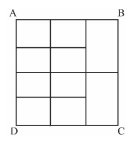
In the figure, $A B C D$ is a square. It consists of squares and rectangles of areas $1 \mathrm{~cm}^2$ and $2 \mathrm{~cm}^2$ as shown. The perimeter of the square $A B C D$ (in cm ) is
A) 17
B) 15
C) 16
D) 14

Problem 5

If $a\ast b = \frac{a+b}{a-b}$, then the value of $\frac{13 * 6}{5 * 2}$ is
A) $\frac{21}{4}$
B) $\frac{17}{3}$
C) $\frac{19}{39}$
D) $\frac{57}{49}$

Problem 6

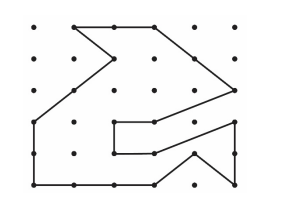
In the adjoining figure, the distance between any two adjacent dots is 1 cm . The area of the shaded region (in $\mathrm{cm}^2$ ) is
A) $\frac{31}{3}$
B) $\frac{31}{2}$
C) $\frac{33}{2}$
D) $\frac{35}{2}$

Problem 7

Three natural numbers $n_1, n_2, n_3$ are taken.
Let $n_{1<} n_{2<} n_3$ and $n_1+n_2+n_3=6$. The value of $n_3$ is
A) 1
B) 2
C) 3
D) 1 or 2 or 3

Problem 8

In the adjoining figure, AP and EQ are respectively the bisectors of $\angle \mathrm{BAC}$ and $\angle \mathrm{DEF}$. Then, the measure of angle $x$ is
A) $90^{\circ}$
B) $85^{\circ}$
C) $105^{\circ}$
D) $75^{\circ}$

Problem 9

The number of two-digit positive integers which have at least one 7 as a digit is
A) 17
B) 19
C) 9
D) 18

Problem 10

The fractions $\frac{1}{5}$ and $\frac{1}{3}$ are shown on the number line. In which position should $\frac{1}{4}$ be shown?

A) $p$
B) $q$
C) $r$
D) $s$

Problem 11

Samrud reads $\frac{1}{3}$ of a story book on the first day, $\frac{1}{2}$ of the remaining book on the second day and $\frac{\mathbf{1}}{\mathbf{4}}$ of the remaining book as on the end of the first day, on the third day and left with 23 pages unread. The number of pages of the book is
A) 138
В) 148
C) 128
D) 136

Problem 12

The product of four different natural numbers is 100 . What is the sum of the four numbers?
A) 20
B) 10
C) 12
D) 18

Problem 13

Peter starts from a point A in a playground and walks $100 m$ towards East. Then he walks 30 m towards North and then 70 m towards West and then finally 10 m North to reach the point B. The distance between A and B (in metres) is
A) 50
B) 42
C) 40
D) 30

Problem 14

In the adjoining figure $\angle \mathrm{DAB}$ is $8^{\circ}$ more than $\angle \mathrm{ADC}$; $\angle \mathrm{BCD}$ is $8^{\circ}$ less than $\angle \mathrm{ADC}$. $\angle \mathrm{FEB}$ is half of $\angle \mathrm{FBE}$. Then the measure of $\angle \mathrm{BFE}$ is
A) $54^{\circ}$
B) $52^{\circ}$
C) $49^{\circ}$
D) $50^{\circ}$

Problem 15

The fraction to be added to the fraction $\frac{1}{2+\frac{1}{3+\frac{1}{1+\frac{1}{4}}}}$ to get 1 is
A) $\frac{26}{43}$
В) $\frac{18}{43}$
C) $\frac{24}{43}$
D) $\frac{23}{43}$

Problem 16

Some amount of money is divided among A, B and C, so that for every ₹100 A has, B has ₹ 65 and c has ₹ 40. If the share of C is ₹ 4000, the total amount of money (in ₹) is $\rule{2cm}{0.2mm}$.

Problem 17

ABCDE is a pentagon. The angles $\mathrm{A}, \mathrm{B}, \mathrm{C}, \mathrm{D}, \mathrm{E}$ are in the ratio 8:9:12:15:10. The external bisector of B and the internal bisector of C meet at P . Then the measure of $\angle \mathrm{BPC}$ is $\rule{2cm}{0.2mm}$.

Problem 18

The least number, when lessened (decreased) by 5 , to be divisible by 36,48 , 21 , and 28 is $\rule{2cm}{0.2mm}$.

Problem 19

When $10 \frac{5}{6}$ is divided by 91 , we get a fraction $\frac{a}{b}$, where $a, b$ are natural numbers with no common factors other than 1 ; then $(b-a)$ is equal to $\rule{2cm}{0.2mm}$.

Problem 20

Let $p$ be the smallest prime number such that the numbers $(p+6),(p+8)$, $(p+12)$ and $(p+14)$ are also prime. Then the remainder when $p^2$ is divided by 4 is $\rule{2cm}{0.2mm}$.

Problem 21

A bag contains certain number of black and white balls, of which $60 \%$ are black. When 9 white balls are added to the bag, the ratio of the black balls to the white balls is $4: 3$. The number of white balls in the bag at the beginning is $\rule{2cm}{0.2mm}$.

Problem 22

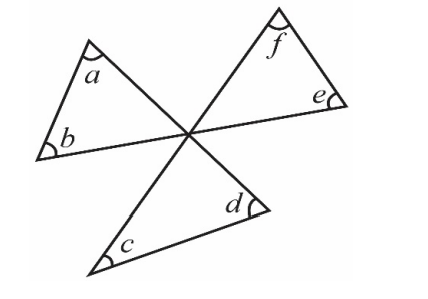
In the adjoining figure, the sum of the measures of the angles $a, b, c, d, e, f$ is $\rule{2cm}{0.2mm}$.

Problem 23

A basket contains apples, bananas, and oranges. The total number of apples and bananas is 88 . The total number of apples and oranges is 80 . The total number of bananas and oranges is 64 . Then the number of apples is $\rule{2cm}{0.2mm}$.

Problem 24

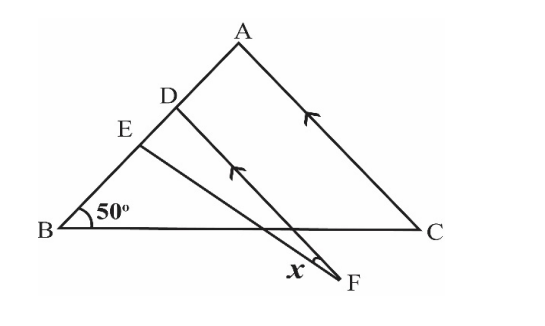
ABC is an isosceles triangle in which $\mathrm{AB}=\mathrm{AC}$ EDF is an isosceles triangle in which $\mathrm{EF}=\mathrm{DE}$. FD is parallel to AC . The degree measure of marked angle $x$ is $\rule{2cm}{0.2mm}$.

Problem 25

The length and breadth of a rectangle are both prime numbers, and its perimeter is 40 cm . Then the maximum possible area of the rectangle (in $\mathrm{cm}^2$ ) is $\rule{2cm}{0.2mm}$.

Exploring Number Theory: Understand Euclidean Algorithm with IMO 1959 Problem 1

Number Theory is one of the most fascinating and ancient branches of mathematics. In this post, we'll delve into a classic problem from the International Mathematical Olympiad (IMO) 1959, exploring fundamental concepts such as divisibility, greatest common divisors (gcd), and the Euclidean algorithm. This will serve as a strong foundation for understanding more advanced topics in Number Theory.

The Problem: Prove Irreducibility of a Fraction

The problem asks us to prove that the fraction:

$\frac{21 n+4}{14 n+3}$

is irreducible for every natural number $n$. In other words, we need to show that the greatest common divisor (gcd) of the numerator $21 n+4$ and the denominator $14 n+3$ is always 1, meaning these two terms share no common factors for any natural number $n$.

What Does "Irreducible" Mean?

A fraction is irreducible if its numerator and denominator share no common factors other than 1. For example, the fraction $\frac{10}{14}$ is reducible because both 10 and 14 share the factor 2. After dividing both by their gcd (2), we get $\frac{5}{7}$, which is the irreducible form of $\frac{10}{14}$.
In this problem, we're asked to show that no matter which $n$ is chosen, the fraction $\frac{21 n+4}{14 n+3}$ cannot be reduced, meaning the gcd of $21 n+4$ and $14 n+3$ is 1 for all $n$.

Watch the Video

Key Idea: GCD and the Euclidean Algorithm

To solve this, we can use the Euclidean algorithm, a systematic method for finding the gcd of two numbers by repeatedly applying the division lemma. Let's walk through the key steps to understand the solution.

Step 1: Division Lemma

The division lemma states that for any two integers $a$ and $b$, there exist integers $q$ and $r$ such that:

$$
b=a q+r
$$

where $r$ is the remainder when $b$ is divided by $a$. This allows us to express any number as a multiple of another, plus a remainder.

Step 2: Applying the Euclidean Algorithm

We want to compute the gcd of $21 n+4$ and $14 n+3$ by performing successive subtractions, which is at the heart of the Euclidean algorithm.

First, compute the difference between the numerator and the denominator:

$$
(21 n+4)-(14 n+3)=7 n+1
$$

So, we now need to find the gcd of $14 n+3$ and $7 n+1$. Applying the Euclidean algorithm again:

$$
(14 n+3)-2(7 n+1)=1
$$

Now, we see that the gcd of $7 n+1$ and 1 is clearly 1 . Hence, the gcd of $21 n+4$ and $14 n+3$ is also 1 . This confirms that the fraction is irreducible for any $n$.

Why This Problem Matters

This problem provides a beautiful introduction to Number Theory by illustrating how simple concepts like gcd, divisibility, and the Euclidean algorithm can be used to solve complex problems. It opens the door to deeper explorations into prime numbers, modular arithmetic, and advanced number-theoretic functions.

The Power of Number Theory

The IMO 1959 problem showcases the elegance and depth of Number Theory. By understanding the fundamental ideas of gcd and using the Euclidean algorithm, we can solve challenging problems and gain a deeper appreciation for the mathematical structures that govern numbers.

For those interested in diving deeper, there are excellent resources and courses available online to further explore Number Theory. Whether you're preparing for mathematical competitions or simply want to expand your knowledge, mastering these basic ideas will provide a strong foundation for future mathematical adventures.

Australian Mathematics Competition - 2019 - Upper Primary Division - Grades 5 & 6- Questions and Solutions

Problem 1:

$201-9=$

(A) 111 (B) 182 (C) 188 (D) 192 (E) 198

Problem 2:

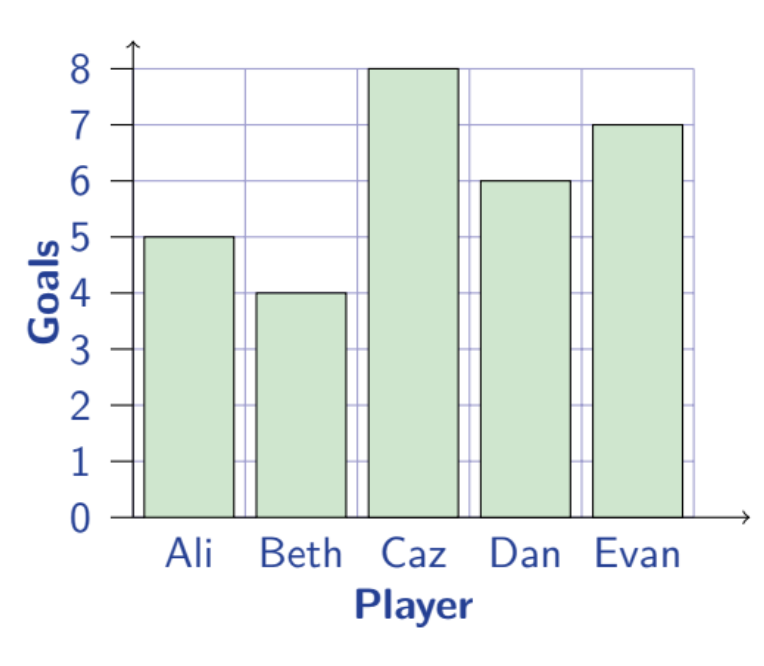
A Runnyball team has 5 players. This graph shows the number of goals each player scored in a tournament. Who scored the second-highest number of goals?


(A) Ali (B) Beth (C) Caz (D) Dan (E) Evan

Problem 3:

Six million two hundred and three thousand and six would be written as

(A) 62036 (B) 6230006 (C) 6203006 (D) 6203600 (E) 6200306

Problem 4:

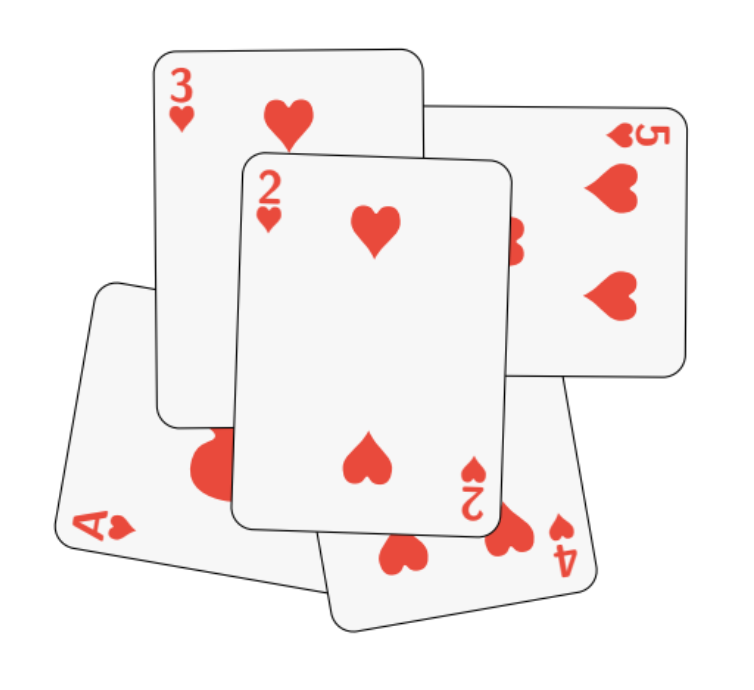
These cards were dropped on the table, one at a time. In which order were they dropped?

Problem 5:

Sophia is at the corner of 1st Street and 1st Avenue. Her school is at the corner of 4th Street and 3rd Avenue. To get there, she walks


(A) 4 blocks east, 3 blocks north (B) 3 blocks west, 4 blocks north (C) 4 blocks west, 2 blocks north (D) 3 blocks east, 2 blocks north (E) 2 blocks north, 2 blocks south

Problem 6:

Jake is playing a card game, and these are his cards. Elena chooses one card from Jake at random. Which of the following is Elena most likely to choose?

Problem 7:

Which 3D shape below has 5 faces and 9 edges?

Problem 8:

We're driving from Elizabeth to Renmark, and as we leave we see this sign. We want to stop at a town for lunch and a break, approximately halfway to Renmark. Which town is the best place to stop?

(A) Gawler (B) Nuriootpa (C) Truro (D) Blanchetown (E) Waikerie

Problem 9:

What is the difference between the heights of the two flagpoles, in metres?


(A) 16.25 (B) 16.75 (C) 17.25 (D) 17.75 (E) 33.25

Problem 10:

Most of the numbers on this scale are missing.

Which number should be at position $P$ ?
(A) 18 (B) 33 (C) 34 (D) 36 (E) 42

Problem 11:

In a game, two ten-sided dice each marked 0 to 9 are rolled and the two uppermost numbers are added. For example, with the dice as shown, $0+9=9$. How many different results can be obtained?

(A) 17 (B) 18 (C) 19 (D) 20 (E) 21

Problem 12:

Every row and every column of this $3 \times 3$ square must contain each of the numbers 1,2 and 3 . What is the value of $N+M$ ?

(A) 2 (B) 3 (C) 4 (D) 5 (E) 6

Problem 13:

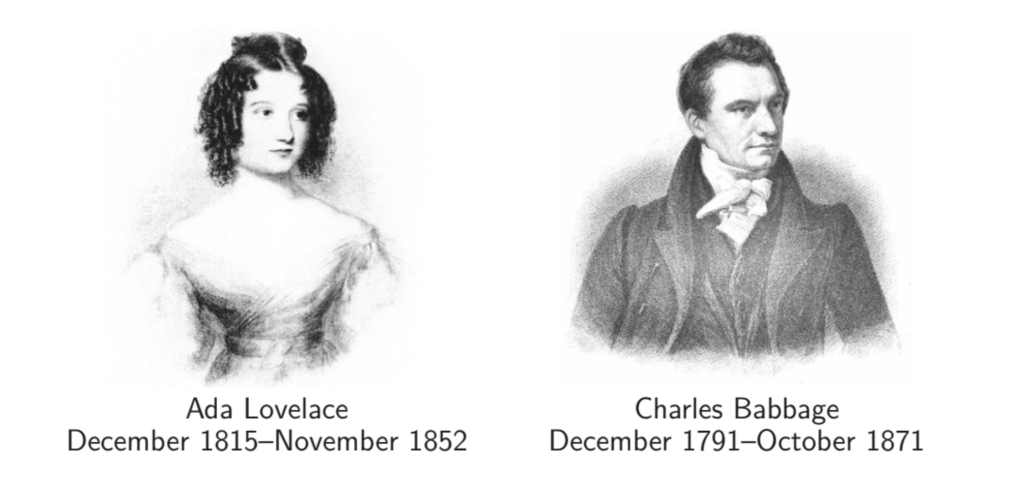
Ada Lovelace and Charles Babbage were pioneering researchers into early mechanical computers. They were born 24 years apart.

To the nearest year, how much longer did Charles Babbage live than Ada Lovelace?

(A) 29 (B) 32 (C) 35 (D) 37 (E) 43

Problem 14:

You have 12 metres of ribbon. Each decoration needs $\frac{2}{5}$ of a metre of ribbon. How many decorations can you make?

(A) 6 (B) 7 (C) 10 (D) 24 (E) 30

Problem 15:

Andrew and Bernadette are clearing leaves from their backyard. Bernadette can rake the backyard in 60 minutes, while Andrew can do it in 30 minutes with the vacuum setting on the leaf blower. If they work together, how many minutes will it take?

(A) 10 (B) 20 (C) 24 (D) 30 (E) 45

Problem 16:

A carpet tile measures 50 cm by 50 cm . How many of these tiles would be needed to cover the floor of a room 6 m long and 4 m wide?

(A) 24 (B) 20 (C) 40 (D) 48 (E) 96

Problem 17:

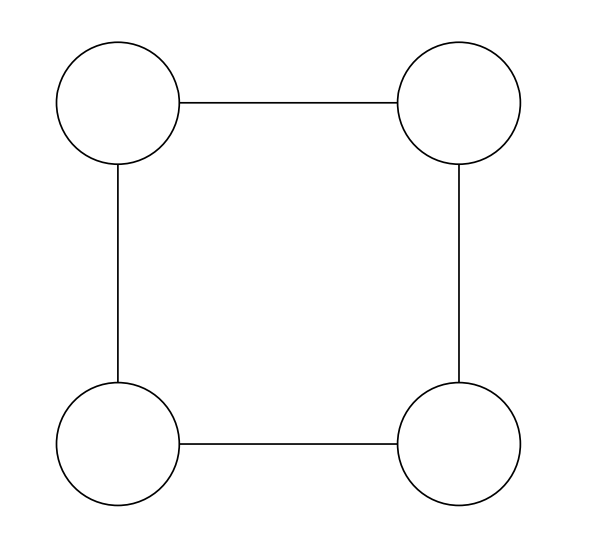
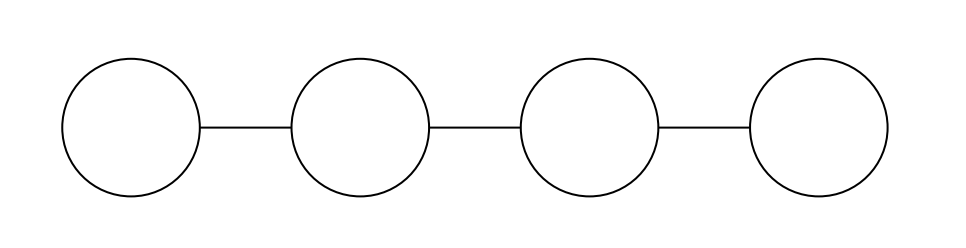
In how many different ways can you place the numbers 1 to 4 in these four circles so that no two consecutive numbers are side by side?

(A) 2 (B) 4 (C) 6 (D) 8 (E) 12

Problem 18:

John, Chris, Anne, Holly and Mike are seated around a round table, each with a card with a number on it in front of them. Each person can see the numbers in front of their two neighbours. Each person calls out the sum of the two numbers in front of their neighbours. John says 30, Chris says 33, Anne says 31, Holly says 38 and Mike says 36. Holly has the number 21 in front of her. What number does Anne have in front of her?

(A) 9 (B) 13 (C) 15 (D) 18 (E) 19

Problem 19:

Annabel has 2 identical equilateral triangles. Each has an area of $9 \mathrm{~cm}^2$. She places one triangle on top of the other as shown to form a star, as shown. What is the area of the star in square centimetres?


(A) 10 (B) 12 (C) 14 (D) 16 (E) 18

Problem 20:

Lola went on a train trip. During her journey she slept for $\frac{3}{4}$ of an hour and stayed awake for $\frac{3}{4}$ of the journey. How long did the trip take?

(A) 1 hour (B) 2 hours (C) $2 \frac{1}{2}$ hours (D) 3 hours (E) 4 hours

Problem 21:

My sister and I are playing a game where she picks two counting numbers and I have to guess them. When I tell her a number, she multiplies my number by her first number and then adds her second number. When I say 15 , she says 50 . When I say 2 , she says 11 . If I say 6 , what should she say?

(A) 23 (B) 27 (C) 35 (D) 41 (E) 61

Problem 22:

Once the muddy water from the 2018 Ingham floods had drained from Harry's house, he found this folded map that had been standing in the floodwater at an angle. He unfolded it and laid it out to dry, but it was still mud-stained. What could it look like now?

Problem 23:

A tower is built from exactly 2019 equal rods. Starting with 3 rods as a triangular base, more rods are added to form a regular octahedron with this base as one of its faces. The top face is then the base of the next octahedron. The diagram shows the construction of the first three octahedra. How many octahedra are in the tower when it is finished?

(A) 2016 (B) 1008 (C) 336 (D) 224 (E) 168

Problem 24:

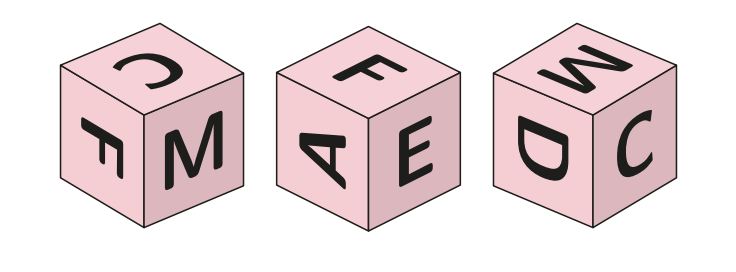
These three cubes are labelled in exactly the same way, with the 6 letters A, M, C, D, E and F on their 6 faces:


The cubes are now placed in a row so that the front looks like this:

When we look at the cubes from the opposite side, we will see

Problem 25:

In Jeremy's hometown of Windar, people live in either North, East, South, West or Central Windar. Jeremy is putting together a chart showing where the students in his class live, but unfortunately his dog chewed his survey results before he managed to label the five columns.


He only remembers two things about the survey: South Windar is more common than both East and Central Windar, and the number of students in North and Central Windar combined is the same as the total of the other three regions.
Using only this information, how many columns can Jeremy correctly label with \(100 \%\) certainty?

(A) 0 (B) 1 (C) 2 (D) 3 (E) 5

Problem 26:

Pip starts with a large square sheet of paper and makes two straight cuts to form four smaller squares. She then takes one of these smaller squares and makes two more straight cuts to make four even smaller ones, as shown.

Continuing in this way, how many cuts does Pip need to make to get a total of 1000 squares of various sizes?

Problem 27:

Seven of the numbers from 1 to 9 are placed in the circles in the diagram in such a way that the products of the numbers in each vertical or horizontal line are the same. What is this product?

Problem 28:

A hare and a tortoise compete in a 10 km race. The hare runs at \(30 \mathrm{~km} / \mathrm{h}\) and the tortoise walks at \(3 \mathrm{~km} / \mathrm{h}\). Unfortunately, at the start, the hare started running in the opposite direction. After some time, it realised its mistake and turned round, catching the tortoise at the halfway mark. For how many minutes did the hare run in the wrong direction?

Problem 29:

I want to place the numbers 1 to 10 in this diagram, with one number in each circle. On each of the three sides, the four numbers add to a side total, and the three side totals are all the same. What is the smallest number that this side total could be?

Problem 30:

The sum of two numbers is 11.63 . When adding the numbers together, Oliver accidentally shifted the decimal point in one of the numbers one position to the left. Oliver got an answer of 5.87 instead. What is one hundred times the difference between the two original numbers?

Australian Mathematics Competition - 2020 - Upper Primary Division - Grades 5 & 6- Questions and Solutions

Problem 1:

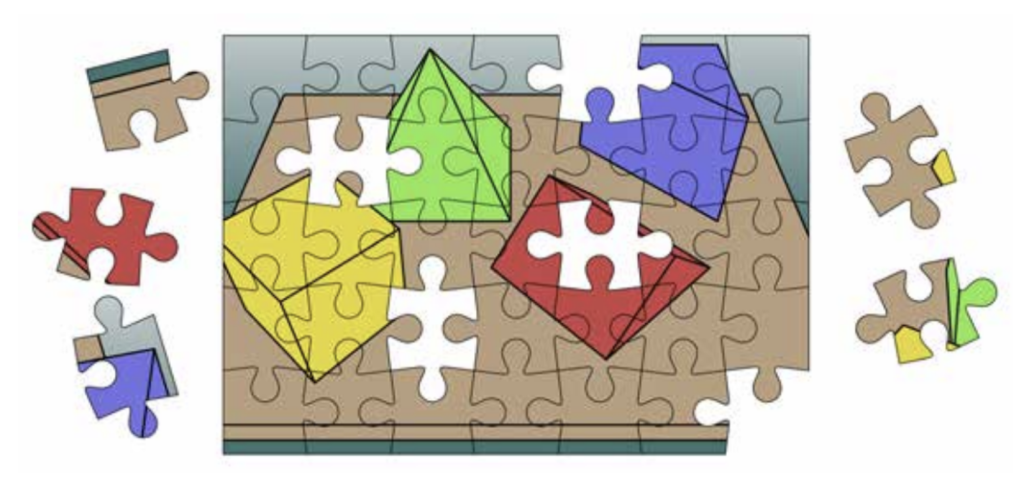
How many pieces have been placed in the jigsaw puzzle so far?

(A) 25 (B) 27 (C) 30 (D) 33 (E) 35

Problem 2:

What is half of 2020 ?

(A) 20 (B) 101 (C) 110 (D) 1001 (E) 1010

Problem 3:

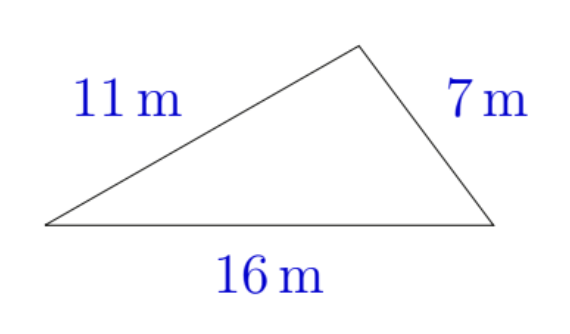
What is the perimeter of this triangle?

(A) 33 m (B) 34 m (C) 35 m (D) 36 m (E) 37 m

Problem 4:

Which fraction is the largest?

(A) one-half (B) one-quarter (C) one-third (D) three-quarters (E) six-tenths

Problem 5:

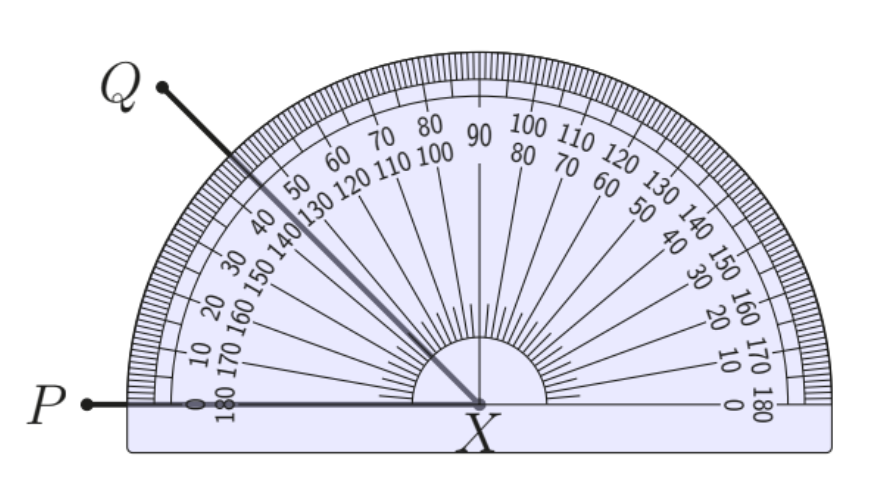
A protractor is used to measure angle (P X Q). The angle is

(A) $45^{\circ}$ (B) $55^{\circ}$ (C) $135^{\circ}$ (D) $145^{\circ}$ (E) $180^{\circ}$

Problem 6:

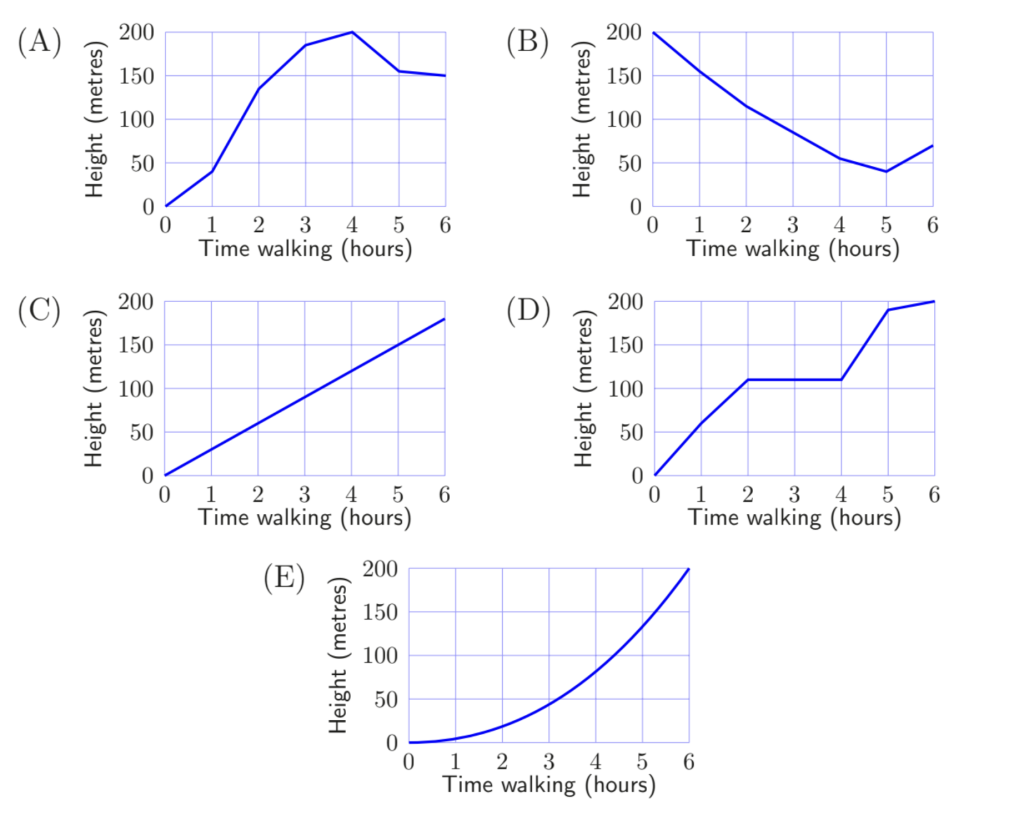
Some friends are walking to a lake in the mountains. First they climb a hill before they walk down to the lake. Which graph most accurately represents their journey?

Problem 7:

How many tenths are in 6.2 ?

(A) 62 (B) 8 (C) 4 (D) 12 (E) 36

Problem 8:

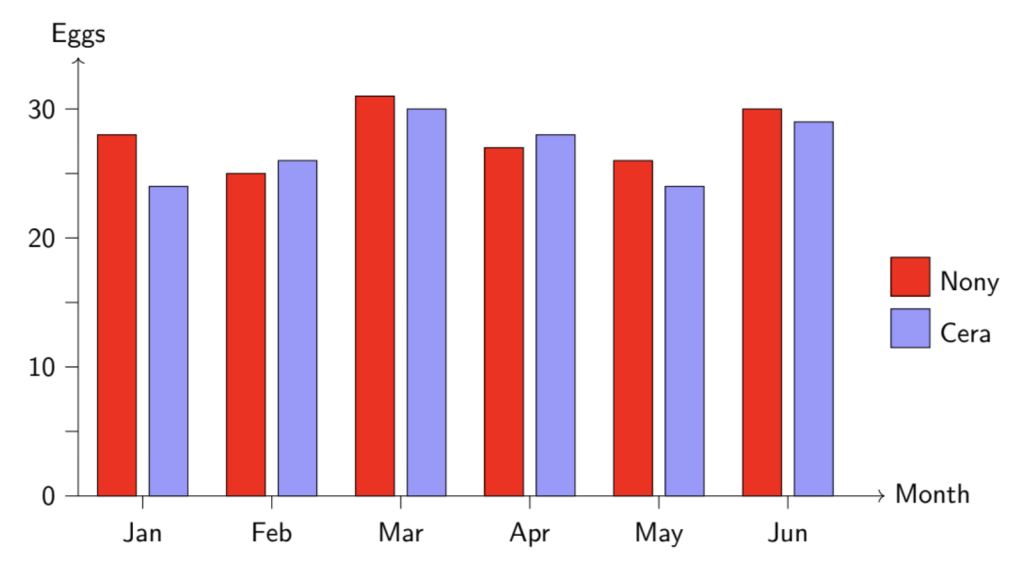
The graph shows the number of eggs laid by backyard chickens Nony and Cera for the first six months of the year.

In how many months did Nony lay more eggs than Cera?
(A) 1 (B) 2 (C) 3 (D) 4 (E) 5

Problem 9:

A class of 24 students, all of different heights, is standing in a line from tallest to shortest. Mary is the 8th tallest and John is the 6 th shortest. How many students are standing between them in the line?

(A) 6 (B) 7 (C) 8 (D) 9 (E) 10

Problem 10:

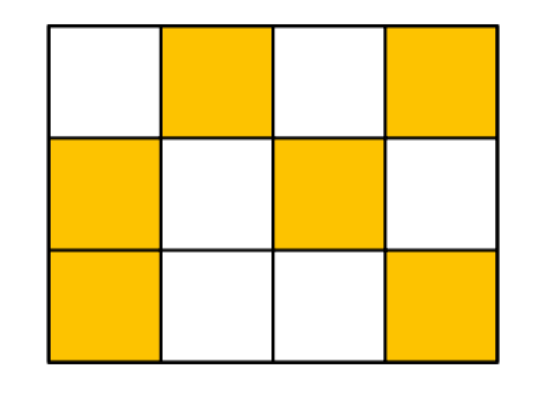
Maria divided a rectangle into a number of identical squares and coloured some of them in, as shown. She wants three-quarters of the rectangle's area to be coloured in altogether. How many more squares does she need to colour in?


(A) 0 (B) 1 (C) 2 (D) 3 (E) 4

Problem 11:

At the end of a game of marbles, Lei has 15 marbles, Dora has 8 and Omar has 4 . How many marbles must Lei give back to his friends if they want to start the next game with an equal number each?

(A) 5 (B) 6 (C) 7 (D) 8 (E) 9

Problem 12:

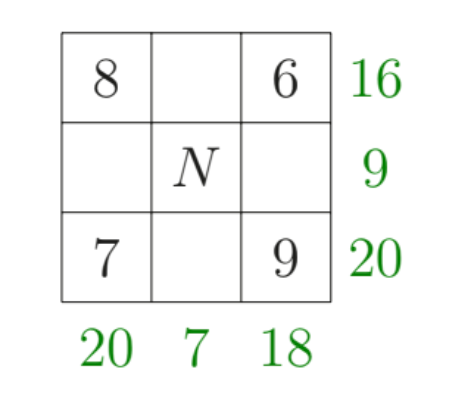
In the grid, the total of each row is given at the end of the row, and the total of each column is given at the bottom of the column.
The value of $N$ is

(A) 1 (B) 2 (C) 3 (D) 4 (E) 5

Problem 13:

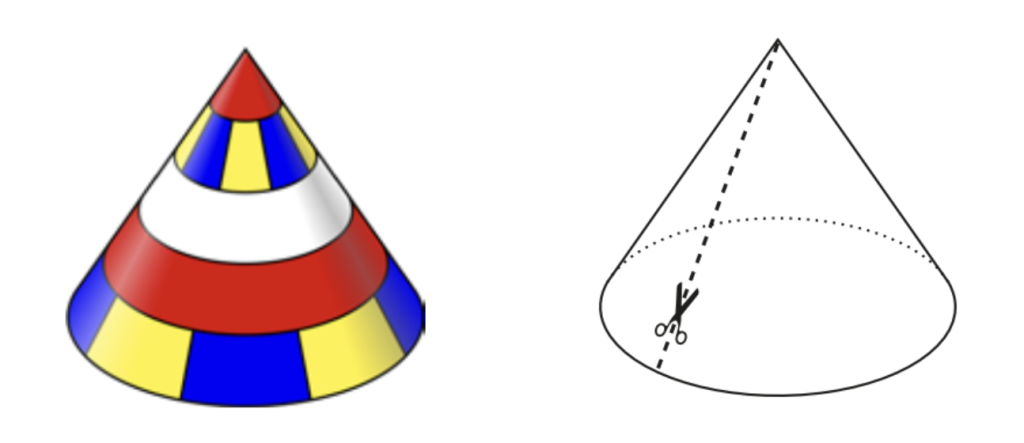
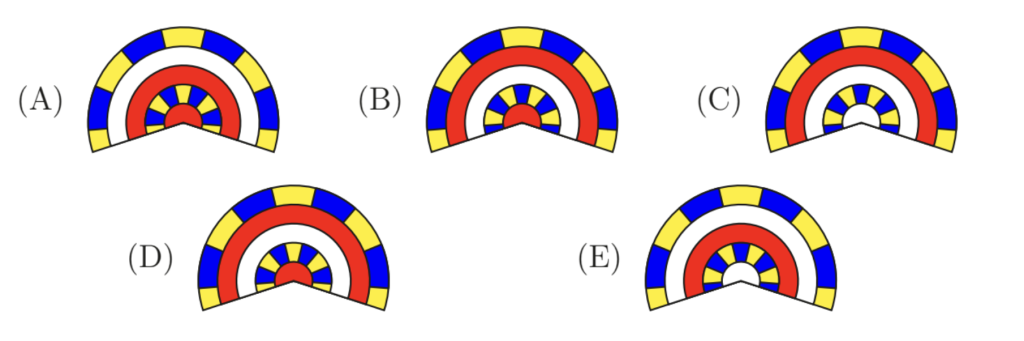
At his birthday party, Ricky and his friends wear stripy paper hats in the shape of a cone, as shown on the left. After the party, Ricky makes a straight cut in one of the hats all the way up to the point at the top, as shown on the right.

Which of the following best matches what the hat will look like when Ricky flattens it out on the table?

Problem 14:

Emma is going to write all the numbers from 1 to 50 in order. She writes 25 digits on the first line of her page. What was the last number she wrote on this line?

(A) 13 (B) 15 (C) 17 (D) 19 (E) 21

Problem 15:

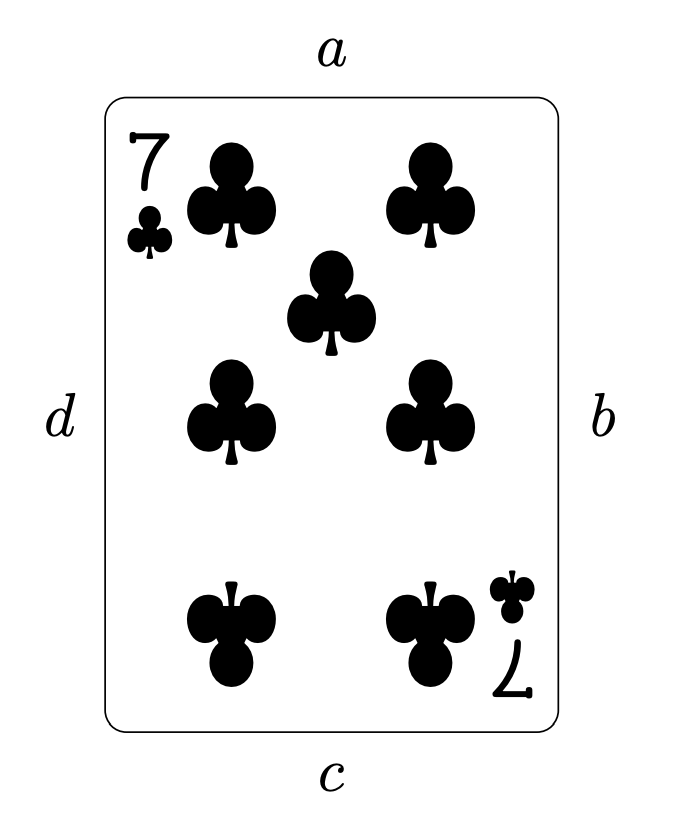
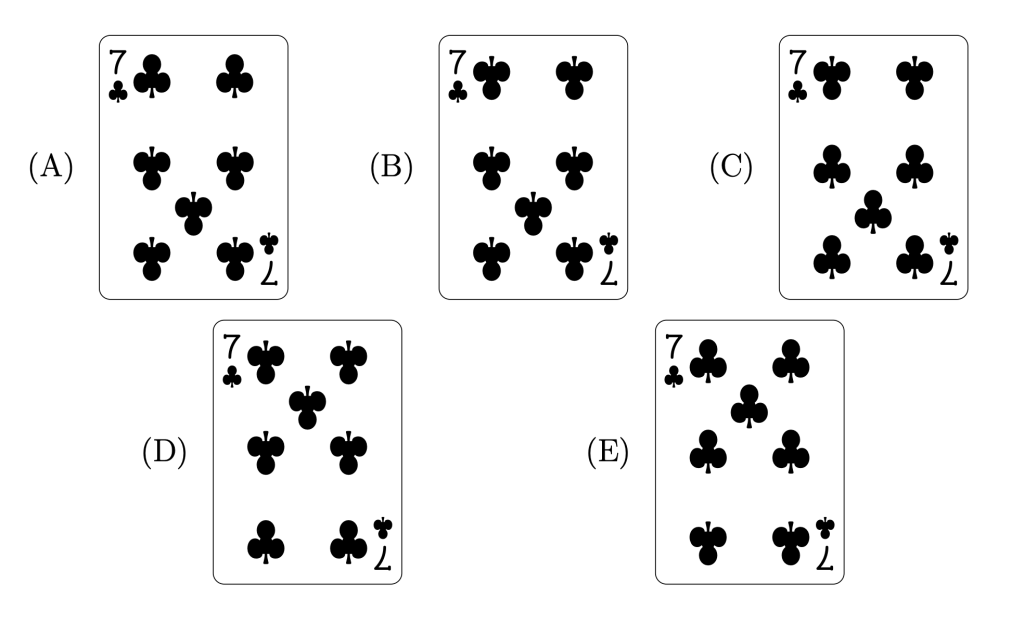
The playing card shown is flipped over along edge $b$ and then flipped over again along edge $c$. What does it look like now?

Problem 16:

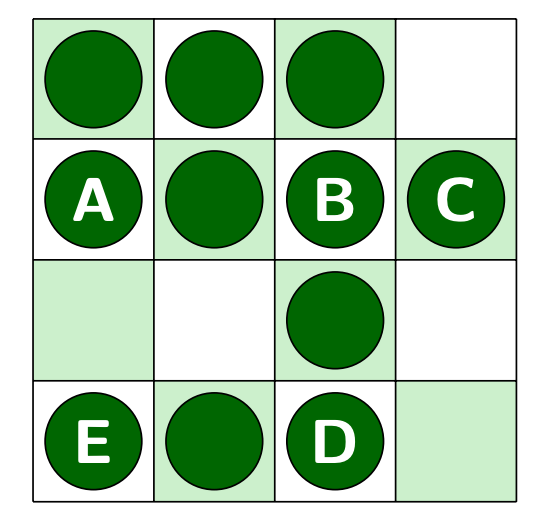
Which labelled counter should you remove so that no two rows have the same number of counters and no two columns have the same number of counters?

Problem 17:

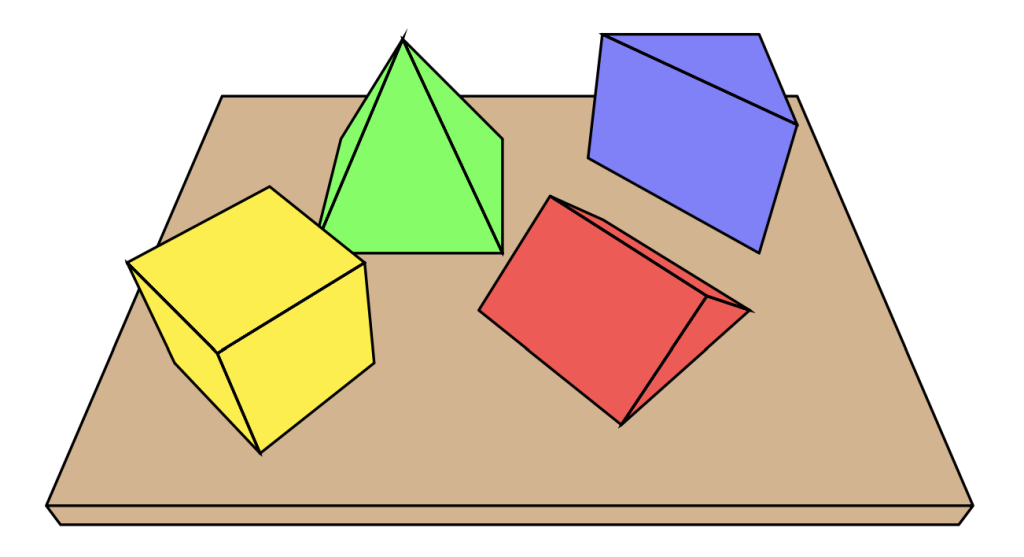
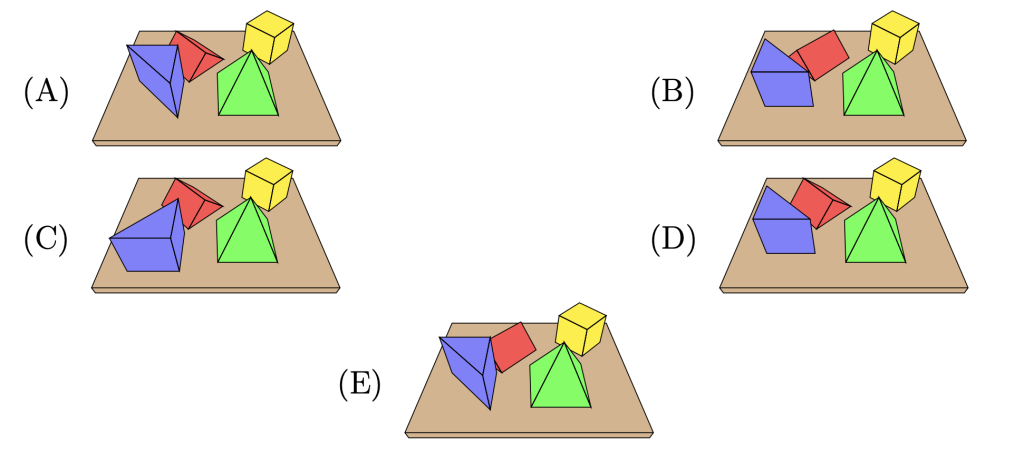
Aidan puts a range of 3D shapes on his desk at school. This is the view from his side of the desk:

Nadia is sitting on the opposite side of the desk facing Aidan. Which of the following diagrams best represents the view from Nadia's side of the desk?

Problem 18:

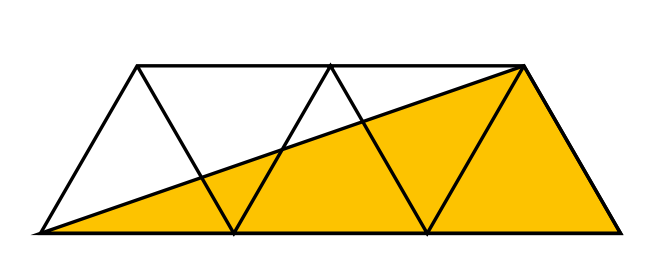
The area of each of the five equilateral triangles in the diagram is 1 square metre. What is the shaded area?

(A) $1.5 \mathrm{~m}^2$ (B) $2 \mathrm{~m}^2$ (C) $2.5 \mathrm{~m}^2$ (D) $3 \mathrm{~m}^2$ (E) $3.5 \mathrm{~m}^2$

Problem 19:

Kayla is 5 years old and Ryan is 13 years younger than Cody. One year ago, Cody's age was twice the sum of Kayla's and Ryan's age. Find the sum of the three children's current ages.

(A) 10 (B) 22 (C) 26 (D) 30 (E) 36

Problem 20:

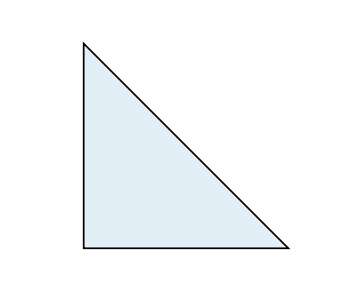
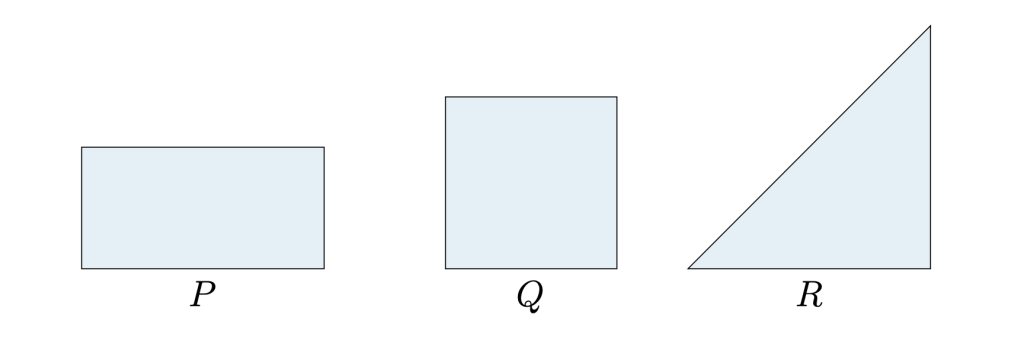
Mary has a piece of paper. She folds it exactly in half. Then she folds it in half again. She finishes up with this shape.

Which of the shapes $P, Q$ and $R$ shown below could have been her starting shape?

(A) only $P$ (B) only $Q$ (C) only $R$ (D) only $P$ and $R$ (E) all three

Problem 21:

Four positive whole numbers are placed at the vertices of a square. On each edge, the difference between the two numbers at the vertices is written. The four edge numbers are $1,2,3$ and 4 in some order. What is the smallest possible sum of the numbers at the vertices?

(A) 10 (B) 11 (C) 12 (D) 13 (E) 14

Problem 22:

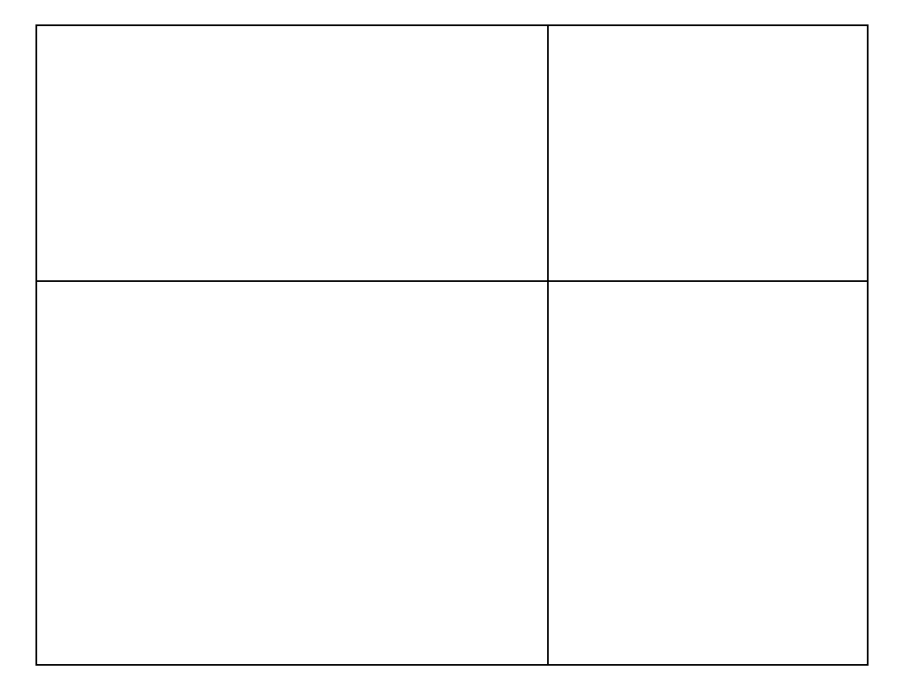
The large rectangle shown has been divided into 4 smaller rectangles. The perimeters of three of these are $10 \mathrm{~cm}, 16 \mathrm{~cm}$ and 20 cm . The fourth rectangle does not have the largest or the smallest perimeter of the four smaller rectangles.

What, in centimetres, is the perimeter of the large rectangle?

(A) 26 (B) 30 (C) 32 (D) 36 (E) 46

Problem 23:

A bale of hay can be eaten by a horse in 2 days, by a cow in 3 days and by a sheep in 12 days. A farmer has 22 bales of hay and one horse, one cow and one sheep to feed. How many days will his bales last?

(A) 20 (B) 22 (C) 24 (D) 26 (E) 28

Problem 24:

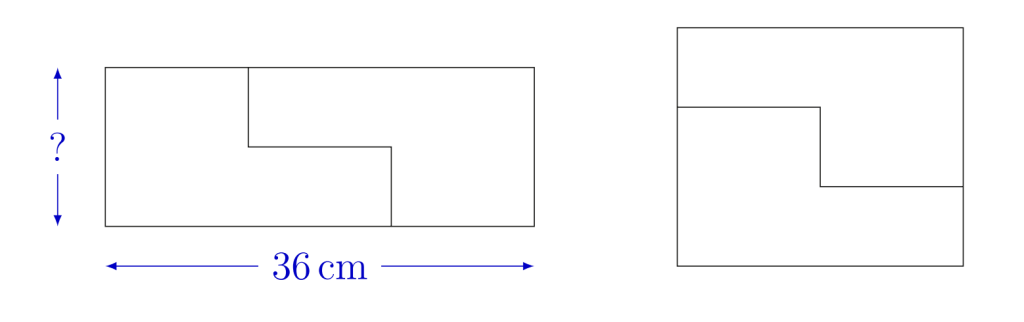
This rectangle is 36 cm long. It is cut into two pieces and rearranged to form a square, as shown.


What is the height of the original rectangle?

(A) 14 cm (B) 16 cm (C) 18 cm (D) 20 cm (E) 24 cm

Problem 25:

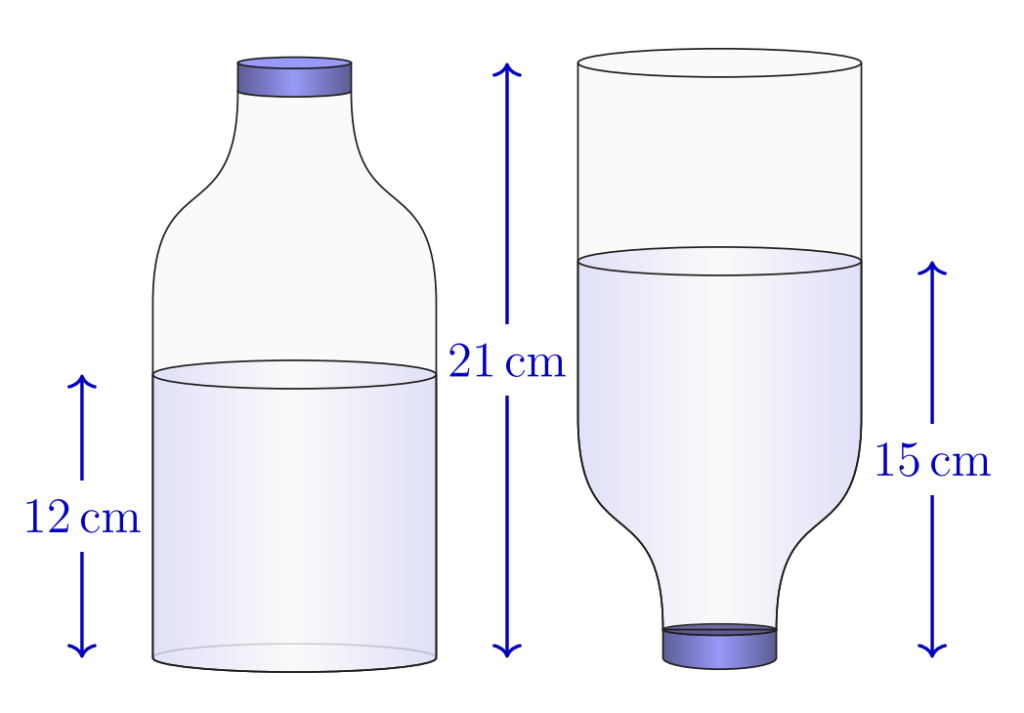
A bottle with a sealed lid contains some water. The diagram shows this bottle up the right way and upside down. How full is the bottle?


(A) $\frac{1}{2}$ (B) $\frac{4}{7}$ (C) $\frac{5}{7}$ (D) $\frac{2}{3}$ (E) $\frac{9}{14}$

Problem 26:

A number is oddtastic if all of its digits are odd. For example, 9,57 and 313 are oddtastic. However, 50 and 787 are not oddtastic, since 0 and 8 are even digits. How many of the numbers from 1 to 999 are oddtastic?

Problem 27:

On my chicken farm where I have 24 pens, the pens were a bit crowded. So I built 6 more pens, and the number of chickens in each pen reduced by 6 . How many chickens do I have?

Problem 28:

How many even three-digit numbers are there where the digits add up to $8 ?$

Problem 29:

Madeleine types her three-digit Personal Identification Number (PIN) into this keypad. All three digits are different, but the buttons for the first and second digits share an edge, and the buttons for the second and third digits share an edge. For instance, 563 is a possible PIN, but 536 is not, since 5 and 3 do not share an edge. How many possibilities are there for Madeleine's PIN?

Problem 30:

Writing one digit every second, you have half an hour to list as many of the counting numbers as you can, starting $1,2,3, \ldots$. At the end of half an hour, what number have you just finished writing?