Ramanujan Contest (NMTC Inter 2019 - XI and XII Grades) - Stage I - Problems and Solution

Part A

Problem 1

Ram and Shyam play table tennis with Ram's chance of winning a game being $\frac{3}{5}$ and Shyam's $\frac{2}{5}$. The winner gets 1 point and loser 0 points. The match terminates when one player has 2 points more than the other. The probability of Ram winning the game at exactly the end of $6^{th}$ game, not before, is
(A) $\frac{364}{15625}$
(B) $\frac{1296}{15625}$
(C) $\frac{432}{3125}$
(D) $\frac{2592}{15625}$

Problem 2

Thirty volunteers are distributed to three poling booths. Each booth must have at least one and all must have different number of volunteers allotted. Then the number of ways of allocating volunteers is :
(A) 406
(B) 496
(C) 378
(D) None of these

Problem 3

The number of values of a for which the function $f(x)=\cos 2 x+2 a(1+\cos x)$ has a minimum value $\frac{1}{2}$ is :
(A) 0
(B) 1
(C) 2
(D) 3

Problem 4

Let $f(x)=\frac{x}{\sqrt{x^2-1}}$. If $f^2(x)=f(f(x)), f^3(x)=f\left(f^2(x)\right), \ldots \ldots, f^{n+1}(x)=f\left(f^n(x)\right)$, then $f^{2019}(\sqrt{2})$ is :
(A) 1
(B) 0
(C) $\sqrt{2}$
(D) not define

Problem 5

The area of the curve enclosed by $|x-2 \sqrt{2}|+|y-\sqrt{5}|=2$ is :
(A) 16
(B) 12
(C) 8
(D) 4

Problem 6

Let $a$ be an irrational number. How many lines through the point $(a, 2a)$ contain at least two points with both coordinates rational ?
(A) Infinitely many
(B) At least two but finitely many
(C) Only one
(D) None

Problem 7

Suppose $A, A_2, \ldots \ldots, A_{33}$ be 33 sets each containing 6 elements and $B_1, B_2, \ldots . ., B_n$ be $n$ sets each with 8 elements. if \[\bigcup_{i=1}^{33} A_{i} = \bigcup_{i=1}^{n} B_{i}=S\] and if each element of $S$ occurs exactly 9 times in $A_1, \ldots$ $A_2, A_{33}$ and exactly 4 times in $B_1, \ldots B_2, B_n$, then $n$ is :
(A) 22
(B) 33
(C) 12
(D) 11

Problem 8

Let $a, b$ and $c$ be real numbers such that $2 a^2-b c-9 a+10=0$ and $4 b^2+c^2+b c-7 a-8=0$. Then the set of real values that a can take is given by
(A) $[1,4.2]$
(B) $(-\infty, 1) \cup(4.2, \infty)$
(C) $(1,4.2)$
(D) $[1,4.2)$

Problem 9

Let $g(x)=\left[\frac{1}{\operatorname{cosec}(x)}\right]$, then the range of $g(x)$ is $(\mathbb{Z}$ is the set of integers)
(A) $\mathbb{Z}$
(B) $\mathbb{Z}$-{0}
(C) {0}
(D) {0,1,-1}

Problem 10

The ordered pair of numbers $(x, y)$ satisfy both the equations $x+y=3$ and $x^5+y^5+162=0$. Then


(A) There are 5 pairs of real solutions
(B) there are four pairs of real solutions
(C) The are two pairs of real and two pairs of non-real solutions
(D) All four pairs are non-real solutions

Problem 11
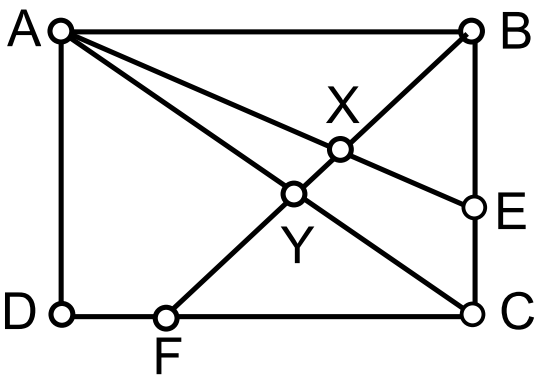
In a rectangle $A B C D$, point $E$ lies on $B C$ such that $\frac{B E}{E C}=2$ and point $F$ lies on $C D$ such that $\frac{C F}{F D}=$ 2. Lines $A E$ and $A C$ intersect $B F$ at $X$ and $Y$ respectively. If $F Y: Y X: X B=a: b: c$, are relatively prime positive integers, then the minimum value of $a+b+c$ is :


(A) 4
(B) 8
(C) 12
(D) 16

Problem 12

Rita takes a train home at $4: 00$, arriving at the station at 6:00 Every day, driving the same rate, rate, her husband meets her at the station at 6:00. On day she takes the train an hour early and arrives at 5:00. Her husband leaves home to meet her at the usual time, so Rita begins to walk home. he meets her on the way and hey reach home 20 minutes earlier than usual. The number of minutes Rita was walking before she met her husband on the way is :
(A) 20
(B) 40
(C) 50
(D) 60

Problem 13

A regular polygon has 100 sides each of length. A another regular polygon has 200 sided each of length 2 . When the area of the larger polygon is divided by the area of the smaller polygon, the quotient is closest to the integer
(A) 2
(B) 4
(C) 8
(D) 16

Problem 14

The function $f$ satisfies $f(f(x))=f(x+2)-3$ for all integers $x$. If $f(1)=4 ; f(4)=3$, then $f(5)$ equals
(A) 3
(B) 6
(C) 9
(D) 12

Problem 15

If $x$ and $y$ are positive real numbers such that $x+y=1$, then maximum value of $x y^4+x^4 y$ is
(A) $\frac{1}{16}$
(B) $\frac{1}{12}$
(C) $\frac{1}{8}$
(D) $\frac{1}{4}$

Part B

Problem 16

Consider all 4 element subsets of the set $A={1,2,3, \ldots 8}$. Each of these subsets has a greatest element. The arithmetic mean of the greatest elements of these 4 element subsets is $\rule{1cm}{0.15mm}$

Problem 17

The number of times the digit occurs in the result of $1+11+111+\ldots . .+111 \ldots . .111$ (100digits) is $\rule{1cm}{0.15mm}$.
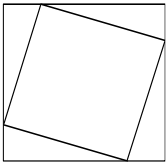
Problem 18

In a $38 \times 32$ rectangle $A B C D$, points $P, Q, R, S$ are taken on the sides $A B, B C, C D, D A$ respectively such that the lengths $A P, B Q, C R$ and $D S$ are integers and $P Q R S$ is rectangle. The largest possible area of $P Q R S$ is $\rule{1cm}{0.15mm} $.

Problem 19

6 blue, 7 green and 10 white balls are arranged in row such that every blue ball is between and green and a white ball. Moreover, a white ball and a green ball must not be next to each other. The number of such arrangements is $\rule{1cm}{0.15mm}$

Problem 20

Let us call a sum of integers a cool sum if the first and last terms are 1 and each term differs from its neighbours by at most. For example, $1+2+2+3+3+2+1$ and $1+2+3+4+3+2+1$ are cool sums. The minimum number of terms required to write 2019 as a cool sum is $\rule{1cm}{0.15mm}$.
Problem 21

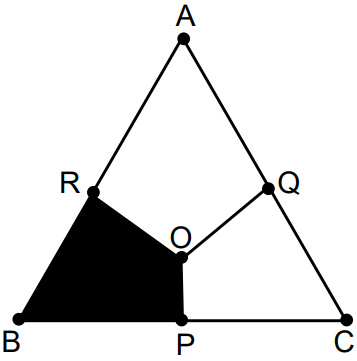
$O$ is a point inside an equilateral triangle $A B C$. The perpendicular distance $O P, O Q, O R$ to the sides of the triangle are in the ratio $O P: O Q: O R=1: 2: 3$. If $\frac{\text { Area of quadrilateral OPBR }}{\text { Area of triangleABC }}=\frac{a}{b}$, where $\mathrm{a}, \mathrm{b}$ are co-prime positive integers, then $\mathrm{a}+\mathrm{b}$ equals $\rule{1cm}{0.15mm}$.
Problem 22

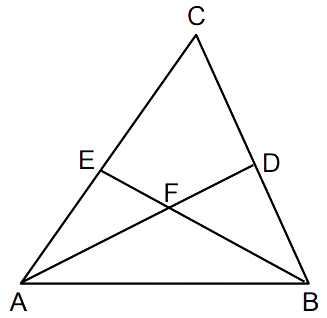
In $\triangle \mathrm{ABC}, \mathrm{AB}=6, \mathrm{BC}=7$ and $\mathrm{CA}=8$. Point $\mathrm{D}$ lies on $\mathrm{BC}$ and $\mathrm{AD}$ bisects $\angle \mathrm{BAC}$. Point $\mathrm{E}$ lies on $A C$ and $B E$ bisects $\angle A B C$. If the bisectors intersect at $F$, then the ratio $A F: F D=$ $\rule{1cm}{0.15mm}$.

Problem 23

Let $a, b, c$ be real numbers such that the polynomial $f(x)=x^3+a x^2+x+10$ has three distinct roots and each root of $f(x)$ is also a root of the polynomial $h(x)=x^4+x^3+b x^2+13 x+c$. The $h(1)=$ $\rule{1cm}{0.15mm}$.

Problem 24

In quadrilateral $A B C D, A B=10, B C=33, C D=10$ and $D A=15$. If $B D$ is an integer then $B D=$ $\rule{1cm}{0.15mm}$.

Problem 25

For each positive integer $n$ let $f(n)=n^4-3 n^2+9$. Then the sum of all $f(n)$ which are prime is $\rule{1cm}{0.15mm}$.

Problem 26

13 boys are sitting in a row in a theatre. After the intermission, they return and are seated such that either they occupy the same seat or the adjacent seat in such a way that it differs from the original arrangement. The number of ways this is possible is $\rule{1cm}{0.15mm}$.

Problem 27

$\mathrm{A}_1 \mathrm{~A}_2 \mathrm{~A}_3 \ldots . . \mathrm{A}_{15}$ is a 15 sided regular polygon. The number of distinct equilateral triangles in the plane of the polygon, with exactly two of their vertices from the set $\left{A_1, A_2, A_3 \ldots \ldots A_{15}\right}$ is $\rule{1cm}{0.15mm}$.

Problem 28

The polynomial $P(x)=x^3+a x^2+b x+c$ has the property that the mean of its roots, the product of its roots, and the sum of its coefficients are all equal. If the $y$ intercept of the graph $y=P(x)$ is 2 then $b=$ $\rule{1cm}{0.15mm}$.

Problem 29

$A B C D$ is a quadrilateral in the first quadrant where $A=(3,9), B=(1,1), C=(5,3)$ and $D=(p, q)$. The quadrilateral formed by joining the midpoints of $A B, B C, C D$ and $D A$ is a square. Then $p+q=$ $\rule{1cm}{0.15mm}$.

Problem 30

The product of four positive integers $a, b, c$ and $d$ is 9 ! The number $a, b, c, d$ satisfy $a b+a+b=$ $1224, b c+b+c=549$ and $c d+c+d=351$. The $a+b+c+d=\ldots \ldots$ $\rule{1cm}{0.15mm}$.

Gauss Contest (NMTC PRIMARY 2019 - V and VI Grades) - Stage I- Problems and Solution

Part A

Problem 1

How many glasses of 120 millilitres can you fill from a 3 litre can of juice?
(A) 20
(B) 24
(C) 25
(D) $60 \mathrm{ml}$ is left in the can after filling as many glasses as possible

Problem 2

The sum of $2211+2213+2215+2217+2219+2221+2223+2225+2227+2229$ is
(A) 22200
(B) 22225
(C) 22250
(D) 22275

Problem 3

If a number is first multiplied by $\frac{4}{ 7}$ and then divided by $\frac{12}{7}$ then it is equivalent to which of the following operations on the number?

(A) multiplying by $\frac{1}{3}$
(B) dividing by $\frac{1}{3}$
(C) multiplying by 3
(D) dividing by $\frac{2}{3}$

Problem 4

$X$ is a 5 digit number. Let $Y$ be the sum of the digits of $X$. Let $Z$ be the sum of the digits of $Y$. Then the maximum possible value that $Z$ can have is
(A) 9
(B) 8
(C) 10
(D) 12

Problem 5

A square is constructed on a graph paper which has a square grid of $1 \mathrm{~cm}$ width. Ram paints all the squares which cross the two diagonals of the square and finds that there are 19 of them. Then the side of the square is
(A) 20
(B) 19
(C) 10
(D) 9

Problem 6

Look at the set of numbers ${2,3,5,7,8,10,12}$. Four numbers are selected from this and made into two pairs. The pairs are added and the resulting two numbers are multiplied. The smallest such product is
(A) 72
(B) 60
(C) 54
(D) 64

Problem 7

Anita wants to enter a number into each small triangular cell of the triangular table. The sum of the numbers in any two such cells with a common side must be the same. She has already entered two numbers. What is the sum of all the numbers in the table?

(A) 19
(B) 20
(C) 21
(D) 22

Problem 8

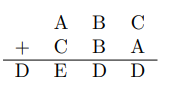
Where A, B, C, D, E are distinct digits satisfying this addition fact, then E is

(A) 3
(B) 5
(C) 2
(D) 4

Problem 9

A large rectangle is made up of eleven identical rectangles whose longer sides are $21 \mathrm{~cm}$ long. The perimeter of the large rectangle in $\mathrm{cm}$ is

(A) 150
(B) 126
(C) 108
(D) 96

Problem 10

Sum of the odd numbers from 1 to 2019 both inclusive, is divisible by
(A) only 100
(B) only 101
(C) both 100 and 101
(D) neither by 100 nor by 101

Problem 11

The circumference of a circle is numerically greater than the area of the circle. Then the maximum length of the radius cannot be greater than
(A) 2
(B) $\frac{7}{4}$
(C) $\frac{9}{5}$
(D) $\frac{11}{6}$

Problem 12

A calendar for 2019 is made using 4 sheets, each sheet having 3 months. The total number of days shown in each of the four sheets $\left(1^{\text {st }}, 2^{\text {nd }}, 3^{\text {red }}, 4^{\text {th }}\right)$ respectively is
(A) $(90,91,92,92)$
(B) $(90,92,91,92)$
(C) $(90,92,91,92)$
(D) $(90,92,92,91)$

Problem 13

Triples of odd numbers $(a, b, c)$ with $a<b<c$, with $a, b, c$ from 1 to 10 are generated such that $a+b+c$ is prime number. The number of such triple is
(A) 5
(B) 6
(C) 7
(D) 3

Problem 14

A number leaves a remainder 2 when divided by 6 . Then the possible remainder(s) when the same number is divided by 9 is
(A) ${1,4,7}$
(B) ${2,5,8}$
(C) ${5,8}$
(D) ${2,5}$

Problem 15

A box of dimension $40 \times 35 \times 28$ units is used to keep smaller cuboidal boxes so that no space is left between the boxes. If the box is packed with 100 such smaller boxes of the same size, then dimension of the smaller box is
(A) $7 \times 8 \times 7$
(B) $8 \times 7 \times 7$
(C) $7 \times 7 \times 8$
(D) $20 \times 7 \times 7$

Part B

Problem 16

The number of two digit numbers which are divisible by the sum of their digits is $\rule{1cm}{0.15mm}$.

Problem 17

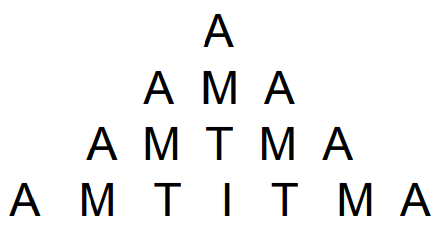
Given below is the triangular form of AMTI.

The number of ways you can spell AMTI, top to bottom, right to left or left to right or a combination of these is $\rule{1cm}{0.15mm}$.

Problem 18

The number of odd prime numbers less than 100 which can be written as the sum of two squares is $\rule{1cm}{0.15mm}$.

Problem 19

If $4921 \times D=A B B B D$ then $B$ is $\rule{1cm}{0.15mm}$.

Problem 20

36 children took a math talent test. For a contestant Anu the number of students who scored above her was 1.5 times the number who scored below her. Her rank when the scores are put in decreasing order is $\rule{1cm}{0.15mm}$.

Problem 21

Small rectangular sheets of length $\frac{2}{3}$ units and breadth $\frac{3}{5}$ units are available. These sheets are assembled and pasted in a big cardboard sheet, edge to edge and made into a square. The minimum number of such sheet required is $\rule{1cm}{0.15mm}$.

Problem 22

Ramanujan's number is 1729. The number of composite divisors of 1729 less than 1729 is $\rule{1cm}{0.15mm}$.

Problem 23

$\mathrm{N}$ is an 100000 digit number with no zero digit and the sum of the digits of $\mathrm{N}$ is 100001 , then the number of such N's is $\rule{1cm}{0.15mm}$.

Problem 24

Peter 8 years old asked his mother how old she was. She said, "when you are as old as I am now, I will be 54 years old". Peter's mother's current age is $\rule{1cm}{0.15mm}$.

Problem 25

A string of beads has a recurring pattern as follows : 5 blue, 4 black, 4 white, 5 blue, 4 black, 4 white and so on. The colour of the $321^{st}$ bead is $\rule{1cm}{0.15mm}$.

Kaprekar Contest (NMTC Sub-Junior 2019 - VII and VIII Grades) - Stage I- Problems and Solution

Part A

Problem 1

If $4921 \times D=A B B B D$, then the sum of the digits of $A B B B D \times D$ is
(A) 19
(B) 20
(C) 25
(D) 26

Problem 2

What is the $2019^{th}$ digit to the right of the decimal point, in the decimal representation of $\frac{5}{28}$ ?

(A) 2
(B) 4
(C) 8
(D) 7

Problem 3

If $X$ is a 1000 digit number, $Y$ is the sum of its digits, $Z$ the sum of the digits of $Y$ and $W$ the sum of the digits of $Z$, then the maximum possible value of $W$ is
(A) 10
(B) 11
(C) 12
(D) 22

Problem 4

Let $x$ be the number $0.000 \ldots . . .001$ which has 2019 zeroes after the decimal point. Then which of the following numbers is the greatest?
(A) $10000+x$
(B) $10000 \cdot x$
(C) $\frac{10000}{x}$
(D) $\frac{1}{x^2}$

Problem 5

Where A, B, C, D, E are distinct digits satisfying this addition fact, then E is

(A) 3
(B) 5
(C) 2
(D) 4

Problem 6

In a $5 \times 5$ grid having 25 cells, Janani has to enter 0 or 1 in each cell such that each sub square grid of size $2 \times 2$ has exactly three equal numbers. What is the maximum possible sum of the numbers in all the 25 cells put together?
(A) 23
(B) 21
(C) 19
(D) 18

Problem 7

$A B C D$ is a square. $E$ is one fourth of the way from $A$ to $B$ and $F$ is one fourth of the way from $B$ to C. $X$ is the centre of the square. Side of the square is $8 \mathrm{~cm}$. Then the area of the shaded region in the figure in $\mathrm{cm}^2$ is

(A) 14
(B) 16
(C) 18
(D) 20

Problem 8

$A B C D$ is a rectangle with $E$ and $F$ are midpoints of $C D$ and $A B$ respectively and $G$ is the mid-point of $\mathrm{AF}$. The ratio of the area of $\mathrm{ABCD}$ to area of $\mathrm{AECG}$ is

(A) $4: 3$
(B) $3: 2$
(C) $6: 5$
(D) $8: 3$

Problem 9

each alphabet represents a different digit, what is the maximum possible value
of FLAT?

(A) 2450
(B) 2405
(C) 2305
(D) 2350

Problem 10

How many positive integers smaller than 400 can you get as a sum of eleven consecutive positive integers?
(A) 37
(B) 35
(C) 33
(D) 31

Problem 11

Let $x, y$ and $z$ be positive real numbers and let $x \geq y \geq z$ so that $x+y+z=20.1$. Which of the following statements is true?
(A) Always $x y<99$
(B) Always $x y>1$
(C) Always $x y \neq 75$
(D) Always $yz \neq 49$

Problem 12

A sequence $\left[a_n\right]$ is generated by the rule, $a_n=a_{n-1}-a_{n-2}$ for $n \geq 3$ Given $a_1=2$ and $a_2=4$, then sum of the first 2019 terms of the sequence is given by
(A) 8
(B) 2692
(C) -2692
(D) -8

Problem 13

There are exactly 5 prime numbers between 2000 and 2030 . Note: $2021=43 \times 47$ is not a prime number. The difference between the largest and the smallest among these is
(A) 16
(B) 20
(C) 24
(D) 26

Problem 14

Which of the following geometric figures is possible to construct?


(A) A pentagon with 4 right angled vertices
(B) An octagon with all 8 sides equal and 4 angles each of measure $60^{\circ}$ and other four angles of measure $210^{\circ}$
(C) A parallelogram with 3 vertices of obtuse angle measures.
(D) $A$ hexagon with 4 reflex angles.

Problem 15

If $y^{10}=2019$, then
(A) $2<y<3$
(B) $1<y<2$
(C) $4<y<5$
(D) $3<y<4$

Part B

Problem 16

A sequence of all natural numbers whose second digit (from left to right) is 1 , is written in strictly increasing order without repetition as follows: $11,21,31,41,51,61,71,81,91,110,111, \ldots$ Note that the first term of the sequence is 11 . The third term is 31 , eighth term is 81 and tenth term is 110. The 100th term of the sequence will be $\rule{1cm}{0.15mm}$

Problem 17

In $\triangle \mathrm{ABC}, \mathrm{AB}=6 \mathrm{\textrm {cm }}, \mathrm{AC}=8 \mathrm{\textrm {cm }}$, median $A D=5 \mathrm{~cm}$. Then, the area of $\triangle \mathrm{ABC}$ in $\mathrm{cm}^2$ is $\rule{1cm}{0.15mm}$.

Problem 18

Given $a, b, c$ are real numbers such that $9 a+b+8 c=12$ and $8 a-12 b-9 c=1$. Then $a^2-b^2+c^2=\rule{1cm}{0.15mm} $

Problem 19

In the given figure, $\triangle A B C$ is a right angled triangle with $\angle A B C=90^{\circ} . D, E, F$ are points on $A B, A C$, $\mathrm{BC}$ respectively such that $\mathrm{AD}=\mathrm{AE}$ and $\mathrm{CE}=\mathrm{CF}$. Then, $\angle \mathrm{DEF}= \rule{1cm}{0.15mm}$ (in degree).

Problem 20

Numbers of 5-digit multiples of 13 is $\rule{1cm}{0.15mm}$.

Problem 21

The area of a sector and the length of the arc of the sector are equal in numerical value. Then the radius of the circle is $\rule{1cm}{0.15mm}$.

Problem 22

If $a, b, c, d$ are positive integers such that $a+\frac{1}{b+\frac{1}{c+\frac{1}{d}}}=\frac{43}{30}$, then $d$ is $\rule{1cm}{0.15mm}$.

Problem 23

A teacher asks 10 of her students to guess her age. They guessed it as $34,38,40,42,46,48,51$, 54,57 and 59. Teacher said "At least half of you guessed it too low and two of you are off by one. Also my age is a prime number". The teacher's age is $\rule{1cm}{0.15mm}$.

Problem 24

The sum of 8 positive integers is 22 and their LCM is 9. The number of integers among these that are less than 4 is $\rule{1cm}{0.15mm}$.

Problem 25

The number of natural numbers $n \leq 2019$ such that $\sqrt[3]{48 n}$ is an integer is $\rule{1cm}{0.15mm}$.

Bhaskara Contest (NMTC Junior 2019 - IX and X Grades) - Stage I- Problems and Solution

Part A

Problem 1

The number of 6 digit numbers of the form "ABCABC", which are divisible by 13 , where $A, B$ and $C$ are distinct digits, $A$ and $C$ being even digits is
(A) 200
(B) 250
(C) 160
(D) 128

Problem 2

In $\triangle \mathrm{ABC}$, the medians through $\mathrm{B}$ and $\mathrm{C}$ are perpendicular. Then $\mathrm{b}^2+\mathrm{c}^2$ is equal to
(A) $2 a^2$
(B) $3 a^2$
(C) $4 a^2$
(D) $5 a^2$

Problem 3

In a quadrilateral $A B C D, A B=A D=10, B D=12, C B=C D=13$. Then


(A) $A B C D$ is a cyclic quadrilateral
(B) $A B C D$ has an in-circle
(C) $A B C D$ has both circum-circle and in-circle
(D) It has neither a circum-circle nor an in-circle

Problem 4

Given three cubes with integer side lengths, if the sum of the surface areas of the three cubes is 498 $cm^2$, then the sum of the volumes of the cubes in all possible solutions is
(A) 731
(B) 495
(C) 1226
(D) None of these

Problem 5

In a rhombus of side length 5 , the length of one of the diagonals is at least 6 , and the length of the other diagonal is at most 6 . What is the maximum value of the sum of the diagonals ?
(A) $10 \sqrt{2}$
(B) $14$
(C) $5 \sqrt{6}$
(D) $12$

Problem 6

In the sequence $1,4,8,10,16,21,25,30$ and 43 , the number of blocks of consecutive terms whose sums are divisible by 11 is
(A) only one
(B) exactly two
(C) exactly three
(D) exactly four

Problem 7

Let $\mathrm{A}={1,2,3, \ldots \ldots \ldots . ., 17}$. For every nonempty subset $\mathrm{B}$ of $\mathrm{A}$ find the product of the reciprocals of the members of $\mathrm{B}$. The sum of all such product is
(A) $\frac{153}{17 !}$
(B) $\frac{153}{\operatorname{lcm}(1,2, \ldots ., 17)}$
(C) $18$
(D) $17$

Problem 8

The remainder of $f(x)=x^{100}+x^{50}+x^{10}+x^2-6$ when divided by $x^2-1$ is
(A) $x+1$
(B) $-2$
(C) $0$
(D) $2$

Problem 9

The number of acute angled triangles whose vertices are chosen from the vertices of a rectangular box is
(A) 6
(B) 8
(C) 12
(D) 24

Problem 10

In the subtraction below, what is the sum of the digits in the result?

$111 \ldots 111 (\text{100 digits}) -222 \ldots222 (\text{50 digits})$


(A) 375
(B) 420
(C) 429
(D) 450

Problem 11

If $m$ and $n$ are positive integers such that $\frac{m+n}{m^2+m n+n^2}=\frac{4}{49}$, then $m+n$ is equal to
(A) 4
(B) 8
(C) 12
(D) 16

Problem 12

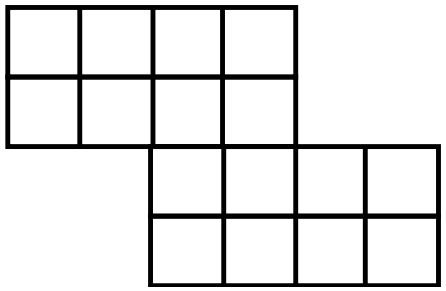
Given a sheet of 16 stamps as shown, the number of ways of choosing three connected stamps (two adjacent stamps must have an edge in common) is


(A) 40
(B) 41
(C) 42
(D) 44

Problem 13

In an election 320 votes were cast for five candidates. The winner's margins over the other four candidates were $9,13,18$ and 25 . The lowest number of votes received by a candidate was
(A) 49
(B) 50
(C) 51
(D) 52

Problem 14

A competition has 25 questions and is marked as follows


(A) Five marks are awarded for each correct answer to questions 1 to 15
(B) Six marks are awarded for each correct answer to questions 16 to 25
(C) Each incorrect answer to questions 16 to 20 loses 1 mark
(D) Each incorrect answer to questions 21 to 25 loses 2 marks

Problem 15

A, M, T, I are positive integers such that $A+M+T+I=10$. The maximum possible value of A $\times$ M $\times$ T $\times$ I+A $\times$ M $\times$ T+A $\times$ M $\times$ I+A $\times$ T $\times$ I+M $\times$ T $\times$ I+A $\times$ M+A $\times$ T+A $\times$ I+M $\times$ T+M $\times$ I +T $\times$ 1

(A) 109
(B) 121
(C) 133
(D) 144

Part B

Problem 16

The three digit number $\mathrm{XYZ}$ when divided by 8 , gives as quotient the two digit number $\mathrm{ZX}$ and remainder $\mathrm{Y}$. The number $\mathrm{XYZ}$ is$\rule{1cm}{0.15mm}$

Problem 17

The digit sum of any number is the sum of its digits. $\mathrm{N}$ is a 3 digit number. When the digit sum of $\mathrm{N}$ is subtracted from $\mathrm{N}$, we obtain the square of the digit sum of $\mathrm{N}$. The number $\mathrm{N}$ is $\rule{1cm}{0.15mm}$.

Problem 18

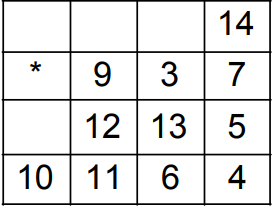
A $4 \times 4$ anti-magic square is an arrangement of the numbers 1 to 16 in a square so that the totals of each of the four rows, four columns and the two diagonals are ten consecutive numbers in some order. The diagram shows an incomplete anti magic square. When it is completed, the number in the position of ${ }^*$ is $\rule{1cm}{0.15mm} $.

Problem 19

An escalator moves up at a constant rate. John walks up the escalator at the rate of one step per second and reaches the top in twenty seconds. The next day John's rate was two steps per second, and he reached the top in sixteen seconds. The number of steps in the escalator is $\rule{1cm}{0.15mm}$

Problem 20

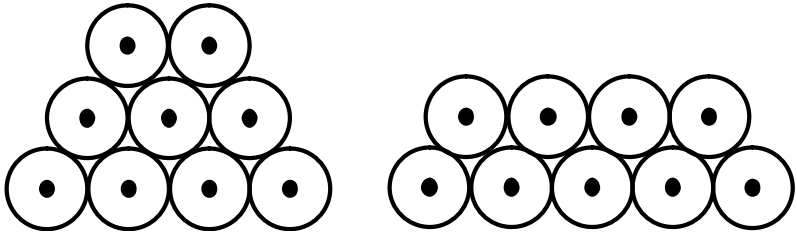
In a stack of coins, each row has exactly one coin less than the row below. If we have nine coins, two such towers are possible. Of these, the tower on the left is the tallest. If you have 2015 coins, the height of the tallest towers is $\rule{1cm}{0.15mm}$.

Problem 21

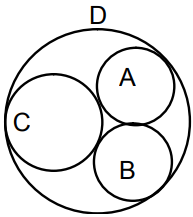
Circles A, B and C are externally tangent to each other and internally tangent to circle D. Circles A and $B$ are congruent. Circle $C$ has radius 1 unit and passes through the centre of circle $D$. Then the radius of circle B is units $\rule{1cm}{0.15mm}$.

Problem 22

The number of different integers $x$ that satisfy the equation $\left(x^2-5 x+5\right)^{\left(x^2-11 x+30\right)}=1$ is $\rule{1cm}{0.15mm}$.

Problem 23

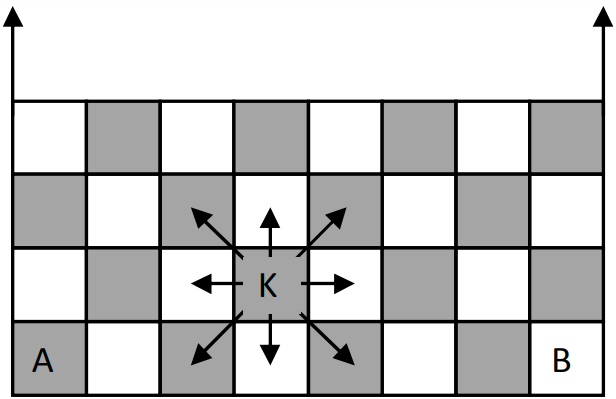
In a single move a King $\mathrm{K}$ is allowed to move to any of the squares touching the square it is on, including diagonals, as indicated in the figure. The number of different paths using exactly seven moves to go from $A$ to $B$ is $\rule{1cm}{0.15mm}$.

Problem 24

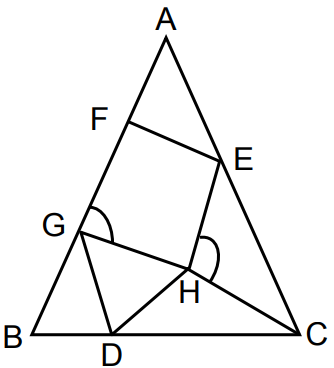
In $\triangle A B C$ shows below, $A B=A C, F$ is a point on $A B$ and $E$ a point on $A C$ such that $A F=E F, H$ is a point in the interior of $\triangle A B C, D$ is a point on $B C$ and $G$ is a point on $A B$ such that $E H=C H=D H=G H=D G$ $=\mathrm{BG}$. Also, $\angle \mathrm{CHE}=\angle \mathrm{HGF}$. The measure of $\angle \mathrm{BAC}$ in degree is $\rule{1cm}{0.15mm}$.

Problem 25

Let $x$ and $y$ be real numbers satisfying $x^4 y^5+y^4 x^5=810$ and $x^3 y^6+y^3 x^6=945$. Then the value of $2 x^3+$ $x^3 y^3+2 y^3$ is $\rule{1cm}{0.15mm}$.