Australian Mathematics Competition - 2022 - Middle Primary Years - Grade 3 & 4 - Questions

Problem 1:

How many dots are in this pattern?

(A) 20
(B) 21
(C) 22
(D) 23
(E) 24

Problem 2:

What number is one hundred more than \(465 \) ?

(A) 365
(B) 455
(C) 475
(D) 565
(E) 1465

Problem 3:

What fraction of this rectangle is shaded?

(A) \(\frac{1}{2}\)
(B) \(\frac{1}{4}\)
(C) \(\frac{1}{6}\)
(D) \(\frac{1}{8}\)
(E) \(\frac{1}{10}\)

Problem 4:

There were 17 dogs and 9 ran away. How many dogs were left?

(A) 7
(B) 8
(C) 12
(D) 26
(E) 27

Problem 5:

John is playing a board game. He moves his blue piece (>) one square up then three squares left. Which piece does he land on?

Problem 6:

Which shape is not used in this snowman picture?

(A) circle
(B) oval
(C) triangle
(D) square
(E) rectangle

Problem 7:

Eve starts at 20 and counts up by twos: (20,22,24) and so on. What is the tenth number she counts?

(A) 30
(B) 32
(C) 34
(D) 36
(E) 38

Problem 8:

This graph was made by a Year 3 class. How many students chose either Saturday or Sunday as their favourite day?

(A) 5
(B) 8
(C) 10
(D) 12
(E) 20

Problem 9:
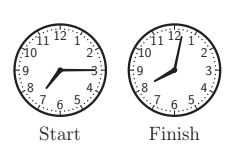
I went for a bike ride this morning. These clocks show my start and finish times.
In minutes, how long was my ride?

(A) 9
(B) 13
(C) 47
(D) 52
(E) 62

Problem 10:

Edie and Louie are standing in a line with other children. Edie is fourth from the front and Louie is fourth from the back of the line. There are 15 children in the line. How many children are between Edie and Louie?

(A) 7
(B) 8
(C) 10
(D) 11
(E) 12

Problem 11:

There are 49 ten-cent coins in my pink piggy bank and 25 twenty-cent coins in my blue piggy bank.
How much money do I have altogether?


(A) \(\$ 7.40\)
(B) \(\$ 9.90\)
(C) \(\$ 12.30\)
(D) \(\$ 14.80\)
(E) \(\$ 990\)

Problem 12:

How many more small cubes are needed to complete this large cube?

(A) 6
(B) 8
(C) 9
(D) 12
(E) 20

Problem 13:

Ms Amali brings 100 stickers to share equally among her class of 23 students. How many stickers will she have left over?

(A) 3
(B) 8
(C) 12
(D) 17
(E) 21

Problem 14:

This card is flipped over its right-hand edge and then flipped again over its bottom edge. What does the card look like now?

Problem 15:

Chris wants to use the same number in both boxes to make this number sentence true. What number should she use?

(A) 1 (B) 2 (C) 3 (D) 4 (E) 5

Problem 16:

Sally says to her brother, 'You are 10 years older than me'. Her brother says, 'You are right, and I am three times your age'. How old is Sally?

(A) 4 (B) 5 (C) 6 (D) 7 (E) 8

Problem 17:

How many of the small coloured tiles are needed to cover the large cross shape shown?

(A) 10
(B) 15
(C) 20
(D) 36
(E) 40

Problem 18:

Siobhan has seven cards, numbered 1 to 7 . She places six of them correctly in the three number sentences. Which card does she have left over?

(A) 1
(B) 2
(C) 3
(D) 5
(E) 7

Problem 19:

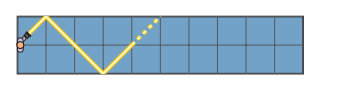
A long rectangular room 10 m long and 2 m wide has mirrors on all four walls. Any beam of light hitting these mirrors bounces back at the same angle as shown below. A guard standing at one end of the room shines a torch at an angle of \(45^{\circ}\) to the walls, making a narrow beam that bounces off the mirrors several times, stopping when it returns to her. How many times does the beam of light bounce off the mirrors?
(A) 7
(B) 9
(C) 10
(D) 11
(E) 22

Problem 20:

A can filled with 30 marbles weighs 115 g . The same can with 20 marbles weighs 85 g . How much does the empty can weigh?

(A) 10 g
(B) 20 g
(C) 25 g
(D) 30 g
(E) 55 g

Problem 21:

Peter wants to buy a length of ribbon to wrap around a box as shown. The box is 20 cm long, 20 cm wide and 20 cm high. It takes an extra 80 cm of ribbon to tie the bow. What is the best estimate of the amount of ribbon that Peter needs to buy to tie around the box?

(A) 160 cm
(B) 180 cm
(C) 240 cm
(D) 280 cm
(E) 320 cm

Problem 22:

In week 1, Hamish and Eliza open bank accounts for their savings. Hamish saves (\$ 12) every two weeks, starting in week 1 . Eliza saves (\$ 32) in week 1 and then (\$ 4) every week after that. When will they first have the same amount of money in the bank?

(A) week 3
(B) week 5
(C) week 7
(D) week 9
(E) week 11

Problem 23:

A different whole number is placed in each corner of a square. Two numbers joined by an edge must have a difference of more than 1. When the four numbers are added together, what is the smallest possible total?

(A) 10
(B) 11
(C) 12
(D) 13
(E) 14

Problem 24:

Three whole numbers add to 21 . When these same three numbers are multiplied together they equal 280 . What is the smallest of these three numbers?

(A) 1
(B) 2
(C) 4
(D) 7
(E) 10

Problem 25:

Steven made this cube from a paper net, then pushed a pin through it as shown. He then removed the pin, leaving holes in the cube, and unfolded the cube back to its net. Which of the following could be the net of Steven's cube?

Problem 25:


I notice that my electricity meter currently reads 896754 units, where all the digits are different. How many more units of electricity will I need to use before all the digits are again different?

Problem 27:

How many whole numbers between 200 and 500 contain the digit 3 ?

Problem 28:

On a digital display, a combination of bars light up to represent each digit as shown:
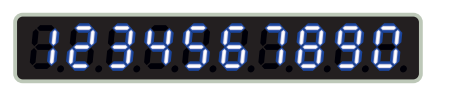
In some special numbers, the number of bars which light up in the digits is the same as the sum of the digits. For example, in 373 the number of bars is (5+3+5=13) which is the equal to (3+7+3=13). What is the largest such three-digit number?

Problem 29

Nguyen writes down some numbers according to the following rules. Starting with the number 1 , he doubles the number and adds 4 , so the second number he writes is 6 . He now repeats this process, starting with the last number written, doubling and then adding 4, but he doesn't write the hundreds digit if the number is bigger than 100 . What is the 2022nd number that Nguyen writes down?

Problem 30:

I choose three different numbers out of this list and add them together: 1, 3, 5, 7, 9,…, 105 How many different totals can I get?
Australian Mathematics Competition 2019 - Middle Primary Year 3 and 4 - Problems & Solutions

Problem 1:

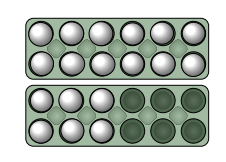
How many eggs are in these cartons?

(A) 12
(B) 15
(C) 16
(D) 18
(E) 21

Problem 2:

Which one of the following is the largest number?

(A) 401
(B) 410
(C) 14
(D) 140
(E) 44

Problem 3:

Which of the following is equal to 3 m?

(A) 3 cm
(B) 30 cm
(C) 300 cm
(D) 3000 cm
(E) 36 cm

Problem 4:

A bowl has 8 peaches. After the children take one each, there is one peach left. How many children are there?

(A) 5
(B) 6
(C) 7
(D) 8
(E) 9

Problem 5:

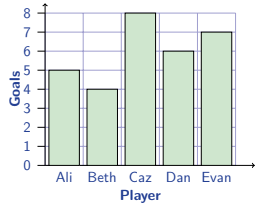
A Runnyball team has 5 players.This graph shows the number of goals each player scored in a tournament. Who scored the second-highest number of goals?

(A) Ali
(B) Beth
(C) Caz
(D) Dan
(E) Evan

Problem 6:

The next counting number after 1089 is

(A) Ali
(B) Beth
(C) Caz
(D) Dan
(E) Evan

Problem 7:

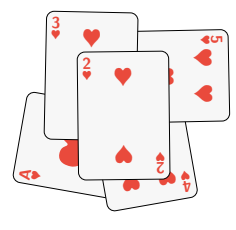
These cards were dropped on the table, one at a time. In which order were they dropped?

Problem 8:

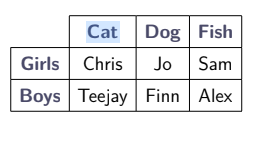
The table shows the pets six children own. Which boy owns a dog?

Problem 9:

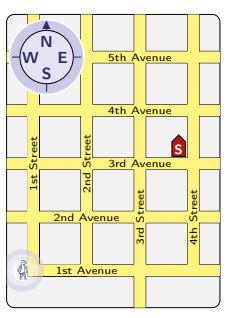
Sophia is at the corner of 1st Street and 1st Avenue. Her school is at the corner of 4th Street and 3rd Avenue. To get there, she walks

Problem 10:

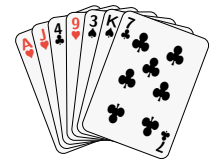
Jake is playing a card game, and these are his cards. Elena chooses one card from Jake at random. Which of the following is Elena most likely to choose?

\((\mathrm{A})\) a heart \((\boldsymbol{})\)
(B) a diamond \( (\stackrel{)}{ }\)
(C) a spade
(D) a picture card (J, Q or K)
(E) an even-numbered card

Problem 11:

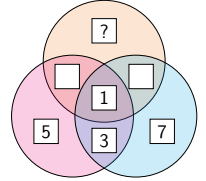
In Jacqui's puzzle, a number is put in each box. In each circle, the four numbers must add to 13 .


Which number goes in the top box?
(A) 2
(B) 3
(C) 4
(D) 5
(E) 6

Problem 12:

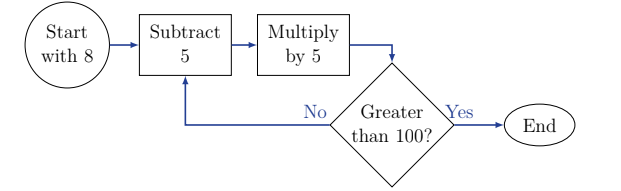
Noah follows the instructions in this flow chart. What number does he end with?


(A) 120
(B) 150
(C) 200
(D) 225
(E) 250

Problem 13:

On this number line, where would the number \(\frac{1}{2}\) be?


(A) A
(B) B
(C) C
(D) D
(E) E

Problem 14:

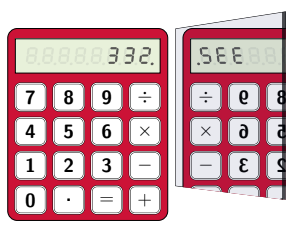
When Bessie puts a mirror next to her calculator, the digits sometimes spell words in the mirror. Which number spells 'BESSIE' in the mirror?


(A) 315538
(B) 835513
(C) 832213
(D) 815312
(E) 312238

Problem 15:

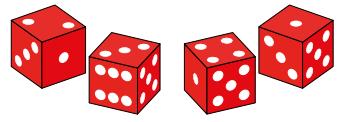
Looking at this view of four dice, how many dots cannot be seen?


(A) 21
(B) 28
(C) 32
(D) 36
(E) 45

Problem 16:

A pencil costs 25 cents and a ruler costs 80 cents. With (\$ 5) I bought one ruler and as many pencils as I could afford.


What change did I get?
(A) 25 cents
(B) 20 cents
(C) 15 cents
(D) 10 cents
(E) 5 cents

Problem 17:

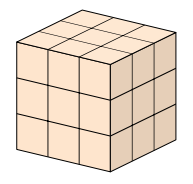
27 identical cubes are used to make this $3 \times 3 \times 3$ cube.How many more are needed to make a $4 \times 4 \times 4$ cube?


(A) 1
(B) 25
(C) 27
(D) 36
(E) 37

Problem 18:

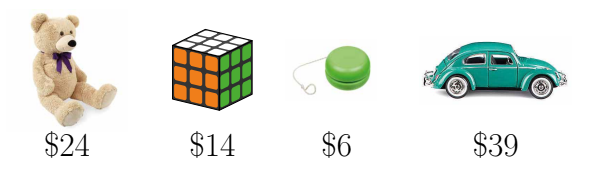
Meena has a (\$ 50) gift voucher to spend in a toyshop, but they won't give change from the voucher. Here is a short list of toys she would like. She tried to spend as much of the (\$ 50) as possible.

\$24
\$14
\$6
\$39
If she buys no more than one of each toy, how much of the voucher will not get used?

(A) (\$ 1)
(B) (\$ 3)
(C) (\$ 5)
(D) (\$ 7)
(E) (\$ 9)

Problem 19:

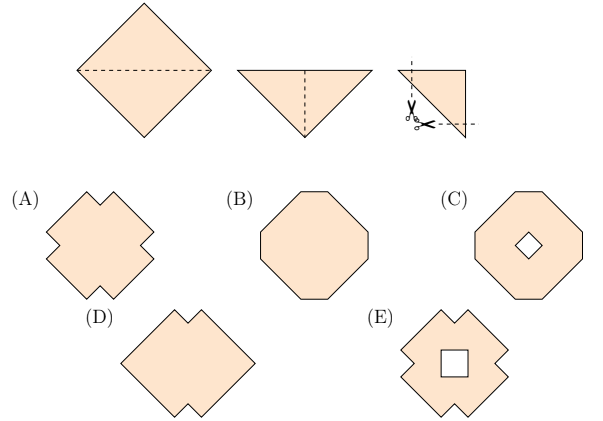
A square piece of paper is folded twice along its diagonals, as shown in the diagram. Two corners are then cut off. When the paper is unfolded, what will it look like?

Problem 20:

It takes Preeti 30 minutes to walk to school. Sometimes she goes on her bike and she cycles twice as fast as she walks. Occasionally, her mother takes her in the car, which goes three times as fast as her bike. How many minutes does it take to get to school in the car?
(A) 2
(B) 4
(C) 5
(D) 10
(E) 15

Problem 21:

In my dance class, 14 students are taller than Bob, and 12 are shorter than Alice. Four students are both shorter than Alice and taller than Bob. How many students are in my dance class?
(A) 22
(B) 24
(C) 26
(D) 28
(E) 30

Problem 22:

My sister and I are playing a game where she picks two counting numbers and I have to guess them. When I tell her a number, she multiplies my number by her first number and then adds her second number. When I say 15 , she says 50 . When I say 2 , she says 11 . If I say 6 , what should she say?


(A) 23
(B) 27
(C) 35
(D) 41
(E) 61

Problem 23:

A year 6 student saved 100 cents in 5 days, each day saving 5 cents more than the previous day. How many cents did she save on the fifth day?
(A) 20 cents
(B) 25 cents
(C) 30 cents
(D) 40 cents
(E) 50 cents

Problem 24:

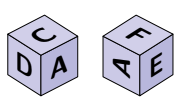
A cube has the letters A, M, C, D, E and F on its six faces. Two different views of the cube are shown. I place the cube on the table so that the front shows \(\mathbf{C}\). If I look at the back of the cube, what will I see?

Problem 25:

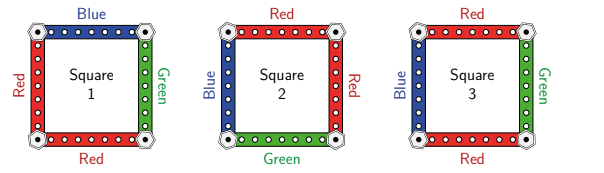
Shirley has six pieces of her construction kit: two red, two blue and two green. She wants to build a square using four of the pieces.

Shirley considers Square 1 below to be the same as Square 2, since the colours match once Square 2 is turned over and rotated. However she considers Square 3 to be different from Square 1, since no matter how it is turned, the two red sides are always opposite, and cannot match Square 1.

How many different squares could she build?

(A) 4
(B) 8
(C) 12
(D) 16
(E) 18

Problem 26:

At my local greengrocer, you take a ticket from the machine and wait until your number is called. The roll of tickets goes from 000 up to 999. When I was there last week with my neighbour, we took two tickets in a row and our two numbers added to 777 .


What was the next ticket number after ours?

Problem 27:

There are 390 children at a summer camp. One-third of the number of girls is equal to one-half of the number of boys. How many girls are there?

Problem 28:

How many of the numbers from 100 to 999 have exactly one zero digit?

Problem 29:

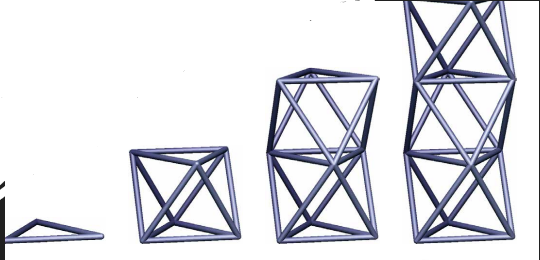
A tower is built from exactly 2019 equal rods. Starting with 3 rods as a triangular base, more rods are added to form a regular octahedron with this base as one of its faces. The top face is then the base of the next octahedron. The diagram shows the construction of the first three octahedra.


How many octahedra are in the tower when it is finished?

Problem 30:

John is one year older than his wife Mary. They have three children, whose ages are two years apart. The product of John and Mary's ages is less than 2019. The product of the three children's ages is also less than 2019. Next year both these products will be greater than 2020 . This year, what is the sum of all five ages?