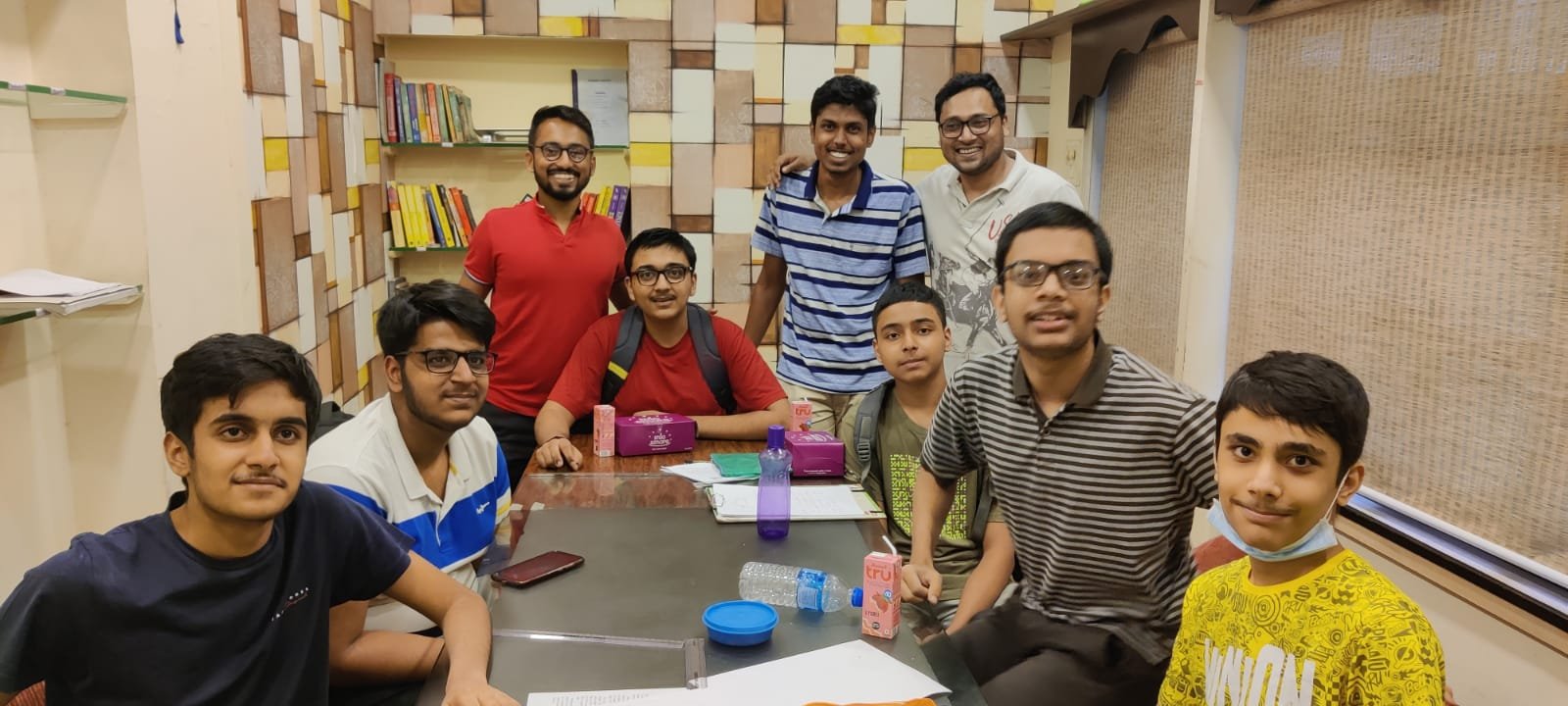
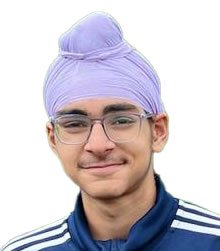
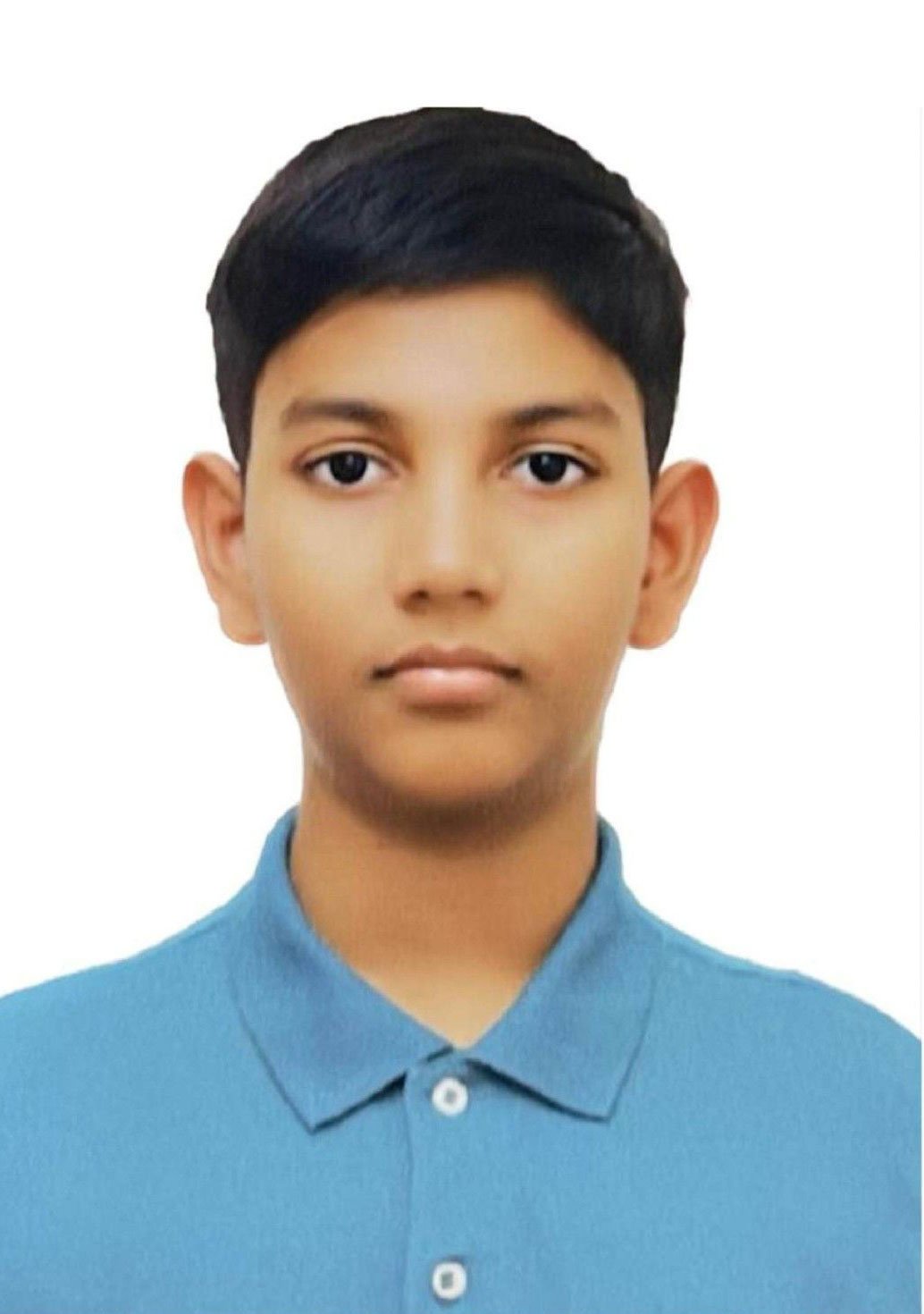
Arjun Gupta is one of the brightest young minds, who has made remarkable achievements in the world of Math Olympiads.
Arjun’s mathematical story includes success in the IOQM 2023 and RMO 2023, where his performance placed him among the top math talents in India. With focused preparation and strong mentorship at Cheenta, he went on to qualify for the INMO (Indian National Mathematical Olympiad) — a highly competitive stage. His success at INMO led him to the prestigious INMO Training Camp (INMOTC), where India’s most promising young mathematicians train for international excellence.
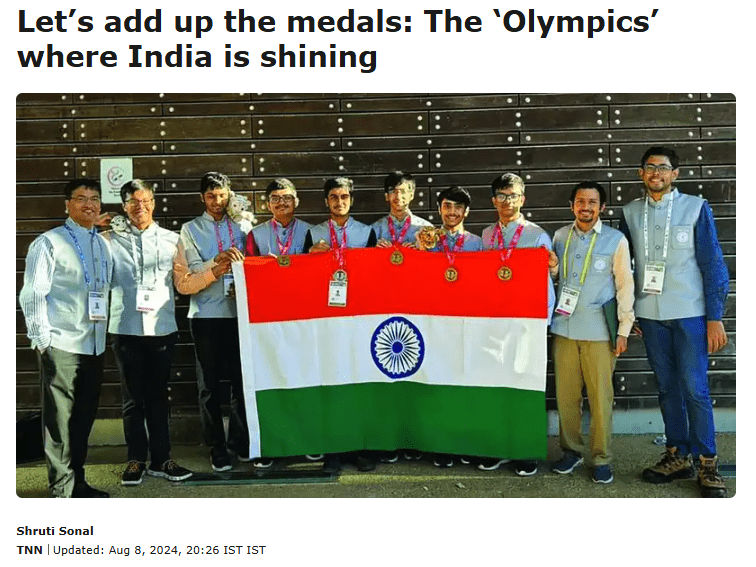
Arjun reached one of the highest school-level math competitions by representing India at the International Mathematical Olympiad (IMO). He won both bronze and gold medal at the IMO, which placed him among the world’s top young mathematicians from India.
Arjun’s love for problem-solving also led him to the Sharygin Geometrical Olympiad 2022, an international contest that focuses on deep geometrical thinking.
In 2025, Arjun achieved another goal by gaining admission to Cambridge University, along with three other Cheenta students who were accepted into Cambridge University.
But Arjun’s talent doesn’t stop at mathematics. He is also an internationally accomplished chess player. In his own words:
“Apart from Math, I love Chess such that I represented India twice in the World Youth Chess Championship category besides winning other Asian and National Chess Competitions.”
His achievements in IMO were recognized widely, including a special feature in the Times of India, celebrating Cheenta students' contributions to the world of Olympiads. Here is the link of the article.
Counting Chains with Casework in Combinatorics: A Problem from the RMO 2024
In this exploration, we dive into a combinatorial problem from the 2024 Regional Math Olympiad (RMO) in India, centered on counting specific number sequences, called "chains." Using a function \ (f(n) \), defined as the number of chains that start at 1 and end at \( n \) with each previous number dividing the next, the problem applies strategic casework to calculate \( f(2^m \cdot 3) \).
We want to determine: \(f(2^m \cdot 3)\) where each chain is a sequence that:
Begins at 1 and ends at \( 2^m \cdot 3 \),
Has each term dividing the next.
Concepts Used:
Combinatorial Casework: Breaking down problems by considering specific scenarios helps in counting complex structures systematically.
Binomial Theorem: Key in calculating possible combinations, where the sum of binomial coefficients up to \( n \) equals \( 2^n \).
Watch the Video
Solution Outline:
The solution involves structured casework using the position of the first appearance of 3 as a "switch" to organize sub-cases.
Understanding Chains
For example, \( f(4) \) is the number of "4-chains" starting at 1 and ending at 4, where each term divides the next, such as \( [1, 4] \) and \( [1, 2, 4] \).
Casework on Position of 3:
Identify when 3 first appears in the sequence, which can happen at positions like \( 3, 2^j \cdot 3, \ldots, 2^m \cdot 3 \).
Divide cases based on different powers of 2, allowing systematic counting of sequences in each case.
Applying Binomial Coefficients:
Use binomial coefficients to count the number of valid choices for sequences involving powers of 2 on either side of the appearance of 3.
This yields: \[2^{m-1} \times m + 2^m\]
Final Answer:
By organizing cases and summing possibilities, we obtain the final count: \[2^{m-1} \cdot (m + 2)\]
This problem exemplifies the effectiveness of casework in combinatorics, teaching a methodical approach to counting sequences. Through strategic splitting and summing, it provides a beautiful solution to a challenging problem in combinatorial mathematics.
RMO 2024 - Problems & Solutions
The Regional Mathematical Olympiad (RMO), preceded by the all-India pre-RMO (IOQM) or PRMO, is the first step towards representing India at the global platform for 'mathletes', the International Mathematical Olympiad (IMO).
The RMO is a three-hour written test with six or seven problems. On the basis of the performance in the RMO, a certain number of students are selected from each region to participate in the Indian National Mathematical Olympiad (INMO), second step towards the IMO.
In this post we have added the problems and solutions from the RMO 2024.
Let \(n>1\) be a positive integar. Call a rearrangement \(a_1, a_2, \ldots, a_n\) of \(1,2, \ldots, n\) nice.
If for every \(k=2,3, \ldots, n\), we have that \(a_1+a_2+\cdots+a_k\) is not divisible by \(k\). (a) If \(n>1\) is odd, prove that there is no nice rearrangement of \(1,2, \ldots, n\). (b) If \(n\) is even, find a nice rearrangement of \(1,2, \ldots, n\).
Solution
(a) If $n$ is ODD, then consider any rearrangement $a_1, a_2, \ldots, a_n$.
For $k=n$, we get $a_1+a_2+\cdots+a_n=1+2+\cdots+n=\frac{n(n+1)}{2}=$
$n\left(\frac{n+1}{2}\right)$ which is a multiple of $n$ since $n$ is co-prime to 2 and
thus the condition would be violated rendering the rearrangement 'not nice'.
(b) If $n$ is EVEN, then the following rearrangement is nice.
$$ a_i= \begin{cases}i-1 & , \text { if } i \text { is even } \\ \ i+1 & , \text { if } i \text { is odd }\end{cases} $$
That is, $\left(a_1, a_2, \ldots, a_n\right)=(2,1,4,3,6,5, \ldots, n, n-1)$. This rearrangement is nice because
$$a_1+a_2+\cdots+a_k= \begin{cases}\frac{k(k+1)}{2}=\left(\frac{k}{2}\right)(k+1) & , \text { if } k \text { is even } \\ \ \frac{k(k+1)}{2}+1= k\left(\frac{k+1}{2}\right)+1 & , \text { if } k \text { is odd }\end{cases}$$
Now it is conspicuous that both possible values of the sum are not divisible by $k$ (except for $k=1$ ) because in the first sum, $\frac{k}{2}$ and $k+1$ are relatively prime numbers and in the second sum, it is the next number of a multiple of $k$ which cannot be a multiple of $k$.
Problem 2
For a positive integer (n), let \(R(n)\) be the sum of the remainders when \(n\) is divided by \(1,2, \ldots, n\). For example, \(R(4)=0+0+1+0=1,\ R(7)=0+1+1+3+2+1+0=8\). Find all positive integers \(n\) such that \(R(n)=n-1\).
Solution
Let $n$ be EVEN, then consider the numbers from $\frac{n}{2}+1, \frac{n}{2}+2, \ldots, n-1$. Now, all these numbers bear a quotient of 1 when dividing $n$ because twice of each exceeds $n$. Hence, they leave a remainder of $\frac{n}{2}-1, \frac{n}{2}-2, \ldots, 1$ respectively when dividing $n$ and so the sum of these remainders is no greater than $R(n)$. Thus,
\begin{align*}R(n)&\geq 1+2+\cdots+\left(\frac{n}{2}-1\right)\\&=\frac{\left(\frac{n}{2}-1\right)\left(\frac{n}{2}\right)}{2}\\\Rightarrow n-1&\geq\frac{n^2-2n}{8}\\\Rightarrow n^2-10n+17&\leq 17\\\Rightarrow (n-5)^2&\leq 17\\\Rightarrow n&=2,4,6,8\ (\text{as we assumed $n$ to be EVEN})\end{align*}
Similarly working for $n$ being ODD necessarily yields the remainders $\frac{n-1}{2}, \frac{n-3}{2}, \ldots, 1$ when dividing $n$ and thus
\begin{align*}R(n) &\geq 1+2+\cdots+\frac{n-1}{2}\\\Rightarrow n-1 &\geq \frac{\left(\frac{n-1}{2}\right)\left(\frac{n+1}{2}\right)}{2}\\\Rightarrow n &\leq 7\end{align*} Therefore, in total, we just need to check $R(n)$ value for the numbers $n=$ $1,2,3,4,5,6,7,8$. Manually working on them gives $R(1)=0, R(2)=0, R(3)=$ $1, R(4)=1, R(5)=4, R(6)=3, R(7)=8, R(8)=8$. Hence, the positive integers $n$ such that $R(n)=n-1$ are $\boxed{n=1,5}$.
Problem 3
Let \(A B C\) be an acute triangle with \(A B=A C\). Let \(D\) be the point on \(B C\) such that \(A D\) is perpendicular to \(B C\). Let \(O, H, G\) be the circumcentre, orthocentre and centroid of triangle \(A B C\) respectively. Suppose that \(2 \cdot O D=23 \cdot H D\). Prove that \(G\) lies on the incircle of \( \triangle A B C\).
Solution
Let $I$ be the incenter, center of incircle, of $\triangle A B C . A B=A C \Rightarrow \triangle A B D \cong$ $\triangle A C D$, so we have $A D$ as the perpendicular bisector of $B C$ and the angle bisector of $\angle A$. Thus, $O, G, H, I$ all lie on $A D$. We know that for any triangle, $O, G, H$ are collinear in that order with $O G: G H=1: 2$.
Let $H D=2 x$, then $O D=\frac{23 \cdot H D}{2}=23 x \Rightarrow O H=21 x$. Now, $O G: G H=$ $1: 2 \Rightarrow O G=7 x, G H=14 x, G D=16 x$ as shown. We also know that centroid divides median in the ratio $2: 1 \Rightarrow A G: G D=2: 1 \Rightarrow A G=$ $32 x \Rightarrow A O=25 x$. Now, $O A=O B=25 x$, so in $\triangle O B D$, we have $B D=$ $\sqrt{O B^2-O D^2}=\sqrt{(25 x)^2-(23 x)^2}=4 x \sqrt{6}$. In $\triangle A B D, A B=\sqrt{A D^2+B D^2}=$ $\sqrt{(48 x)^2+96 x^2}=20 x \sqrt{6}$. Hence, the semi-perimeter $s=A B+B D=20 x \sqrt{6}+$ $4 x \sqrt{6}=24 x \sqrt{6}$ and $[A B C]=\frac{1}{2} \times 2 B D \times A D=192 x^2 \sqrt{6}$.
Thus, inradius $r=\frac{\mid A B C]}{s}=\frac{192 x^2 \sqrt{6}}{24 x \sqrt{6}}=8 x \Rightarrow I D=8 x$. Thus, $G I=G D-I D=$ $16 x-8 x=8 x$ and as we already know that $8 x$ is the radius of incircle, we conclude that $G$ lies on the incircle of $\triangle A B C$.
Problem 4
Let \(a_1, a_2, a_3, a_4\) be real numbers such that \(a_1^2+a_2^2+a_3^2+a_4^2=1\). Show that there exist \(i, j\) with \(1 \leq i<j \leq 4\), such that \(\left(a_i-a_j\right)^2 \leq \frac{1}{5}\).
Solution
Without loss of generality, let $a_1\leq a_2\leq a_3\leq a_4$. Let $d_1= a_2-a_1,\ d_2 = a_3-a_2,\ d_3 = a_4-a_3$ and let $d=min{d_1,d_2,d_3}$.
Case (i) - $d=d_1$ So, $d=a_2-a_1$ and let $x=a_2+\frac{d}{2}\Rightarrow a_2=x-\frac{d}{2},\ a_1=x-\frac{3d}{2}$. So, $a_3=x+\frac{d}{2}+y,\ a_4=x+\frac{3d}{2}+z$, for some $y,z\geq 0$. Then,
Case (ii) - $d=d_2$ So, $d=a_3-a_2$ and let $x=a_2+\frac{d}{2}\Rightarrow a_2=x-\frac{d}{2},\ a_3=x+\frac{d}{2}$. So, $a_1=x-\frac{3d}{2}-z,\ a_4=x+\frac{3d}{2}+y$, for some $y,z\geq 0$. Then,
Case (iii) - $d=d_3$ So, $d=a_4-a_3$ and let $x=a_3-\frac{d}{2}\Rightarrow a_3=x+\frac{d}{2},\ a_4=x+\frac{3d}{2}$. So, $a_2=x-\frac{d}{2}-y,\ a_1=x-\frac{3d}{2}-z$, for some $y,z\geq 0$. Then,
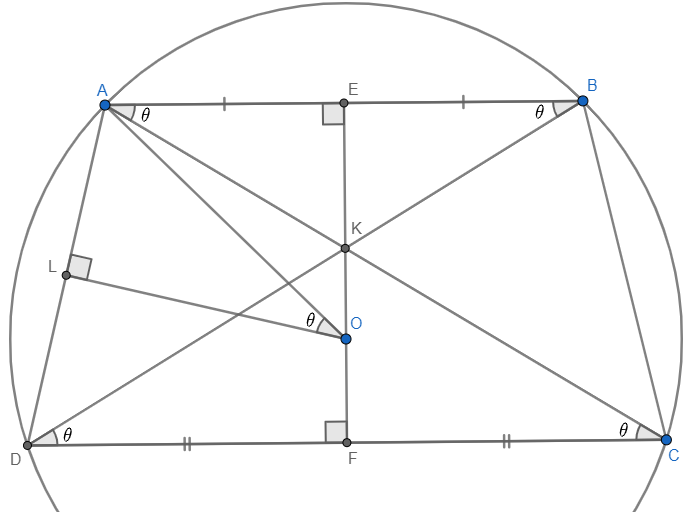
Let \(A B C D\) be a cyclic quadrilateral such that \(A B\) is parallel to \(C D\). Let \(O\) be the circumcentre of \(A B C D\), and \(L\) be the point on \(A D\) such that \(O L\) is perpendicular to \(A D\). Prove that
\(O B \cdot(A B+C D)=O L \cdot(A C+B D) \)
Solution
Let $\angle ABD=\theta\Rightarrow\angle BDC=\theta$ (since $AB||CD$). By the Inscribed angle theorem, $\angle BAC=\angle BDC=\angle ABD=\angle ACD=\theta$ (thus $ABCD$ is isoceles trapezoid). Hence, $\triangle ABK, \triangle CDK$ are isoceles and so $AB, CD$ have common perpendicular bisector through $K$ which also passes through center of circle $O$, making $E,K,O,F$ collinear as shown.
Now, by the Inscribed angle theorem, $\angle AOD=2\theta\Rightarrow\angle AOL=\theta$ since $\triangle AOD$ is isoceles. Thus, $\cos{\theta}=\frac{OL}{OA}\rightarrow\boxed{eq1}$.
In $\triangle ABK, \cos{\theta}=\frac{AE}{AK}=\frac{BE}{BK}$ and so by the componendo-dividendo rule, $\cos{\theta}=\frac{AE+BE}{AK+BK}=\frac{AB}{AK+BK}$. Similarly, in $\triangle CDK, \cos{\theta}=\frac{CF}{CK}=\frac{DF}{DK}=\frac{CF+DF}{CK+DK}=\frac{CD}{CK+DK}$. Combining these two results and applying componendo-dividendo rule once again, we get, $\cos{\theta}=\frac{AB}{AK+BK}=\frac{CD}{CK+DK}=\frac{AB+CD}{AK+BK+CK+DK}=\frac{AB+CD}{AC+BD}\rightarrow\boxed{eq2}$.
From the equations $eq1$ and $eq2$, we conclude that $\cos{\theta}=\frac{OL}{OA}=\frac{AB+CD}{AC+BD}\Rightarrow \boxed{OB \cdot(A B+C D)=O L \cdot(A C+B D)}$, since $OA=OB=radius$.
Problem 6
Let \(n \geq 2\) be a positive integer. Call a sequence \(a_1, a_2, \cdots, a_k\) of integers an \(n\)-chain if \(1=a_1<a_2<\cdots<a_k=n\), and \(a_i\) divides \(a_{i+1}\) for all \(i, 1 \leq i \leq k-1\). Let \(f(n)\) be the number of \(n\)-chains where \(n \geq 2\). For example, \(f(4)=2\) corresponding to the 4 -chains $(1, 4)$ and $(1, 2, 4)$. Prove that \(f\left(2^m \cdot 3\right)=2^{m-1}(m+2)\) for every positive integer \(m\).
Solution
39 Cheenta students succeeded in IOQM 2024
39 Cheenta students qualified for IOQM 2024 (RMO cut-off). About 130 kids students appeared in the contest from Cheenta this year making the success rate about 30%.
This remarkable achievement is the result of months of dedicated effort. Most of these students regularly participated in
Here are some of the qualified students who additionally qualified for Cheenta Advanced Math Expert Certification. Cheenta certifications are for pure mathematics, computer science, statistics, physics and research. They are accepted by our collaborating institutions for scholarships, internships and work-study opportunities.
Aditya Punatar
Saket Anand Gudadhe
Vihaan Shah
Kiaan Sawant
Ritam Das
Ambar Agarwal
Saisha Ganjiwale
Adhiraj Singh Anand
Divij Gupta
Soham Bharati
Shamik Saraswati
Krishiv Mohan
Souradip Das
Vismayah A. Mathew
Raghav Pai
Jayaditya Gupta
Avigyan Chakraborty
Alivia Roy
Advitya R
Nikhil Ganesh Chaudhury
S. Ashwin
Reyaansh Agrawal
Ayaan Kalra
Arnav Tayal
Neel Avinash
IOQM 2024 - Problems and Solutions
IOQM is the first level of (real) math olympiad in India. More than a 100,000 students take it every year. Success in IOQM leads to the second level which is RMO (Regional Math Olympiad) and third level INMO (Indian National Math Olympiad).
In this post we have added the problems and solutions from the IOQM 2024.
The smallest positive integer that does not divide $ \times 2 \times 3 \times 4 \times 5 \times 6 \times 7 \times 8 \times 9$ is:
Solution
Since this is 9 ! it will be divisible by all the numbers from $1-9$. Also, 9 ! contains $2 * 5=10$, it is divisible by 10 . Lets check for 11 . Since 11 is a prime number : 9! will not be divisible by 11 . So, the smallest positive number that does not divides $1 \times 2 \times \times 3 \times 4 \times 5 \times 6 \times$ $7 \times 8 \times 9$ is 11 .
Problem 2
The number of four-digit odd numbers having digits $1,2,3,4$, each occuring exactly once, is:
Solution
Number of odd numbers that we can form using $1,2,3,4$ without repeating implies that ones digit is either 1 or 3 . Rest of the three places can be occupied any of the remaining three digits. So the number of total ways $=3 \times 2 \times 1 \times 2=12$.
Problem 3
The number obtained by taking the last two digits of $5^{2024}$ in the same order is:
Solution
Last two digits of $5^n=25$
Problem 4
Let $A B C D$ be a quadriateral with $\angle A D C=70^{\circ}, \angle A C D=70^{\circ}, \angle A C B=10^{\circ}$ and $\angle B A D=110^{\circ}$. The measure of $\angle C A B$ (in degrees) is:
Problem 5
Let $a=\frac{x}{y}+\frac{y}{z}+\frac{z}{x}$, let $b=\frac{x}{z}+\frac{y}{x}+\frac{z}{y}$ and let $c=\left(\frac{x}{y}+\frac{y}{z}\right)\left(\frac{y}{z}+\frac{z}{x}\right)\left(\frac{z}{x}+\frac{x}{y}\right)$. The value of $|a b-c|$ is:
Solution
$a=\frac{x}{y}+\frac{y}{z}+\frac{z}{x}=\frac{x^2 z+y^2 x+z^2 y}{x y z}$
$b=\frac{x}{z}+\frac{y}{x}+\frac{z}{y}=\frac{x^2 y+y^2 z+z^2 x}{x y z}$
Find the number of triples of real numbers $(a, b, c)$ such that $a^{20}+b^{20}+c^{20}=a^{24}+b^{24}+c^{24}=1$
Solution
The triples $(a, b, c)$ is $(1,0,0),(0,1,0),(0,0,1),(-1,0,0),(0,-1,0),(0,0,-1)$
Problem 7
Determine the sum of all possible surface areas of a cube two of whose vertices are $(1,2,0)$ and $(3,3,2)$.
Solution
Notice that the distance between the points $(1,2,0)$ and $(3,3,2)=$ $\sqrt{2^2+1^2+2^2}=3$.
In the cube, we can have the vertices $(1,2,0)$ and $(3,3,2)$ as endpoints of a side of a cube (or) endpoints of a face diagonal (or) endpoints of a main diagonal and there is no other configuration. If $a$ denotes the side length of a cube, then $a=3, a \sqrt{2}=3, a \sqrt{3}=3$ are the only possibilities.
This implies $a=3, \frac{3}{\sqrt{2}}, \sqrt{3}$. We know that the surface area of cube $=$ $6 a^2=6 \times 9$ (or) $6 \times \frac{9}{2}$ (or) $6 \times 3$. Hence, the sum of all possible surface areas $=6 \times 9+6 \times \frac{9}{2}+6 \times 3=6\left(9+\frac{9}{2}+3\right)=99$.
Problem 8
Let $n$ be the smallest integer such that the sum of digits of $n$ is divisible by 5 as well as the sum of digits of $(n+1)$ is divisible by 5 . What are the first two digits of $n$ in the same order?
Solution
Let $S(m)$ denote the sum of digits of a natural number $m$. Notice that, $S(m+1)=S(m)+1$, if $m$ does not end with 9 .
Clearly, if the number $n$ does not end with 9 , then $S(n)$ and $S(n+1)$ would only differ by 1 and hence both of them cannot be divisible by 5 simultaneously. Hence, $n=\overline{x 9}$.
Now, similarly if $x$ does not end with 9 , then $S(n)=S(x)+9 ; S(n+1)=$ $S(x+1)=S(x)+1 \Rightarrow S(n+1)-S(n)=8$, contradiction. Hence, $n=\overline{y 99}$. And again $y$ must end with 9 as otherwise, $S(n+1)-S(n)=9+9-1=17$, contradiction.
If we proceed in this way, then we would get $n=\overline{z 9999}$. Now, for the smallest value of such $n$, we take $z$ to be a single digit number. Note that $9+9+9+9=36$ is 1 modulo 5 and hence we need $z$ to be 4 modulo 5 . Thus, $z=4$ is the least possible such number and hence $n=49999$ is the least possible value of $n$.
Problem 9
Consider the grid of points $X={(m, n) \mid 0 \leq m, n \leq 4}$. We say a pair of points ${(a, b),(c, d)}$ in $X$ is a knight-move pair if $(c=a \pm 2$ and $d=b \pm 1$ ) or ( $c=a \pm 1$ and $d=b \pm 2$ ). The number of knight-move pairs in $X$ is:
Solution
Solution: We will find the possible number of knight-move pairs corresponding to each point and add all of them. But in this counting each point would be over counted exactly twice (as pair consits of two distinct points) and we divide by 2 at last in order to account for it and to get the final answer.
Let us consider only the points in $Y={(m, n) \mid 0 \leq m, n \leq 2} \subset X$ because using symmetry one can extend the number of possible pairs containing that point to all the other points. Counting by this way explicitly, one would get the number of pairs as shown in the diagram.
Hence, the sum of all the numbers $=4 \times(2+3+4+3)+4 \times(4+6)+8=96$. So, final answer $=\frac{96}{2}=48$.
Problem 10
Determine the number of positive integral values of $p$ for which there exists a triangle with sides $a, b$, and $c$ which satisfy
$$ a^2+\left(p^2+9\right) b^2+9 c^2-6 a b-6 p b c=0 . $$
Solution
Notice that
$$ a^2+\left(p^2+9\right) b^2+9 c^2-6 a b-6 p b c=(p b-3 c)^2+(a-3 b)^2=0 $$
Hence, individually the bracket values must be $0 \Rightarrow p b-3 c=0 ; a-3 b=0 \Rightarrow$ $a=3 b ; p b=3 c$. Hence, $(a, b, c)=\left(3 b, b, \frac{p b}{3}\right)$. We know that the necessary and sufficient condition for existence of a triangle is that the largest side being less than sum of other two sides. So, we take two cases now,
If $p<9 \Rightarrow \frac{p b}{3}<3 b \Rightarrow 3 b$ is the largest side. Hence, we need $3b<b+\frac{pb}{3}\Rightarrow p>6$. Hence, the allowed values for this case are $p=7,8$.
If $p \geq 9 \Rightarrow \frac{p b}{3}\geq 3 b \Rightarrow \frac{p b}{3}$ is the largest side. Hence, we need $\frac{p b}{3}<3 b+b \Rightarrow$ $p<12$. Hence, the possible values for this case are $p=9,10,11$.
Hence, there five possible values for $p$ which are $7,8,9,10,11$.
What is the value of $\frac{1}{a}+\frac{1}{b}+\frac{1}{c} ?$
Solution
By adding up the two equations, we would get, $$\frac{a+1}{2b+1}+\frac{2b+1}{3c+1}+\frac{3c+1}{a+1}=3\rightarrow Eq 1$$ Notice that each of these terms are positive real numbers and their product $\frac{a+1}{2b+1}\times\frac{2b+1}{3c+1}\times\frac{3c+1}{a+1}=1$.
Let $\alpha=\frac{a+1}{2b+1},\ \beta=\frac{2b+1}{3c+1},\ \gamma=\frac{3c+1}{a+1}$, then by the AM-GM inequality, $$\frac{\alpha+\beta+\gamma}{3}\geq\left(\alpha\beta\gamma\right)^{\frac{1}{3}}=1$$ with the equality holding true when $\alpha=\beta=\gamma=1$. But from the equation $Eq 1$, we know that the equality holds true and hence $\frac{a+1}{2b+1}=\frac{2b+1}{3c+1}=\frac{3c+1}{a+1}=1\Rightarrow \boxed{a=2b=3c}$. Now, substituting it in the first equation in the question, we get, $a=\frac{1}{2}=2b=3c\Rightarrow\frac{1}{a}+\frac{1}{b}+\frac{1}{c}=12$.
Problem 12
Consider a square $A B C D$ of side length 16. Let $E, F$ be points on $C D$ such that $C E=E F=F D$. Let the line $B F$ and $A E$ meet in $M$. The area of $\triangle M A B$ is:
Solution
Drop perpendiculars from $M$ to $AB, CD$ and let the foot of perpendiculars be $X,Y$ respectively as shown.
Let $a=16=side\ of\ square$. Note that $CE=EF=FD\Rightarrow EF=\frac{a}{3}$. Since, $AB||EF\Rightarrow\triangle ABM\sim\triangle EFM\Rightarrow\frac{MX}{MY}=\frac{AB}{EF}=3$. But, we know that $XY=a\Rightarrow MX=\frac{3a}{4},\ MY=\frac{a}{4}$. Hence, area of $\triangle MAB=\frac{1}{2}\times MX\times AB=\frac{3a^2}{8}=96$.
Problem 13
Three positive integers $a, b, c$ with $a>c$ satisfy the folowing equations:
$$ a c+b+c=b c+a+66, \quad a+b+c=32 $$
Find the value of $a$.
Solution
Problem 14
Initially, there are $3^{80}$ particles at the origin $(0,0)$. At each step the particles are moved to points above the $x$-axis as follows: if there are $n$ particles at any point $(x, y)$, then $\left\lfloor\frac{n}{3}\right\rfloor$ of them are moved to $(x+1, y+1),\left\lfloor\frac{n}{3}\right\rfloor$ are moved to $(x, y+1)$ and the remaining to $(x-1, y+1)$. For example, after the first step, there are $3^{79}$ particles each at $(1,1),(0,1)$ and $(-1,1)$. After the second step, there are $3^{78}$ particles each at $(-2,2)$ and $(2,2), 2 \times 3^{78}$ particles each at $(-1,2)$ and $(1,2)$, and $3^{79}$ particles at $(0,2)$. After 80 steps, the number of particles at $(79,80)$ is:
Solution
Problem 15
Let $X$ be the set consisting of twenty positive integers $n, n+2, \ldots, n+38$. The smallest value of $n$ for which any three numbers $a, b, c \in X$, not necessarily distinct, form the sides of an acute-angled triangle is:
Problem 16
Let $f: \mathbb{R} \rightarrow \mathbb{R}$ be a function satisfying the relation $4 f(3-x)+3 f(x)=x^2$ for any real $x$. Find the value of $f(27)-f(25)$ to the nearest integer. (Here $\mathbb{R}$ denotes the set of real numbers.)
Solution
Problem 17
Consider an isosceles triangle $A B C$ with sides $B C=30, C A=A B=20$. Let $D$ be the foot of the perpendicular from $A$ to $B C$, and let $M$ be the midpoint of $A D$. Let $P Q$ be a chord of the circumcircle of triangle $A B C$, such that $M$ lies on $P Q$ and $P Q$ is parallel to $B C$. The length of $P Q$ is:
Solution
Problem 18
Let $p, q$ be two-digit numbers neither of which are divisible by 10 . Let $r$ be the four-digit number by putting the digits of $p$ followed by the digits of $q$ (in order). As $p, q$ vary, a computer prints $r$ on the screen if $\operatorname{gcd}(p, q)=1$ and $p+q$ divides $r$. Suppose that the largest number that is printed by the computer is $N$. Determine the number formed by the last two digits of $N$ (in the same order).
Problem 19
Consider five points in the plane, with no three of them collinear. Every pair of points among them is joined by a line. In how many ways can we color these lines by red or blue, so that no three of the points form a triangle with lines of the same color.
Solution
Problem 20
On a natural number $n$ you are allowed two operations: (1) multiply $n$ by 2 or (2) subtract 3 from n. For example starting with 8 you can reach 13 as follows: $8 \rightarrow 16 \rightarrow 13$. You need two steps and you cannot do in less than two steps. Starting from 11, what is the least number of steps required to reach 121 ?
Solution
Problem 21
An intenger $n$ is such that $\left\lfloor\frac{n}{9}\right\rfloor$ is a three digit number with equal digits, and $\left\lfloor\frac{n-172}{4}\right\rfloor$ is a 4 digit number with the digits $2,0,2,4$ in some order. What is the remainder when $n$ is divided by $100 ?$
Solution
Problem 22
In a triangle $A B C, \angle B A C=90^{\circ}$. Let $D$ be the point on $B C$ such that $A B+B D=A C+C D$. Suppose $B D: D C=2: 1$. If $\frac{A C}{A B}=\frac{m+\sqrt{p}}{n}$, where $m, n$ are relatively prime positive integers and $p$ is a prime number, determine the value of $m+n+p$.
Solution
Problem 23
Consider the fourteen numbers, $1^4, 2^4, \ldots, 14^4$. The smallest natural number $n$ such that they leave distinct remainders when divided by $n$ is:
using Fermat’s Little theorem we get $a \equiv b(\bmod 31)$ which is not possible hence 31 is the right answer
Problem 24
Consider the set $F$ of all polynomials whose coefficients are in the set of ${0,1}$. Let $q(x)=x^3+x+1$. The number of polynomials $p(x)$ in $F$ of degree 14 such that the product $p(x) q(x)$ is also in $F$ is:
Solution
Problem 25
A finite set $M$ of positive integers consists of distinct perfect squares and the number 92 . The average of the numbers in $M$ is 85 . If we remove 92 from $M$, the average drops to 84 . If $N^2$ is the largest possible square in $M$, what is the value of $N$ ?
$x=16$ satisfies the equation if $\left.\lfloor x\rfloor=17 \Rightarrow 16+15 x+15 x^2\right)=17^3$ has a root in $(17,18)$ But $\lfloor x\rfloor=18$ has no solution $\text { sum }=16+17=33$
Problem 27
In a triangle $A B C$, a point $P$ in the interior of $A B C$ is such that $\angle B P C-\angle B A C=\angle C P A-\angle C B A=\angle A P B-\angle A C B$. Suppose $\angle B A C=30^{\circ}$ and $A P=12$. Let $D, E, F$ be the feet of perpendiculars form $P$ on to $B C, C A, A B$ respectively. If $m \sqrt{n}$ is the area of the triangle $D E F$ where $m, n$ are integers with prime, then what is the value of the product $m n$ ?
Solution
let $\alpha, \beta, \gamma$ be $\angle B P C, \angle C P A, \angle A P C$ respectively.
Find the largest positive integer $n<30$ such that $\frac{1}{2}\left(n^8+3 n^4-4\right)$ is not divisible by the square of ann prime number.
Solution
$f(n)=\frac{n^8+3 n^4-4}{2}$
Note, by Fermat’s little theorem,
$ x^4=1(\bmod 5) $
$ x^8=1(\bmod 5)$
Also, powers of $n$ are even. $n=k(\bmod 25) \quad$ when $k=1,2,3,4$
then $25 / f(n) \Rightarrow n \neq 21,22,23,24,26,27,28,29$ Also note $4 / f(25)$ $\therefore$ largest such $n=20$
Problem 29
Let $n=2^{19} 3^{12}$. Let $M$ denote the number of positive divisors of $n^2$ which are less than $n$ but would not divide $n$. What is the number formed by taking the last two digits of $M$ (in the same order)?
Solution
$n=2^{19} \cdot 3^{12}$
$n^2=2^{19} \cdot 3^{24}$ Let $2^a 3^b$ be such a divisor of $n^2$ which does not divide $n$ but is less than $n$.
Case 1. $a>19, b \leq 12=118$ Case 2. $a \leq 19, b>12=110$
$\therefore 118+110=228 \rightarrow 28$
Problem 30
Let $A B C$ be a right-angled triangle with $\angle B=90^{\circ}$. Let the length of the altitude $B D$ be equal to 12 What is the minimum possible length of $A C$, given that $A C$ and the perimeter of triangle $A B C$ are integers?
There are no Pythagorean triples with hypotenuse = 24.
$\therefore$ least possible $A C=25$
(15, 20, 25 triangle)
Three Resources for IOQM and Math Olympiads
IOQM and other Math Olympiads like American Math Competitions can be really challenging. It requires the student to go beyond the school curriculum and think about non-routine problems. In this post I will share three resources that can help you to systematically take up the preparation.
Books for IOQM and Math Olympiad
In this age of abundance, there is a lot of great books on Math Olympiads. The trick is to choose one relatively good book, and solve all problems from it, cover to cover. In fact we strongly suggest our students to focus on a single book before moving to other resources.
You may start with Challenge and Thrill of Pre-College Mathematics by V Krishnamurthy, C R Pranesachar, and K N Ranganathan. This is an excellent book that covers all the topics for IOQM standard. If you are in Grade 8 or below then use Mathematical Circles (Russian Experience) by Dmitry Fomin, Sergey Genkin, Ilia Itenberg.
Ofcourse there are plenty of other great books. Here are a few of them:
Principles and Techniques in Combinatorics by Chen Chuan-Chon
Number Theory: Structures, Examples, and Problem by Titu Andreescu, Dorin Andrica
Euclidean Geometry in Mathematical Olympiads (EGMO) by Evan Chen
Algebra
Secrets in Inequalities by Pham Kim Huang
Functional Equation by Venkatchala
An Introduction to Diophantine Equations: A Problem-Based Approach by Dorin Andrica, Ion Cucurezeanu, et al.
Complex Numbers from A to Z by by Titu Andreescu and Dorin Andrica
Software for IOQM and Math Olympiad
Cheenta has an excellent software for Math Olympiad, Physics Olympiad and ISI - CMI Entrance related problem solving. This tool provides students with sequence of problem. The software adapts with the child's performance and provides problems accordingly. It is available at https://panini8.com/
The software also lets students ask doubt problems and communicate with fellow learners using Latex. We have observed that children who use this problem solving software for 15 minutes every day experience remarkable improvement in their performance.
Start With a Problem
At Cheenta every learning begins with a
Non-Routine Problem
Try the problems with hints
but try them on your own!
Solve With Hints
Ask Doubts
Cheenta community has hundreds of teachers and students
Ask your doubts. Respond to others.
Learn about your strengths and weaknesses
Know your topicwise progress.
Check Topic Wise Progress
Live Classes for IOQM and Math Olympiad
Cheenta has outstanding program for IOQM and Math Olympiads. Typically the program includes three components.
Compulsory Classes - twice a week
Concept Class
Homework Tutorial
Optional Problem Solving Class - upto five times a week
Optional 1-on-1 Class - for personalisation
Cheenta programs has been extremely successful in mathematical olympiads since 2010. For example in 2024, ten out of 78 students who qualified for Indian National Math Olympiad (from lakhs of Students) were from Cheenta.
Unlocking Math Olympiad Success: Navigating the Maze of Fake vs. Real Olympiads
Hey there, math enthusiasts and aspiring Olympiad champions! 🌟
Welcome back to our Math-related discussion, where we dive deep into the enchanting world of mathematics. Today, we're going to embark on a journey that's both exciting and crucial for every young math prodigy - the quest from Fake Math Olympiads to Real Math Olympiads!
The Olympiad Odyssey Begins
Picture this: Thousands and thousands of bright-eyed students in India, full of mathematical dreams, gearing up for the first level of the prestigious Indian Mathematical Olympiad (IOQM). They're armed with certificates, silver medals, and even gold medals from private Olympiads in their younger years, brimming with excitement and anticipation.
But then, reality strikes, and it's not pretty. Many of these talented youngsters are met with single-digit scores, and some even land a big, fat zero. It's disheartening, to say the least. These students, who are brimming with potential and love for mathematics, find their dreams crashing like a house of cards.
The Fake Olympiad Trap
At Cheenta, our mission is to nurture young mathematical minds, and we've seen this pattern too many times. We've got around five or six hundred students with us right now, and we've been preaching the same message over and over again: "Beware of fake Olympiads!" Why, you ask? Well, here's the scoop.
1. Question Quality: The questions in these private Olympiads often don't even come close to the real deal. They're not challenging enough and don't adequately prepare you for the IOQM.
2. False Hopes: These fake Olympiads dangle the tantalizing carrot of medals and certificates, making students believe they're math geniuses. But when the IOQM reality check arrives, it's often a rude awakening.
Real Olympiads vs. Fake Ones
Now, you might wonder, how do you tell the real Olympiads from the fakes? It's simpler than you think.
1. Organizer Matters: Genuine Olympiads are organized by reputable mathematical associations like the Mathematical Association of America or the Association of Mathematics Teachers of India (AMTI). These contests are gold mines of challenging problems crafted by true mathematical wizards.
2. Avoid Money-Making Schemes: Private Olympiads are often designed solely to make money, and they thrive on false promises. Those shiny gold medals? They're more about marketing than merit.
Nurturing Olympiad Success
So, how did our Cheenta students manage to shine in the IOQM this year? The secret is simple, but it requires dedication. We focus on problem-solving workshops, dedicating five days a week to Olympiad mathematics. It's all about non-routine mathematics and nothing else.
Your Path to Olympiad Glory
Now, here's the action plan for you, whether you're with Cheenta or charting your own course:
1. Consistency is Key: Dedicate at least one hour every day to non-routine mathematics. Consistency is the magic ingredient that fuels cumulative progress.
2. Aim for 3,000 Problems: Challenge yourself to tackle 3,000 problems in a year. For our students, that's 1,000 in class and 2,000 as homework. It's a starting point, but a strong one.
Embrace the Math Journey
Remember, mathematics is not just a subject; it's a world of wonder waiting to be explored. I'm still immersed in it, even at my age, because it's an endless adventure. Dive into the world of mathematics, seek its beauty, and you'll find yourself enchanted.
Join the Conversation!
This might be a one-sided conversation, but it doesn't have to be. Share your thoughts in the comments. What are your experiences with fake Olympiads? Let's discuss and learn together. 🌟
Watch the video by Dr. Ashani Dasgupta Founder - faculty at Cheenta.
IOQM 2022 Part B Problem 3 I Binary Tree & Recursion
Try this beautiful Recursion Problem based on Binary Tree appeared in IOQM 2022 Part B, Problem 3.
IOQM 2022 Part B I Problem 3
For a positive integer $N$, let $T(N)$
denote the number of arrangements
of the integers $\\$ $1,2, \ldots, N$
into a sequence $a_{1}, a_{2}, \ldots, a_{N}$
such that
$a_{i}>a_{2 i}$ for all $i, 1 \leq i<2 i \leq N \\$
and
$a_{i}>a_{2 i+1}$,
for all $i, 1 \leq i<2 i+1 \leq N$.
For example, $T(3)$ is 2 , since
the possible
arrangements are 321 and 312 . (a) Find $T(7)$. (b) If $K$ is the largest non-negative
integer
so that $2^{K}$ divides $T\left(2^{n}-1\right)$,
show that $\\K=$ $2^{n}-n-1$. (c) Find the largest non-negative
integer
$K$ so that
$2^{K}$ divides $T\left(2^{n}+1\right)$.
Key Concepts
Binary Tree
Recursion Relation
Induction
Suggested Book | Source | Answer
Problem Solving Strategies by Arthur Engel
IOQM 2022
$ (i) 80 $
$ (iii)$ The highest power of $2$ dividing $T\left(2^{n}+1\right)$ is $ 2^{n}-1 $
Try with Hints
Create a Binary Tree with nodes using the given numbers as the following rule:
At each node the root is greater than the child node
Observe a bijection between the these nodes and every possible valid arrangements
Observe that the maximum number will be the root. Now try to find how the subsequent nodes will be formed.
Leave the maximum number for the root. Then we would have \(2^{n}-2\) numbers. Now they can be grouped into 2 groups of \(2^{n-1}-1\) numbers each. Try to build a recursion using \(T(N)\). Then observe \[ 2^{n-2} {{2^{n}}\choose {2^{n-1}}} =(2^{n}-1){{2^{n}-2}\choose{2^{n-1}-1}} \]
Then find the highest power of \(2\) which divides\({{2^n}\choose {2^{n-1}}}.\)
Try to solve this similarly as the second part.
Then try to build a recursive relation of the highest power of 2 dividing $T(N)$ an solve it
Answer Key (This is a work in progress, please proceed with caution. We are reviewing some of these answers).
1st Problem - 45
2nd Problem - 68
3rd Problem - 8
4th Problem
5th Problem - 40
6th Problem - 30
7th Problem - 35
8th Problem - 24
9th Problem - 8
10th Problem - 40
11th Problem - 12
12th Problem
Problem 1
Three parallel lines $L_{1}, L_{2}, L_{3}$ are drawn in the plane such that the perpendicular distance between $L_{1}$ and $L_{2}$ is 3 and the perpendicular distance between $L_{2}$ and $L_{3}$ is also $3 .$ A square $A B C D$ is constructed such that $A$ lies on $L_{1}, B$ lies on $L_{3}$ and $C$ lies on $L_{2}$. Find the area of the square.
Ria writes down the numbers $1,2, \ldots, 101$ in red and blue pens. The largest blue number is equal to the number of numbers written in blue and the smallest red number is equal to half the number of numbers written in red. How many numbers did Ria write with red pen?
Solution & Discussion
Claim: Numbers written in blue needs to be consecutive from \(1,2, .[\) where \(B\) is the largest blue no] The smallest required \(\operatorname{no}(\mathrm{r}) \rightarrow B+1\) Total red number \(=2(B+1)\) \[ \begin{gathered} 2(B+1)+B=101 \\ 2 B+B+2=101 \\ 3 B=99 \\ B=33 \end{gathered} \] \[ r=34 \] total req no. \(\rightarrow 2 r=68\)
Problem 3
Consider the set $\mathcal{T}$ of all triangles whose sides are distinct prime numbers which are also in arithmetic progression. Let $\Delta \in \mathcal{T}$ be the triangle with the least perimeter. If $a^{\circ}$ is the largest angle of $\Delta$ and if $L$ is its perimeter, determine the value of $\frac{a}{L}$.
Solution
The triangles in $\tau=\{(a, b, c) | a+b>c, a+d=b, b+d=c, a, b, c \qquad \textrm{are prime}\}$ such that $a$ is less than $b$ is less than $c$. Least such prime tuple is $(3,5,7)$. Therefore, $7^{2}=3^{2}+5^{2}-2.3 .5 . \cos \alpha=>\alpha=120^{\circ}$ Then $\alpha / \mathrm{L}=120 / 15(\mathrm{~L}=$ perimeter $=15)$. Thus $\alpha / L=8$
Problem 4
Consider the set of all 6-digit numbers consisting of only 3 digits, $a, b, c$, where $a, b, c$ are distinct. Suppose the sum of all these numbers is 593999406 . What is the largest remainder when the three digit number $a b c$ is divided by $100 ?$
Solution
It is found that there are \(3^{6} = 729\) numbers where each digit will repeat 243 times. Therefore ,sum of those numbers \(=111111 \times 243(a+b+c).\) So now , \(\frac{593999406}{111111 \times 243}=\mathrm{a}+\mathrm{b}+\mathrm{c}=22.\) To get the maximum remainder, number will be 598 , so \(598 \equiv 98 \text{(mod 100)}.\)
Problem 5
In parallelogram ABCD the longer side is twice the shorter side. Let XYZW be the quadrilateral formed by the internal bisectors of the angles of $A B C D$. If the area of $X Y Z W$ is 10 . find the area of $A B C D$.
Since \(\mathrm{A} \mathrm{X} \| \mathrm{DZ} \Rightarrow \angle \mathrm{AXD}=\angle \mathrm{ZDX}\) \[ \begin{aligned} &\angle \mathrm{ADX}=\angle \mathrm{ZDX} \\ &\angle \mathrm{AXD}=\angle \mathrm{ADX} \\ &\mathrm{AD}=\mathrm{AX} \end{aligned} \] \( A X Z D\) will be rhombus
Let $x, y, z$ be positive real numbers such that $x^{2}+y^{2}=49 \cdot y^{2}+y z+z^{2}=36$ and $x^{2}+\sqrt{3} x z+z^{2}=25$. If the value of $2 x y+\sqrt{3} y z+z x$ can be written as $p \sqrt{q}$ where $p, q$ are integers and $q$ is not divisible by square of any prime number, find $p+q$.
Find the number of maps $f:\{1,2,3\} \longrightarrow\{1,2,3,4,5\}$ such that $f(i) \leq f(j)$ whenever $i$
Solution
You have to choose the 3 function values $f(1), f(2), f(3)$ from 5 possibilities, with repetition allowed. The order of the 3 chosen numbers is not important, because once you have chosen them, the condition $f(i) \leq f(j)$ tells you which is $f(1)$, which is $f(2)$ and which is $f(3)$. The number of choices of 3 elements from 5 , with order not important and repetition allowed, is $$ C(5+3-1,3)=C(7,3)=35 $$
Problem 8
For any real number $t$, let $\lfloor t\rfloor$ denote the largest integer $\leq t$. Suppose that $N$ is the greatest integer such that $$ [\sqrt{[\sqrt{[\sqrt{N}]}]}]=4 $$ Find the sum of digits of $N$..
Let $P_{0}=(3,1)$ and define $P_{n+1}=\left(x_{n}, y_{n}\right)$ for $n \geq 0$ by $$ x_{n+1}=-\frac{3 x_{n}-y_{n}}{2}, \quad y_{n+1}=-\frac{x_{n}+y_{n}}{2} $$ Find the area of the quadrilateral formed by the points $P_{96}, P_{97}, P_{98}, P_{99}$.
Problem 10
Suppose that \(P\) is the polynomial of least degree with integer coefficients such that \(P(\sqrt{7}+\sqrt{5})=2(\sqrt{7}-\sqrt{5})\). Find \(P(2)\).
In how many ways can four married couples sit in a merry-go-round with identical seats such that men and women occupy alternate seats and no husband seats next to his wife?
Solution
The number of ways the husbands can seat is $3!=6$. The first wife is having 2 options the rest are having only one option each. Hence the total possibility is $3! \times 2=12$.
Problem 12
A $12 \times 12$ board is divided into 144 unit squares by drawing lines parallel to the sides. Two rooks placed on two unit squares are said to be non attacking if they are not in the same column or same row. Find the least number $N$ such that rooks are placed on the unit squares, one rook per square, we can always find 7 rooks such that no two are attacking each other.
Solution
Part B
Problem 1
Let $D$ be an interior point on the side $B C$ of an acute-angled triangle $A B C$. Let the circumcircle of triangle $A D B$ intersect $A C$ again at $E(\neq A)$ and the circumcircle of triangle $A D C$ intersect $A B$ again at $F(\neq A)$. Let $A D, B E$ and $C F$ intersect the circumcircle of triangle $A B C$ again at $D_1(\neq A), E_1(\neq B)$ and $F_1(\neq C)$, respectively. Let $I$ and $I_1$ be the incentres of triangles $D E F$ and $D_1 E_1 F_1$, respectively. Prove that $E, F, I, I_1$ are concyclic.
Problem 2
Find all natural numbers $n$ for which there exists a permutation $\sigma$ of $1,2, \ldots, n$ such that $$ \sum_{i=1}^n \sigma(i)(-2)^{i-1}=0 . $$
Note: A permutation of $1,2, \ldots, n$ is a bijective function from ${1,2, \ldots, n}$ to itself.
Problem 3
For a positive integer $N$, let $T(N)$ denote the number of arrangements of the integers $1,2, \ldots, N$ into a sequence $a_1, a_2, \ldots, a_N$ such that $a_i>a_{2 i}$ for all $i, 1 \leq i<2 i \leq N$ and $a_i>a_{2 i+1}$, for all $i, 1 \leq i<2 i+1 \leq N$. For example, $T(3)$ is 2 , since the possible arrangements are 321 and 312 . (a) Find $T(7)$. (b) If $K$ is the largest non-negative integer so that $2^K$ divides $T\left(2^n-1\right)$, show that $K=$ $2^n-n-1$. (c) Find the largest non-negative integer $K$ so that $2^K$ divides $T\left(2^n+1\right)$.