Australian Mathematics Competition - 2022 - Upper Primary Division - Grades 5 & 6- Questions and Solutions

Problem 1:

What number is two hundred and five thousand, one hundred and fifty?

(A) 150 (B) 205 (C) 20150 (D) 25150 (E) 205150

Problem 2:

What fraction of this picture is shaded?
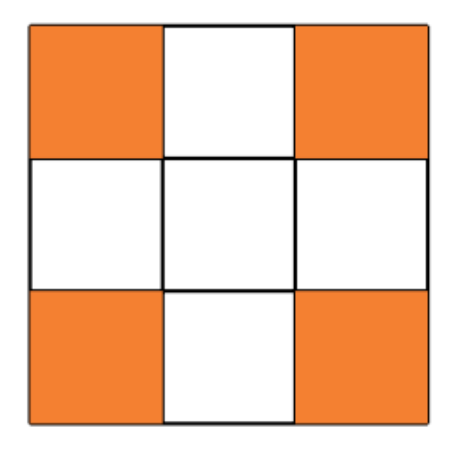

(A) $\frac{1}{2}$ (B) $\frac{2}{3}$ (C) $\frac{3}{4}$ (D) $\frac{4}{9}$ (E) $\frac{5}{9}$

Problem 3:

$2220-2022=$

(A) 18 (B) 188 (C) 198 (D) 200 (E) 202

Problem 4:

Audrey wrote these three numbers in order from smallest to largest:

$$
\begin{array}{llll}
1.03 & 0.08 & 0.4
\end{array}
$$

In which order did she write them?

(A) $0.08,1.03,0.4$ (B) $0.08,0.4,1.03$ (C) $0.4,0.08,1.03$
(D) $0.4,1.03, .008$ (E) $1.03,0.4,0.08$

Problem 5:

I was 7 years old when my brother turned 3. How old will I be when
he turns 7?

(A) 9 (B) 10 (C) 11 (D) 12 (E) 13

Problem 6:

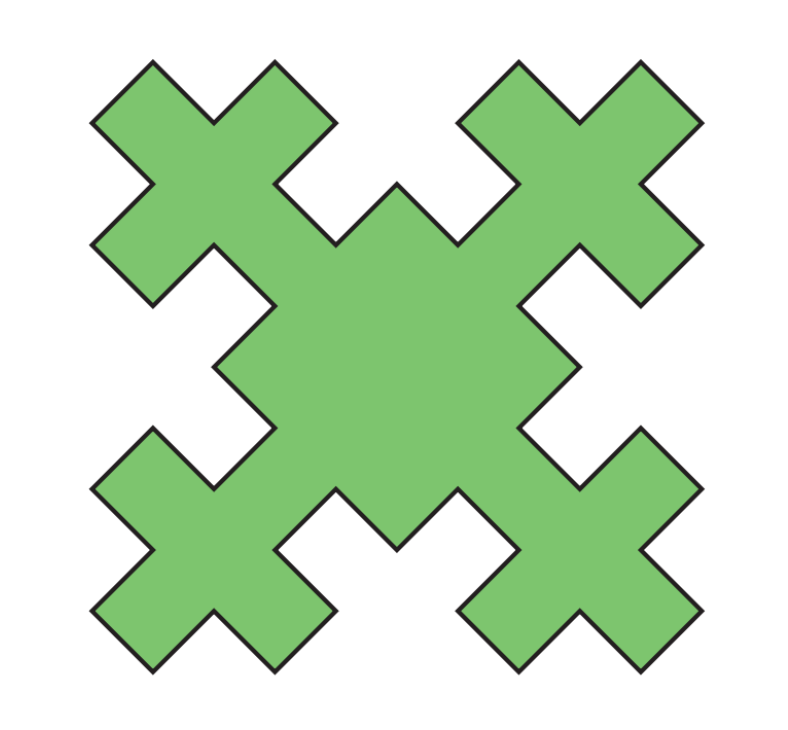
This shape is built from 29 squares, each $1 \mathrm{~cm} \times 1 \mathrm{~cm}$. What is its perimeter in centimetres?
(A) 52 (B) 58 (C) 60 (D) 68 (E) 72

Problem 7:

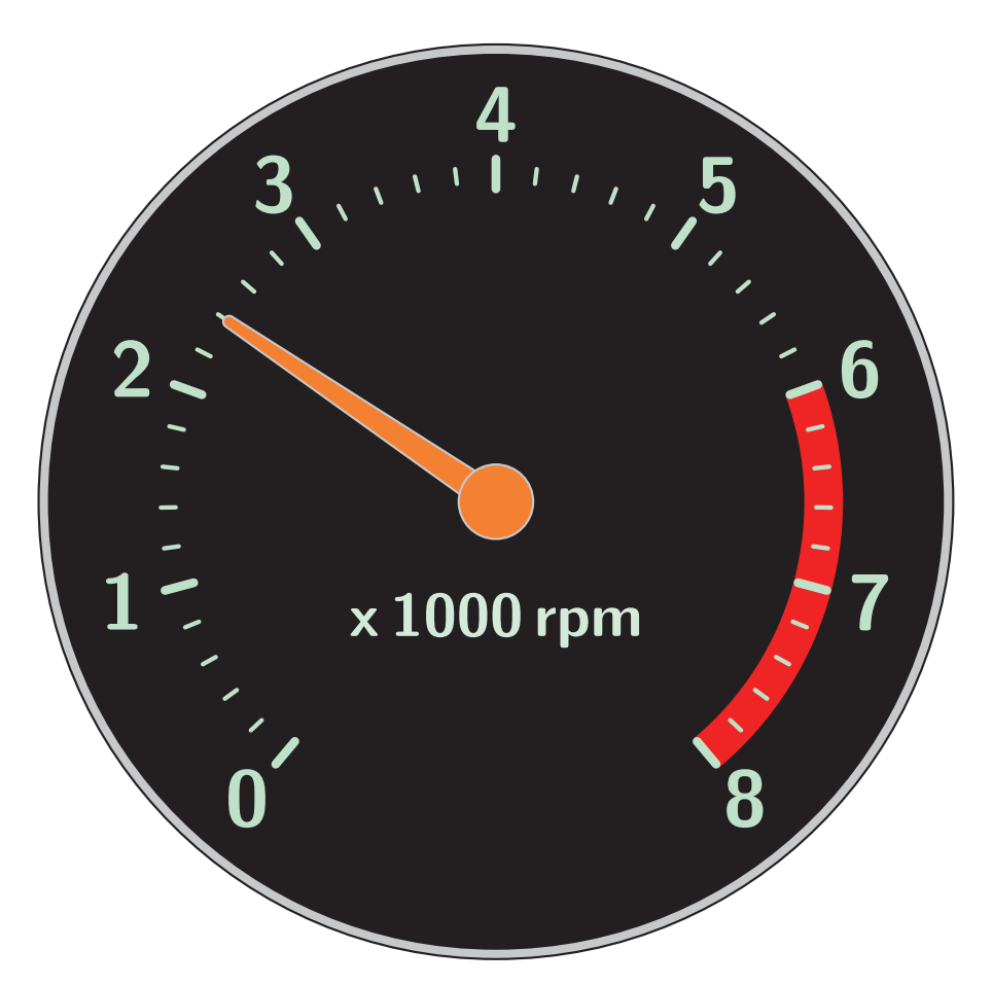
A tachometer indicates how fast the crankshaft in a car's engine is spinning, in thousands of revolutions per minute (rpm). What is the reading on the tachometer shown?


(A) 2.2 rpm (B) 2.4 rpm (C) 240 rpm (D) 2200 rpm (E) 2400 rpm

Problem 8:

Joseph had a full, one-litre bottle of water. He drank 320 millilitres of it. How much was left?

(A) 660 mL (B) 670 mL (C) 680 mL (D) 730 mL (E) 780 mL

Problem 9:

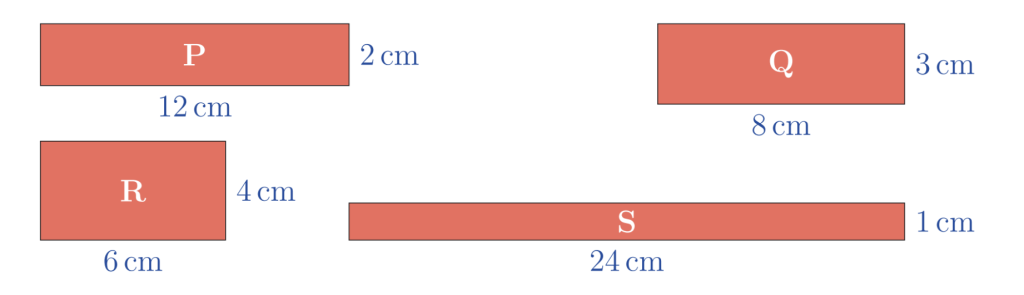
Which of these rectangles has an area of 24 square centimetres?


(A) Q only (B) Q and R only (C) R only (D) S only (E) P, Q, R and S

Problem 10:

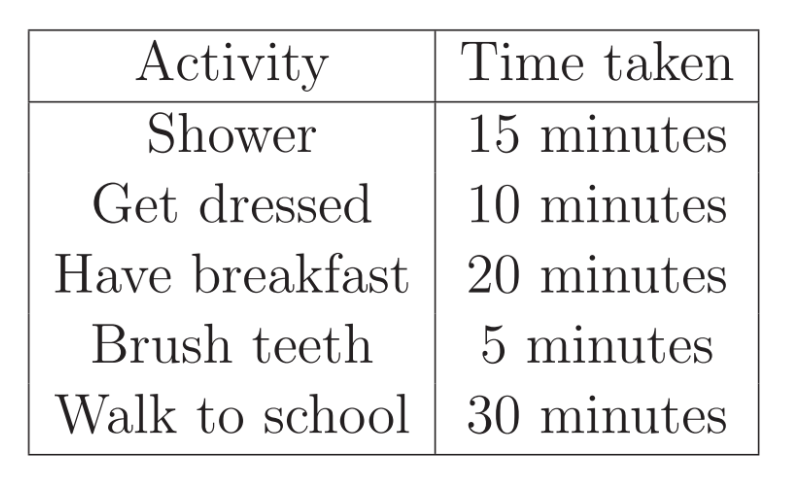
This table shows Jai's morning routine. If he needs to be at school by $8: 55 \mathrm{am}$ what is the latest time he can start his shower?

(A) 7:35 am (B) 7: 50 am (C) 8:05 am (D) 8:20 am (E) 8:35 am

Problem 11:

Which spinner is twice as likely to land on red as white?

Problem 12:

Starting at 0 on the number line, Clement walks back and forth in the following pattern: 3 to the right, 2 to the left, 3 to the right, 2 to the left, and so on.
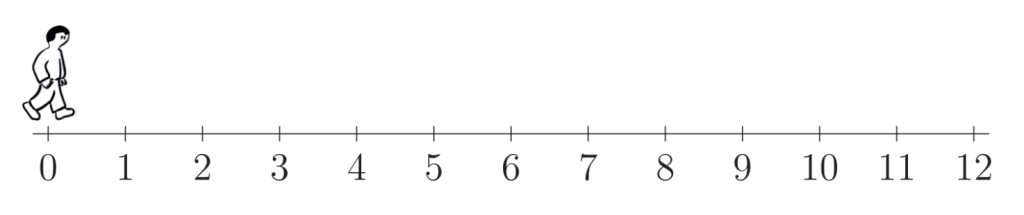
How many times does he walk past the position represented by $4 \frac{1}{2}$ ?

(A) 1 (B) 2 (C) 3 (D) 4 (E) 5

Problem 13:

Three digits are missing from this sum. Toby worked out the missing numbers and added them together. What was his answer?
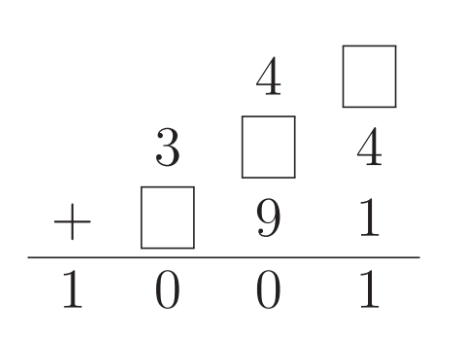
(A) 11 (B) 13 (C) 15 (D) 17 (E) 19

Problem 14:

I have three cardboard shapes: a square, a circle and a triangle. I glue them on top of each other as shown in this diagram.
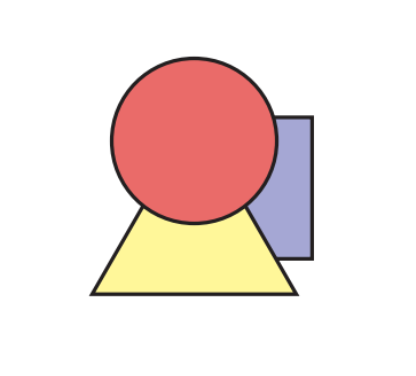
I then flip the glued-together shapes over. What could they look like?

Problem 15:

What is the missing number needed to make this number sentence true? $270 \div 45=\square \div 15$

(A) 3 (B) 6 (C) 60 (D) 90 (E) 150

Problem 16:

Three different squares are arranged as shown. The perimeter of the largest square is 32 centimetres. The area of the smallest square is 9 square centimetres. What is the perimeter of the mediumsized square?
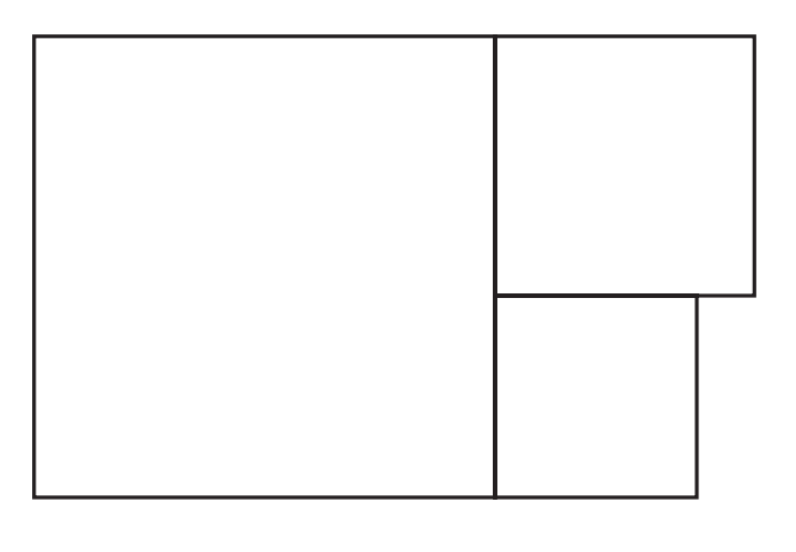
(A) 12 cm (B) 14 cm (C) 20 cm (D) 24 cm (E) 30 cm

Problem 17:

Huang has a bag of marbles. Mei takes out one-third of them. Huang then takes out one-half of those left, leaving 8 marbles in the bag. How many marbles were originally in the bag?

(A) 12 (B) 16 (C) 18 (D) 24 (E) 36

Problem 18:

A different positive whole number is placed at each vertex of a cube. No two numbers joined by an edge of the cube can have a difference of 1.
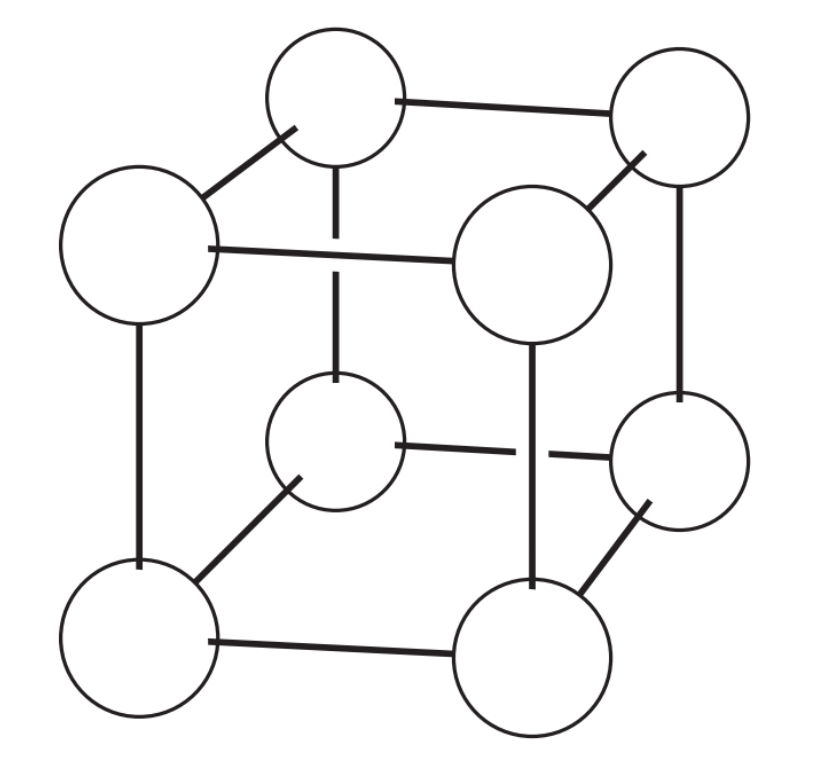
What is the smallest possible sum of the eight numbers?

(A) 36 (B) 37 (C) 38 (D) 39 (E) 40

Problem 19:

George is 78 this year. He has three grandchildren: Michaela, Tom and Lucy. Michaela is 27 , Tom is 23 and Lucy is 16 . After how many years will George's age be equal to the sum of his grandchildren's ages?

(A) 3 (B) 6 (C) 9 (D) 10 (E) 12

Problem 20:

Ms Graham asked each student in her Year 5 class how many television sets they each have This graph shows the results.
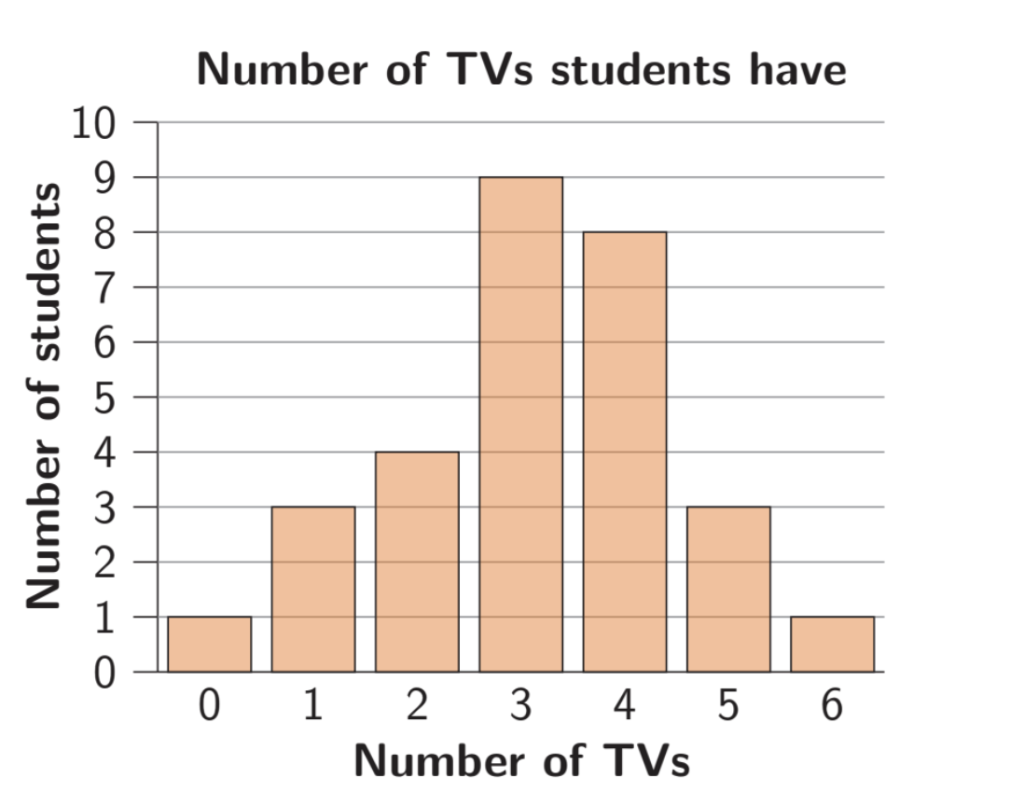
How many television sets do the students have altogether?

(A) 9 (B) 29 (C) 91 (D) 99 (E) 101

Problem 21:

In a mathematics competition, 70 boys and 80 girls competed. Prizes were won by 6 boys and $15 \%$ of the girls. What percentage of the students were prize winners?

(A) $10 \%$ (B) $12 \%$ (C) $15 \%$ (D) $18 \%$ (E) $20 \%$

Problem 22:

Ariel writes the letters of the alphabet on a piece of paper as shown She turns the page upside down and looks at it in her bathroom mirror. How many of the letters appear unchanged when viewed this way?
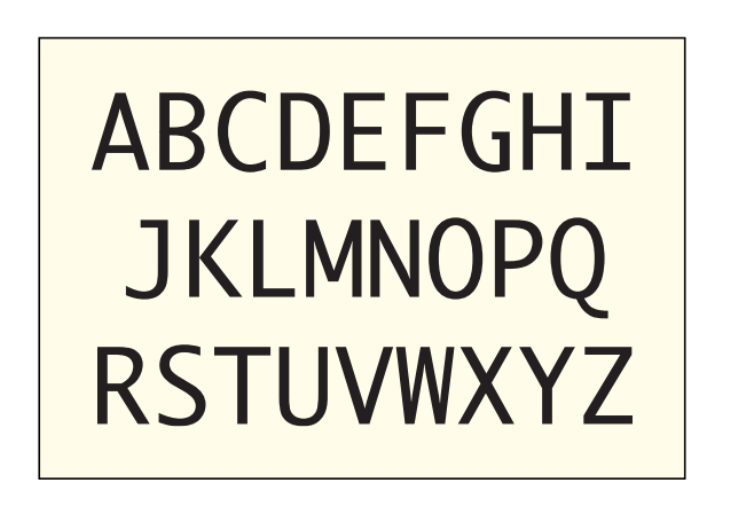
(A) 0 (B) 3 (C) 4 (D) 6 (E) 9

Problem 23:

The Australian Mathematical College (AMC) has 1000 students. Each student takes 6 classes a day. Each teacher teaches 5 classes per day with 25 students in each class. How many teachers are there at the AMC?

(A) 40 (B) 48 (C) 50 (D) 200 (E) 240

Problem 24:

This list pqrs, pqsr, prqs, prsq, … can be continued to include all 24 possible arrangements of the four letters $p, q, r$ and $s$. The arrangements are listed in alphabetical order. Which one of the following is 19th in this list?

(A) $s p q r$ (B) $s r p q$ (C) $q p s r$ (D) $q r p s$ (E) $r p s q$

Problem 25:

In this puzzle, each circle should contain an integer. Each of the five lines of four circles should add to 40. When the puzzle is completed, what is the largest number used?
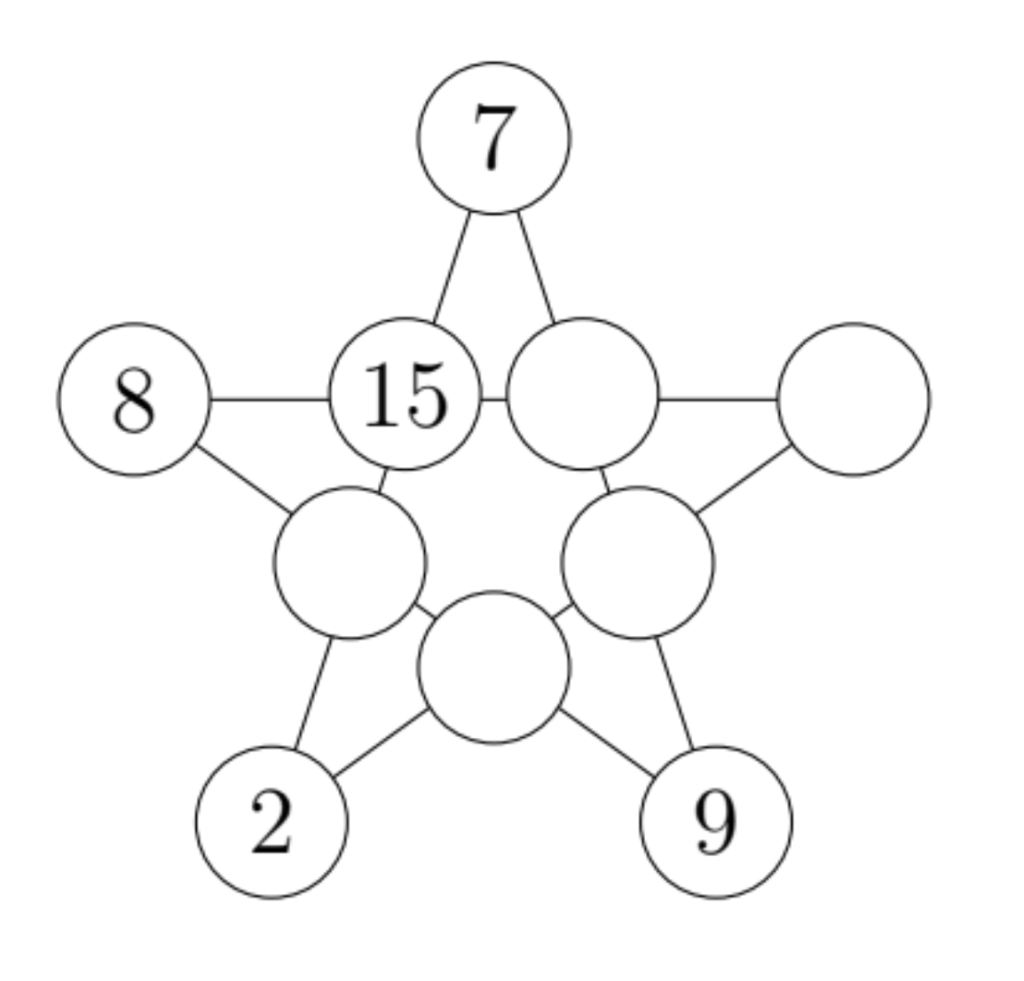
(A) 15 (B) 16 (C) 17 (D) 18 (E) 19

Problem 26:

Nguyen writes down some numbers according to the following rules. Starting with the number 1, he doubles the number and adds 4 , so the second number he writes is 6 . He now repeats this process, starting with the last number written, doubling and then adding 4, but he doesn't write the hundreds digit if the number is bigger than 100 . What is the 2022nd number that Nguyen writes down?

Problem 27:

Karen's mother made a cake for her birthday. After it was iced on the top and the 4 vertical faces, it was a cube with 20 cm sides. Darren was asked to decorate the cake with chocolate drops. He arranged them all over the icing in a square grid pattern, spaced with centres 2 cm apart. Those near the edges of the cube had centres 2 cm from the edge. The diagram shows one corner of the cake.
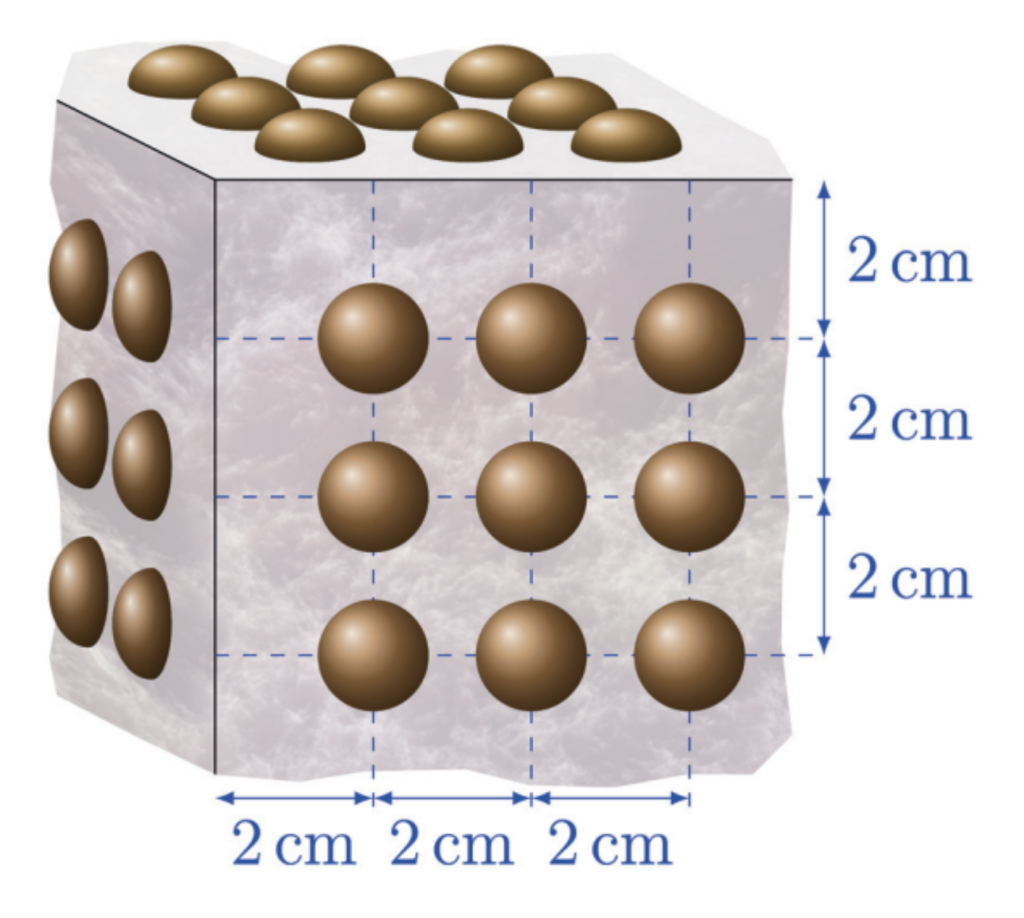
How many chocolate drops did Darren use to decorate Karen's cake?

Problem 28:

I choose three different numbers out of this list and add them together:

$$
1,3,5,7,9, \ldots, 105
$$

How many different totals can I get?

Problem 29:

The Athletics clubs of Albury and Wodonga agree to send a combined team to the regional championships. They have 11 sprinters on the combined team, 5 from Albury and 6 from Wodonga. For the $4 \times 100$ metre relay, they agree to have a relay team with two sprinters from the Albury club and two sprinters from the Wodonga club. How many relay teams are possible?

Problem 30:

The following is a net of a rectangular prism with some dimensions, in centimetres, given.
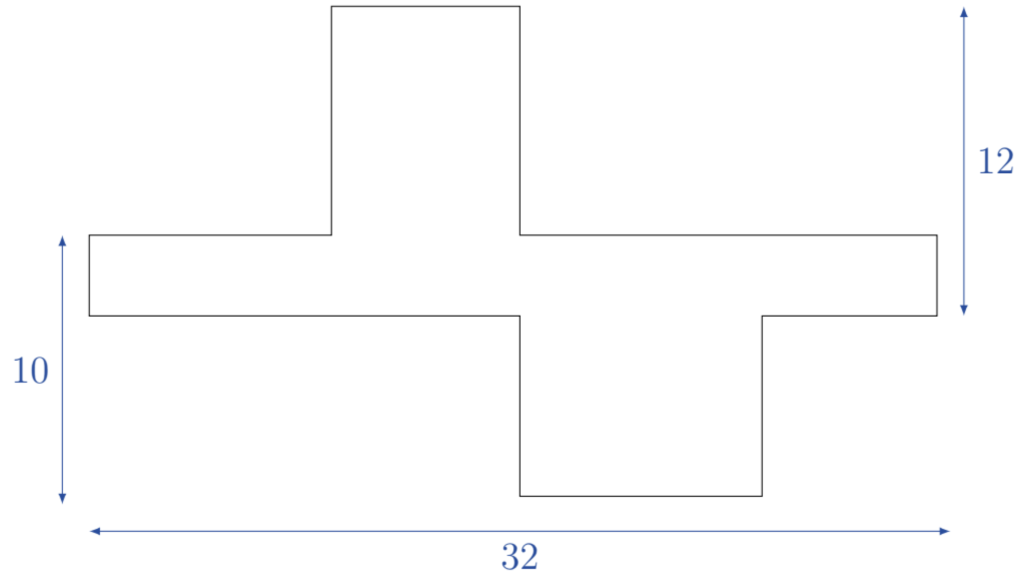
What is the volume of the rectangular prism in cubic centimetres?


Australian Mathematics Competition - 2023 - Upper Primary Division - Grades 5 & 6- Questions and Solutions

Problem 1:

This shape is made from 7 squares, each 1 cm by 1 cm . What is its perimeter?

(A) 7 cm (B) 12 cm (C) 14 cm (D) 16 cm (E) 28 cm

Problem 2:

There are five shapes here. How many are quadrilaterals?


(A) 1 (B) 2 (C) 3 (D) 4 (E) 5

Problem 3:

In a board game, Nik rolls three standard dice, one at a time. He needs his three rolls to add to 12 . His first two dice rolls are 5 and 3 . What does he need his third roll to be?

(A) 2 (B) 3 (C) 4 (D) 5 (E) 6

Problem 4:

In this diagram, how many of the small squares need to be shaded for the large rectangle to be one-quarter shaded?

(A) 2 (B) 3 (C) 4 (D) 6 (E) 12

Problem 5:

Petra left for school at 8:51 am. She got to school at 9:09 am. How long did it take Petra to get to school?

(A) 9 minutes (B) 10 minutes (C) 18 minutes (D) 42 minutes (E) 1 hour

Problem 6:

Which letter marks where 25 is on this number line?

Problem 7:

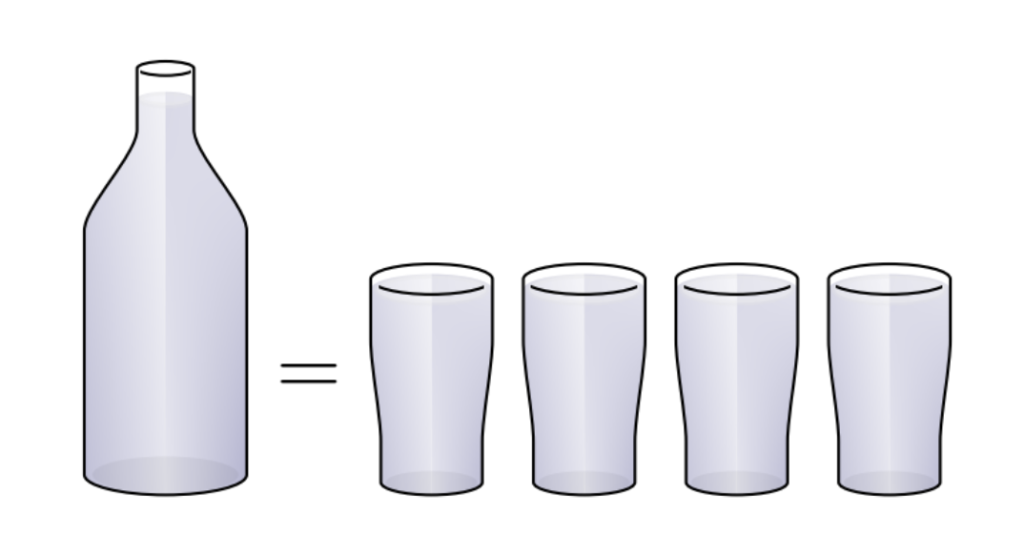
This bottle holds 4 glasses of water.

Which one of the following holds the most water?

Problem 8:

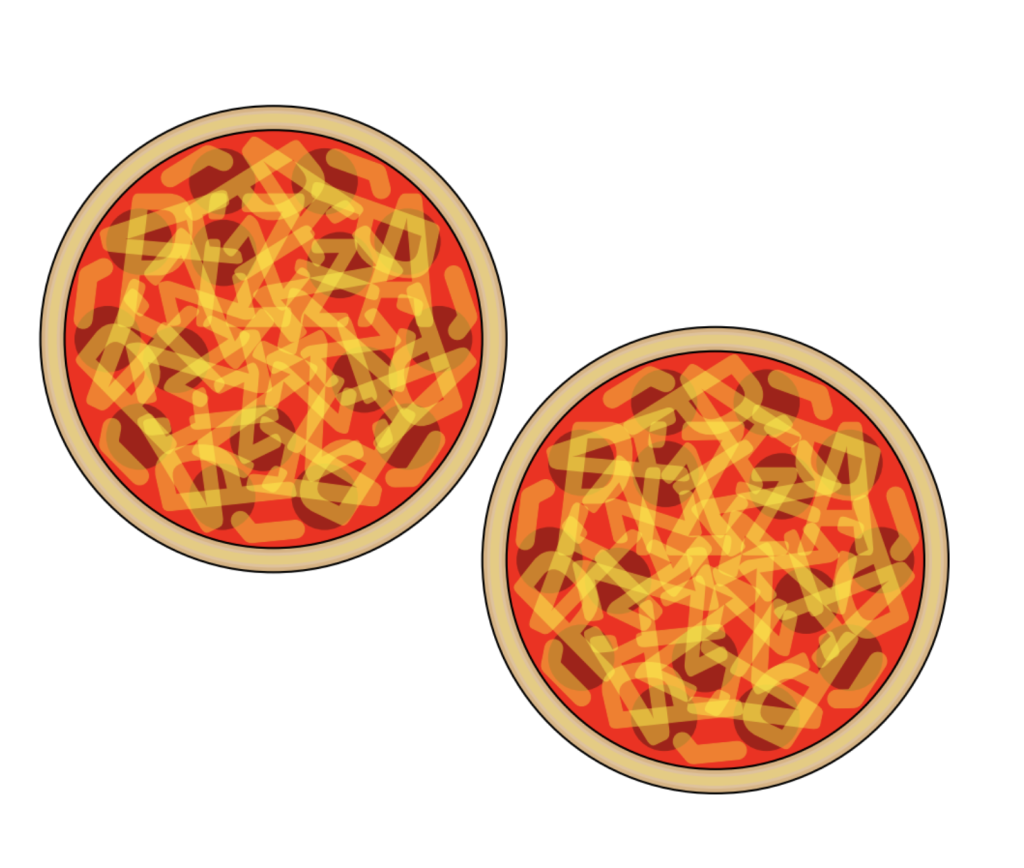
Two pizzas are shared equally between 3 students. What fraction of a whole pizza does each student get?

(A) $\frac{1}{2}$ (B) $\frac{1}{3}$ (C) $\frac{1}{4}$ (D) $\frac{2}{3}$ (E) $\frac{3}{4}$

Problem 9:

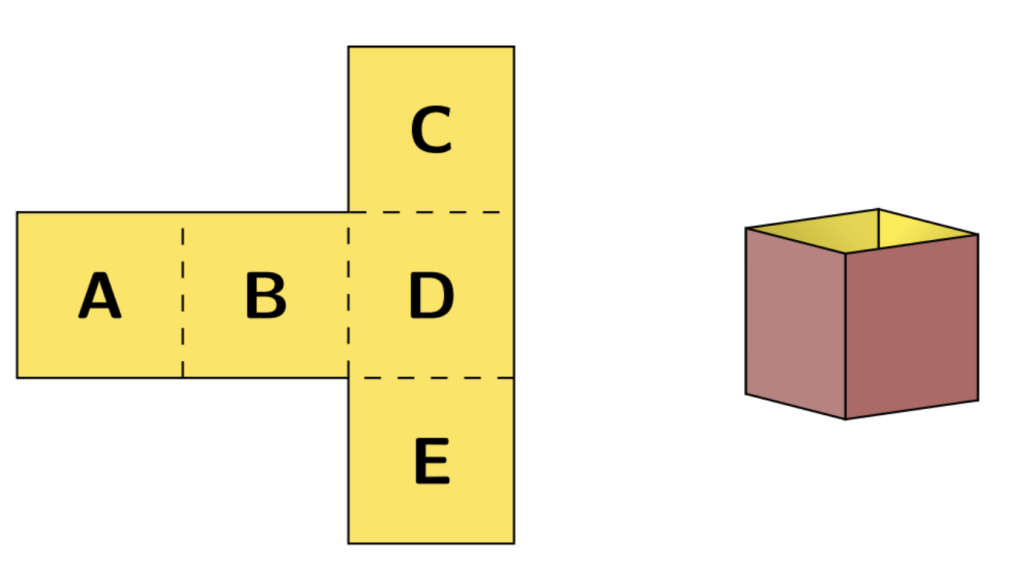
A piece of card is cut out and labelled as shown in the diagram.

It is folded along the dotted lines to make a box without a top. Which letter is on the bottom of the box?

(A) A (B) B (C) C (D) D (E) E

Problem 10:

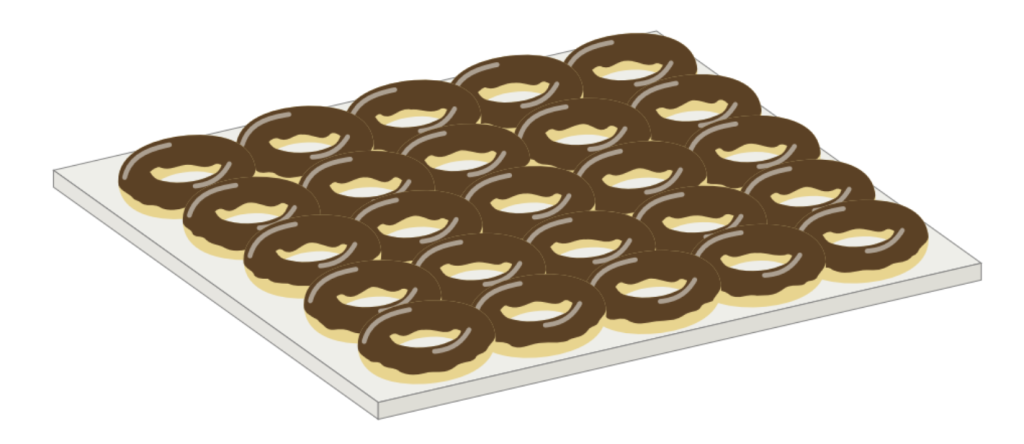
Doughnuts come in bags of 3 and boxes of 8 . I bought exactly 25 doughnuts for my party.What do I get when I add the number of boxes I bought and the number of bags I bought?


(A) 4 (B) 5 (C) 6 (D) 7 (E) 8

Problem 11:

This line graph shows the temperature each hour during a day.

Roughly for how long was the temperature above $20^{\circ} \mathrm{C}$ ?

(A) 7 hours (B) 8 hours (C) 9 hours (D) 10 hours (E) 11 hours

Problem 12:

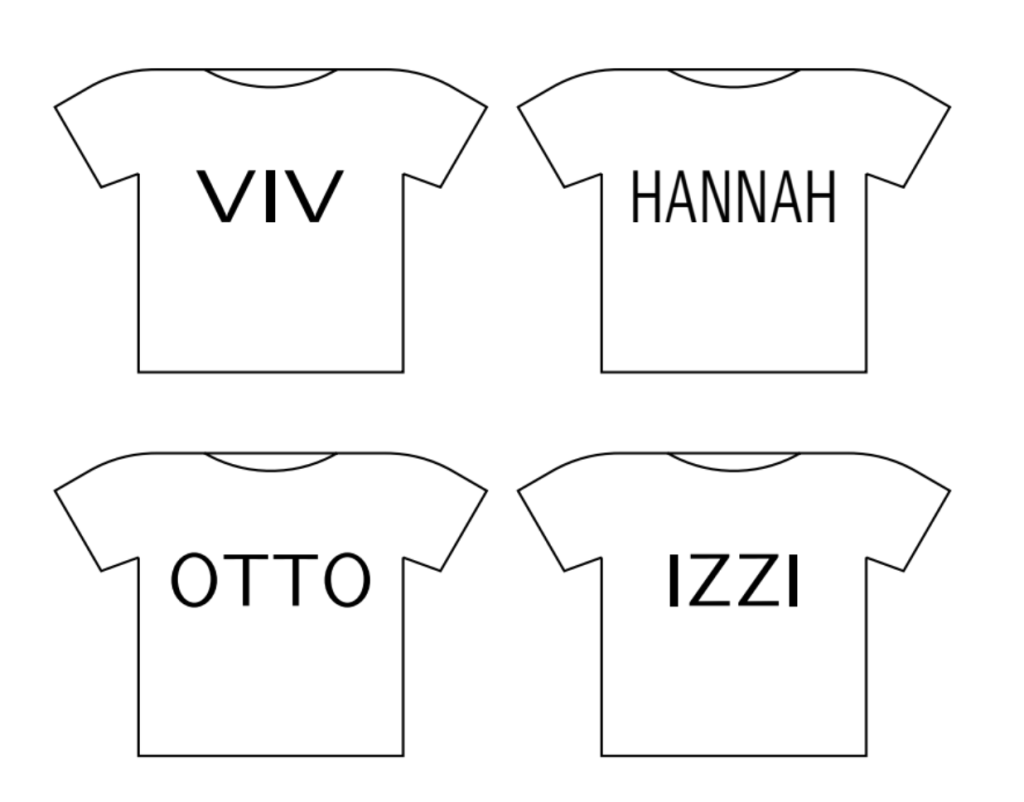
VIV takes her three children, HANNAH, OTTO and IZZI, out shopping. Each is wearing a t-shirt with their name on the front in capital letters. When they stand in front of the shop mirror, which names appear the same in the reflection as on the shirts?


(A) VIV and OTTO (B) VIV, OTTO and IZZI (C) VIV, HANNAH and IZZI (D) HANNAH and OTTO (E) All four of them

Problem 13:

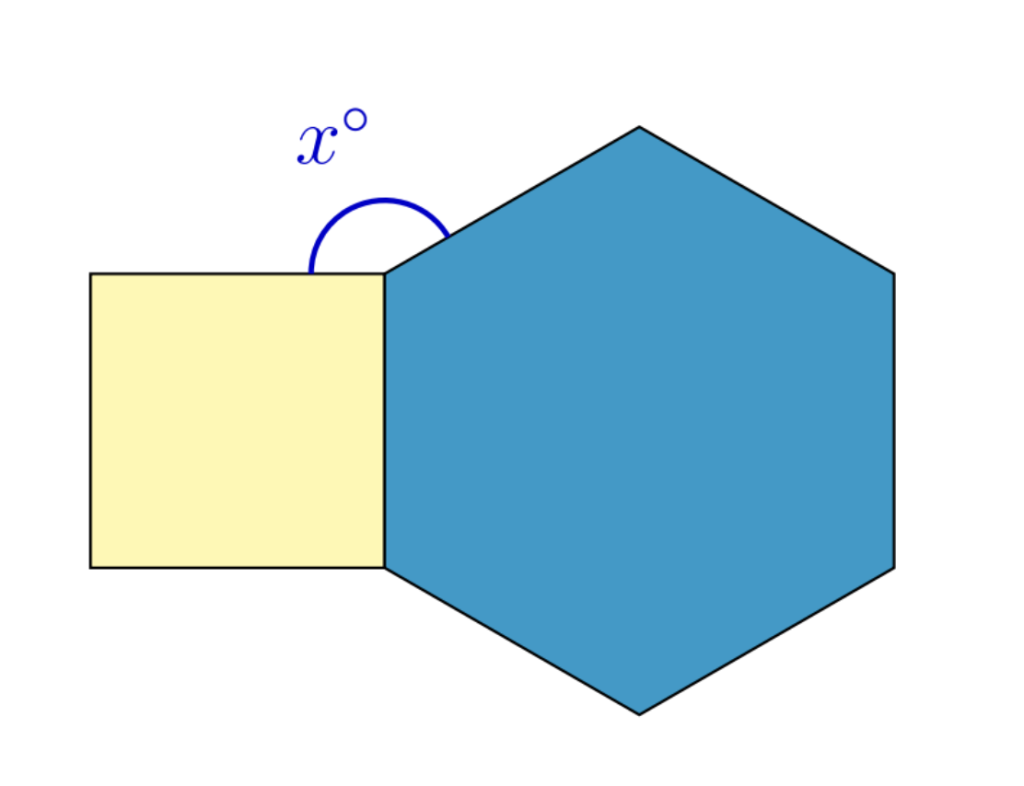
This regular hexagon has angles of $120^{\circ}$ and the square has angles of $90^{\circ}$.

What is the angle $x^{\circ}$ in the diagram?

(A) $90^{\circ}$ (B) $120^{\circ}$ (C) $135^{\circ}$ (D) $150^{\circ}$ (E) $180^{\circ}$

Problem 14:

Syed's mother had some money to share with her family. She gave one-quarter of her money to Syed. Then she gave one-third of what was left to Ahmed. Then she gave one-half of what was left to Raiyan. She was left with $\$ 15$, which she kept for herself. How much money did Syed's mother have to start with?

(A) $\$ 30$ (B) $\$ 45$ (C) $\$ 60$ (D) $\$ 90$ (E) $\$ 120$

Problem 15:

The rectangle shown has a side length of 9 cm . It is divided into 3 identical rectangles as shown. What is the area, in square centimetres, of the original rectangle?

(A) 45 (B) 50 (C) 52 (D) 54 (E) 63

Problem 16:

This diagram shows a rectangle with a perimeter of 30 cm . It has been divided by 2 lines into 4 small rectangles. Three of the small rectangles have the perimeters shown. What is the perimeter of fourth small rectangle?

(A) 10 cm (B) 12 cm (C) 14 cm (D) 16 cm (E) 18 cm

Problem 17:

There are 10 questions in a test. Each correct answer scores 5 points, each wrong answer loses 3 points, and if a question is left blank it scores 0 points. Tycho did this test and scored 27 points. How many questions did Tycho leave blank?

(A) 1 (B) 2 (C) 3 (D) 4 (E) 5

Problem 18:

Estelle is making decorations shaped like the 8-pointed star shown. She folds a square of paper to make a triangle with 8 layers as shown.

How could she cut the triangle so that the unfolded shape is the star?

Problem 19:

Earlier this year Ben said, 'Next year I will turn 13 , but 2 days ago I was $10 . '$ Ben's birthday is

(A) 1st January (B) 2nd January (C) 29th December (D) 30th December (E) 31st December

Problem 20:

Peyton, Luka and Dan have 180 stickers in total. Peyton has half as many stickers as Luka. Dan has three times as many as Luka.
How many stickers does Peyton have?

(A) 20 (B) 24 (C) 30 (D) 40 (E) 54

Problem 21:

Mrs Graaf invents a game for her students to practise arithmetic. They roll two 10 -sided dice to pick two random numbers. Starting at one of the numbers, they keep adding the other number until they reach a 3-digit number. Ian rolls a 5 and an 8 . If he chooses to start with 5 and then add 8 again and again, his list is $5,13,21, \ldots$, 93,101 . If he chooses to start with 8 and add 5 , his list is $8,13,18, \ldots, 98,103$ On Nara's turn, she makes a list that ends with 107. What pair of numbers could she have rolled?

(A) 4 and 8 (B) 5 and 7 (C) 3 and 4 (D) 6 and 9 (E) 3 and 8

Problem 22:

At a school concert, the tickets cost $\$ 20$ per adult and $\$ 2$ per child. The total paid by the 100 people who attended was $\$ 920$. How many were children?

(A) between 25 and 35 (B) between 35 and 45 (C) between 45 and 55 (D) between 55 and 65 (E) between 65 and 75

Problem 23:

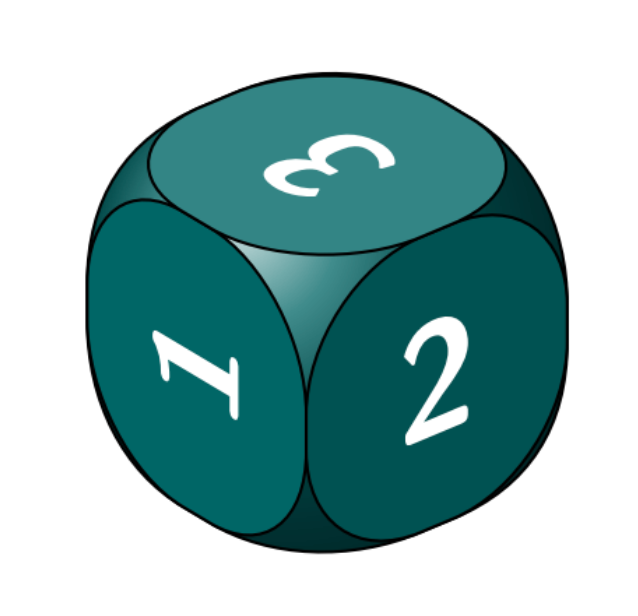
Meena has a standard dice, with each pair of opposite faces adding to 7 . At first, the three faces she can see add to 6 , as shown. She holds the dice between a pair of opposite faces and rotates it $180^{\circ}$, keeping these opposite faces facing the same direction. She puts the dice back down and adds up the three faces she can now see.

What is the smallest possible total she could get?

(A) 6 (B) 8 (C) 10 (D) 12 (E) 14

Problem 24:

I have 4 whole numbers that add up to 98. If I were to add 6 to the first number, subtract 6 from the second number, multiply the third number by 6 and divide the fourth number by 6, the four answers would all be the same. What is the sum of the largest two of my original four numbers?

(A) 72 (B) 86 (C) 88 (D) 90 (E) 94

Problem 25:

When I ride my bike at 20 kilometres per hour, each wheel turns at 2 revolutions per second. When I ride 1 kilometre, how many revolutions does each wheel make?

(A) 40 (B) 240 (C) 320 (D) 360 (E) 420

Problem 26:

Problem 27:

Li attempted to multiply a single-digit number by 36 , but he accidentally multiplied by 63 instead. His answer was 189 larger than the correct answer. What was the correct answer to the multiplication?

Problem 28:

Using 9 out of the 10 possible digits Safia writes 3 numbers, each between 100 and 999. She adds her 3 numbers together. What is the smallest possible sum?

Problem 29:

Yifan has a construction set consisting of red, blue and yellow rods. All rods of the same colour are the same length, but differently coloured rods are different lengths. She wants to make quadrilaterals using these rods.

What number do you get when you multiply the lengths of one red rod, one blue rod and one yellow rod?

Problem 30:

Janus is making patterns using square tiles. Each pattern is made by copying the previous pattern, then adding a tile to every grid square that shares an edge with the copied pattern.

His last pattern is the largest one that can be made with fewer than 1000 tiles. How many tiles are in this last pattern?

American Mathematics Contest 12B (AMC 12B) 2024 - Problems and Solution

The American Mathematics Contest 12 (AMC 12) is the first exam in the series of exams used to challenge bright students, grades 12 and below, on the path towards choosing the team that represents the United States at the International Mathematics Olympiad (IMO).

High scoring AMC 12 students are invited to take the more challenging American Invitational Mathematics Examination (AIME).

The AMC 12 is administered by the American Mathematics Competitions (AMC).

In this post we have added the problems and solutions from the AMC 12B 2024.

Do you have an idea? Join the discussion in Cheenta Software Panini8: https://panini8.com/newuser/ask

Problem 1

In a long line of people arranged left to right, the 1013th person from the left is also the 1010th person from the right. How many people are in line?
(A) 2021
(B) 2022
(C) 2023
(D) 2024
(E) 2025

Solution

Problem 2

What is $10!-7!\cdot 6!?$
(A) -120
(B) 0
(C) 120
(D) 600
(E) 720

Solution

Problem 3

For how many integer values of $x$ is $|2 x| \leq 7 \pi ?$
(A) 16
(B) 17
(C) 19
(D) 20
(E) 21

Solution

Problem 4

Balls numbered $1,2,3, \ldots$ are deposited in 5 bins, labeled $A, B, C, D$, and $E$, using the following procedure. Ball 1 is deposited in bin $A$, and balls 2 and 3 are deposited in $B$. The next three balls are deposited in bin $C$, the next 4 in bin $D$, and so on, cycling back to bin $A$ after balls are deposited in bin $E$. (For example, 22, 23, . . , 28 are deposited in bin $B$ at step 7 of this process.) In which bin is ball 2024 deposited?
(A) $A$
(B) $B$
(C) $C$
(D) $D$
(E) $E$

Solution

Problem 5

In the following expression, Melanie changed some of the plus signs to minus signs:

$$
1+3+5+7+\cdots+97+99
$$

When the new expression was evaluated, it was negative. What is the least number of plus signs that Melanie could have changed to minus signs?
(A) 14
(B) 15
(C) 16
(D) 17
(E) 18

Solution

Problem 6

The national debt of the United States is on track to reach $5 \cdot 10^{13}$ dollars by 2033 . How many digits does this number of dollars have when written as a numeral in base 5 ? (The approximation of $\log _{10} 5$ as 0.7 is sufficient for this problem.)
(A) 18
(B) 20
(C) 22
(D) 24
(E) 26

Solution

Problem 7

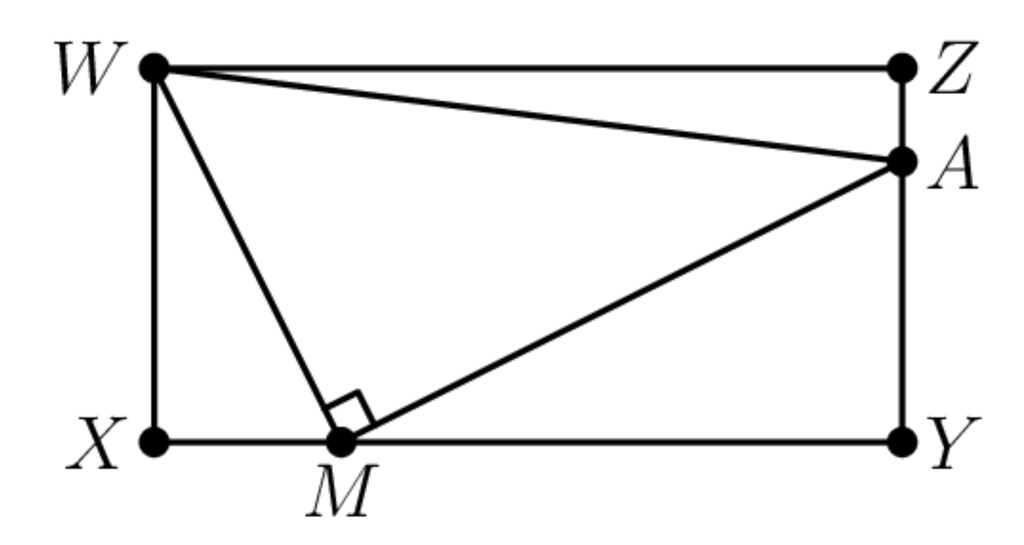
In the figure below $W X Y Z$ is a rectangle with $W X=4$ and $W Z=8$. Point $M$ lies $\overline{X Y}$, point $A$ lies on $\overline{Y Z}$, and $\angle W M A$ is a right angle. The areas of $\triangle W X M$ and $\triangle W A Z$ are equal. What is the area of $\triangle W M A$ ?

(A) 13
(B) 14
(C) 15
(D) 16
(E) 17

Solution

Problem 8

What value of $x$ satisfies

$$
\frac{\log _2 x \cdot \log _3 x}{\log _2 x+\log _3 x}=2 ?
$$

(A) 25
(B) 32
(C) 36
(D) 42
(E) 48

Solution

Problem 9

A dartboard is the region B in the coordinate plane consisting of points $(x, y)$ such that $|x|+|y| \leq 8$. A target T is the region where $\left(x^2+y^2-25\right)^2 \leq 49$. A dart is thrown at a random point in B . The probability that the dart lands in T can be expressed as $\frac{m}{n} \pi$, where $m$ and $n$ are relatively prime positive integers. What is $m+n$ ?
(A) 39
(B) 71
(C) 73
(D) 75
(E) 135

Solution

Problem 10

A list of 9 real numbers consists of $1,2.2,3.2,5.2,6.2,7$, as well as $x, y, z$ with $x \leq y \leq z$. The range of the list is 7 , and the mean and median are both positive integers. How many ordered triples $(x, y, z)$ are possible?
(A) 1
(B) 2
(C) 3
(D) 4
(E) infinitely many

Solution

Problem 11

Let $x_n=\sin ^2\left(n^{\circ}\right)$. What is the mean of $x_1, x_2, x_3, \cdots, x_{90}$ ?
(A) $\frac{11}{45}$
(B) $\frac{22}{45}$
(C) $\frac{89}{180}$
(D) $\frac{1}{2}$
(E) $\frac{91}{180}$

Solution

Problem 12

Suppose $z$ is a complex number with positive imaginary part, with real part greater than 1 , and with $|z|=2$. In the complex plane, the four points $0, z, z^2$, and $z^3$ are the vertices of a quadrilateral with area 15 . What is the imaginary part of $z$ ?
(A) $\frac{3}{4}$
(B) 1
(C) $\frac{4}{3}$
(D) $\frac{3}{2}$
(E) $\frac{5}{3}$

Solution

Problem 13

There are real numbers $x, y, h$ and $k$ that satisfy the system of equations

$x^2+y^2-6 x-8 y=h$
$x^2+y^2-10 x+4 y=k$

What is the minimum possible value of $h+k$ ?
(A) -54
(B) -46
(C) -34
(D) -16
(E) 16

Solution

Problem 14

How many different remainders can result when the 100 th power of an integer is divided by $125 ?$
(A) 1
(B) 2
(C) 5
(D) 25
(E) 125

Solution

Problem 15

A triangle in the coordinate plane has vertices $A\left(\log _2 1, \log _2 2\right), B\left(\log _2 3, \log _2 4\right)$, and $C\left(\log _2 7, \log _2 8\right)$. What is the area of $\triangle A B C$ ?
(A) $\log _2 \frac{\sqrt{3}}{7}$
(B) $\log _2 \frac{3}{\sqrt{7}}$
(C) $\log _2 \frac{7}{\sqrt{3}}$
(D) $\log _2 \frac{11}{\sqrt{7}}$
(E) $\log _2 \frac{11}{\sqrt{3}}$

Solution

Problem 16

A group of 16 people will be partitioned into 4 indistinguishable 4 -person committees. Each committee will have one chairperson and one secretary. The number of different ways to make these assignments can be written as $3^r M$, where $r$ and $M$ are positive integers and $M$ is not divisible by 3 . What is $r$ ?
(A) 5
(B) 6
(C) 7
(D) 8
(E) 9

Solution

Problem 17

Integers $a$ and $b$ are randomly chosen without replacement from the set of integers with absolute value not exceeding 10 . What is the probability that the polynomial $x^3+a x^2+b x+6$ has 3 distinct integer roots?
(A) $\frac{1}{240}$
(B) $\frac{1}{221}$
(C) $\frac{1}{105}$
(D) $\frac{1}{84}$
(E) $\frac{1}{63}$.

Solution

Problem 18

The Fibonacci numbers are defined by $F_1=1, F_2=1$, and $F_n=F_{n-1}+F_{n-2}$ for $n \geq 3$. What is $\frac{F_2}{F_1}+\frac{F_4}{F_2}+\frac{F_6}{F_3}+\cdots+\frac{F_{20}}{F_{10}} ?$
(A) 318
(B) 319
(C) 320
(D) 321
(E) 322

(A) 318
(B) 319
(C) 320
(D) 321
(E) 322

Solution

Problem 19

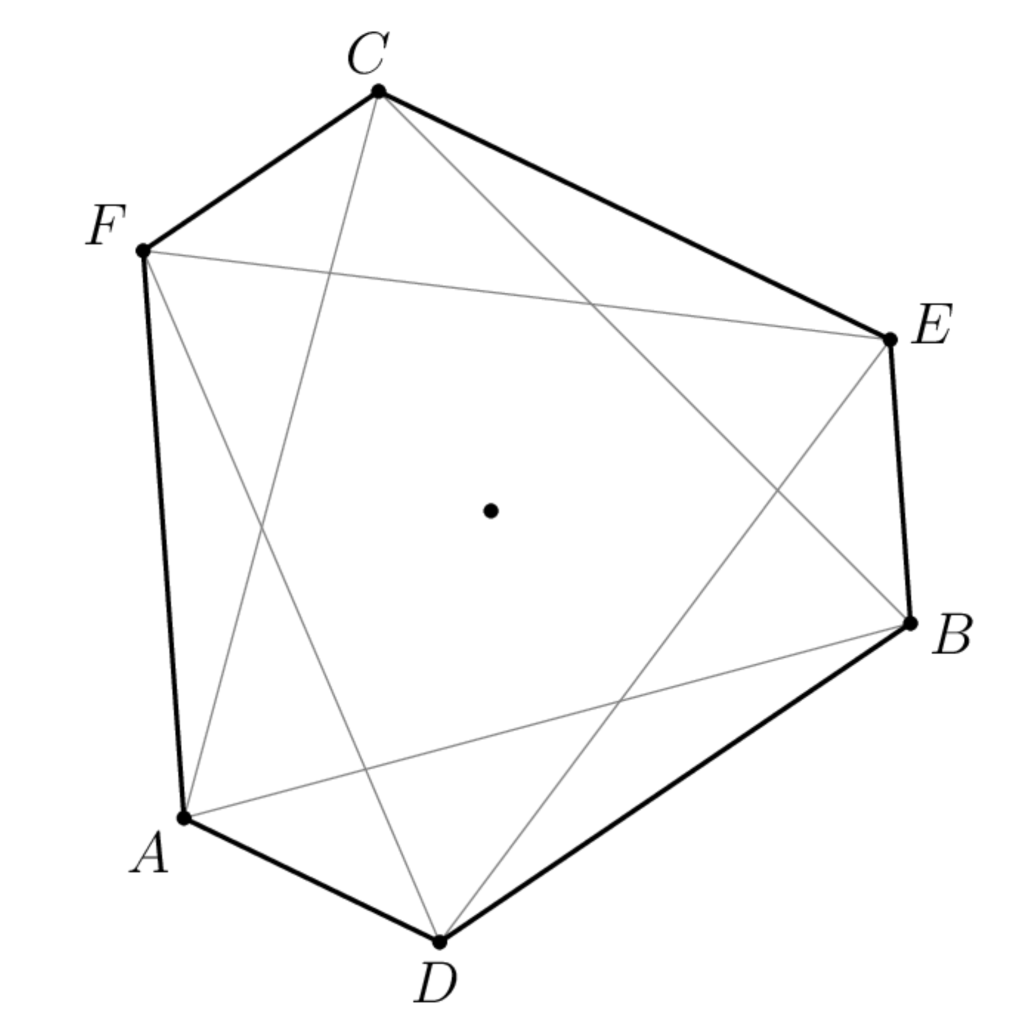
Equilateral $\triangle A B C$ with side length 14 is rotated about its center by angle $\theta$, where $0<\theta<60^{\circ}$, to form $\triangle D E F$. See the figure. The area of hexagon $A D B E C F$ is $91 \sqrt{3}$. What is $\tan \theta$ ?

(A) $\frac{3}{4}$
(B) $\frac{5 \sqrt{3}}{11}$
(C) $\frac{4}{5}$
(D) $\frac{11}{13}$
(E) $\frac{7 \sqrt{3}}{13}$

Solution

Problem 20

Suppose $A, B$, and $C$ are points in the plane with $A B=40$ and $A C=42$, and let $x$ be the length of the line segment from $A$ to the midpoint of $\overline{B C}$. Define a function $f$ by letting $f(x)$ be the area of $\triangle A B C$. Then the domain of $f$ is an open interval $(p, q)$, and the maximum value $r$ of $f(x)$ occurs at $x=s$. What is $p+q+r+s$ ?
(A) 909
(B) 910
(C) 911
(D) 912
(E) 913

Solution

Problem 21

The measures of the smallest angles of three different right triangles sum to $90^{\circ}$. All three triangles have side lengths that are primitive Pythagorean triples. Two of them are $3-4-5$ and $5-12-13$. What is the perimeter of the third triangle?
(A) 40
(B) 126
(C) 154
(D) 176
(E) 208

Solution

Problem 22

Let $\triangle A B C$ be a triangle with integer side lengths and the property that $\angle B=2 \angle A$. What is the least possible perimeter of such a triangle?
(A) 13
(B) 14
(C) 15
(D) 16
(E) 17

Solution

Problem 23

A right pyramid has regular octagon $A B C D E F G H$ with side length 1 as its base and apex $V$. Segments $\overline{A V}$ and $\overline{D V}$ are perpendicular. What is the square of the height of the pyramid?
(A) 1
(B) $\frac{1+\sqrt{2}}{2}$
(C) $\sqrt{2}$
(D) $\frac{3}{2}$
(E) $\frac{2+\sqrt{2}}{3}$

Solution

Problem 24

What is the number of ordered triples $(a, b, c)$ of positive integers, with $a \leq b \leq c \leq 9$, such that there exists a (non-degenerate) triangle $\triangle A B C$ with an integer inradius for which $a, b$, and $c$ are the lengths of the altitudes from $A$ to $\overline{B C}, B$ to $\overline{A C}$, and $C$ to $\overline{A B}$, respectively? (Recall that the inradius of a triangle is the radius of the largest possible circle that can be inscribed in the triangle.)
(A) 2
(B) 3
(C) 4
(D) 5
(E) 6

Solution

Problem 25

Pablo will decorate each of 6 identical white balls with either a striped or a dotted pattern, using either red or blue paint. He will decide on the color and pattern for each ball by flipping a fair coin for each of the 12 decisions he must make. After the paint dries, he will place the 6 balls in an urn. Frida will randomly select one ball from the urn and note its color and pattern. The events "the ball Frida selects is red" and "the ball Frida selects is striped" may or may not be independent, depending on the outcome of Pablo's coin flips. The probability that these two events are independent can be written as $\frac{m}{n}$, where $m$ and $n$ are relatively prime positive integers. What is $m$ ? (Recall that two events $A$ and $B$ are independent if $P(A$ and $B)=P(A) \cdot P(B)$.
(A) 243
(B) 245
(C) 247
(D) 249
(E) 251

Solution

American Mathematics Contest 12A (AMC 12A) 2024 - Problems and Solution

The American Mathematics Contest 12 (AMC 12) is the first exam in the series of exams used to challenge bright students, grades 12 and below, on the path towards choosing the team that represents the United States at the International Mathematics Olympiad (IMO).

High scoring AMC 12 students are invited to take the more challenging American Invitational Mathematics Examination (AIME).

The AMC 12 is administered by the American Mathematics Competitions (AMC).

In this post we have added the problems and solutions from the AMC 12A 2024.

Do you have an idea? Join the discussion in Cheenta Software Panini8: https://panini8.com/newuser/ask

Problem 1

What is the value of $9901 \cdot 101-99 \cdot 10101 ?$
(A) 2
(B) 20
(C) 200
(D) 202
(E) 2020

Solution

Problem 2

A model used to estimate the time it will take to hike to the top of the mountain on a trail is of the form $T=a L+b G$, where $a$ and $b$ are constants, $T$ is the time in minutes, $L$ is the length of the trail in miles, and $G$ is the altitude gain in feet. The model estimates that it will take 69 minutes to hike to the top if a trail is 1.5 miles long and ascends 800 feet, as well as if a trail is 1.2 miles long and ascends 1100 feet. How many minutes does the model estimates it will take to hike to the top if the trail is 4.2 miles long and ascends 4000 feet?
(A) 240
(B) 246
(C) 252
(D) 258
(E) 264

Solution

Problem 3

The number 2024 is written as the sum of not necessarily distinct two-digit numbers. What is the least number of two-digit numbers needed to write this sum?
(A) 20
(B) 21
(C) 22
(D) 23
(E) 24

Solution

Problem 4

What is the least value of $n$ such that $n$ ! is a multiple of $2024 ?$
(A) 11
(B) 21
(C) 22
(D) 23
(E) 253

Solution

Problem 5

A data set containing 20 numbers, some of which are 6 , has mean 45 . When all the 6 s are removed, the data set has mean 66 . How many 6 s were in the original data set?
(A) 4
(B) 5
(C) 6
(D) 7
(E) 8

Solution

Problem 6

The product of three integers is 60. What is the least possible positive sum of the three integers?
(A) 2
(B) 3
(C) 5
(D) 6
(E) 13

Solution

Problem 7

In $\triangle A B C, \angle A B C=90^{\circ}$ and $B A=B C=\sqrt{2}$. Points $P_1, P_2, \ldots, P_{2024}$ lie on hypotenuse $\overline{A C}$ so that $A P_1=P_1 P_2=P_2 P_3=\cdots=$

$P_{2023} P_{2024}=P_{2024} C$. What is the length of the vector sum

$\overrightarrow{B P_1}+\overrightarrow{B P_2}+\overrightarrow{B P_3}+\cdots+\overrightarrow{B P_{2024}}?$

(A) 1011
(B) 1012
(C) 2023
(D) 2024
(E) 2025

Solution

Problem 8

How many angles $\theta$ with $0 \leq \theta \leq 2 \pi$ satisfy $\log (\sin (3 \theta))+\log (\cos (2 \theta))=0$ ?
(A) 0
(B) 1
(C) 2
(D) 3
(E) 4

Solution

Problem 9

Let $M$ be the greatest integer such that both $M+1213$ and $M+3773$ are perfect squares. What is the units digit of $M$ ?
(A) 1
(B) 2
(C) 3
(D) 6
(E) 8

Solution

Problem 10

Let $\alpha$ be the radian measure of the smallest angle in a $3-4-5$ right triangle. Let $\beta$ be the radian measure of the smallest angle in a 7-24-25 right triangle. In terms of $\alpha$, what is $\beta$ ?
(A) $\frac{\alpha}{3}$
(B) $\alpha-\frac{\pi}{8}$
(C) $\frac{\pi}{2}-2 \alpha$
(D) $\frac{\alpha}{2}$
(E) $\pi-4 \alpha$

Solution

Problem 11

There are exactly $K$ positive integers $b$ with $5 \leq b \leq 2024$ such that the base- $b$ integer $2024_b$ is divisible by 16 (where 16 is in base ten). What is the sum of the digits of $K$ ?
(A) 16
(B) 17
(C) 18
(D) 20
(E) 21

Problem 12

The first three terms of a geometric sequence are the integers $a, 720$, and $b$, where $a<720<b$. What is the sum of the digits of the least possible value of $b$ ?
(A) 9
(B) 12
(C) 16
(D) 18
(E) 21

Solution

Problem 13

The graph of $y=e^{x+1}+e^{-x}-2$ has an axis of symmetry. What is the reflection of the point $\left(-1, \frac{1}{2}\right)$ over this axis?
(A) $\left(-1,-\frac{3}{2}\right)$
(B) $(-1,0)$
(C) $\left(-1, \frac{1}{2}\right)$
(D) $\left(0, \frac{1}{2}\right)$
(E) $\left(3, \frac{1}{2}\right)$

Solution

Problem 14

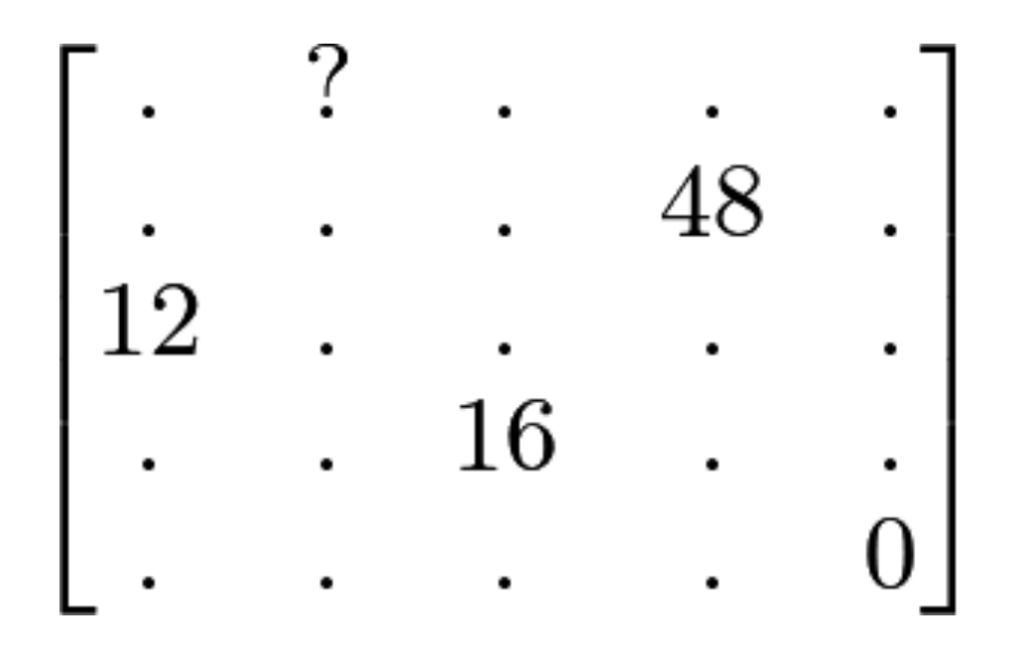
The numbers, in order, of each row and the numbers, in order, of each column of a $5 \times 5$ array of integers form an arithmetic progression of length 5 . The numbers in positions $(5,5),(2,4),(4,3)$, and $(3,1)$ are $0,48,16$, and 12 , respectively. What number is in position $(1,2) ?$

(A) 19
(B) 24
(C) 29
(D) 34
(E) 39

Solution

Problem 15

The roots of $x^3+2 x^2-x+3$ are $p, q$, and $r$. What is the value of

$$
\left(p^2+4\right)\left(q^2+4\right)\left(r^2+4\right) ?
$$

(A) 64
(B) 75
(C) 100
(D) 125
(E) 144

Solution

Problem 16

A set of 12 tokens ---3 red, 2 white, 1 blue, and 6 black --- is to be distributed at random to 3 game players, 4 tokens per player. The probability that some player gets all the red tokens, another gets all the white tokens, and the remaining player gets the blue token can be written as $\frac{m}{n}$, where $m$ and $n$ are relatively prime positive integers. What is $m+n$ ?
(A) 387
(B) 388
(C) 389
(D) 390
(E) 391

Solution

Problem 17

Integers $a, b$, and $c$ satisfy $a b+c=100, b c+a=87$, and $c a+b=60$. What is $a b+b c+c a$ ?
(A) 212
(B) 247
(C) 258
(D) 276
(E) 284

Solution

Problem 18

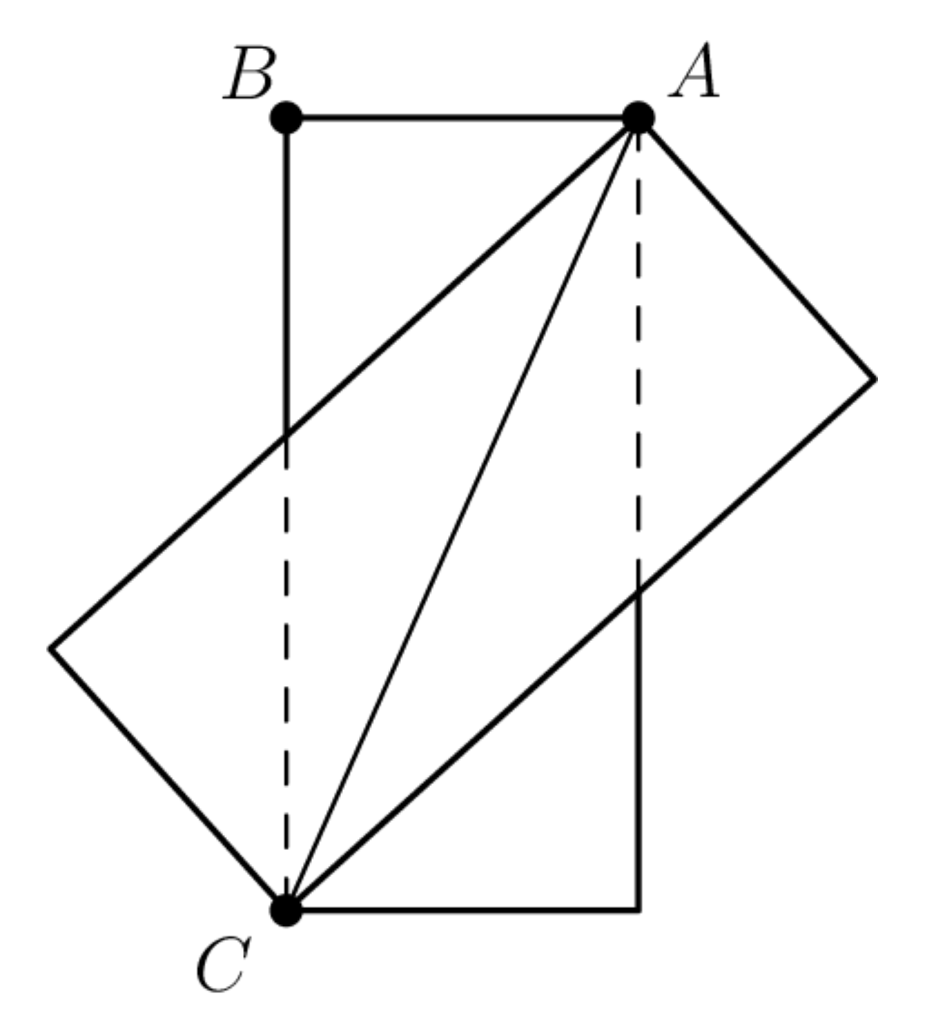
On top of a rectangular card with sides of length 1 and $2+\sqrt{3}$, an identical card is placed so that two of their diagonals line up, as shown ( $\overline{A C}$, in this case $)$.

Continue the process, adding a third card to the second, and so on, lining up successive diagonals after rotating clockwise. In total, how many cards must be used until a vertex of a new card lands exactly on the vertex labeled $B$ in the figure?
(A) 6
(B) 8
(C) 10
(D) 12
(E) No new vertex will land on $B$.

Solution

Problem 19

Cyclic quadrilateral $A B C D$ has lengths $B C=C D=3$ and $D A=5$ with $\angle C D A=120^{\circ}$. What is the length of the shorter diagonal of $A B C D$ ?
(A) $\frac{31}{7}$
(B) $\frac{33}{7}$
(C) 5
(D) $\frac{39}{7}$
(E) $\frac{41}{7}$

Solution

Problem 20

Points $P$ and $Q$ are chosen uniformly and independently at random on sides $\overline{A B}$ and $\overline{A C}$, respectively, of equilateral triangle $\triangle A B C$. Which of the following intervals contains the probability that the area of $\triangle A P Q$ is less than half the area of $\triangle A B C ?$
(A) $\left[\frac{3}{8}, \frac{1}{2}\right]$
(B) $\left(\frac{1}{2}, \frac{2}{3}\right]$
(C) $\left(\frac{2}{3}, \frac{3}{4}\right]$
(D) $\left(\frac{3}{4}, \frac{7}{8}\right]$
(E) $\left(\frac{7}{8}, 1\right]$

Solution

Problem 21

Suppose that $a_1=2$ and the sequence $\left(a_n\right)$ satisfies the recurrence relation

$\frac{a_n-1}{n-1}=\frac{a_{n-1}+1}{(n-1)+1}$

for all $n \geq 2$. What is the greatest integer less than or equal to

$$
\sum_{n=1}^{100} a_n^2 ?
$$

(A) 338,550
(B) 338,551
(C) 338,552
(D) 338,553
(E) 338,554

Solution

Problem 22

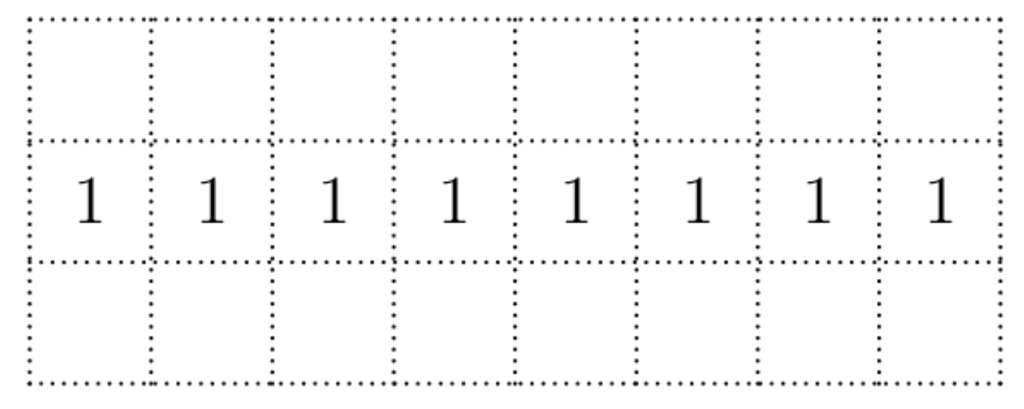
The figure below shows a dotted grid 8 cells wide and 3 cells tall consisting of $1^{\prime \prime} \times 1^{\prime \prime}$ squares. Carl places 1 -inch toothpicks along some of the sides of the squares to create a closed loop that does not intersect itself. The numbers in the cells indicate the number of sides of that square that are to be covered by toothpicks, and any number of toothpicks are allowed if no number is written. In how many ways can Carl place the toothpicks?

Solution

Problem 23

What is the value of


$\tan ^2 \frac{\pi}{16} \cdot \tan ^2 \frac{3 \pi}{16}+\tan ^2 \frac{\pi}{16} \cdot \tan ^2 \frac{5 \pi}{16}+$

$\tan ^2 \frac{3 \pi}{16} \cdot \tan ^2 \frac{7 \pi}{16}+\tan ^2 \frac{5 \pi}{16} \cdot \tan ^2 \frac{7 \pi}{16}$?

(A) 28
(B) 68
(C) 70
(D) 72
(E) 84

Solution

Problem 24

A disphenoid is a tetrahedron whose triangular faces are congruent to one another. What is the least total surface area of a disphenoid whose faces are scalene triangles with integer side lengths?
(A) $\sqrt{3}$
(B) $3 \sqrt{15}$
(C) 15
(D) $15 \sqrt{7}$
(E) $24 \sqrt{6}$

Solution

Problem 25

A graph is symmetric about a line if the graph remains unchanged after reflection in that line. For how many quadruples of integers $(a, b, c, d)$, where $|a|,|b|,|c|,|d| \leq 5$ and $c$ and $d$ are not both 0 , is the graph of

$$
y=\frac{a x+b}{c x+d}
$$

symmetric about the line $y=x$ ?
(A) 1282
(B) 1292
(C) 1310
(D) 1320
(E) 1330

Solution

Proving Geometric Properties in Isosceles Triangles: A Deep Dive into RMO 2024 Problem No. 3

In this exploration, we tackle a rich geometry problem from the 2024 Regional Math Olympiad (RMO). Given an acute-angled isosceles triangle \( \triangle ABC \) with the circumcenter \( O \), orthocenter \( H \), and centroid \( G \), along with specific distances between them, we aim to prove that the triangle's incircle passes through the centroid \( G \).

See the Problem

Key Observations:

Collinearity of Points:

    Euler’s Line:

      Watch the Video

      Step-by-Step Solution:

      Proving the Incircle Passes Through \( G \):

      Conclusion:

      By proving \( IG \) equals the inradius, we show that the centroid \( G \) indeed lies on the incircle, completing the proof. This problem elegantly ties together triangle properties, collinearity, and Euler's line, demonstrating the interconnectedness of geometric points in advanced problem-solving.

      RMO 2024 - Problems & Solutions

      The Regional Mathematical Olympiad (RMO), preceded by the all-India pre-RMO (IOQM) or PRMO, is the first step towards representing India at the global platform for 'mathletes', the International Mathematical Olympiad (IMO).

      The RMO is a three-hour written test with six or seven problems. On the basis of the performance in the RMO, a certain number of students are selected from each region to participate in the Indian National Mathematical Olympiad (INMO), second step towards the IMO.

      In this post we have added the problems and solutions from the RMO 2024.

      Do you have an idea? Join the discussion in Cheenta Software Panini8: https://panini8.com/newuser/ask

      Problem 1
      Answer: (b) \(2,1,4,3,6,5,\ldots,n,n-1\)
      See Solution
      Problem 2
      Answer: \(n=1,5\)
      See Solution
      Problem 3
      Answer:
      See Solution
      Problem 4
      Answer:
      See Solution
      Problem 5
      Answer:
      See Solution
      Problem 6
      Answer:
      See Solution

      Problem 1

      Let \(n>1\) be a positive integar. Call a rearrangement \(a_1, a_2, \ldots, a_n\) of \(1,2, \ldots, n\) nice.

      If for every \(k=2,3, \ldots, n\), we have that \(a_1+a_2+\cdots+a_k\) is not divisible by \(k\).
      (a) If \(n>1\) is odd, prove that there is no nice rearrangement of \(1,2, \ldots, n\).
      (b) If \(n\) is even, find a nice rearrangement of \(1,2, \ldots, n\).

      Solution

      (a) If $n$ is ODD, then consider any rearrangement $a_1, a_2, \ldots, a_n$.

      For $k=n$, we get $a_1+a_2+\cdots+a_n=1+2+\cdots+n=\frac{n(n+1)}{2}=$

      $n\left(\frac{n+1}{2}\right)$ which is a multiple of $n$ since $n$ is co-prime to 2 and

      thus the condition would be violated rendering the rearrangement 'not nice'.


      (b) If $n$ is EVEN, then the following rearrangement is nice.

      $$
      a_i= \begin{cases}i-1 & , \text { if } i \text { is even } \\ \ i+1 & , \text { if } i \text { is odd }\end{cases}
      $$

      That is, $\left(a_1, a_2, \ldots, a_n\right)=(2,1,4,3,6,5, \ldots, n, n-1)$. This rearrangement is nice because

      $$a_1+a_2+\cdots+a_k= \begin{cases}\frac{k(k+1)}{2}=\left(\frac{k}{2}\right)(k+1) & , \text { if } k \text { is even } \\ \ \frac{k(k+1)}{2}+1= k\left(\frac{k+1}{2}\right)+1 & , \text { if } k \text { is odd }\end{cases}$$

      Now it is conspicuous that both possible values of the sum are not divisible by $k$ (except for $k=1$ ) because in the first sum, $\frac{k}{2}$ and $k+1$ are relatively prime numbers and in the second sum, it is the next number of a multiple of $k$ which cannot be a multiple of $k$.

      Problem 2

      For a positive integer (n), let \(R(n)\) be the sum of the remainders when \(n\) is divided by \(1,2, \ldots, n\). For example, \(R(4)=0+0+1+0=1,\ R(7)=0+1+1+3+2+1+0=8\). Find all positive integers \(n\) such that \(R(n)=n-1\).

      Solution

      Let $n$ be EVEN, then consider the numbers from $\frac{n}{2}+1, \frac{n}{2}+2, \ldots, n-1$. Now, all these numbers bear a quotient of 1 when dividing $n$ because twice of each exceeds $n$. Hence, they leave a remainder of $\frac{n}{2}-1, \frac{n}{2}-2, \ldots, 1$ respectively when dividing $n$ and so the sum of these remainders is no greater than $R(n)$. Thus,

      \begin{align*}R(n)&\geq 1+2+\cdots+\left(\frac{n}{2}-1\right)\\&=\frac{\left(\frac{n}{2}-1\right)\left(\frac{n}{2}\right)}{2}\\\Rightarrow n-1&\geq\frac{n^2-2n}{8}\\\Rightarrow n^2-10n+17&\leq 17\\\Rightarrow (n-5)^2&\leq 17\\\Rightarrow n&=2,4,6,8\ (\text{as we assumed $n$ to be EVEN})\end{align*}

      Similarly working for $n$ being ODD necessarily yields the remainders $\frac{n-1}{2}, \frac{n-3}{2}, \ldots, 1$ when dividing $n$ and thus

      \begin{align*}R(n) &\geq 1+2+\cdots+\frac{n-1}{2}\\\Rightarrow n-1 &\geq \frac{\left(\frac{n-1}{2}\right)\left(\frac{n+1}{2}\right)}{2}\\\Rightarrow n &\leq 7\end{align*}
      Therefore, in total, we just need to check $R(n)$ value for the numbers $n=$ $1,2,3,4,5,6,7,8$. Manually working on them gives $R(1)=0, R(2)=0, R(3)=$ $1, R(4)=1, R(5)=4, R(6)=3, R(7)=8, R(8)=8$. Hence, the positive integers $n$ such that $R(n)=n-1$ are $\boxed{n=1,5}$.

      Problem 3

      Let \(A B C\) be an acute triangle with \(A B=A C\). Let \(D\) be the point on \(B C\) such that \(A D\) is perpendicular to \(B C\). Let \(O, H, G\) be the circumcentre, orthocentre and centroid of triangle \(A B C\) respectively. Suppose that \(2 \cdot O D=23 \cdot H D\). Prove that \(G\) lies on the incircle of \( \triangle A B C\).

      Solution

      Let $I$ be the incenter, center of incircle, of $\triangle A B C . A B=A C \Rightarrow \triangle A B D \cong$ $\triangle A C D$, so we have $A D$ as the perpendicular bisector of $B C$ and the angle bisector of $\angle A$. Thus, $O, G, H, I$ all lie on $A D$. We know that for any triangle, $O, G, H$ are collinear in that order with $O G: G H=1: 2$.

      Let $H D=2 x$, then $O D=\frac{23 \cdot H D}{2}=23 x \Rightarrow O H=21 x$. Now, $O G: G H=$ $1: 2 \Rightarrow O G=7 x, G H=14 x, G D=16 x$ as shown. We also know that centroid divides median in the ratio $2: 1 \Rightarrow A G: G D=2: 1 \Rightarrow A G=$ $32 x \Rightarrow A O=25 x$. Now, $O A=O B=25 x$, so in $\triangle O B D$, we have $B D=$ $\sqrt{O B^2-O D^2}=\sqrt{(25 x)^2-(23 x)^2}=4 x \sqrt{6}$. In $\triangle A B D, A B=\sqrt{A D^2+B D^2}=$ $\sqrt{(48 x)^2+96 x^2}=20 x \sqrt{6}$. Hence, the semi-perimeter $s=A B+B D=20 x \sqrt{6}+$ $4 x \sqrt{6}=24 x \sqrt{6}$ and $[A B C]=\frac{1}{2} \times 2 B D \times A D=192 x^2 \sqrt{6}$.

      Thus, inradius $r=\frac{\mid A B C]}{s}=\frac{192 x^2 \sqrt{6}}{24 x \sqrt{6}}=8 x \Rightarrow I D=8 x$. Thus, $G I=G D-I D=$ $16 x-8 x=8 x$ and as we already know that $8 x$ is the radius of incircle, we conclude that $G$ lies on the incircle of $\triangle A B C$.

      Problem 4

      Let \(a_1, a_2, a_3, a_4\) be real numbers such that \(a_1^2+a_2^2+a_3^2+a_4^2=1\). Show that there exist \(i, j\) with \(1 \leq i<j \leq 4\), such that \(\left(a_i-a_j\right)^2 \leq \frac{1}{5}\).

      Solution

      Without loss of generality, let $a_1\leq a_2\leq a_3\leq a_4$. Let $d_1= a_2-a_1,\ d_2 = a_3-a_2,\ d_3 = a_4-a_3$ and let $d=min{d_1,d_2,d_3}$.

      Case (i) - $d=d_1$
      So, $d=a_2-a_1$ and let $x=a_2+\frac{d}{2}\Rightarrow a_2=x-\frac{d}{2},\ a_1=x-\frac{3d}{2}$.
      So, $a_3=x+\frac{d}{2}+y,\ a_4=x+\frac{3d}{2}+z$, for some $y,z\geq 0$. Then,

      \begin{align*}1&=a_1^2+a_2^2+a_3^2+a_4^2\\&=\left(x-\frac{3d}{2}\right)^2+\left(x-\frac{d}{2}\right)^2+\left(x+\frac{d}{2}+y\right)^2+\left(x+\frac{3d}{2}+z\right)^2\\ &=4x^2+5d^2+y^2+2y\left(x+\frac{d}{2}\right)+2z\left(x+\frac{3d}{2}\right)\\ &=\underbrace{(x+y)^2+(x+z)^2}_{non-negative}+\underbrace{2x^2+yd+3zd}_{non-negative}+5d^2\\
      \Rightarrow 1&\geq 5d^2\Rightarrow \boxed{d^2\leq\frac{1}{5}}.
      \end{align*}

      Case (ii) - $d=d_2$
      So, $d=a_3-a_2$ and let $x=a_2+\frac{d}{2}\Rightarrow a_2=x-\frac{d}{2},\ a_3=x+\frac{d}{2}$.
      So, $a_1=x-\frac{3d}{2}-z,\ a_4=x+\frac{3d}{2}+y$, for some $y,z\geq 0$. Then,

      \begin{align*} 1&=a_1^2+a_2^2+a_3^2+a_4^2\\ &=\left(x-\frac{3d}{2}-z\right)^2+\left(x-\frac{d}{2}\right)^2+\left(x+\frac{d}{2}\right)^2+\left(x+\frac{3d}{2}+y\right)^2\\ &=4x^2+5d^2+y^2+2y\left(x+\frac{3d}{2}\right)-2z\left(x-\frac{3d}{2}\right)\\ &=\underbrace{(x+y)^2+(x-z)^2}_{non-negative}+\underbrace{2x^2+3yd+3zd}_{non-negative}+5d^2\\
      \Rightarrow 1&\geq 5d^2\Rightarrow \boxed{d^2\leq\frac{1}{5}}.
      \end{align*}

      Case (iii) - $d=d_3$
      So, $d=a_4-a_3$ and let $x=a_3-\frac{d}{2}\Rightarrow a_3=x+\frac{d}{2},\ a_4=x+\frac{3d}{2}$.
      So, $a_2=x-\frac{d}{2}-y,\ a_1=x-\frac{3d}{2}-z$, for some $y,z\geq 0$. Then,

      \begin{align*} 1&=a_1^2+a_2^2+a_3^2+a_4^2\\ &=\left(x-\frac{3d}{2}-z\right)^2+\left(x-\frac{d}{2}-y\right)^2+\left(x+\frac{d}{2}\right)^2+\left(x+\frac{3d}{2}\right)^2\\ &=4x^2+5d^2+y^2-2y\left(x-\frac{d}{2}\right)-2z\left(x-\frac{3d}{2}\right)\\ &=\underbrace{(x-y)^2+(x-z)^2}_{non-negative}+\underbrace{2x^2+yd+3zd}_{non-negative}+5d^2\\
      \Rightarrow 1&\geq 5d^2\Rightarrow \boxed{d^2\leq\frac{1}{5}}.
      \end{align*}

      Problem 5

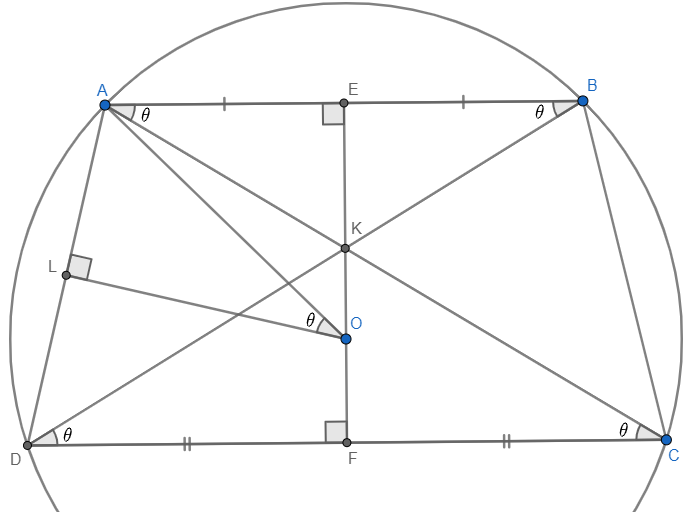
      Let \(A B C D\) be a cyclic quadrilateral such that \(A B\) is parallel to \(C D\). Let \(O\) be the circumcentre of \(A B C D\), and \(L\) be the point on \(A D\) such that \(O L\) is perpendicular to \(A D\). Prove that

      \(O B \cdot(A B+C D)=O L \cdot(A C+B D) \)

      Solution

      Let $\angle ABD=\theta\Rightarrow\angle BDC=\theta$ (since $AB||CD$). By the Inscribed angle theorem, $\angle BAC=\angle BDC=\angle ABD=\angle ACD=\theta$ (thus $ABCD$ is isoceles trapezoid). Hence, $\triangle ABK, \triangle CDK$ are isoceles and so $AB, CD$ have common perpendicular bisector through $K$ which also passes through center of circle $O$, making $E,K,O,F$ collinear as shown.

      Now, by the Inscribed angle theorem, $\angle AOD=2\theta\Rightarrow\angle AOL=\theta$ since $\triangle AOD$ is isoceles. Thus, $\cos{\theta}=\frac{OL}{OA}\rightarrow\boxed{eq1}$.

      In $\triangle ABK, \cos{\theta}=\frac{AE}{AK}=\frac{BE}{BK}$ and so by the componendo-dividendo rule, $\cos{\theta}=\frac{AE+BE}{AK+BK}=\frac{AB}{AK+BK}$. Similarly, in $\triangle CDK, \cos{\theta}=\frac{CF}{CK}=\frac{DF}{DK}=\frac{CF+DF}{CK+DK}=\frac{CD}{CK+DK}$. Combining these two results and applying componendo-dividendo rule once again, we get, $\cos{\theta}=\frac{AB}{AK+BK}=\frac{CD}{CK+DK}=\frac{AB+CD}{AK+BK+CK+DK}=\frac{AB+CD}{AC+BD}\rightarrow\boxed{eq2}$.

      From the equations $eq1$ and $eq2$, we conclude that $\cos{\theta}=\frac{OL}{OA}=\frac{AB+CD}{AC+BD}\Rightarrow \boxed{OB \cdot(A B+C D)=O L \cdot(A C+B D)}$, since $OA=OB=radius$.

      Problem 6

      Let \(n \geq 2\) be a positive integer. Call a sequence \(a_1, a_2, \cdots, a_k\) of integers an \(n\)-chain
      if \(1=a_1<a_2<\cdots<a_k=n\), and \(a_i\) divides \(a_{i+1}\) for all \(i, 1 \leq i \leq k-1\). Let \(f(n)\) be the number of \(n\)-chains where \(n \geq 2\). For example, \(f(4)=2\) corresponding to the 4 -chains $(1, 4)$ and $(1, 2, 4)$.
      Prove that \(f\left(2^m \cdot 3\right)=2^{m-1}(m+2)\) for every positive integer \(m\).

      Solution

      Exploring Ratios in Paper-Folding Geometry: A Challenge from the Australian Math Competition

      In this problem, we investigate how folding a rectangle with a \(3:1\) length-to-width ratio along its diagonal creates a pentagon, then calculate the ratio of the pentagon’s area to the rectangle’s area. Here’s a step-by-step breakdown:

      Problem Overview:

      Watch the Video

      Key Concepts:

      1. Diagonal Folding: Folding divides the rectangle into two congruent triangles. Upon folding, a pentagon is formed with overlapping areas.
      2. Using Pythagorean Theorem: The length of the diagonal \(d\) is:
        \(d = \sqrt{(3x)^2 + x^2} = x \sqrt{10}\)

      Solution:

      To calculate the pentagon’s area, we:

      1. Divide Areas: Recognize that the folded area includes parts of two triangles and involves subtracting a duplicated section.
      2. Area Calculation:

      This problem illustrates the beauty of geometric folding and similarity concepts, sharpening skills in spatial reasoning and area transformations.

      Sharygin Geometry Olympiad 2024

      Cheenta hosted the final round of prestigious Sharygin Geometry Olympiad in India. The olympiad is intended for high-school students of four eldest grades. This post contains the problems from this contest.

      Sharygin Olympiad is conducted by organisers from esteemed institutions in Russia.

      1. Steklov Mathematical Institute RAS
      2. Department of Education, Moscow City
      3. Moscow Center for Pedagogical Mastery
      4. Moscow Center for Continuous Mathematical Education
      5. Journal of Classical Geometry
      6. Moscow Institute of Physics and Technology

      Awardees from India - 2024

      1. ⁠Rishav Dutta (3rd prize)
      2. ⁠⁠Krishiv Khandelwal (3rd Prize)
      3. Sayantan Mazumdar (3rd Prize)
      4. ⁠⁠Debarchan Neogi (3rd Prize)
      5. Aratrik Pal (2nd Prize)
      6. ⁠⁠Kanav Talwar (1st Prize)

      First Day Problems - Grade 8

      First Day Problems - Grade 9

      First Day Problems - Grade 10

      Second Day Problems - Grade 8

      Second Day Problems - Grade 9

      Second Day Problems - Grade 10

      Proving Cyclic Quadrilaterals and Right Angles: A Problem from the Singapore Math Olympiad

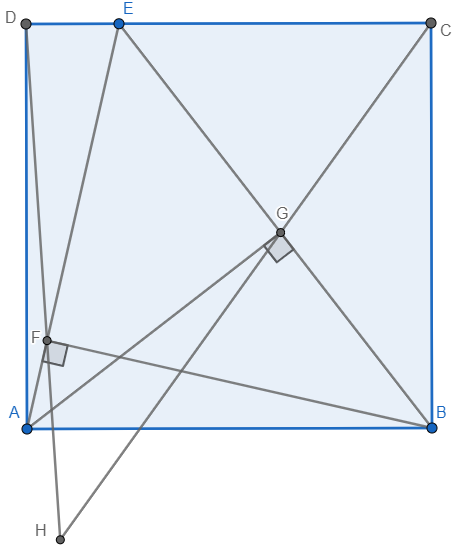
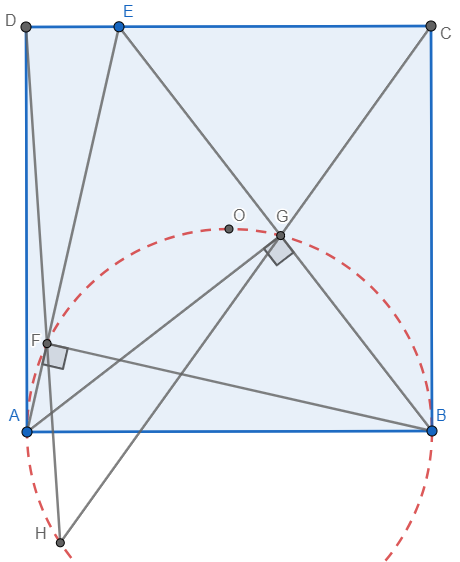
      In this video, we explore a challenging geometry problem from the Singapore Math Olympiad (Senior Section, Round 2). The problem involves a square, a randomly chosen point on one of its sides, and various perpendiculars and intersections leading to the proof of a right angle. Let’s break down the key concepts used to arrive at the solution.

      Problem Overview:

      Watch the Video

      Key Concepts Used:

      Step-by-Step Proof Summary:

      1. Establish Concyclic Points: We first construct the circumcircle of \(\triangle AFB\) and show that it passes through point \(G\), making \(A\), \(F\), \(O\), \(G\), and \(B\) concyclic.
      2. Use Angle Properties: By analyzing the angles subtended by the chords, we establish that the angles at the circumference involving these points are equal, ensuring concyclicity.
      3. Prove Point \(H\) Lies on the Circle: By showing that points \(F\), \(D\), \(E\), and \(O\) are concyclic, and performing a similar analysis on the other side of the square, we conclude that point \(H\) must also lie on the circumcircle.
      4. Conclude with the Right Angle: Since point \(H\) lies on the circle whose diameter is segment \(AB\), the \(\angle AHB\) must be \(90{^\circ}\) by the inscribed angle theorem.

      This solution beautifully illustrates how advanced geometry concepts like cyclic quadrilaterals, concyclicity, and angle chasing can be used to solve complex problems involving right angles and perpendiculars.

      Motivation and Exploration:
      The video also discusses the motivation behind defining certain points and relationships, such as the center of the square. Experimentation, including transformations like inversion, can often reveal hidden properties and relationships in geometry. This problem is an excellent example of how problem-solving in geometry is as much about exploration and insight as it is about formal methods.

      Understanding Angle Properties in an Isosceles Trapezium: Australian Mathematical Competition 2013

      In this video, Deepan, a faculty member at Cheenta, walks through an exciting problem from the Junior Section of the Australian Math Competition 2013. The problem involves angle chasing in various geometric shapes, such as equilateral triangles, squares, and an isosceles trapezium.

      Watch the Video

      Here are the key points covered:

      This video beautifully ties together concepts of equilateral triangles, squares, isosceles trapeziums, and angle chasing, offering an engaging exploration of geometry.