Exploring Homothety and Similar Triangles: A Problem from the Australian Math Competition
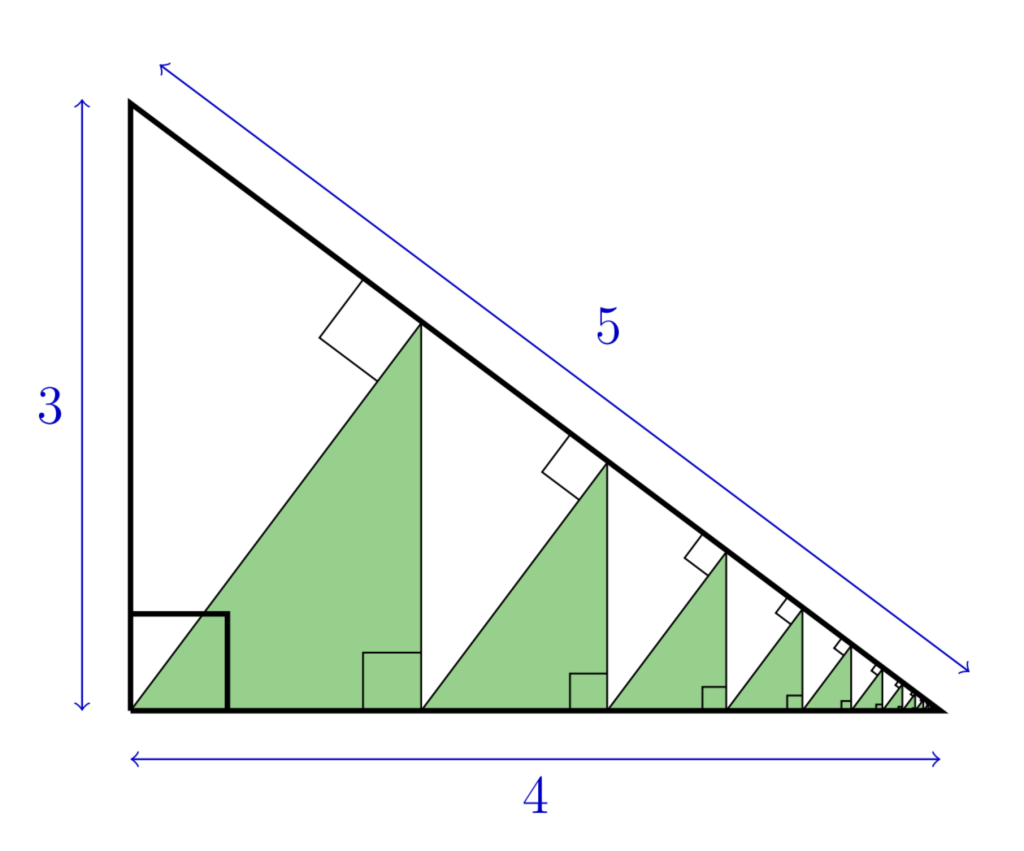
In this video, we explore the geometric concept of homothety through a fascinating problem from the Australian Mathematical Competition. The problem involves an infinite series of smaller right-angled triangles drawn inside a larger right-angled triangle, and we are tasked with finding the area of the shaded (green) region.
Watch the Video
Here’s what we learned:
- Homothety and Scaling: The key idea in this problem is \(\textit{homothety}\), a geometric transformation where figures are enlarged or reduced in size, while keeping their proportions constant. This principle is crucial in understanding the scaling of the geometrical shapes.
- Right-Angled Triangles and Similarity: The main triangle is a \(3-4-5\) right-angled triangle, one of the most well-known types. By recognizing that smaller triangles inside it are similar to the larger triangle, we can use their proportional relationships to calculate areas.
- Properties of Trapezium: If two lines are perpendicular to a line, then they are \(\textit{parallel}\) lines. Then the quadrilaterals formed are trapeziums. By applying the properties of trapeziums, we are able to simplify calculations.
- Similar Triangles Theorem for Areas: A key result from the similar triangles is that the ratio of their areas is the square of the ratio of their corresponding sides. This is applied multiple times throughout the problem to find areas of smaller triangles as well as trapeziums.
- Summation of Infinite Series: By applying the concept of \(\textit{homothety}\), we find that the sum of the areas of all trapeziums equals the area of the largest triangle. From this, the fraction of the area covered by the shaded green portion can be calculated.
This problem beautifully combines geometric transformations, similar triangles, and infinite series, showcasing the powerful applications of \(\textit{homothety}\) in solving complex geometry problems.

