Dudeney Puzzle: A Tale from Pythagoras to Dehn - Part II
(Remember the Dudeney puzzle introduced in the last post. We have ended with the question "Why four?"...We will be revealing the reason in this post.)
Obviously, by the way, we have given the algorithm, there is an upper bound to the number of pieces required.
The next natural question is Do there exist a lower bound?
What is the minimum number of cuts required to convert an equilateral triangle into a square?
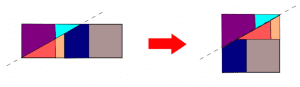
Dudeney proved that 4 is the least he can reduce it to by the following elegant construction:

Now, this seems to arise the following question:
(1). Do there exist dissections with three pieces?
(2). Do there exist dissections with two pieces?
(1) is still unsolved, but (2) cannot take place and is obvious!
A Square \(\Leftrightarrow \) An Equilateral Triangle in two cuts is not possible:

The possible types of cuts are drawn above. Observe S3 cannot give rise to any of the T cuts as it gives rise to 2 quadrilaterals. S2 can give rise to T2 which is not possible S2 gives rise to a quadrilateral with 2 right angles. S1 can give rise to T1 but it is possible if T1 is the median cut but in that case, it will not be right-angled isosceles.
What about three pieces? Please share your ideas in the comments!
Let’s dive deep into the Four Piece Cut: A lot of work has been done in the past.

These are the details and yet ugly looking but it reveals how to do the cut.
Let me provide the math and measurements of one angle as it consists of one parameter only.
\(\alpha =\)arc\(\sin (\frac{\sqrt{\sqrt{3}}}{2}) \approx 41.150335^\circ\)
Well, you will observe while solving this you will get a four-degree polynomial which has the shown above the real root. Also, perhaps, I am not sure this angle is not constructable, but for practical purposes to enjoy this six decimal place precision is perfect.
Since then these have become a good way for math entertainment in class to show the magical beauty of math.
Hey, this is not over! We have more questions to ask and seek an answer to!
What is a general good lower bound on the number of pieces required to transform any polygon to another of the same area by the above method?
Alfred Tarski proved that if P is convex and the diameters of P and Q are respectively given by d(P)and d(Q), then the minimum number n of pieces required to compose polygon Q from another polygon P \(\geq \) d(P)/d(Q)
Can You prove it?
Think of this, it is very intuitive it means that for P \(\rightarrow \) Q with an increase in the maximum distance between two points in P and a decrease in that of Q we have to increase the number of pieces as we have to make triangles with a lesser diameter in a larger diameter polygon.
Thus for two convex polygons P and Q such that P \(\Leftrightarrow \) Q. Then the minimum number n of pieces required to compose polygon Q from another polygon P \(\geq \) max {d(P)/d(Q), d(Q)/d(P)}.
Since Alfred Tarski has arrived into the picture, we can’t help but sharing the idea about his dissection of a circle into a square.
Circle to Square Dissection Problem
The Problem: Can you cut the circle into a finite number of pieces and reassemble them to get a square?[equidissectability]
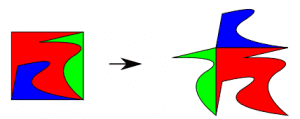
Yes! They are not possible with scissor cut only! Even if curved edges are considered by scissor cuts. The proof requires a bit of playing around with pictures a beautiful observation. Remember the picture for Scissor Congruence:

Observe that the In scissors congruence, any time a section of the convex circular perimeter is created or destroyed it cancels with a corresponding pieces of concave circular perimeter. So convex circular perimeter − concave circular perimeter is an invariant of scissors congruence.
A 1964 publication by Dubins, Hirsch, and Karush informs us that a circular disk is “scissor congruent” to no other strictly convex body. We can never physically achieve a solution to the circle-squaring problem with scissors and paper. The proof used the above idea.
Now the beauty of something outside of Human Imagination comes into the question:
Can you decompose the circle into a finite number of pieces and reassemble them to get square?[equidecomposability, it means it may not be cut be scissors but yes it can be done somehow]
Miklós Laczkovich, however, shocked mathematicians around the world with an affirmative response to Tarski’s question. In 1990, Laczkovich proved that any circle in the plane is equidecomposable with a square of equal area. He succeeded because he allowed pieces that are difficult to imagine—dustings of points that are selected using the controversial Axiom of Choice. Laczkovich’s proof shows that such a decomposition is theoretically possible, but there is no picture to help us understand how this is accomplished. He gives an upper bound of \(10^{50}\) for the number of pieces that are required in this decomposition, and he shows that the rearrangement of the pieces can be accomplished using translations alone. None of the pieces require a rotation or a reflection.
Now, how about transcending into the third dimension?
Hilbert’s 3rd Problem exactly deals with this problem:
Given any two polyhedra of equal volume, is it always possible to cut the first into finitely many polyhedral pieces which can be reassembled to yield the second?
Max Dehn proved that it is false providing a counterexample using some Mathematical Idea called Dehn Invariant, which remains same under dissections and reassembling.
He proved that A cube and a regular tetrahedron are not dissection congruent.
In fact, the following result is true: Two polyhedra are dissection congruent if and only if they have the same volume and Dehn invariant.
Banach Tarski’s Paradox is worth mentioning and also is the child of Alfred Tarski, which is also based on the “decomposability” of the Sphere and is the starting point of measure theory and something out of human imagination and intuition:
Given a solid ball in 3‑dimensional space, there exists a decomposition of the ball into a finite number of disjoint subsets, which can then be put back together in a different way to yield two identical copies of the original ball. Indeed, the reassembly process involves only moving the pieces around and rotating them without changing their shape. However, the pieces themselves are not "solids" in the usual sense, but infinite scatterings of points. The reconstruction can work with as few as five pieces.

 et's travel back 2 Millenia to the Land of the Greeks where