B.Math 2007 Objective Paper| Problems & Solutions

Here are the problems and their corresponding solutions from B.Math Hons Objective Admission Test 2007.

Problem 1 :

The number of ways of going up $7$ steps if we take one or two steps at a time is

(A) $19$ ;
(B) $20$;
(C) $21$ ;
(D) $22$ .

Problem 2 :

Consider the surface defined by $x^{2}+2 y^{2}-5 z^{2}=0$. If we cut the surface by the plane given by the equation $x=z,$ then we obtain a

(A) hyperbola;
(B) circle;
(C) parabola;
(D) pair of straight lines.

Problem 3 :

Let $a, b$ be real numbers. The number of real solutions of the system of equations $x+y=a$ and $x y=b$ is

(A) at most $1$ ;
(B) at most $2$;
(C) at least $1$;
(D) at least $2$.

Problem 4 :

If a fair coin is tossed $100$ times, then the probability of getting at least one head is

(A) $\frac{100}{2^{100}}$;
(B) $\frac{99}{100}$;
(C) $1-\frac{1}{100 !}$;
(D) $1-\frac{1}{2^{100}}$.

Problem 5 :

Let $f(x)$ be a degree five polynomial with real coefficients. Then the number of real roots of $f$ must be

(A) $1$;
(B) $2$ or $4$;
(C) $1$ or $3$ or $5$ ;
(D) none of the above.

Problem 6 :

The number of ways in which $3$ girls and $2$ boys can sit on a bench so that no two girls are adjacent is

(A) $6$ ;
(B) $12$ ;
(C) $32$ ;
(D) $120$ .

Problem 7 :

Let $R_{n}=2+\sqrt{2+\sqrt{2+\ldots+\sqrt{2}}}\left(n\right.$ square root signs). Then $\lim _{n \rightarrow \infty} R_{n}$ equals

(A) $4$;
(B) $8$;
(C) $16$ ;
(D) $e^{2}$.

Problem 8 :

Let $a_{n}$ be the sequence whose $n$ th term is the sum of the digits of the natural number $9 n$. For example, $a_{1}=9, a_{11}=18$ etc. The minimum $m$ such that $a_{m}=81$ is

(A) $110111112$ ;
(B) $119111113$ ;
(C) $111111111$;
(D) none of the above.

Problem 9 :

$\lim _{n \rightarrow \infty}\left[2 \log (3 n)-\log \left(n^{2}+1\right)\right]$

(A) is $0$ ;
(B) is $2 \log 3$;
(C) is $4 \log 6$;
(D) does not exist.

Problem 10 :

Let $S=\{x \in \mathbb{R}|1 \leq| x \mid \leq 100\}$ be a subset of the real line. Let $M$ be a non-empty subset of $\bar{S}$ such that for all $x, y$ in $M,$ their product $x y$ is also in $M .$ Then $M$ can have

(A) only one element;
(B) at most $2$ elements;
(C) more than $2$ but only finitely many elements;
(D) infinitely many elements.

Problem 11:

An astronaut lands on a planet and meets a native of the planet. She asks the native "How many days do you have in your year?" He answers "It is the sum of the souares of three consecutive natural numbers but it is also the sum of the sauares of the next two numbers". The answer to the astronaut's question is

(A) $365$;
(B) $1095$ ;
(C) $30000$ ;
(D) $10^{10}$.

Problem 12 :

Let $a_{1}=2$ and for all natural number $n$, define $a_{n+1}=a_{n}\left(a_{n}+1\right) .$ Then, as $n \rightarrow \infty$, the number of prime factors of $a_{n}$

(A) goes to infinity;
(B) goes to a finite limit;
(C) oscillates boundedly;
(D) oscillates unboundedly.

Problem 13 :

Suppose that the equation $a x^{2}+b x+c=0$ has a rational solution. If $a, b, c$ are integers then

(A) at least one of $a, b, c$ is even;
(B) all of $a, b, c$ are even;
(C) at most one of $a, b, c$ is odd;
(D) all of $a, b, c$ are odd.

Problem 14 :

Let $S={1,2,3,4}$. The number of functions $f: S \rightarrow S$ such that $f(i) \leq 2 i$ for all $i \in S$ is

(A) $32$ ;
(B) $64$;
(C) $128$;
(D) $256$ .

Problem 15 :

Let $f: \mathbb{R} \rightarrow \mathbb{R}$ be a function defined by $f(x)=x^{2}-\frac{x^{2}}{1+x^{2}}$. Then

(A) $f$ is one-one but not onto;
(B) $f$ is onto but not one-one;
(C) $f$ is both one-one and onto;
(D) $f$ is neither one-one nor onto.

Problem 16 :

Define the sequence $\{a_{n}\}$ by $a_{1}=1, a_{2}=\frac{e}{2}, a_{3}=\frac{e^{2}}{4}, a_{4}=\frac{e^{3}}{8}, \ldots$ Then
$\lim_ {n \rightarrow \infty} a_{n}$ is

(A) $0$;
(B) $1$;
(C) $e^{e}$;
(D) infinite.

Problem 17 :

Let $C$ be the circle of radius 1 around 0 in the complex plane and $z_{0}$ be a fixed point on $C$. Then the number of ordered pairs $\left(z_{1}, z_{2}\right)$ of points on $C$ such that $z_{0}+z_{1}+z_{2}=0$ is

(A) $0$ ;
(B) $1$;
(C) $2$;
(D) $\infty$.

Problem 18 :

The number of real solutions of $e^{x}+x^{2}=\sin x$ is

(A) $0$;
(B) $1$;
(C) $2$;
(D) $\infty$.

Problem 19 :

The set of complex numbers $z$ such that $|z+1| \leq|z-1|$ is the half plane

(A) of complex numbers that lie above the real axis;
(B) of complex numbers that lie below the real axis;
(C) of complex numbers that lie left of the imaginary axis;
(D) of complex numbers that lie right of the imaginary axis.

Problem 20 :

$\lim _{x \rightarrow 0} \cos (\sin x)$ is

(A) $-1$ ;
(B) $0$;
(C) $1 / 2$;
(D) $1$ .

Problem 21 :

The number of rational roots of the polynomial $x^{3}-3 x-1$ is

(A) $0$ ;
(B) $1$;
(C) $2$;
(D) $3$.

Problem 22 :

$\sum_{n=1}^{\infty} \frac{n^{2}}{n !}$ equals

(A) $e$;
(B) $2 e$;
(C) $e^{2}$;
(D) $\infty$.

Problem 23 :

Let $n>1$ be a natural number and let $A=\left(\begin{array}{cc}1 & n \\ 0 & 1\end{array}\right) .$ Then

(A) $A^{n}=I d$;
(B) $A^{n^{2}+1}=I d$;
(C) $A^{n^{4}+1}=I d$;
(D) none of these numbers.

Problem 24 :

The number of ways of breaking a stick of length $n>1$ into $n$ pieces of unit length (at each step break one of the pieces with length $>1$ into two pieces of integer lengths) is

(A) $(n-1) !$;
(B) $n !-1$;
(C) $2^{n-2}$;
(D) $2^{n-1}-1$.

Problem 25 :

Let $A B C$ be a right angled triangle in the plane with area $s$. Then the maximum area of a rectangle inside $A B C$ is

(A) $s / 4$;
(B) $s / 3$;
(C) $s / 2$;
(D) $s$.
Some Useful Links:

ISI Entrance 2010 - B.Math Subjective Paper| Problems & Solutions

Here, you will find all the questions of ISI Entrance Paper 2010 from Indian Statistical Institute's B. Math Entrance. You will also get the solutions soon of all the previous year problems.

Problem 1:

Prove that in each year, the $13$ th day of some month occurs on a Friday.

Problem 2:

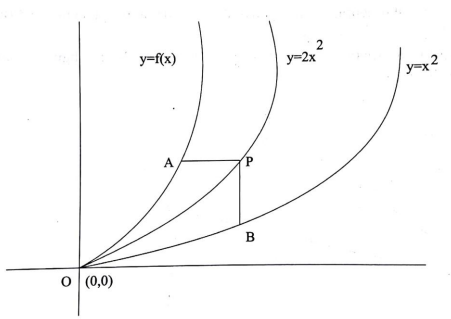
In the accompanying figure, $y=f(x)$ is the graph of a one-to-one continuous function $f$. At each point $P$ on the graph of $y=2 x^{2}$, assume that the areas $O A P$ and $O B P$ are equal. Here $P A \cdot P B$ are the horizontal and vertical segments. Determine the function $f$.

Problem 3:

Show that. for any positive integer $n,$ the sum of $8 n+4$ consecutive positive integers cannot be a perfect square.

Problem 4:

If $a, b, c \in(0,1)$ satisfy $a+b+c=2,$ prove that

$\frac{a b c}{(1-a)(1-b)(1-c)} \geq 8$.

Problem 5:

Let $a_{1}>a_{2}>\cdots>a_{r}$ be positive real numbers. Compute $\lim _{n \rightarrow \infty}\left(a_{1}^{n}+a_{2}^{n}+\cdots+a_{r}^{n}\right)^{1 / n}$.

Problem 6:

Let each of the vertices of a regular $9$-gon (polygon of $9$ equal sides and equal angles) be coloured black or white.
(a) Show that there are two adjacent vertices of the same colour.
(b) Show there are 3 vertices of the same colour forming an isosceles triangle.

Problem 7:

Let $a, b, c$ be real numbers and. assume that all the roots of $x^{3}+a x^{2}+b x+c=0$ have the same absolute value, Show that $a=0$ if, and only if, $b=0$.

Problem 8:

I et $f$ be a real-valued differentiable function on the real line $\mathbb{R}$ such that $\lim _{x \rightarrow 0} \frac{f(x)}{x^{2}}$ exists, and is finite. Prove that $f^{\prime}(0)=0$.

Problem 9:

Let $f(x)$ be a polynomial with integer coefficients. Assume that 3 divides the value f(n) for each integer $n$. Prove that when $f(x)$ is divided by $x^{3}-x$ the remainder is of the form $3 r(x)$, where $r(x)$ is a polynomial with integer coefficients.

Problem 10:

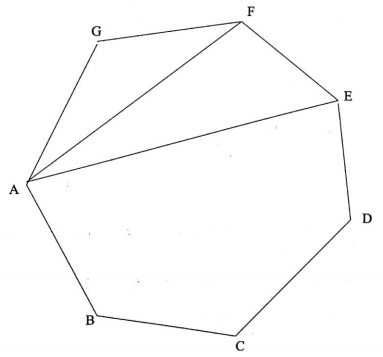
Consider a regular heptagon (polygon of 7 equal sides and equal angles) ABCDEFG.

(a) Prove $\frac{1}{\sin \frac{\pi}{7}}=\frac{1}{\sin \frac{2 \pi}{7}}+\frac{1}{\sin \frac{3 \pi}{7}}$.
(b) Using (a) or otherwise, show that $\frac{1}{A G}=\frac{1}{A F}+\frac{1}{A E}$. (See the figure appearing in the next page.)

Some useful link :

Test of Mathematics Solution Subjective 176 - Value of a Polynomial at x = n+1

Test of Mathematics at the 10+2 Level

This is a Test of Mathematics Solution Subjective 176 (from ISI Entrance). The book, Test of Mathematics at 10+2 Level is Published by East West Press. This problem book is indispensable for the preparation of I.S.I. B.Stat and B.Math Entrance.


Also visit: I.S.I. & C.M.I. Entrance Course of Cheenta

Problem

Suppose that P(x) is a polynomial of degree n such that $ P(k) = \frac {k}{k+1} $ for k = 0, 1, 2, ..., n . Find the value of P(n+1).


Solution

Consider an auxiliary polynomial g(x) = (x+1)P(x) - x . g(x) is an n+1 degree polynomial (as P(x) is n degree and we multiply (x+1) with it). We note that g(0) = g(1) = ... = g(n) = 0  (as the given condition allows (k+1) P(k) - k = 0 for all k from 0 to n). Hence 0, 1, 2, ... , n are the n+1 roots of g(x).

Therefore we may write g(x) = (x+1)P(x) - x = C(x)(x-1)(x-2)...(x-n) where C is a constant. Put x = -1. We get g(-1) = (-1+1)P(-1) - (-1) = C(-1)(-1-1)(-1-2)...(-1-n).

Thus 1 = C $ (-1)^{(n+1) } (n+1)! $ gives us the value of C. We put the value of C in the equation (x+1)P(x) - x = C(x)(x-1)(x-2)...(x-n) and replace x by n+1 to get the value of P(n+1).

$ (n+2)P(n+1) - (n+1) = \frac { (-1)^{(n+1)}}{(n+1)!} (n+1)(n)(n-1) ... (1) $ implying $ P(n+1) = \frac { (-1)^{(n+1)} + (n+1)}{(n+2)} $

ISI Entrance Paper 2018 - B.Stat, B.Math Subjective

Here, you will find all the questions of ISI Entrance Paper 2018 from Indian Statistical Institute's B.Stat Entrance. You will also get the solutions soon of all the previous year problems.

Problem 1:

Find all pairs $(x,y)$ with $x,y$ real, satisfying the equations:

$\sin(\frac{x+y}{2})=0,\vert x\vert+\vert y\vert=1$

Problem 2:

Suppose that $PQ$ and $RS$ are two chords of a circle intersecting at a point $O$. It is given that $PO=3 \mathrm{cm}$ and $SO=4 \mathrm{cm}$. Moreover, the area of the triangle $POR$ is $7 \mathrm{cm}^2$. Find the area of the triangle $QOS$.

Problem 3:

Let $f:\mathbb{R} \to \mathbb{R}$ be a continuous function such that for all $x \in \mathbb{R}$ and for all $t \geq 0$, $f(x)=f(e^{t}x)$. Show that $f$ is a constant function.

Problem 4:

Let $f:(0,\infty)\to \mathbb{R}$ be a continuous function such that for all $x \in(0,\infty)$, $f(2x)=f(x)$. Show that the function $g$ defined by the equation $g(x)=\int_{x}^{2x} f(t)\frac{dt}{t}$ for $x>0$ is a constant function.

Problem 5:

Let $f:\mathbb{R}\to \mathbb{R}$ be a differentiable function such that its derivative $f'$ is a continuous function. Moreover, assume that for all $x \in\mathbb{R}$, $0 \leq \vert f'(x)\vert\leq \frac{1}{2}$. Define a sequence of real numbers $ \{a_n\}_{n\in\mathbb{N}}$ by : $a_1=1$ and $a_{n+1}=f(a_n)$ for all $n\in\mathbb{N}$. Prove that there exists a positive real number $M$ such that for all $n\in\mathbb{N}$,

|an|M

Problem 6:

Let, $a\geq b\geq c >0$ be real numbers such that for all natural number $n$, there exist triangles of side lengths $a^{n} , b^{n} ,c^{n}$. Prove that the triangles are isosceles.

Problem 7:

Let $a, b, c$ are natural numbers such that $a^{2}+b^{2}=c^{2}$ and $c-b=1$

Prove that,

(i) $a$ is odd,

(ii) $b$ is divisible by $4$,

(iii) $a^{b}+b^{a}$ is divisible by $c$.

Problem 8:

Let $n\geq 3$. Let $A=((a_{ij}))_{1\leq i,j\leq n}$ be an $n\times n$ matrix such that $a_{ij}\in\{-1,1\}$ for all $1\leq i,j\leq n$. Suppose that $a_{k1}=1$ for all $1\leq k\leq n$ and $\sum_{k=1}^n a_{ki}a_{kj}=0$ for all $i\neq j$. Show that $n$ is a multiple of $4$.

Some useful Links:

ISI BStat BMath problem 14 | Objective Problems Discussion

Let's discuss this objective problem number 14 from ISI BStat BMath. Try to solve the problem and then read their solution.

Problem 14

f(x) = tan(sinx) (x > 0)

To understand the graph of a function, easiest and the most proper method is to apply techniques from calculus. We will quickly compute, derivative and second derivative and try to understand extreme points and convexity of the curve.

$latex f'(x) = cos (x) sec^2 (sin (x)) $

Hence when cos(x) is positive (correspondingly negative), derivative is positive (is negative). Therefore from $ (0, \frac{\pi}{2} ) $ function is increasing, $ ( \frac{\pi}{2} , \frac{3\pi}{2} ) $ the function is decreasing. Also it has critical points on cos (x) is 0 (at $ x = \frac{\pi}{2} , \frac{3\pi}{2} $ )

Now we compute the second derivative.

$ f''(x) = - \sec^2 (\sin(x)) (\sin(x) - 2 \cos^2(x) \tan (\sin(x))) $

At $ x = \frac{\pi}{2} $ second derivative is $ -\sec^2 1 $ [hence we have a maxima] and at $ x = \frac{3\pi}{2} $ second derivative is $ \sec^2 1 $ [hence we have a minima]

Finally we compute $ f(\frac{\pi}{2} ) = \tan 1 > 1 , f(\frac{3\pi}{2} ) = - \tan 1 < -1 $.

Moreover, the function is differentiable at the points of maxima and minima. Hence answer is (B)