AMC 2021 Middle Primary โ€“ Problem 22 with Solution | Australian Mathematics Competition Explained

Let's discuss a problem from the AMC 2021 Middle Primary Category: Problem 22 which revolves around puzzle.

Question


The biscuit section in a cookbook has 6 pages. The sum of all the page numbers in this section is 147 . What is the number of the last page in this section of the book?


(A) 26
(B) 27
(C) 28
(D) 29
(E) 30

Solution


To number the pages we want $6$ consecutive numbers .

Let's try to check the nearest numbers divisible by $6$.
If we multiply $6 \times 20 = 120$ which is less than the number that we have to get : $147$.

If we multiply $6\times 30 = 180$ which is more than the number that we have to get : $147$.

So the required number will be in between $20$ and $30$.
As the number is bigger than 120 so let's try to take the first number as $20$ then rest of the 5 consecutive numbers.
Adding the numbers: $20+21+22+23+24+25 = 135$. This is less than $147$.
Let's see how much less we are getting: $147 - 135 = 12$.

So, instead of starting from $20$ if we start from $22$ we will get :
$22 + 23+ 24+ 25 +26 + 27 = 147$.

So the last page number is $27$.

What is AMC (Australian Mathematics Competition)?

The Australian Mathematics Competition (AMC) is one of Australia's largest and oldest annual mathematics competitions, aimed at fostering interest and excellence in mathematics among student

Explore Panini8 Software through this video:1

Australian Mathematics Competition - 2022 - Middle Primary Years - Grade 3 & 4 - Questions

Problem 1:

How many dots are in this pattern?

(A) 20
(B) 21
(C) 22
(D) 23
(E) 24

Problem 2:

What number is one hundred more than \(465 \) ?

(A) 365
(B) 455
(C) 475
(D) 565
(E) 1465

Problem 3:

What fraction of this rectangle is shaded?

(A) \(\frac{1}{2}\)
(B) \(\frac{1}{4}\)
(C) \(\frac{1}{6}\)
(D) \(\frac{1}{8}\)
(E) \(\frac{1}{10}\)

Problem 4:

There were 17 dogs and 9 ran away. How many dogs were left?

(A) 7
(B) 8
(C) 12
(D) 26
(E) 27

Problem 5:

John is playing a board game. He moves his blue piece (>) one square up then three squares left. Which piece does he land on?

Problem 6:

Which shape is not used in this snowman picture?

(A) circle
(B) oval
(C) triangle
(D) square
(E) rectangle

Problem 7:

Eve starts at 20 and counts up by twos: (20,22,24) and so on. What is the tenth number she counts?

(A) 30
(B) 32
(C) 34
(D) 36
(E) 38

Problem 8:

This graph was made by a Year 3 class. How many students chose either Saturday or Sunday as their favourite day?

(A) 5
(B) 8
(C) 10
(D) 12
(E) 20

Problem 9:

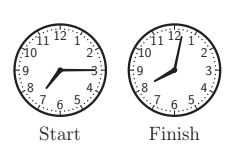
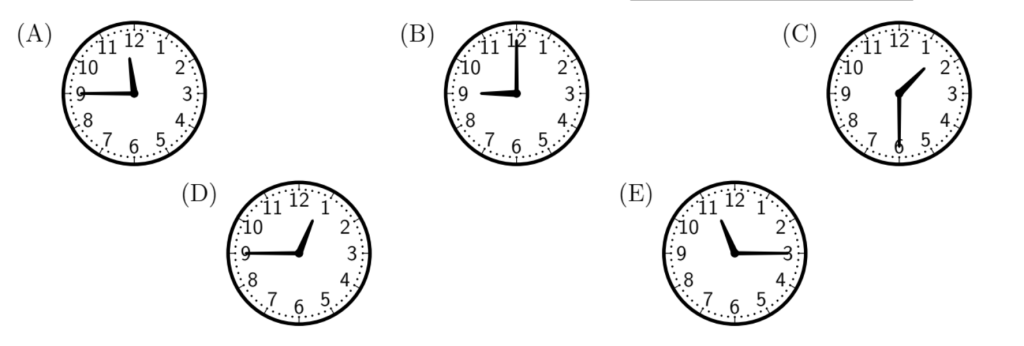
I went for a bike ride this morning. These clocks show my start and finish times.
In minutes, how long was my ride?

(A) 9
(B) 13
(C) 47
(D) 52
(E) 62

Problem 10:

Edie and Louie are standing in a line with other children. Edie is fourth from the front and Louie is fourth from the back of the line. There are 15 children in the line. How many children are between Edie and Louie?

(A) 7
(B) 8
(C) 10
(D) 11
(E) 12

Problem 11:

There are 49 ten-cent coins in my pink piggy bank and 25 twenty-cent coins in my blue piggy bank.
How much money do I have altogether?


(A) \(\$ 7.40\)
(B) \(\$ 9.90\)
(C) \(\$ 12.30\)
(D) \(\$ 14.80\)
(E) \(\$ 990\)

Problem 12:

How many more small cubes are needed to complete this large cube?

(A) 6
(B) 8
(C) 9
(D) 12
(E) 20

Problem 13:

Ms Amali brings 100 stickers to share equally among her class of 23 students. How many stickers will she have left over?

(A) 3
(B) 8
(C) 12
(D) 17
(E) 21

Problem 14:

This card is flipped over its right-hand edge and then flipped again over its bottom edge. What does the card look like now?

Problem 15:

Chris wants to use the same number in both boxes to make this number sentence true. What number should she use?

(A) 1 (B) 2 (C) 3 (D) 4 (E) 5

Problem 16:

Sally says to her brother, 'You are 10 years older than me'. Her brother says, 'You are right, and I am three times your age'. How old is Sally?

(A) 4 (B) 5 (C) 6 (D) 7 (E) 8

Problem 17:

How many of the small coloured tiles are needed to cover the large cross shape shown?

(A) 10
(B) 15
(C) 20
(D) 36
(E) 40

Problem 18:

Siobhan has seven cards, numbered 1 to 7 . She places six of them correctly in the three number sentences. Which card does she have left over?

(A) 1
(B) 2
(C) 3
(D) 5
(E) 7

Problem 19:

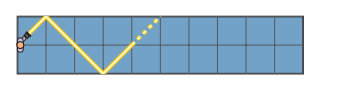
A long rectangular room 10 m long and 2 m wide has mirrors on all four walls. Any beam of light hitting these mirrors bounces back at the same angle as shown below. A guard standing at one end of the room shines a torch at an angle of \(45^{\circ}\) to the walls, making a narrow beam that bounces off the mirrors several times, stopping when it returns to her. How many times does the beam of light bounce off the mirrors?

(A) 7
(B) 9
(C) 10
(D) 11
(E) 22

Problem 20:

A can filled with 30 marbles weighs 115 g . The same can with 20 marbles weighs 85 g . How much does the empty can weigh?

(A) 10 g
(B) 20 g
(C) 25 g
(D) 30 g
(E) 55 g

Problem 21:

Peter wants to buy a length of ribbon to wrap around a box as shown. The box is 20 cm long, 20 cm wide and 20 cm high. It takes an extra 80 cm of ribbon to tie the bow. What is the best estimate of the amount of ribbon that Peter needs to buy to tie around the box?

(A) 160 cm
(B) 180 cm
(C) 240 cm
(D) 280 cm
(E) 320 cm

Problem 22:

In week 1, Hamish and Eliza open bank accounts for their savings. Hamish saves (\$ 12) every two weeks, starting in week 1 . Eliza saves (\$ 32) in week 1 and then (\$ 4) every week after that. When will they first have the same amount of money in the bank?

(A) week 3
(B) week 5
(C) week 7
(D) week 9
(E) week 11

Problem 23:

A different whole number is placed in each corner of a square. Two numbers joined by an edge must have a difference of more than 1. When the four numbers are added together, what is the smallest possible total?

(A) 10
(B) 11
(C) 12
(D) 13
(E) 14

Problem 24:

Three whole numbers add to 21 . When these same three numbers are multiplied together they equal 280 . What is the smallest of these three numbers?

(A) 1
(B) 2
(C) 4
(D) 7
(E) 10

Problem 25:

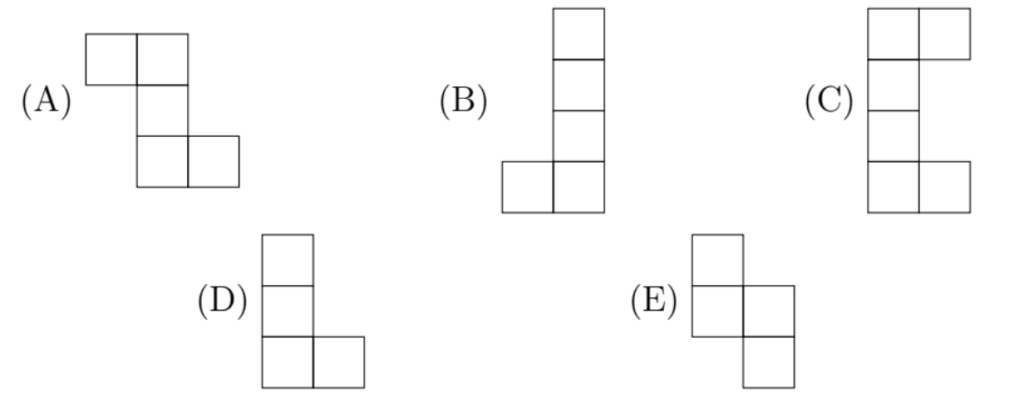
Steven made this cube from a paper net, then pushed a pin through it as shown. He then removed the pin, leaving holes in the cube, and unfolded the cube back to its net. Which of the following could be the net of Steven's cube?

Problem 25:


I notice that my electricity meter currently reads 896754 units, where all the digits are different. How many more units of electricity will I need to use before all the digits are again different?

Problem 27:

How many whole numbers between 200 and 500 contain the digit 3 ?

Problem 28:

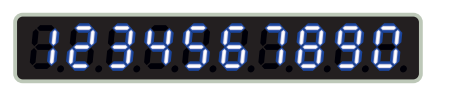
On a digital display, a combination of bars light up to represent each digit as shown:

In some special numbers, the number of bars which light up in the digits is the same as the sum of the digits. For example, in 373 the number of bars is (5+3+5=13) which is the equal to (3+7+3=13). What is the largest such three-digit number?

Problem 29

Nguyen writes down some numbers according to the following rules. Starting with the number 1 , he doubles the number and adds 4 , so the second number he writes is 6 . He now repeats this process, starting with the last number written, doubling and then adding 4, but he doesn't write the hundreds digit if the number is bigger than 100 . What is the 2022nd number that Nguyen writes down?

Problem 30:

I choose three different numbers out of this list and add them together: 1, 3, 5, 7, 9,โ€ฆ, 105 How many different totals can I get?

Australian Mathematics Competition - 2018 - Upper Primary Division - Grades 5 & 6- Questions and Solutions

Problem 1:

Which one of these numbers is closest to 208 ?

(A) 190 (B) 200 (C) 205 (D) 210 (E) 218

Problem 2:

Callie has $\$ 47$ and then gets $\$ 25$ for her birthday. How much does she have now?


(A) $\$ 52$ (B) $\$ 62$ (C) $\$ 65$ (D) $\$ 69$ (E) $\$ 72$

Problem 3:

Which one of the following numbers is a multiple of 8 ?

(A) 18 (B) 28 (C) 38 (D) 48 (E) 58

Problem 4:

Kate made this necklace from alphabet beads.
She put it on the wrong way around, showing the back of the beads. What does this look like?

Problem 5:

Write the number for eight thousand, eight hundred and eight.

(A) 88008 (B) 80808 (C) 80088 (D) 888 (E) 8808

Problem 6:

Jane has a number of 20 c coins and Tariq has a number of 50 c coins. They have the same amount of money. What is the smallest number of coins they could have all together?

(A) 2 (B) 5 (C) 6 (D) 7 (E) 10

Problem 7:

Mrs Chapman put 58 books back on the library shelves. She put 12 books on each shelf except the last shelf. How many books did she put on the last shelf?

(A) 7 (B) 8 (C) 9 (D) 10 (E) 11

Problem 8:

A shopkeeper displays plastic cups like this. Each level has one less than the level below it, and the top level has only one cup. She keeps this pattern going until she has 28 cups. How many levels is this?

(A) 5 (B) 6 (C) 7 (D) 8 (E) 9

Problem 9:

Six friends each make a phone call to another city.
The cost of each call depends on the time taken for the call as well as the distance.
From this diagram decide whose phone call lasts longer than Pat's, but costs less.


(A) Al (B) Bill (C) Jo (D) Mia (E) Zac

Problem 10:

Aimee, Bilal and Caitlin are comparing their ages. Aimee is 8 years old. In three years time, Bilal will be 9 . Two years ago, Caitlin was 5 .
Ordered from youngest to oldest, they are

(A) Aimee, Bilal, Caitlin (B) Bilal, Caitlin, Aimee (C) Caitlin, Aimee, Bilal (D) Bilal, Aimee, Caitlin (E) Aimee, Caitlin, Bilal

Problem 11:

What value is indicated on this popularity meter?

(A) 36.65 (B) 37.15 (C) 37.3 (D) 37.65 (E) 38.65

Problem 12:

One of these shapes made of squares has been flipped and turned to make the following pattern, without any overlaps. Which one?

Problem 13:

Fred looked at the clock during the Library lesson. Which one of these times could the clock have shown?

Problem 14:

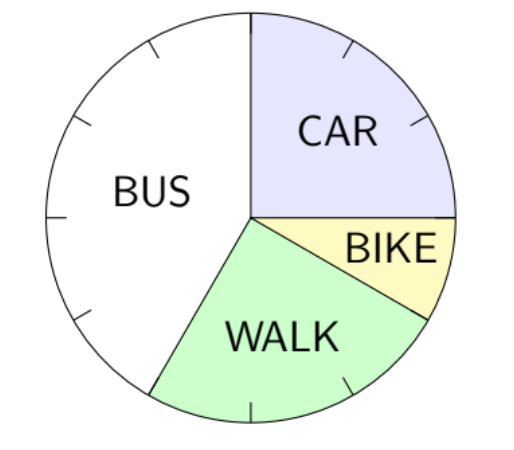
Last year Alan worked 5 days a week for 48 weeks. The graph shows how Alan travelled to work each day. On how many days did Alan travel by bus?

(A) 20 (B) 80 (C) 100 (D) 140 (E) 240

Problem 15:

In this grid, each number at the end of a row or below a column indicates how many squares in that row or column contain a counter.
Which one of the following grids could also have counters with these rules?

Problem 16:

To send large parcels overseas, it costs $\$ 24$ for the first 10 kg and $\$ 8$ for each extra 5 kg or part thereof. How much would it cost to send a 28 kg parcel overseas?

(A) $\$ 48$ (B) $\$ 52$ (C) $\$ 56$ (D) $\$ 60$ (E) $\$ 64$

Problem 17:

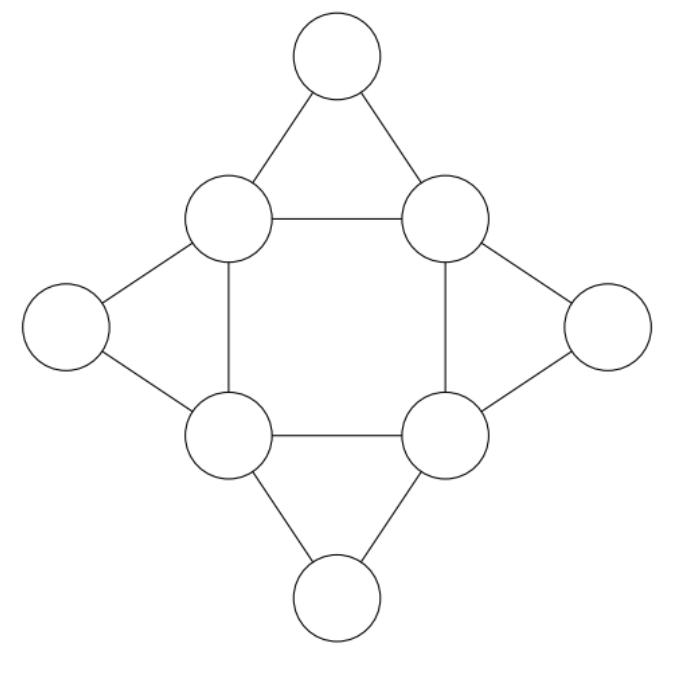
The numbers from 1 to 3 are entered into the circles in the grid shown. Two circles joined by a line may not contain the same number.
There are several ways of doing this. What is the smallest possible total of the eight numbers?

(A) 10 (B) 12 (C) 14 (D) 15 (E) 16

Problem 18:

What fraction of this regular hexagon is shaded?


(A) $\frac{1}{2}$ (B) $\frac{2}{3}$ (C) $\frac{3}{4}$ (D) $\frac{3}{5}$ (E) $\frac{4}{5}$

Problem 19:

Pictures of fruit have been placed in this grid to represent numbers less than 10 .
The totals for each row and column are shown. What is the total value of an apple ๐ŸŽ and an orange ๐ŸŠ ?


(A) 8 (B) 9 (C) 10 (D) 11 (E) 12

Problem 20:

Andrew is doing some tidying. He can tidy 2 big rooms in the same time it takes to tidy 3 small rooms. He can tidy one big room and three small rooms in 90 minutes.
How long will it take him to tidy 3 big rooms and 6 small rooms?

(A) 3.5 hours (B) 4 hours (C) 4.5 hours (D) 5 hours (E) 5.5 hours

Problem 21:

A rectangle measures 3 cm by 4 cm . A diagonal stripe is shaded which starts 1 cm from the diagonal corners, as in the diagram.
What fraction of the area of the rectangle is this shaded strip?

(A) $\frac{1}{2}$ (B) $\frac{1}{3}$ (C) $\frac{1}{4}$ (D) $\frac{1}{5}$ (E) $\frac{2}{5}$

Problem 22:

Beginning with a row of 20 coins, Anh takes the first coin, then every fourth coin after that.
From the remaining coins, Brenda takes the first coin and every third coin after that.
From the remaining coins, Chen takes the first coin and every second coin after that.
Dimitris takes all the remaining coins.
Does anyone get more coins than all the others?

(A) Yes, Anh does (B) Yes, Brenda does (C) Yes, Chen does (D) Yes, Dimitris does (E) No, they all get the same number of coins

Problem 23:

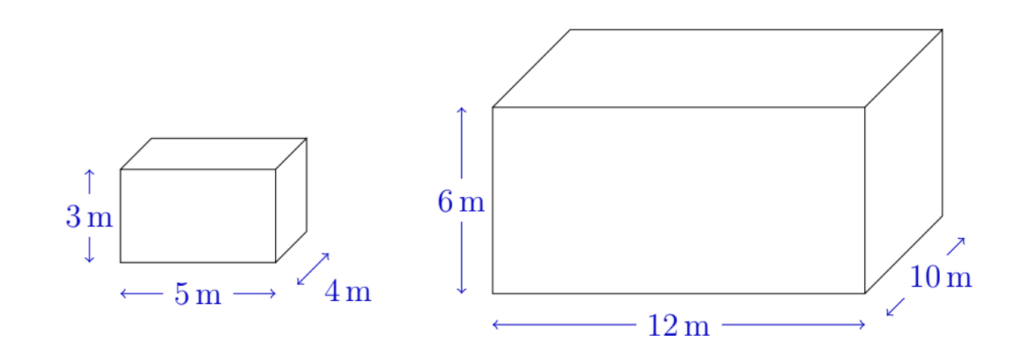
These two water tanks are to be filled. A hose used to do this can fill the smaller tank in 2 hours. How many hours will the same hose take to fill the larger tank?

(A) 4 (B) 6 (C) 9 (D) 12 (E) 24

Problem 24:

A farmer has a rectangular property 8 km by 6 km , with fencing along the boundary and diagonal fences as shown.
One day she leaves her farmhouse at $H$ to inspect all her fences, returning home to $H$ when this is done.
What is the minimum distance, in kilometres, she must travel to do this?


(A) 48 (B) 58 (C) 59 (D) 60 (E) 64

Problem 25:

What is the sum of the digits in the result of the subtraction

where the first number has 20 digits each 1 , and the second has 10 digits, each 2 ?

(A) 72 (B) 81 (C) 89 (D) 90 (E) 99

Problem 26:

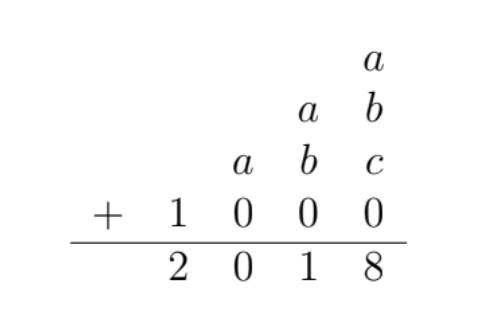
In the algorithm below, the letters $a, b$ and $c$ represent different digits from 0 to 9 . What is the three-digit number $a b c$ ?

Problem 27:

Using only digits 0,1 and 2 , this cube has a different number on each face.
Numbers on each pair of opposite faces add to the same 3 -digit total.
What is the largest that this total could be?

Problem 28:

I wrote the counting numbers joined together:

$1234567891011121314151617 \ldots$

Which of the counting numbers was I writing when the 100th zero was written?

Problem 29:

Jan and Jill are both on a circular track.
Jill runs at a steady pace, completing each circuit in 72 seconds.
Jan walks at a steady pace in the opposite direction and meets Jill every 56 seconds.
How long does it take Jan to walk each circuit?

Problem 30:

The answer to a cross-number puzzle clue is a whole number (not a word). A fragment of such a puzzle is shown. Some clues are:

Across

  1. Square of 27-down.
  2. Half of 1-across.

Down

  1. Twice 2-down.
  2. A multiple of 9 .

What is 2-down?

Announcement of Australian Maths Competition: