Australian Mathematics Competition - 2016 - Upper Primary - Grade 5 & 6 - Questions and Solutions

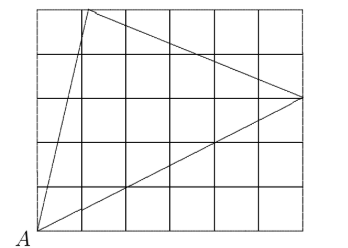
Problem 1:

Which of these numbers is the smallest?
(A) 655
(B) 566
(C) 565
(D) 555
(E) 556

Problem 2:

Two pizzas are sliced into quarters. How many slices will there be?
(A) 2
(B) 10
(C) 6
(D) 8
(E) 16

Problem 3:

Join the dots \(P, Q, R\) to form the triangle \(P Q R\).
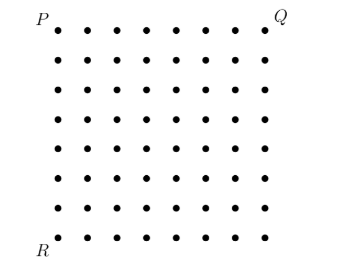
How many dots lie inside the triangle \(P Q R\) ?
(A) 13
(B) 14
(C) 15
(D) 17
(E) 18

Problem 4:

\(0.3+0.4\) is
(A) 0.07
(B) 0.7
(C) 0.12
(D) 0.1
(E) 7

Problem 5:

Lee's favourite chocolates are 80 c each. He has five dollars to spend. How many of these chocolates can he buy?
(A) 4
(B) 5
(C) 6
(D) 7
(E) 8

Problem 6:

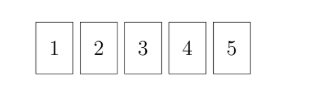
Ten chairs are equally spaced around a round table. They are numbered 1 to 10 in order. Which chair is opposite chair 9 ?
(A) 1
(B) 2
(C) 3
(D) 4
(E) 5

Problem 7:

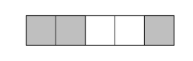
In a piece of music, a note like is worth one beat, is worth half a beat, is worth
2 beats and is worth 4 beats. How many beats are in the following piece of music?

(A) 4
(B) 5
(C) 6
(D) 7
(E) 8

Problem 8:

Phoebe put her hand in her pocket and pulled out 60 cents. How many different ways could this amount be made using \(10 \mathrm{c}, 20 \mathrm{c}\) and 50 c coins?
(A) 2
(B) 3
(C) 4
(D) 5
(E) 6

Problem 9:

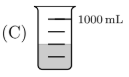
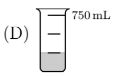
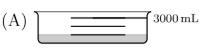
Which of these containers is currently holding the most water?
Problem 10:

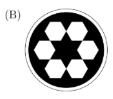
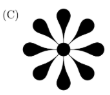
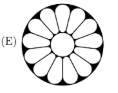
Which of these shapes has the most axes of symmetry (mirror lines)?
Problem 11:

A sailor coiled a rope on his ship's deck, and some paint was spilled across half of it. What did the rope look like when it was uncoiled?

Problem 12:

If the area of the tangram shown is 64 square centimetres, what is the area in square centimetres of the small square?
(A) 32
(B) 24
(C) 16
(D) 8
(E) 4

Problem 13:

For each batch of 25 biscuits, Jack uses \(2 \frac{1}{2}\) packets of chocolate chips. How many packets does he need if he wants to bake 200 biscuits?
(A) 20
(B) 8
(C) 80
(D) 10
(E) 50

Problem 14:

Which one of the following is correct?
(A) Two even numbers add to an odd number.
(B) An odd number minus an odd number is always odd.
(C) Adding 2 odd numbers and an even number is always odd.
(D) Adding 3 odd numbers is always odd.
(E) An odd number multiplied by an odd number always equals an even number.

Problem 15:

The perimeter of the outer square is 36 cm , and the perimeter of the inner square is 20 cm .
If the four rectangles are all identical, what is the perimeter of the shaded rectangle in centimetres?
(A) 12
(B) 14
(C) 24
(D) 20
(E) 18

Problem 16:

George has a new lock that opens if the four numbers \(1,2,3\) and 4 are pressed once each in the correct order.
If the first number must be larger than the second number, how many combinations are possible?
(A) 10
(B) 12
(C) 15
(D) 18
(E) 20

Problem 17:

A straight cut is made through the hexagon shown to create two new shapes. Which of the following could not be made?
(A) one triangle and one hexagon
(B) two pentagons
(C) two quadrilaterals
(D) one quadrilateral and one pentagon
(E) one triangle and one quadrilateral

Problem 18:

The numbers \(3,9,15,18,24\) and 29 are divided into two groups of 3 numbers and each group is added. The difference between the two sums (totals) of 3 numbers is as small as possible. What is the smallest difference?
(A) 0
(B) 1
(C) 2
(D) 5
(E) 8
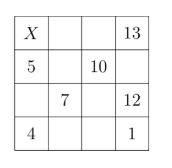
Problem 19:

Benny built a magic square using the numbers from 1 to 16 , where the numbers in each row, each column and each diagonal add up to the same total.
What number does he place at the X ?
(A) 16
(B) 15
(C) 17
(D) 11
(E) 14

Problem 20:

Andy has a number of red, green and blue counters.
He places eight counters equally spaced around a circle according to the following rules:

How many blue counters will Andy need to use?
(A) 0
(B) 1
(C) 2
(D) 3
(E) 4

Problem 21:

I have five coloured discs in a pile as shown.
I take the top two discs and put them on the bottom (with the red dise still on top of the blue disc).
Then I again take the top two discs and put them on the bottom.
If I do this until I have made a total of 21 moves, which dise will be on the bottom?

(A) red
(B) blue
(C) green
(D) yellow
(E) orange

Problem 22:

A zoo keeper weighed some of the animals at Melbourne Zoo. He found that the lion weighs 90 kg more than the leopard, and the tiger weighs 50 kg less than the lion. Altogether the three animals weigh 310 kg . How much does the lion weigh?
(A) 180 kg
(B) 150 kg
(C) 140 kg
(D) 130 kg
(E) 100 kg

Problem 23:

Adrienne, Betty and Cathy were the only three competitors participating in a series of athletic events. In each event, the winner gets 3 points, second gets 2 points and third gets 1 point. After the events, Adrienne has 8 points, Betty has 11 points and Cathy has 5 points. In how many events did Adrienne come second?
(A) 0
(B) 1
(C) 2
(D) 3
(E) 4

Problem 24:

Jane and Tom are comparing their pocket money. Jane has as many 5c coins as Tom has 10 c coins and as many 10 c coins as Tom has 20 c coins. However, Jane has as many 50c coins as Tom has 5 c coins.
They have no other coins and they find that they each have the same amount of money.
What is the smallest number of coins they each can have?
(A) 3
(B) 4
(C) 5
(D) 6
(E) 7

Problem 25:

A tuckshop has two jars of cordial mixture.
Jar A is \(30 \%\) cordial, while Jar B is \(60 \%\) cordial.
Some of Jar A is mixed with some of Jar B to make 18 litres of \(50 \%\) cordial.
How many litres from Jar A are used?
(A) 9
(B) 12
(C) 4
(D) 3
(E) 6

Problem 26:

Qiang, Rory and Sophia are each wearing a hat with a number on it. Each adds the two numbers on the other two hats, giving totals of 11,17 and 22 . What is the largest number on a hat?

Problem 27:

The number 840 is the 3 -digit number with the most factors. How many factors does it have?

Problem 28:

A class has 2016 matchsticks. Using blobs of modelling clay to join the matches together, they make a long row of cubes. This is how their row starts.

They keep adding cubes to the end of the row until they don't have enough matches left for another cube. How many cubes will they make?

Problem 29:

You have an unlimited supply of five different coloured pop-sticks, and want to make as many different coloured equilateral triangles as possible, using three sticks.
One example is shown here.
Two triangles are not considered different if they are rotations or reflections of each other.
How many different triangles are possible?

Problem 30:

Today my three cousins multiplied their ages together and it came to 2016. This day last year their ages multiplied to 1377 .
When they multiplied their ages together 2 years ago today, what was their answer?

Australian Mathematics Competition - 2014 - Upper Primary - Grade 5 & 6 - Questions and Solutions

Problem 1:

What is the value of \(7+6+4+3\) ?
(A) 20
(B) 19
(C) 18
(D) 17
(E) 16

Problem 2:

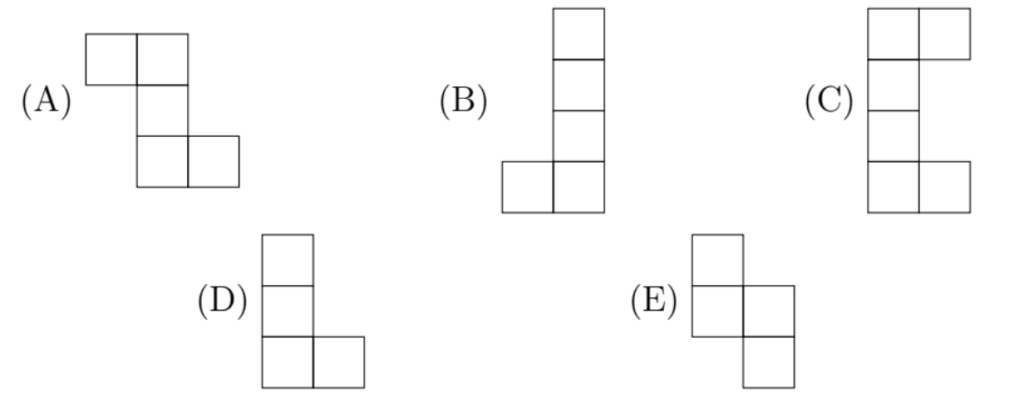
Which shape can make a pyramid if you fold along the dotted lines?

Problem 3:

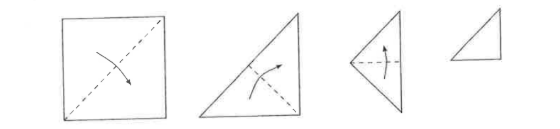
A square of paper is folded in half to make a triangle, then in half to make a smaller triangle, then in half again to make an even smaller triangle.

How many layers of paper are in the final triangle?
(A) 3
(B) 4
(C) 6
(D) 8
(E) 12

Problem 4:

The year 5 students at my local school were surveyed to find which one of the four teams in the local football competition they followed.

How many more students followed the most popular team than followed the least popular team?
(A) 3
(B) 4
(C) 5
(D) 6
(E) 8

Problem 5:

This week at my lemonade stand I sold \(\$ 29\) worth of lemonade, but I had spent \(\$ 34\) on lemons and \(\$ 14\) on sugar. My total loss for the week was
(A) \(\$ 1\)
(B) \(\$ 9\)
(C) \(\$ 19\)
(D) \(\$ 21\)
(E) \(\$ 29\)

Problem 6:

A piece of paper is cut out and labelled as shown. It is folded along the dashed lines to form an open box and placed so that the top is open. Which letter is on the bottom of the box?
(A) A
(B) B
(C) C
(D) D
(E) E

Problem 7:

Which of the following gives an odd number?
(A) \(12^2\)
(B) \(141-57\)
(C) \(36 \times 9\)
(D) \(308 \div 7\)
(E) \(\frac{1}{3}\) of 123

Problem 8:

A new block of flats is being built and Trudy is buying the letterbox numbers. The letterboxes are to be labelled from 190 to 212 . How many zeros will she need to buy?
(A) 22
(B) 13
(C) 12
(D) 10
(E) 4

Problem 9:

This \(4 \times 4\) square grid can be covered by three shapes made from \(1 \times 1\) squares. None of the shapes overlap.

If two of the shapes are

then the third shape is

Problem 10:

Given that \(\frac{1001}{77}=13\), what is the value of \(\frac{100.1}{770} ?\)
(A) 0.13
(B) 1.3
(C) 13
(D) 130
(E) 1300

Problem 11:

These two squares, each with a side length of 10 cm , overlap as shown in the diagram. The shape of the overlap is also a square which has an area of 16 square centimetres. In centimetres, what is the perimeter of the combined shape?
(A) 40
(B) 56
(C) 64
(D) 80
(E) 92

Problem 12:

Six boys looked in the fridge and found this much leftover pizza. They shared the leftover pizza equally. How much of the whole pizza did each boy get?
(A) \(\frac{1}{12}\)
(B) \(\frac{1}{8}\)
(C) \(\frac{1}{6}\)
(D) \(\frac{1}{4}\)
(E) \(\frac{1}{3}\)

Problem 13:

Which of the shaded areas below is the largest?

(A) A
(B) B
(C) C
(D) D
(E) E

Problem 14:

A map, 40 cm wide and 20 cm high, is folded along the dashed lines indicated to form a \(10 \mathrm{~cm} \times 10 \mathrm{~cm}\) square so that it just fits in its envelope. It is then pinned to a notice board.

Which one of the following could be the pattern of pinholes on the map?

Problem 15:

Sally thinks of a number, multiplies it by 2 , adds 2 , divides by 2 and then subtracts 2 . Her answer is 2 . What was her original number?
(A) 1
(B) 2
(C) 3
(D) 4
(E) 5

Problem 16:

The paint colour 'Roebourne Red' is made by mixing 2 parts yellow, 5 parts red and 1 part black.
If a batch of paint was made using 3 litres of yellow, how many litres of paint would be in the whole batch?
(A) 6
(B) 8
(C) 9
(D) 10 ,
(E) 12

Problem 17:

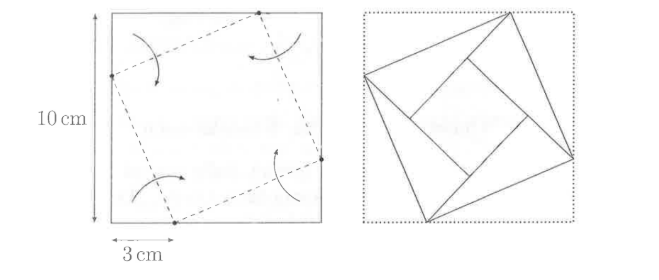
A square of paper has its corners folded in as shown to make a smaller square with an internal square, as shown on the right. What is the area of this internal square?

(A) \(4 \mathrm{~cm}^2\)
(B) \(9 \mathrm{~cm}^2\)
(C) \(16 \mathrm{~cm}^2\)
(D) \(49 \mathrm{~cm}^2\)
(E) \(58 \mathrm{~cm}^2\)

Problem 18:

Ancient Egyptian mathematicians used fractions but only with a numerator of 1 , such as \(\frac{1}{2}\) or \(\frac{1}{7}\) or \(\frac{1}{14}\). They made other fractions by adding these fractions together. For example, \(\frac{3}{4}\) was written as \(\frac{1}{2}+\frac{1}{4}\). Which of the following is an Ancient Egyptian way of writing \(\frac{11}{16}\) ?
(A) \(\frac{1}{2}+\frac{1}{4}+\frac{1}{10}\)
(B) \(\frac{1}{2}+\frac{1}{8}+\frac{1}{16}\)
(C) \(\frac{1}{4}+\frac{1}{8}+\frac{1}{16}\)
(D) \(\frac{1}{2}+\frac{1}{4}+\frac{1}{8}+\frac{1}{16}\)
(E) \(\frac{1}{3}+\frac{1}{6}+\frac{1}{2}\)

Problem 19:

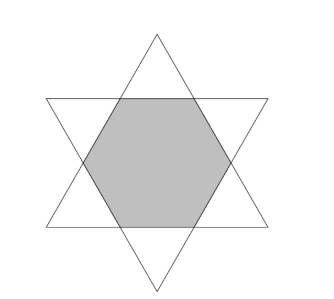
This symmetrical star is made up of two overlapping equilateral triangles of the same size. The area of the star is 60 square centimetres. What is the area of the shaded region in square centimetres?
(A) 30
(B) 36
(C) 42
(D) 45
(E) 48

Problem 20:

In this correctly worked addition, \(P, Q, R\) and \(S\) represent different digits, and all seven digits are different. What is the sum of \(P, Q, R\) and \(S\) ?
(A) 23
(B) 22
(C) 18
(D) 16
(E) 14

Problem 21:

In a competition between four people, Sally scored twice as many points as Brian and 30 points more than Corrie. Donna scored 50 points more than Brian. Which of the following statements is definitely true?
(A) Sally won the competition.
(B) Brian came last in the competition.
(C) Donna won the competition.
(D) Corrie beat Brian.
(E) Sally and Donna together scored more than Brian and Corrie.

Problem 22:

A plane was travelling at an altitude of 4500 metres for 20 minutes. It then climbed at a rate of 500 metres per minute for 5 minutes before descending at 350 metres per minute for 8 minutes. Which of the following graphs best describes the altitude of the plane over this time?

Problem 23:

Mrs Graham wants to fill her swimming pool for the summer. She knows that if she uses the backyard hose it will take 12 hours, or if she uses the frontyard hose it will take 4 hours. How long will it take if she uses both hoses together?
(A) 3 hours
(B) 2.5 hours
(C) 2 hours
(D) 1.5 hours
(E) 1 hour

Problem 24:

Four soccer teams played each other four times in a season of competition. Each winning team was awarded 3 points. Teams that had a draw were awarded 1 point each, and losing teams were awarded no points. The season ended with Kangaroos on 21 points, Kookaburras on 17 points, Koalas on 16 points and Crocodiles on 12 points. How many games ended in a draw?
(A) 7
(B) 6
(C) 5
(D) 4
(E) 3

Problem 25:

Five different whole numbers, chosen from the numbers from 1 to 30 , add up to 30 . What is the greatest possible value of the largest of these numbers?
(A) 6
(B) 10
(C) 15
(D) 20
(E) 26

Problem 26:

A 3 by 5 grid of dots is set out as shown. How many straight line segments can be drawn that join two of these dots and pass through exactly one other dot?

Problem 27:

A cube is made up of \(1 \mathrm{~cm} \times 1 \mathrm{~cm} \times 1 \mathrm{~cm}\) blocks and measures \(12 \mathrm{~cm} \times 12 \mathrm{~cm} \times 12 \mathrm{~cm}\). Sharyn is using the same set of blocks to make a set of stairs.
The picture shows how she started, making a set of stairs 4 blocks high, 4 blocks from front to back and 5 blocks wide.
Her finished set of stairs will use all the blocks and be 8 blocks high and 8 blocks from front to back. How many blocks wide will they be?

Problem 28:

Three whole numbers add up to 149 and multiply to give 987 . What is the largest of the three numbers?

Problem 29:

Which three-digit number is 11 times the sum of its digits?

Problem 30:

How many three-digit numbers are there in which one of the digits is the sum of the other two?

Australian Mathematics Competition - 2013 - Upper Primary - Grade 5 & 6 - Questions and Solutions

Problem 1:

What fraction of this rectangle is shaded?

(A) one-fifth
(B) two-fifths
(C) two-thirds
(D) one-third
(E) three-fifths

Problem 2:

Which of the following numbers is closest to zero?
(A) 0.03
(B) 0.048
(C) 0.009
(D) 0.005
(E) 0.02

Problem 3:

A 737 passenger aircraft has 3 seats on each side of a centre aisle in each row. It is designed to carry 150 passengers. How many rows of seats does it have?
(A) 50
(B) 37
(C) 33
(D) 32
(E) 25

Problem 4:

Alice has two 50c coins, three 20c coins and eight 5c coins. David has four 20c coins and six 10c coins. How much more money does Alice have than David?
(A) 40 c
(B) 60 c
(C) 80 c
(D) \(\$ 1.40\)
(E) \(\$ 2.00\)

Problem 5:

What is the difference between the largest and smallest 5-digit numbers which can be made from rearranging the 5 digit cards below?

(A) 41967
(B) 41976
(C) 44444
(D) 42024
(E) 41076

Problem 6:

At the supermarket, a regular packet of chips is 75 g . A packet of chips on special is advertised at one-third extra. How many grams does the special packet have?
(A) 50
(B) 78
(C) 100
(D) 125
(E) 150

Problem 7:

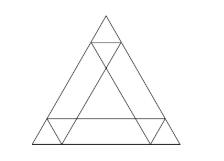
How many triangles are in the following picture?

(A) 9
(B) 10
(C) 13
(D) 14
(E) 17

Problem 8:

Jan doubles a number then adds two. Then she halves that number and subtracts two. Her final answer is six. What was her original number?
(A) 1
(B) 6
(C) 7
(D) 14
(E) 16

Problem 9:

On the number line, where should the fraction \(\frac{1}{3}\) be placed?

(A) between 0 and 0.3
(B) between 0.3 and 0.4
(C) between 0.4 and 0.7
(D) between 0.7 and 0.8
(E) between 0.8 and 1

Problem 10:

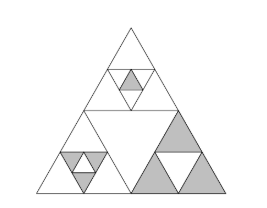
Each triangle in the diagram is equilateral. What fraction of the largest triangle is shaded?

(A) \(\frac{1}{4}\)
(B) \(\frac{15}{64}\)
(C) \(\frac{1}{3}\)
(D) \(\frac{3}{16}\)
(E) \(\frac{7}{32}\)

Problem 11:

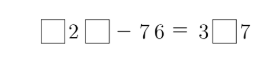
In the number sentence below, three of the digits are missing, as shown by the boxes. If the number sentence is correct, what is the sum of the three missing digits?

(A) 7
(B) 8
(C) 10
(D) 11
(E) 17

Problem 12:

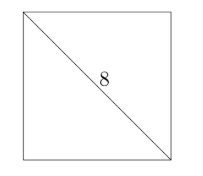
In the square shown, the length of the diagonal is 8 cm . What is the area of the square?

(A) \(28 \mathrm{~cm}^2\)
(B) \(32 \mathrm{~cm}^2\)
(C) \(49 \mathrm{~cm}^2\)
(D) \(64 \mathrm{~cm}^2\)
(E) \(81 \mathrm{~cm}^2\)

Problem 13:

A bus leaves a bus stop at \(10: 35 \mathrm{am}\) and then stops at 4 other bus stops. If neighbouring stops are 10 minutes apart and the bus remains at each stop for 3 minutes, at what time does the bus arrive at the last stop?

(A) 11:11 am
(B) 11:14 am
(C) 11:21 am
(D)11:24 am
(E) 11:27 am

Problem 14:

A muffin recipe which makes 12 muffins requires \(\frac{2}{3}\) of a cup of milk. How many muffins can be made using 18 cups of milk?
(A) 90
(B) 108
(C) 144
(D) 216
(E) 324

Problem 15:

Two identical equilateral triangles, each with an area equal to \(36 \mathrm{~cm}^2\), are placed one on top of the other so that the overlap forms a regular hexagon.

What is the area of the hexagon?
(A) \(18 \mathrm{~cm}^2\)
(B) \(20 \mathrm{~cm}^2\)
(C) \(24 \mathrm{~cm}^2\)
(D) \(30 \mathrm{~cm}^2\)
(E) \(36 \mathrm{~cm}^2\)

Problem 16:

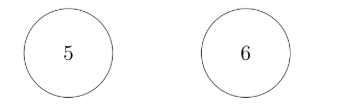
A ten-sided dice (numbers \(0-9) \) and a six-sided dice (numbers \(1-6) \) are thrown at the same time. What is the chance of displaying a total of 6 ?
(A) one in ten
(B) one in eight
(C) one in six
(D) one in five
(E) one in two

Problem 17:

Each of the faces of 2 discs has a different whole number on it. The numbers on two of the faces are shown.

If the discs are tossed, the possible sums of the numbers showing are \(10,11,12\) and 13 . What is the product of the two numbers that are on the other side of these two discs?
(A) 24
(B) 25
(C) 30
(D) 32
(E) 35

Problem 18:

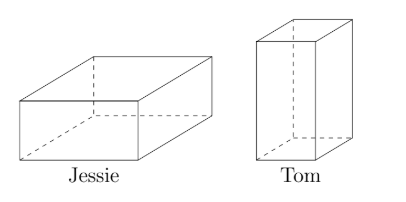
A school builds a raised vegetable patch in its garden by joining four panels to form an open-ended prism and filling it with soil. Each of the thin plastic panels has sides of length 40 cm and 80 cm . Jessie wants to stand the panels on their long side and Tom wants to stand them on their short side as shown.

Which statement is true?
(A) It is impossible to calculate the volume of soil needed to fill the vegetable patch.
(B) It is impossible to compare the volumes of soil needed to fill the vegetable patch.
(C) Both vegetable patches need the same volume of soil.
(D) Jessie's vegetable patch needs more soil than Tom's.
(E) Tom's vegetable patch needs more soil than Jessie's.

Problem 19:

Aditya's dad is one year older than his mum and next year the product of his parents' ages will be over 1000 for the first time. What is the product of their ages now?
(A) 930
(B) 961
(C) 992
(D) 995
(E) 999

Problem 20:

Jake and Joe wanted to buy the same magazine. Jake needed \(\$ 2.80\) more to buy it, while Joe needed \(\$ 2.60\) more. So they put their money together and bought the magazine. They had \(\$ 2.60\) left. How much was the magazine?
(A) \(\$ 10\)
(B) \(\$ 9\)
(C) \(\$ 8\)
(D) \(\$ 7\)
(E) \(\$ 6\)

Problem 21:

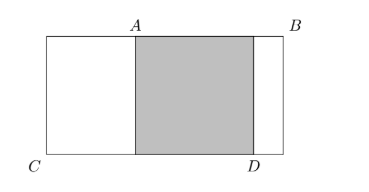
There is a shaded square inside a rectangle as shown. From \(A\) to \(B\) is 6 cm and from \(C\) to \(D\) is 8 cm . What is the perimeter of the large rectangle?

(A) 28 cm
(B) 27 cm
(C) 26 cm
(D) 25 cm
(E) 24 cm

Problem 22:

Karen's class and Jacqui's class are sharing some apples donated by a local farmer and everyone in each classroom will have 6 apples. If Karen's class shared all the apples, each student would have 10 apples. If Jacqui's class shared all the apples, how many apples would each student in the class have?
(A) 5
(B) 8
(C) 10
(D) 12
(E) 15

Problem 23:

Eight \(1 \times 1\) square tiles are laid to form a shape as shown.

Two more \(1 \times 1\) tiles are added, so that at least one side of each new tile is shared with a side of the original shape. Several different perimeter lengths are now possible. What is the sum of the shortest and longest possible perimeters of the modified shape?
(A) 28
(B) 30
(C) 32
(D) 34
(E) 36

Problem 24:

On a special cubic dice the numbers \(1,2,3,4,5\) and 6 are on the faces: 1 is on the face opposite 2,3 is on the face opposite 4 , and 5 is on the face opposite 6 .

Each vertex is given a vertex number, which is the sum of the numbers on the three faces that form the vertex. If I subtract the smallest vertex number from the largest vertex number, what number will I get?
(A) 1
(B) 3
(C) 5
(D) 6
(E) 7

Problem 25:

A number is formed by writing the numbers 1 to 30 in order as shown.

\[
12345678910111213 \ldots \ldots . . . .2930
\]

Simeon removed 45 of these 51 digits leaving 6 in their original order to make the largest 6-digit number possible. What is the sum of the digits of this number?
(A) 33
(B) 38
(C) 41
(D) 43
(E) 51

Problem 26:

Dried dog food is available in three sizes: 1 kg bags, which cost \(\$ 6\); 3 kg bags, which cost \(\$ 15\); and 8 kg bags, which cost \(\$ 25\). What is the smallest number of bags you can buy such that the average price per kilogram is exactly \(\$ 4\) ?

Problem 27:

In how many ways can three different numbers be selected from the numbers 1 to 12 , so that their sum can be exactly divided by 3 ?

Problem 28:

Adam, Barney and Joe carry 999 books out of the library. Adam works for 3 hours, Barney works for 4 hours and Joe works for 5 hours. They work at different speeds, with Adam carrying 5 books for every 3 books Barney carries and every 2 books Joe carries. How many books did Adam carry?

Problem 29:

Find the largest 3-digit number, with no two digits the same and with its digits in ascending order, which when multiplied by 5 has its digits in descending order?

Problem 30:

A hockey game between two teams is 'relatively close' if the number of goals scored by the two teams never differ by more than two. In how many ways can the first 12 goals of a game be scored if the game is 'relatively close'?

Australian Mathematics Competition - 2011 - Upper Primary - Grade 5 & 6 - Questions and Solutions

Problem 1:

Which of the following numbers has the same value as 152 hundredths?
(A) 1520
(B) 152
(C) 15.2
(D) 1.52
(E) 0.152

Problem 2:

The value of \(1+10+10 \times 10+10 \times 10 \times 10\) is
(A) 1010
(B) 10111
(C) 1111
(D) 1110
(E) 11111

Problem 3:

Mike buys a can of 5 tennis balls for \(\$ 2.50\). How much would three balls cost?
(A) 90 c
(B) \(\$ 1.50\)
(C) \(\$ 1.80\)
(D) \(\$ 2.40\)
(E) \(\$ 3\)

Problem 4:

Auckland's time zone is two hours ahead of Melbourne's. What time is it in Auckland when it is 2 am in Melbourne?
(A) 4 am
(B) midnight
(C) 6 pm
(D) 6 am
(E) 8 am

Problem 5:

How many rectangles of any size are in this diagram?

(A) 11
(B) 10
(C) 9
(D) 8
(E) 6

Problem 6:

School shirts are on sale for \(25 \%\) off the usual price. Bethany buys a shirt on sale for \(\$ 6.00\). How much did she save?
(A) \(\$ 4.50\)
(B) \(\$ 2.00\)
(C) \(\$ 1.50\)
(D) \(\$ 3.00\)
(E) \(\$ 4.00\)

Problem 7:

Which of the following is not a net for an open top box?

Problem 8:

Which of the following is true?
(A) If you add two odd numbers you always get an odd number.
(B) If you multiply two odd numbers you always get an even number.
(C) If you add an odd and an even number you always get an even number.
(D) If you multiply an odd and an even number you always get an even number.
(E) If you multiply two even numbers you always get an odd number.

Problem 9:

The temperature on a winter's day was recorded in degrees Celsius every hour from 7 am to 12 noon as shown on the graph.

What was the difference, in degrees Celsius, between the temperature recorded at 9 am and at 11 am ?
(A) 1
(B) 2
(C) 3
(D) 4
(E) 5

Problem 10:

A notice in an elevator states that 13 persons or 1000 kg is the maximum load. Which of the following is the closest to the average body mass that the manufacturer used for one person?
(A) 13 kg
(B) 50 kg
(C) 80 kg
(D) 100 kg
(E) 130 kg

Problem 11:

On weekends, Fred earns money by washing cars and mowing lawns. He receives \(\$ 5\) for a mow and \(\$ 9\) for a car wash. Last weekend he earned \(\$ 56\). Which of the following explanations is possible?
(A) 5 mows and 3 car washes
(B) 6 mows and 3 car washes
(C) 2 mows and 5 car washes
(D) 5 mows and 4 car washes
(E) 4 mows and 4 car washes

Problem 12:

The diagram shows a 7-piece tangram puzzle.

What is the area, in square centimetres, of the shaded part if the whole puzzle is a square with side 8 cm ?
(A) 2
(B) 4
(C) 6
(D) 8
(E) 10

Problem 13:

Jennifer has made this hexagonal spinner.

If she spins it 72 times, about how many times would she expect to land on a 2 ?
(A) 6
(B) 8
(C) 10
(D) 12
(E) 24

Problem 14:

You are standing somewhere on the map below.

Directly to the east you see a house \(ๅ…จ\), directly to the north you see a person \(\$\) and directly west you can see a tree \(\$\). Which square are you standing in?
(A) D4
(B) F2
(C) J6
(D) G10
(E) J10

Problem 15:

Jim is running a two-lap race. He passes a marker on the first lap which is exactly a third of the way round the lap. What fraction of the race will be completed when he passes the same marker again?
(A) \(\frac{1}{3}\)
(B) \(\frac{1}{2}\)
(C) \(\frac{2}{3}\)
(D) \(\frac{3}{4}\)
(E) \(\frac{5}{6}\)

Problem 16:

Bill is 2 years older than his brother Graham, who in turn is 3 years older than their twin sisters Sally and Jill. If the combined total of their ages is 40 , how old is Graham?
(A) 8
(B) 9
(C) 10
(D) 11
(E) 13

Problem 17:

Sam draws a rectangle with sides of length 56 cm and 98 cm . Jan divides Sam's rectangle into squares by drawing lines joining opposite sides. What is the smallest number of lines that Jan must draw?
(A) 9
(B) 10
(C) 11
(D) 13
(E) 15

Problem 18:

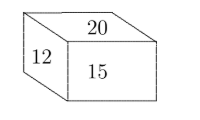
The areas of three faces of a rectangular prism are 12 square centimetres, 15 square centimetres and 20 square centimetres. What is the volume, in cubic centimetres, of the rectangular prism?

(A) 30
(B) 48
(C) 56
(D) 60
(E) 72

Problem 19:

Tony has an 8 cm by 12 cm paper rectangle. He folds it in half three times, each time making a smaller rectangle. What is the smallest possible perimeter of the rectangle after the third fold?
(A) 24 cm
(B) 16 cm
(C) 14 cm
(D) 12 cm
(E) 10 cm

Problem 20:

The numbers on the six faces of this cube are consecutive even numbers.

If the sums of the numbers on each of the three pairs of opposite faces are equal, find the sum of all six numbers on this cube.
(A) 196
(B) 188
(C) 210
(D) 186
(E) 198

Problem 21:

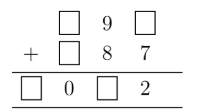
In the following addition, some of the digits are missing.

The sum of the missing digits is
(A) 23
(B) 21
(C) 20
(D) 18
(E) 15

Problem 22:

Six towns labelled \(P, Q, R, S, T\) and \(U\) in the diagram are joined by roads as shown.

Starting at \(P\), George the postman visits each town without returning to \(P\). He wants to save time by travelling the shortest distance. How many kilometres will he need to drive?
(A) 19
(B) 20
(C) 21
(D) 22
(E) 23

Problem 23:

A set of 4-digit numbers are formed using four cards numbered 2,3 , 5 and 6 , with each number formed containing every digit. How many numbers in this set will be divisible by 8 ?

(A) 4
(B) 6
(C) 8
(D) 10
(E) 12

Problem 24:

Mary has 62 square blue tiles and a number of square red tiles. All tiles are the same size. She makes a rectangle with red tiles inside and blue tiles on the perimeter. What is the largest number of red tiles she could have used?
(A) 62
(B) 182
(C) 210
(D) 224
(E) 240

Problem 25:

Carly is writing a fantasy novel which includes inventing a new language. She decides to base her alphabet on letters formed from three straight lines joining four dots arranged in a square where each line joins two dots. Each letter goes through all four dots and can be drawn without removing the pencil from the paper, (you may retrace a line). Three such letters are shown.

How many different letters can she have in her alphabet?
(A) 12
(B) 16
(C) 24
(D) 32
(E) 36

Problem 26:

What is the smallest number which is divisible by 7 and 6 and has two odd digits?

Problem 27:

Which 2-digit number is equal to the sum of its first digit plus the square of its second digit?

Problem 28:

Andrew thinks of 4 consecutive numbers. The sum of the first three numbers is 100 more than the fourth number. What is the sum of these four consecutive numbers?

Problem 29:

Paul is one year older than his wife and they have two children whose ages are also one year apart. Paul notices that on his birthday in 2011, the product of his age and his wife's age plus the sum of his children's ages is 2011.
What would have been the result if he had done this calculation thirteen years before?

Problem 30:

Joe the handyman was employed to fix house numbers onto the doors of 80 new houses in a row. He screwed digits on their front doors, numbering them from 1 to 80 . Then he noticed that there were houses already numbered 1 to 64 in the street, so he had to replace all the numbers with new ones, 65 to 144 . If he re-used as many digits as possible (where he could use an upside down 6 as a 9 and vice versa), how many new digits must he have supplied?

Australian Mathematics Competition - 2010 - Upper Primary - Grade 5 & 6 - Questions and Solutions

Problem 1:

What is one thousand and twenty-seven in numerals?
(A) 100027
(B) 10027
(C) 1027
(D) 127
(E) 27

Problem 2:

Jillian is standing inside a pet shop and looking out the window shown in the diagram.

Problem 3:

Lee is 14 years old. Liz is 10 years old. Dad's age is twice the sum of their ages. How old is Dad?
(A) 46
(B) 48
(C) 50
(D) 52
(E) 54

Problem 4:

The midpoints of the sides of a square are joined as shown. A part of the original square is shaded as shown. What fraction of the original square is shaded?
(A) \(\frac{1}{4}\)
(B) \(\frac{1}{6}\)
(C) \(\frac{2}{3}\)
(D) \(\frac{1}{3}\)
(E) \(\frac{1}{5}\)

Problem 5:

In a queue in the school canteen, Sarah was behind Tim and Carl was between Sarah and Tim. Sarah was in front of Brett who was in front of George. Who was fourth in line?
(A) Sarah
(B) Tim
(C) Carl
(D) Brett
(E) George

Problem 6:

When five numbers are added the total is 2010 . One of the numbers is changed from 235 to 532 . What is the total of the five numbers now?
(A) 1723
(B) 2542
(C) 2360
(D) 1896
(E) 2307

Problem 7:

Eight blocks are glued together as shown.

Problem 8:

What is the difference between the largest and smallest 3-digit numbers that can be made from the following 1-digit cards, if each card is to be used once only in each number?

(A) 477
(B) 495
(C) 1009
(D) 468
(E) 555

Problem 9:

My father won \(\$ 1000\) in a lottery. He put one-fifth in the bank, spent one-quarter of what was left on me and gave the rest to my mother. How much did my mother receive?
(A) \(\$ 400\)
(B) \(\$ 888\)
(C) \(\$ 450\)
(D) \(\$ 550\)
(E) \(\$ 600\)

Problem 10:

Starting at \(A\) and walking around the figure back to \(A\), how far do I walk?
(A) 52 m
(B) 48 m
(C) 54 m
(D) 50 m
(E) 56 m

Problem 11:

This is Liam's timetable for a normal school day.

How many minutes of class time does Liam have every day?
(A) 300
(B) 250
(C) 500
(D) 270
(E) 240

Problem 12:

The average of two numbers is 11 . One of the numbers is 6 more than the other. Which is the larger number?
(A) 6
(B) 8
(C) 11
(D) 14
(E) 17

Problem 13:

What fraction of the rectangle is shaded?

(A) \(\frac{1}{3}\)
(B) \(\frac{5}{12}\)
(C) \(\frac{1}{2}\)
(D) \(\frac{2}{7}\)
(E) \(\frac{3}{8}\)

Problem 14:

In a group of 55 students, exactly 39 are enrolled in mathematics and exactly 35 are enrolled in science. How many students are enrolled in both mathematics and science?
(A) 20
(B) 16
(C) 19
(D) 4
(E) 55

Problem 15:

Jeremy decides to measure area in hexagonal units (instead of squares) using the hexagonal unit as shown.

What is the area of the triangle in Jeremy's hexagonal units?

(A) 4
(B) \(4 \frac{1}{6}\)
(C) \(4 \frac{1}{3}\)
(D) \(4 \frac{1}{2}\)
(E) 3

Problem 16:

To make a quilt 120 cm by 90 cm for my baby's cot, I add borders to a central panel as shown. If the borders are the same width all the way around, then the dimensions of the central panel, in centimetres, could be
(A) 100 by 60
(B) 90 by 60
(C) 90 by 70
(D) 86 by 36
(E) 75 by 50

Problem 17:

Place the numbers \(1,2,3,4\) and 5 , one in each circle in the diagram so that no number is joined by a line to a consecutive number.

The sum of the numbers \(X\) and \(Y\) could be
(A) 3
(B) 4
(C) 6
(D) 7
(E) 8

Problem 18:

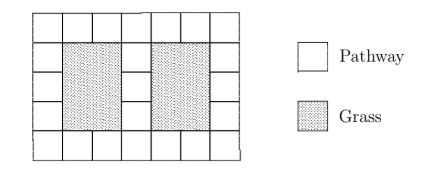
Below is a diagram of a garden. Some of the garden is grass and some is a pathway made from square blocks.

The total area of the grass is 108 square metres.
What is the area, in square metres, of the pathway?
(A) 216
(B) 54
(C) 181
(D) 207
(E) 200

Problem 19:

A shop has a sale and sells hats for \(\$ 12\) each in the morning, taking \(\$ 720\). After lunch, the price is dropped to \(\$ 9\) each and the shop sells twice as many. What was the total amount taken on the day?
(A) \(\$ 1800\)
(B) \(\$ 900\)
(C) \(\$ 1260\)
(D) \(\$ 1440\)
(E) \(\$ 2880\)

Problem 20:

The areas, in square centimetres, of three rectangles are given.

What is the area, in square centimetres, of the shaded rectangle?
(A) 36
(B) 48
(C) 56
(D) 60
(E) 70

Problem 21:

Mike thinks of a two-digit number. Karen reverses the digits and when the two numbers are added the total is 132 . How many different numbers could Mike have thought of?
(A) 4
(B) 7
(C) 8
(D) 10
(E) 12

Problem 22:

Two bolts and two screws weigh as much as one bolt and ten nails. One bolt weighs as much as one screw and one nail. How many nails weigh as much as one bolt?
(A) 3
(B) 4
(C) 5
(D) 6
(E) 7

Problem 23:

My birthday is 18 November. Four of my friends' birthdays are 1 November, 12 November, 21 November and 1 December. The five of us decide to hold a birthday party on the date closest to all the birthdays. (This means that the sum of the days from the chosen date to each birthday is as small as possible.) Which date should this be?
(A) 12 November
(B) 19 November
(C) 15 November
(D) 18 November
(E) 17 November

Problem 24:

Annie is recording the number of cars in the family of each child in her class in a column graph. She has not drawn the column for the number of families that have exactly two cars.

The average number of cars per family is \(1 \frac{1}{3}\). How many families have exactly two cars?
(A) 0
(B) 1
(C) 2
(D) 3
(E) 4

Problem 25:

Five rectangles, each 12 cm long and of equal width, are placed together to form a single rectangle, still 12 cm long but 5 times as wide. The new rectangle has a perimeter twice as great as each of the original rectangles. What is the perimeter, in centimetres, of the new rectangle?
(A) 48
(B) 60
(C) 64
(D) 72
(E) 84

Problem 26:

Consider this statement:
THIS IS ONE GREAT MATHS CHALLENGE
Every minute, the first letter of each word is moved to the other end of the word. In how many minutes will the original sentence appear back again?

Problem 27:

Below is an example of a triangle drawn on a 6 by 5 grid with one vertex \(A\) on the bottom left-hand corner and the other two vertices on the top and right-hand boundaries.

What is the largest number of squares that can be cut by the sides of such a triangle?

Problem 28:

The product of three consecutive whole numbers is 12144 . What is their sum?

Problem 29:

When a number has the digit 2 put at both ends, its value increases by 2785 . What is the original number?

Problem 30:

I have 4 black and 4 white cubes of equal size. In how many different ways can they be put together to form a \(2 \times 2 \times 2\) cube? (Two cubes are not considered different if they can be rotated to look the same.)

Problem 28, Upper Primary: Australian Mathematics Competition 2023

Let's discuss a problem from the AMC 2023 Upper Primary: Problem 28 which revolves around basic calculation.

Problem


Using \(9\) out of the \(10\) possible digits Safia writes \(3\) numbers, each between \(100\) and \(999\). She adds her \(3\) numbers together. What is the smallest possible sum?


As mentioned the sum has to be the smallest possible so we have to consider the smallest numbers.

Let's select the three smallest numbers for the hundredth place: 1, 2, 3

Let's select the next three smallest numbers for the ten's place also include zero: 0, 4, 5
Let's select the next three numbers for the one's place: 6, 7, 8

Thus the three numbers become: \(106, 247, 358\)

If we add them the sum becomes: \(106 + 247 + 358 = 711 \).

Thus the smallest possible sum is \(711\).

What is AMC (Australian Mathematics Competition)?

The Australian Mathematics Competition (AMC) is one of Australia's largest and oldest annual mathematics competitions, aimed at fostering interest and excellence in mathematics among students.

Here is a beautiful book suggestion by Cheenta :

Solution: Australian Mathematics Competition 2022 โ€“ Upper Primary, Problem 16

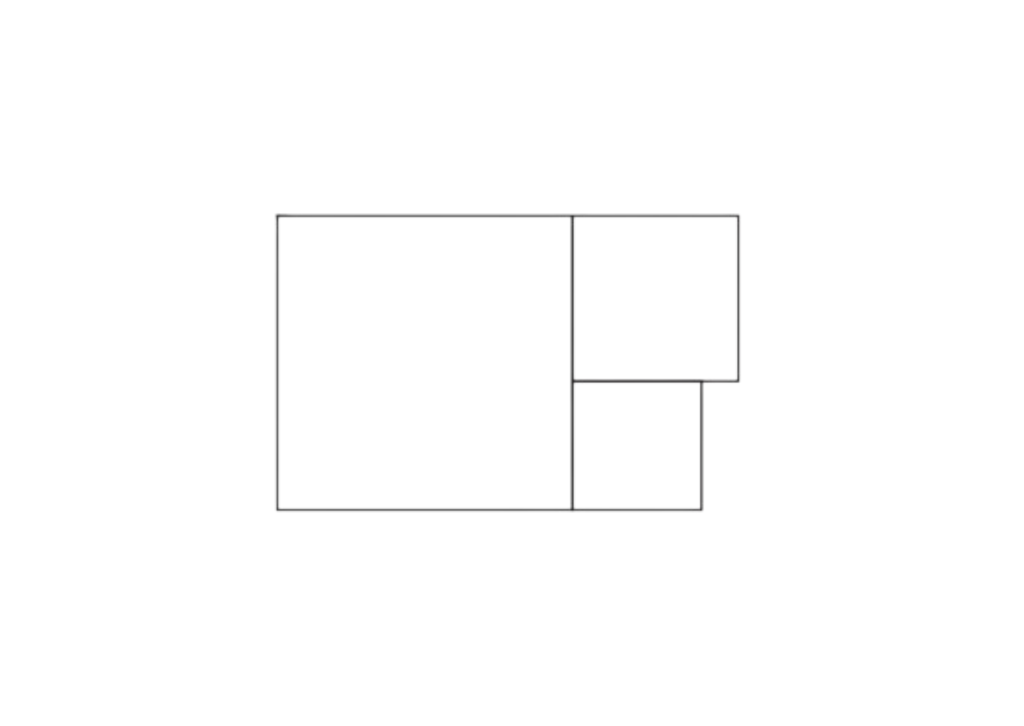
Let's discuss a problem from AMC 2022 - Upper Primary - 16 on Geometry.


(A) 12 cm (B) 14 cm (C) 20 cm (D) 24 cm (E) 30 cm


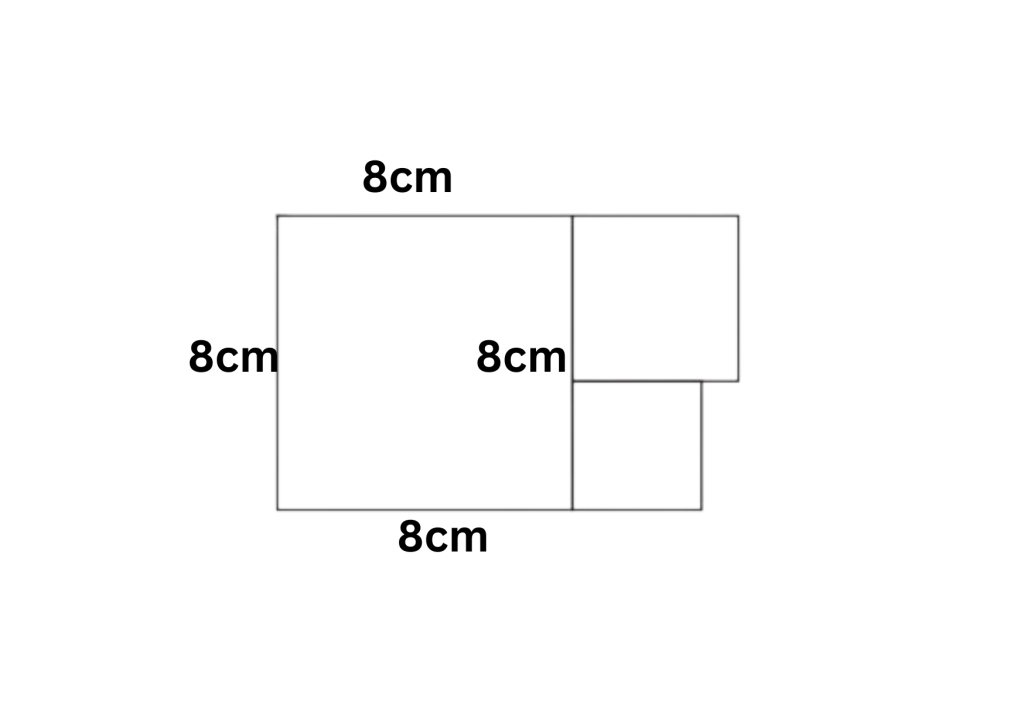
In this problem, it is given that the big square has a perimeter of \(32\)cms. We know how to find the perimeter of a square.
The perimeter is nothing but the length of the boundary. So \(4a\) is the perimeter of a square. Thus \(4a = 32\),

so, \(a = \frac {32}{4} = 8\).

Thus the side length of the bigger square is = \(8\)cms.

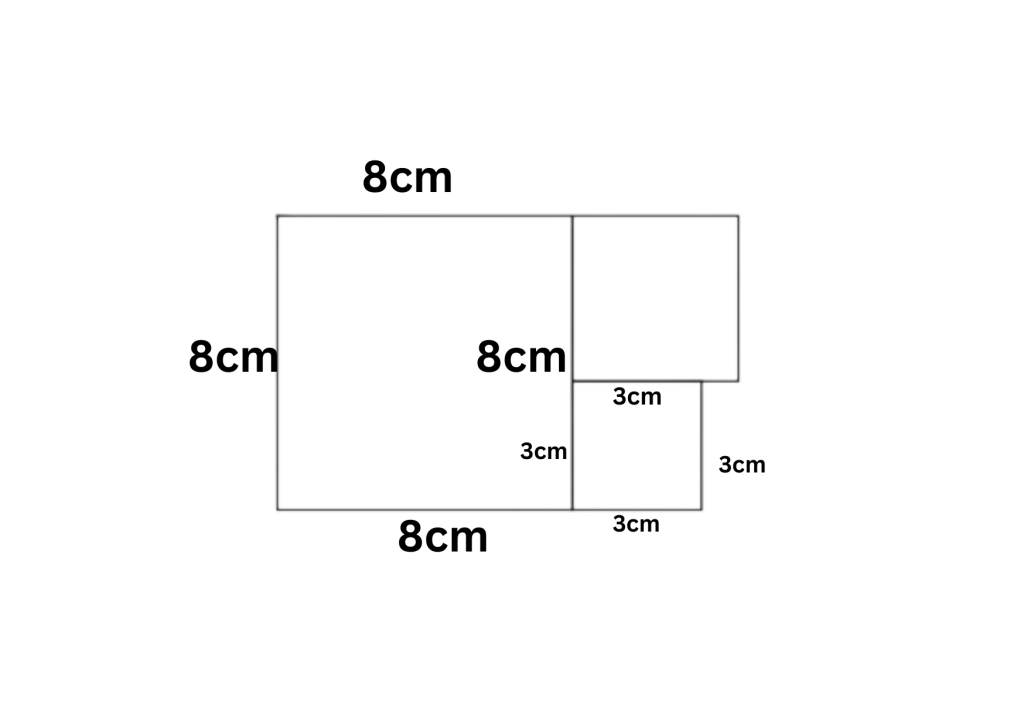
The small square has the area as \(9\) sq cms.

The area of a square is = \( a^2\). Thus \(a^2 = 9, a = 3\).

Thus the side length of the smallest square is 3 cms.

Thus the medium square has a side length of = \(8-3\) cm = \(5\)cm.

Thus the perimeter of the medium square is = \(4a = 4 \times 5 = 20\) cm.

What is AMC (Australian Mathematics Competition)?

The Australian Mathematics Competition (AMC) is one of the largest and oldest annual mathematics competitions in Australia, aimed at fostering interest and excellence in mathematics among students

AMC 2023: Australian Mathematics Competition 2023 โ€“ Upper Primary, Solution

Let's discuss a problem from the AMC 2023 Upper Primary: Problem 17 which revolves around basic counting.

Problem


There are \(10\) questions in a test. Each correct answer scores \(5\) points, each wrong answer loses \(3\) points, and if a question is left blank it scores \(0\) points. Tycho did this test and scored \(27\) points. How many questions did Tycho leave blank? (amc-2023-17)


From the given data we understand,

Suppose one corrects all the questions then he will get = \( 10 \times 5 = 50\).

But Tycho got \(27\) marks so he couldn't correct all the questions. Some of them are wrong and some of them are un attempted along with the corrected answers.

Let's consider that he could solve correctly \(7\) problems so he will get: \(7 \times 5 = 35\)

He got wrong in \(2\) questions = \( 2 \times -3 = -6\)

He wasn't attempted \(1\) problem = \( 1 \times 0\)

Thus the total mark is: \( 35 - 6 + 0 = 29\) which does not match the desired marks.

Let's try with \(6 \)corrected problems = \( 6 \times 5 = 30\)

\(1\) incorrect problem = \(1 \times -3 = -3\)

And \(3\) unattempted questions = \( 3\times 0 = 0\)

Total marks he gets =\(30 - 3 + 0 = 27\).

So the number of unattempted questions is = C) \(3\).

What is AMC (Australian Mathematics Competition)?

The Australian Mathematics Competition (AMC) is one of the largest and oldest annual mathematics competitions in Australia, aimed at fostering interest and excellence in mathematics among students

Detailed Solution and Discussion: Australian Mathematics Competition 2023 โ€“ Upper Primary, Problem 22

Problem


At a school concert, the tickets cost \( \$ 20\) per adult and \(\$ 2\) per child. The total paid by the \(100\) people who attended was \(\$ 920\). How many were children?

(A) between 25 and 35 (B) between 35 and 45 (C) between 45 and 55 (D) between 55 and 65 (E) between 65 and 75

Solution


Let's solve this problem by considering x as the number of adults and y as the number of children.

Thus, \(x + y = 100\)

From the first statement, we can conclude,

The total number of adults = \(20x\)

The total number of children = \(2y\).

Thus, \(20x + 2y = 920\).

As we know, \(x + y = 100\),

So, \(y = 100 - x\) ----------------------(1)

\(20x + 2y = 920\).

\(\therefore\) \(20x + 2(100 -x)\) [applying (1)]

\(\therefore\)\(20x + 200 - 2x = 920\)

\(\therefore\)\(18x = 920 -200 = 720\)

\(\therefore\)\(x = 720\div 18 = 40\)

Thus, \(x = 40\).

Applying the value of \(x\) in \(eq^n (1)\) we get,

\(y = 100 - x = 100 - 40 = 60\)

So the number of children is \(60\).

The answer is D) between 55 and 65.

What is AMC (Australian Mathematics Competition)?

The Australian Mathematics Competition (AMC) is one of the largest and oldest annual mathematics competitions in Australia, aimed at fostering interest and excellence in mathematics among students.

Australian Mathematics Competition - 2018 - Upper Primary Division - Grades 5 & 6- Questions and Solutions

Problem 1:

Which one of these numbers is closest to 208 ?

(A) 190 (B) 200 (C) 205 (D) 210 (E) 218

Problem 2:

Callie has $\$ 47$ and then gets $\$ 25$ for her birthday. How much does she have now?


(A) $\$ 52$ (B) $\$ 62$ (C) $\$ 65$ (D) $\$ 69$ (E) $\$ 72$

Problem 3:

Which one of the following numbers is a multiple of 8 ?

(A) 18 (B) 28 (C) 38 (D) 48 (E) 58

Problem 4:

Kate made this necklace from alphabet beads.
She put it on the wrong way around, showing the back of the beads. What does this look like?

Problem 5:

Write the number for eight thousand, eight hundred and eight.

(A) 88008 (B) 80808 (C) 80088 (D) 888 (E) 8808

Problem 6:

Jane has a number of 20 c coins and Tariq has a number of 50 c coins. They have the same amount of money. What is the smallest number of coins they could have all together?

(A) 2 (B) 5 (C) 6 (D) 7 (E) 10

Problem 7:

Mrs Chapman put 58 books back on the library shelves. She put 12 books on each shelf except the last shelf. How many books did she put on the last shelf?

(A) 7 (B) 8 (C) 9 (D) 10 (E) 11

Problem 8:

A shopkeeper displays plastic cups like this. Each level has one less than the level below it, and the top level has only one cup. She keeps this pattern going until she has 28 cups. How many levels is this?

(A) 5 (B) 6 (C) 7 (D) 8 (E) 9

Problem 9:

Six friends each make a phone call to another city.
The cost of each call depends on the time taken for the call as well as the distance.
From this diagram decide whose phone call lasts longer than Pat's, but costs less.


(A) Al (B) Bill (C) Jo (D) Mia (E) Zac

Problem 10:

Aimee, Bilal and Caitlin are comparing their ages. Aimee is 8 years old. In three years time, Bilal will be 9 . Two years ago, Caitlin was 5 .
Ordered from youngest to oldest, they are

(A) Aimee, Bilal, Caitlin (B) Bilal, Caitlin, Aimee (C) Caitlin, Aimee, Bilal (D) Bilal, Aimee, Caitlin (E) Aimee, Caitlin, Bilal

Problem 11:

What value is indicated on this popularity meter?

(A) 36.65 (B) 37.15 (C) 37.3 (D) 37.65 (E) 38.65

Problem 12:

One of these shapes made of squares has been flipped and turned to make the following pattern, without any overlaps. Which one?

Problem 13:

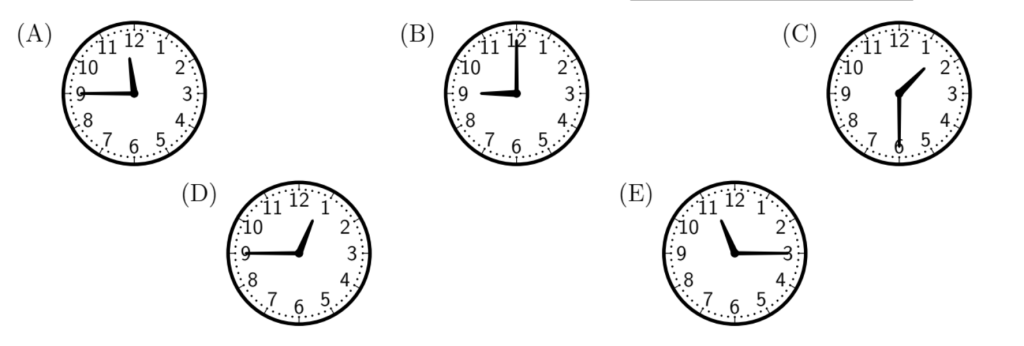
Fred looked at the clock during the Library lesson. Which one of these times could the clock have shown?

Problem 14:

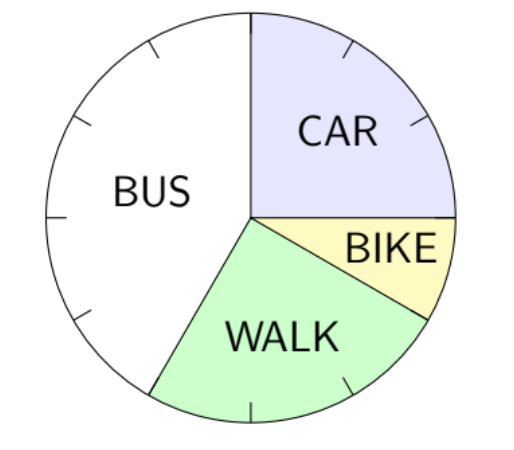
Last year Alan worked 5 days a week for 48 weeks. The graph shows how Alan travelled to work each day. On how many days did Alan travel by bus?

(A) 20 (B) 80 (C) 100 (D) 140 (E) 240

Problem 15:

In this grid, each number at the end of a row or below a column indicates how many squares in that row or column contain a counter.
Which one of the following grids could also have counters with these rules?

Problem 16:

To send large parcels overseas, it costs $\$ 24$ for the first 10 kg and $\$ 8$ for each extra 5 kg or part thereof. How much would it cost to send a 28 kg parcel overseas?

(A) $\$ 48$ (B) $\$ 52$ (C) $\$ 56$ (D) $\$ 60$ (E) $\$ 64$

Problem 17:

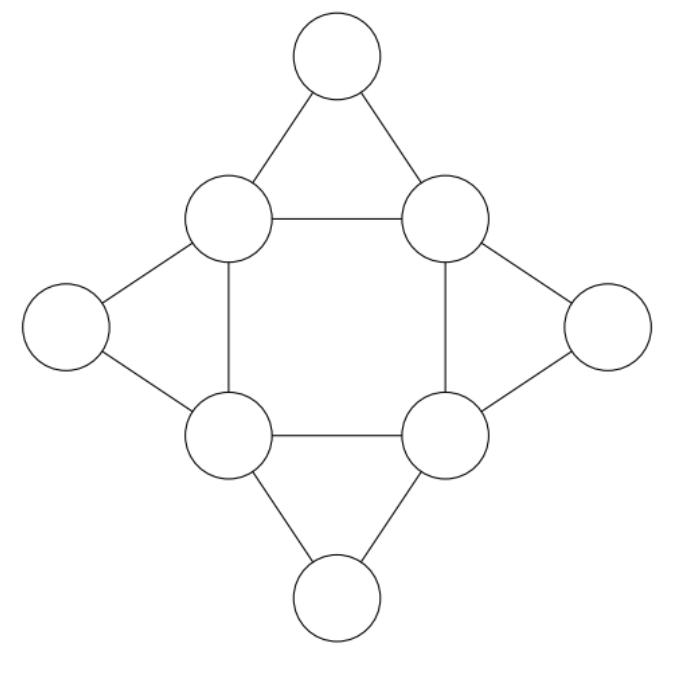
The numbers from 1 to 3 are entered into the circles in the grid shown. Two circles joined by a line may not contain the same number.
There are several ways of doing this. What is the smallest possible total of the eight numbers?

(A) 10 (B) 12 (C) 14 (D) 15 (E) 16

Problem 18:

What fraction of this regular hexagon is shaded?


(A) $\frac{1}{2}$ (B) $\frac{2}{3}$ (C) $\frac{3}{4}$ (D) $\frac{3}{5}$ (E) $\frac{4}{5}$

Problem 19:

Pictures of fruit have been placed in this grid to represent numbers less than 10 .
The totals for each row and column are shown. What is the total value of an apple ๐ŸŽ and an orange ๐ŸŠ ?


(A) 8 (B) 9 (C) 10 (D) 11 (E) 12

Problem 20:

Andrew is doing some tidying. He can tidy 2 big rooms in the same time it takes to tidy 3 small rooms. He can tidy one big room and three small rooms in 90 minutes.
How long will it take him to tidy 3 big rooms and 6 small rooms?

(A) 3.5 hours (B) 4 hours (C) 4.5 hours (D) 5 hours (E) 5.5 hours

Problem 21:

A rectangle measures 3 cm by 4 cm . A diagonal stripe is shaded which starts 1 cm from the diagonal corners, as in the diagram.
What fraction of the area of the rectangle is this shaded strip?

(A) $\frac{1}{2}$ (B) $\frac{1}{3}$ (C) $\frac{1}{4}$ (D) $\frac{1}{5}$ (E) $\frac{2}{5}$

Problem 22:

Beginning with a row of 20 coins, Anh takes the first coin, then every fourth coin after that.
From the remaining coins, Brenda takes the first coin and every third coin after that.
From the remaining coins, Chen takes the first coin and every second coin after that.
Dimitris takes all the remaining coins.
Does anyone get more coins than all the others?

(A) Yes, Anh does (B) Yes, Brenda does (C) Yes, Chen does (D) Yes, Dimitris does (E) No, they all get the same number of coins

Problem 23:

These two water tanks are to be filled. A hose used to do this can fill the smaller tank in 2 hours. How many hours will the same hose take to fill the larger tank?

(A) 4 (B) 6 (C) 9 (D) 12 (E) 24

Problem 24:

A farmer has a rectangular property 8 km by 6 km , with fencing along the boundary and diagonal fences as shown.
One day she leaves her farmhouse at $H$ to inspect all her fences, returning home to $H$ when this is done.
What is the minimum distance, in kilometres, she must travel to do this?


(A) 48 (B) 58 (C) 59 (D) 60 (E) 64

Problem 25:

What is the sum of the digits in the result of the subtraction

where the first number has 20 digits each 1 , and the second has 10 digits, each 2 ?

(A) 72 (B) 81 (C) 89 (D) 90 (E) 99

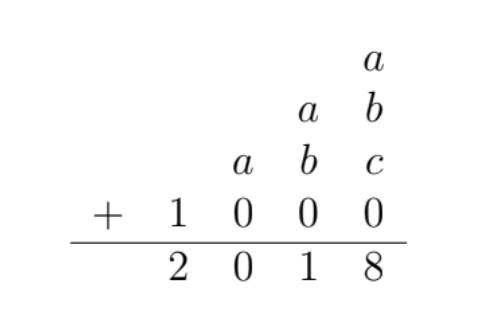
Problem 26:

In the algorithm below, the letters $a, b$ and $c$ represent different digits from 0 to 9 . What is the three-digit number $a b c$ ?

Problem 27:

Using only digits 0,1 and 2 , this cube has a different number on each face.
Numbers on each pair of opposite faces add to the same 3 -digit total.
What is the largest that this total could be?

Problem 28:

I wrote the counting numbers joined together:

$1234567891011121314151617 \ldots$

Which of the counting numbers was I writing when the 100th zero was written?

Problem 29:

Jan and Jill are both on a circular track.
Jill runs at a steady pace, completing each circuit in 72 seconds.
Jan walks at a steady pace in the opposite direction and meets Jill every 56 seconds.
How long does it take Jan to walk each circuit?

Problem 30:

The answer to a cross-number puzzle clue is a whole number (not a word). A fragment of such a puzzle is shown. Some clues are:

Across

  1. Square of 27-down.
  2. Half of 1-across.

Down

  1. Twice 2-down.
  2. A multiple of 9 .

What is 2-down?