Australian Mathematics Competition - 2023 - Middle Primary - Grade 3 & 4 - Questions and Solutions

Problem 1:

What is the total number of petals on all 5 flowers?
(A) 10
(B) 15
(C) 20
(D) 25
(E) 50

Problem 2:

\[
2+3+7+8=
\]

(A) 10
(B) 20
(C) 30
(D) 40
(E) 50

Problem 3:

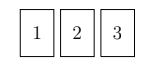
Which one of these shapes is a rectangle?

Problem 4:

Which digital clock time matches the time shown on the clock face?

Problem 5:

Emma has a bag containing 5 red, 4 yellow, 1 black and 2 blue buttons. When she chooses 1 button at random, what colour is it most likely to be?
(A) green
(B) blue
(C) black
(D) yellow
(E) red

Problem 6:

What fraction of the circle is part A ?


(A) one-half
(B) one-third
(C) two-thirds
(D) one-quarter
(E) three-quarters

Problem 7:

In a board game, Nik rolls three standard dice, one at a time. He needs his three rolls to add to 12.
His first two dice rolls are 5 and 3 . What does he need his third roll to be?


(A) 2
(B) 3
(C) 4
(D) 5
(E) 6

Problem 8:

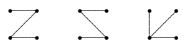
Which shape has only one line of symmetry?

Problem 9:

Anastasia Ant is on a sheet of wire mesh with 10 cm squares. She can only move along the wires. She moves 10 cm east, then 30 cm north and 20 cm west. What is the least possible distance she needs to move to return to her starting point?

(A) 10 cm
(B) 20 cm
(C) 30 cm
(D) 40 cm
(E) 50 cm

Problem 10:

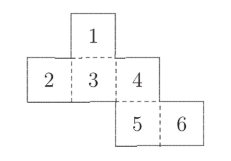
A piece of card is cut out and labelled as shown in the diagram. It is folded along the dotted lines to make a box without a top. Which letter is on the bottom of the box?
(A) A
(B) B
(C) C
(D) D
(E) E

Problem 11:

Jiang is threading beads onto a string to make a necklace. He decides to use a sequence, starting with a red bead, then a yellow bead and a blue bead. He repeats this pattern until he has 20 beads on the necklace.
How many red beads will he use?

(A) 5
(B) 6
(C) 7
(D) 8
(E) 9

Problem 12:

How many people played tennis on the busiest day of the week at the Paradise North Tennis Club?
(A) 45
(B) 50
(C) 55
(D) 60
(E) 65

Problem 13:

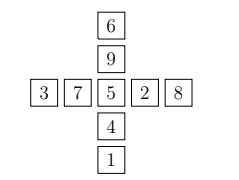
When this puzzle is complete, each of the four lines will add up to 14 . What will the four missing numbers add to?
(A) 10
(B) 14
(C) 15
(D) 16
(E) 18

Problem 14:

Which one of the following could give an answer of \(25 ?\)
(A) an odd number plus an odd number
(B) an even number multiplied by an even number
(C) an even number divided by an odd number
(D) an odd number minus an even number
(E) an even number multiplied by an odd number

Problem 15:

This bottle holds 4 glasses of water.

Which one of the following holds the most water?

Problem 16:

Fido needs to be weighed at the vet, but he won't sit still. So the vet weighs himself and then weighs himself holding Fido.

How much does Fido weigh?
(A) 23 kg
(B) 26 kg
(C) 28 kg
(D) 30 kg
(E) 32 kg

Problem 17:

Grandma adds 3 spoons of sugar to the juice of 10 lemons to make lemonade. How many lemons are needed if 15 spoons of sugar are used to make Grandma's recipe?
(A) 20
(B) 22
(C) 25
(D) 30
(E) 50

Problem 18:

Janus is making patterns using square tiles.
Each pattern is made by copying the previous pattern, then adding new tiles around the outside edges.
The new tiles alternate in colours, as shown.

What will be the total number of tiles in Pattern 5?
(A) 25
(B) 33
(C) 37
(D) 40
(E) 41

Problem 19:

My laptop's battery meter tells me what fraction of the battery charge is left. I used the laptop for 4 hours and 20 minutes and it went from

What would the reading be after using the laptop for another 130 minutes?

Problem 20:

Syed's mother had some money to share with her family.
She gave one-quarter of her money to Syed.
Then she gave one-third of what was left to Ahmed.
Then she gave one-half of what was left to Raiyan.
She was left with \(\$ 15\), which she kept for herself.
How much money did Syed's mother have to start with?
(A) \(\$ 30\)
(B) \(\$ 45\)
(C) \(\$ 60\)
(D) \(\$ 90\)
(E) \(\$ 120\)

Problem 21:

In 2023, Janine's birthday is on a Thursday. Ngoc's birthday is one month later, meaning that it is on the same day-number in the next month. Ngoc's birthday is not on a Saturday or a Sunday. Which day of the week is Ngoc's birthday?
(A) Monday
(B) Tuesday
(C) Wednesday
(D) Thursday
(E) Friday

Problem 22:

Sally empties her piggy bank to see how much she has saved. She has 20 coins altogether and the total value of her coins is (\$ 3.80). She notices that she has twice as many 50 c coins as 20 c coins. The remaining coins are 10c coins. How many 10c coins does she have?
(A) 2
(B) 4
(C) 8
(D) 11
(E) 14

Problem 23:

Three different numbers from 1 to 20 are chosen. They add to 20 . Two of the numbers are 2 apart. How many possibilities are there for the largest number?
(A) 6
(B) 7
(C) 8
(D) 9
(E) 10

Problem 24:

Estelle is making decorations shaped like the 8-pointed star shown. She folds a square of paper to make a triangle with 8 layers as shown.

How could she cut the triangle so that the unfolded shape is the star?

Problem 25:

Tom is digging holes in his garden for his new plants. As he is working he slows down. Each new hole takes a minute longer to dig than the last hole.
The first 5 holes have taken him 35 minutes in total. How long will it take him to dig the next 2 holes?
(A) 11 minutes
(B) 17 minutes
(C) 21 minutes
(D) 24 minutes
(E) 25 minutes

Problem 26:

To unlock a security door, Daniyal enters a code on the keypad shown. To make it easy to remember:

What are the last 3 digits in Daniyal's code?

Problem 27:

In this puzzle, \(\triangle\), \(\square\) and represent different nonzero digits. What is the three-digit number \(\triangle \square \bigcirc\) ?

Problem 28:

Ollie arranges the numbers 1 to 6 to form three 2-digit numbers.
Exactly one of his numbers divides by 3 but not divides by 4 , and exactly one other divides by 4 . None of them divide by 5 .
The three numbers add to 93 .
What is the number which does not divide by either 3 or 4 ?

Problem 29:

A table in the shape of a trapezium can seat 5 people. When two tables are put together in a row, 8 people can be seated. What is the smallest number of trapezium tables required to seat 2023 people if they are all placed in a row?

Problem 30:

Yifan has a construction set consisting of red, blue and yellow rods. All rods of the same colour are the same length, but differently coloured rods are different lengths. She wants to make quadrilaterals using these rods.

What number do you get when you multiply the lengths of one red rod, one blue rod and one yellow rod?

AMC 2021 Middle Primary – Problem 22 with Solution | Australian Mathematics Competition Explained

Let's discuss a problem from the AMC 2021 Middle Primary Category: Problem 22 which revolves around puzzle.

Question


The biscuit section in a cookbook has 6 pages. The sum of all the page numbers in this section is 147 . What is the number of the last page in this section of the book?


(A) 26
(B) 27
(C) 28
(D) 29
(E) 30

Solution


To number the pages we want $6$ consecutive numbers .

Let's try to check the nearest numbers divisible by $6$.
If we multiply $6 \times 20 = 120$ which is less than the number that we have to get : $147$.

If we multiply $6\times 30 = 180$ which is more than the number that we have to get : $147$.

So the required number will be in between $20$ and $30$.
As the number is bigger than 120 so let's try to take the first number as $20$ then rest of the 5 consecutive numbers.
Adding the numbers: $20+21+22+23+24+25 = 135$. This is less than $147$.
Let's see how much less we are getting: $147 - 135 = 12$.

So, instead of starting from $20$ if we start from $22$ we will get :
$22 + 23+ 24+ 25 +26 + 27 = 147$.

So the last page number is $27$.

What is AMC (Australian Mathematics Competition)?

The Australian Mathematics Competition (AMC) is one of Australia's largest and oldest annual mathematics competitions, aimed at fostering interest and excellence in mathematics among student

Explore Panini8 Software through this video:1

AMC 2021 Middle Primary – Problem 14 with Solution | Australian Mathematics Competition Explained

Let's discuss a problem from the AMC 2021 Middle Primary Category: Problem 14 which revolves around basic algebra.

Question


Five boxes are compared on a balance.

Which of the five boxes is lightest?

Solution


From the picture we can understand that box $C$ isd lighter than box $A$. Again box $C$ is heavier than box $D$. Thus box $C$ is not lightest.

Box $D$ is lighter than box $C$ but heavier than box $E$. So box $D$ is not lightest.

Box $E$ is lighter than box $D$ but heavier than box $B$.

Thus the relation we get is:

$A\li C \li D \li E \li B$.

Thus box $B$ is the lightest.

What is AMC (Australian Mathematics Competition)?

The Australian Mathematics Competition (AMC) is one of Australia's largest and oldest annual mathematics competitions, aimed at fostering interest and excellence in mathematics among students.

Australian Mathematics Competition - 2015 - Middle Primary - Grade 3 & 4 - Questions and Solutions

Problem 1:

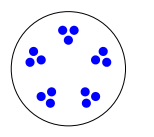
How many dots are on the plate?
(A) 10
(B) 12
(C) 13
(D) 14
(E) 15

Problem 2:

Jill had 15 grapes. She ate 5. How many are left?
(A) 7
(B) 8
(C) 9
(D) 10
(E) 11

Problem 3:

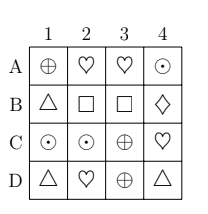
This grid gives the position of different shapes.

For example, a $\diamond$ is in position B4.
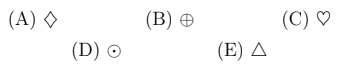
Which shape is in position D2?

Problem 4:

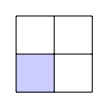
What fraction of this shape is shaded?
(A) \(\frac{1}{2}\)
(B) \(\frac{1}{3}\)
(C) \(\frac{1}{4}\)
(D) \(\frac{1}{5}\)
(E) \(\frac{1}{6}\)

Problem 5:

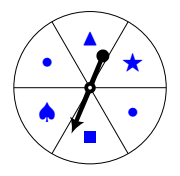
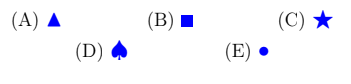
On this spinner, which shape are you most likely to spin?

Problem 6:

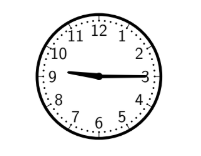
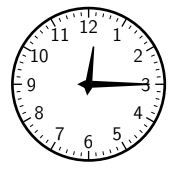
What time is shown on this clock?

(A) twelve o'clock
(B) a quarter to nine
(C) a quarter past three
(D) a quarter past twelve
(E) three o'clock

Problem 7:

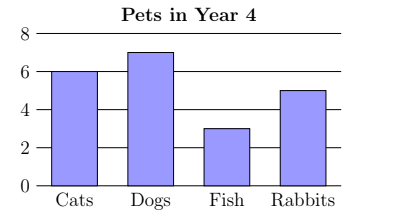
The graph below shows the number of pets owned by the students in a Year 4 class.

How many pets does this class have altogether?
(A) 24
(B) 22
(C) 21
(D) 14
(E) 4

Problem 8:

Which number do you need in the box to make this number sentence true?\(19+45=20+\square\)

(A) 34
(B) 44
(C) 46
(D) 64
(E) 84

Problem 9:

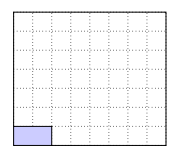
How many 2 by 1 rectangles will fit exactly into an 8 by 7 rectangle?
(A) 14
(B) 28
(C) 36
(D) 56
(E) 63

Problem 10:

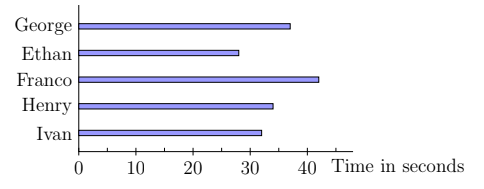
Five swimmers were in a 50 m race. The time each swimmer took to finish the race is shown in this graph. Who won the race?

(A) George
(B) Ethan
(C) Franco
(D) Henry
(E) Ivan

Problem 11:

Cianna is stringing beads for a necklace, starting with two round beads, then a square bead, and then repeating this pattern of three beads.

She finished her necklace with a round bead, which happens to be the 18th round bead. How many square beads are on her necklace?
(A) 10
(B) 12
(C) 18
(D) 6
(E) 8

Problem 12:

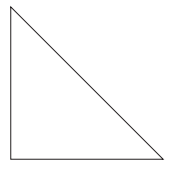
The triangle shown is folded in half three times without unfolding, making another triangle each time.

Which figure shows what the triangle looks like when unfolded?

Problem 13:

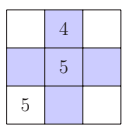
When complete, each row, column and diagonal in this diagram has a sum of 15 . What is the sum of the numbers in the shaded squares?
(A) 20
(B) 25
(C) 27
(D) 30
(E) 45

Problem 14:

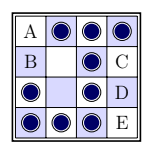
To which square should I add a counter so that no two rows have the same number of counters, and no two columns have the same number of counters?
(A) A
(B) B
(C) C
(D) D
(E) E

Problem 15:

John wrote his name on his book. Martha said he wrote with a black pen. Aaron said it was a brown pencil. Frankie said it was a black crayon. If each of John's friends were half right, what did he really use to write his name?
(A) a brown pen
(B) a brown crayon
(C) a brown pencil
(D) a black pen
(E) a black pencil

Problem 16:

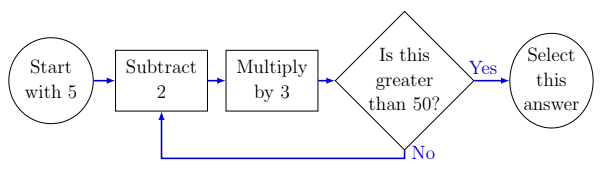
Follow the instructions in this flow chart.

(A) 57
(B) 63
(C) 75
(D) 81
(E) 84

Problem 17:

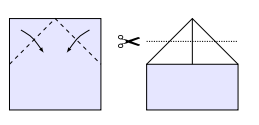
A square piece of paper is folded along the dashed lines shown and then the top is cut off.

The paper is then unfolded. Which shape shows the unfolded piece?

Problem 18:

Rod had fewer than 100 blocks. When he made five equal rows, he had one block left over. With four equal rows, he had one block left over. With nine equal rows, there were no blocks left over. How many blocks did he have?
(A) 18
(B) 49
(C) 81
(D) 91
(E) 99

Problem 19:

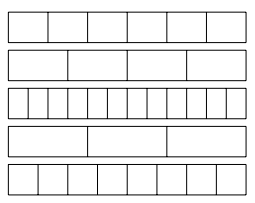
Simon has some 24 cm long strips. Each strip is made from a different number of equal-sized tiles.
Simon took 1 tile from each strip to make a new strip. How long is the new strip?
(A) 18 cm
(B) 20 cm
(C) 23 cm
(D) 24 cm
(E) 33 cm

Problem 20:

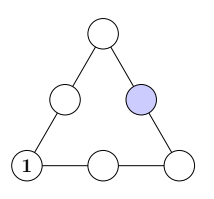
The numbers 1 to 6 are placed in the circles so that each side of the triangle has a sum of 10 . If 1 is placed in the circle shown, which number is in the shaded circle?
(A) 2
(B) 3
(C) 4
(D) 5
(E) 6

Problem 21:

Grandpa had (\$ 400) in his wallet. He gave half the money to his wife. From what was left, he then gave one-quarter to his son. Half of the remainder went to his grandson. How much money did his grandson receive?
(A) \(\$ 50\)
(B) \(\$ 125\)
(C) \(\$ 100\)
(D) \(\$ 200\)
(E) \(\$ 75\)

Problem 22:

The numbers \(40,19,37,33,12,25,46,18,39,21\) are matched in pairs so that the sum of each pair is the same. Which number is paired with 39 ?
(A) 19
(B) 33
(C) 21
(D) 18
(E) 25

Problem 23:

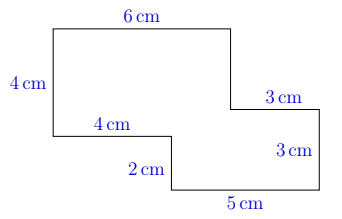
This shape is made from two overlapping rectangles.
What is its area in square centimetres?
(A) 35
(B) 37
(C) 39
(D) 41
(E) 43

Problem 24:

Molly is thinking of a number. Twice her number take away seven is the same as her number plus five. What is her number?
(A) 19
(B) 17
(C) 15
(D) 12
(E) 10

Problem 25:

Tom borrowed some items from the stationery cupboard. He found that 5 glue sticks weigh the same as 2 staplers, and that 3 staplers weigh the same as 20 erasers.

How many glue sticks balance with how many erasers?
(A) 3 glue sticks with 8 erasers
(B) 3 glue sticks with 50 erasers
(C) 1 glue stick with 6 erasers
(D) 3 glue sticks with 17 erasers
(E) 7 glue sticks with 23 erasers

Problem 26:

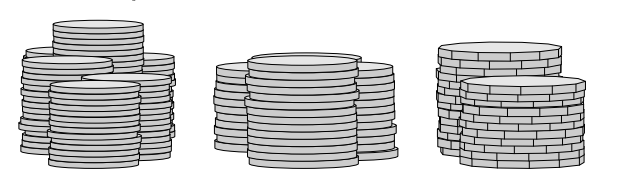
Jill has three large piles of coins: \(10 \mathrm{c}, 20 \mathrm{c}\) and 50 c . In how many different ways can she make one dollar?

Problem 27:

A newspaper open on the table had page 42 opposite page 55 because someone had removed some pages from the centre. What is the number of the last page of the newspaper?

Problem 28:

Alex is designing a square patio, paved by putting bricks on edge using the basketweave pattern shown.
She has 999 bricks she can use, and designs her patio to be as large a square as possible. How many bricks does she use?

Problem 29:

There are many ways that you can add three different positive whole
numbers to get a total of 12. For instance, 1 + 5 + 6 = 12 is one way
but 2 + 2 + 8 = 12 is not, since 2, 2 and 8 are not all different.
If you multiply these three numbers, you get a number called the
product.
Of all the ways to do this, what is the largest possible product?

Problem 30:

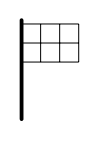
A 3×2 flag is divided into six squares, as shown.
Each square is to be coloured green or blue, so
that every square shares at least one edge with
another square of the same colour.
In how many different ways can this be done?

Australian Mathematics Competition - 2012 - Middle Primary - Grade 3 & 4 - Questions and Solutions

Problem 1:

The value of \(48-25\) is
(A) 63
(B) 17
(C) 27
(D) 13
(E) 23

Problem 2:

The area, in square metres, of the rectangle below is

(A) 9
(B) 10
(C) 12
(D) 14
(E) 16

Problem 3:

In which order would you place the following cards to make the largest 5-digit number?

(A) PQR
(B) QRP
(C) QPR
(D) PRQ
(E) RQP

Problem 4:

What should we get if we add one tenth, one hundredth and two thousandths?
(A) 112
(B) 1.12
(C) 300
(D) 0.112
(E) 0.13

Problem 5:

Mary's soccer team wins a game by two goals. Between them the two teams scored 8 goals. How many goals did Mary's team score?
(A) 3
(B) 4
(C) 5
(D) 6
(E) 8

Problem 6:

Which of these spinners would be more likely to spin a rabbit?

Problem 7:

What is the perimeter, in metres, of the shape

below?

(A) 9
(B) 12
(C) 15
(D) 18
(E) none of these

Problem 8:

The digits of 2012 can be arranged to make several 4-digit numbers (the first digit of a 4-digit number cannot be zero). The difference between the largest and the smallest of these is
(A) 2012
(B) 1202
(C) 1122
(D) 1180
(E) 1188

Problem 9:

Mary colours in a honeycomb tessellation of hexagons. If hexagons share a common edge, she paints them in different colours.

What is the smallest number of colours she needs?
(A) 2
(B) 3
(C) 4
(D) 5
(E) 6

Problem 10:

Sentries marked \(S\) guard the rows and columns they are on. Sentries marked \(T\) guard

diagonally. How many squares are unguarded?
(A) 1
(B) 3
(C) 5
(D) 7
(E) 8

Problem 11:

Sam is 12 years old and Tom is 7 years old. When the sum of their ages is 45 , how old will Tom be?
(A) 15
(B) 19
(C) 20
(D) 25
(E) 27

Problem 12:

The net shown is folded to make a cube. Which face is opposite the face marked O ?
(A) J
(B) K
(C) L
(D) M
(E) N

Problem 13:

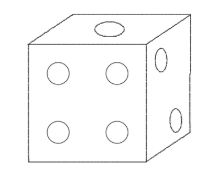
Three standard dice are rolled and the numbers on the top faces are added together.

How many different totals are possible?
(A) 15
(B) 16
(C) 18
(D) 24
(E) 36

Problem 14:

A garden stake is used to support a small tree. 90 cm of the stake is above the ground and one-third of the stake is below the ground. How long is the stake?
(A) 135 cm
(B) 120 cm
(C) 93 cm
(D) 90 cm
(E) 30 cm

Problem 15:

The square shown is a magic square. This means that the sum of all rows, columns and diagonals are the same. What is the value of \(R\) ?
(A) 8
(B) 9
(C) 12
(D) 13
(E) 16

Problem 16:

Adrian is watching a 90 -minute movie. His computer indicates that the movie is seven-tenths of the way through. How long is there still to play?
(A) 25 minutes
(B) 27 minutes
(C) 37 minutes
(D) 63 minutes
(E) 90 minutes

Problem 17:

Michael threw 8 darts at the dartboard shown.

All eight darts hit the dartboard. Which of the following could have been his total score?
(A) 22
(B) 37
(C) 42
(D) 69
(E) 76

Problem 18:

Five students, Cam, Franco, Adrian, Trent and Xavier line up in order of age from youngest to oldest. Cam is next to Adrian in the line while Franco and Trent are not next to each other. Who cannot be in the middle of the line?
(A) Cam
(B) Franco
(C) Adrian
(D) Trent
(E) Xavier

Problem 19:

Alex placed 9 number cards and 8 addition symbol cards on the table as shown.

Keeping the cards in the same order he decided to remove one of the addition cards to form a 2-digit number. If his new total was 99, which 2-digit number did he form?
(A) 32
(B) 43
(C) 54
(D) 65
(E) 76

Problem 20:

Ann thinks of a two-digit number and notices that the first digit is one more than twice the second digit. How many different numbers could she have thought of?
(A) 1
(B) 2
(C) 3
(D) 5
(E) 6

Problem 21:

Five towns are joined by roads, as shown in the diagram.

How many ways are there of travelling from town \(P\) to town \(T\) if no town can

be visited more than once?
(A) 3
(B) 5
(C) 6
(D) 7
(E) 9

Problem 22:

Mike is one year older than his brother and one year younger than his sister. When all three ages are multiplied together the result is 504. What is the sum of their ages?
(A) 17
(B) 16
(C) 21
(D) 24
(E) 36

Problem 23:

One of the mischief makers in a class decided to play a prank by glueing together some \(1 \times 1 \times 1\) blocks to form a solid cube. If he used 64 blocks to make the cube and needed to put glue on every face that was to be touching another face, how many faces were glued?
(A) 176
(B) 216
(C) 240
(D) 264
(E) 288

Problem 24:

Jasdeep plays a game in which he has to write the numbers 1 to 6 on the faces of a cube. However, he loses a point if he puts two numbers which differ by 1 on faces which share a common edge. What is the least number of points he can lose?
(A) 0
(B) 1
(C) 2
(D) 3
(E) 4

Problem 25:

Twelve points are marked on a square grid as shown.

How many squares can be formed by joining 4 of these

points?
(A) 5
(B) 6
(C) 9
(D) 11
(E) 13

Problem 26:

A \(5 \times 5 \times 5\) cube has a \(1 \times 1 \times 5\) hole cut through from one side to the opposite side, a \(3 \times 1 \times 5\) hole through another and a \(3 \times 1 \times 5\) hole through the third as shown in the diagram.

How many \(1 \times 1 \times 1\) cubes are removed in this process?

Problem 27:

The difference between two numbers is 42 . If five is added to each of them, the larger number becomes three times the smaller number. What is the larger number at the start?

Problem 28:

A rectangular tile has a perimeter of 24 cm . When Sally places four of these tiles in a row to create a larger rectangle, she finds the perimeter is double the perimeter of a single tile. What would be the perimeter of the rectangle formed by adding another 46 tiles to make a row of 50 tiles?

Problem 29:

How many ways are there of walking up a set of 7 stairs if you can take one or two steps at a time?

Problem 30:

A rhombus-shaped tile is formed by joining two equilateral triangles together. Three of these tiles are

combined edge to edge to form a variety of shapes as in the example given.

How many different shapes can be formed? (Shapes which are reflections or rotations

of other shapes are not considered different.)

Australian Mathematics Competition - 2011 - Middle Primary - Grade 3 & 4 - Questions and Solutions

Problem 1:

Mike buys a can of 4 tennis balls for \(\$ 2\). How much does each tennis ball cost?
(A) 25 c
(B) 50 c
(C) \(\$ 1\)
(D) \(\$ 4\)
(E) \(\$ 8\)

Problem 2:

The number 8000 is the same as
(A) 800 tens
(B) 800 units
(C) 80 tens
(D) 80 units
(E) 8 hundreds

Problem 3:

One side of a square is 6 cm long. What is the perimeter, in centimetres, of this square?
(A) 6
(B) 18
(C) 24
(D) 26
(E) 30

Problem 4:

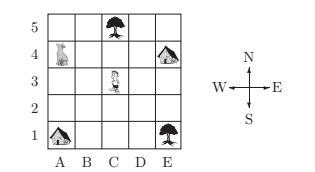
Imagine you are standing on the square which is in column C and row 4.

What can you see directly to the east?

Problem 5:

What number is halfway between 103 and 113 ?
(A) 107
(B) 110
(C) 105
(D) 109
(E) 108

Problem 6:

Ben cuts three oranges into quarters for the soccer team to eat at half-time. How many quarters are there?
(A) 3
(B) 6
(C) 7
(D) 12
(E) 16

Problem 7:

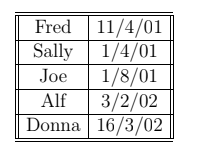
Mrs Harris asked five of her Year 4 children to record their birthdates in a table as shown below

Which child is the eldest?
(A) Sally
(B) Fred
(C) Joe
(D) Alf
(E) Donna

Problem 8:

Gina is 11 years old and her sister Bev is 8 years old. Their mum is twice as old as the sum of their ages. How old is their mum?
(A) 3
(B) 19
(C) 27
(D) 30
(E) 38

Problem 9:

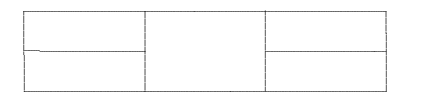
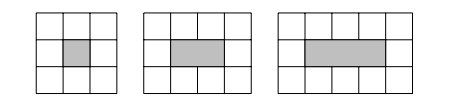
How many rectangles of any size are in this

diagram?

(A) 11
(B) 10
(C) 9
(D) 8
(E) 6

Problem 10:

I can buy 10 L of petrol for \(\$ 15\). How much do I pay for 40 L ?
(A) \(\$ 40\)
(B) \(\$ 55\)
(C) \(\$ 60\)
(D) \(\$ 65\)
(E) \(\$ 80\)

Problem 11:

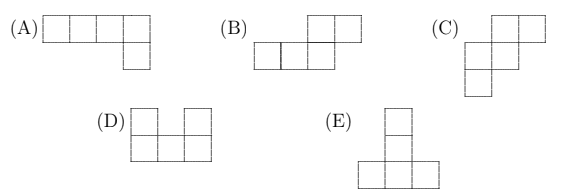
Which of the following is not a net for an open top box?

Problem 12:

Peter and Sue travelled from Cairns to Brisbane by aeroplane. Their flight took 130 minutes. If they left Cairns at 8:10 am, what time did they arrive in Brisbane?
(A) 10:10 am
(B) 9:40 am
(C) 10:40 am
(D) 9:30 am
(E) \(10: 20 \mathrm{am}\)

Problem 13:

Which one of the following statements is true?
(A) If you add two odd numbers you always get an odd number.
(B) If you multiply two odd numbers you always get an even number.
(C) If you add an odd and an even number you always get an even number.
(D) If you multiply an odd and an even number you always get an even number.
(E) If you multiply two even numbers you always get an odd number.

Problem 14:

Zac bought four medium pizzas with \(\$ 20\) and received \(\$ 3.60\) in change. How much would two pizzas have cost him?
(A) \(\$ 4.10\)
(B) \(\$ 5.00\)
(C) \(\$ 7.20\)
(D) \(\$ 8.20\)
(E) \(\$ 10.00\)

Problem 15:

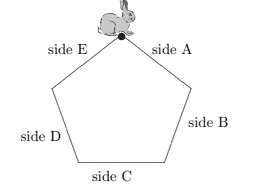
Raelene the rabbit started at the dot and travelled clockwise around the regular pentagon with equal sides.

What side was she on when she had travelled \(\frac{3}{4}\) of the distance around the pentagon?
(A) A
(B) B
(C) C
(D) D
(E) E

Problem 16:

How many even two-digit numbers are there where the sum of the digits is 5 ?
(A) 0
(B) 2
(C) 3
(D) 4
(E) 5

Problem 17:

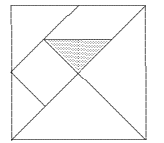
The diagram shows a 7-piece tangram puzzle.

What is the area, in square centimetres, of the shaded part if the whole puzzle is a square with

side 8 cm ?
(A) 2
(B) 4
(C) 6
(D) 8
(E) 10

Problem 18:

On a school trip, we took 6 tents for 18 students. Each tent sleeps either two or four students. How many of the tents were for two students?
(A) 1
(B) 2
(C) 3
(D) 4
(E) 5

Problem 19:

The annual parents' meeting is held on the 199th day of the calendar year. In which month will the meeting be held in 2011?
(A) April
(B) May
(C) June
(D) July
(E) August

Problem 20:

The following tile is made from three unit squares.

What is the area, in square units, of the smallest square which can be made from tiles of this shape?
(A) 16
(B) 25
(C) 36
(D) 64
(E) 81

Problem 21:

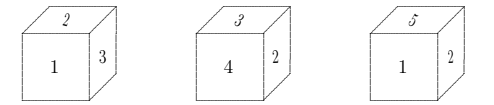
A cube has each of the numbers from 1 to 6 on its faces. The cube is shown in three different positions.

What number is on the opposite face to the face numbered \(6 ?\)
(A) 1
(B) 2
(C) 3
(D) 4
(E) 5

Problem 22:

In a number game you throw 2 six-sided dice to get 2 numbers from 1 to 6 . You then choose one instruction card from the three shown below to find out what to do with the two numbers.

How many different whole number answers are possible in this game?
(A) 13
(B) 15
(C) 17
(D) 20
(E) 21

Problem 23:

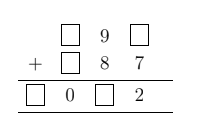
In the following addition, some of the digits are missing.

The sum of the missing digits is
(A) 23
(B) 19
(C) 21
(D) 18
(E) 24

Problem 24:

The ages of a family of six add up to 106 years. The two youngest are 3 and 7 . What would the family's ages have added up to five years ago?
(A) 74
(B) 76
(C) 78
(D) 79
(E) 96

Problem 25:

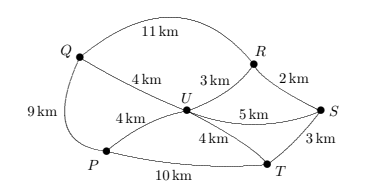
Six towns labelled \(P, Q, R, S, T\) and \(U\) in the diagram are joined by roads as shown.

Starting at \(P\), George the postman visits each town without returning to \(P\). He wants to save time by travelling the shortest distance. How many kilometres will he need to drive?
(A) 19
(B) 20
(C) 21
(D) 22
(E) 23

Problem 26:

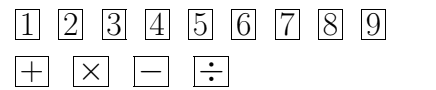
In a card game, there are 9 single-digit cards and 4 operation cards as shown.

A player must use 4 digit cards and 3 operation cards. What is the largest whole number which can be made if an operation card must be placed between each of the single-digit cards?

Problem 27:

A tiler has been given an odd-shaped tile to work with. It is made up from 3 squares, each with 10 cm sides.

If he had 5 of these tiles and placed them next to each other to form a shape, what would be the smallest perimeter, in centimetres, that he could make?

Problem 28:

Jacqui has \(\$ 200\) in her purse in \(\$ 5, \$ 10\) and \(\$ 20\) notes. She has 20 of these notes altogether. If she has more \(\$ 20\) notes than \(\$ 10\) notes, how many \(\$ 5\) notes does she have?

Problem 29:

Mary has 62 square blue tiles and a number of square red tiles. All tiles are the same size. She makes a rectangle with red tiles inside and blue tiles on the perimeter. What is the largest number of red tiles she could have used?

Problem 30:

Carly is writing a fantasy novel which includes inventing a new language. She decides to base her alphabet on letters formed from three straight lines joining four dots arranged in a square where each line joins two dots. Each letter goes through all four dots and can be drawn without removing the pencil from the paper, (you may retrace a line). Three such letters are shown.

How many different letters can she have in her alphabet?

Australian Mathematics Competition - 2010 - Middle Primary - Grade 3 & 4 - Questions and Solutions

Problem 1:

Which number is \(1+10+100+1000 ?\)
(A) 1111
(B) 11111
(C) 1110
(D) 1010
(E) 10111

Problem 2:

Which number is halfway between 600 and \(700 ?\)
(A) 550
(B) 645
(C) 650
(D) 655
(E) 700

Problem 3:

Greg starts at the square with the symbol * in it. He moves two squares up and one square to the right. Which symbol is in the square where he finishes?

Problem 4:

100 people were asked to name their favourite place to visit in Australia. Their five favourite places were: How many more people voted for Sydney Harbour Bridge than for Phillip Island?
(A) 40
(B) 20
(C) 10
(D) 5
(E) 7

Problem 5:

A water tank has 56 L of water in it. If 28 L of water are added, how much water will be in the tank?
(A) 84 L
(B) 56 L
(C) 28 L
(D) 76 L
(E) 78 L

Problem 6:

What is one thousand and twenty-seven in numerals?
(A) 100027
(B) 10027
(C) 1027
(D) 127
(E) 27

Problem 7:

The following tally was made by a Year 4 class about the pets they had at home.

Which one of the following statements is correct?
(A) There were more birds than fish.
(B) There were more dogs than cats.
(C) The class had 30 pets altogether.
(D) The least popular pet was a bird.
(E) The most popular pet was a cat.

Problem 8:

The midpoints of the sides of a square are joined as shown. A part of the original square is shaded as shown. What fraction of the original square is shaded?
(A) \(\frac{1}{4}\)
(B) \(\frac{1}{6}\)
(C) \(\frac{2}{3}\)
(D) \(\frac{1}{3}\)
(E) \(\frac{1}{5}\)

Problem 9:

What change should you receive from \(\$ 5\) after buying three 55 c stamps?
(A) \(\$ 1.65\)
(B) \(\$ 2.35\)
(C) \(\$ 2.45\)
(D) \(\$ 3.35\)
(E) \(\$ 3.45\)

Problem 10:

Jillian is standing inside a pet shop and looking out the window shown in the

diagram.

What does she see?
(A) POHS TヨP
(B) POHट TEP
(C) Тヨฯ ૧๐нટ
(D) POHट TヨP
(E) ૧૦Нટ Тヨ૧

Problem 11:

I read my book from a quarter to ten until half past eleven. How long did I read for?
(A) 45 min
(B) 1.5 hr
(C) 1 hr 45 min
(D) 2 hr 15 min
(E) 2 hr 45 min

Problem 12:

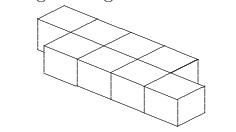
Eight blocks are glued together as shown.

How many faces of these blocks are glued together?
(A) 7
(B) 8
(C) 10
(D) 12
(E) 18

Problem 13:

Mrs Conomos has 16 flowers. She wants to place the flowers in two vases so that one vase has three times as many flowers as the other. How many flowers will there be in the vase with the most flowers?
(A) 8
(B) 10
(C) 12
(D) 14
(E) 16

Problem 14:

The number of cars in the family of each child in a class is recorded.

Which one of the following statements is true?
(A) Two families have two cars each.
(B) Six families have at least two cars each.
(C) Four families have exactly one car each.
(D) Every family has at least one car.
(E) Three families have exactly two cars each.

Problem 15:

This is Liam's timetable for a normal school day. How many minutes of class time does Liam have every day?
(A) 300
(B) 250
(C) 500
(D) 270
(E) 240

Problem 16:

Which three Australian banknotes would you have if you had five of each and a total of \(\$ 400\) ?
(A) \(\$ 5, \$ 10, \$ 20\)
(B) \(\$ 5, \$ 10, \$ 50\)
(C) \(\$ 5, \$ 10, \$ 100\)
(D) \(\$ 5, \$ 20, \$ 50\)
(E) \(\$ 10, \$ 20, \$ 50\)

Problem 17:

Use the diagram to find which of the boxes is the lightest.

(A) a
(B) b
(C) c
(D) d
(E) e

Problem 18:

Winnie is in the middle of a tuckshop queue. Jacob is three behind Winnie and has four people behind him. How many people are in the tuckshop queue?
(A) 8
(B) 14
(C) 15
(D) 16
(E) 17

Problem 19:

The distance between fenceposts is 5 metres. What is the number of fenceposts needed to build a fence around a triangular paddock with sides \(25 \mathrm{~m}, 25 \mathrm{~m}\) and 30 m ?
(A) 13
(B) 15
(C) 16
(D) 17
(E) 19

Problem 20:

Harold wrote down his Personal Identification Number (PIN) but it got smudged and all he can see on his note is \(35 \bullet 2\). He remembers that the PIN was divisible by 2 but not by 4 . Which of the following could be the missing digit?
(A) 1
(B) 2
(C) 3
(D) 5
(E) 7

Problem 21:

Which of the following shapes cannot be used to fill completely a \(4 \times 4\) grid with no overlap?

Problem 22:

Jacqui starts from the year 2010 and counts down 7 at a time, giving the sequence \(2010,2003,1996,1989, \ldots\). A year that she will count is
(A) 1786
(B) 1787
(C) 1788
(D) 1789
(E) 1790

Problem 23:

A rectangle is divided into four smaller rectangles with areas in square centimetres as shown in the diagram. The area, in square centimetres, of the shaded rectangle is
(A) 21
(B) 25
(C) 30
(D) 31
(E) 32

Problem 24:

Don went shopping to buy toilet paper. Which of the following gave the best value?
(A) 2 rolls for \(\$ 2.15\)
(B) 1 roll for \(\$ 1.35\)
(C) 4 rolls for \(\$ 4.20\)
(D) 10 rolls for \(\$ 9.50\)
(E) 12 rolls for \(\$ 11.95\)

Problem 25:

Andrew lives in a house at point A on the map shown. Each section of road between two consecutive intersections is 1 km . Andrew often goes out for a 6 km run, but likes to vary his route, though without running any section of road twice. How many different routes can he take? (The same route in an opposite direction does not count as different.)
(A) 3
(B) 4
(C) 5
(D) 6
(E) 8

Problem 26:

If all the numbers from 1 to 2010 are written down, how many of these will have two or more zeros next to each other?

Problem 27:

Alex and his family plan to travel from Australia to England and then to France. They will need to change their money for each country. 100 Australian dollars converts to 40 English pounds, for England. 100 English pounds converts to 80 euros, for France.

How many Australian dollars would be needed to get 120 euros?

Problem 28:

Five rectangles, each 12 cm long and of equal width, are placed together to form a single rectangle, still 12 cm long but 5 times as wide. The new rectangle has a perimeter twice as great as each of the original rectangles. What is the perimeter, in centimetres, of the new rectangle?

Problem 29:

Consider this statement:
THIS IS ONE GREAT MATHS CHALLENGE
Every minute, the first letter of each word is moved to the other end of the word. In how many minutes will the original sentence appear back again?

Problem 30:

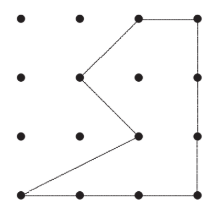
Below is an example of a triangle drawn on a 6 by 5 grid with one vertex \(A\) on the bottom left-hand corner and the other two vertices on the top and right-hand boundaries.

What is the largest number of squares that can be cut by the sides of such a triangle?

Australian Mathematics Competition - 2013 - Middle Primary - Grade 3 & 4 - Questions and Solutions

Problem 1:

Ten years after the year 2013 will be
(A) 2003
(B) 2013
(C) 2014
(D) 2023
(E) 2113

Problem 2:

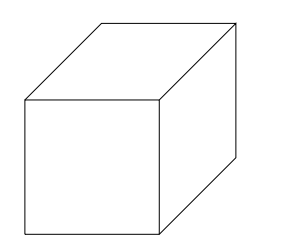
How many edges does a cube have?

(A) 4
(B) 6
(C) 8
(D) 9
(E) 12

Problem 3:

Each lap of Laura's school running track is 400 metres long. She runs 3 laps. How far does she run?
(A) 300 m
(B) 600 m
(C) 800 m
(D) 1200 m
(E) 3000 m

Problem 4:

What fraction of this rectangle is shaded?

(A) one-fifth
(B) two-fifths
(C) two-thirds
(D) one-third
(E) three-fifths

Problem 5:

What is three times the difference between 9 and 3 ?
(A) 6
(B) 9
(C) 18
(D) 36
(E) 81

Problem 6:

Jenny's hat has the words COTTON CLUB written on it. What does she see on her hat when she looks in the mirror?

(A) CLUB N COTTO (B) B COTTON CLU (C) BUL CN COTTO (D) COTTON CLUB (E) UBL CN COTTO

Problem 7:

Sally is playing a board game where you throw a dice numbered from 1 to 6 , move along a numbered board and then follow the instructions on each square you land on. On one turn, she throws a 6 and lands on a square which tells her to go back 4 squares. This puts her on a square which tells her to go forward 3 squares. She finishes up on square 7 . What square did she start that turn on?
(A) 1
(B) 2
(C) 3
(D) 4
(E) 5

Problem 8:

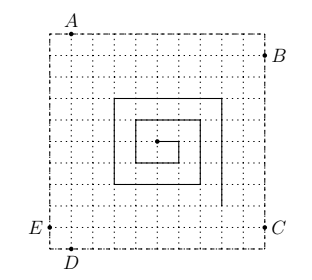
Joel is in the centre of a maze which fills a 10-metre square. He knows he can get out of the maze if he follows the path in the spiral pattern below. The maze has exits on the boundary at \(\mathrm{A}, \mathrm{B}, \mathrm{C}, \mathrm{D}\) and E . By which exit will Joel leave the maze?

(A) (A)
(B) (B)
(C) (C)
(D) (D)
(E) (E)

Problem 9:

What is the difference between the largest and smallest 3 -digit numbers which can be made from rearranging the 3 digit cards below?

(A) 198
(B) 200
(C) 202
(D) 298
(E) 302

Problem 10:

Brad thinks of a number, doubles it and adds 2 . His result is 14 . What was the number he thought of at the start?
(A) 6
(B) 7
(C) 8
(D) 12
(E) 30

Problem 11:

Alice has two 50 c coins, three 20 c coins and eight 5 c coins. David has four 20 c coins and six 10 c coins. How much more money does Alice have than David?
(A) 40 c
(B) 60 c
(C) 80 c
(D) \(\$ 1.40\)
(E) \(\$ 2.00\)

Problem 12:

Jim is one year older than his brother and one year younger than his sister. The sum of their three ages is 30 . How old is his sister?
(A) 8
(B) 9
(C) 10
(D) 11
(E) 12

Problem 13:

Mary counts on in 3 s starting at 30 whilst John counts on in 5 s starting at 20 . If they say each number out loud together, starting at the same time, what same number will they both say together?
(A) 30
(B) 40
(C) 45
(D) 50
(E) 60

Problem 14:

Given a 2 -digit number, a new 3 -digit number is formed by putting the digit 1 after it. The new number is
(A) the original number plus 1
(B) ten times the original number plus 1
(C) one hundred plus the original number
(D) one hundred times the original number
(E) one hundred times the original number plus 1

Problem 15:

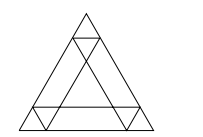
How many triangles are in the following picture?

(A) 9
(B) 10
(C) 13
(D) 14
(E) 17

Problem 16:

To mix concrete you need 4 shovelfuls of sand, 2 shovelfuls of gravel and 1 shovelful of cement. If 56 shovelfuls are put into a mixer, how many would be of gravel?
(A) 7
(B) 16
(C) 20
(D) 32
(E) 40

Problem 17:

A train from Brisbane to Cairns leaves at \(1: 25 \mathrm{pm}\) on Tuesday, and arrives at \(7: 35 \mathrm{pm}\) on Wednesday. How long was the trip?
(A) 6 h 10 min
(B) 24 h 50 min
(C) 18 h 10 min
(D) 29 h 10 min
(E) 30 h 10 min

Problem 18:

An online poll asked the question, 'Is Maths your favourite subject?'
The results of the poll are as follows:
6 out of every 10 voted yes.
3 out of every 10 voted no.
1 out of every 10 was undecided.
If 120 people answered yes, how many of those polled were undecided?
(A) 20
(B) 24
(C) 30
(D) 45
(E) 70

Problem 19:

George is planning a garden bed which is to be 1 metre wide and a whole number of metres long. It is to be surrounded by 1 metre \(\times 1\) metre pavers as shown in the diagrams below. As the design for the garden gets longer, the number of pavers needs to increase.

Which of the following best describes the number of pavers required for each garden bed design?
(A) The number of pavers needed is 8 times the length of the garden bed.
(B) The number of pavers needed is 6 times the length of the garden bed plus 2.
(C) The number of pavers needed is 4 times the length of the garden bed.
(D) The number of pavers needed is 4 times the length of the garden bed plus 2 .
(E) The number of pavers needed is 2 times the length of the garden bed plus 6 .

Problem 20:

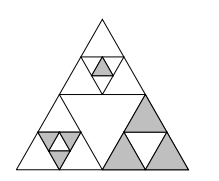
Each triangle in the diagram is equilateral. What fraction of the largest triangle is shaded?

(A) \(\frac{1}{4}\)
(B) \(\frac{15}{64}\)
(C) \(\frac{1}{3}\)
(D) \(\frac{3}{16}\)
(E) \(\frac{7}{32}\)

Problem 21:

Kathy plays Eddie in a game with 12 rounds. In each round the winner scores 5 points and the loser scores 3 points. When the game ends, Eddie's total score is 46 points. How many rounds did Kathy win?
(A) 4
(B) 5
(C) 6
(D) 7
(E) 8

Problem 22:

Nine cards numbered 1 to 9 are set out as in the diagram. The sum of the numbers in the vertical column is equal to the sum of the numbers in the horizontal row. How many different numbers could be used in the central square of the diagram?

(A) 1
(B) 3
(C) 5
(D) 7
(E) 9

Problem 23:

There are thirty 20c coins in a row. I replace every second coin with a 50 c coin. Next, I replace every third coin with a \(\$ 1\) coin. Finally, I replace every fourth coin with a \(\$ 2\) coin. The value of the thirty coins is now
(A) \(\$ 18.50\)
(B) \(\$ 22.80\)
(C) \(\$ 25.60\)
(D) \(\$ 26.50\)
(E) \(\$ 27.80\)

Problem 24:

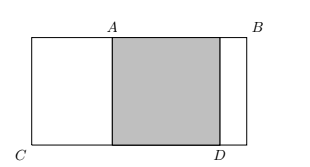
There is a shaded square inside a rectangle as shown. From \(A\) to \(B\) is 6 cm and from \(C\) to \(D\) is 8 cm . What is the perimeter of the large rectangle?

(A) 28 cm
(B) 27 cm
(C) 26 cm
(D) 25 cm
(E) 24 cm

Problem 25:

Jake and Joe wanted to buy the same magazine. Jake needed \(\$ 2.80\) more to buy it, while Joe needed \(\$ 2.60\) more. So they put their money together and bought the magazine. They had \(\$ 2.60\) left. How much was the magazine?
(A) \(\$ 10\)
(B) \(\$ 9\)
(C) \(\$ 8\)
(D) \(\$ 7\)
(E) \(\$ 6\)

Problem 26:

I take 2 vitamin C tablets every day. If I increase my dose to 3 tablets a day, a full bottle would last 8 days less. How many tablets are in a full bottle?

Problem 27:

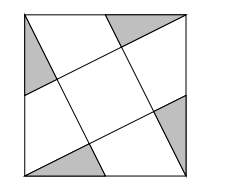
Each side of this large square is 30 cm . The middle of each side is joined to a corner as shown. What area, in square centimetres, has been shaded?

Problem 28:

Starting at 100 and going through to 999 , how many numbers have two or more digits the same?

Problem 29:

In how many ways can three different numbers be selected from the numbers 1 to 12 , so that their sum can be exactly divided by 3 ?

Problem 30:

Adam, Barney and Joe carry 999 books out of the library. Adam works for 3 hours, Barney works for 4 hours and Joe works for 5 hours. They work at different speeds, with Adam carrying 5 books for every 3 books Barney carries and every 2 books Joe carries. How many books did Adam carry?

Australian Mathematics Competition - 2014 - Middle Primary - Grade 3 & 4 - Questions and Solutions

Problem 1:

1. \(8+4=\)

(A) 4
(B) 8
(C) 12
(D) 32
(E) 84

Problem 2:

Today is Thursday. What day will it be in 10 days time?
(A) Monday
(B) Tuesday
(C) Wednesday
(D) Saturday
(E) Sunday

Problem 3:

Simon has a collection of 27 toy cars. He wants to put them into groups of 3 cars. How many groups will he have?
(A) 24
(B) 9
(C) 12
(D) 8
(E) 30

Problem 4:

I have a \(\$ 10\) note and an ice-cream costs \(\$ 2.20\). What is the greatest number of ice-creams I can buy?
(A) 3
(B) 4
(C) 5
(D) 6
(E) 7

Problem 5:

Which one of the following shapes has a line of symmetry?

Problem 6:

Tom wasn't feeling well. His doctor read his temperature at \(1.8^{\circ} \mathrm{C}\) above normal, which is usually \(37^{\circ} \mathrm{C}\). What, in degrees Celsius, was Tom's temperature?
(A) 35.2
(B) 37.18
(C) 37.8
(D) 38.7
(E) 38.8

Problem 7:

Bill types a number into his calculator so that upside down, it looks like BILL. What is the number?
(A) 8111
(B) 8177
(C) 7713
(D) 3177
(E) 7718

Problem 8:

Which shape can make a pyramid if you fold along the dotted lines?

Problem 9:

The chairs on the main ski lift at Thredbo are numbered from 26 to 100. How many such chairs are there?
(A) 24
(B) 25
(C) 74
(D) 75
(E) 76

Problem 10:

Cecily is 10 years older than Naida. Naida is 6 years younger than Joycelyn. If Cecily is now 42, how old is Joycelyn?
(A) 32
(B) 34
(C) 36
(D) 38
(E) 40

Problem 11:

Stuart and Susan are brother and sister. She says 'I have a sister' and he says 'I have a brother'. What is the smallest possible number of children in their family?
(A) 2
(B) 3
(C) 4
(D) 5
(E) 6

Problem 11:

The year 5 students at my local school were surveyed to find which one of the four teams in the local football competition they followed.

How many more students followed the most popular team than followed the least popular team?
(A) 3
(B) 4
(C) 5
(D) 6
(E) 8

Problem 13:

Lesley needs to catch the school bus at 7:30 am on school mornings. She takes 25 minutes to get ready and 10 minutes to walk to the bus stop from home. In order to catch the bus, what is the latest time she can get up?
(A) 6:45 am
(B) 6:55 am
(C) 7:00 am
(D) 7:05 am
(E) 7:10 am

Problem 14:

A square of paper is folded in half to make a triangle, then in half to make a smaller triangle, then in half again to make an even smaller triangle.

How many layers of paper are in the final triangle?
(A) 3
(B) 4
(C) 6
(D) 8
(E) 12

Problem 15:

This \(4 \times 4\) square grid can be covered by three shapes made from \(1 \times 1\) squares. None of the shapes overlap.

Problem 16:

Miranda ties two ribbons in her hair each day before school. She can choose from her school's colours of red, blue and white. She has a bag of school ribbons with at least four of each colour in it. Without looking, she pulls out some ribbons. How many must she pull out to be sure of a pair of the same colour?
(A) 2
(B) 3
(C) 4
(D) 5
(E) 6

Problem 17:

Four rectangles, each 100 cm long and 20 cm wide, are arranged around a square without overlapping, as shown.
How long is each side of the middle square?
(A) 60 cm
(B) 80 cm
(C) 90 cm
(D) 100 cm
(E) 120 cm

Problem 18:

In this diagram, when you multiply the two numbers in the circles you get the same answer as when you multiply the two numbers in the squares. What is the missing number?
(A) 3
(B) 4
(C) 5
(D) 6
(E) 10

Problem 19:

Li has some small tiles, each 3 cm by 2 cm , which he puts together without overlapping to make a filled-in square. What is the smallest number of these tiles for which this can be done?
(A) 2
(B) 3
(C) 4
(D) 5
(E) 6

Problem 20:

A party game played with a six-sided dice is fair if the chance of winning is equal to the chance of losing each time the dice is rolled. Which one of these games is fair?
(A) You win if you roll a 6.
(B) You win if you roll a 2 or a 5.
(C) You win if you roll a number greater than 4.
(D) You win if you roll a number less than 3.
(E) You win if you roll an odd number.

Problem 21:

Which of the shaded areas below is the largest?

(A) A
(B) B
(C) C
(D) D
(E) E

Problem 22:

Joseph had some cash in his pocket. He had three of each of the Australian coins.

When he took them out to count them, he dropped the coins and lost some down the drain! He found \(\$ 11.05\). How much did he lose?
(A) \(\$ 1.05\)
(B) 90 c
(C) 60 c
(D) 50 c
(E) 45 c

Problem 23:

There are 15 children attending a birthday party and we order some pizzas. Each pizza will be sliced into 8 equal pieces. What is the smallest number of pizzas we need to order to make sure that each child can eat 3 pieces?
(A) 4
(B) 5
(C) 6
(D) 7
(E) 8

Problem 24:

Jack is 8 years old and his sister Charlotte is 14 years old. When Jack's and Charlotte's ages add up to 48, how old will Jack be?
(A) 18
(B) 21
(C) 22
(D) 24
(E) 31

Problem 25:

In this magic square, the even numbers

\(2,4,6, \ldots, 18\)

are placed so that the sums of the numbers in each row, column and diagonal are equal. What is the sum of the two numbers in the shaded squares?
(A) 12
(B) 14
(C) 18
(D) 22
(E) 28

Problem 26:

Six different whole numbers, chosen from the numbers from 1 to 100 , add up to 100 . What is the greatest possible value of the largest of these numbers?

Problem 27:

A number is palindromic if it reads the same forwards as backwards. For example, 686 is palindromic. How many numbers from 100 to 300 are palindromic?

Problem 28:

A group of 64 students went rowing. They were given 12 rowing boats, each boat either large or small. The large boats each carried 6 students and the small ones 4 students. How many large boats were they given?

Problem 29:

In the school hall there are square tables and chairs to put around them.

Each table is big enough to seat 4 people. The tables can be joined in a long row to seat more people. For example, a row of four tables can seat 10 people.

If the school needs to set up three long rows to seat 240 people, how many tables are needed?

Problem 30:

How many 2-digit numbers are there where one digit is a multiple of the other and neither digit is zero? For example, 11 and 26, but not 96 or 40 .

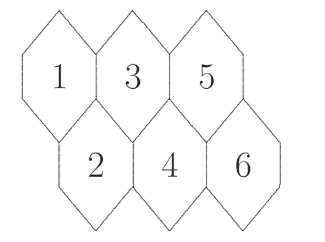
Australian Mathematics Competition - 2009 - Middle Primary - Grade 3 & 4 - Questions and Solutions

Problem 1:

The value of $1000+200+4$ is
(A) 10204
(B) 1204
(C) 1000204
(D) 10002004
(E) 124

Problem 2:

For the number below, what number will be obtained if I double the thousands digit and halve the tens digit?

(A) 2224
(B) 8214
(C) 4414
(D) 8244
(E) 2214

Problem 3:

A normal dice is shown in the diagram. What is the total of the numbers on the faces not shown?
(A) 7
(B) 11
(C) 13
(D) 14
(E) 15

Problem 4:

To what number do I add 11 to get $28 ?$
(A) 39
(B) 17
(C) 27
(D) 7
(E) 19

Problem 5:

Which of the following is closest to 1000 seconds?
(A) 1 hour
(B) 1 day
(C) 45 minutes
(D) 30 minutes
(E) 15 minutes

Problem 6:

The net below is folded to form a cube.

On this cube, what number is on the face opposite the number 6 ?
(A) 1
(B) 2
(C) 3
(D) 4
(E) 5

Problem 7:

Which of the following stories could match this number sentence?

$$
14-7+9=16
$$

(A) Simon had 14 lollies, he ate 9 of them and then his sister gave him 9 more. He then had 16 lollies.
(B) James had 18 lollies, he gave 14 to his sister, he ate 9 and had 7 left.
(C) Lan had 14 lollies, she ate 7 of them, then was given 9 more by her mother. She now has 16 lollies.
(D) Karen ate 14 lollies, took 7 from her sister, ate 9 more and had 16 left.
(E) Helen had 14 lollies, was given 7 more by her brother and 9 more by her sister and now has 16 lollies.

Problem 8:

Some friends are playing darts. Their darts land at the points $(6,7),(2,3),(7,6),(3,5)$ and $(1,6)$. Which dart scored the highest?
(A) the dart at $(6,7)$
(B) the dart at $(2,3)$
(C) the dart at $(7,6)$
(D) the dart at $(3,5)$
(E) the dart at $(1,6)$

Problem 9:

A string of beads has a repeating pattern of blue, red, red, green, yellow and yellow. Starting from green, what is the colour of the 18th bead?
(A) red
(B) green
(C) blue
(D) yellow
(E) orange

Problem 10:

The grid is a 1-centimetre grid. What is the area, in square centimetres, of the figure shown?
(A) $3 \frac{1}{2}$
(B) 4
(C) $4 \frac{1}{2}$
(D) 5
(E) $5 \frac{1}{2}$

Problem 11:

I read 3 chapters of my book each night except Saturday and Sunday when I read 4 chapters each night. How many chapters do I read in a week?
(A) 8
(B) 15
(C) 21
(D) 23
(E) 29

Problem 12:

Given the roads and distances marked below, how far is it by road, in kilometres, from Cobra to Kairo?

(A) 30
(B) 45
(C) 60
(D) 71
(E) 80

Problem 13:

When a barrel is one-quarter full it contains 6 litres. How many litres does it hold when it is two-thirds full?
(A) 16
(B) 18
(C) 20
(D) 21
(E) 24

Problem 14:

Jye takes four steps to walk the same distance that Fred covers in three steps. If each of Fred's steps is 50 cm , what distance, in metres, does Jye walk if he takes 24 steps?
(A) 3
(B) 6
(C) 9
(D) 12
(E) 16

Problem 15:

Using $5 \mathrm{c}, 10 \mathrm{c}, 20 \mathrm{c}$ and 50 c coins, in how many different ways can you make up 50c?

(A) 4
(B) 6
(C) 8
(D) 10
(E) 13

Problem 16:

Five teams play each other once in a basketball competition. How many games were played in total?
(A) 10
(B) 12
(C) 14
(D) 20
(E) 28

Problem 17:

How many triangles are there in this figure?
(A) 20
(B) 32
(C) 36
(D) 40
(E) 44

Problem 18:

The recipe for making pancakes is:
1 egg
1 cup ( 250 mL ) milk
1 cup flour
1 teaspoon sugar
pinch of salt
This will be enough mixture to cook 12 small pancakes.
How much milk would you need to make 42 small pancakes?
(A) 3 cups
(B) $3 \frac{1}{2}$ cups
(C) 765 mL
(D) 1050 mL
(E) $5 \frac{1}{4}$ cups

Problem 19:

The picture shows a cube with some corners labelled. It is cut into two pieces by making a straight cut from $P Q$ to $R S$. The two pieces formed are:
(A) both triangular prisms
(B) both triangular pyramids
(C) both square prisms
(D) both square pyramids
(E) one square pyramid and one triangular pyramid

Problem 20:

I live in a small street with 6 houses. One day 35 letters were delivered in my street and I received more letters than anyone else. What is the smallest number of letters I could have received?
(A) 1
(B) 3
(C) 5
(D) 7
(E) 8

Problem 21:

The ages of the three children in the Jones family add up to 14 . If their ages are multiplied together, the result is 70 . What is the age of the eldest child?
(A) 5
(B) 7
(C) 8
(D) 10
(E) 14

Problem 22:

We form a rectangle using 24 square tiles, each 1 cm by 1 cm . Which of the following, in centimetres, could not be the perimeter?
(A) 20
(B) 22
(C) 28
(D) 36
(E) 50

Problem 23:

I bought a map of Australia, unfolded it and marked 8 places I wanted to visit.

I then refolded the map and placed it back on the table as it was. In what order are my marks stacked from top to bottom?
(A) RTYQKAWP
(B) YKRAWTPQ
(C) RTQYKAWP
(D) YKTPRAWQ
(E) YKWARTPQ

Problem 24:

Jeremy replaces one digit by the symbol $\triangle$ and another by the symbol $\triangle$. Given that the sum

is correct, which digit does the symbol $\triangle$ represent?
(A) 2
(B) 3
(C) 4
(D) 5
(E) 6

Problem 25:

Our family's cat and dog together weigh 7 kg . Our dog and rabbit together weigh 6 kg . Our cat and rabbit together weigh 5 kg .

In kilograms, how much does our cat weigh?
(A) 2
(B) 2.5
(C) 3
(D) 3.5
(E) 4

Problem 26:

Sally has a pile of jelly beans. Her brother eats half of them, then her sister eats a quarter of the remaining jelly beans. Her father finds the leftover jelly beans and eats one-third of them leaving Sally with 6 jelly beans. How many jelly beans did Sally have to begin with?

Problem 27:

Ms Davey has a box of marbles in her storeroom. She can share her marbles equally between $2,3,4,5$ or 6 children with no marbles leftover. What is the smallest number of marbles that could be in Ms Davey's box?

Problem 28:

In the diagram, 6 equal polygons touch as shown, and each of them contains a number from 1 to 6 .

How many ways are there to move from polygon 1 to polygon 6 if you can move only to a touching polygon labelled with a larger number?

Problem 29:

In a television quiz show, Rachel wins 250 points for a correct answer but loses 150 points for an incorrect answer. Rachel answered 15 questions and obtained 2150 points. How many questions did she get correct?

Problem 30:

Each day Merlin places the same number of flowers (at least one) at three temples. To get to any temple from another he crosses a magic river once. He also has to cross a magic river once to get to the first temple. Each time he crosses a magic river, the number of flowers he has doubles. He has no flowers left when he leaves the third temple. What is the minimum number of flowers he must have at the start?