Australian Mathematics Competition - 2013 - Junior years - Grade 7 & 8 - Questions and Solutions

Problem 1:

\(1999+24\) is equal to
(A) 1923
(B) 2003
(C) 2013
(D) 2023
(E) 2113

Problem 2:

\(P Q R\) is a straight line. Find the value of \(x\).

(A) 40
(B) 90
(C) 100
(D) 110
(E) 120

Problem 3:

The value of the fraction \(\frac{1}{2}\) is closest to
(A) 0.45
(B) 0.6
(C) \(\frac{1}{3}\)
(D) \(\frac{5}{8}\)
(E) \(\frac{2}{5}\)

Problem 4:

Which of the following is equal to 20 ?
(A) \(3+2 \times 4\)
(B) \((9+5) \times 2-4 \times 2\)
(C) \(10^2\)
(D) \(20+20 \div 2\)
(E) \(10 \div 2\)

Problem 5:

How many minutes are there between \(8: 37 \mathrm{am}\) and \(10: 16 \mathrm{am}\) ?
(A) 39
(B) 79
(C) 99
(D) 141
(E) 179

Problem 6:

Three squares each with an area of \(25 \mathrm{~cm}^2\) are placed side by side to form a rectangle. The perimeter, in centimetres, of the rectangle is
(A) 20
(B) 36
(C) 40
(D) 75
(E) 100

Problem 7:

If every digit of a whole number is either a 3 or a 5 , the number will always be
(A) divisible by 3
(B) divisible by 5
(C) prime
(D) even
(E) odd

Problem 8:

(P) is the point at 0.56 and \(Q\) is the point at 1.2 on a number line. The point which is halfway between \(P\) and \(Q\) is at
(A) 0.34
(B) 0.64
(C) 0.83
(D) 0.88
(E) 0.93

Problem 9:

If triangle \(A B C\) is isosceles with \(\angle A=40^{\circ}\), what are all of the possible values for \(\angle B\) ?
(A) \(40^{\circ}\)
(B) \(40^{\circ}\) and \(70^{\circ}\)
(C) \(40^{\circ}\) and \(100^{\circ}\)
(D) \(70^{\circ}\) and \(100^{\circ}\)
(E) \(40^{\circ}, 70^{\circ}\) and \(100^{\circ}\)

Problem 10:

In Gwen's classroom, the desks are arranged in a grid. Each row has the same number of desks. Gwen's desk is third from the front, second from the back and has one desk to the left and four to the right. How many desks are there?
(A) 20
(B) 24
(C) 25
(D) 28
(E) 30

Problem 11:

William travels to school in two different ways. Either he walks to school and takes the bus home, or he takes the bus to school and walks home. In each case his total travelling time is 40 minutes. If he were to take the bus both ways, his total travelling time would be 20 minutes. How many minutes would it take if he walked both ways?
(A) 30
(B) 40
(C) 50
(D) 60
(E) 80

Problem 12:

The opposite faces on a standard dice add to give a total of 7. The game of Corners is played by rolling a dice and then choosing a vertex of the dice with your eyes closed. For example, the score for the vertex chosen below would be \(4+5+6=15\).

Which of the following scores is NOT possible when playing Corners?
(A) 6
(B) 7
(C) 8
(D) 9
(E) 10

Problem 13:

A piece of paper in the shape of an equilateral triangle has one corner folded over, as shown.

What is the value of \(x\) ?
(A) 60
(B) 70
(C) 80
(D) 90
(E) 100

Problem 14:

Beginning at the point \(A\), Joel draws the spiral pattern of line segments below on a 1 cm grid. If he continues this pattern, how long, in centimetres, is the 97 th segment?

(A) 46
(B) 47
(C) 48
(D) 49
(E) 50

Problem 15:

Sixteen discs are arranged in four rows of four. The discs have a number on one side and are either red or green on the other. The number shows how many discs touching that disc have green on the other side.

Which of the following statements is true?
(A) All of the rows have the same number of green discs.
(B) Row one has more green discs than any other row.
(C) Row two has more green discs than any other row.
(D) Row three has fewer green discs than any other row.
(E) Row four has fewer green discs than any other row.

Problem 16:

While shopping this week I misread my shopping list and bought 5 loaves of bread and 2 bottles of milk. So I went back to the supermarket, got a full refund, and bought 2 loaves of bread and 5 bottles of milk. This cost me \(\$ 4.20\) less than my first purchase. How do the prices of bread and milk compare?
(A) A loaf of bread costs \(\$ 1.40\) more than a bottle of milk.
(B) A loaf of bread costs \(\$ 0.60\) more than a bottle of milk.
(C) A loaf of bread costs \(\$ 0.42\) more than a bottle of milk.
(D) A loaf of bread costs \(\$ 0.60\) less than a bottle of milk.
(E) A loaf of bread costs \(\$ 1.40\) less than a bottle of milk.

Problem 17:

Starting with the number 0 on my calculator, I do a calculation in five steps. At each step, I either add 1 or multiply by 2 . What is the smallest number that cannot be the final result?
(A) 11
(B) 10
(C) 9
(D) 8
(E) 7

Problem 18:

The three squares in the figure below are the same size. Find the value, in degrees, of \(\angle A M T\).

(A) \(45^{\circ}\)
(B) \(50^{\circ}\)
(C) \(55^{\circ}\)
(D) \(60^{\circ}\)
(E) \(75^{\circ}\)

Problem 19:

Eight \(1 \times 1\) square tiles are laid as shown.

Two more \(1 \times 1\) tiles are added, so that at least one side of each new tile is shared with a side of the original shape. Several different perimeter lengths are now possible. What is the sum of the shortest and longest possible perimeter of the modified shape?
(A) 28
(B) 30
(C) 32
(D) 34
(E) 36

Problem 20:

In the triangle \(P Q R, S\) is a point on \(P R\) such that \(P Q S\) and \(S Q R\) are both isosceles triangles (as shown). Angle \(Q P S\) is equal to angle \(S Q R\).

What is the value of \(x\) ?
(A) 30
(B) 36
(C) 40
(D) 45
(E) 48

Problem 21:

A biologist has a set of cages in a \(4 \times 4\) array. He wants to put one mouse (black or white) into each cage in such a way that each mouse has at least one neighbour of each colour (neighbouring cages share a common wall).

The black mice are more expensive, so he wants to use as few of them as possible. What is the smallest number of black mice that he needs?
(A) 4
(B) 5
(C) 6
(D) 7
(E) 8

Problem 22:

Two discs have different numbers on each side as shown.

The discs are flipped and they land on a table. The two numbers on the sides that are showing are added. If the possible sums that can be obtained in this way are \(8,9,10\) and 11 , the sum \(b+c+d\) is
(A) 8
(B) 18
(C) 20
(D) 27
(E) 30

Problem 23:

An oddie number is a 3 -digit number with all three digits odd. The number of oddie numbers divisible by 3 is
(A) 20
(B) 26
(C) 29
(D) 41
(E) 42

Problem 24:

Consider the following \(4 \times 4\) squares with a \(1 \times 1\) square deleted \(shown in black\).

Consider tiling the squares \(\mathrm{P}, \mathrm{Q}\) and R using tiles like the one below.

Which of the following statements is true?
(A) Only P can be tiled this way.
(B) Only Q can be tiled this way.
(C) Only R can be tiled this way.
(D) Only P and Q can be tiled this way.
(E) All the shapes can be tiled this way.

Problem 25:

A number is formed by writing the numbers 1 to 30 in order as shown.

\[
\text { 12345678910111213……… } 2930
\]

Simeon removed 45 of these 51 digits leaving 6 in their original order to make the largest 6-digit number possible. What is the sum of the digits of this number?
(A) 33
(B) 38
(C) 41
(D) 43
(E) 51

Problem 26:

Consider a sequence of letters where each letter is \(A\) or \(B\). We call the sequence stable if, when we tally the number of \(A\) s and the number of \(B \mathrm{~s}\) in the sequence, working from left to right, the difference is never greater than one. For example, the sequence \(A B B A B A\) is stable but the sequence \(A A B B A B\) is not, because after counting the first two letters, the difference is two. How many stable sequences with eighteen letters are there?

Problem 27:

Whenever Callum reads a date like \(1 / 8 / 2013\), he incorrectly interprets it as two divisions, with the second one evaluated before the first one:

\[
1 \div(8 \div 2013)=251 \frac{5}{8}
\]

For some dates, like this one, he does not get an integer, while for others, like \(28 / 7 / 2013\), he gets \(28 \div(7 \div 2013)=8052\), an integer. How many dates this year \(day/month/year\) give him an integer?

Problem 28:

What is the smallest positive integer that can be expressed as the sum of nine consecutive integers, the sum of ten consecutive integers and the sum of eleven consecutive integers?

Problem 29:

Each of the four circles below has a whole number value. \(X\) is the value of the top-left circle. A number written on the figure indicates the product of the values of the circles it lies within. What is the value of \(X+k\) ?

Problem 30:

Three different non-zero digits are used to form six different 3-digit numbers. The sum of five of them is 3231 . What is the sixth number?
Australian Mathematics Competition - 2020 - Junior years - Grade 7 & 8 - Questions and Solutions

Problem 1:

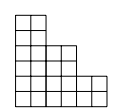
How many \(1 \times 1\) squares are in this diagram?

(A) 16
(B) 18
(C) 20
(D) 24
(E) 25

Problem 2:

What is half of 2020?
(A) 20
(B) 101
(C) 110
(D) 1001
(E) 1010

Problem 3:

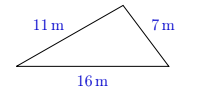
What is the perimeter of this triangle?

(A) 33 m
(B) 34 m
(C) 35 m
(D) 36 m
(E) 37 m

Problem 4:

I stepped on the train at 8.48 am and left at 9.21 am. How many minutes did I spend on the train?
(A) 27
(B) 33
(C) 43
(D) 87
(E) 93

Problem 5:

What is the value of \(y\) in this triangle?

(A) 10
(B) 30
(C) 50
(D) 70
(E) 90

Problem 6:

\(2-(0-(2-0))\)=
(A) -4
(B) -2
(C) 0
(D) 2
(E) 4

Problem 7:

In the grid, the total of each row is given at the end of the row, and the total of each column is given at the bottom of the column.
The value of \(N\) is

(A) 1
(B) 2
(C) 3
(D) 4
(E) 5

Problem 8:

A letter \(\mathbf{G}\) is rotated clockwise by \(135^{\circ}\). Which of the following pictures best represents the final image?

Problem 9:

\(\frac{1+2+3+4+5}{1+2+3+4}-\frac{1+2}{1+2+3}=\)
(A) 3
(B) \(\frac{5}{6}\)
(C) 1
(D) \(\frac{7}{6}\)
(E) 2

Problem 10:

Sebastien is thinking of two numbers whose sum is 26 and whose difference is 14 . The product of Sebastien's two numbers is
(A) 80
(B) 96
(C) 105
(D) 120
(E) 132

Problem 11:

A country consists of two islands as shown on this map. In square kilometres, its area is


(A) between 100 and 1000
(B) between 1000 and 10000
(C) between 10000 and 100000
(D) between 100000 and 1000000
(E) greater than 1000000

Problem 12:


\(123456-12345+1234-123+12-1=\)
(A) 33333
(B) 101010
(C) 111111
(D) 122223
(E) 112233

Problem 13:

Lily is 2020 days old. How old was she on her last birthday?
(A) 4
(B) 5
(C) 6
(D) 7
(E) 8

Problem 14:

A piece of paper is folded twice as shown and cut along the dotted lines. Once unfolded, which letter does the piece of paper most resemble?

(A) M
(B) O
(C) N
(D) B
(E) V

Problem 15:

An equilateral triangle is subdivided into several smaller equilateral triangles, as shown. The shaded triangle has a side length of 2. What is the perimeter of the large triangle?

(A) 24
(B) 27
(C) 30
(D) 33
(E) 36

Problem 16:

The \(\triangle (X Y S)\) is enclosed by a rectangle \(P Q R S\) as shown in the diagram. In square centimetres, what is the area of \(\triangle (X Y S)\)?

(A) 82
(B) 88
(C) 94
(D) 112
(E) 130

Problem 17:

Four teams play in a soccer tournament. Each team plays one game against each of the other three teams. Teams earn 3 points for a win, 1 point for a draw and 0 points for a loss. After all the games have been played, one team has 6 points, two teams have 4 points and one team has 3 points. How many games ended in a draw?
(A) 0
(B) 1
(C) 2
(D) 3
(E) 4

Problem 18:

An isosceles triangle has a perimeter of 28 cm and sides of integer length. How many different such triangles can be made?
(A) 5
(B) 6
(C) 7
(D) 8
(E) 9

Problem 19:

In the grid shown, the numbers from 1 to 4 must appear once in each row and column. Also, the sum of numbers in each of the four regions separated by red lines must be the same. What is the sum (x+y) ?

(A) 8
(B) 7
(C) 6
(D) 5
(E) 4

Problem 20:

Anupam has a cardboard square with a perimeter of 400 centimetres. He draws a horizontal line and a vertical line on the square and cuts along these lines to create four rectangles. What is the largest possible sum of the perimeters of these four rectangles, in centimetres?
(A) 400
(B) 600
(C) 800
(D) 1000
(E) 1200

Problem 21:

The ends of the tangled string shown are pulled in the direction of the arrows so that the string either untangles or forms a simpler knot.

Which of the following best matches the knot, or otherwise, that is formed when the string is tightened?

Problem 22:

Mr Atkins wrote some homework questions for his class to practise order of operations. One of the questions was \(2+3 \times(4+3)\), with answer 23 . However, one of his students just worked from left to right and ignored the brackets, writing \(2+3=5\), \(5 \times 4=20,20+3=23\), the correct answer. Mr Atkins thought that this was fascinating, so he tried to come up with another question where working left to right gave the right answer. He tried \(5+4 \times(7+\square)\). What number should he put in the box?
(A) 2
(B) 4
(C) 6
(D) 8
(E) 10

Problem 23:

My friend and I took a maths test with 10 questions. Question 1 was worth 1 mark, question 2 was worth 2 marks, question 3 was worth 3 marks, and so on. Correct answers scored full marks and incorrect answers scored 0 marks. We both scored the same number of marks and correctly answered the same number of questions. However, we didn't solve exactly the same set of questions as each other. What is the maximum score that I could have received for the test?
(A) 44
(B) 46
(C) 48
(D) 50
(E) 52

Problem 24:

A light rail network has 21 drivers, but not all of them are required at the same time:

Given that every driver must work on at least one of these shifts, what is the maximum number of drivers that can work on all three shifts?
(A) 5
(B) 6
(C) 7
(D) 8
(E) 9

Problem 25:

A bag contains exactly 50 coins. The coins are either worth 10 cents, 20 cents or 50 cents, and there is at least one of each. The total value of the coins is (\$ 10). How many different ways can this occur?
(A) 2
(B) 4
(C) 8
(D) 12
(E) 16

Problem 26:

The digits 1 to 9 are used exactly once each to make three 3-digit numbers. The second number is three times the first number. The third number is five times the first number. What is the second number?

Problem 27:

Madeleine types her three-digit Personal Identification Number (PIN) into this keypad. All three digits are different, but the buttons for the first and second digits share an edge, and the buttons for the second and third digits share an edge. For instance, 563 is a possible PIN, but 536 is not, since 5 and 3 do not share an edge. How many possibilities are there for Madeleine's PIN?

Problem 28:

Starting with a \(9 \times 9 \times 9\) cube, Augusta removed as few \(1 \times 1 \times 1\) cubes as possible so that the resulting sculpture had front view, top view and side view all the same, as shown. How many \(1 \times 1 \times 1\) cubes did Augusta remove?

Problem 29:

A different integer from 1 to 10 is placed on each of the faces of a cube. Each vertex is then assigned a number which is the sum of the numbers on the three faces which touch that vertex. Only the vertex numbers are shown here. What is the product of the 4 smallest face numbers?

Problem 30:

My grandson makes wall hangings by stitching together 16 square patches of fabric into a \(4 \times 4\) grid. I asked him to use patches of red, blue, green and yellow, but to ensure that no patch touches another of the same colour, not even diagonally. The picture shows an attempt which fails only because two yellow patches touch diagonally. In how many different ways can my grandson choose to arrange the coloured patches correctly?

Australian Mathematics Competition - 2022 - Junior years - Grade 7 & 8 - Questions and Solutions

Problem 1:

What is the perimeter of this rhombus?

(A) 20 cm
(B) 24 cm
(C) 28 cm
(D) 32 cm
(E) 36 cm

Problem 2:

The temperature in the mountains was \(4^{\circ} \mathrm{C}\) but dropped overnight by \(7^{\circ} \mathrm{C}\). What was the temperature in the morning?
(A) \(3{ }^{\circ} \mathrm{C}\)
(B) \(11^{\circ} \mathrm{C}\)
(C) \(-3^{\circ} \mathrm{C}\)
(D) \(-4^{\circ} \mathrm{C}\)
(E) \(-11^{\circ} \mathrm{C}\)

Problem 3:

What is the value of \(20 \times 2\) ?
(A) 42
(B) 440
(C) 2022
(D) 2220
(E) 4400

Problem 4:

Which spinner is twice as likely to land on red as white?

Problem 5:

Russell's tuba lesson started at 4:28 pm and finished at 5:05 pm. How long was the lesson?
(A) 23 minutes
(B) 27 minutes
(C) 33 minutes
(D) 37 minutes
(E) 43 minutes

Problem 6:

What fraction of the square is shaded?


(A) \(\frac{1}{3}\)
(B) \(\frac{1}{4}\)
(C) \(\frac{2}{5}\)
(D) \(\frac{1}{2}\)
(E) \(\frac{3}{8}\)

Problem 7:

What is the value of \(10^3-11^2\) ?
(A) 8
(B) 22
(C) 279
(D) 779
(E) 879

Problem 8:

Which one of these fractions lies between 4 and 5 on the number line?
(A) \(\frac{7}{2}\)
(B) \(\frac{15}{4}\)
(C) \(\frac{16}{5}\)
(D) \(\frac{17}{4}\)
(E) \(\frac{18}{5}\)

Problem 9:

In the triangle \(\triangle {P Q R}\) shown, \(P Q = P R\) and \(\angle Q P R=48^{\circ}\). What is \(\angle P Q R\) ?

(A) \(60^{\circ}\)
(B) \(66^{\circ}\)
(C) \(72^{\circ}\)
(D) \(78^{\circ}\)
(E) \(84^{\circ}\)

Problem 10:

What is the time and day one-quarter of a week after midday on Sunday?
(A) 6 am Tuesday
(B) 9 pm Tuesday
(C) midday Monday
(D) 3 am Wednesday
(E) 6 pm Monday

Problem 11:

These three coins have a number on each side. The two numbers on each coin are multiplied by 60 . What is the sum of the three hidden numbers?

(A) 17
(B) 21
(C) 29
(D) 31
(E) 39

Problem 12:

Three different squares are arranged as shown. The perimeter of the largest square is 36 cm . The area of the smallest square is \(9 \mathrm{~cm}^2\). What is the perimeter of the medium-sized square?

(A) 12 cm
(B) 18 cm
(C) 24 cm
(D) 30 cm
(E) 32 cm

Problem 13:

Australia uses 160 million litres of petrol each day. There is enough petrol stored to last 60 days. How much more petrol does Australia need to buy to have enough stored for 90 days?
(A) 4 million litres
(B) 4.8 million litres
(C) 480 million litres
(D) 160 million litres
(E) 4800 million litres

Problem 14:

A number of students were asked about their favourite drink: juice, milk or water. This pie chart shows their answers. Eighty students chose milk. How many students chose juice?

(A) 80
(B) 100
(C) 120
(D) 160
(E) 480

Problem 15:

How many of these numbers are divisible by 3 ?
\(1, \quad 12, \quad 123, \quad 1234, \quad 12345, \quad 123456, \quad 1234567, \quad 12345678,123456789\)
(A) 3
(B) 4
(C) 5
(D) 6
(E) 7

Problem 16:

Standard dice have 1 and 6 opposite, 2 and 5 opposite and 3 and 4 opposite. I can position any dice to be able to see 1,2 or 3 sides.
What is the smallest number of dice I can arrange to see exactly 100 dots at once?

(A) 5
(B) 6
(C) 7
(D) 10
(E) 17

Problem 17:

This logo is reflected in the vertical axis \(\ell\) shown, rotated clockwise by \(90^{\circ}\), then reflected in the vertical axis \(\ell\) again. What does it look like after these three steps?

Problem 18:

In this grid, the puzzle is to fill each square with either \(\times\) or \(\circ\) following two rules. Firstly, in each row and column there must be three of each symbol. Secondly, there can't be three consecutive squares with the same symbol in any row or column. When this puzzle is solved, what is the arrangement of symbols in the three shaded squares in the lower left?


(A) \(\times \circ \times\)
(B) \(\circ \times \circ\)
(C) \(\times \times \circ\)
(D) \(\circ \times \times\)
(E) \(\circ \circ \times\)

Problem 19:

Ash, Sash and Tash like to collect and swap monster trading cards. They meet to trade some cards with each other. Ash trades 11 cards, Sash trades 8 and Tash trades 15 . Each card is swapped exactly once with another card belonging to another person. Everyone ends up with the same number of cards that they started with. How many cards does Sash swap with Tash?


(A) 1
(B) 3
(C) 4
(D) 6
(E) 7

Problem 20:

Within the square \(P Q R S\), lines are drawn from each corner to the middle of the opposite sides as shown. What fraction of \(P Q R S\) is shaded?


(A) \(\frac{1}{4}\)
(B) \(\frac{1}{3}\)
(C) \(\frac{3}{8}\)
(D) \(\frac{1}{2}\)
(E) \(\frac{2}{3}\)

Problem 21:

The first number in a list is 2 . After that, each number is calculated by adding the digits of the previous number together and squaring the result. What is the 2022nd number in the list?
(A) 49
(B) 169
(C) 256
(D) 529
(E) 1024

Problem 22:

On a large grid, rows and columns are numbered as shown. All squares in row 1 are shaded. Every second square in row 2 is shaded. Every third square in row 3 is shaded, and so on. As a result, each column has certain squares shaded. For instance, the shaded squares in column 6 are the three squares shown and one more in row 6. In column 105, how many squares are shaded?

(A) 3
(B) 4
(C) 8
(D) 12
(E) 35

Problem 23:

Usually, Andrew walks home from school in 24 minutes. Last Monday, he walked for the first 15 minutes but then it started to rain, so he ran the rest of the way home. His running speed is 1.5 times his usual walking speed. How many minutes did it take him to get from school to home?
(A) 18
(B) 20
(C) 21
(D) 22
(E) 23

Problem 24:

The single-digit unit fractions are \(\frac{1}{2}, \frac{1}{3}, \frac{1}{4}, \frac{1}{5}, \frac{1}{6}, \frac{1}{7}, \frac{1}{8}\) and \(\frac{1}{9}\). How many pairs of these fractions are there where the first fraction minus the second fraction is bigger than \(\frac{1}{10}\).
(A) 5
(B) 10
(C) 15
(D) 20
(E) 25

Problem 25:

In the grid shown, the numbers 1 to 6 are placed so that when joined in ascending order they make a trail. The trail moves from one square to an adjacent square but does not move diagonally. In how many ways can the numbers 1 to 6 be placed in the grid to give such a trail?

(A) 16
(B) 20
(C) 24
(D) 28
(E) 36

Problem 26:

In the sum shown, the symbols \(\diamond, \odot\) and \(\square\) represent three different digits. What is the three-digit number represented by \(\diamond \odot \square\) ?

Problem 27:

The digits (1,2,3,4,5,6,7,8) are separated into two groups of 4 each. Each group is formed into a four-digit number and the two numbers are added. Finally, the digits in this sum are added together. An example of this is (3541+7628=11169), with digit sum (1+1+1+6+9=18). What is the difference between the largest possible and smallest possible digit sums?

Problem 28:

A surf club consists of three types of members: trainees, paddlers and legends. There are 20 trainees, which is less than half the membership. There are twice as many legends as paddlers. After a surf rescue, they received a dollar 1000 donation to be divided among the members. All the donation was shared and every member received a whole number of dollars, at least dollar 2. Each paddler received 6 times as much as each trainee. Each legend received dollar 5 more than each paddler. How many members are in the surf club?

Problem 29:

Horton has a regular hexagon of area 60. For each choice of three vertices of the hexagon, he writes down the area of the triangle with these three vertices. What is the sum of the 20 areas that Horton writes down?

Problem 30:

In how many ways can 100 be written as the sum of three different positive integers? Note that we do not consider sums formed by reordering the terms to be different, so that (34+5+61) and (61+34+5) are treated as the same sum.


Australian Mathematics Competition - 2023 - Junior years - Grade 7 & 8 - Questions and Solutions

Problem 1:

Kurt paved his courtyard in the pattern shown. How many \(1 \times 1\) pavers are in his courtyard?


(A) 28
(B) 30
(C) 32
(D) 34
(E) 36

Problem 2:

Which of the following expressions has the smallest value?
(A) (3+2)
(B) (3-2)
(C) \(3 \times 2\)
(D) \(3 \div 2\)
(E) 32

Problem 3:

The numbers on the top corners of these five playing cards add to 21. What is the number on the hidden card?


(A) 2
(B) 3
(C) 5
(D) 7
(E) 9

Problem 4:

What is the value of (x) in this diagram?


(A) 50
(B) 60
(C) 70
(D) 80
(E) 100

Problem 5:

These two clocks show the opening and closing times of my local Marine Discovery Centre. For how long is it open each day?


(A) 5 hours and 40 minutes
(B) 6 hours and 20 minutes
(C) 6 hours and 40 minutes
(D) 7 hours and 20 minutes
(E) 7 hours and 40 minutes

Problem 6:

What is the value of \(\frac{2+3+4}{7+8+9}\)?
(A) \(\frac{1}{6}\)
(B) \(\frac{2}{7}\)
(C) \(\frac{3}{8}\)
(D) \(\frac{4}{9}\)
(E) \(\frac{1}{2}\)

Problem 7:

How many \(25 \mathrm{~cm} \times 25 \mathrm{~cm}\) squares fit in a \(50 \mathrm{~cm} \times 1 \mathrm{~m}\) rectangle?


(A) 1
(B) 2
(C) 4
(D) 6
(E) 8

Problem 8:

This graph shows the water stored in my rainwater tank last May. What was the increase in water in the tank between the 10th and the 30th of May?


(A) 32 kL
(B) 37 kL
(C) 40 kL
(D) 42 kL
(E) 43 kL

Problem 9:

The sum of the ages of Ali, Bey and Cam is 32 years. What will be the sum of their ages in 3 years?
(A) 33 years
(B) 35 years
(C) 38 years
(D) 41 years
(E) 96 years

Problem 10:

A parallelogram \(P Q R S\) has an area of \(60 \mathrm{~cm}^2\) and a side \(P Q\) of length 10 cm. Which length is 6 cm?


(A) \(R Q\)
(B) \(R S\)
(C) \(Q T\)
(D) \(P T\)
(E) \(Q S\)

Problem 11:

Mei can travel to her grandma's house by a direct route, or by a scenic route that is 5 km longer. When she travels by the scenic route and comes directly home, the round trip is 35 km. How long is the direct route?

(A) 5 km
(B) 12.5 km
(C) 15 km
(D) 20 km
(E) 22.5 km

Problem 12:

In the game of Nurdle, players try to guess a three-digit number. After each guess, the digits are marked with one of the following three symbols:
\(\checkmark\) if the digit is correct and in the right place
\(\odot\) if the digit is correct but is not yet in the right place
\(\times\) if the digit is not in the three-digit number at all.


Mike's guesses so far are shown. How many different three-digit numbers fit the clues he has so far?
(A) 5
(B) 6
(C) 7
(D) 8
(E) 9

Problem 13:

In this triangle, the number in the centre of each side is the sum of the two numbers at the ends of the sides. What is the sum of the three numbers at the ends of the sides?


(A) 46
(B) 52
(C) 59
(D) 64
(E) 68

Problem 14:

A fuel tank is \(40 \%\) empty. Then 40 litres of fuel is removed. The tank is now \(40 \%\) full. How many litres are in a full tank?
(A) 40
(B) 100
(C) 160
(D) 200
(E) 400

Problem 15:

The game Tutu uses 4 standard dice with opposite faces adding to 7 . The dice are rolled and randomly arranged into a \(2 \times 2\) block.


A block's score is the sum of the 4 numbers showing on top plus the sum of the 8 numbers showing around the outside.
What is the largest possible score for the block shown?


(A) 44
(B) 46
(C) 48
(D) 50
(E) 52

Problem 16 :

The five clocks below are all showing the wrong time. One clock is 3 minutes away from the correct time and another is 7 minutes away. Which clock is closest to the correct time?

Problem 17:

I wrote a list of all multiples of 7 between 1 and 500. Then I looked at the last digit of each number in my list.
Which digit appeared most often as the last digit?
(A) 1
(B) 3
(C) 7
(D) 9
(E) None of (A)-(D), because there is no single last digit that appears most often

Problem 18:

Amy designed this rectangular flag for her fleet of yachts. What fraction of the flag is shaded?


(A) \(\frac{2}{3}\)
(B) \(\frac{3}{5}\)
(C) \(\frac{5}{8}\)
(D) \(\frac{1}{2}\)
(E) \(\frac{7}{12}\)

Problem 19:

Daniyal enters a code on the keypad to unlock a security door. To make it easy to remember:

What is the 5th digit of Daniyal's code?

Problem 20:

Jake had 3 times as many gold balloons as blue balloons, and no other colours. Then some blew away, leaving him with 5 times as many blue balloons as gold balloons.
What is the smallest number of balloons that Jake could have started with?
(A) 15
(B) 20
(C) 24
(D) 30
(E) 100

Problem 21:

Li attempted to multiply a single-digit number by 36 , but he accidentally multiplied by 63 instead. His answer was 189 larger than the correct answer. What was the correct answer to the multiplication?
(A) 180
(B) 189
(C) 216
(D) 252
(E) 288

Problem 22:

The numbers from 1 to 12 are to be placed on the vertices of the 5 interconnected squares in this diagram. The sum of the 4 vertices of any of the 5 squares is a constant. What is this constant?


(A) 26
(B) 28
(C) 30
(D) 32
(E) 34

Problem 23:

Ann is running around her favourite running course at a steady pace of 5 minutes per kilometre. She passes a marker which she knows is one-quarter of the way round. One minute and 40 seconds later, she passes another marker which is one-third of the way round. How long will it take her to run the whole course?
(A) 18 minutes
(B) 20 minutes
(C) 20 minutes and 40 seconds
(D) 22 minutes and 30 seconds
(E) 24 minutes

Problem 24:

Jaz unlocked a secret level in the game Numbercraft. She entered a 6-digit code where the sum of the first three digits equals the sum of the last three digits. Further, she gained a bonus, since her code had four 7 s in a row.
For instance, she could have entered 077770.


How many different codes could she have entered to get the secret level and the bonus?
(A) 10
(B) 18
(C) 20
(D) 27
(E) 64

Problem 25:

Two identical dice have faces labelled \(\mathrm{A}, \mathrm{C}, \mathrm{H}\), \(\mathrm{M}, \mathrm{S}\) and \(T\) .


The diagram shows what they look like when placed in front of a mirror, but the reflection of the second dice has been left blank.
What does the reflection of the second dice look like?

Problem 26:

I start with a number, multiply it by 10, and then subtract a multiple of 9 that is less than 100. My answer is 5347. What number did I start with?

Problem 27:

Amelia noticed that the names of three friends, Mei, Emma and Liam, were all made from letters of 'Amelia'. She chose different values from 0 to 9 for each of (A, E, I, L) and (M) so that


\(M+E+I=E+M+M+A=L+I+A+M\)

What is the largest possible value of (A+M+E+L+I+A) ?

Problem 28:

There are three sets of three parallel lines in a plane. Lines in different sets are not parallel, and every pair of non-parallel lines intersect. The diagram shows one way to do this, but for other arrangements, the number of points of intersection varies.


Find the largest possible number of intersection points and the smallest possible number of intersection points, then multiply these two numbers.

Problem 29:

A two-digit number has the property that when it is divided by the sum of its digits the result is 4 with remainder 3. What is the sum of all two-digit numbers with this property?

Solution

Click here to get the detailed solution.

Problem 30:

Donna likes all numbers that are not divisible by 3 and Sandra likes all numbers that have no digits divisible by 3 . How many four-digit numbers are there that both Donna and Sandra like?