NSEP 2015 Problem 5 | Rotational Mechanics & Small Oscillation
Try out this problem on the one rotational mechanics and small oscillation from National Standard Examination in Physics 2015-2016.
NSEP 2015-16 ~ Problem 5
A thin rod of length l in the shape of a semicircle is pivoted at one of its ends such that it is free to oscillate in its own place. The frequency f of small oscillation of the semicircular rod is
(a) $\frac{1}{2\pi} \sqrt{\frac{g\pi}{2l}}$ (b) $\frac{1}{2\pi} \sqrt{\frac{g\sqrt{\pi^2+4}}{2l}}$ (c) $\frac{1}{2\pi} \sqrt{\frac{g(\pi+4)}{l}}$ (d) $\frac{1}{2\pi} \sqrt{\frac{g(\pi^2+1)}{2\pi l}}$
Key Concepts
Rotational Mechanics and Moment of Inertia
Small Oscillations
Suggested Book | Source | Answer
Concept of Physics H.C. Verma
University Physics by H. D. Young and R.A. Freedman
Fundamental of Physics D. Halliday, J. Walker and R. Resnick
National Standard Examination in Physics(NSEP) 2015-2016
Option-(b) $\frac{1}{2\pi} \sqrt{\frac{g\sqrt{\pi^2+4}}{2l}}$
Try with Hints
Suppose, we have $\Gamma = -k\theta $, where $\theta $ is the angular displacement and $\Gamma $ is the torque.
Then, we can write the angular acceleration $\alpha $ as,
$$ \alpha = \frac{\Gamma}{I}= -\frac{k}{I}\theta = w^2 \theta$$
where I is the moment of inertia, i.e., mass's counterpart in rotational mechanics.
Finally we have, $w = 2\pi f= \sqrt{\frac{\alpha }{\theta}} = \sqrt{\frac{\Gamma }{I\theta}} $, where f is the frequency of the oscillation.
Now for a force $\vec{F}$, $\Gamma = F r \sin(\theta)$. Now using small angle approximation $\sin(\theta) = \theta $. Hence,
$$ f = \frac{1}{2\pi }\sqrt{\frac{Fr}{I}} $$
Now, we can consider the semi-circle of mass m as a point of mass m concentrated into it's centre of mass. This will give us as shown in the figure.
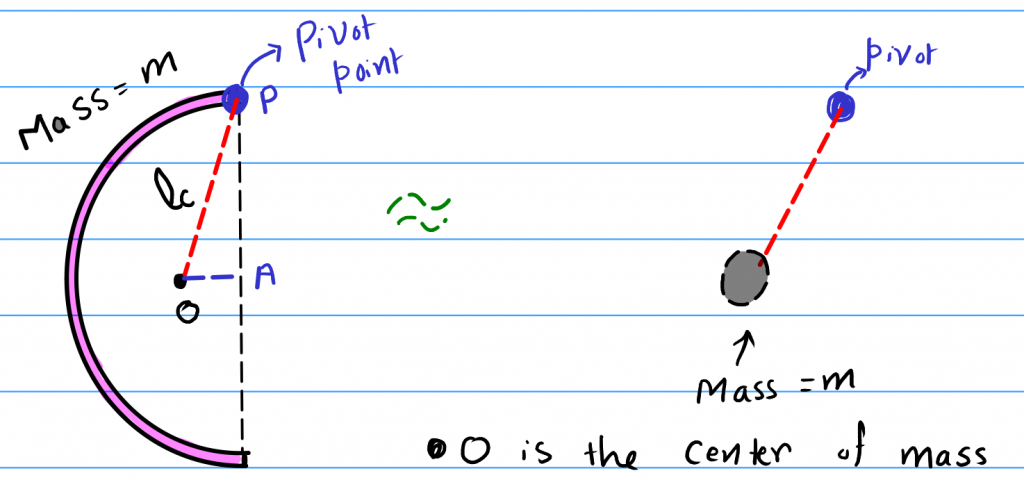
Now, for a semi-circle the centre of mass is at a height of $\frac{2R}{\pi}$ distance above the radius, i.e., $AO = \frac{2R}{\pi}$, where $AP=R=\frac{l}{\pi}$.
Now, $F r = mg l_{c} = mg \sqrt{R^2 + (\frac{2R}{\pi})^2}$
and $I = 2mR^2$
Putting these values gives us,
$f=\frac{1}{2 \pi} \sqrt{\frac{F r}{I}}$
=$\frac{1}{2 \pi} \sqrt{\frac{g \sqrt{\pi^{2}+4}}{2 \pi R}}$
=$\frac{1}{2 \pi} \sqrt{\frac{g \sqrt{\pi^{2}+4}}{2 l}}$
Physics Olympiad Program at Cheenta
