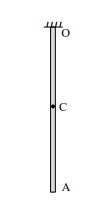
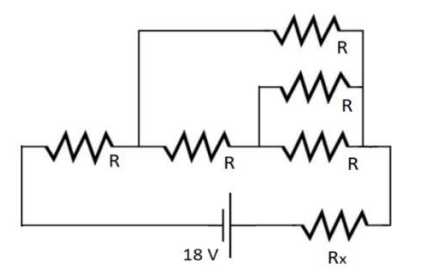
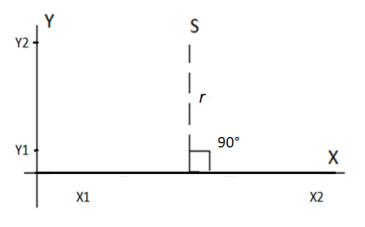
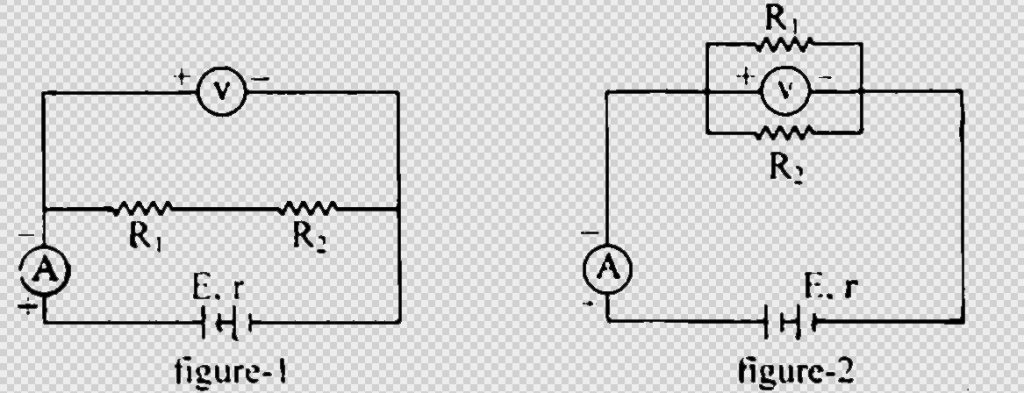
BANGLADESH PHYSICS OLYMPIAD 2026 (Regional Round - Rajshahi) Category A
1. একটি দণ্ডের দৈর্ঘ্য, 12.30 cm অন্যটির 3.456 cm । মোট দৈর্ঘ্য কত দশমিক স্থান পর্যন্ত লেখা উচিত? (The measurement of a rod is 12.30 cm and another rod is 3.456 cm . Their total length should be recorded as — )
(A) 15.756 cm
(B) $\quad 15.76 \mathrm{~cm}$
(C) 15.8 cm
(D) 15.75 cm
2. যদি ত্বরণ $a=5 \mathrm{~m} / \mathrm{s}^{2}$ হয়, তবে এর মান $\mathrm{cm} / \mathrm{min}^{2}$ এককে কত? (If the acceleration $a=5 \mathrm{~m} / \mathrm{s}^{2}$, what is its value in $\mathrm{cm} / \mathrm{min}^{2}$ ?)
3. যমুনা নদীতে দুটি নৌকা চলছে। নৌকা A পূর্বদিকে $4 \mathrm{~m} / \mathrm{s}$ বেগে এবং নৌকা B পূর্বদিকে $3 \mathrm{~m} / \mathrm{s}$ বেগে চলছে। নৌকা A এর কাছে নৌকা B এর বেগ কত মনে হবে? (Two boats are moving on the Jamuna River. Boat A travels east at $4 \mathrm{~m} / \mathrm{s}$, and Boat B travels east at $3 \mathrm{~m} / \mathrm{s}$. What is the velocity of Boat $B$ relative to Boat A?)
(A) পশ্চিম দিকে $1 \mathrm{~m} / \mathrm{s}(1 \mathrm{~m} / \mathrm{s}$ west)
4. যদি $x-t$ (অবস্থান-সময়) গ্রাফের ঢাল সময়ের সাথে বৃদ্ধি পায়, তবে কণাটি— (If the slope of an $x-t$ (position-time) graph increases with time, the particle:)
(A) সমবেগে চলে (moves with constant velocity)
(B) ত্বরণ প্রাপ্ত হয় (is accelerating)
(C) মন্দন প্রাপ্ত হয় (is decelerating)
(D) স্থির হয়ে যায় (comes to rest)
5. সিলেটের একটি ঢালু রাস্তা দিয়ে একটি বাস $12 \mathrm{~m} / \mathrm{s}$ গতিতে নেমে যাচ্ছে। বেগ বনাম সময় লেখচিত্রে অনুভূমিকের সমান্তরাল একটি রেখা পাওয়া গেলে, বাসটি কত ত্বরণে নিচে নামছে? (ধর, অভিকর্ষজ ত্বরণ, g = $10 \mathrm{~m} / \mathrm{s}^{2}$ ) (A bus is moving down an inclined road in Sylhet with a speed of $12 \mathrm{~m} / \mathrm{s}$. If the velocity-time graph is a straight line parallel to the time axis, what is the acceleration with which the bus is moving downward? (Assume the acceleration due to gravity, $\mathrm{g}=10 \mathrm{~m} / \mathrm{s}^{2}$ )
(A) $0 \mathrm{~m} / \mathrm{s}^{2}$
(B) $10 \mathrm{~m} / \mathrm{s}^{2}$ upward
(C) $10 \mathrm{~m} / \mathrm{s}^{2}$ downward
(D) $12 \mathrm{~m} / \mathrm{s}^{2}$ downward
6. একটি বস্তু মুক্ত স্থানে অবস্থান করছে, যেখানে ঘর্ষণ ও বায়ু প্রতিরোধের মতো বাহ্যিক প্রভাব অনুপস্থিত। যখন বস্তুর উপর একটি বল প্রয়োগ করা হয়, তখন নিউটনের গতি-সূত্র অনুযায়ী বস্তুটি ত্বরণ প্রাপ্ত হয়। বস্তুর উৎপন্ন ত্বরণ কোনটির উপর নির্ভর করে? (An object is placed in free space, where external influences such as friction and air resistance are absent. When a force is applied to the object, it begins to accelerate according to Newton's laws of motion. The resulting acceleration of the object depends on)
(A) কেবল বস্তুর ভরের উপর (the mass of the object only)
(B) কেবল প্রয়োগকৃত বলের উপর (the applied force only)
(C) প্রয়োগকৃত বল এবং বস্তুর ভর-উভয়ের উপর (both the applied force and the mass of the object)
(D) বল এবং ভর, কোনটির উপর ই না। (neither the force nor the mass)
7. যখন একটি বস্তুকে উচ্চ পর্বতের চূড়ায় নেওয়া হয়, তার ভর ও ওজন (When a body is taken to the top of a high mountain, its mass and weight)
(A) উভয়ই কমে যায় (Both decrease)
(B) উভয়ই অপরিবর্তিত থাকে (Both remain same)
(C) ভর অপরিবর্তিত থাকে, ওজন কমে যায় (Mass remains same, weight decreases)
(D) ভর কমে যায়, ওজন বেড়ে যায় (Mass decreases, weight increases)
8. একটি উঁচুভবন থেকে একটি পাথর নিচে ফেলে দিলে সেটি 4 সেকেন্ড পর ভূমি স্পর্শ করে। ভবনটির উচ্চতা কত? (ধর, $g=10 \mathrm{~m} / \mathrm{s}^{2}$ ) (A stone is dropped from a tall building and takes 4 seconds to reach the ground. What is the height of the building? (Take the acceleration due to gravity as g $=10 \mathrm{~m} / \mathrm{s}^{2}$ )
(A) $\mathbf{4 0 ~ m}$
(B) 80 m
(C) 120 m
(D) 200 m
9. অমিত $70 \mathrm{~km} / \mathrm{h}$ বেগে একটি বল উপরের দিকে ছুঁড়ে মারে। সর্বোচ্চ বিন্দুতে বলের বেগ কত? (ধর, অভিকর্ষজ ত্বরণ, $\mathrm{g}=10 \mathrm{~m} / \mathrm{s}^{2}$ ) (Amit throws a ball upward at $70 \mathrm{~km} / \mathrm{h}$. What is the velocity of the ball at the top of its path?) (Take the acceleration due to gravity as $\mathrm{g}=10 \mathrm{~m} / \mathrm{s}^{2}$ )
(A) $0 \mathrm{~km} / \mathrm{h}$
(B) $35 \mathrm{~km} / \mathrm{h}$
(C) $70 \mathrm{~km} / \mathrm{h}$ upward
(D) $70 \mathrm{~km} / \mathrm{h}$ downward
10. একটা ক্রিকেট ম্যাচে রান নেওয়ার সময়ে 130-kg ভরের একজন ব্যাটসম্যানের সাথে 65-kg ভরের একজন বোলারের মুখোমুখি সংঘর্ষ হলো। ব্যাটসম্যান যদি বোলারের উপর ( $\mathrm{F}_{\text {bat }}$ ) এবং বোলার যদি ব্যাটসম্যানের উপর ( $\mathrm{F}_{\text {bowi }}$ ) বল প্রয়োগ করে তাহলে কোনটি সঠিক? (A 130-kg cricket batsman accidentally collides head-on with a 65-kg bowler while running between the wickets. During the collision, the heavier batsman exerts a force of magnitude ( $\mathrm{F}_{\text {bat }}$ ) on the smaller bowler. If the bowler exerts a force ( $\mathrm{F}_{\text {bowl }}$ ) back on the batsman, which statement is correct?)
11. একজন ছাত্র 10 kg ওজনের একটি আমের ঝুড়ি 2 মিটার উঁচু টেবিলের উপর তুলে রাখল। এক্ষেত্রে কাজের পরিমাণ কত? (ধর, অভিকর্ষজ ত্বরণ, $\mathrm{g}=10 \mathrm{~m} / \mathrm{s}^{2}$. (A student lifts a mango basket of 10 kg onto a table that is 2 meters high. How much work is done?) (Take the acceleration due to gravity as $\mathrm{g}=10 \mathrm{~m} / \mathrm{s}^{2}$ )
(A) 0 J
(B) 5 J
(C) 20 J
(D) 200 J
12. একটি ইলেকট্রন একটি অ্যাক্সিলারেটরের মধ্যে $9 \times 10^{5} \mathrm{~m} / \mathrm{s}$ বেগে চলছে। যদি ইলেকট্রনের গতি দ্বিগুণ করা হয়, তাহলে এর গতিশক্তি কত গুণ বৃদ্ধি পাবে? (ধর, একটি ইলেকট্রনের ভর $10^{-30} \mathrm{~kg}$ ) (An electron is moving in an accelerator at a speed of $9 \times 10^{5} \mathrm{~m} / \mathrm{s}$. If its speed is doubled, by what factor does its kinetic energy (KE) increase?) (Assume the mass of an electron is $10^{-30} \mathrm{~kg}$ )
(A) 0
(B) 4
(C) 5
(D) 3
13. কোনো এক পার্কে বসে তুমি দেখলে যে, $100-\mathrm{kg}$ ভরের একজন সাইকেল আরোহী 5 সেকেন্ডের মধ্যে শূন্য থেকে পূর্বদিকে $20 \mathrm{~km} / \mathrm{h}$ গতি তুলল। লোকটি কী পরিমাণ কাজ করল তা গতিশক্তির পরিবর্তন থেকে বের করলে। একই সময়ে, তোমার বন্ধু রাফিও ঘটনাটি দেখছিল। তখন সে বাসে $10 \mathrm{~km} / \mathrm{h}$ গতিতে পশ্চিমে যাচ্ছিল। সে একইভাবে কৃত কাজ হিসাব করল। যদি তোমরা দুজনেই সঠিকভাবে হিসাব কর, তাহলে কি তোমাদের ফলাফল একই হবে? (While sitting in a park, you observe a $100-\mathrm{kg}$ cyclist accelerating from rest to $20 \mathrm{~km} / \mathrm{h}$ east over 5 seconds. You calculate the work done from the change in kinetic energy. At the same time, your friend Rafi, traveling in a bus at $10 \mathrm{~km} / \mathrm{h}$ west, observes the same cyclist and calculates the work. If both of you are correct, will Rafi get the same result as you?)
(A) রাফির ক্ষেতের কাজের মান কম হবে (Rafi calculates smaller work)
(B) রাফির ক্ষেত্রে কাজের মান বেশি হবে (Rafi calculates larger work)
(C) হ্যাঁ, একই হবে (Both find the same work)
(D) রাফির ক্ষেত্রে কাজের মান শূন্য হবে (Rafi finds zero work)
14. সরল ছন্দিত গতিতে (SHM), বেগ ও সরণ — (In SHM, velocity and displacement are—)
(A) সম দশায় থাকে (In phase)
(B) যে কোন দশায় থাকে Random phase
(C) $90^{\circ}$ দশা পার্থক্যে থাকে (Out of phase by $90^{\circ}$ )
(D) $180^{\circ}$ দশা পার্থক্যে থাকে (Out of phase by $180^{\circ}$ )
15. পাস্কালের সূত্র অনুযায়ী, সঙ্কুচিত তরলে প্রয়োগ করা চাপ —(According to Pascal's law, pressure applied to a confined fluid is —)
(A) শুধু উপরের দিকে সঞ্চারিত হয় (transmitted only upwards)
(B) সব দিকেই সমানভাবে সঞ্চারিত হয় (transmitted equally in all directions)
(C) শুধুমাত্র বলের দিকেই সঞ্চারিত হয় (transmitted only in the direction of force)
(D) একদমই সঞ্চারিত হয় না (not transmitted at all)
16. দুটি থার্মোমিটার, একটি সেলসিয়াস ও অন্যটি ফারেনহাইট, একই সংখ্যাগত মান দেখায়। সেই তাপমাত্রা কেলভিন স্কেলে কত? (Two thermometers, one in Celsius and another in Fahrenheit, show the same numerical reading. What is that temperature in Kelvin?)
(A) 233 K
(B) 253 K
(C) 273 K
(D) 313 K
17. নিম্নলিখিত কোনটি তরল ও গ্যাসে ঘটে কিন্তু কঠিনে নয়? (Which of the following occurs in liquids and gases but not in solids?)
(A) পরিবহন (Conduction)
(B) প্রতিফলন (Reflection)
(C) বিকিরণ (Radiation)
(D) পরিচলন (Convection)
18. একটি ধাতু ও কাঠ একই গরম ঘরে রাখা হলে ধাতু বেশি গরম মনে হয় কারণ —(A piece of metal and a piece of wood are kept in the same hot room. The metal feels hotter because -)
(A) ধাতু বেশি তাপ বিকিরণ করে (Metal emits more heat.)
(B) কাঠ তাপ উৎপন্ন করে (Wood produces heat.)
(C) ধাতুর আপেক্ষিক তাপ বেশি (Metal has higher specific heat.)
(D) ধাতু তাপ বেশি পরিবাহন করে (Metal conducts heat better.)
19. দুটি সমতল আয়না ৬০ ${ }^{\circ}$ কোণে অবস্থিত। একটি রশ্মি প্রথম আয়নায় আঘাত করে দ্বিতীয় আয়নায় প্রতিফলিত হয়। প্রাথমিক রশ্মি এবং চূড়ান্ত প্রতিফলিত রশ্মির মধ্যের কোণ হবে— (Two plane mirrors are inclined at $60^{\circ}$. A ray strikes one mirror and reflects to the second mirror. The angle between initial incident ray and final reflected ray is -)
(A) $60^{\circ}$
(B) $90^{\circ}$
(C) $120^{\circ}$
(D) $150^{\circ}$
20. সূর্য থেকে পৃথিবীতে আলো পৌঁছাতে ৮ মিনিট ২০ সেকেন্ড লাগে। আনুমানিক দূরত্ব কত? (Light takes 8 minutes 20 seconds to reach Earth from the Sun. Approximate distance?)
(A) $1.5 \times 10^{11} \mathrm{~m}$
(B) $3 \times 10^{8} \mathrm{~m}$
(C) $1 \times 10^{10} \mathrm{~m}$
(D) $3 \times 10^{11} \mathrm{~m}$
BANGLADESH PHYSICS OLYMPIAD 2026 (Regional Round - Barisal) Category A
1. একজন শিক্ষার্থী $4.56 \times 1.4 \times 2.345$ গুণ করলে ফলাফল কতটি Significant Figure নিয়ে লেখা উচিত? (A student multiplies $4.56 \times 1.4 \times 2.345$. The answer should be expressed with how many significant figures?)
(A) 5
(B) 4
(C) 3
(D) 2
2. যদি $g=9.8 \mathrm{~m} / \mathrm{s}^{2}$, তবে $\mathrm{cm} / \mathrm{min}^{2}$ এককে এর মান কত হবে? (If the acceleration due to gravity $g=9.8 \mathrm{~m} / \mathrm{s}^{2}$, what will be its value in $\mathrm{cm} / \mathrm{min}^{2}$ ?)
3. মানুষের হৃৎপিণ্ড সারাজীবনে সর্বমোট কতটি কম্পন সম্পন্ন করে? একজন স্বাভাবিক মানুষ গড়ে ৭০ বছর বাঁচে এবং স্বাভাবিক হার্টরেট হচ্ছে প্রতি মিনিটে ৮০। (How many times does a human heart beat in a lifetime? Assume an average heart rate of 80 beats per minute and a lifespan of 70 years.)
(A) $1.2 \times 10^{8}$
(B) $2 \times 10^{9}$
(C) $3 \times 10^{9}$
(D) $3 \times 10^{11}$
4. একটি কণা 5 m পূর্বে এবং 3 m পশ্চিমে যায়। দূরত্ব ও সরণ কত হবে (A particle moves 5 m east and then 3 m west. Distance and displacement are)
5. খুব অল্পসংখ্যক দৌড়বিদই চার মিনিটের কম সময়ে এক মাইল দৌড় সম্পন্ন করতে পেরেছেন। ১৯৫৪ সালে রজার ব্যানিস্টার সর্বপ্রথম এই অসাধ্য সাধন করেন। পরবর্তীতে মরক্কোর হিশাম আল গেরুজ বিশ্বরেকর্ডটি ৩ মিনিট ৪৩ সেকেন্ডে নামিয়ে আনেন। বিশ্বরেকর্ডটি গড়তে হিশামকে গড়ে কত জোরে ছুটতে হয়েছিল? ১ মাইলকে ১৬০০ মিটার ধরে হিসাব করতে পারো।(Only a few runners have managed to complete a mile in under 4 minutes. Roger Bannister from Britain was the first to break this barrier in 1954 at Oxford University. In 1999, Moroccan athlete Hicham El Guerrouj set the record with a time of 3 minutes 43 seconds. Calculate Hicham's average speed in meters per second. Assume 1 mile $=1600 \mathrm{~m}$ )
(A) $7.2 \mathrm{~m} / \mathrm{s}$
(B) $4.7 \mathrm{~m} / \mathrm{s}$
(C) $3.3 \mathrm{~m} / \mathrm{s}$
(D) $6.7 \mathrm{~m} / \mathrm{s}$
6. সমত্বরণ কিভাবে $a-t$ গ্রাফে প্রকাশিত হয়? (How is uniform (constant) acceleration represented on an a-tgraph?)
(A) Horizontal line
(B) Sloped line
(C) Curved line
(D) Increasing parabola
7. ব্রেক চাপার পরে $30 \mathrm{~km} / \mathrm{h}$ এ চলমান একটি গাড়ি সম্পূর্ণ থেমে যাওয়ার পূর্বে 20 m দূরত্ব অতিক্রম করে। যদি গাড়িটির গতি $60 \mathrm{~km} / \mathrm{h}$ হতো, তাহলে ব্রেক চাপার পর কতদূর গিয়ে গাড়িটি থামত? মনে কর যে, ব্রেক চাপার পরে সৃষ্ট বল গাড়ির গতির উপর নির্ভর করে না (A car traveling at $30 \mathrm{~km} / \mathrm{h}$ can come to a complete stop within a distance of 20 m . If the car's speed is doubled to $60 \mathrm{~km} / \mathrm{h}$, what will be its stopping distance? Assume the maximum braking force does not depend on speed.)
(A) 20 m
(B) 40 m
(C) 60 m
(D) 80 m
8. ভর $m$ এর একটি ব্লককে অনুভূমিকের সঙ্গে $\theta$ কোণে হেলে থাকা ঘর্ষণহীন তলে রাখা হয়েছে। ঢালের দিকে ব্লকের ওজনের কত অংশ কাজ করে?? (A block of mass $m$ is placed on a frictionless incline making an angle $\theta$ with the horizontal. What is the component of the block's weight along the incline?)
(A) mg
(B) $\mathrm{mg} \sin \theta$
(C) $m g \cos \theta$
(D) $\mathrm{mg} \tan \theta$
9. একটি বল উল্লম্বভাবে উপরে ছোঁড়া হয়েছে। সর্বোচ্চ বিন্দুতে বেগ এবং ত্বরণ হবে (A ball is thrown vertically upward. At the highest point, velocity and acceleration are )
(A) $\quad v=0, a=0$
(B) $v=0, a=g$ upward
(C) $v=g, a=0$
(D) $v=0, a=g$ downward
10. উপরে ছোঁড়া কণার সর্বোচ্চ উচ্চতা কোনটির উপর নির্ভর করে? (Maximum height reached by a body thrown upward depends on —)
(A) শুধুমাত্র প্রাথমিক বেগ (Initial velocity only)
(B) শুধুমাত্র ত্বরণ (Acceleration only)
(C) শুধুমাত্র সময় (Time only)
(D) বস্তুটির ভর (Mass of the body)
11. $m$ ভর বিশিষ্ট একটি বস্তুকে সমবেগে উল্লম্বভাবে উচ্চতা $h$ পর্যন্ত উত্তোলন করা হলো। মহাকর্ষ দ্বারা করা কাজ কত? (An object of mass $m$ is lifted vertically to height $h$ with constant velocity. Work done by gravity is —)
(A) mgh
(B) -mgh
(C) 0
(D) 2 mgh
12. নিম্নলিখিত কোন রাশি ধনাত্মক ও ঋণাত্মক উভয়ই হতে পারে? (Which of the following quantities can be both positive and negative?)
(A) শক্তি (Energy)
(B) ক্ষমতা (Power)
(C) ভর (Mass)
(D) কাজ (Work)
13. যদি একটি বস্তু সমান বেগে চলে, তবে উপর মোট কাজ কত? (If a body moves at constant velocity, the net work done on it is -)
(A) সর্বোচ্চ (Maximum)
(B) শূন্য (Zero)
(C) ঋণাত্মক (Negative)
(D) বলের উপর নির্ভর করে (Depends on force)
14. সরল ছন্দিত গতিতে সর্বাধিক ত্বরণ ঘটে কোথায়? (Where does the maximum acceleration occur in simple harmonic motion (SHM)?)
(A) মধ্য অবস্থানে (Mean position)
(B) অর্ধ-বিস্তার বিন্দুতে (Half amplitude)
(C) বিস্তার বিন্দুতে (Amplitude)
(D) শূন্য সরণ অবস্থায় (Zero displacement)
15. একটা বলের পরিধি 9 inches । বলের ঘনত্ব $0.8 \mathrm{~g} / \mathrm{cm}^{3}$ হলে, বলটির ভর কত? (১ ইঞ্চি = ২.৫৪ সেন্টিমিটার)] A standard cricket ball has a circumference of 9 inches. If the ball is made of a material with density $0.8 \mathrm{~g} / \mathrm{cm}^{3}$, what is its mass? ( $1 \mathrm{in} .=2.54 \mathrm{~cm}$ )
(A) 140 g
(B) 150 g
(C) 160 g
(D) 170 g
16. একটি কঠিন পদার্থ জলে ভাসছে এবং তার ৩/৪ অংশ নিমজ্জিত। এর ঘনত্ব কত? (A solid object is floating in water with $3 / 4$ of its volume submerged. What is its density?)
17. সেলসিয়াস ও ফারেনহাইট স্কেলের মান সমান হয় কোন তাপমাত্রায়? (At what temperature do the Celsius and Fahrenheit scales have the same value?)
(A) $-32^{\circ}$
(B) $-40^{\circ}$
(C) $-273^{\circ}$
(D) $0^{\circ}$
18. ঘরে হিটার চালু করার পর আমরা উষ্ণতা অনুভব করি। এক্ষেত্রে রুমের তাপমাত্রা বেড়ে যাওয়ার প্রধান কারণ কোনটি? (A boy feels warmer in a room after a heater is turned on. Which type of heat transfer is responsible for the increase in room temperature?)
(A) পরিবহন (Conduction)
(B) পরিচলন (Convection)
(C) বিকিরণ (Radiation)
(D) কোনোটিই নয় (None)
19. যখন কোনো সিস্টেমে তাপ প্রবেশ করে, তখন সেই সিস্টেমের অভ্যন্তরীণ শক্তি (When heat flows into a system, the internal energy of the system)
(A) কমে যায় (decreases)
(B) অপরিবর্তিত থাকে (remains same)
(C) বৃদ্ধি পায় (increases)
(D) শূন্য হয়ে যায় (becomes zero)
20. কোনো মাধ্যমের প্রতিসরাঙ্ক 1.33 । এই মাধ্যমে আলোর বেগ হবে (The refractive index of a medium is 1.33 . The speed of light in this medium is )
1. যদি দৈর্ঘ্য, ভর ও সময়ের একক যথাক্রমে $a, b$, ও $c$ গুণ পরিবর্তন করা হয়, তবে শক্তির নতুন একক কী হবে? (If the base units of length, mass, and time are changed to $a$ times, $b$ times, and $c$ times of their original values respectively, what will be the new unit of energy?)
(A) $a^{2} b c^{-2}$ times old unit
(B) $a^{2} b c^{-3}$ times old unit
(C) $a b^{2} c^{-2}$ times old unit
(D) $a^{2} b c^{-1}$ times old unit
2. যদি আলোর বেগ $3.0 \times 10^{8} \mathrm{~m} / \mathrm{s}$ হয়, তবে সেটি $\mathrm{cm} / \mu \mathrm{s}$ এককে কত হবে? (If the velocity of light $c=3.0 \times 10^{8} \mathrm{~m} / \mathrm{s}$, how can it be expressed in $\mathrm{cm} / \mu \mathrm{s}$ (microsecond)?)
3. কোনো সংখ্যার যতগুলো অঙ্ক নিশ্চিতভাবে জানা যায় তাকে তার সিগনিফিকেন্ট ফিগার বলে। উদাহরণস্বরূপ, ২৪.২৪ সংখ্যাটিতে সিগনিফিকেন্ট ফিগার হচ্ছে চারটি; অন্যদিকে ০.০৯৩-সংখ্যাটিতে রয়েছে দুইটি। তাহলে, ২.৫ এবং ২.৪—এই সংখ্যা দুটির গুণফলের সঠিক প্রকাশ কোনটি হবে? (The number of reliably known digits in a measurement is called its significant figures. For example, 24.24 mm has four significant figures, and 0.093 cm has two. If you multiply 2.5 by 2.4 , what is the correct answer with the proper number of significant figures?)
A) 6
B) 06
C) 6.0
D) 6.00
4. একজন ছেলে বাড়ি থেকে বের হয়ে ফুচকা কেনার জন্য পূর্বদিকে ৮০ মিটার যায়। কেনাকাটার পর পশ্চিম দিকে ৬০ মিটার ফেরত আসে। সে কতটুকু দূরত্ব অতিক্রম করেছে? (A boy leaves his home and walks 80 m east to buy fuchka. Then he walks 60 m west back toward home. What distance did he travel?)
A) 20 m
(B) 70 m
(C) 100 m
(D) 140 m
5. $v-t$ গ্রাফের নিচের ক্ষেত্রফল নির্দেশ করে - (The area under a $v-t$ graph gives - )
(A) Velocity
(B) Acceleration
(C) Displacement
(D) Speed
6. যদি দুটি বস্তু বিপরীত দিকে চলে, তবে তাদের আপেক্ষিক বেগ — (If two objects move in opposite directions, the relative velocity —)
(A) তাদের বেগের যোগফলের সমান (Equals the sum of their speeds)
(B) তাদের বেগের পার্থক্যের সমান (Equals the difference of their speeds)
(C) শূন্য (Zero)
(D) ভরের উপর নির্ভর করে (Depends on mass)
7. একটি বস্তু স্থির অবস্থান থেকে শুরু করে $a$ ত্বরণে $t$ সময় ধরে চলে। অতিক্রান্ত দূরত্ব হবে (An object starts from rest and moves with uniform acceleration $a$ for time $t$. The distance covered is )
(A) $a t$
(B) $1 / 2 a t^{2}$
(C) $2 a t$
(D) $a / t$
8. একটি বল ঘর্ষণহীন পৃষ্ঠে গড়ায়। এটি শেষমেশ থামল। নিউটনের প্রথম সূত্র কি ভঙ্গ হয়েছে? (A ball is rolling on a frictionless surface. It eventually stops. Is Newton's 1st law violated?)
(A) হ্যাঁ, যেহেতু গতি থেমেছে (Yes, because motion stopped)
(B) না, কারণ বাহ্যিক বল কাজ করেছে (No, because some external force acted)
(C) হ্যাঁ, জড়তা ব্যর্থ হয়েছে (Yes, because inertia failed)
(D) বলা যায় না (Cannot say)
9. সমান আয়তনের দুটি ভারী বল একটি বহুতল ভবন থেকে একই সাথে ফেলে দেওয়া হলো। একটি বলের ভর অপরটির দ্বিগুণ। বলদুটির মাটিতে পড়তে কি একই সময় লাগবে? (Two small heavy balls have the same size, but one is twice as heavy as the other. If both are dropped at the same time from a second-story balcony, the time to reach the ground will be:)
A) হালকা বলটির দ্বিগুণ সময় লাগবে (Lighter ball takes twice as long)
B) ভারী বলের দ্বিগুণ সময় লাগবে (Heavier ball takes twice as long)
C) হালকা বলটি অনেক বেশি সময় নিবে (Lighter ball takes much longer time)
D) হ্যাঁ, প্রায় কাছাকাছি সময় লাগবে (Both take nearly the same time)
10. গাছ থেকে মাটিতে পড়তে একটি আমের ১ সেকেন্ড সময় লাগল। আমটি কত উঁচু থেকে পড়েছে? (ধর, অভিকর্ষজ ত্বরণ, $g=১ ০$ মিটার/সেকেন্ড ${ }^{2}$ (A mango falls from a tree and takes 1 seconds to reach the ground. From what height did it fall? (Take the acceleration due to gravity as $g=10 \mathrm{~m} / \mathrm{s}^{2}$ )
(A) 5 m
(B) 10 m
(C) 50 m
(D) 100 m
11. কোন উচ্চতায় একটি বস্তুর ওজন পৃথিবীপৃষ্ঠের ১/৪ অংশে পরিণত হবে? (Given Earth’s radius $R$ ) At what height above the Earth's surface will the weight of a body become onefourth of its value on the surface?
(A) $R / 2$
(B) $R$
(C) $\sqrt{3} R$
D. $R(\sqrt{2}-1)$
12. সরল ছন্দিত গতিতে, যখন সরণ সর্বাধিক হয়, তখন গতিশক্তি এবং স্থিতিশক্তি হয়— (In simple harmonic motion, when displacement is maximum, kinetic energy (K.E) and potential energies (P.E) are)
(A) K.E. max, P.E. zero
(B) K.E. zero, P.E. max
(C) Both max
(D) Both zero
13. সমান আয়তনের নিচের বস্তুগুলো পানিতে ডুবানো হলে, কোন বস্তুর উপর প্লবতা (উর্ধ্বমুখী বল) সর্বোচ্চ হবে? (Which of the following objects, each with a volume of $1 \mathrm{~cm}^{3}$ and fully submerged in water, experiences the greatest buoyant force?)
(A) এক ঘন সে.মি.এর একটি কাঠের ব্লক (A $1-\mathrm{cm}^{3}$ block of wood)
(B) এক ঘন সে.মি.এর একটি বরফের ব্লক (A $1-\mathrm{cm}^{3}$ block of ice)
(C) এক ঘন সে.মি.এর একটি লোহার ব্লক (A $1-\mathrm{cm}^{3}$ block of iron)
(D) সবার ক্ষেত্রে সমান হবে (All experience the same buoyant force)
14. প্যাসকালের সূত্র অনুযায়ী, সীমাবদ্ধ তরলে চাপ প্রয়োগ করলে (According to Pascal’s law, pressure applied to a confined fluid)
(A) গভীরতার সাথে কমে (Decreases with depth)
(B) গভীরতার সাথে বৃদ্ধি পায় (Increases with depth)
(C) সবদিকে সমানভাবে প্রেরিত হয় (Transmitted equally in all directions)
(D) শুধুমাত্র উল্লম্বভাবে কাজ করে (Only acts vertically)
15. দুইটি ট্যাংকে সমান উচ্চতার তরল আছে কিন্তু ক্ষেত্রফল ভিন্ন। তলদেশের চাপ — (Two tanks have the same height of liquid but different cross-sectional areas. Pressure at the bottom -)
(A) সমান (Same)
(B) বড় ক্ষেত্রফলে বেশি চাপ (Larger area → more pressure)
(C) ছোট ক্ষেত্রফলে বেশি চাপ (Smaller area → more pressure)
(D) আয়তনের উপর নির্ভরশীল (Depends on volume)
16. একজন ছাত্র একটি খালি বালতির ভর মেপে দেখল যে, সেটি ১.৫ কেজি। পানি রাখার পরে বালতির ভর ৬.৫ কেজি হলে, বালতিতে রাখা পানির আয়তন কত? (পানির ঘনত্ব ১০০০ কেজি/মিটার (A student measures the mass of an empty bucket as 1.5 kg . When it is filled with water, the total mass is 6.5 kg . What is the volume of the water? (Take the density of water as $1000 \mathrm{~kg} / \mathrm{m}^{3}$ )
(A) $8 \mathrm{~m}^{3}$
(B) $4 \mathrm{~cm}^{3}$
(C) $5000 \mathrm{~cm}^{3}$
(D) $5000 \mathrm{~m}^{3}$
17. কেলভিন স্কেলের এক ডিগ্রির সাথে ফারেনহাইট স্কেলের এক ডিগ্রির অনুপাত আনুমানিক কত? (The ratio of one degree on the Kelvin scale to one degree on the Fahrenheit scale is approximately)
(A) $1: 1$
(B) $1: 1.8$
(C) $1.8: 1$
(D) $1: 2.8$
18. একটি রুমের তাপ মূলত দেওয়াল ও জানালা দিয়ে হারায়। যদি দেওয়ালগুলোকে তাপ নিরোধক করা হয়, তবে কোন প্রক্রিয়াটি সবচেয়ে বেশি হ্রাস পায় (Heat loss from a room mainly occurs through walls and windows. If walls are insulated, which mode reduces most?)
(A) সঞ্চালন (Convection)
(B) বিকিরণ (Radiation)
(C) বাষ্পীভবন (Evaporation)
(D) পরিবহন (Conduction)
19. একটি আলোর রশ্মি কাঁচের মধ্যে ( $\mathrm{n}=1.5$ ) ১ মিটার পথ অতিক্রম করে। সময় কত লাগবে? (A ray of light travels 1 m in glass ( $\mathrm{n}=1.5$ ). Time taken?)
(A) 3.33 ns
(B) 5 ns
(C) 10 ns
(D) 20 ns
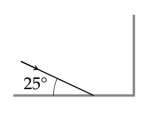
20. দুটি সমতল আয়না একে অপরের সাথে লম্বভাবে রাখা রয়েছে। আলোক রশ্মি প্রথম আয়নাটির সাথে ২৫ কোণে আপতিত হলে, নির্গত রশ্মি দ্বিতীয় আয়নার সাথে কত কোণ তৈরি করবে? (Two plane mirrors are placed perpendicular to each other. A light beam strikes the first mirror at an angle of $25^{\circ}$. What angle will the outgoing beam make with the second mirror?)
(A) $25^{\circ}$
(B) $50^{\circ}$
(C) $65^{\circ}$
(D) $75^{\circ}$
National Standard Examination in Physics - 2025
1. A point mass m moves in a straight line under a retardation $k v^{2}$ [where $k$ is a positive constant and $v$ is the instantaneous velocity]. The initial velocity of the point mass is $u$. The displacement of the point mass at time t is
(a) $\frac{1}{k} \ln (1+k u t)$
(b) $\frac{1}{k} \ln$ kut
(c) $k$ ln kut
(d) $\frac{1}{k} \ln (1-k u t)$
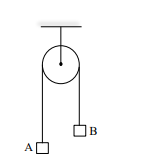
2. In the arrangement shown in figure, 'a' represents the magnitude of acceleration of small blocks A and B while ' T ' is the tension in the massless string passing over the frictionless and massless pulley. The sum of the masses of blocks A and B is constant. For this system, a linear relationship can be obtained between
(a) a and $\frac{1}{\mathrm{~T}}$
(b) a and T
(c) a and $\mathrm{T}^{2}$
(d) T and a ${ }^{2}$
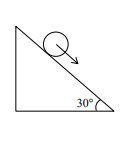
3. A thin uniform circular ring of mass m is rolling without slipping down an inclined plane of inclination $30^{\circ}$ with the horizontal. The coefficient of friction between the ring and the surface is $\mu$. The correct statement is
(a) linear acceleration of the center of the ring along the plane is $a=\frac{g}{2}$
(b) force of friction between the ring and the inclined plane is $\mathrm{F}_{\text {friction }}=\frac{\mathrm{mg}}{4}$
(c) the ring keeps rolling for all values of the coefficient of friction $\mu \geq \frac{1}{4}$
(d) linear acceleration of the center of the ring along the plane is $a=\frac{g}{3}$
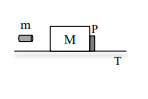
4. A bullet of mass m can penetrate a target (a heavy block of mass M ) up to a distance S , when the target M is held stationary by a stopper P (shown in figure). Up to what distance $\mathrm{S}^{\prime}$ the bullet will penetrate if the block of mass M is free to move (i.e. when the stopper P is removed) on the frictionless surface T .
5. Knowing that the atomic masses of Al and Mg are respectively ${ }_{13}^{25} \mathrm{Al}=24.990432 \mathrm{u}$ and ${ }_{12}^{25} \mathrm{Mg}=24.985839 \mathrm{u}$ while electron mass is often expressed as $\mathrm{m}_{\mathrm{e}}=0.511 \mathrm{MeV}$, the Q value (energy liberated) of the $\beta$ decay nuclear reaction ${ }^{25} \mathrm{Al} \rightarrow{ }^{25} \mathrm{Mg}+\mathrm{e}^{+}+v$ in MeV is
(a) 4.278
(b) 3.767
(c) 3.256
(d) 931.478
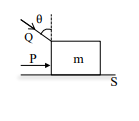
6. A block of mass m , lying on a rough horizontal plane, is acted upon by a horizontal force P and simultaneously by another force Q acting at an angle $\theta$ from the vertical as shown. The block will remain in equilibrium if the coefficient of friction between the block and the surface $S$ is
(a) at least $\frac{P+Q \sin \theta}{m g+Q \cos \theta}$
(b) at least $\frac{P+Q \cos \theta}{m g+Q \sin \theta}$
(c) equal to $\frac{\mathrm{P}+\mathrm{Q} \sin \theta}{\mathrm{mg}-\mathrm{Q} \cos \theta}$
(d) equal to $\frac{P+Q \cos \theta}{m g-Q \sin \theta}$
7. Knowing that the acceleration due to gravity on the Earth surface is g and the radius of the Earth is R , a small body of mass m falls on the Earth from a height $\mathrm{h}=\frac{\mathrm{R}}{5}$ above the Earth's surface. During the freefall, the potential energy of the falling body decreases by
(a) mgh
(b) $\frac{4}{5} \mathrm{mgh}$
(c) $\frac{5}{6} \mathrm{mgh}$
(d) $\frac{6}{7} \mathrm{mgh}$
8. At some instant, a motor car is moving on a circular path of radius 600 m , with a speed $\mathrm{u}=30 \mathrm{~ms}^{-1}$. If its speed is increased at a rate of $2 \mathrm{~ms}^{-2}$, the magnitude of the acceleration of the car at that instant is
(a) $2.0 \mathrm{~ms}^{-2}$
(b) $2.5 \mathrm{~ms}^{-2}$
(c) $3.5 \mathrm{~ms}^{-2}$
(d) $1.5 \mathrm{~ms}^{-2}$
9. A cricket ball, thrown across a field, is at heights of $\mathrm{h}_{1}$ and $\mathrm{h}_{2}$ above the point of projection, at time $\mathrm{t}_{1}$ and time $t_{2}$ after the throw, respectively. It is then caught by the wicket keeper at the same height as that from which it was thrown. The Time of Flight (T) of the ball is
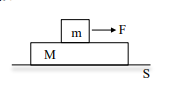
10. A plate of mass M is placed on a horizontal frictionless surface S . A block of mass m is placed on the plate. The coefficient of dynamic friction between the block and the plate is $\mu$. If a horizontal force $\mathrm{F}=2 \mu \mathrm{mg}$ is applied to the block (as shown), the acceleration of the plate will be
11. A simple pendulum, with a bob of mass m , oscillates in a vertical plane, with an angular amplitude $\theta_{0}$. The tension in its string when it passes through the mean position is 2 mg . Neglecting the effect of air friction and the viscosity of air, the angular amplitude $\theta_{0}$ is
(a) $30^{\circ}$
(b) $60^{\circ}$
(c) $90^{\circ}$
(d) $120^{\circ}$
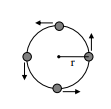
12. Because of their mutual gravitational attraction, four identical planets each of mass m are orbiting in a circular path of radius r in the same sense (angular direction). The magnitude of the velocity of each planet is
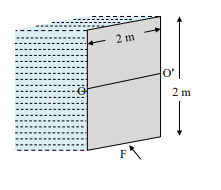
13. A rigid square sheet of size $2 \mathrm{~m} \times 2 \mathrm{~m}$ is hinged at the middle of the vertical edges to serve as a door which can turn about the horizontal axis $\mathrm{OO}^{\prime}$. A fluid of density $\rho$ fills the space to the left of the sheet up to its top. The horizontal force F required (to be applied at the lower edge) to hold the sheet vertical is
(a) $\frac{2}{3} \rho g$
(b) $\frac{4}{3} \rho \mathrm{~g}$
(c) $\frac{8}{3} \rho \mathrm{~g}$
(d) $\frac{1}{3} \rho \mathrm{~g}$
14. A major artery in human body, with radius 0.4 cm , carries blood at a flow rate of 5.0 cubic centimeters per second. The pressure difference of blood per meter length of the artery is nearly [Given that the coefficient of viscosity ( $\eta$ ) of blood at body temperature is $4.0 \times 10^{-3} \mathrm{~Pa}$.s and the density of mercury is $13.6 \mathrm{~g} / \mathrm{cm}^{3}$ ]
(a) 9.6 mm of Hg
(b) 3.2 mm of Hg
(c) 1.5 mm of Hg
(d) 6.0 mm of Hg
15. If P represents radiation pressure, E represents radiation energy striking per unit area per unit time and c represents speed of light then the possible values of non-zero integers $x, y$ and $z$ such that $\mathrm{P}^{x} \mathrm{E}^{y} \mathrm{c}^{z}$ is dimensionless, may be
(a) $x=1, y=1, z=1$
(b) $x=-1, y=1, z=1$
(c) $x=1, y=-1, z=1$
(d) $x=1, y=1, z=-1$
16. A large tank, open at the top, has two small holes in the vertical wall. One is a square hole of side 's' at a depth $h$ below the top and the other is a circular hole of radius r at a depth 4 h below the top (given that $\mathrm{s} \ll \mathrm{h} ; \mathrm{r} \ll \mathrm{h})$. When the tank is completely filled up to the brim with water, the quantity of water flowing out per second from each hole is the same, then r is equal to
(a) $2 \pi \mathrm{~S}$
(b) $\frac{\mathrm{S}}{2 \pi}$
(c) $\frac{\mathrm{s}}{\sqrt{2 \pi}}$
(d) $\frac{\mathrm{s}}{2 \sqrt{\pi}}$
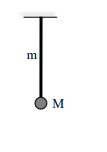
17. A pendulum consists of a heavy but very small bob of mass M suspended at the end of a rigid rod of mass m and length L . The time period of small oscillations in the vertical plane, about a horizontal axis through the upper end of the rod is
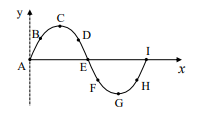
18. A transverse wave is travelling along a long stretched string from left to right (along + ve $x$ direction). The snapshot of a small part of the string at any moment $t$ is shown in the figure. At this particular instant
(a) A and E are at rest for a moment while C and G have maximum speed
(b) B and D have upward velocity whereas F and H have downward
(c) D, E, F are moving downward at that moment
(d) B and H are moving downward at that moment
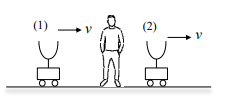
19. Two tuning forks, with natural frequency 700 Hz each, move relative to a stationary observer. Fork (1) moves towards the observer while the fork (2) moves away from the observer. Both the forks move with same velocity $v$ on the same line. The observer, standing between the two forks, hears 4 beats per sec. Using the speed of sound in air as $v_{s}=350 \mathrm{~ms}^{-1}$, the speed of each tuning fork is
(a) $2.0 \mathrm{~ms}^{-1}$
(b) $1.5 \mathrm{~ms}^{-1}$
(c) $1.0 \mathrm{~ms}^{-1}$
(d) $0.5 \mathrm{~ms}^{-1}$
20. The speed of sound in a mixture of 1 mole of Helium (molar mass $=4 \mathrm{~g}$ ) and 2 moles of oxygen (molar mass $=32 \mathrm{~g}$ ) at $27^{\circ} \mathrm{C}$ is nearly
(a) $318 \mathrm{~ms}^{-1}$
(b) $332 \mathrm{~ms}^{-1}$
(c) $381 \mathrm{~ms}^{-1}$
(d) $401 \mathrm{~ms}^{-1}$
21. Three identical large metal plates are kept parallel and close to each other. Each plate can be treated as an ideal black body and has very high thermal conductivity. The first and third plates are maintained at high temperature $\mathrm{T}_{1}=3 \mathrm{~T}$ and $\mathrm{T}_{3}=2 \mathrm{~T}$. The temperature $\mathrm{T}_{2}$ of the middle (i.e. second) plate under steady state condition is
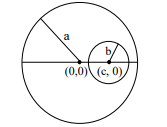
22. A thin uniform circular disc of radius ' $a$ ' is placed in XY plane with its center at origin ( 0,0 ). A small circular disc of radius $b$ with center at ( $c, 0$ ) is cut and taken out to create a hole. The center of mass of the remaining disc is at
(a) $-\frac{b^{2}}{a^{2}} c, 0$
(b) $-\frac{b^{2}}{a^{2}-c^{2}} c, 0$
(c) $-\frac{b^{2}}{a^{2}+b^{2}} c, 0$
(d) $-\frac{b^{2}}{a^{2}-b^{2}} c, 0$
23. One mole of an ideal monoatomic gas, contained in a cylinder fitted with movable piston, is originally at $\mathrm{P}_{1}, \mathrm{~V}_{1}$ and $\mathrm{T}_{1}=27^{\circ} \mathrm{C}$. The gas is slowly heated. Initially 8.31 watt-hour of energy is added to it; at the same time it is allowed to expand at constant pressure to a new state $\mathrm{P}_{1}, \mathrm{~V}_{2}$ and $\mathrm{T}_{2}$. The correct option is
(a) Value of $\mathrm{T}_{2}$ is $1740^{\circ} \mathrm{C}$
(b) Work done by the gas is 2160 R joule
(c) Internal energy of the gas increases by 1440 R joule
(d) $\frac{V_{2}}{V_{1}}=5.8$
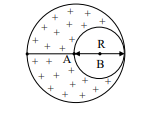
24. A non-conducting solid sphere, of radius R , with its center at A , has a spherical cavity of diameter R with center at B as shown. There is no charge in the cavity while the solid part has a uniform volume charge density $\rho$. Electric potential at the center of the sphere (at point A) is $V=\frac{k \rho R^{2}}{12 \epsilon_{0}}$ (in SI units) where the value of $k$ is
(a) 3
(b) 5
(c) 7
(d) 9
25. Energy from the Sun falls on the Earth surface at the rate of $1400 \mathrm{~W} / \mathrm{m}^{2}$, which is known as solar constant. The respective rms values $\mathrm{E}_{\mathrm{rms}}$ and $\mathrm{B}_{\mathrm{rms}}$ of electric and magnetic fields in the sunlight (electromagnetic radiation) reaching Earth surface are (Take speed of light $\mathrm{c}=3 \times 10^{8} \mathrm{~ms}^{-1}$ )
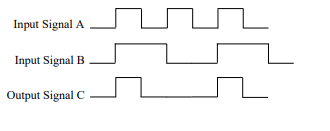
26. The figure below depicts the voltage wave forms of binary input signals A and B and the output signal C of a certain logic gate.
The logic gate is
(a) AND
(b) NAND
(c) OR
(d) XOR
27. Two electric charges, $+q$ at the origin $\mathrm{O}(0,0)$ and $-2 q$ at the point $\mathrm{A}(6,0)$ are placed on $x$ axis. The locus of the point P in $x-y$ plane where the potential vanishes $(\mathrm{V}=0)$ is
(a) a straight line perpendicular to $x$ axis and passing through $(2,0)$
(b) only the point $(2,0)$
(c) a circle with center at ( $-2,0$ ) and radius 4
(d) an ellipse with foci at O and A
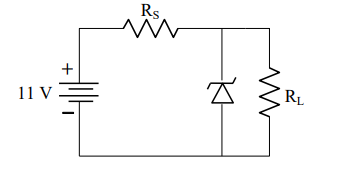
28. In the circuit shown, the Zener diode is an ideal one with breakdown voltage of 5.0 volt. The values of the resistances are $\mathrm{R}_{\mathrm{S}}=10 \mathrm{k} \Omega$ and $\mathrm{R}_{\mathrm{L}}=1 \mathrm{k} \Omega$. The current through the resistances, when the supply voltage is 11.0 V , is
(a) 0.6 mA through $\mathrm{R}_{\mathrm{S}}$ and 5.0 mA through $\mathrm{R}_{\mathrm{L}}$
(b) 1.0 mA through $\mathrm{R}_{\mathrm{S}}$ and 1.0 mA through $\mathrm{R}_{\mathrm{L}}$
(c) 1.1 mA through $\mathrm{R}_{\mathrm{S}}$ and no current through $\mathrm{R}_{\mathrm{L}}$
(d) no current through $\mathrm{R}_{\mathrm{S}}$ and 11 mA through $\mathrm{R}_{\mathrm{L}}$
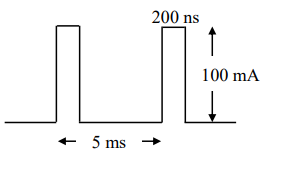
29. In an accelerator the electrons are accelerated up to an energy of 50 MeV . The electrons do not emerge continuously from the accelerator rather they come in pulses at time interval of 5.0 milliseconds. Each pulse has a much shorter duration of 200 nanoseconds. Electron current during the pulse is 100 mA , while the current is zero between the two successive pulses (see figure), then
(a) the average current per pulse is 4 mA
(b) the peak value of power delivered by the electron beam is 50 MW
(c) the average power delivered by the electron beam is 200 W
(d) the average power delivered by the electron beam is 2 MW
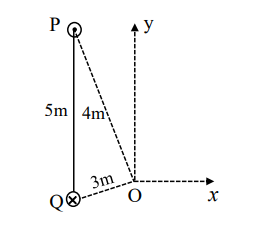
30. Two infinitely long straight parallel wires perpendicular to the plane of the paper are 5 m apart. One of the wires, P carries current I out of the plane of the paper and the other, Q carries the current I into the plane of paper. The magnetic field B at the origin O of the coordinate system with $x$ and y axes as perpendicular and parallel to PQ , respectively, is [Given $\mathrm{OP}=4 \mathrm{~m}$ and $\mathrm{OQ}=3 \mathrm{~m}$ ]
31. Charge q is uniformly distributed over the surface of a thin non-conducting annular disc of inner radius $\mathrm{R}_{1}$ and outer radius $\mathrm{R}_{2}$. The disc is made to rotate with constant frequency f , about an axis passing through the center of the annular disc and perpendicular to its plane. The magnetic moment of the disc is
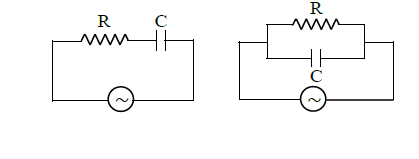
32. For a resistance R and capacitance C in series, the impedance is twice that of a parallel combination of the same elements when used with an AC voltage of frequency $f$. The frequency $f$ of the applied emf is
(a) $\mathrm{f}=2 \pi \mathrm{RC}$
(b) $\mathrm{f}=\frac{1}{2 \pi \mathrm{RC}}$
(c) $\mathrm{f}=\frac{2 \pi}{\mathrm{RC}}$
(d) $f=\frac{1}{2 \pi \sqrt{R^{2}+C^{2}}}$
33. In an experiment on photoelectric effect on a metal surface, one finds a stopping potential of 1.8 V for the wavelength of 300 nm and a stopping potential of 0.9 V for the wavelength of 400 nm . The cutoff wavelength $\lambda_{0}$ (the maximum wavelength that can produce photoelectric effect) for the metal is
(a) 500 nm
(b) 550 nm
(c) 600 nm
(d) 750 nm
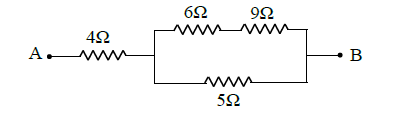
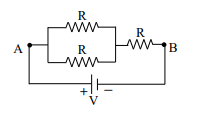
34. Given that the power dissipated in $5 \Omega$ resistance is 7.2 W in the circuit shown.
Statement (1): Power dissipated in $6 \Omega$ resistance is 6 W .
Statement (2): Potential difference $\mathrm{V}_{\mathrm{AB}}$ between A and B is $\mathrm{V}_{\mathrm{AB}}=12.4 \mathrm{~V}$
Then
(a) Statement (1) is correct but statement (2) is wrong
(b) Statement (1) is wrong but statement (2) is correct
(c) Both statements (1) and (2) are wrong
(d) Both statements (1) and (2) are correct
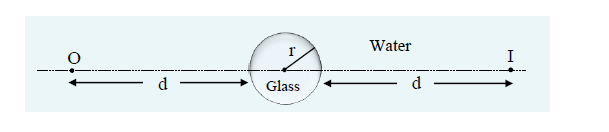
35. A transparent and homogeneous sphere of glass of radius r is immersed in water (refractive indices of glass and water being ${ }_{a} \mu_{g}=\frac{3}{2}$ and ${ }_{a} \mu_{w}=\frac{4}{3}$ ). The image of a point object O , located at distance d on its axis in front of the sphere, is formed at point I at the same distance d from the sphere on the opposite side as shown.
The distance d is equal to
(a) $2 r$
(b) 3 r
(c) 6 r
(d) 8 r
36. A certain substance, with a dielectric constant $\mathrm{k}=2.5$ and the dielectric strength $\mathrm{E}=1.8 \times 10^{7} \mathrm{~N} / \mathrm{C}$, completely fills the space between the plates of a parallel plate capacitor (with circular plates) of capacitance $\mathrm{C}=72.0 \mathrm{nF}$. The minimum diameter of the circular plates, to ensure that the capacitor can withstand a potential difference of $\mathrm{V}=4.0 \mathrm{kV}$, is
(a) 12 cm
(b) 24 cm
(c) 48 cm
(d) 96 cm
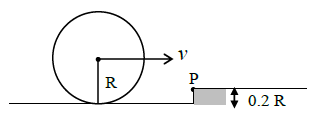
37. A uniform solid sphere of radius R rolls without slipping on a rough horizontal surface with a forward velocity $v$ of its center. On its way, it suddenly encounters a small step of height 0.2 R as shown. The angular velocity of the sphere just after the impact is [given that the sphere does not bounce back, rather it goes ahead up the step]
(a) $\frac{v}{7 R}$
(b) $\frac{3 v}{7 R}$
(c) $\frac{6 v}{7 R}$
(d) $\frac{v}{R}$
38. The magnetic field (B) produced by the current $i$ flowing through the sides of a square loop of side $\ell$, at a point P at distance $x$ from the center of the square, on the axis perpendicular to the plane of the square loop and passing through its center, is
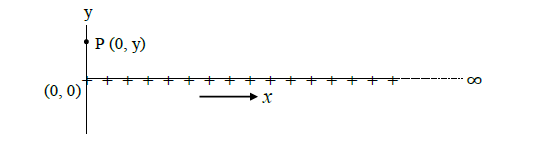
39. A linear positive charge distribution, with linear charge density $\lambda$ coulomb per meter, extends along $+x$ - axis from $x=0$ to $x=\infty$.
The electric field $\vec{E}$ at any point $\mathrm{P}(0, \mathrm{y})$ on the y - axis
(a) is proportional to $\frac{\lambda}{y^{2}}$ irrespective of whether y is positive or negative.
(b) is always directed away and perpendicular to the line of charge.
(c) has a vanishing component parallel to the line of charge.
(d) is directed along a straight line of slope $m=-1$ if y is positive but along a line of slope $m=+1$ if y is negative.
40. Imagine a situation, in which an infinite sheet with positive charge $+\sigma$ per unit area lies in the xy-plane and a second infinite sheet with negative charge $-\sigma$ per unit area lies in the yz-plane. The net electric field E at any point $(\mathrm{x}, \mathrm{y}, \mathrm{z})$ [that does not lie on either of these planes xy or yz ] can be expressed as
41. For the electric field E , in a region of space where a non-uniform, but spherically symmetric distribution of charge has a charge density $\rho(\mathrm{r})$ as $\quad \rho(r)=\rho_{0}\left(1-\frac{r}{R}\right)$ for $r \leq R, \quad$ one can say that $\rho(r)=0 \quad$ for $r \geq R$,
(a) $\mathrm{E}=0$ : both at $\mathrm{r}=0$ and $\mathrm{r}=\mathrm{R}$
(b) $\mathrm{E} \propto \mathrm{r}$ for $\mathrm{r}<\mathrm{R}$ and $E \propto \frac{1}{r^{2}}$ for $r \geq R$
(c) the magnitude of E increases with r and reaches its maximum at $r=\frac{2 R}{3}$
(d) the maximum electric field produced by the given charge distribution is $E_{\max }=\frac{\rho_{0} R}{3 \in_{0}}$
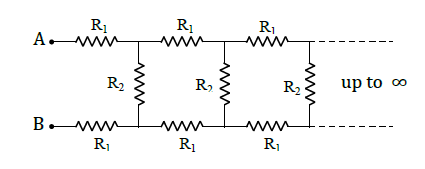
42. A typical network of resistances $\mathrm{R}_{1}$ and $\mathrm{R}_{2}$ shown below extends to infinity towards the right. The total resistance $R_{\text {effective }}$ of this network between points $A$ and $B$ is
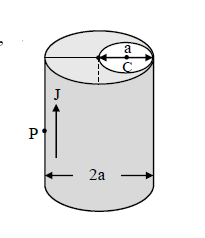
43. A cylindrical cavity of diameter 'a' exists inside a long solid cylinder of diameter '2a' as shown in figure. Both the cylinder and the cavity are taken to be infinitely long. The axis of the cavity is parallel to the axis of the cylinder and is at a distance $\frac{\mathrm{a}}{2}$ from it. A uniform current of current density $\mathrm{J}\left(\mathrm{Am}^{-2}\right)$ flows through the cylinder along its length and not through the cavity. The magnitude of the magnetic field at a point P on the surface of the cylinder lying farthest from the axis of the cavity, is
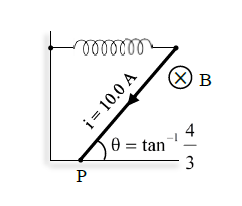
44. A thin uniform rod, of length $\ell=0.200 \mathrm{~m}$ with negligible mass, is attached to the floor by a frictionless hinge at a fixed point P . A horizontal spring connects the other end of the rod to a vertical wall. The rod is in a uniform magnetic field $\mathrm{B}=0.500$ tesla directed into the plane of paper. There is a current $\mathrm{i}=10.0 \mathrm{~A}$ in the rod in the direction shown. Force constant of the spring is $5.00 \mathrm{~N} / \mathrm{m}$. The rod is in equilibrium at $\theta=\tan ^{-1} \frac{4}{3}$
Statement (1) Torque on the rod due to magnetic force is 0.1 Nm clockwise Statement (2) In equilibrium the energy stored in the spring is 0.039 J
(a) Statement (1) is correct but statement (2) is wrong
(b) Statement (1) is wrong but statement (2) is correct
(c) Both statements (1) and (2) are wrong
(d) Both statements (1) and (2) are correct
45. The electric flux through a certain area of a dielectric medium is $\phi=\left(8.00 \times 10^{3}\right) t^{4}$ in SI units. The displacement current through that area is 12.5 pA at a time $\mathrm{t}=20.0 \mathrm{~ms}$. The dielectric constant of the dielectric medium is
(a) 22.1
(b) 5.52
(c) 55.2
(d) 2.76
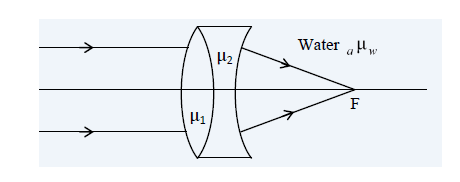
46. A thin equi-convex lens of flint glass (refractive index $\mu_{1}$ ) is kept coaxially in contact with another thin equi-concave lens of crown glass (refractive index $\mu_{2}$ ). The system is completely immersed in water $\left({ }_{a} \mu_{w}=\frac{4}{3}\right)$.
Parallel rays of light incident parallel to the principal axis in water are focused by this system at a distance of 24 cm beyond the system. The thickness of the system is negligible. If the radius of curvature of each surface is $\mathrm{R}=20 \mathrm{~cm}$, the difference ( $\mu_{1}-\mu_{2}$ ) is
(a) $\frac{2}{9}$
(b) $\frac{3}{9}$
(c) $\frac{4}{9}$
(d) $\frac{5}{9}$
47. Two identical large thin metal plates carrying charges $+\mathrm{q}_{1}$ and $+\mathrm{q}_{2}\left(\mathrm{q}_{1}>\mathrm{q}_{2}\right)$, respectively, are kept close at a distance d apart and parallel to each other to form a parallel plate capacitor of capacitance C . The potential difference between the plates is
(a) $\frac{q_{1}-q_{2}}{C}$
(b) $\frac{q_{1}-q_{2}}{2 C}$
(c) $\frac{q_{1}-q_{2}}{4 C}$
(d) $\frac{q_{1}+q_{2}}{2 C}$
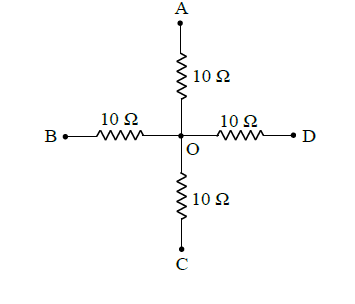
48. In a certain electrical network, the three nodes $\mathrm{A}, \mathrm{B}$ and C are each at a potential of 1.0 volt while the node D is at a potential 2.0 volt. The potential at the Node O in volt is
(a) $\frac{3}{2}$
(b) $\frac{4}{3}$
(c) $\frac{5}{4}$
(d) $\frac{6}{5}$
49. A thin uniform metallic rod, of length $\ell=1.0 \mathrm{~m}$ and area of cross section $\mathrm{A}=2 \mathrm{~mm}^{2}$, is made to rotate with angular velocity $\omega=400 \mathrm{rad} / \mathrm{s}$ in a horizontal plane about a vertical axis through one of its ends. The density and the Young's modulus of the material of the rod are $\rho=10^{4} \mathrm{~kg} \mathrm{~m}^{-3}$ and $\mathrm{Y}=2.0 \times 10^{11} \mathrm{Nm}^{-2}$. Taking r as the distance of a point on the rod from the axis of rotation, the
(a) tension at midpoint of the rod is $\mathrm{T}=1200 \mathrm{~N}$.
(b) tension in the rod varies with distance r from the axis of rotation as $\mathrm{T}=1600 \mathrm{r}^{2} \mathrm{~N}$
(c) stress in the rod at $\mathrm{r}=0.5 \mathrm{~m}$ is $3.0 \times 10^{8} \mathrm{Nm}^{-2}$
(d) elongation of the rod is $\frac{8}{3} \mathrm{~mm}$
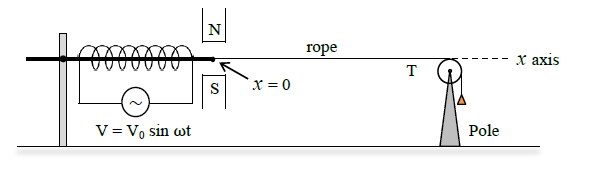
50. One end of a long and thin rope, stretched horizontally with a tension $\mathrm{T}=8 \mathrm{~N}$, along $x$ axis, is supporting a weight after passing over a pulley fixed on a vertical pole (see figure). At the other end, a simple harmonic oscillator (a clamped iron rod along the axis of a solenoid fed with AC voltage and oscillating between north and south poles) at $x=0$, generates a transverse wave of frequency 100 Hz and an amplitude of 2 cm , in the rope. The wave propagates along the rope. The mass per unit length of the rope is $20 \mathrm{~g} / \mathrm{m}$. Ignoring the effect of gravity (on the rope), the correct option(s) is /are
(a) Wavelength of the transverse wave is 20 cm .
(b) Maximum magnitude of transverse acceleration of any point on the rope is nearly $800 \mathrm{~ms}^{-2}$
(c) If the oscillator produces maximum negative displacement at $x=0$ at time $\mathrm{t}=0$, the equation of the wave can be expressed as $\mathrm{y}(x, \mathrm{t})=-0.02 \sin [10 \pi x-100 \pi \mathrm{t}]$ in SI units.
(d) Tension in the given rope remaining unchanged, if a harmonic oscillator of frequency 200 Hz is used (instead of earlier frequency 100 Hz ), the wavelength will be 10 cm .
51. Nuclei of a radioactive element A are being produced at a constant rate $\alpha$. The element A has a decay constant $\lambda$. If there are $\mathrm{N}_{0}$ nuclei at $\mathrm{t}=0$, then
(a) number of nuclei $\mathrm{N}(\mathrm{t})$, at time t , is $\mathrm{N}(\mathrm{t})=\frac{1}{\lambda}\left[\left(\alpha-\lambda \mathrm{N}_{0}\right) \mathrm{e}^{-\lambda \mathrm{t}}\right]$
(b) if $\alpha=\lambda \mathrm{N}_{0}$, the number of nuclei $\mathrm{N}(\mathrm{t})$ at any time t will remain constant
(c) if $\alpha=2 \lambda \mathrm{~N}_{0}$ then $\mathrm{N}(\mathrm{t})=2 \mathrm{~N}_{0}$ as $\mathrm{t} \rightarrow \infty$
(d) if $\alpha=2 \lambda N_{0}$, the number of nuclei $N(t)$ after one half-life of $A$ is $N\left(\frac{T}{2}\right)=\frac{3}{2} N_{0}$
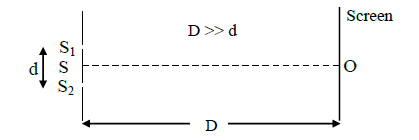
52. In Young's double slit experiment, a fine beam of coherent monochromatic light of wavelength $\lambda=600 \mathrm{~nm}$ is incident on identical slits $\mathrm{S}_{1}$ and $\mathrm{S}_{2}$ at separation d. The intensity at the central maximum formed at O is $\mathrm{I}_{\text {max }}$ and the angular fringe width is $\beta=0.1^{\circ}$. When a thin transparent film is placed in front of the slit $\mathrm{S}_{2}$, the intensity at O changes. It is found that the smallest thickness of the film, for which the intensity at O becomes half the maximum intensity ( i.e. $\frac{\mathrm{I}_{\text {max }}}{2}$ ), is 250 nm . Neglecting the absorption of light by the film, the zero order fringe earlier at O now forms at $\mathrm{O}^{\prime}$ where $\mathrm{OO}^{\prime}=0.5 \mathrm{~mm}$.
Choose correct option(s)
(a) The refractive index of the film is 1.6
(b) The fringe width near O is 2 mm
(c) On the screen, $\mathrm{O}^{\prime}$ is above O
(d) The distance D of the screen from the double slit is nearly 1.15 m
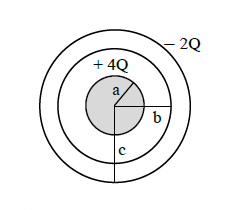
53. An insulated non-conducting solid sphere of radius 'a', carrying a positive charge +4 Q uniformly distributed throughout its volume, is surrounded by a concentric thick conducting spherical shell of inner radius $b$ and outer radius $c$. This thick shell carries a negative charge - 2Q (see figure). The correct option(s) is/are
(a) Electric field strength at distance $r(r<a)$ from the center is $\vec{E}=\frac{1}{4 \pi \epsilon_{0}} \frac{4 Q}{a^{3}} \vec{r}$
(b) Charge on the inner surface of the conducting spherical shell is +2 Q
(c) Charge on the outer surface of the conducting spherical shell is +2 Q
(d) Electrical energy stored in region $0<\mathrm{r}<\mathrm{a}$ [i.e. in the inner sphere] is $\frac{2 \mathrm{Q}^{2}}{5 \pi \in_{0} \mathrm{a}}$
54. A single electron orbits around a stationary nucleus of charge +Ze in a hydrogen-like atom, where Z is the atomic number and e is the magnitude of the charge on an electron. It requires 47.25 eV to excite the electron from second Bohr orbit to the third Bohr orbit. Ionization energy of hydrogen atom is 13.6 eV . Then
(a) the value of Z is 5
(b) the energy required to excite the electron from the $3^{\text {rd }}$ orbit to the $4^{\text {th }}$ orbit is 16.53 eV (nearly)
(c) the wavelength of electromagnetic radiation required to liberate the electron completely when in the first Bohr orbit is $36.56 \AA$
(d) the angular momentum of an electron in the second Bohr orbit is $1.056 \times 10^{-33} \mathrm{Js}$
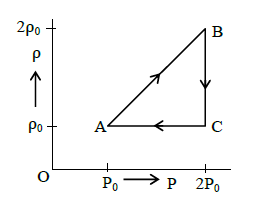
55. One mole of an ideal monoatomic gas of molecular mass M undergoes a cyclic process (ABCA) shown in the figure as a density ( $\rho$ ) versus pressure (P) curve. The correct option(s) is/are
(a) Work done on the gas in going from A to B is $\mathrm{W}_{\mathrm{AB}}=\frac{\mathrm{MP}_{0}}{\rho_{0}} \ell \mathrm{n} 2$
(b) Work done by the gas in the process BC is $\mathrm{W}_{\mathrm{BC}}=\frac{\mathrm{MP}_{0}}{2 \rho_{0}}$
(c) Efficiency $(\eta)$ of the complete cycle ABCA is $\eta=\frac{2}{5}(1-\ell \operatorname{n} 2)$
(d) Heat rejected by the gas in the complete cycle $A B C A$ is $Q_{A B C A}=\frac{{M P_{0}}^{\rho_{0}}}{\rho_{0}}(1-\ell \operatorname{n} 2)$
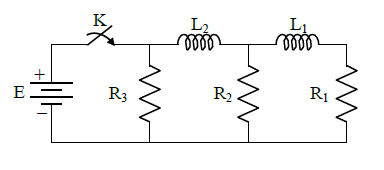
56. Two ideal inductors $\mathrm{L}_{1}=\mathrm{L}_{2}=\mathrm{L}$ and three identical resistors $\mathrm{R}_{1}=\mathrm{R}_{2}=\mathrm{R}_{3}=\mathrm{R}$ have been connected to a DC source of emf E as shown in the circuit. When the key K is kept pressed (closed) for a long time, the current through the resistance $\mathrm{R}_{1}$ on the extreme right is measured to be I . Immediately after releasing (switching off) the key, the current through the resistors is
(a) I downwards in $\mathrm{R}_{1}$
(b) I downwards in $\mathrm{R}_{2}$
(c) 2 I upwards in $\mathrm{R}_{3}$
(d) zero in each $\mathrm{R}_{1}, \mathrm{R}_{2}$ and $\mathrm{R}_{3}$
57. A particle of mass $m$ moves along $x$ axis with its potential energy as $U(x)=\frac{\alpha}{x^{2}}-\frac{\beta}{x}$ where $\alpha$ and $\beta$ are positive constants. The particle is released from rest at $x_{0}=\frac{\alpha}{\beta}$. Then
(a) $\mathrm{U}(x)$ can be expressed as $U(x)=\frac{\alpha}{x_{0}^{2}}\left[\left(\frac{x_{0}}{x}\right)^{2}-\frac{x_{0}}{x}\right]$
(b) velocity of the particle $v(x)$ as a function of $x$ can be expressed as $v(x)=\left[\frac{2 \alpha}{m x_{0}^{2}}\left\{\frac{x_{0}}{x}-\left(\frac{x_{0}}{x}\right)^{2}\right\}\right]^{\frac{1}{2}}$
(c) the maximum speed of the particle is $v_{\text {max }}=\sqrt{\frac{\alpha}{2 m x_{0}^{2}}}$
(d) the total energy of the particle $\mathrm{KE}(x)+\mathrm{U}(x)$ is zero
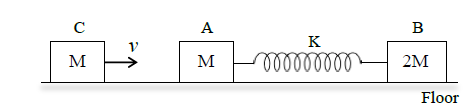
58. Two blocks A and B , of masses M and 2 M , respectively, are connected by a massless spring of natural length $\mathrm{L}_{0}$ and spring constant K . The blocks are initially at rest on a smooth horizontal floor with spring at its natural length $\mathrm{L}_{0}$. A third block C of mass M , identical to that of block A , moves on the floor with speed $v$ along the line joining A and B and collides with A elastically. In the subsequent motion
(a) the spring will be compressed to a maximum when at a length of $v \sqrt{\frac{M}{3 K}}$
(b) the kinetic energy of A and B together, when the spring is compressed to the maximum, is $\frac{M v^{2}}{6}$
(c) the blocks A and B stop for a moment when the spring is at the maximum compression
(d) the time required to reach the maximum compression from the normal length is $\frac{\pi}{2} \sqrt{\frac{2 \mathrm{M}}{3 \mathrm{~K}}}$
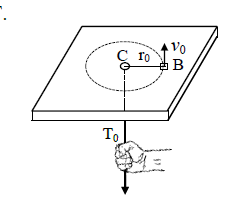
59. A small block B of mass $\mathrm{m}=0.25 \mathrm{~kg}$, lying on a frictionless horizontal table, is attached to a massless cord (breaking strength 40 N ) passing through a narrow hole C at the center of the table. Initially when the block is revolving in a circle of radius $\mathrm{r}_{0}=0.80 \mathrm{~m}$ about a vertical axis through the hole, with a tangential speed of $\mathrm{v}_{0}=4.00 \mathrm{~m} / \mathrm{s}$; the tension in the string is $\mathrm{T}_{0}$ and the kinetic energy of the block is $\mathrm{K}_{0}$. The string is then pulled down slowly from below, decreasing the radius of circular path from $\mathrm{r}_{0}$ to r so that the kinetic energy of the block is now K and the tension in the string is T .
As a result
(a) the tension $\mathrm{T}=\mathrm{T}_{0} \frac{\mathrm{r}_{0}^{4}}{\mathrm{r}^{4}}$
(b) the kinetic energy $\mathrm{K}=\mathrm{K}_{0} \frac{\mathrm{r}_{0}^{2}}{\mathrm{r}^{2}}$
(c) the radius r of the circular path just when the string breaks is 0.40 m
(d) the work done by the tension in the string in reducing the radius of circle from $\mathrm{r}_{0}$ to $\frac{\mathrm{r}_{0}}{2}$ is $4 \mathrm{~K}_{0}$
60. A circular coil of thin insulated copper wire ( $\mathrm{N}=2000$ turns), wrapped around an iron cylinder of cross-section area $\Delta \mathrm{S}=0.001 \mathrm{~m}^{2}$, is connected to a suspended type moving coil ballistic galvanometer. The suspended rectangular coil of the galvanometer is of mass $m=80 \mathrm{~g}$, length $\ell=5 \mathrm{~cm}$, breadth $\mathrm{b}=3$ cm and has $\mathrm{n}=100$ turns of fine copper wire wound on a non-metallic frame of ivory. This rectangular coil of the galvanometer is free to execute torsional oscillations in a radial magnetic field $\mathrm{B}=0.1$ tesla. The galvanometer is being used to measure the charge by employing the formula $\mathrm{q}=\frac{\mathrm{T}}{2 \pi} \frac{\mathrm{c}}{\mathrm{nAB}} \theta$. [Given that the moment of inertia of the oscillating coil about the vertical axis is $I=2.7 \times 10^{-6} \mathrm{~kg} \mathrm{~m}^{2}$ and the torsional constant (torsional rigidity) of the suspension fiber is $\mathrm{c}=3.0 \times 10^{-3} \mathrm{Nm} /$ radian : $\mathrm{A}=\ell \times b$ is the area of the coil]
When the magnetic induction of 1.0 weber per meter ${ }^{2}$, perpendicular to the plane of the circular coil, is reversed (in opposite direction), a deflection of 40 mm is observed on a scale placed 1.0 meter away in front of the reflecting mirror attached with the suspension fiber of the rectangular coil. The correct statement(s) is/are
(a) the time period of the oscillating rectangular coil is $\mathrm{T}=0.19 \mathrm{~s}$
(b) the net change in flux through the circular coil wrapped on the iron cylinder is 4.0 weber
(c) the induced charge in the circular coil wrapped on the iron cylinder is $\mathrm{q}_{\text {ind }}=240 \mu \mathrm{C}$
(d) total resistance of the circuit containing the circular coil is $\mathrm{R}=33.3 \mathrm{k} \Omega$
National Standard Examination in Physics - 2024
1. In the Bohr model of hydrogen atom, the force between the nucleus and the electron is modified as $F=\frac{e^2}{4 \pi \epsilon_0}\left(\frac{1}{r^2}+\frac{\delta}{r^3}\right)$ where $\delta$ is a small constant. Using the Bohr radius $a_0=\frac{\epsilon_0 h^2}{\pi m e^2}$, the radius of $n^{\text {th }}$ orbit is
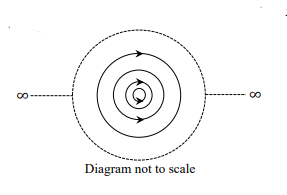
2. An infinite number of conducting rings having increasing radii $r_0, r_1, r_2, r_3$ and so on, such that $r_0=r, r_1=2 r, r_2=2^2 r, r_3=2^3 r$ and so on …. upto $\infty$, have been placed concentrically on a plane. All the rings carry the same current $i$ but the current in consecutive rings is in opposite direction as shown. The magnetic field produced at the common center of the rings is
3. One mole of an ideal monoatomic gas, initially at temperature T , is heated in such a way that its molar heat capacity during the process of heating is $\mathrm{C}=2 \mathrm{R}$. The volume of the gas gets tripled (at constant pressure) during the process. The final temperature attained by the gas is (a) 3 T (b) $3^2 \mathrm{~T}$ (c) $\frac{1}{3} \mathrm{~T}$ (d) $3^3 \mathrm{~T}$
4. A spring is compressed under the action of a constant force F . The compression of the spring is $\xi$. Suppose the direction of the force is reversed suddenly as well as its magnitude is doubled. The maximum extension of the spring beyond its natural length will now be (the spring obeys Hook's law). (a) $2 \xi$ (b) $3 \xi$ (c) $4 \xi$ (d) $5 \xi$
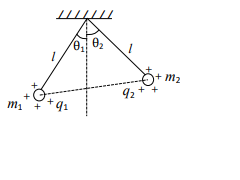
5. Two small positively charged spherical balls are suspended from a common point at the ceiling by non-conducting massless strings of equal length $\ell$. The first ball has mass $m_1$ and charge $q_1$ while the second ball has mass $m_2$ and charge $q_2$. If the two strings subtend angles $\theta_1$ and $\theta_2$ with the vertical as shown, then
6. An air filled parallel plate capacitor, with plate area A and plate separation d , is connected to a battery of emf V volt having negligible internal resistance. One of the plates of the capacitor vibrates with amplitude 'a' (a << d) and angular frequency $\omega$. If the instantaneous current in the circuit reaches a maximum value $\mathrm{I}_{0}$, the amplitude of the vibrations is ' a ' equal to\\
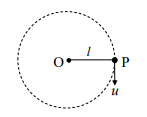
7. A small ball of mass $m$ is attached to one end of a massless un-stretchable string of length $\ell$ and is held at the point P . The other end of the string is fixed to a support at O such that OP is horizontal. The minimum downward speed $u$, that should be imparted to the ball at the point P so that the ball can complete the vertical circle without any slack in the string, is
(a) $\sqrt{2 g \ell}$
(b) $\sqrt{3 g \ell}$
(c) $\sqrt{4 g \ell}$
(d) $\sqrt{5 g \ell}$
8. An illuminated point object is placed on the principal axis, in front of an equi-convex glass lens of focal length $\mathrm{f}=40 \mathrm{~cm}$, at a distance of $\mathrm{u}=1.20 \mathrm{~m}$ from the lens. A reflecting plane mirror has been placed behind the lens perpendicular to the principal axis and facing the lens. The nature of the final image and the distance of the plane mirror from the lens, so as to form the final image at the plane mirror itself, is
(a) virtual image, 40 cm
(b) real image, 40 cm
(c) virtual image, 50 cm
(d) real image, 20 cm
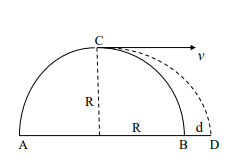
9. A ball is kicked horizontally from the top C of a hemispherical rock ACB of radius R on a horizontal ground, with a velocity $v$, so as not to hit the rock at any point during its flight.
Choose the correct statement (see the figure)
(a) The ball will just strike at B
(b) The ball will strike at D where $\mathrm{d}=\mathrm{BD}=(\sqrt{2}-1) \mathrm{R}$
(c) The ball will strike at D such that $\mathrm{d}=\mathrm{BD}=(2-\sqrt{2}) \mathrm{R}$
(d) The speed $v$ of the ball should always be greater than the critical speed $v_{0}$ where $v_{0}$ is $\sqrt{\frac{g R}{2}}$
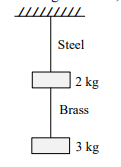
10. The ratio of lengths, radii and Young's moduli of steel to brass wires in the figure are $\alpha, \beta$ and $\gamma$, respectively. The corresponding ratio of the increase in their lengths is
(a) $\frac{2 \alpha}{3 \beta^{2} \gamma}$
(b) $\frac{5 \alpha}{3 \beta^{2} \gamma}$
(c) $\frac{2 \alpha \beta^{2}}{3 \gamma}$
(d) $\frac{5 \alpha \beta^{2}}{3 \gamma}$
11. A uniform beam of light of intensity $60 \mathrm{~mW} / \mathrm{m}^{2}$ is incident on a totally absorbing sphere of radius $2.0 \mu \mathrm{~m}$. The density of the material of the sphere is $\rho=5.0 \times 10^{3} \mathrm{~kg} / \mathrm{m}^{3}$. The sphere is placed in a region of space where gravitational force can be neglected / ignored. The magnitude of acceleration of the sphere due to the incidence of the light is
(a) $1.5 \mathrm{~ms}^{-2}$
(b) $3.0 \mathrm{~ms}^{-2}$
(c) $7.5 \mathrm{~ms}^{-2}$
(d) Zero
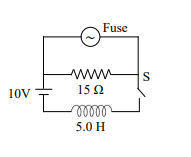
12. The fuse, in the upper branch of the circuit shown, is an ideal 4.0 A fuse. The fuse has zero resistance as long as current through it remains less than 4.0 A. The fuse blows out when the current reaches 4.0 A. Needless to say that the resistance becomes infinite thereafter. Switch S is closed at time $t=0$. The fuse blows out at time
(a) $t=2$ sec
(b) $t=4$ sec
(c) $t=8$ sec
(d) It won't blow
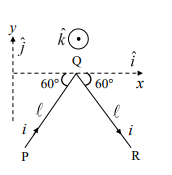
13. The bent wire PQR shown in the figure lies in a uniform magnetic field $\vec{B}=3.0 \hat{i}+4.0 \hat{k} T$. The direction $\hat{k}$ being normal to the plane of the paper and directed towards the viewer. The two straight sections PQ and QR of the wire each have length 2.0 m and the wire carries a current of 2.5 A. Net force on the wire due to magnetic field $\vec{B}$ is
(a) $40 \hat{\mathrm{j}} \mathrm{N}$
(b) $-20 \hat{\mathrm{j}} \mathrm{N}$
(c) $-40 \hat{\mathrm{j} ~ \mathrm{~N}}$
(d) $-20 \sqrt{3} \hat{\mathrm{j}} \mathrm{N}$
14. A charged spherical capacitor consists of two concentric spherical shells of radii a and $\mathrm{b}(\mathrm{b}>\mathrm{a})$. Half of the stored electrical energy of this system lies within a spherical region of radius r if
(a) $r=\sqrt{a b}$
(b) $r=\frac{a+b}{2}$
(c) $r=\frac{2 a b}{a+b}$
(d) $r=\frac{a^{2}+b^{2}}{a+b}$
15. Two stars of masses $M_{1}=M_{s}$ and $M_{2}=15 M_{s}$ (where $M_{s}=$ mass of the Sun) form a binary system. The stars are revolving round each other, always being at a separation of $\mathrm{d}=4 \mathrm{AU}$ between them ( 1 AU is distance of the Earth from the Sun), move in circular orbits about their center of mass. The period of revolution of each star is
(a) 1 year
(b) 2 years
(c) 4 years
(d) 8 years
16. The total energy released in $\alpha$ decay of a stationary Radium nucleus ${ }^{226} \mathrm{Ra}$ (mass 116 u ) is $\mathrm{Q}=4.9 \mathrm{MeV}$ (mass of $\alpha$ particle $\mathrm{m}_{\alpha}=4 \mathrm{u}$ ) then the
(a) energy of the recoiled daughter nucleus is nearly 8.7 keV
(b) energy of the recoiled daughter nucleus is nearly 4.81 MeV
(c) recoil speed of the daughter nucleus is $2.74 \times 10^{5} \mathrm{~ms}^{-1}$
(d) speed of emitted $\alpha$ particle is nearly $1.5 \times 10^{6} \mathrm{~ms}^{-1}$
17. A listener at rest (with respect to the air and the ground) hears a sound of frequency $f_{1}$ from a source moving towards him with a velocity of $15 \mathrm{~ms}^{-1}$, towards East. If the listener now moves towards the approaching source with a velocity of $25 \mathrm{~ms}^{-1}$, towards West, he hears a frequency $f_{2}$ that differs from $f_{1}$ by 40 Hz . The frequency $f$ of the sound produced by the source is (speed of sound in the air is $340 \mathrm{~ms}^{-1}$ )
(a) 520 Hz
(b) 450 Hz
(c) 480 Hz
(d) 550 Hz
18. A uniform rod of length $\ell$ swings from a pivot as a physical pendulum. The position of the pivot can be varied along the length of the rod. The minimum time period with which the rod can oscillate with an appropriate position of the pivot is $T=2 \pi \sqrt{\frac{L}{g}}$ where $L$ is equal to
(a) $\frac{\ell}{2}$
(b) $\frac{\ell}{\sqrt{2}}$
(c) $\frac{\ell}{\sqrt{3}}$
(d) $\frac{\ell}{2 \sqrt{3}}$
19. The number density of conduction electrons in pure silicon at room temperature is about $10^{16} \mathrm{~m}^{-3}$. The number density of conduction electrons is increased by a factor of $10^{6}$ by doping the silicon lattice with phosphorus. Assume that at room temperature every phosphorus atom contributes one electron to the conduction band. The fraction of silicon atoms replaced by phosphorus atoms is (Given that the density of silicon is $2.33 \mathrm{gm} / \mathrm{cm}^{3}$ and that the molar mass of silicon $\mathrm{M}=28.1 \mathrm{gm}$ )
(a) $1.0 \times 10^{-7}$
(b) $2.0 \times 10^{-7}$
(c) $4.0 \times 10^{-7}$
(d) $5.0 \times 10^{-7}$
20. A soap bubble 10 cm in radius, with a film thickness of $\frac{10}{3} \times 10^{-6} \mathrm{~cm}$, is charged to a potential of 80 V . The bubble bursts and converts into a single spherical drop. Assuming that the soap solution is a good conductor, the potential at the surface of the drop is
(a) 2 kV
(b) 4 kV
(c) 6 kV
(d) 8 kV
21. Three resistances, each of $\mathrm{R}=4 \Omega$ rated 16 W , are connected across A and B as shown. Potential difference of $V$ volt is applied between points $A$ and $B$.
Statement 1: Maximum potential difference V that can be applied is 12 volt.
Statement 2: Maximum power that can be dissipated is 24 watt.
(a) Statements 1 and 2 both are wrong
(b) Statement 1 is correct but statement 2 is wrong
(c) Statement 1 is wrong but statement 2 is correct
(d) Statements 1 and 2 both are correct
22. Water is filled in a vertical cylinder up to a certain height h . The cylinder is made to rotate with an angular velocity $\omega$ about a vertical axis coinciding with the axis of the cylinder. The water surface seen from top appears as a/an
(a) ellipsoid
(b) hemisphere
(c) paraboloid
(d) hyperboloid
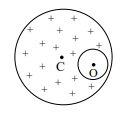
23. A uniformly charged non-conducting sphere with its center at C carries positive charge with uniform charge density $+\rho$, except in a spherical cavity (inside the sphere) with center O . The electric field $\mathbf{E}$ at any point inside the cavity is
(a) zero
(b) uniform
(c) directed radially outward
(d) directed radially inward
24. A cylindrical tank with base area $\mathrm{A}=0.05 \mathrm{~m}^{2}$ is filled with water up to a height $\mathrm{H}=50 \mathrm{~cm}$. There is a small hole of area $a=0.001 \mathrm{~m}^{2}(a \ll \mathrm{~A})$ in the bottom of the tank. It takes time t to empty the tank up to a height $\frac{\mathrm{H}}{2}$ (i.e to empty half of the water volume). The additional time required to empty the tank completely is
(a) t
(b) $t \sqrt{2}$
(c) $\mathrm{t}(\sqrt{2}-1)$
(d) $\mathrm{t}(\sqrt{2}+1)$
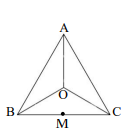
25. OABC is a regular tetrahedron, each side of which is made of uniform wire of resistance $4 \Omega / \mathrm{m}$. The length of each side is 2 m . The point M is the midpoint of the side BC . The resistance between O and M is
(a) $5 \Omega$
(b) $4 \Omega$
(c) $10 \Omega$
(d) $15 \Omega$
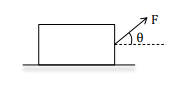
26. A box weighing W is placed on a rough horizontal floor. The coefficient of static friction between the box and the floor is $\mu$. To move the box, a pulling force F is applied along the rope joined to the box at an angle $\theta$ with horizontal. By suitable choice of $\theta$, the minimum value of $F$ that can make the box move is
(a) $\mu \mathrm{W}$
(b) $\frac{\mathrm{W}}{\sqrt{1+\mu^{2}}}$
(c) $\frac{\mu \mathrm{W}}{\sqrt{1+\mu^{2}}}$
(d) $\frac{W \sqrt{1-\mu^{2}}}{\mu}$
27. The external wall of a room measuring $2 \mathrm{~m} \times 3 \mathrm{~m}$ consists of a layer of white pine of thickness $\mathrm{d}_{\text {pine }}=2.0 \mathrm{~cm}$ and a layer of rock wool in succession. The external temperature is 36 K below the indoor temperature (Given the thermal conductivity coefficient of white pine $\mathrm{K}_{\mathrm{P}}=0.10 \mathrm{Wm}^{-1} \mathrm{kelvin}^{-1}$ and that of rock wool $\mathrm{K}_{\mathrm{w}}=0.04 \mathrm{Wm}^{-1}$ kelvin $^{-1}$ ). The thickness of the layer of the rock wool, so that the thermal conduction rate $\mathrm{P}_{\text {cond }}=\frac{\mathrm{dQ}}{\mathrm{dt}}$ across the wall does not exceed 120 watt (assuming no loss of heat during conduction and no other way of heat transfer other than conduction), is
(a) 7.2 cm
(b) 6.4 cm
(c) 4.8 cm
(d) 0.8 cm
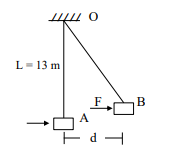
28. A 240 kg block is suspended from a fixed point O , at the end of a long ( $\mathrm{L}=13 \mathrm{~m}$ ) massless rope. A horizontal force F slowly pushes the block to move it a horizontal distance $\mathrm{d}=5 \mathrm{~m}$ sideways, to a position B where it remains stationary as shown in the figure.
Statement 1 Force F at position B is 980 N.
Statement 2 Work done by the force to bring the box from A to B is 2352 J
(a) Only statement 1 is correct
(b) Only statement 2 is correct
(c) Both statements 1 and 2 are wrong
(d) Both statements 1 and 2 are correct
29. The number of radioactive nuclei N of a radioactive sample is experimentally measured as a function of time t . At $\mathrm{t}=0, \mathrm{~N}(\mathrm{t}=0)=50,000$ and at $\mathrm{t}=10 \mathrm{~s}, \mathrm{~N}(\mathrm{t}=10 \mathrm{~s})=5000 \pm 100$. The half-life of the sample is estimated from these measurements. The error in the estimation of the half-life is approximately [note that for small values of $x, L t x \rightarrow 0, \ln (1+x) \approx x$ ]
(a) 0.26 s
(b) 0.15 s
(c) 0.05 s
(d) 0.10 s
30. An amount of heat equal to 10.61 J is given to an ideal gas at constant pressure of one atm ( $1.01 \times 10^{5} \mathrm{~Pa}$ ). As a result the volume of the gas increases by $30.0 \mathrm{~cm}^{3}$. The gas is
(a) mono atomic
(b) diatomic
(c) tri-atomic
(d) mixture of monoatomic and diatomic
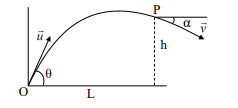
31. A ball is projected from point O on the ground with a certain velocity $\vec{u}$ at angle $\theta$ from horizontal. When it reaches point P located at a horizontal distance L from O and is at a height h above the ground, the angle $\alpha$ subtended by the velocity vector $\vec{v}$ with horizontal at this point P is expressed as
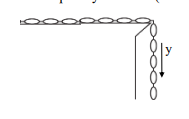
32. A flexible chain, of length L and uniform mass per unit length $\lambda$, slides off the edge of a frictionless table (see figure). Initially a length $y=y_{0}$ of the chain hangs over the edge, with the chain held at rest. Now the chain is let free. The velocity of the chain when the chain becomes completely vertical (i.e. when the chain is just to leave the edge) is
33. A Keplerian telescope is adjusted in its normal setting for parallel rays. Mounting of the objective has diameter D and the diameter of the image of that mounting formed by the eye piece of the telescope is d . Magnifying power of the telescope is
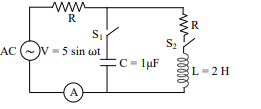
34. In the circuit shown below, the resistance $\mathrm{R}=\sqrt{3} \times 10^{3} \Omega$, the inductance $\mathrm{L}=2 \mathrm{H}$ and the capacitance $\mathrm{C}=1 \mu \mathrm{~F}$ have been connected to an AC supply of the peak voltage of $\mathrm{V}_{\max }=5$ volt at a frequency $\omega$. Either the switch $\mathrm{S}_{1}$ or the switch $\mathrm{S}_{2}$ is closed at a time. In either case, same maximum current ( $\mathrm{i}_{\text {max }}$ ) is recorded in the circuit. The frequency of the AC source is nearly
(a) 1.5 kHz
(b) 500 Hz
(c) 326 Hz
(d) 126 Hz
35. There are two given physical quantities $A=\frac{F}{\rho v^{2} D}$ and $B=\frac{\rho v D}{\eta}$ where $F$ is force, $\rho$ is density, $D$ is diameter, $v$ is velocity and $\eta$ is the Coefficient of viscosity. Which of the two A and B is/are dimensionless?
(a) A
(b) B
(c) neither A nor B
(d) both A and B
36. A uniform inextensible string of length L and mass M is suspended vertically from a rigid support. A transverse pulse is allowed to propagate down through the string from the support. At the same time, a ball of mass $m$ is dropped from the rigid support. The ball will pass the pulse at a distance of (from the top of the string i.e. from the support)
(a) $\frac{15 \mathrm{~L}}{16}$
(b) $\frac{8 \mathrm{~L}}{9}$
(c) $\frac{\mathrm{L}}{2}$
(d) $\frac{3 \mathrm{~L}}{4}$
37. In a positron decay, the radionuclide ${ }^{11} C$ decays according to ${ }^{11} C \longrightarrow{ }^{11} B+e^{+}+v$ [the respective atomic masses are ${ }^{11} C=11.01142 u,{ }^{11} B=11.00931 u$ and the mass of positron $=$ the mass of electron $\left.=m_{e}=0.00055 u\right]$. The disintegration energy (i.e. the Q value) is approximately
(a) 1.45 MeV
(b) 0.94 MeV
(c) 0.43 MeV
(d) -1.45 MeV
38. Two mechanical waves, given by $y_{1}=A \sin (8 x-50 t)$ and $y_{2}=A \sin \left(8 x+50 t+\frac{\pi}{3}\right)$ travelling in opposite directions along $x$ - axis, superpose. The position of the node (for $x>0$ ) nearest to the origin is (the displacements $\mathrm{y}_{1}$ and $\mathrm{y}_{2}$ are in meter)
(a) 32.7 cm
(b) 16.35 cm
(c) 6.54 cm
(d) 5.45 cm
39. At a certain location on the Earth surface, the intensity of sunlight is $1.00 \mathrm{~kW} / \mathrm{m}^{2}$. A perfectly reflecting concave mirror, of radius of curvature R and aperture radius r , is facing the Sun to produce the light intensity of $100 \mathrm{~kW} / \mathrm{m}^{2}$ at the image. Knowing that the disc of the Sun subtends an angle of 0.01 radian at the Earth surface, the relation between $R$ and $r$ is
(a) $\mathrm{R}=10 \mathrm{r}$
(b) $R=20 r$
(c) $R=40 r$
(d) $r=20 R$
40. A charge Q is uniformly distributed throughout the volume of a non-conducting sphere of radius R . The total electrostatic energy of electric field inside the sphere is $U=\alpha \times \frac{Q^{2}}{4 \pi \epsilon_{0} R}$. The value of $\alpha$ is
(a) Zero
(b) $\frac{3}{5}$
(c) $\frac{1}{2}$
(d) $\frac{1}{10}$
41. A long straight vertical wire of circular cross section of radius R contains $n$ conduction electrons per unit volume. A current I flows upward in the wire. The expression for magnetic force on an electron at the surface of the wire is [Assume all the conduction electrons are moving with drift velocity]
42. In Young's double slit experiment, a bright fringe is observed at $\mathrm{y}=1.5 \mathrm{~cm}$ from the center of the fringe pattern when monochromatic light of wavelength 612 nm is used. The screen is at 1.4 m from the plane of the two slits, whose separation is 0.4 mm . The number of dark fringes between the center and the said bright fringe at $\mathrm{y}=1.5 \mathrm{~cm}$ is
(a) 13
(b) 8
(c) 7
(d) 6
43. An illuminated point object is placed in front of an equi-convex lens of refractive index $\mu=1.5$ and focal length $\mathrm{f}=40 \mathrm{~cm}$, at a distance of $\mathrm{u}=1.20 \mathrm{~m}$ in front of the lens on its principal axis. Water ( $\mu=4 / 3$ ) fills the space behind the lens up to a distance of 40 cm from the lens. The final image is formed on the principal axis beyond the lens at a distance v from the lens. The value of v and the nature of image are
(a) 60 cm , virtual
(b) 80 cm , virtual
(c) 110 cm , real
(d) 130 cm , real
44. A paramagnetic gas at room temperature $27^{\circ} \mathrm{C}$ is placed in an external uniform magnetic field of magnitude $\mathrm{B}=1.5$ tesla . The atoms of the gas have magnetic dipole moment $\mu=1.0 \mu_{\mathrm{B}}$ where $1 \mu_{\mathrm{B}}=\frac{\mathrm{eh}}{4 \pi \mathrm{~m}}$ is Bohr magneton, and m is the mass of electron. The energy difference $\Delta \mathrm{U}_{\mathrm{B}}$ between the parallel alignment and the antiparallel alignment of the atom's magnetic dipole moment, with respect to the external field B , is $x \times 10^{-4} \mathrm{eV}$ where the value of $x$ is
(a) 17.4
(b) 1.74
(c) 34.8
(d) 8.7
45. A glass capillary with inner diameter of 0.40 mm is vertically submerged in water so that the length of its part protruding above the water surface is $\mathrm{h}=25 \mathrm{~mm}$. Surface Tension of water is $\mathrm{T}=0.073 \mathrm{Nm}^{-1}$. Since the water wets the glass completely, it may be concluded that the
(a) length of capillary above the water surface is insufficient so the water will flow out as a fountain
(b) water will rise up to the brim forming a meniscus of radius 1.2 mm at the top
(c) water will rise up to the brim forming a meniscus of radius 0.6 mm at the top
(d) water will rise up to the brim forming a meniscus of radius equal to radius of the capillary
46. The container A in the figure holds an ideal gas at a pressure of $5.0 \times 10^{5} \mathrm{~Pa}$ at $27^{\circ} \mathrm{C}$. It is connected to the container B by a thin tube fitted with a closed valve. Container B with volume four times the volume of A holds the same ideal gas at a pressure $1.0 \times 10^{5} \mathrm{~Pa}$ at $127{ }^{\circ} \mathrm{C}$. The valve is now opened to allow the pressure to equalize, but the temperature of each container is maintained as before. The common pressure in the two containers (in kPa ) is
(a) 200
(b) 300
(c) 320
(d) 180
47. A thin plastic disc, which is a quarter of a circle of radius $\mathrm{R}=0.6 \mathrm{~m}$, lies in the first quadrant of $\mathrm{x}-\mathrm{y}$ plane, with the center of curvature at the origin O as shown. It is charged uniformly on one side (one face) with surface charge density $\sigma$. Electric potential at point $\mathrm{P}(0,0,0.8 \mathrm{~m})$ is
(a) $\frac{\sigma}{8 \epsilon_{0}}$
(b) $\frac{\sigma}{8 \pi \epsilon_{0}}$
(c) $\frac{\sigma}{20 \epsilon_{0}}$
(d) $\frac{\sigma}{40 \epsilon_{0}}$
48. The charge on a small point object at A produces an electric potential $\mathrm{V}=3$ volt at a point P . Because of an unavoidable situation, leakage of the charge from the object at A starts at $\mathrm{t}=0$ at a constant rate of $3 \mu \mathrm{Cs}^{-1}$. To maintain the potential of 3 volt at the point P , the object is made to move towards P with a certain velocity $v$. When the point object crosses the point D shown in the figure, it is found to have a charge of $10 \mu \mathrm{C}$ and the direction of its velocity is perpendicular to OD. The resulting magnetic field $\mathbf{B}$, at this instant, at the location O (such that $\mathrm{OD}=1.0 \mathrm{~m}$ ) is
(a) $8.1 n T$
(b) $\frac{1}{9} \mu T$
(c) $9.9 \mu \mathrm{~T}$
(d) $9.0 n T$
49. An electric circuit consists of a battery of emf $E$, an inductance $L$ and a resistance $R$ in series. The switch S is closed at $\mathrm{t}=0$. The current in the circuit grows exponentially with time as depicted by curve (1). The values of the circuit parameters (E, L or R) are now somehow changed. The circuit is closed second time, the growth of current I follows curve (2). The following conclusion(s) may be drawn
(a) E and R are unchanged but L has increased
(b) $\frac{E}{R}$ is unchanged but $\frac{L}{R}$ has increased
(c) $\frac{E}{R}$ is unchanged but $\frac{L}{R}$ has decreased
(d) Stored magnetic energy has increased
50. The Earth is revolving around the Sun (mass M ) in a circular orbit of radius r with a period of revolution $T=1$ year. Suppose that during the revolution of the Earth, at any instant, the mass of the Sun instantaneously becomes double i.e. 2M. The correct alternative(s) is/are [Assume that the Sun and the Earth are point masses]
(a) The period of revolution of the Earth around the Sun now becomes $\frac{1}{\sqrt{2}}$ year
(b) There is no change in angular momentum of the Earth around the Sun
(c) Minimum distance of the Earth from Sun during revolution is now $\frac{r}{3}$
(d) Maximum speed of the Earth during revolution around the Sun is $3 \sqrt{\frac{G M}{r}}$
51. An optical fibre consists of a glass core (refractive index $\mathrm{n}_{1}$ ) surrounded by a cladding (refractive index $n_{2}<n_{1}$ ). A beam of light enters one end of the fibre at P , from air at angle $\theta$, with the axis of fibre as shown in the figure. Choose the correct option(s)
(a) Maximum value of $\theta$ for which a ray can travel down the fibre is $\theta=\sin ^{-1} \sqrt{n_{1}^{2}-n_{2}^{2}}$
(b) Maximum value of $\theta$ for which a ray can travel down the fibre is $\theta=\cos ^{-1} \sqrt{n_{1}^{2}-n_{2}^{2}}$
(c) If $\theta=30^{\circ}$ (in air) and $n_{1}=1.50$, then for reflection just at the critical angle, the value of $n_{2}$ is $\sqrt{2}$
(d) A ray entering at $\theta=0$ travels a distance L from P to Q , inside the fibre directly along the fibre axis. Another ray travelling through fibre is repeatedly reflected at the critical angle, at interface of glass core and surrounding layer/cladding. Both the rays travel from point P to point Q on the axis. If the two rays started from point P at the same time, the difference $\Delta t$ in the time taken to reach the point Q by the two rays is $\Delta t=\frac{n_{1}}{n_{2}} \times \frac{L}{c}\left(n_{1}-n_{2}\right)$ (here c is the speed of light in vacuum)
52. A series LCR circuit fed with AC has resonant angular frequency of $\omega=2.0 \times 10^{4} \mathrm{rad} / \mathrm{s}$. When the same circuit is driven at an angular frequency of $2.5 \times 10^{4} \mathrm{rad} / \mathrm{s}$, it has an impedance of $1.0 \mathrm{k} \Omega$ and phase constant of $\phi=45^{\circ}$. The values of $\mathrm{L}, \mathrm{C}$ and R for this circuit may be
(a) $\mathrm{R}=707 \Omega$
(b) $\mathrm{L}=78.6 \mathrm{mH}$
(c) $\mathrm{C}=31.8 \mathrm{nf}$
(d) $\mathrm{R}=506 \Omega$
53. A long straight wire, having a radius greater than 4.0 mm , carries a current that is uniformly distributed over its cross - section. The magnitude of magnetic field $\mathbf{B}$ due to the current is 0.28 mT at $\mathrm{r}=4.0 \mathrm{~mm}$ and 0.20 mT at $\mathrm{r}=10.0 \mathrm{~mm}$, respectively, from the axis of the wire then the
(a) magnitude of the magnetic field $\mathbf{B}$ at a distance $\mathrm{r}=2.0 \mathrm{~mm}$ from axis is 0.14 mT
(b) magnitude of the magnetic field $\mathbf{B}$ at $\mathrm{r}=5.0 \mathrm{~mm}$ is greater than that at $\mathrm{r}=6.0 \mathrm{~mm}$
(c) current flowing in the wire is $\mathrm{I}=20 \mathrm{~A}$
(d) current density in the wire is $\mathrm{J} \approx 1.1 \times 10^{5} \mathrm{~A} / \mathrm{m}^{2}$
54. In the given combination of capacitors $\mathrm{C}_{1}=4 \mu \mathrm{~F}, \mathrm{C}_{2}=2 \mu \mathrm{~F}, \mathrm{C}_{3}=2 \mu \mathrm{~F}, \mathrm{C}_{4}=4 \mu \mathrm{~F}$ and $\mathrm{C}_{5}=3 \mu \mathrm{~F}$, a source of 12 volt is connected across the points A and B . Then the
(a) equivalent capacity between A and B is $\frac{8}{3} \mu \mathrm{~F}$
(b) stored electrical energy of the system is $204 \mu \mathrm{~J}$
(c) potential difference between X and Y is $\mathrm{V}_{\mathrm{XY}}=2$ volt
(d) potential difference across the capacitor $\mathrm{C}_{2}$ is 8 volt
55. One mole of an ideal monoatomic gas, initially at temperature $T$, is compressed to $\frac{1}{8}$ of its volume by a piston in a cylinder such that the heat dissipated into the environment is equal to the change in the internal energy of the gas. Then the
(a) molar heat capacity of the gas is $\mathrm{C}=\frac{3 \mathrm{R}}{2}$
(b) final temperature of the gas is 2 T
(c) work done on the gas is 3 RT
(d) equation of state of the process is $\mathrm{PV}^{4 / 3}=$ constant
56. A solid ball of mass M and radius R (see figure) is lying on a horizontal table. The ball experiences a short horizontal impulse which imparts a momentum p to the ball. The height of point of impact above the center line is $\mathrm{h}=\alpha \mathrm{R}(0 \leq \alpha \leq 1)$. Choose the correct option/option(s).
(a) Translational energy of the ball is $\frac{p^{2}}{2 M}$
(b) Energy of pure rotational motion of the ball is $\frac{5}{4} \frac{\mathrm{p}^{2} \alpha^{2}}{\mathrm{M}}$
(c) For $\alpha=\frac{2}{5}$, the ball rolls without sliding
(d) For $\alpha=0$, pure rotational motion will be observed
57. According to Bohr theory, in the ground state of hydrogen atom, an electron revolves in circular orbit of radius $r$ with velocity $v$ and circulation frequency $f$. The magnetic dipole moment of the electronic orbit is $p_{m}$. The magnetic field produced by the circulating electron at the center of the atom is $\mathbf{B}$. Then for a $\mathrm{He}^{+}$ion in the state $\mathrm{n}=2$ (electron in the $2^{\text {nd }}$ orbit)
(a) the radius of the orbit is 2 r
(b) the magnetic dipole moment of the orbit is $2 p_{m}$
(c) the frequency of circulation is $\frac{f}{2}$
(d) the magnetic field at the center is $\frac{\mathrm{B}}{4}$
58. A body of mass $\mathrm{m}=0.25 \mathrm{~kg}$ is moving along $x$ axis under the action of a conservative force. Its potential energy as a function of position $x$ is given by $\mathrm{U}(x)=-\frac{100 x}{x^{2}+4} \mathrm{~J}(x$ in m). Then
(a) force $\mathrm{F}(x)$ acting on the body at $x=0$ is 25 N
(b) there is stable equilibrium at $x=2 \mathrm{~m}$
(c) there is unstable equilibrium at $X=-2 \mathrm{~m}$
(d) the body executes (small) oscillations with angular frequency $\omega=0.5 \mathrm{rads}^{-1}$
59. A uniform rod OA of length L is freely pivoted at one end O . Let C be the midpoint (i.e. $\mathrm{OC}=\frac{\mathrm{L}}{2}=\mathrm{CA}$ ).
Choose the correct statement(s)
(a) The rod can perform small angular oscillations with time period $\mathrm{T}=2 \pi \sqrt{\frac{\mathrm{~L}}{2 \mathrm{~g}}}$
(b)The rod is brought to the horizontal position and then released from rest. The angular velocity of the rod at the instant when it is vertical is $\omega=\sqrt{\frac{3 g}{\mathrm{~L}}}$
(c) When the oscillating rod comes to the vertical position, it breaks at midpoint C without generating any impulsive force, the largest angle from vertical reached by the upper part OC of the rod is $60^{\circ}$.
(d)After breaking, the lower part just falls vertically rotating about its center.
60. A boy stands on a stationary ice boat on a frictionless horizontal flat iceberg. The boy and the boat have a combined mass of $M=60 \mathrm{~kg}$. Two balls of masses $m_{1}=10 \mathrm{~kg}$ and $m_{2}=20 \mathrm{~kg}$ are placed on the boat. In order to get the boat moving, the boy throws the balls backward horizontally either in succession or both together. In each case the balls are thrown backward with a certain speed $v_{\text {rel }}=6 \mathrm{~ms}^{-1}$ relative to the boat just when the ball is being thrown. The resulting speed of the system of the boat and the boy is
(a) $V=2.00 \mathrm{~ms}^{-1}$ when both the balls $\mathrm{m}_{1}$ and $\mathrm{m}_{2}$ are thrown together.
(b) $\mathrm{V}=3.00 \mathrm{~ms}^{-1}$ when both the balls $\mathrm{m}_{1}$ and $\mathrm{m}_{2}$ are thrown together.
(c) $V=2.17 \mathrm{~ms}^{-1}$ if the balls are thrown one after the other, first $m_{1}$ and then $m_{2}$.
(d) $V=2.19 \mathrm{~ms}^{-1}$ if the balls are thrown one after the other, first $\mathrm{m}_{2}$ and then $\mathrm{m}_{1}$.
NSEJS (2020) - Problems & Solution
Problem 1
Gravitational collapse is the contraction of an astronomical object under its own gravity. This draws the matter inwards towards the centre of gravity. A neutron star is an example of the collapsed core of a giant star. A certain neutron star of radius 10 km is of mass \(1.5 M_{\odot}\). The acceleration due to gravity on the surface of the neutron star is nearly
The tympanic membrane (ear drum) is a very delicate component of the human ear. Typically, its diameter is 1 cm . The maximum force the ear can withstand is 2.5 N . In case a diver has to enter sea water of density \(1.05 \times 10^3 \mathrm{~kg} / \mathrm{m}^3\) without any protective gear, the maximum safe depth for the diver to go into water is about
(a) 12 m (b) 9 m (c) 3 m (d) 1.5 m
Problem 3
Two illuminated point objects \(\mathrm{O}_1\) and \(\mathrm{O}_2\) are placed at a distance 24 cm from each other along the principal axis of a thin convex lens of focal length 9 cm such that images of both the objects are formed at the same position. Then the respective distances of the lens from \(\mathrm{O}_1\) and \(\mathrm{O}_2\) (in cm ) are
(a) 12 and 12 (b) 18 and 6 (c) 14 and 10 (d) 16 and 8
Problem 4
A nuclear reactor is working at \(30 \%\) efficiency (i.e. conversion of nuclear energy to electrical energy). In this reactor \({ }_{92}^{235} \mathrm{U}\) nucleus undergoes fission and releases 200 MeV energy per atom. If 1000 kW of electrical power is obtained in this reactor, then the number of atoms disintegrated (undergone fission) per second in the reactor is
Two blocks A and B are in contact with each other and are placed on a frictionless horizontal surface. A force of 90 N is applied horizontally on block A (situation I) and the same force is applied horizontally on block B (situation II). Mass of A is 20 kg and B is 10 kg . Then the correct statement is
(a) Since both the blocks are in contact, magnitude of force by block A on B will be 90 N (situation I) and magnitude of force by block B on A will also be 90 N (situation II). (b) Magnitude of force by block A on B is 30 N (situation I ) and magnitude of force by block B on A is 60 N (situation II). (c) Magnitude of force by block A on B is 60 N (situation I ) and magnitude of force by block B on A is 30 N (situation II). (d) The 90 N force will produce acceleration of different magnitudes in A and B .
Problem 6
In the adjoining circuit, \(R=5 \Omega\). It is desired that the voltage across \(R_x\) should be 6 V , then the value of \(R_x\) should be
An infinitely long conductor when carrying current (I), produces a magnetic field (B) around it. If such a conductor is placed along the X-axis, then the magnitude of (B) at a distance (r) is given by the relation \(B=\frac{\mu_0}{4 \pi} \frac{2 I}{r}\), (where \(\frac{\mu_0}{4 \pi}=10^{-7} \mathrm{NA}^{-2}\) is a constant). The following figure shows such an infinitely long conductor placed along X -axis carrying current (I) and (B) at (S) is \(2 \times 10^{-4} \mathrm{~T}\), directed into the plane of the paper at S. Given \(r=1 \mathrm{~cm}\). Then, the correct statements are
(a) \(I=10 \mathrm{~A}\) (b) The number of electrons transported across the cross section of the conductor during time 1 s is \(6.25 \times 10^{19}\) (c) The direction of current (I) is from \(X_2\) to \(X_1\). (d) The electrons will flow in the direction \(\mathrm{X}_2\) to \(\mathrm{X}_1\).
Problem 8
The ratio of the charge of an ion or subatomic particle to its mass \((q / m)\) is called specific charge. Then the correct options are
(a) SI unit of specific charge can be written as \(\mathrm{A} \cdot \mathrm{s} / \mathrm{kg}\). (b) If all the isotopes of hydrogen are ionized then tritium will have least specific charge among them. (c) specific charge of an \(\alpha\)-particle will be greater than that of an electron. (d) specific charge ratio of an electron is \(1.75 \times 10^{11} \mathrm{C} / \mathrm{kg}\).
Problem 9
A girl (G) walks into a room along the path shown by the dashed line (see figure on right). She tries to observe images of small toys numbered 1,2 , and 3 in the plane mirror on the wall. The order in which she will see images of the toys is:
(A) 3,2,1 (B) 3,2 (C) 1, 2, 3 (D) 2, 3
Problem 10
A heating element in the form of a wire with uniform circular cross sectional area has a resistance of \(310 \Omega\), and can bear a maximum current of 5.0 A . The wire can be cut into pieces of equal length. The number of pieces, arranged suitably, so as to draw maximum power when connected to a constant voltage of 220 V , is
(A) 7 (B) 8 (C) 44 (D) 62
Problem 11
Consider the following two statements Statement \(S_1\): If you put 100 g ice at \(0^{\circ} \mathrm{C}\) and 100 g water at \(0^{\circ} \mathrm{C}\) into a freezer, which is maintained at \(-10^{\circ} \mathrm{C}\), the ice will eventually lose the lager amount of heat. Statement \(S_2\) : At \(0^{\circ} \mathrm{C}\), water is denser than ice Choose the correct statement among the following.
(A) Both \(S_1\)and \(S_2\) are true and \(S_2\) is the correct explanation of \(S_1\) (B) Both \(S_1\) and \(S_2\) are true and \(S_2\) is not the correct explanation of \(S_1\) (C) \(S_1\) is true but \(S_2\) is false (D) \(S_1\) is false but \(S_2\) is true
Problem 12
Consider the paths of (1) Halley's Comet near the sun, and (2) an alpha particle scattered by a nucleus. In the figures below, the dots represent the Sun/Nuclei, and the curves with arrows mark the paths of the comet/alpha particle schematically.The correct statement about the trajectories is
(A) I represents trajectory for Halley's Comet and II for the scattering of alpha particles. (B) III represents trajectory for Halley's Comet and II for the scattering of alpha particles (C) II represents trajectory for Halley's Comet and I for scattering of alpha particles (D) II represents trajectory for Halley's Comet and III for scattering for scattering of alpha particles.
NSEJS [2010] Problems & Solution
Problem 1
Which one of the following statements is INCORRECT?
(A) If the net force on a body is zero, its velocity is constant or zero (B) If the net force on a body is zero, its acceleration is constant and (C) If the velocity of a body is constant, its acceleration is zero (D) A body may have a varying velocity yet a constant speed
Problem 2
Two forces each of magnitude (P) act on a body placed at a point (O) as shown. The force necessary to keep the body at rest is of magnitude.
(A) P along +X axis (B) P along - X axis (C) 2 P along +X axis (D) P/2 along - X axis
Problem 3
Two spheres having masses 10 g and 25 g are projected horizontally from the same height with velocities \(v_1\) and \(v_2\) and they fall to the ground in time intervals \(t_1\) and \(t_2\) respectively. If the ratio \(v_1: v_2\) is \(1: 3\), the ratio \(t_1: t_2\) will be
A convex lens \(L_1\) forms an image of the same size as that of the object at a distance of 24 cm . If the lens \(\mathrm{L}_1\) is replaced by another convex lens \(\mathrm{L}_2\), the image formed is magnified and erect. Therefore, the focal lenght of \(L_2\) is
(A) less than 12 cm (B) 12 cm (C) between 12 cm and 24 cm (D) more than 24 cm
Problem 6
A wooden ball of density \(0.8 \mathrm{~g} / \mathrm{cm}^3\) is placed in water. The ratio of the volume above the water surface to that below the water surface is
(A) 0.25 (B) 0.20 (C) 2.0 (D) 4.0
Problem 7
A stone is released from an elevator moving upwards with an acceleration (a). The acceleration of the stone after the release is
A converging beam of light falls on a convex mirror of radius of curvature 20 cm , the point of convergence being 10 cm behind the mirror. The image is
(A) virtual and formed 10 cm in front of the mirror (B) real and formed in front of the mirror (C) formed at infinity (D) virtual and formed 10 cm behind the mirror
Problem 9
When a sound wave moves through air along (X) axis, there is a variation in density of air in this direction. The graphical representation of this variation for two sound waves A and B is as shown. Which of the following statements is correct?
(A) Frequency of A is greater than that of B (B) Velocity of B is greater than that of A (C) Wavelength of B is greater than that of A (D) Loudness of A is greater than that of B
Problem 10
In the figure shown below, each of the lenses has a focal length of 10 cm. Therefore, the image formed by the combination of lenses is
(A) virtual, erect and magnified (B) virtual, inverted and diminished (C) virtual, erect and diminished (D) real, erect and diminished
Problem 11
A convex mirror used as the rear view mirror of a motor vehicle has a warning written on it - 'Objective in this mirror are nearer than they appear'. The reason for this warning is that
(A) the image is diminished (B) the image distance is less than the focal length of the mirror (C) the image distance is less than the object distance (D) the image distance is more than the object distance
Problem 12
A uniform wire of resistance 36 ohm is bent into a circle. A battery is connected between points (A) and (B) as shown. The effective resistance between (A) and (B) is
(A) 36 ohm (B) 30 ohm (C) 6 ohm (D) 5 ohm
Problem 13
On North Pole, when the surface of sea gets frozen due to cold weather, eskimos can still fish by cutting a portion of ice at the surface to find water underneath. This is possible because water
(A) has low thermal conductivity (B) has high specific heat (C) has high surface tension (D) shows anomalous behaviour
Problem 14
A, DC current flows through a vertical wire in the downward direction. For an observer looking at the wire, the direction of magnetic field at a point between him and the wire is
(A) upward (B) to the right (C) to the left (D) downward
Problem 15
A number of electric bulbs of rating 220 volt, 100 watt are to be connected in parallel to a 220 volt supply. If a 5 A fuse wire is used for this arrangement to bulbs, the maximum number of bulbs that can be included in the arrangement will be
(A) 10 (B) 11 (C) 22 (D) 44
Problem 16
In the circuit given below, AB is a thick copper wire and S is a switch. When the switch is closed, the effective resistance of the circuit will be
In figure (1) ammeter reads \(I_1\) and voltmeter reads \(V_1\). Similarly, in figure (2) ammeter reads \(I_2\) while voltmeter reads \(\mathrm{V}_2\). Then which of the following statements is correct?
(A) \(\mathrm{V}_1>\mathrm{V}_2\) and \(\mathrm{I}_1>\mathrm{I}_2\) (B) \(\mathrm{V}_1>\mathrm{V}_2\) and \(\mathrm{I}_1<\mathrm{I}_2\) (C)\(\mathrm{V}_1<\mathrm{V}_2\) and \(\mathrm{I}_1>\mathrm{I}_2\) (D) \(\mathrm{V}_1<\mathrm{V}_2\) and \(\mathrm{I}_1<\mathrm{I}_2\)
Problem 18
The latent heat of fusion of a solid is the quantity of heat in joules required to convert
(A) 1 mg of the solid to liquid, without any change in temperature. (B) 1 g of the solid to liquid, without any change in temperature. (C) 100 g of the solid to liquid, without any change in temperature. (D) 1000 g of the solid to liquid, without any change in temperature.
Problem 19
If the pressure of a given mass of a gas is reduced to half and temperature is doubled simultaneously, the volume will be-
(A) the same as above (B) twice as before (B) four times as before (D) one forth as before
Problem 20
While picking up a pair of eye glasses dropped by a friend, you notice that they form an inverted image of the background and that the image is stretched horizontally as well. Your friend suffers from
(A) only myopia (B) only hypermetropia (C) only astigmatism (D) hypermetropia as well as astigmatism
NSEJS – 2023 - Problems & Solution
Problem 1
Two blocks A and B of masses 1 kg and 4 kg respectively are moving with equal kinetic energies. Read the following statements \(S_1\) and \(S_2\) Statement \(S_1\) : Ratio of speed of the block A to that of B is (1: 2) Statement \(S_2\) : Ratio of magnitude of linear momentum of (A) to that of (B) is (1: 2) Now choose the correct option:
(a) Both \(\mathrm{S}_1\) and \(\mathrm{S}_2\) are true (b) Both \(\mathrm{S}_1\) and \(\mathrm{S}_2\) are false (c) \(S_1\) is true, \(S_2\) is false (d) \(\mathrm{S}_1\) is false, \(\mathrm{S}_2\) is true
Problem 2
The mass of a straight copper wire is 20.95 g and its electrical resistance is \(0.065 \Omega\). If the density and resistivity of copper are \(\mathrm{d}=8900 \mathrm{~kg} / \mathrm{m}^3\) and \(\rho=1.7 \times 10^{-8}\) ohm-meter respectively, the length of the copper wire is
(a) 3 m (b) 6 m (c) 12 m (d) date is insufficient
Problem 3
It is known that the speed of sound in a gas is directly proportional to square root of its absolute temperature T measured in Kelvin i.e. \(v \propto \sqrt{T}\) Speed of sound in air at \(0^{\circ} \mathrm{C}\) is \(332 \mathrm{~m} / \mathrm{s}\). On a hot day, the speed of sound was measured \(360 \mathrm{~m} / \mathrm{s}\) in NCR Delhi, the temperature of air in Delhi on that very day must have been close to
A small bar magnet is allowed to fall vertically through a metal ring lying in a horizontal plane. During its fall, the acceleration of the magnet in the region close to the ring must be ( g is the acceleration due to gravity)
(a) equal to (g) (b) less than (g) and uniform (c) less than g and non-uniform (d) greater than (g) and uniform
Problem 5
A U-tube of uniform cross section contains two different liquids in its limbs namely water (density \(1.0 \times 10^3 \mathrm{~kg} / \mathrm{m}^3) \) and Mercury (density \(13.6 \times 10^3 \mathrm{~kg} / \mathrm{m}^3) \) as shown in figure. The difference of height of mercury column in two limbs of the tube is \(\mathrm{H}=1.5 \mathrm{~cm}\). The height h of the water column in the left limb above the Mercury column must be nearly (Neglect surface tension effects)
(a) 13.6 cm (b) 20.4 cm (c) 27.0 cm (d) 9.0 cm
Problem 6
An object pin is placed at a distance 10 cm from first focus of a thin convex lens on its principal axis, the lens forms a real and inverted image of this object pin at a distance 40 cm beyond the second focus. The focal length of the lens is
(a) 16 cm (b) 20 cm (c) 25 cm (d) 40 cm
Problem 7
A bullet of mass 0.25 kg moving horizontally with velocity \(v(\mathrm{~m} / \mathrm{s})\) strikes a stationary block of mass 1.00 kg suspended by a long inextensible string of negligible mass and length \(\ell\). The bullet gets embedded in the block and the system rises up to maximum height \(\mathrm{h}=19.6 \mathrm{~cm}\) (as shown in the figure. The string still remains taut). The value of initial speed (v) of the bullet is
The order of magnitude of the pressure (in pascal) exerted by an adult human on the Earth when he stands bare footed on the Earth on both of his legs, is
On the board of an experiment, three bulbs \(\mathrm{B}_1(100 \mathrm{~W}, 200 \mathrm{~V})\), \(\mathrm{B}_2(60 \mathrm{~W}, 200 \mathrm{~V})\) and \(\mathrm{B}_3(40 \mathrm{~W}, 200 \mathrm{~V})\) are connected to a 200 V fluctuating supply with a fuse in series as shown in the figure. The electric current rating of the fuse required in the circuit to protect all the three bulbs must be
(a) 0.2 Amp (b) 0.3 Amp (c) 0.5 Amp (d) 1.0 Amp
Problem 11
An ant is sitting on the principal axis of a convex mirror of focal length (f), at a distance (2 f) from the pole in front of the mirror. It starts moving on principal axis towards the mirror. During the course of motion, the distance between the ant and its image
(a) throughout increases (b) throughout decreases (c) first increases, then decreases (d) first decreases, then increases
Problem 12
You are given three resistance of values \(2 \Omega, 4 \Omega\) and \(6 \Omega\). Which of the following values of equivalent resistance is not possible to get by using/arranging these three resistors in any circuit?
(a) Less than \(2 \Omega\) (b) Equal to \(4.4 \Omega\) (c) Equal to \(5.5 \Omega\) (d) Equal to \(7.6 \Omega\)
Problem 13
ABC is a 0.8 meter long curved wire track in a vertical plane. A bead of mass 3 g is released from rest at A . It slides along the wire and comes to rest at C . The average frictional force opposing the motion in a single trip from A to C is
Two long straight conductors 1 and 2 , carrying parallel currents \(I_1\) and \(I_2\) in the same direction, are lying parallel and close to each other, as shown in the figure. \(F_e\) and \(F_m\) respectively represent the electric and the magnetic forces, applied by conductor 1 on conductor 2. Choose the correct alternative regarding nature of \(\mathrm{F_e}\) and \(\mathrm{F_m}\)
(a) \(\mathrm{F_e}\) is repulsive while \(\mathrm{F_m}\) is attractive (b) \(\mathrm{F_e}\) is repulsive and \(\mathrm{F_m}\) is repulsive too (c) \(F_e\) is zero and \(F_m\) is repulsive (d) \(\mathrm{F_e}\) is zero and \(\mathrm{F_m}\) is attractive
Problem 15
A doctor measures the temperature of a patient by a digital thermometer as \(37.3^{\circ} \mathrm{C}\). As a Physics student you will record his temperature in Kelvin as
(a) 310.30 K (b) 310.45 K (c) 310.46 K (d) 310.31 K
Problem 16
Two planets \(P_1\) and \(P_2\) are moving around the Sun, in circular orbits of radii \(10^{13} \mathrm{~m}\) and \(10^{12} \mathrm{~m}\) respectively. The ratio of the orbital speeds of planets \(P_1\) and \(P_2\) in their respective orbits is
Crane A and crane B take 1 minute and 2 minute respectively to lift a car of mass 2 ton ( 2000 kg ) upward through a vertical height \(\mathrm{h}=3\) meter. If the efficiencies of the engines (defined as the ratio of work output to fuel energy input) of both the cranes are equal, your inference is that
(a) the power supplied by crane B is 1000 kW (b) the crane A and the crane B consume equal amount of fuel (c) the power supplied by crane A is more than the power supplied by crane B (d) the crane A consumes more fuel in lifting the car than the crane B
Problem 18
Two tungsten filament bulbs with rating 100 watt, 200 volt and 60 watt, 200 volt are connected in series with a variable supply of \(0-400 \mathrm{~V}\) range, as shown. The supply voltage is gradually increased from 0 to 400 V . Choose the correct statement(s).
(a) When supply voltage is 200 volt, 60 W bulb glows brighter (b) When supply voltage is 200 volt, total power dissipated in both the bulbs is greater than 37.5 W (c) When the supply voltage is 400 V , the 100 W bulb gets fused (d) When supply voltage becomes 400 V , none of the bulbs glow
Problem 19
A solid sphere of radius \(R=10 \mathrm{~cm}\) floats in water with \(60 \%\) of its volume submerged. In an oil, this sphere floats with \(80 \%\) of its volume submerged. If the density of water is \(1000 \mathrm{~kg} / \mathrm{m}^3\). The correct statement(s) is/are that
(a) the density of the material of sphere is \(600 \mathrm{~kg} / \mathrm{m}^3\) (b) the density of the oil is \(750 \mathrm{~kg} / \mathrm{m}^3\) (c) the weight of the sphere in air is close to 24.64 N (d) the loss in weight of the sphere when floating in oil is close to 30.82 N
Problem 20
A particle starts moving from origin O along (x) axis. The velocity-time graph of motion of particle is given below. The positive values of (v) refer to direction of motion along (+x) axis, the negative values of (v) refer to direction of motion along (-x) direction. Choose the correct statement(s).
(a) Initial acceleration of the particle is \(4 \mathrm{~m} / \mathrm{s}^2\) (b) The displacement of particle from origin is 130 m after 16 second (c) Average speed of the moving particle during (0-16) second is \(11.88 \mathrm{~m} / \mathrm{s}\) (d) Somewhere during the motion for (0-16) second, the retardation of the particle is \(10 \mathrm{~m} / \mathrm{s}^2\)
NSEP 2015 Problem 12 | Periodic Motion due to Electrostatic Force
Try this problem on periodic motion due to electrostatic force from NSEP 2015 Problem 12.
NSEP 2015-16 Problem 12
A particle of mass m and charge $-q$ moves along a diameter of a uniform spherical distribution of radius R with total charge $+Q$. The angular frequency of the periodic motion performed by the particle is
a) $\sqrt{\frac{2\pi qQ}{\epsilon_0 mR^3}}$ b) $\sqrt{\frac{qQ}{2\pi \epsilon_0 mR^3}}$ c) $\sqrt{\frac{qQ}{\epsilon_0 mR^3}}$ d) $\sqrt{\frac{qQ}{4\pi \epsilon_0 mR^3}}$
Key Concepts
Periodic Motion
Gauss's Law of Electrostatic
Suggested Book | Source | Answer
Concept of Physics H.C. Verma
University Physics by H. D. Young and R.A. Freedman
Fundamental of Physics D. Halliday, J. Walker and R. Resnick
National Standard Examination in Physics(NSEP) 2015-2016
The problem describe a structure something like that,
The whole blue region is charged and the black particle oscillates between A and B. We have to find the angular velocity of this oscillation.
To solve this problem we have to find what will be the Electric force inside the sphere. Using the gauss's law we can solve that.
Using the gauss's law, if we consider a Gaussian surface (sphere) of radius $r$, then charge inside that region is $Q_{in} = \frac{Q}{\frac{4}{3}\pi R^3}\frac{4}{3}\pi r^3 = Q\cdot \frac{r^3}{R^3}$
$$E\cdot 4\pi r^2 = \frac{Q_{in}}{\epsilon_0}$$
This means the particle will get a force of $F = -q E = -\frac{qQ}{4\pi \epsilon}\frac{r}{R^3}$
Arranging this in a equation,
$$ F = m\frac{d^2r}{dt^2} = -\frac{qQr}{4\pi \epsilon R^3}$$
Try this problem on pulley problem on inclined plane from NSEP 2015 Problem 9.
NSEP 2015-16 ~ Problem 9
Maases $m_1$ and $m_2$ are connected to a string passing over a pulley as shown. Mass $m_2$ starts from rest and falls through a distance $d$ in time t. Now, by interchanging the masses the time required for $m_1$ to fall through the same distance is $2t$. Therefore, the ratio of masses $m_2 : m_1$
a) $\frac{2}{3}$ b) $\frac{3}{2}$ c) $\frac{5}{2}$ d) $\frac{4}{3}$
$m_1$ and $m_2$ are interchanged from real problem
Key Concepts
Newton's Laws of Motion
Idea of accelerations, velocity and displacement
Suggested Book | Source | Answer
Concept of Physics H.C. Verma
University Physics by H. D. Young and R.A. Freedman
Fundamental of Physics D. Halliday, J. Walker and R. Resnick
National Standard Examination in Physics(NSEP) 2015-2016
Option-(b) $\frac{3}{2}$
Try with Hints
We know at the beginning the blocks have zero velocities. Using the relation $s= ut+\frac{1}{2}at^2$, we can find the relation between the accelerations for two cases (i.e., when they are interchanged).
Knowing the accelerations we can now use the second law of newton to find the ratio of masses.