AMERICAN MATHEMATICS COMPETITION 8 - 2025

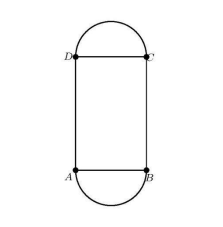
PROBLEM 1 :

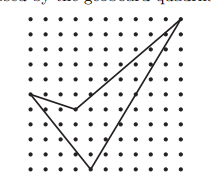
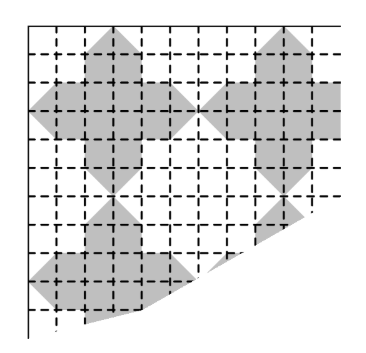
The eight-pointed star, shown in the figure below, is a popular quilting pattern. What percent of the entire $4 \times 4$ grid is covered by the star?

(A) 40
(B) 50
(C) 60
(D) 75
(E) 80

ANSWER :

(B) 50

PROBLEM 2 :

The table below shows the ancient Egyptian hieroglyphs that were used to represent different numbers.

For example, the number 32 was represented by the hieroglyphs $\cap \cap \cap |$. What number is represented by the following combination of hieroglyphs?

(A) 1,423
(B) 10,423
(C) 14,023
(D) 14,203
(E) 14,230

ANSWER :

(B) 10,423

PROBLEM 3 :

Buffalo Shuffle-o is a card game in which all the cards are distributed evenly among all players at the start of the game. When Annika and 3 of her friends play Buffalo Shuffle-o, each player is dealt 15 cards. Suppose 2 more friends join the next game. How many cards will be dealt to each player?

(A) 8
(B) 9
(C) 10
(D) 11
(E) 12

ANSWER :

(C) 10

PROBLEM 4 :

Lucius is counting backward by 7 s . His first three numbers are 100,93 , and 86 . What is his 10 th number?
(A) 30
(B) 37
(C) 42
(D) 44
(E) 47

ANSWER :

(B) 37

PROBLEM 5 :

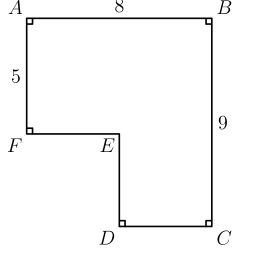
Betty drives a truck to deliver packages in a neighborhood whose street map is shown below. Betty starts at the factory (labled $F$ ) and drives to location $A$, then $B$, then $C$, before returning to $F$. What is the shortest distance, in blocks, she can drive to complete the route?

(A) 20
(B) 23
(C) 24
(D) 26
(E) 28

ANSWER :

(C) 24

PROBLEM 6 :

Sekou writes the numbers $15,16,17,18,19$. After he erases one of his numbers, the sum of the remaining four numbers is a multiple of 4 . Which number did he erase?
(A) 15
(B) 16
(C) 17
(D) 18
(E) 19

ANSWER :

(C) 17

PROBLEM 7 :

On the most recent exam on Prof. Xochi's class,

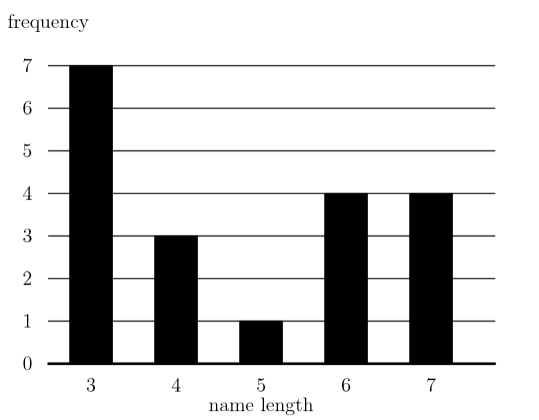
How many students earned a score of at least $80 \%$ and less than $90 \%$ ?
(A) 8
(B) 14
(C) 22
(D) 37
(E) 45

ANSWER :

(D) 37

PROBLEM 8 :

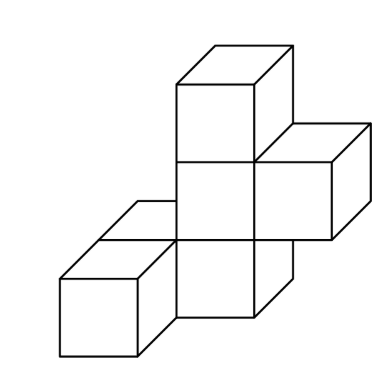
Isaiah cuts open a cardboard cube along some of its edges to form the flat shape shown on the right, which has an area of 18 square centimeters. What is the volume of the cube in cubic centimeters?

(A) $3 \sqrt{3}$
(B) 6
(C) 9
(D) $6 \sqrt{3}$
(E) $9 \sqrt{3}$

ANSWER :

(A) $3 \sqrt{3}$

PROBLEM 9 :

Ningli looks at the 6 pairs of numbers directly across from each other on a clock. She takes the average of each pair of numbers. What is the average of the resulting 6 numbers?

(A) 5
(B) 6.5
(C) 8
(D) 9.5
(E) 12

ANSWER :

(B) 6.5

PROBLEM 10 :

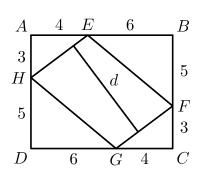
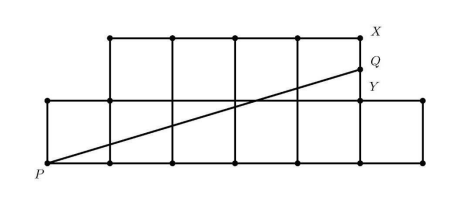
In the figure below, $A B C D$ is a rectangle with sides of length $A B=5$ inches and $A D=3$ inches. Rectangle $A B C D$ is rotated $90^{\circ}$ clockwise around the midpoint of side $D C$ to give a second rectangle. What is the total area, in square inches, covered by the two overlapping rectangles?

(A) 21
(B) 22.25
(C) 23
(D) 23.75
(E) 25

ANSWER :

(D) 23.75

PROBLEM 11 :

A tetromino consists of four squares connected along their edges. There are five possible tetromino shapes, $I, O, L, T$, and $S$, shown below, which can be rotated or flipped over. Three tetrominoes are used to completely cover a $3 \times 4$ rectangle. At least one of the tiles is an $S$ tile. What are the other two tiles?

(A) $I$ and $L$
(B) $I$ and $T$
(C) $L$ and $L$
(D) $L$ and $S$
(E) $O$ and $T$

ANSWER :

(C) $L$ and $L$

PROBLEM 12 :

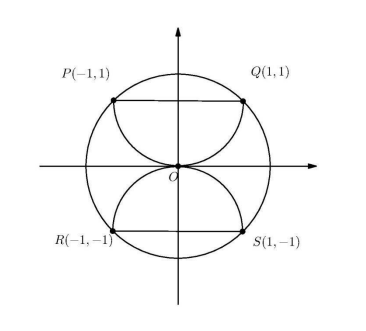
The region shown below consists of 24 squares, each with side length 1 centimeter. What is the area, in square centimeters, of the largest circle that can fit inside the region, possibly touching the boundaries?

(A) $3 \pi$
(B) $4 \pi$
(C) $5 \pi$
(D) $6 \pi$
(E) $8 \pi$

ANSWER :

(C) $5 \pi$

PROBLEM 13 :

Each of the even numbers $2,4,6, \ldots, 50$ is divided by 7 . The remainders are recorded. Which histogram displays the number of times each remainder occurs?

ANSWER :

(A)

PROBLEM 14 :

A number $N$ is inserted into the list $2,6,7,7,28$. The mean is now twice as great as the median. What is $N$ ?
(A) 7
(B) 14
(C) 20
(D) 28
(E) 34

ANSWER :

(E) 34

PROBLEM 15 :

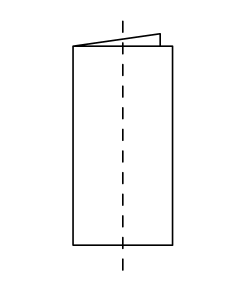
Kei draws a 6 -by- 6 grid. He colors 13 of the unit squares silver and the remaining squares gold. Kei then folds the grid in half vertically, forming pairs of overlapping unit squares. Let $m$ and $M$ equal the least and greatest possible number of gold-on-gold pairs, respectively. What is the value of $m+M$ ?

(A) 12
(B) 14
(C) 16
(D) 18
(E) 20

ANSWER :

(C) 16

PROBLEM 16 :

Five distinct integers from 1 to 10 are chosen, and five distinct integers from 11 to 20 are chosen. No two numbers differ by exactly 10 . What is the sum of the ten chosen numbers?
(A) 95
(B) 100
(C) 105
(D) 110
(E) 115

ANSWER :

(C) 105

PROBLEM 17 :

In the land of Markovia, there are three cities: $A, B$, and $C$. There are 100 people who live in $A, 120$ who live in $B$, and 160 who live in $C$. Everyone works in one of the three cities, and a person may work in the same city where they live. In the figure below, an arrow pointing from one city to another is labeled with the fraction of people living in the first city who work in the second city. (For example, $\frac{1}{4}$ of the people who live in $A$ work in $B$.) How many people work in $A$ ?

(A) 55
(B) 60
(C) 85
(D) 115
(E) 160

ANSWER :

(D) 115

PROBLEM 18 :

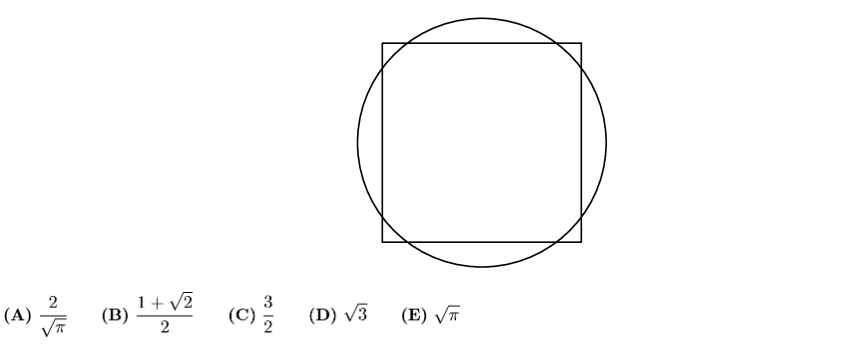
The circle shown below on the left has a radius of 1 unit. The region between the circle and the inscribed square is shaded. In the circle shown on the right, one quarter of the region between the circle and the inscribed square is shaded. The shaded regions in the two circles have the same area. What is the radius $R$, in units, of the circle on the right?

(A) $\sqrt{2}$
(B) 2
(C) $2 \sqrt{2}$
(D) 4
(E) $4 \sqrt{2}$

ANSWER :

(B) 2

PROBLEM 19 :

Two towns, $A$ and $B$, are connected by a straight road that is 15 miles long. Travelling from city $A$ to town $B$, the speed limit changes every 5 miles: from 25 to 40 to 20 miles per hour (mph). Two cars, one at town $A$ and one at town $B$, start moving toward each other at the same time. They drive at exactly the speed limit in each portion of the road. How far from town $A$, in miles, will the two cars meet?

(A) 7.75
(B) 8
(C) 8.25
(D) 8.5
(E) 8.75

ANSWER :

(D) 8.5

PROBLEM 20 :

Sarika, Dev, and Rajiv are sharing a large block of cheese. They take turns cutting off half of what remains and eating it: first Sarika eats half of the cheese, then Dev eats half of the remaining half, then Rajiv eats half of what remains, then back to Sarika, and so on. They stop when the cheese is too small to see. About what fraction of the original block of cheese does Sarika eat in total?
(A) $\frac{4}{7}$
(B) $\frac{3}{5}$
(C) $\frac{2}{3}$
(D) $\frac{3}{4}$
(E) $\frac{7}{8}$

ANSWER :

(A) $\frac{4}{7}$.

PROBLEM 21 :

The Konigsberg School has assigned grades 1 through 7 to pods $A$ through $G$, one grade per pod. Some of the pods are connected by walkways, as shown in the figure below. The school noticed that each pair of connected pods has been assigned grades differing by 2 or more grade levels. (For example, grades 1 and 2 will not be in pods directly connected by a walkway.) What is the sum of the grade levels assigned to pods $C, E$, and $F$ ?

(A) 12
(B) 13
(C) 14
(D) 15
(E) 16

ANSWER :

(A) 12

PROBLEM 22 :

A classroom has a row of 35 coat hooks. Paulina likes coats to be equally spaced, so that there is the same number of empty hooks before the first coat, after the last coat, and between every coat and the next one. Suppose there is at least 1 coat and at least 1 empty hook. How many different numbers of coats can satisfy Paulina's pattern?

(A) 2
(B) 4
(C) 5
(D) 7
(E) 9

ANSWER :

(D) 7

PROBLEM 23 :

How many four-digit numbers have all three of the following properties?
(I) The tens and ones digit are both 9 .
(II) The number is 1 less than a perfect square.
(III) The number is the product of exactly two prime numbers.
(A) 0
(B) 1
(C) 2
(D) 3
(E) 4

ANSWER :

(B) 1

PROBLEM 24 :

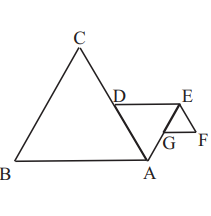
In trapezoid $A B C D$, angles $B$ and $C$ measure $60^{\circ}$ and $A B=D C$. The side lengths are all positive integers, and the perimeter of $A B C D$ is 30 units. How many non-congruent trapezoids satisfy all of these conditions?

(A) 0
(B) 1
(C) 2
(D) 3
(E) 4

ANSWER :

(E) 4

PROBLEM 25 :

Makayla finds all the possible ways to draw a path in a $5 \times 5$ diamond-shaped grid. Each path starts at the bottom of the grid and ends at the top, always moving one unit northeast or northwest. She computes the area of the region between each path and the right side of the grid. Two examples are shown in the figures below. What is the sum of the areas determined by all possible paths?

(A) 2520
(B) 3150
(C) 3840
(D) 4730
(E) 5050

ANSWER :

(B) 3150

AMERICAN MATHEMATICS COMPETITION 8 - 2022

PROBLEM 1 :

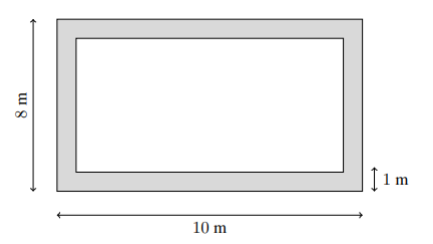
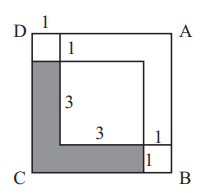
The Math Team designed a logo shaped like a multiplication symbol, shown below on a grid of 1-inch squares. What is the area of the logo in square inches?

(A) 10
(B) 12
(C) 13
(D) 14
(E) 15

ANSWER :

(A) 10

PROBLEM 2 :

Consider these two operations:

$$
\begin{aligned}
a \bullet b & =a^2-b^2 \
a \star b & =(a-b)^2
\end{aligned}
$$

What is the output of $(5 \diamond 3) \star 6$ ?
(A) -20
(B) 4
(C) 16
(D) 100
(E) 220

ANSWER :

(D) 100

PROBLEM 3 :

When three positive integers $a, b$, and $c$ are multiplied together, their product is 100 . Suppose $a<b<c$. In how many ways can the numbers be chosen?
(A) 0
(B) 1
(C) 2
(D) 3
(E) 4

ANSWER :

(E) 4

PROBLEM 4 :

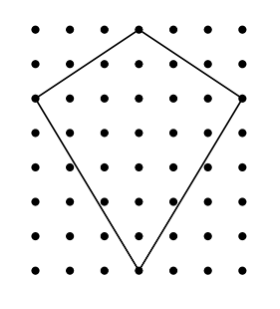
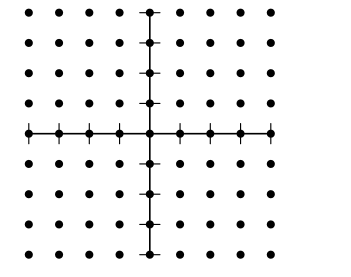
The letter $\mathbf{M}$ in the figure below is first reflected over the line $q$ and then reflected over the line $p$. What is the resulting image?

ANSWER :

(E)

PROBLEM 5 :

Anna and Bella are celebrating their birthdays together. Five years ago, when Bella turned 6 years old, she received a newborn kitten as a birthday present. Today the sum of the ages of the two children and the kitten is 30 years. How many years older than Bella is Anna?
(A) 1
(B) 2
(C) 3
(D) 4
(E) 5

ANSWER :

(C) 3

PROBLEM 6 :

Three positive integers are equally spaced on a number line. The middle number is 15 , and the largest number is 4 times the smallest number. What is the smallest of these three numbers?
(A) 4
(B) 5
(C) 6
(D) 7
(E) 8

ANSWER :

(C) 6

PROBLEM 7 :

When the World Wide Web first became popular in the 1990 s, download speeds reached a maximum of about 56 kilobits per second.
Approximately how many minutes would the download of a 4.2 -megabyte song have taken at that speed? (Note that there are 8000 kilobits in a megabyte.)
(A) 0.6
(B) 10
(C) 1800
(D) 7200
(E) 36000

ANSWER :

(B) 10

PROBLEM 8 :

What is the value of

$$
\frac{1}{3} \cdot \frac{2}{4} \cdot \frac{3}{5} \cdots \frac{18}{20} \cdot \frac{19}{21} \cdot \frac{20}{22} ?
$$

(A) $\frac{1}{462}$
(B) $\frac{1}{231}$
(C) $\frac{1}{132}$
(D) $\frac{2}{213}$
(E) $\frac{1}{22}$

ANSWER :

(B) $\frac{1}{231}$.

PROBLEM 9 :

A cup of boiling water $\left(212^{\circ} \mathrm{F}\right)$ is placed to cool in a room whose temperature remains constant at $68^{\circ} \mathrm{F}$. Suppose the difference between the water temperature and the room temperature is halved every 5 minutes. What is the water temperature, in degrees Fahrenheit, after 15 minutes?
(A) 77
(B) 86
(C) 92
(D) 98
(E) 104

ANSWER :

(B) 86

PROBLEM 10 :

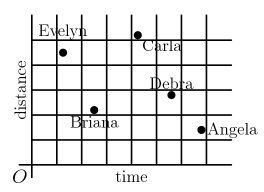
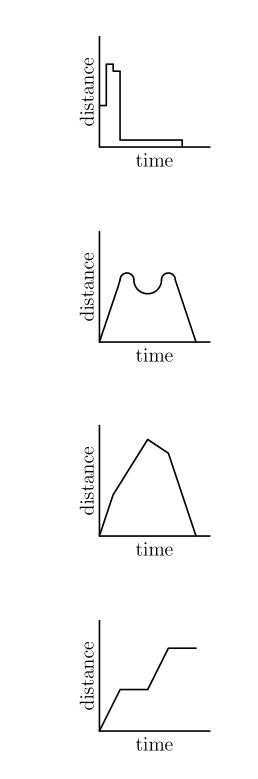
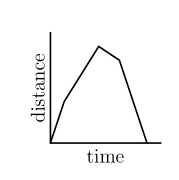
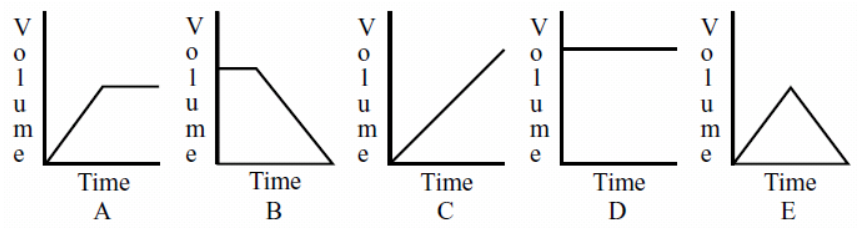
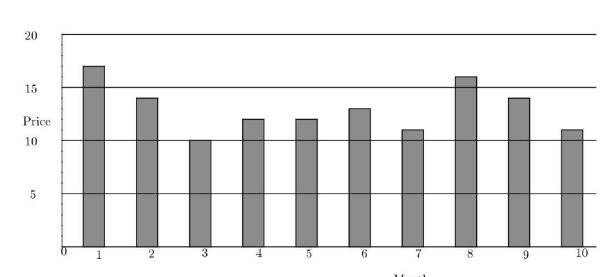
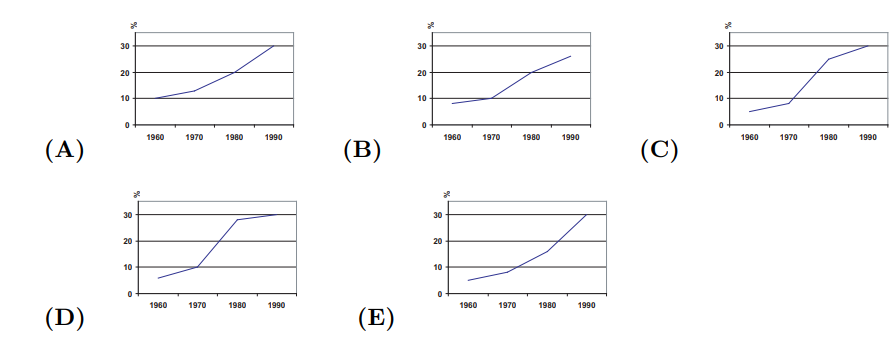
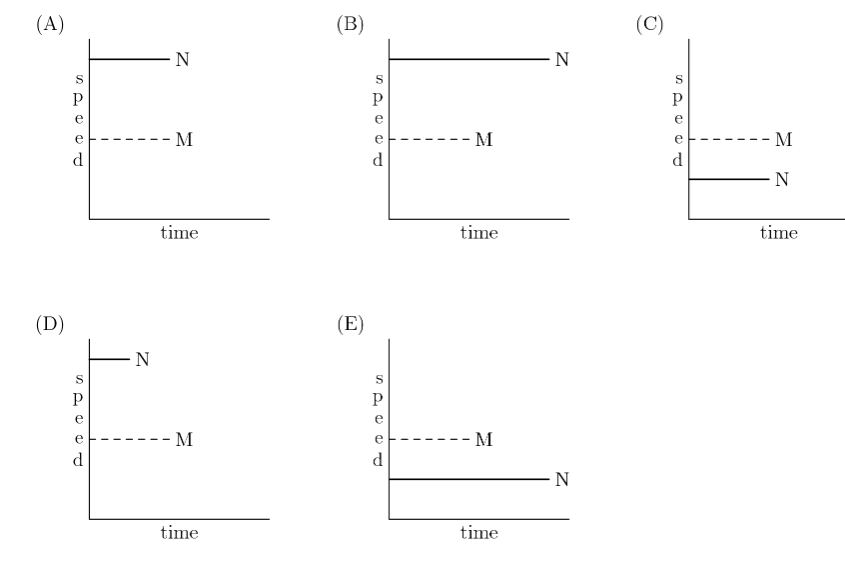
One sunny day, Ling decided to take a hike in the mountains. She left her house at 8 AM , drove at a constant speed of 45 miles per hour, and arrived at the hiking trail at 10 AM . After hiking for 3 hours, Ling drove home at a constant speed of 60 miles per hour. Which of the following graphs best illustrates the distance between Ling's car and her house over the course of her trip?

ANSWER :

(E)

PROBLEM 11 :

Henry the donkey has a very long piece of pasta. He takes a number of bites of pasta, each time eating 3 inches of pasta from the middle of one piece. In the end, he has 10 pieces of pasta whose total length is 17 inches. How long, in inches, was the piece of pasta he started with?
(A) 34
(B) 38
(C) 41
(D) 44
(E) 47

ANSWER :

(D) 44

PROBLEM 12 :

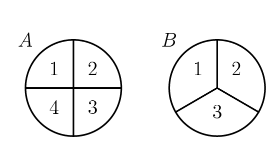
The arrows on the two spinners shown below are spun. Let the number $N$ equal 10 times the number on Spinner A , added to the number on Spinner B. What is the probability that $N$ is a perfect square number?

(A) $\frac{1}{16}$
(B) $\frac{1}{8}$
(C) $\frac{1}{4}$
(D) $\frac{3}{8}$
(E) $\frac{1}{2}$

ANSWER :

(B) $\frac{1}{8}$

PROBLEM 13 :

How many positive integers can fill the blank in the sentence below?
"One positive integer is ____ more than twice another, and the sum of the two numbers is $28 . "$


(A) 6
(B) 7
(C) 8
(D) 9
(E) 10

ANSWER :

(D) 9

PROBLEM 14 :


In how many ways can the letters in BEEKEEPER be rearranged so that two or more Es do not appear together?
(A) 1
(B) 4
(C) 12
(D) 24
(E) 120

ANSWER :

(D) 24

PROBLEM 15 :

Laszlo went online to shop for black pepper and found thirty different black pepper options varying in weight and price, shown in the scatter plot below. In ounces, what is the weight of the pepper that offers the lowest price per ounce?

(A) 1
(B) 2
(C) 3
(D) 4
(E) 5

ANSWER :

(C) 3

PROBLEM 16 :

Four numbers are written in a row. The average of the first two is 21 , the average of the middle two is 26 , and the average of the last two is 30 . What is the average of the first and last of the numbers?
(A) 24
(B) 25
(C) 26
(D) 27
(E) 28

ANSWER :

(B) 25

PROBLEM 17 :

If $n$ is an even positive integer, the double factorial notation $n!!$ represents the product of all the even integers from 2 to $n$. For example, $8!!=2 \cdot 4 \cdot 6 \cdot 8$. What is the units digit of the following sum?

$$
2!!+4!!+6!!+\cdots+2018!!+2020!!+2022!!
$$

(A) 0
(B) 2
(C) 4
(D) 6
(E) 8

ANSWER :

(B) 2

PROBLEM 18 :

The midpoints of the four sides of a rectangle are $(-3,0),(2,0),(5,4)$, and $(0,4)$. What is the area of the rectangle?
(A) 20
(B) 25
(C) 40
(D) 50
(E) 80

ANSWER :

(C) 40

PROBLEM 19 :

Mr. Ramos gave a test to his class of 20 students. The dot plot below shows the distribution of test scores.

Later Mr. Ramos discovered that there was a scoring error on one of the questions. He regraded the tests, awarding some of the students 5 extra points, which increased the median test score to 85 . What is the minimum number of students who received extra points?
(Note that the median test score equals the average of the 2 scores in the middle if the 20 test scores are arranged in increasing order.)
(A) 2
(B) 3
(C) 4
(D) 5
(E) 6

ANSWER :

(C) 4

PROBLEM 20 :

The grid below is to be filled with integers in such a way that the sum of the numbers in each row and the sum of the numbers in each column are the same. Four numbers are missing. The number $x$ in the lower left corner is larger than the other three missing numbers. What is the smallest possible value of $x$ ?

(A) -1
(B) 5
(C) 6
(D) 8
(E) 9

ANSWER :

(D) 8

PROBLEM 21 :

Steph scored 15 baskets out of 20 attempts in the first half of a game, and 10 baskets out of 10 attempts in the second half. Candace took 12 attempts in the first half and 18 attempts in the second. In each half, Steph scored a higher percentage of baskets than Candace. Surprisingly they ended with the same overall percentage of baskets scored. How many more baskets did Candace score in the second half than in the first?

(A) 7
(B) 8
(C) 9
(D) 10
(E) 11

ANSWER :

(C) 9

PROBLEM 22 :

A bus takes 2 minutes to drive from one stop to the next, and waits 1 minute at each stop to let passengers board. Zia takes 5 minutes to walk from one bus stop to the next. As Zia reaches a bus stop, if the bus is at the previous stop or has already left the previous stop, then she will wait for the bus. Otherwise she will start walking toward the next stop. Suppose the bus and Zia start at the same time toward the library, with the bus 3 stops behind. After how many minutes will Zia board the bus?

(A) 17
(B) 19
(C) 20
(D) 21
(E) 23

ANSWER :

(A) 17

PROBLEM 23 :

A △ or $\bigcirc$ is placed in each of the nine squares in a 3 -by- 3 grid. Shown below is a sample configuration with three $\triangle s$ in a line.

How many configurations will have three △ s in a line and three □ s in a line?
(A) 39
(B) 42
(C) 78
(D) 84
(E) 96

ANSWER :

D) 84

PROBLEM 24 :

The figure below shows a polygon $A B C D E F G H$, consisting of rectangles and right triangles. When cut out and folded on the dotted lines, the polygon forms a triangular prism. Suppose that $A H=E F=8$ and $G H=14$. What is the volume of the prism?
(A) 112
(B) 128
(C) 192
(D) 240
(E) 288

ANSWER :

(C) 192

PROBLEM 25 :

A cricket randomly hops between 4 leaves, on each turn hopping to one of the other 3 leaves with equal probability. After 4 hops what is the probability that the cricket has returned to the leaf where it started?

(A) $\frac{2}{9}$
(B) $\frac{19}{80}$
(C) $\frac{20}{81}$
(D) $\frac{1}{4}$
(E) $\frac{7}{27}$

ANSWER :

(E) $\frac{7}{27}$

AMERICAN MATHEMATICS COMPETITION 8 - 2021

PROBLEM 1 :

Which of the following values is largest?
(A) $2+0+1+7$
(B) $2 \times 0+1+7$
(C) $2+0 \times 1+7$
(D) $2+0+1 \times 7$
(E) $2 \times 0 \times 1 \times 7$

ANSWER : (A) $2+0+1+7$

PROBLEM 2 :

Alicia, Brenda, and Colby were the candidates in a recent election for student president. The pie chart below shows how the votes were distributed among the three candidates. If Brenda received 36 votes, then how many votes were cast all together?

(A) 70
(B) 84
(C) 100
(D) 106
(E) 120

ANSWER :(E) 120

PROBLEM 3 :

What is the value of the expression $\sqrt{16 \sqrt{8 \sqrt{4}}}$ ?
(A) 4
(B) $4 \sqrt{2}$
(C) 8
(D) $8 \sqrt{2}$
(E) 16

ANSWER : (C) 8

PROBLEM 4 :

When 0.000315 is multiplied by $7,928,564$ the product is closest to which of the following?
(A) 210
(B) 240
(C) 2100
(D) 2400
(E) 24000

ANSWER : (D) 2400

PROBLEM 5 :

What is the value of the expression $\frac{1 \cdot 2 \cdot 3 \cdot 4 \cdot 5 \cdot 6 \cdot 7 \cdot 8}{1+2+3+4+5+6+7+8}$ ?
(A) 1020
(B) 1120
(C) 1220
(D) 2240
(E) 3360

ANSWER : (B) 1120

PROBLEM 6 :

If the degree measures of the angles of a triangle are in the ratio $3: 3: 4$, what is the degree measure of the largest angle of the triangle?
(A) 18
(B) 36
(C) 60
(D) 72
(E) 90

ANSWER : (D) 72

PROBLEM 7 :

Let $\boldsymbol{Z}$ be a 6 -digit positive integer, such as 247247 , whose first three digits are the same as its last three digits taken in the same order. Which of the following numbers must also be a factor of $Z$ ?
(A) 11
(B) 19
(C) 101
(D) 111
(E) 1111

ANSWER : (A) 11

PROBLEM 8 :

Malcolm wants to visit Isabella after school today and knows the street where she lives but doesn't know her house number. She tells him, "My house number has two digits, and exactly three of the following four statements about it are true."
(1) It is prime.

(2) It is even.
(3) It is divisible by 7 .
(4) One of its digits is 9 .

This information allows Malcolm to determine Isabella's house number. What is its units digit?
(A) 4
(B) 6
(C) 7
(D) 8
(E) 9

ANSWER : (D) 8

PROBLEM 9 :

All of Marcy's marbles are blue, red, green, or yellow. One third of her marbles are blue, one fourth of them are red, and six of them are green. What is the smallest number of yellow marbles that Marcy could have?
(A) 1
(B) 2
(C) 3
(D) 4
(E) 5

ANSWER : (D) 4

PROBLEM 10 :

A box contains five cards, numbered $1,2,3,4$, and 5 . Three cards are selected randomly without replacement from the box. What is the probability that 4 is the largest value selected?
(A) $\frac{1}{10}$
(B) $\frac{1}{5}$
(C) $\frac{3}{10}$
(D) $\frac{2}{5}$
(E) $\frac{1}{2}$

ANSWER : (D) $\frac{2}{5}$

PROBLEM 11 :

A square-shaped floor is covered with congruent square tiles. If the total number of tiles that lie on the two diagonals is 37 , how many tiles cover the floor?
(A) 148
(B) 324
(C) 361
(D) 1296
(E) 1369

ANSWER : (C) 361

PROBLEM 12 :

The smallest positive integer greater than 1 that leaves a remainder of 1 when divided by 4,5 , and 6 lies between which of the following pairs of numbers?
(A) 2 and 19
(B) 20 and 39
(C) 40 and 59
(D) 60 and 79
(E) 80 and 124

ANSWER : (D) 60 and 79

PROBLEM 13 :

Peter, Emma, and Kyler played chess with each other. Peter won 4 games and lost 2 games. Emma won 3 games and lost 3 games. If Kyler lost 3 games, how many games did he win?
(A) 0
(B) 1
(C) 2
(D) 3
(E) 4

ANSWER : (B) 1

PROBLEM 14 :

Chloe and Zoe are both students in Ms. Demeanor's math class. Last night they each solved half of the problems in their homework assignment alone and then solved the other half together. Chloe had correct answers to only $80 \%$ of the problems she solved alone, but overall $88 \%$ of her answers were correct. Zoe had correct answers to $90 \%$ of the problems she solved alone. What was Zoe's overall percentage of correct answers?
(A) 89
(B) 92
(C) 93
(D) 96
(E) 98

ANSWER : (C) 93

PROBLEM 15 :

In the arrangement of letters and numerals below, by how many different paths can one spell AMC8? Beginning at the A in the middle, a path allows only moves from one letter to an adjacent (above, below, left, or right, but not diagonal) letter. One example of such a path is traced in the picture.

(A) 8
(B) 9
(C) 12
(D) 24
(E) 36

ANSWER : (D) 24

PROBLEM 16 :

In the figure below, choose point $D$ on $\overline{B C}$ so that $\triangle A C D$ and $\triangle A B D$ have equal perimeters. What is the area of $\triangle A B D$ ?

(A) $\frac{3}{4}$
(B) $\frac{3}{2}$
(C) 2
(D) $\frac{12}{5}$
(E) $\frac{5}{2}$

ANSWER : (D) $\frac{12}{5}$

PROBLEM 17 :

Starting with some gold coins and some empty treasure chests, I tried to put 9 gold coins in each treasure chest, but that left 2 treasure chests empty. So instead I put 6 gold coins in each treasure chest, but then I had 3 gold coins left over. How many gold coins did I have?
(A) 9
(B) 27
(C) 45
(D) 63
(E) 81

ANSWER : (C) 45

PROBLEM 18 :

In the non-convex quadrilateral $A B C D$ shown below, $\angle B C D$ is a right angle, $A B=12, B C=4, C D=3$, and $A D=13$.

What is the area of quadrilateral $A B C D$ ?
(A) 12
(B) 24
(C) 26
(D) 30
(E) 36

ANSWER : (B) 24

PROBLEM 19 :

For any positive integer $M$, the notation $M!$ denotes the product of the integers 1 through $M$. What is the largest integer $n$ for which $5^n$ is a factor of the sum $98!+99!+100!$ ?
(A) 23
(B) 24
(C) 25
(D) 26
(E) 27

ANSWER : (D) 26

PROBLEM 20 :

An integer between 1000 and 9999 , inclusive, is chosen at random. What is the probability that it is an odd integer whose digits are all distinct?
(A) $\frac{14}{75}$
(B) $\frac{56}{225}$
(C) $\frac{107}{400}$
(D) $\frac{7}{25}$
(E) $\frac{9}{25}$

ANSWER : (B) $\frac{56}{225}$

PROBLEM 21 :

Suppose $a, b$, and are nonzero real numbers, and . What are the possible value(s) for $\frac{a}{|a|}+\frac{b}{|b|}+\frac{c}{|c|}+\frac{a b c}{|a b c|}$ ?
(A) 0
(B) 1 and - 1
(C) 2 and - 2
(D) 0,2, and - 2
(E) 0 , 1 , and -1

ANSWER : (A) 0

PROBLEM 22 :

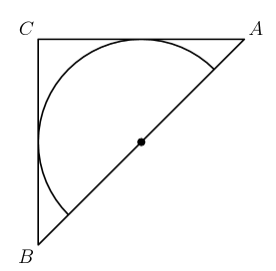
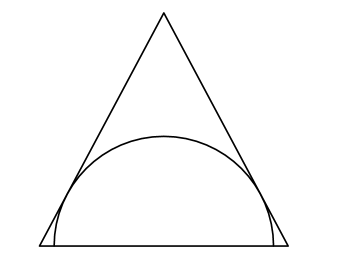
In the right triangle $A B C, A C=12, B C=5$, and angle $C$ is a right angle. A semicircle is inscribed in the triangle as shown. What is the radius of the semicircle?

(A) $\frac{7}{6}$
(B) $\frac{13}{5}$
(C) $\frac{59}{18}$
(D) $\frac{10}{3}$
(E) $\frac{60}{13}$

ANSWER : (D) $\frac{10}{3}$

PROBLEM 23 :

Each day for four days, Linda traveled for one hour at a speed that resulted in her traveling one mile in an integer number of minutes. Each day after the first, her speed decreased so that the number of minutes to travel one mile increased by 5 minutes over the preceding day. Each of the four days, her distance traveled was also an integer number of miles. What was the total number of miles for the four trips?
(A) 10
(B) 15
(C) 25
(D) 50
(E) 82

ANSWER : (C) 25

PROBLEM 24 :

Mrs. Sanders has three grandchildren, who call her regularly. One calls her every three days, one calls her every four days, and one calls her every five days. All three called her on December 31, 2021. On how many days during the next year did she not receive a phone call from any of her grandchildren?
(A) 78
(B) 80
(C) 144
(D) 146
(E) 152

ANSWER : (D) 146

PROBLEM 25 :

In the figure shown, $\overline{U S}$ and $\overline{U T}$ are line segments each of length 2 , and $m \angle T U S=60^{\circ}$. Arcs $\overparen{\mathrm{TR}}$ and $\overparen{\mathrm{SR}}$ are each one-sixth of a circle with radius 2 . What is the area of the region shown?

ANSWER : (B)

AMERICAN MATHEMATICS COMPETITION - 2020


Problem 1 :
Luka is making lemonade to sell at a school fundraiser. His recipe requires 4 times as much water as sugar and twice as much sugar as lemon juice. He uses 3 cups of lemon juice. How many cups of water does he need?
(A) 6
(B) 8
(C) 12
(D) 18
(E) 24

ANSWER :

(E) 24

Problem 2 :
Four friends do yardwork for their neighbors over the weekend, earning $\$ 15, \$ 20, \$ 25$, and $\$ 40$, respectively. They decide to split their earnings equally among themselves. In total how much will the friend who earned $\$ 40$ give to the others?
(A) $\$ 5$
(B) $\$ 10$
(C) $\$ 15$
(D) $\$ 20$
(E) $\$ 25$

ANSWER :

(C) $\$ 15$

Problem 3 :
Carrie has a rectangular garden that measures 6 feet by 8 feet. She plants the entire garden with strawberry plants. Carrie is able to plant 4 strawberry plants per square foot, and she harvests an average of 10 strawberries per plant. How many strawberries can she expect to harvest?
(A) 560
(B) 960
(C) 1120
(D) 1920
(E) 3840

ANSWER :

(D) 1920

Problem 4 :
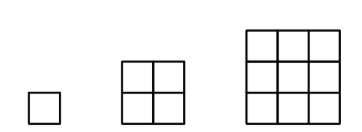
Three hexagons of increasing size are shown below. Suppose the dot pattern continues so that each successive hexagon contains one more band of dots. How many dots are in the next hexagon?


(A) 35
(B) 37
(C) 39
(D) 43
(E) 49

ANSWER :

(B) 37

Problem 5 :
Three fourths of a pitcher is filled with pineapple juice. The pitcher is emptied by pouring an equal amount of juice into each of 5 cups. What percent of the total capacity of the pitcher did each cup receive?
(A) 5
(B) 10
(C) 15
(D) 20
(E) 25

ANSWER :

(C) 15

Problem 6 :
Aaron, Darren, Karen, Maren, and Sharon rode on a small train that has five cars that seat one person each. Maren sat in the last car. Aaron sat directly behind Sharon. Darren sat in one of the cars in front of Aaron. At least one person sat between Karen and Darren. Who sat in the middle car?
(A) Aaron
(B) Darren
(C) Karen
(D) Maren
(E) Sharon

ANSWER :

(A) Aaron

Problem 7 :
How many integers between 2020 and 2400 have four distinct digits arranged in increasing order? (For example, 2357 is one such integer.)
(A) 9
(B) 10
(C) 15
(D) 21
(E) 28

ANSWER :

(C) 15

Problem 8 :

Ricardo has 2020 coins, some of which are pennies (1-cent coins) and the rest of which are nickels (5-cent coins). He has at least one penny and at least one nickel. What is the difference in cents between the greatest possible and least possible amounts of money that Ricardo can have?
(A) 8062
(B) 8068
(C) 8072
(D) 8076
(E) 8082

ANSWER :

(C) 8072

Problem 9 :
Akash's birthday cake is in the form of a $4 \times 4 \times 4$ inch cube. The cake has icing on the top and the four side faces, and no icing on the bottom. Suppose the cake is cut into 64 smaller cubes, each measuring $1 \times 1 \times 1$ inch, as shown below. How many of the small pieces will have icing on exactly two sides?


(A) 12
(B) 16
(C) 18
(D) 20
(E) 24

ANSWER :

(D) 20

Problem 10 :
Zara has a collection of 4 marbles: an Aggie, a Bumblebee, a Steelie, and a Tiger. She wants to display them in a row on a shelf, but does not want to put the Steelie and the Tiger next to one another. In how many ways can she do this?
(A) 6
(B) 8
(C) 12
(D) 18
(E) 24

ANSWER :

(C) 12

Problem 11 :
After school, Maya and Naomi headed to the beach, 6 miles away. Maya decided to bike while Naomi took a bus. The graph below shows their journeys, indicating the time and distance traveled. What was the difference, in miles per hour, between Naomi's and Maya's average speeds?


(A) 6
(B) 12
(C) 18
(D) 20
(E) 24

ANSWER :

(E) 24

Problem 12 :
For positive integer $n$, the factorial notation $n!$ represents the product of the integers from $n$ to 1 . (For example, $6!=6 \cdot 5 \cdot 4 \cdot 3 \cdot 2 \cdot 1$.) What value of $N$ satisfies the following equation?

$$
5!\cdot 9!=12 \cdot N!
$$

(A) 10
(B) 11
(C) 12
(D) 13
(E) 14

ANSWER :

(A) 10

Problem 13 :
Jamal has a drawer containing 6 green socks, 18 purple socks, and 12 orange socks. After adding more purple socks, Jamal noticed that there is now a $60 \%$ chance that a sock randomly selected from the drawer is purple. How many purple socks did Jamal add?
(A) 6
(B) 9
(C) 12
(D) 18
(E) 24

ANSWER :

(B) 9

Problem 14 :
There are 20 cities in the County of Newton. Their populations are shown in the bar chart below. The average population of all the cities is indicated by the horizontal dashed line. Which of the following is closest to the total population of all 20 cities?


(A) 65,000
(B) 75,000
(C) 85,000
(D) 95,000
(E) 105,000

ANSWER :

(D) 95,000

Problem 15 :
Suppose $15 \%$ of $x$ equals $20 \%$ of $y$. What percentage of $x$ is $y$ ?


(A) 5
(B) 35
(C) 75
(D) $133 \frac{1}{3}$
(E) 300

ANSWER :

(C) 75

Problem 16 :
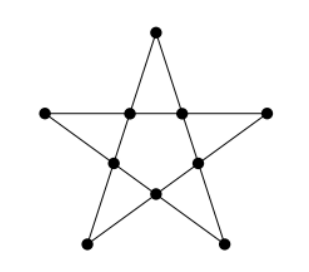
Each of the points $A, B, C, D, E$, and $F$ in the figure below represents a different digit from 1 to 6 . Each of the five lines shown passes through some of these points. The digits along each line are added to produce five sums, one for each line. The total of the five sums is 47 . What is the digit represented by $B$ ?


(A) 1
(B) 2
(C) 3
(D) 4
(E) 5

ANSWER :

(E) 5

Problem 17 :
How many factors of 2020 have more than 3 factors? (As an example, 12 has 6 factors, namely 1 , $2,3,4,6$, and 12 .)
(A) 6
(B) 7
(C) 8
(D) 9
(E) 10

ANSWER :

(B) 7

Problem 18 :
Rectangle $A B C D$ is inscribed in a semicircle with diameter $\overline{F E}$, as shown in the figure. Let $D A=$ 16, and let $F D=A E=9$. What is the area of $A B C D$ ?


(A) 240
(B) 248
(C) 256
(D) 264
(E) 272

ANSWER :

(A) 240

Problem 19 :
A number is called flippy if its digits alternate between two distinct digits. For example, 2020 and 37373 are flippy, but 3883 and 123123 are not. How many five-digit flippy numbers are divisible by 15 ?
(A) 3
(B) 4
(C) 5
(D) 6
(E) 8

ANSWER :

(B) 4

Problem 20 :
A scientist walking through a forest recorded as integers the heights of 5 trees standing in a row. She observed that each tree was either twice as tall or half as tall as the one to its right. Unfortunately some of her data was lost when rain fell on her notebook. Her notes are shown below, with blanks indicating the missing numbers. Based on her observations, the scientist was able to reconstruct the lost data. What was the average height of the trees, in meters?

(A) 22.2
(B) 24.2
(C) 33.2
(D) 35.2
(E) 37.2

ANSWER :

(B) 24.2

Problem 21 :
A game board consists of 64 squares that alternate in color between black and white. The figure below shows square $P$ in the bottom row and square $Q$ in the top row. A marker is placed at $P$. A step consists of moving the marker onto one of the adjoining white squares in the row above. How many 7 -step paths are there from $P$ to $Q$ ? (The figure shows a sample path.)


(A) 28
(B) 30
(C) 32
(D) 33
(E) 35

ANSWER :

(A) 28

Problem 22 :
When a positive integer $N$ is fed into a machine, the output is a number calculated according to the rule shown below.

For example, starting with an input of $N=7$, the machine will output $3 \cdot 7+1=22$. Then if the output is repeatedly inserted into the machine five more times, the final output is 26 .

$$
7 \rightarrow 22 \rightarrow 11 \rightarrow 34 \rightarrow 17 \rightarrow 52 \rightarrow 26
$$

When the same 6 -step process is applied to a different starting value of $N$, the final output is 1 . What is the sum of all such integers $N$ ?

$$
N \rightarrow {-} \rightarrow {-} \rightarrow \rightarrow {-} \rightarrow {-} \rightarrow 1
$$

(A) 73
(B) 74
(C) 75
(D) 82
(E) 83

ANSWER :

(E) 83

Problem 23 :
Five different awards are to be given to three students. Each student will receive at least one award. In how many different ways can the awards be distributed?
(A) 120
(B) 150
(C) 180
(D) 210
(E) 240

ANSWER :

(B) 150

Problem 24 :
A large square region is paved with $n^{2}$ gray square tiles, each measuring $s$ inches on a side. A border $d$ inches wide surrounds each tile. The figure below shows the case for $n=3$. When $n=$ 24 , the 576 gray tiles cover $64 \%$ of the area of the large square region. What is the ratio $\frac{d}{s}$ for this larger value of $n$ ?


(A) $\frac{6}{25}$
(B) $\frac{1}{4}$
(C) $\frac{9}{25}$
(D) $\frac{7}{16}$
(E) $\frac{9}{16}$

ANSWER :

(A) $\frac{6}{25}$

Problem 25 :
Rectangles $R_{1}$ and $R_{2}$, and squares $S_{1}, S_{2}$, and $S_{3}$, shown below, combine to form a rectangle that is 3322 units wide and 2020 units high. What is the side length of $S_{2}$ in units?


(A) 651
(B) 655
(C) 656
(D) 662
(E) 666

ANSWER :

(A) 651

AMERICAN MATHEMATICS COMPETITION 8 - 2023

PROBLEM 1 :

What is the value of $(8 \times 4+2)-(8+4 \times 2)$ ?
(A) 0
(B) 6
(C) 10
(D) 18
(E) 24

ANSWER :

(D) 18

PROBLEM 2 :

A square piece of paper is folded twice into four equal quarters, as shown below, then cut along the dashed line. When unfolded, the paper will match which of the following figures?

ANSWER :

(E)

PROBLEM 3 :

Wind chill is a measure of how cold people feel when exposed to wind outside. A good estimate for wind chill can be found using this calculation

$$
(\text { wind chill })=(\text { air temperature })-0.7 \times(\text { wind speed }),
$$

where temperature is measured in degrees Fahrenheit ( ${ }^{\circ} \mathrm{F}$ ) and the wind speed is measured in miles per hour (mph). Suppose the air temperature is $36^{\circ} \mathrm{F}$ and the wind speed is 18 mph . Which of the following is closest to the approximate wind chill?
(A) 18
(B) 23
(C) 28
(D) 32
(E) 35

ANSWER :

(B) 23

PROBLEM 4 :

The numbers from 1 to 49 are arranged in a spiral pattern on a square grid, beginning at the center. The first few numbers have been entered into the grid below. Consider the four numbers that will appear in the shaded squares, on the same diagonal as the number 7 . How many of these four numbers are prime?

(A) 0
(B) 1
(C) 2
(D) 3
(E) 4

ANSWER :

(D) 3

PROBLEM 5 :

A lake contains 250 trout, along with a variety of other fish. When a marine biologist catches and releases a sample of 180 fish from the lake, 30 are identified as trout. Assume that the ratio of trout to the total number of fish is the same in both the sample and the lake. How many fish are there in the lake?
(A) 1250
(B) 1500
(C) 1750
(D) 1800
(E) 2000

ANSWER :

(B) 1500

PROBLEM 6 :

The digits $2,0,2$, and 3 are placed in the expression below, one digit per box. What is the maximum possible value of the expression?

(A) 0
(B) 8
(C) 9
(D) 16
(E) 18

ANSWER :

(C) 9

PROBLEM 7 :

A rectangle, with sides parallel to the $x$-axis and $y$-axis, has opposite vertices located at $(15,3)$ and $(16,5)$. A line is drawn through points $A(0,0)$ and $B(3,1)$. Another line is drawn through points $C(0,10)$ and $D(2,9)$. How many points on the rectangle lie on at least one of the two lines?

(A) 0
(B) 1
(C) 2
(D) 3
(E) 4

ANSWER :

(B) 1

PROBLEM 8 :

Lola, Lolo, Tiya, and Tiyo participated in a ping pong tournament. Each player competed against each of the other three players exactly twice. Shown below are the win-loss records for the players. The numbers 1 and 0 represent a win or loss, respectively. For example, Lola won five matches and lost the fourth match. What was Tiyo's win-loss record?

(A) 000101
(B) 001001
(C) 010000
(D) 010101
(E) 011000

SOLUTION :

(A) 000101

PROBLEM 9 :

Malaika is skiing on a mountain. The graph below shows her elevation, in meters, above the base of the mountain as she skis along a trail. In total, how many seconds does she spend at an elevation between 4 and 7 meters?

(A) 6
(B) 8
(C) 10
(D) 12
(E) 14

ANSWER :

(B) 8

PROBLEM 10 :

Harold made a plum pie to take on a picnic. He was able to eat only $\frac{1}{4}$ of the pie, and he left the rest for his friends. A moose came by and ate $\frac{1}{3}$ of what Harold left behind. After that, a porcupine ate $\frac{1}{3}$ of what the moose left behind. How much of the original pie still remained after the porcupine left?
(A) $\frac{1}{12}$
(B) $\frac{1}{6}$
(C) $\frac{1}{4}$
(D) $\frac{1}{3}$
(E) $\frac{5}{12}$

ANSWER :

(D) $\frac{1}{3}$

PROBLEM 11 :

NASA's Perseverance Rover was launched on July 30 , 2020. After traveling $292,526,838$ miles, it landed on Mars in Jezero Crater about 6.5 months later. Which of the following is closest to the Rover's average interplanetary speed in miles per hour?
(A) 6,000
(B) 12,000
(C) 60,000
(D) 120,000
(E) 600,000

ANSWER :

(C) 60,000

PROBLEM 12 :

The figure below shows a large white circle with a number of smaller white and shaded circles in its interior. What fraction of the interior of the large white circle is shaded?

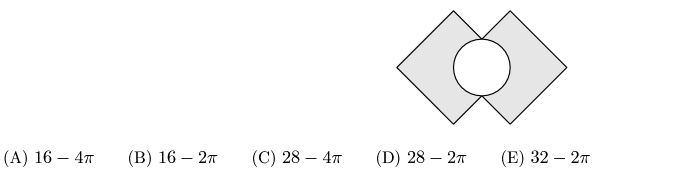
(A) $\frac{1}{4}$
(B) $\frac{11}{36}$
(C) $\frac{1}{3}$
(D) $\frac{19}{36}$
(E) $\frac{5}{9}$

ANSWER :

(B) $\frac{11}{36}$

PROBLEM 13 :

Along the route of a bicycle race, 7 water stations are evenly spaced between the start and finish lines, as shown in the figure below. There are also 2 repair stations evenly spaced between the start and finish lines. The 3 rd water station is located 2 miles after the 1 st repair station. How long is the race in miles?

(A) 8
(B) 16
(C) 24
(D) 48
(E) 96

ANSWER :

(D) 48

PROBLEM 14 :

Nicolas is planning to send a package to his friend Anton, who is a stamp collector. To pay for the postage, Nicolas would like to cover the package with a large number of stamps. Suppose he has a collection of 5 -cent, 10 -cent, and 25 -cent stamps, with exactly 20 of each type. What is the greatest number of stamps Nicolas can use to make exactly $\$ 7.10$ in postage? (Note: The amount $\$ 7.10$ corresponds to 7 dollars and 10 cents. One dollar is worth 100 cents.)
(A) 45
(B) 46
(C) 51
(D) 54
(E) 55

ANSWER :

(E) 55

PROBLEM 15 :

Viswam walks half a mile to get to school each day. His route consists of 10 city blocks of equal length and he takes 1 minute to walk each block. Today, after walking 5 blocks, Viswam discovers he has to make a detour, walking 3 blocks of equal length instead of 1 block to reach the next corner. From the time he starts his detour, at what speed, in mph, must he walk, in order to get to school at his usual time? Here's a hint… if you aren't correct, think about using conversions, maybe that's why you're wrong! -RyanZ4552

(A) 4
(B) 4.2
(C) 4.5
(D) 4.8
(E) 5

ANSWER :

(B) 4.2


PROBLEM 16 :

The letters $\mathrm{P}, \mathrm{Q}$, and R are entered into a $20 \times 20$ table according to the pattern shown below. How many Ps, Qs, and Rs will appear in the completed table?

(A) 132 Ps, $134 \mathrm{Qs}, 134 \mathrm{Rs}$
(B) $133 \mathrm{Ps}, 133 \mathrm{Qs}, 134 \mathrm{Rs}$
(C) $133 \mathrm{Ps}, 134 \mathrm{Qs}, 133 \mathrm{Rs}$
(D) $134 \mathrm{Ps}, 132 \mathrm{Qs}, 134 \mathrm{Rs}$
(E) $134 \mathrm{Ps}, 133 \mathrm{Qs}, 133 \mathrm{Rs}$

ANSWER :

(C) $133 \mathrm{Ps}, 134 \mathrm{Qs}, 133 \mathrm{Rs}$

PROBLEM 17 :

A regular octahedron has eight equilateral triangle faces with four faces meeting at each vertex. Jun will make the regular octahedron shown on the right by folding the piece of paper shown on the left. Which numbered face will end up to the right of $Q$ ?

(A) 1
(B) 2
(C) 3
(D) 4
(E) 5

ANSWER :

(A) 1

PROBLEM 18 :

Greta Grasshopper sits on a long line of lily pads in a pond. From any lily pad, Greta can jump 5 pads to the right or 3 pads to the left. What is the fewest number of jumps Greta must make to reach the lily pad located 2023 pads to the right of her starting position?
(A) 405
(B) 407
(C) 409
(D) 411
(E) 413

ANSWER :

(D) 411

PROBLEM 19 :

An equilateral triangle is placed inside a larger equilateral triangle so that the region between them can be divided into three congruent trapezoids, as shown below. The side length of the inner triangle is $\frac{2}{3}$ the side length of the larger triangle. What is the ratio of the area of one trapezoid to the area of the inner triangle?

(A) $1: 3$
(B) $3: 8$
(C) $5: 12$
(D) $7: 16$
(E) $4: 9$

ANSWER :

(C) $5: 12$

PROBLEM 20 :

Two integers are inserted into the list $3,3,8,11,28$ to double its range. The mode and median remain unchanged. What is the maximum possible sum of the two additional numbers?
(A) 56
(B) 57
(C) 58
(D) 60
(E) 61

ANSWER :

(D) 60

PROBLEM 21 :

Alina writes the numbers $1,2, \ldots, 9$ on separate cards, one number per card. She wishes to divide the cards into 3 groups of 3 cards so that the sum of the numbers in each group will be the same. In how many ways can this be done?
(A) 0
(B) 1
(C) 2
(D) 3
(E) 4

ANSWER :

(C) 2

PROBLEM 22 :

In a sequence of positive integers, each term after the second is the product of the previous two terms. The sixth term is 4000 . What is the first term?
(A) 1
(B) 2
(C) 4
(D) 5
(E) 10

ANSWER :

(D) 5

PROBLEM 23 :

Each square in a $3 \times 3$ grid is randomly filled with one of the 4 gray and white tiles shown below on the right.

What is the probability that the tiling will contain a large gray diamond in one of the smaller $2 \times 2$ grids? Below is an example of such tiling.

(A) $\frac{1}{1024}$
(B) $\frac{1}{256}$
(C) $\frac{1}{64}$
(D) $\frac{1}{16}$
(E) $\frac{1}{4}$

ANSWER :

(C) $\frac{1}{64}$

PROBLEM 24 :

Isosceles $\triangle A B C$ has equal side lengths $A B$ and $B C$. In the figure below, segments are drawn parallel to $\overline{A C}$ so that the shaded portions of $\triangle A B C$ have the same area. The heights of the two unshaded portions are 11 and 5 units, respectively. What is the height of $h$ of $\triangle A B C$ ? (Diagram not drawn to scale.)

(A) 14.6
(B) 14.8
(C) 15
(D) 15.2
(E) 15.4

ANSWER :

(A) 14.6

PROBLEM 25 :

Fifteen integers $a_1, a_2, a_3, \ldots, a_{15}$ are arranged in order on a number line. The integers are equally spaced and have the property that

$$
1 \leq a_1 \leq 10,13 \leq a_2 \leq 20, \text { and } 241 \leq a_{15} \leq 250 .
$$

What is the sum of digits of $a_{14}$ ?
(A) 8
(B) 9
(C) 10
(D) 11
(E) 12

SOLUTION :

(A) 8


AMERICAN MATHEMATICS COMPETITION 8 - 2024

PROBLEM 1 :

What is the unit digit of:

$$
222,222-22,222-2,222-222-22-2 ?
$$

(A) 0
(B) 2
(C) 4
(D) 8
(E) 10

ANSWER :

(B) 2

PROBLEM 2 :

What is the value of this expression in decimal form?

$$
\frac{44}{11}+\frac{110}{44}+\frac{44}{1100}
$$

(A) 6.4
(B) 6.504
(C) 6.54
(D) 6.9
(E) 6.94

ANSWER :

(C) 6.54

PROBLEM 3 :

Four squares of side length $4,7,9$, and 10 are arranged in increasing size order so that their left edges and bottom edges align. The squares alternate in color white-gray-white-gray, respectively, as shown in the figure. What is the area of the visible gray region in square units?

(A) 42
(B) 45
(C) 49
(D) 50
(E) 52

ANSWER :

(E) 52

PROBLEM 4 :

When Yunji added all the integers from 1 to 9 , she mistakenly left out a number. Her incorrect sum turned out to be a square number. What number did Yunji leave out?
(A) 5
(B) 6
(C) 7
(D) 8
(E) 9

ANSWER :

(E) 9

PROBLEM 5 :

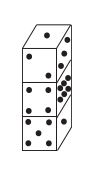
Aaliyah rolls two standard 6 -sided dice. She notices that the product of the two numbers rolled is a multiple of 6 . Which of the following integers cannot be the sum of the two numbers?
(A) 5
(B) 6
(C) 7
(D) 8
(E) 9

ANSWER :

(B) 6

PROBLEM 6 :

Sergai skated around an ice rink, gliding along different paths. The gray lines in the figures below show four of the paths labeled $P, Q, R$, and $S$. What is the sorted order of the four paths from shortest to longest?

(A) $P, Q, R, S$
(B) $P, R, S, Q$
(C) $Q, S, P, R$
(D) $R, P, S, Q$
(E) $R, S, P, Q$

ANSWER :

(D) $R, P, S, Q$

PROBLEM 7 :

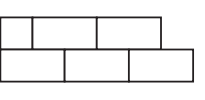
A $3 \times 7$ rectangle is covered without overlap by 3 shapes of tiles: $2 \times 2,1 \times 4$, and $1 \times 1$, shown below. What is the minimum possible number of $1 \times 1$ tiles used?

(A) 1
(B) 2
(C) 3
(D) 4
(E) 5

ANSWER :

(E) 5

PROBLEM 8 :

On Monday, Taye has $\$ 2$. Every day, he either gains $\$ 3$ or doubles the amount of money he had on the previous day. How many different dollar amounts could Taye have on Thursday, 3 days later?
(A) 3
(B) 4
(C) 5
(D) 6
(E) 7

ANSWER :

(D) 6

PROBLEM 9 :

All the marbles in Maria's collection are red, green, or blue. Maria has half as many red marbles as green marbles, and twice as many blue marbles as green marbles. Which of the following could be the total number of marbles in Maria's collection?
(A) 24
(B) 25
(C) 26
(D) 27
(E) 28

ANSWER :

(E) 28

PROBLEM 10 :

In January 1980 the Mauna Loa Observatory recorded carbon dioxide (CO2) levels of 338 ppm (parts per million). Over the years the average $C O 2$ reading has increased by about 1.515 ppm each year. What is the expected $C O 2$ level in ppm in January 2030 ? Round your answer to the nearest integer.
(A) 399
(B) 414
(C) 420
(D) 444
(E) 459

ANSWER :

(B) 414

PROBLEM 11 :

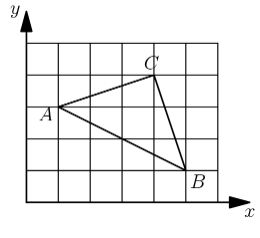
The coordinates of $\triangle A B C$ are $A(5,7), B(11,7)$, and $C(3, y)$, with $y>7$. The area of $\triangle A B C$ is 12 . What is the value of $y$ ?

(A) 8
(B) 9
(C) 10
(D) 11
(E) 12

ANSWER :

(D) 11

PROBLEM 12 :

Rohan keeps 90 guppies in 4 fish tanks.

How many guppies are in the 4th tank?
(A) 20
(B) 21
(C) 23
(D) 24
(E) 26

ANSWER :

(E) 26

PROBLEM 13 :

Buzz Bunny is hopping up and down a set of stairs, one step at a time. In how many ways can Buzz Bunny start on the ground, make a sequence of 6 hops, and end up back on the ground? (For example, one sequence of hops is up-up-down-down-up-down.)

(A) 4
(B) 5
(C) 6
(D) 8
(E) 12

ANSWER :

(B) 5

PROBLEM 14 :

The one-way routes connecting towns $A, M, C, X, Y$, and $Z$ are shown in the figure below(not drawn to scale). The distances in kilometers along each route are marked. Traveling along these routes, what is the shortest distance from A to Z in kilometers?

(A) 28
(B) 29
(C) 30
(D) 31
(E) 32

ANSWER :

(A) 28

PROBLEM 15 :

Let the letters $F, L, Y, B, U, G$ represent distinct digits. Suppose $\underline{F} \underline{L} \underline{Y} \underline{F} \underline{L} \underline{Y}$ is the greatest number that satisfies the equation

$$
8 \cdot \underline{F} \underline{L} \underline{Y} \underline{F} \underline{L} \underline{Y}=\underline{B} \underline{U} \underline{G} \underline{B} \underline{U} \underline{G} .
$$

What is the value of $\underline{F} \underline{L} \underline{Y}+\underline{B} \underline{U} \underline{G}$ ?
(A) 1089
(B) 1098
(C) 1107
(D) 1116
(E) 1125

ANSWER :

(C) 1107

PROBLEM 16 :

Minh enters the numbers 1 through 81 into the cells of a $9 \times 9$ grid in some order. She calculates the product of the numbers in each row and column. What is the least number of rows and columns that could have a product divisible by 3 ?
(A) 8
(B) 9
(C) 10
(D) 11
(E) 12

ANSWER :

(D) 11

PROBLEM 17 :

A chess king is said to attack all the squares one step away from it, horizontally, vertically, or diagonally. For instance, a king on the center square of a $3 \times 3$ grid attacks all 8 other squares, as shown below. Suppose a white king and a black king are placed on different squares of a 3 $x 3$ grid so that they do not attack each other (in other words, not right next to each other). In how many ways can this be done?

(A) 20
(B) 24
(C) 27
(D) 28
(E) 32

ANSWER :

(E) 32

PROBLEM 18 :

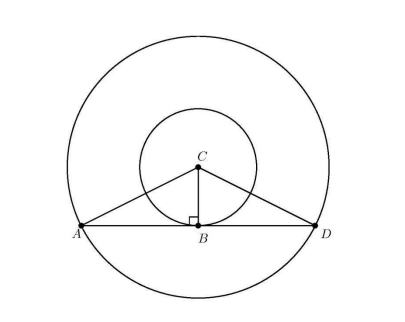
Three concentric circles centered at $O$ have radii of 1, 2, and 3 . Points $B$ and $C$ lie on the largest circle. The region between the two smaller circles is shaded, as is the portion of the region between the two larger circles bounded by central angles $B O C$, as shown in the figure below. Suppose the shaded and unshaded regions are equal in area. What is the measure of $\angle B O C$ in degrees?

(A) 108
(B) 120
(C) 135
(D) 144
(E) 150

ANSWER :

(A) 108

PROBLEM 19 :

Jordan owns 15 pairs of sneakers. Three fifths of the pairs are red and the rest are white. Two thirds of the pairs are high-top and the rest are low-top. The red high-top sneakers make up a fraction of the collection. What is the least possible value of this fraction?

(A) 0
(B) $\frac{1}{5}$
(C) $\frac{4}{15}$
(D) $\frac{1}{3}$
(E) $\frac{2}{5}$

ANSWER :

(C) $\frac{4}{15}$

PROBLEM 20 :

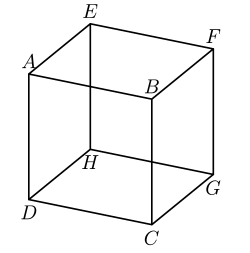
Any three vertices of the cube $P Q R S T U V W$, shown in the figure below, can be connected to form a triangle. (For example, vertices $P, Q$, and $R$ can be connected to form isosceles $\triangle P Q R$.) How many of these triangles are equilateral and contain $P$ as a vertex?

(A) 0
(B) 1
(C) 2
(D) 3
(E) 6

ANSWER :

(D) 3

PROBLEM 21 :

A group of frogs (called an army) is living in a tree. A frog turns green when in the shade and turns yellow when in the sun. Initially, the ratio of green to yellow frogs was $3: 1$. Then 3 green frogs moved to the sunny side and 5 yellow frogs moved to the shady side. Now the ratio is $4: 1$. What is the difference between the number of green frogs and the number of yellow frogs now?
(A) 10
(B) 12
(C) 16
(D) 20
(E) 24

ANSWER :

(E) 24

PROBLEM 22 :

A roll of tape is 4 inches in diameter and is wrapped around a ring that is 2 inches in diameter. A cross section of the tape is shown in the figure below. The tape is 0.015 inches thick. If the tape is completely unrolled, approximately how long would it be? Round your answer to the nearest 100 inches.

(A) 300
(B) 600
(C) 1200
(D) 1500
(E) 1800

ANSWER :

(B) 600

PROBLEM 23 :

Rodrigo has a very large sheet of graph paper. First he draws a line segment connecting point $(0,4)$ to point $(2,0)$ and colors the 4 cells whose interiors intersect the segment, as shown below. Next Rodrigo draws a line segment connecting point $(2000,3000)$ to point $(5000,8000)$. How many cells will he color this time?

(A) 6000
(B) 6500
(C) 7000
(D) 7500
(E) 8000

ANSWER :

(C) 7000

PROBLEM 24 :

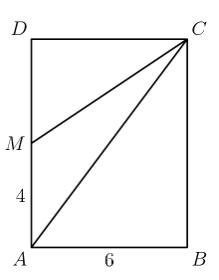
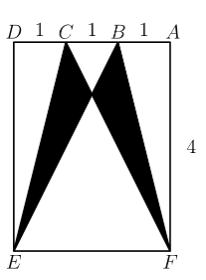
Jean has made a piece of stained glass art in the shape of two mountains, as shown in the figure below. One mountain peak is 8 feet high while the other peak is 12 feet high. Each peak forms a $90^{\circ}$ angle, and the straight sides form a $45^{\circ}$ angle with the ground. The artwork has an area of 183 square feet. The sides of the mountain meet at an intersection point near the center of the artwork, $h$ feet above the ground. What is the value of $h$ ?

(A) 4
(B) 5
(C) $4 \sqrt{2}$
(D) 6
(E) $5 \sqrt{2}$

ANSWER :

(B) 5

PROBLEM 25 :

A small airplane has 4 rows of seats with 3 seats in each row. Eight passengers have boarded the plane and are distributed randomly among the seats. A married couple is next to board. What is the probability there will be 2 adjacent seats in the same row for the couple?

(A) $\frac{8}{15}$
(B) $\frac{32}{55}$
(C) $\frac{20}{33}$
(D) $\frac{34}{55}$
(E) $\frac{8}{11}$

ANSWER :

(C) $\frac{20}{33}$