Sets and Venn diagrams |B.Math Entrance

Try this beautiful problem from B.Math Entrance Exam based on Sets and Venn diagrams.

Sets and Venn diagrams - B.Math Entrance


In a village of 1000 inhabitants, there are three newspapers P, Q,and R in circulation. Each of these papers is read by 500 persons. Papers P and Q are read by 250 persons, papers Q and R are read by 250 persons, papers R and P are read by 250 persons.All the three papers are read by 250 persons. Then the number of persons who read no newspaper at all

  • is 500
  • is 250
  • is 0
  • cannot be determined from the given information

Key Concepts


Sets

Venn diagrams

Algebra

Check the Answer


Answer: is 0.

B. Math Entrance, India

Test of Mathematics at 10+2 Level by East West Press

Try with Hints


Here n(P)=500, n(Q)=500, n(R)=500, n(PQ)=250, n(QR)=250, n(RP)=250, n(PQR)=250

n(P+Q+R)=n(P)+n(Q)+n(R)-n(PQ)-n(QR)-n(RP)+n(PQR)

n(P+Q+R)=1000 Then P,Q and R read by 1000 inhabitantsand the number of persons who read no newspaper at all is 0.

Subscribe to Cheenta at Youtube


I.S.I Entrance-2013 problem 2

[et_pb_section fb_built="1" _builder_version="3.22.4"][et_pb_row _builder_version="3.22.4"][et_pb_column type="4_4" _builder_version="3.22.4"][et_pb_text _builder_version="3.22.4" text_font="Raleway|300|||||||" text_text_color="#ffffff" header_font="Raleway|300|||||||" header_text_color="#e2e2e2" background_color="#0c71c3" border_radii="on|5px|5px|5px|5px" box_shadow_style="preset3" custom_padding="20px|20px|20px|20px"]

Understand the problem

[/et_pb_text][et_pb_text _builder_version="3.22.4" text_font="Raleway||||||||" background_color="#f4f4f4" box_shadow_style="preset2" custom_margin="10px||10px" custom_padding="10px|20px|10px|20px"]For x ≥ 0 define
f(x) =$latex \frac{1}{x+2cos x}$
.
Determine the set {y ∈ R : y = f(x), x ≥ 0}.

[/et_pb_text][/et_pb_column][/et_pb_row][et_pb_row _builder_version="3.22.4"][et_pb_column type="4_4" _builder_version="3.22.4"][et_pb_accordion open_toggle_text_color="#0c71c3" _builder_version="3.22.4" toggle_font="||||||||" body_font="Raleway||||||||" text_orientation="center" custom_margin="10px||10px"][et_pb_accordion_item title="Source of the problem" open="off" _builder_version="3.22.4" title_text_shadow_horizontal_length="0em" title_text_shadow_vertical_length="0em" title_text_shadow_blur_strength="0em" closed_title_text_shadow_horizontal_length="0em" closed_title_text_shadow_vertical_length="0em" closed_title_text_shadow_blur_strength="0em"]

I.S.I. (Indian Statistical Institute) B.Stat/B.Math Entrance Examination 2013. Subjective Problem no. 2.

[/et_pb_accordion_item][et_pb_accordion_item title="Topic" open="off" _builder_version="3.22.4" title_text_shadow_horizontal_length="0em" title_text_shadow_vertical_length="0em" title_text_shadow_blur_strength="0em" closed_title_text_shadow_horizontal_length="0em" closed_title_text_shadow_vertical_length="0em" closed_title_text_shadow_blur_strength="0em"]Calculus , Function 

[/et_pb_accordion_item][et_pb_accordion_item title="Difficulty Level" open="on" _builder_version="3.22.4" title_text_shadow_horizontal_length="0em" title_text_shadow_vertical_length="0em" title_text_shadow_blur_strength="0em" closed_title_text_shadow_horizontal_length="0em" closed_title_text_shadow_vertical_length="0em" closed_title_text_shadow_blur_strength="0em"]

Medium 

[/et_pb_accordion_item][et_pb_accordion_item title="Suggested Book" open="off" _builder_version="3.22.4" title_text_shadow_horizontal_length="0em" title_text_shadow_vertical_length="0em" title_text_shadow_blur_strength="0em" closed_title_text_shadow_horizontal_length="0em" closed_title_text_shadow_vertical_length="0em" closed_title_text_shadow_blur_strength="0em"]

Problems In CALCULUS OF ONE VARIABLE

by I.A. Maron

[/et_pb_accordion_item][/et_pb_accordion][et_pb_text _builder_version="3.22.4" text_font="Raleway|300|||||||" text_text_color="#ffffff" header_font="Raleway|300|||||||" header_text_color="#e2e2e2" background_color="#0c71c3" border_radii="on|5px|5px|5px|5px" box_shadow_style="preset3" custom_margin="48px||48px" custom_padding="20px|20px|20px|20px"]

Start with hints

[/et_pb_text][et_pb_tabs active_tab_background_color="#0c71c3" inactive_tab_background_color="#000000" _builder_version="3.22.4" tab_text_color="#ffffff" tab_font="||||||||" background_color="#ffffff"][et_pb_tab title="Hint 0" _builder_version="3.22.4"]

Do you really need a hint? Try it first!

[/et_pb_tab][et_pb_tab title="Hint 1" _builder_version="3.22.4"]

This problem simply ask for the range of the function defined by f(x)=$latex \frac {1}{x+2cosx}$ compute the derivative of the function = $latex \frac {2sinx-1}{(x+2cosx)^2}$      

[/et_pb_tab][et_pb_tab title="Hint 2" _builder_version="3.22.4"]

 First extrema occurs at $latex x$= $latex \frac{\pi}{6}$ The first derivative is negetive in the interval [ 0, $latex \frac{\pi}{6}$] hence the function is decreasing in this interval f(0)=$latex \frac{1}{2}$ ; f($latex \frac{\pi}{6}$)=$latex \frac{1}{\frac{\pi}{6}+ {\sqrt{3}}}$    

[/et_pb_tab][et_pb_tab title="Hint 3" _builder_version="3.22.4"]

 For x>$latex \frac{\pi}{6}$ the derivative becomes positive , and remain so upto x=$latex \frac{5\pi}{6}$ after which it becomes negative  thus we have minima at x= $latex \frac{\pi}{6}$ and maxima at x= $latex \frac{5\pi}{6}$ f($latex \frac{5\pi}{6}$)= $latex \frac{1}{\frac{5\pi}{6}+\sqrt{3}}$ note that as $latex x\rightarrow \infty$the denominator of the function increases 

[/et_pb_tab][et_pb_tab title="Hint 4" _builder_version="3.22.4"]

Hence we can conclude that    $latex f(x)\rightarrow0$ clearly x=$latex \frac{5\pi}{6}$ gives the global maxima  so , the range is (0,$latex \frac{1}{\frac{5\pi}{6}+\sqrt{3}}$]       

[/et_pb_tab][/et_pb_tabs][et_pb_text _builder_version="3.22.4" text_font="Raleway|300|||||||" text_text_color="#ffffff" header_font="Raleway|300|||||||" header_text_color="#e2e2e2" background_color="#0c71c3" border_radii="on|5px|5px|5px|5px" box_shadow_style="preset3" min_height="12px" custom_margin="50px||50px" custom_padding="20px|20px|20px|20px"]

Connected Program at Cheenta

[/et_pb_text][et_pb_blurb title="I.S.I. & C.M.I. Entrance Program" image="https://cheenta.com/wp-content/uploads/2018/03/ISI.png" _builder_version="3.22.4" header_level="h1" header_font="||||||||" header_text_color="#e02b20" header_font_size="50px" body_font="||||||||"]

Indian Statistical Institute and Chennai Mathematical Institute offer challenging bachelor’s program for gifted students. These courses are B.Stat and B.Math program in I.S.I., B.Sc. Math in C.M.I.

The entrances to these programs are far more challenging than usual engineering entrances. Cheenta offers an intense, problem-driven program for these two entrances.

[/et_pb_blurb][et_pb_button button_url="https://cheenta.com/isicmientrance/" button_text="Learn More" button_alignment="center" _builder_version="3.22.4" custom_button="on" button_text_color="#ffffff" button_bg_color="#e02b20" button_border_color="#e02b20" button_border_radius="0px" button_font="Raleway||||||||" button_icon="%%3%%" button_text_shadow_style="preset1" box_shadow_style="preset1" box_shadow_color="#0c71c3" background_layout="dark"][/et_pb_button][et_pb_text _builder_version="3.22.4" text_font="Raleway|300|||||||" text_text_color="#ffffff" header_font="Raleway|300|||||||" header_text_color="#e2e2e2" background_color="#0c71c3" border_radii="on|5px|5px|5px|5px" box_shadow_style="preset3" custom_margin="50px||50px" custom_padding="20px|20px|20px|20px"]

Similar Problem

[/et_pb_text][et_pb_post_slider include_categories="10" _builder_version="3.22.4"][/et_pb_post_slider][et_pb_divider _builder_version="3.22.4" background_color="#0c71c3"][/et_pb_divider][/et_pb_column][/et_pb_row][/et_pb_section]

Number Theory - Working backward - C.M.I UG -2019

[et_pb_section fb_built="1" _builder_version="3.22.4"][et_pb_row _builder_version="3.25"][et_pb_column type="4_4" _builder_version="3.25" custom_padding="|||" custom_padding__hover="|||"][et_pb_text _builder_version="3.27.4" text_font="Raleway|300|||||||" text_text_color="#ffffff" header_font="Raleway|300|||||||" header_text_color="#e2e2e2" background_color="#0c71c3" custom_padding="20px|20px|20px|20px" border_radii="on|5px|5px|5px|5px" box_shadow_style="preset3" inline_fonts="Aclonica"]

Understand the problem

[/et_pb_text][et_pb_text _builder_version="3.27.4" text_font="Raleway||||||||" background_color="#f4f4f4" custom_margin="10px||10px" custom_padding="10px|20px|10px|20px" box_shadow_style="preset2"]  If there exists a calculator with 12 buttons, 10 being the buttons for the digits and A and B being two buttons being processes where if n is displayed on the calculator if A is pressed it increases the displayed number by 1 and if B is pressed it multiplies n by 2 hence 2n. Hence find the minimum number of moves to get 260 from 1  

[/et_pb_text][/et_pb_column][/et_pb_row][et_pb_row _builder_version="3.25"][et_pb_column type="4_4" _builder_version="3.25" custom_padding="|||" custom_padding__hover="|||"][et_pb_text _builder_version="3.27.4" text_font="Raleway|300|||||||" text_text_color="#ffffff" header_font="Raleway|300|||||||" header_text_color="#e2e2e2" background_color="#0c71c3" custom_margin="48px||48px" custom_padding="20px|20px|20px|20px" border_radii="on|5px|5px|5px|5px" box_shadow_style="preset3" inline_fonts="Aclonica"]

Start with hints

[/et_pb_text][et_pb_accordion open_toggle_text_color="#0c71c3" _builder_version="4.3.4" toggle_font="||||||||" body_font="Raleway||||||||" text_orientation="center" custom_margin="10px||10px"][et_pb_accordion_item title="Source of the problem" _builder_version="3.22.4" open="on"]

C.M.I (Chennai mathematical institute ) U.G- 2019 entrance  

[/et_pb_accordion_item][et_pb_accordion_item title="Topic" _builder_version="4.3.4" open="off"]

General concepts + Number theory

[/et_pb_accordion_item][et_pb_accordion_item title="Difficulty Level" _builder_version="3.22.7" open="off"]4 out of 10

[/et_pb_accordion_item][et_pb_accordion_item title="Suggested Book" open="off" _builder_version="4.3.4"]

Challenges and Thrills of Pre-College Mathematics by University Press[/et_pb_accordion_item][/et_pb_accordion][et_pb_tabs active_tab_background_color="#0c71c3" inactive_tab_background_color="#000000" _builder_version="3.22.7" tab_text_color="#ffffff" tab_font="||||||||" background_color="#ffffff"][et_pb_tab title="Hint 0" _builder_version="3.22.4"]Do you really need a hint? Try it first!

[/et_pb_tab][et_pb_tab title="Hint 1" _builder_version="3.22.4"]

DO you know how to start working backward 

[/et_pb_tab][et_pb_tab title="Hint 2" _builder_version="3.22.4"]

 working backward means that when you press A is makes -1 from the result  and pressing B you can divide 2  

[/et_pb_tab][et_pb_tab title="Hint 3" _builder_version="3.22.4"]

strategies are like this , divide the no. as many step you can , when the result it not divisible by 2 just -1 

[/et_pb_tab][et_pb_tab title="Hint 4" _builder_version="3.22.7"]

\(260\rightarrow130\rightarrow65\rightarrow64\rightarrow32\rightarrow16\rightarrow8\rightarrow4\rightarrow2\rightarrow1\)

[/et_pb_tab][/et_pb_tabs][et_pb_text _builder_version="3.27.4" text_font="Raleway|300|||||||" text_text_color="#ffffff" header_font="Raleway|300|||||||" header_text_color="#e2e2e2" background_color="#0c71c3" min_height="12px" custom_margin="50px||50px" custom_padding="20px|20px|20px|20px" border_radii="on|5px|5px|5px|5px" box_shadow_style="preset3" inline_fonts="Aclonica"]

Connected Program at Cheenta

[/et_pb_text][et_pb_blurb title="I.S.I. & C.M.I. Entrance Program" image="https://cheenta.com/wp-content/uploads/2018/03/ISI.png" _builder_version="3.22.4" header_level="h1" header_font="||||||||" header_text_color="#e02b20" header_font_size="50px" body_font="||||||||"]

Indian Statistical Institute and Chennai Mathematical Institute offer challenging bachelor’s program for gifted students. These courses are B.Stat and B.Math program in I.S.I., B.Sc. Math in C.M.I.

The entrances to these programs are far more challenging than usual engineering entrances. Cheenta offers an intense, problem-driven program for these two entrances.

[/et_pb_blurb][et_pb_button button_url="https://cheenta.com/isicmientrance/" button_text="Learn More" button_alignment="center" _builder_version="3.22.4" custom_button="on" button_text_color="#ffffff" button_bg_color="#e02b20" button_border_color="#e02b20" button_border_radius="0px" button_font="Raleway||||||||" button_icon="%%3%%" background_layout="dark" button_text_shadow_style="preset1" box_shadow_style="preset1" box_shadow_color="#0c71c3"][/et_pb_button][et_pb_text _builder_version="3.27.4" text_font="Raleway|300|||||||" text_text_color="#ffffff" header_font="Raleway|300|||||||" header_text_color="#e2e2e2" background_color="#0c71c3" custom_margin="50px||50px" custom_padding="20px|20px|20px|20px" border_radii="on|5px|5px|5px|5px" box_shadow_style="preset3" inline_fonts="Aclonica"]

Similar Problem

[/et_pb_text][et_pb_post_slider include_categories="10" _builder_version="3.22.4"][/et_pb_post_slider][et_pb_divider _builder_version="3.22.4" background_color="#0c71c3"][/et_pb_divider][/et_pb_column][/et_pb_row][/et_pb_section]

A Proof from my Book

This is proof from my book - my proof of my all-time favorite true result of nature - Pick's Theorem. This is the simplest proof I have seen without using any high pieces of machinery like Euler number as used in The Proofs from the Book.

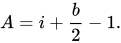
Given a simple polygon constructed on a grid of equal-distanced points (i.e., points with integer coordinates) such that all the polygon vertices are grid points, Pick's theorem provides a simple formula for calculating the area A of this polygon in terms of the number i of lattice points in the interior located in the polygon and the number b of lattice points on the boundary placed on the polygon's perimeter:

A=i+{\frac {b}{2}}-1.

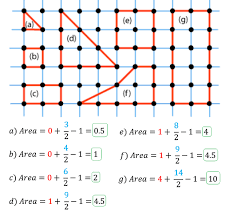
In the language of pictures,

Play around with this in Geogebra.

Kudos to some of the Students of Cheenta Ganit Kendra like Shahbaz Khan and ACHUTHKRISHNAN, who have successfully completed the proof with the help of the following stepstones:

Steps:

Step 1:

Consider the two-dimensional plane. What is the minimum area of a triangle whose vertices are points with integer coordinates?

Hint: Use Determinant form to compute the area of such a triangle.
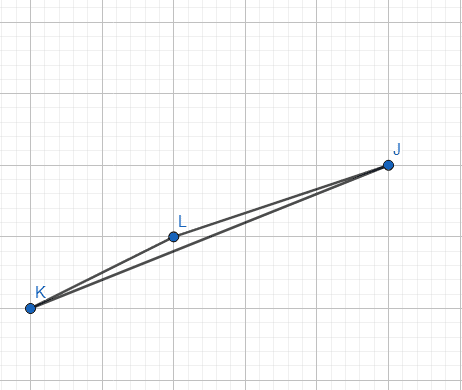
It is such a triangle with minimum area

Such triangles are called Fundamental Triangles.

Step 2

Prove that the triangle with minimum area and with coordinates as integers cannot contain ANY integer point on or inside the triangle except the three vertices.

Hint: Prove by contradiction.

Observe that the above picture is one such example.

Step 3

Find the area of a triangle with integer vertices with m points inside it and n points on its boundary edges. (in terms of m and n ) if possible otherwise prove that it is not possible.

Hint: Just draw pictures and use the previous steps.

Step 4


Find the area of any polygon with integer vertices with m points inside it and n points on its boundary edges. (in terms of m and n ) if possible otherwise prove that it is not possible.

Hint: Just try to follow the ideas in Step 3. Try to observe by introducing one point and by the method of induction.

I would love if you try the steps and discover the Pick's Theorem in such simple steps yourself. Don't forget to try out the interactive Geogebra version as given.

Share your views and ideas in the comments' section.

Enjoy. 🙂

Area of Triangle - ISI BStat 2018 Subjective Problem

Here is a problem based on the area of triangle from ISI B.Stat Subjective Entrance Exam, 2018.

Sequential Hints:

Step 1:

Draw the DIAGRAM with necessary Information, please! This will convert the whole problem into a picture form which is much easier to deal with.

area of triangle- figure

Step 2:

Power of a Point - Just the similarity of \(\triangle QOS\) and \(\triangle POR\)

By the power of a point, PO . OQ = SO . OR . We know SO = 4; PO = 3.

Let, OQ be \(x\). Hence we get the following:

SO = 4; PO = 3; OQ = \(x\); OR = \(\frac{3x}{4}\).

Step 3:

Assume \(\angle QOS = \theta\) .

Now, compute the area in terms of \(x\).

Area of \(\triangle QOS = 2x\sin{\theta}\).

Area of \(\triangle POR = \frac{9x\sin{\theta}}{8} \).

Therefore, we get the following that \(\frac{\triangle QOS }{\triangle POR } = \frac{16}{9}\).

Hence the Area of \(\triangle QOS = \frac{112}{9}\).

A Math Conversation - I

Inspired by the book of Precalculus written in a dialogue format by L.V.Tarasov, I also wanted to express myself in a similar fashion when I found that the process of teaching and sharing knowledge in an easy way is nothing but the output of a lucid conversation between a student and a teacher inside the person only.

Instead of presenting in paragraphs, I will express that discussion in the raw format of conversation to you.

Student: Do you think problem - solving is so important in learning math?

Teacher: Yes, surely without problem-solving, you will not at all enjoy the process of learning of mathematics. If you learn math without problem-solving is like charging the phone without the battery.

S: But why is it so important?

T: Math is nothing but layers of answers to a large number of Whys, Hows, Can We, etc. All the thoughts, questions and answers are refined into something called theorems and lemmas to make them look concise. Theory develops in this way only. Often someone gives a new way of looking into things or connecting two different fields of study, that becomes the definitions, but that was actually done to solve a new problem or question that occurred in their minds or make the things precise. Problems and Theory are the two sides of the same coin.

S: Interesting! So, a student how can we build our own new theory?

T: That's a good question. As I told you, it is about not developing a new theory, it is about solving a new problem always. So find your own problems or existing ones and start spending time with them.

S: What if I couldn't solve a problem?

T: That is the best part when you solve problems. You try to understand what doesn't work. You have to understand why it doesn't work. Then only you can engineer an alternate pathway, and that is eventually called a new theory if it is too influential. But whatever you have thought you can call it your own theory. Even if you cannot develop a full alternated pathway, something new you have thought will help you solve another problem you were pondering upon for sometime. This actually happenned with me.

S: Wow! This problem solving path seems to be quite adventurous. I never thought it this way.

T: Yes, it is. Infact human beings think and behave in this way only, when their rational and logical part of the brain work. Only they have to conscious of the steps they are taking and they have to take the opportunity to learn at every failure.

S: So, are there any problem solving tips for me?

T: I really don't believe in tricks while learning, tricks are important for quick problem solving that is only required in the exam. But those are temporary. Once you develop your own strategies, first of all we will get to know something new from you and also you will never forget those strategies. But yes, from my experience I can help you in approaching problems.

S: Surely, what are they?

T: First of all, you need to understand the working principle of problem-solving. It works like whenever you think or see some problem, you are either blank or you have some ideas to approach based on your previous experiences and knowledge.

S: Yes, then?

T: Well, if you have some ideas, you approach along that path till you can't proceed further. You have to find everytime where is the problem occurring and how to bypass it. This is why different people have different solutions to a problem because they create different bypasses.

S: What if I am blank?

T: You have to learn how to bring in ideas into you.

S: But how?

T: First of all, without knowledge or past experience ideas will rarely come, because that is how humans think using past data. Do you that our visual memory is the maximum memory among all the senses?

S: I felt that was true, but I knew that. But how is it related to math and problem-solving?

T: well, try to draw a picture in your mind or your copy. Try to draw a mindmap, some flowcharts to get some visual aspect of the theory or the problems. Now your visual memory comes into play automatically. That's why, the important step when you learn something new or try to solve something, ALWAYS TRY TO DRAW DIAGRAMS AND PICTURES WHENEVER IT IS POSSIBLE.

S: That's seems quite satisfying. I will start doing it from today only. What else?

T: Actually this is the first and important step. Also, intuition is also gained by the method of HIT AND TRIAL. When you have a problem, you play with the numbers in the problem or the expressions and often it happened to me that something interesting came out. So, also whenever you are blank, you can follow this HIT AND TRIAL methodology to start your idea engines and this helps you in recognizing patterns.

S: Hit and Trial seems exciting and adventurous too. What did you mean by pattern recognition?

T: Pattern recognition is the most important part of math. You have to observe a pattern and justify it with logic in a new problem. The first step to problem-solving is to find the pattern. Then comes the next part of logically justifying the pattern. To help you see the pattern and proceeding through you are guided by DRAWING PICTURES and HIT AND TRIAL methodologies.

S: What about logically justifying a problem?

T: This is the most difficult part and rewarding part of mathematics. Often people are not being properly trained in this domain that's why they find it uninteresting. The method of proofs depends on the pattern you see and observe and that varies from person to person. But proving that the pattern actually holds requires some serious training. Isn't it so beautiful, when you show that what you observe actually works? It is like painting your patterns by the brush of logic.

S: How do I develop that?

T: That is solely practice and you must enjoy that process. That process requires some knowledge and how people approached on similar ideas and patterns. Once you develop that habit, you will find it super rewarding. It is also a continuously learning path.

S: How do we learn like that that interesting way?

T: Yes, that is a really nice question and those who can impart this knowledge into you very fluidly and interestingly are good teachers. If you want to be a good teacher, you have to start practicing that too. You have to understand and question why every step works and are there any other ways to do it? Then only you will learn out of a problem, or a solution you have learned. Even if you are learning, you have to question WHY THIS WAY AND NOT THAT WAY. Develop the habit of questioning at every step of your learning process, then only you will enjoy.

S: Nice! I learnt a lot of new things today. Let me put that into action. See you later. Have a nice day.

T: Yes, you must put them into action. Yes see ya later. Have a nice day. Bye.

S: Bye.

The 3n+1 Problem | Learn Collatz Conjecture

The 3n+1 Problem is known as Collatz Conjecture.

Consider the following operation on an arbitrary positive integer:

The conjecture is that no matter what value of the starting number, the sequence will always reach 1.

Observe that once it reaches 1, it will do like the following oscillation

1 -> 4 -> 2 -> 1-.> 4 ->2 ....

So, we see when it converges to 1, or does it?

We will investigate the problem in certain details as much as possible with occasional exercises and some computer problems ( python ).

Let's start!

Let's start by playing with some numbers and observe what is happening actually.

We will need this frequently. So let's make a little piece of code to do this.

n = 12
print(n)
while n > 1:
    if n % 2 == 0 :
        n = n//2
        print (n)
    else:
        n = 3*n+1
        print (n)

This will give the output :

12 6 3 10 5 16 8 4 2 1

Now depending on the input of "n" you can get different sequences.

Exercise: Please copy this code and changing the input value of "n", play around with the sequences here. (Warning: Change it to python before implementing the code.) Eg: Do it for 7.

3n+1 Problem - sequence

If you observe that different numbers requires different time to converge and that is the unpredictable which makes the problem so hard.

There are in total two possibilities:

Exercise: Find out the length of the sequence for all the numbers from 1 to 100 by a computer program. I will provide you the code. Your job is to find a pattern among the numbers.

c = 1
for n in range(2,101):
    i = n 
    while i > 1:
        if (i % 2 == 0):
            i = i//2
            c = c + 1
            if i == 1 :
                print( "The length of the sequence of {} is {}".format(n, c) )
                c = 1
        else:
            i = 3*i+1
            c = c + 1 

Exercise: Consider the length of a sequence corresponding to a starting number "n' as L(n). Consider numbers of the form n = (8k+4) and n+1 = (8k+5), then find the relationship between L(n) and L(n+1). Try to observe the sequence of lengths for the numbers till 100 and predict the conjecture..

Exercise: Prove the conjecture that you discovered.

Hint:

8k+4 -> 2k+1 -> 6k+4 -> 3k+2

8k+5 -> 24k+ 16 -> 3k+2

Exercise: Prove that if n = 128k + 28, then L(n) = L(n+1) =L(n+2)

Hint:

128k+28 -> 48k+11 -> 81k+20

128k+29 -> 48k+11 -> 81k+20

128k+30 -> 81k+20

Exercise: Try to generalize the result for general k consecutive elements. Maybe you can take help of the computer to observe the pattern. Modify the code as per your choice.


You can try to do an easier problem and get the intuition as an exercise.

Exercise: Try to understand the behavior and the terminating number of the sequence if the rule is the following:

Consider the following operation on an arbitrary positive integer:


1. If the number is even, divide it by two.
2. If the number is odd, add 1.


Exercise: Try to understand the behavior and the terminating number of the sequence if the rule is the following:
Consider the following operation on an arbitrary positive integer:

1. If the number is even, divide it by two.
2. If the number is odd, add any 3.


Exercise: Try to understand the behavior and the terminating number of the sequence if the rule is the following:
Consider the following operation on an arbitrary positive integer:

1. If the number is even, divide it by two.
2. If the number is odd, add ANY ODD NUMBER.

Eager to hear your approaches and ideas. Please mention them in the comments.

Other useful links:-

The Dhaba Problem | ISI and CMI Entrance

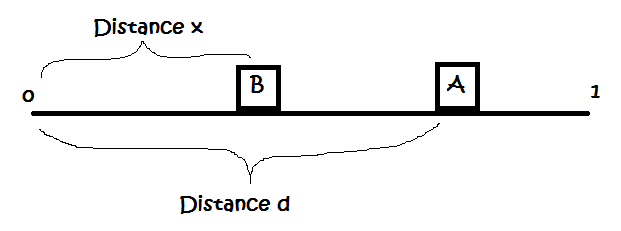
Suppose on a highway, there is a Dhaba. Name it by Dhaba A.

You are also planning to set up a new Dhaba. Where will you set up your Dhaba?

Model this as a Mathematical Problem. This is an interesting and creative part of the BusinessoMath-man in you.

You have to assume something for Mathematical simplicity to model a real life phenomenon via math.

Assumptions:

Observe that the assumptions are valid and are actually followed in real life. Just sit and think for some time placing yourself in that position.

The Explicit Mathematical Problem

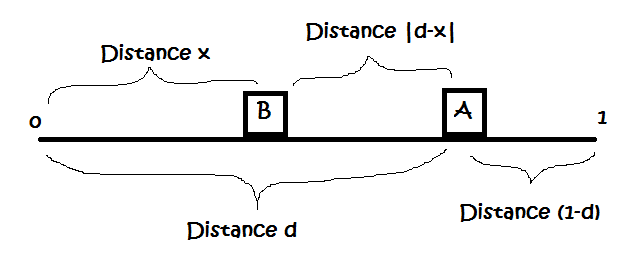
distance of the dhaba
dhaba problem distance

Profit Calculation of your Dhaba B

Now based on the lengths of the roads above and the assumptions made, we have to calculate the profit of Dhaba B.

solution of the dhaba problem
solution

So the profit made by B = c.R , where R is the length of the road on which B has monopoly. Here, as shown R = \c.( x + \frac{|d-x|}{2}\).

We have assumed in this case that \(0 \leq x \leq d\) by the diagram.

So, the profit for the Dhaba B is c.\(\frac{d+x}{2}\) .

Hence as \(0 \leq x \leq d\), the profit is maximized if x = d.

Exercise: Show that the profit of Dhaba B as a function of x is c.(\( 1 - \frac{d+x}{2}\)) if \(d \leq x \leq 1\) .

Also, observe that in this case the profit is maximized at x = d.

Exercise: Calculate the maximum profit in both cases. Do you observe something fishy? What steps and what arguments will you give to understand the fishiness?

Please share your views in the comments section.

Eager to listen to your beautiful ideas.

Other useful links:-

Problem Solving Marathon Week 2

We are having a full fledged Problem Solving Marathon. We are receiving wonderful responses from the end of our students which is making the session more and more alluring day by day. Here we are providing the problems and hints of "Problem Solving Marathon Week 2". The Set comprises three levels of questions as following-Level 0- for Class III-V; Level 1- for Class VI-VIII; Level 2- for the class IX-XII. You can post your alternative idea/solution in here.

Level 0


[Q.1] In triangle $latex CAT$, we have $latex \angle ACT =\angle ATC$ and $latex \angle CAT = 36^\circ$. If $latex \overline{TR}$ bisects $latex \angle ATC$, then $latex \angle CRT =$


Hint 1
Triangle $latex CAT$ is an isosceles triangle


Hint 2
Try to find the value of $latex \angle ATC$


[Q.2] What is the product of $latex \frac{3}{2}\times\frac{4}{3}\times\frac{5}{4}\times\cdots\times\frac{2019}{2018}$?


Hint 1
Figure out the hidden pattern of the problem.


Hint 2
You can make a prototype of that problem i.e, try to calculate product of first three or four terms.


Also Visit: Pre-Olympiad Program


Level 1


[Q.1] How many $latex 7$-digit palindromes (numbers that read the same backward as forward) can be formed using the digits $latex 2$, $latex 2$, $latex 3$, $latex 3$, $latex 5$, $latex 5$, $latex 5$?


Hint 1
First symbolize the number i.e., the number looks like "$latex \textbf{mnoponm}$".


Hint 2
Now $latex \textbf{p}$ cannot be $latex 2$ or $latex 3$.


[Q.2] How many pairs of positive integers $latex (a,b)$ are there such that $latex a$ and $latex b$ have no common factors greater than 1 and: $latex \frac{a}{b} + \frac{14b}{9a}$ is an integer?


Hint 1
put $latex x=\frac{a}{b}$


Hint 2
Discriminant of a Quadratic equation plays a significant role here..


Level 2


[Q.1] Prove that if $latex m$, $latex n$ are integers, then the expression $latex E = m^5 + 3m^4n - 5m^3n^2 - 15m^2n^3 + 4mn^4 + 12n^5$ cannot take the value $latex 33$.


Hint 1
Factorise the given expression..


Hint 2
Then try to find the pairwise different divisors $latex 33$

Problem Solving Marathon Week1 Solution

Problem Solving Marathon Week1 Solution is the effortless attempt from Cheenta's existing student as well as from the end of mentor. Question, rules and hints are given here.

Level 0


Q.1 Which of the following is equal to $latex 1 + \frac{1}{1+\frac{1}{1+1}}$?


This solution is proposed by Swetaabh Mishra from Thousand Flowers. $latex 1 + \frac{1}{1+\frac{1}{1+1}} = 1 + \frac{1}{1+\frac{1}{2}}$
$latex =1 + \frac{1}{\frac{3}{2}}= 1+\frac{2}{3}=1\frac{2}{3} $


Answer of (Q.2) This solution is using hints.
If we pair up the elements of $latex X$ it will look like $latex (10,100)(12,98),(14,96),.....(54,56)$. Now sum of the each pair is $latex 110$. Number of pair $latex =\frac{Number of terms}{2} =\frac{46}{2}$. so $latex X$ will be equal to Number of pair $latex \times 110 =\frac{46}{2} \times 110=2530$ , similarly $latex Y$ will be $latex \frac{46}{2} \times 114=2622$.
So, $latex Y-X$ will be $latex 92$.


Level 1


Q.1 Find all positive integers $latex n$ such that $latex n^2+1$ is divisible by $latex n+1$.


Since, $latex n^2+1$ can be written as $latex n(n+1)-(n-1)$
We can say that if $latex n+1|n^2+1$ then $latex n+1|n-1$. At a glance, it's look like impossible to get any positive integer. If $latex n-1=0$ then it is possible. So there is only one such positive integer $latex n=1$.


Also Visit: Cheenta Olympiad Program


Q.2 Two geometric sequences $latex a_1, a_2, a_3, \ldots$ and $latex b_1, b_2, b_3, \ldots$ have the same common ratio, with $latex a_1 = 27$, $latex b_1=99$, and $latex a_{15}=b_{11}$. Find $latex a_9$.
Example of Geometric Sequence $latex 2,4,8,16$, here common ratio is $latex 2$.


This solution is proposed by Saikrish Kailash from Thousand Flowers.
Two geometric sequence have same common ratio, let it is $latex r$.
Now $latex a_9=27\times r^{(9-1)}=27r^8$. From the given condition $latex a_{15}=b_{11} $. Which is equivalent to $latex 27r^{14}=99r^{10} \Rightarrow r^4=\frac{11}{3}$. Now put the value of $latex r^4$ in $latex a_9=27r^8=27(r^4)^2=363$.


Level 2


Q.1 Let $latex m$, $latex n$, $latex p$ be real numbers such that $latex m^2 + n^2 + p^2 - 2mnp = 1$ . Prove that $latex (1+m)(1+n)(1+p) \leq 4 + 4mnp$.


This solution is proposed by Sampreety Pillai from Early Bird Math Olypmiad Group.
We konw $latex (m-n)^2 \geq 0$ which imply $latex m^2+n^2 \geq 2mn$. similarly $latex n^2+p^2 \geq 2np$, $latex p^2+m^2 \geq 2mp$. Also $latex m^2+1 \geq 2m$, $latex n^2+1 \geq 2n$ and $latex p^2+1 \geq 2p$. Adding these six inequalities, we get $latex 3(m^2+n^2+p^2+1) \geq 2(mn+mp+np+m+n+p)$. by the hypothesis $latex m^2+n^2+p^2=2mnp+1$.
So $latex 3(mnp+1) \geq 2(mn+mp+np+m+n+p)$. Add $latex mnp+1$ both side of last inequality.
Also you can do another type of proof using Cauchy-Schwarz inequality. For that click here.