Proving Geometric Properties in Isosceles Triangles: A Deep Dive into RMO 2024 Problem No. 3
In this exploration, we tackle a rich geometry problem from the 2024 Regional Math Olympiad (RMO). Given an acute-angled isosceles triangle \( \triangle ABC \) with the circumcenter \( O \), orthocenter \( H \), and centroid \( G \), along with specific distances between them, we aim to prove that the triangle's incircle passes through the centroid \( G \).
Points \( O \), \( G \), \( H \), and the incenter \( I \) are collinear along \( AD \), where \( D \) is the foot of the altitude from \( A \) to \( BC \). This holds due to the perpendicular bisector properties in isosceles triangles.
Euler’s Line:
In any triangle, \( O \), \( G \), and \( H \) lie on Euler's line, dividing \( OH \) in the ratio 1:2. This relationship allows us to find specific segment lengths, given distances like \( HD \) and \( OD \).
Watch the Video
Step-by-Step Solution:
Distances Along Euler's Line: Use the given condition \( 2 \cdot HD = 23 \cdot OD \) to find segments \( OG \) and \( GH \).
Median Division by Centroid:
\( G \) divides the median \( AD \) in the ratio 2:1. With this, the distance \( AG \) can be determined.
Calculating Side Lengths:
Using known distances, the length of \( BD \) is found by applying the Pythagorean theorem in \( \triangle BOD \). Side lengths \( AB \) and \( AC \) are deduced for further calculations.
Proving the Incircle Passes Through \( G \):
Inradius Calculation:
Using the formula \( r = \frac{\text{Area}}{\text{Semiperimeter}} \), the inradius \( r \) is derived.
Centroid’s Distance Verification:
Show that \( IG \), the distance from the incenter to the centroid, matches the inradius, confirming \( G \) lies on the incircle.
Conclusion:
By proving \( IG \) equals the inradius, we show that the centroid \( G \) indeed lies on the incircle, completing the proof. This problem elegantly ties together triangle properties, collinearity, and Euler's line, demonstrating the interconnectedness of geometric points in advanced problem-solving.
Counting Chains with Casework in Combinatorics: A Problem from the RMO 2024
In this exploration, we dive into a combinatorial problem from the 2024 Regional Math Olympiad (RMO) in India, centered on counting specific number sequences, called "chains." Using a function \ (f(n) \), defined as the number of chains that start at 1 and end at \( n \) with each previous number dividing the next, the problem applies strategic casework to calculate \( f(2^m \cdot 3) \).
We want to determine: \(f(2^m \cdot 3)\) where each chain is a sequence that:
Begins at 1 and ends at \( 2^m \cdot 3 \),
Has each term dividing the next.
Concepts Used:
Combinatorial Casework: Breaking down problems by considering specific scenarios helps in counting complex structures systematically.
Binomial Theorem: Key in calculating possible combinations, where the sum of binomial coefficients up to \( n \) equals \( 2^n \).
Watch the Video
Solution Outline:
The solution involves structured casework using the position of the first appearance of 3 as a "switch" to organize sub-cases.
Understanding Chains
For example, \( f(4) \) is the number of "4-chains" starting at 1 and ending at 4, where each term divides the next, such as \( [1, 4] \) and \( [1, 2, 4] \).
Casework on Position of 3:
Identify when 3 first appears in the sequence, which can happen at positions like \( 3, 2^j \cdot 3, \ldots, 2^m \cdot 3 \).
Divide cases based on different powers of 2, allowing systematic counting of sequences in each case.
Applying Binomial Coefficients:
Use binomial coefficients to count the number of valid choices for sequences involving powers of 2 on either side of the appearance of 3.
This yields: \[2^{m-1} \times m + 2^m\]
Final Answer:
By organizing cases and summing possibilities, we obtain the final count: \[2^{m-1} \cdot (m + 2)\]
This problem exemplifies the effectiveness of casework in combinatorics, teaching a methodical approach to counting sequences. Through strategic splitting and summing, it provides a beautiful solution to a challenging problem in combinatorial mathematics.
RMO 2024 - Problems & Solutions
The Regional Mathematical Olympiad (RMO), preceded by the all-India pre-RMO (IOQM) or PRMO, is the first step towards representing India at the global platform for 'mathletes', the International Mathematical Olympiad (IMO).
The RMO is a three-hour written test with six or seven problems. On the basis of the performance in the RMO, a certain number of students are selected from each region to participate in the Indian National Mathematical Olympiad (INMO), second step towards the IMO.
In this post we have added the problems and solutions from the RMO 2024.
Let \(n>1\) be a positive integar. Call a rearrangement \(a_1, a_2, \ldots, a_n\) of \(1,2, \ldots, n\) nice.
If for every \(k=2,3, \ldots, n\), we have that \(a_1+a_2+\cdots+a_k\) is not divisible by \(k\). (a) If \(n>1\) is odd, prove that there is no nice rearrangement of \(1,2, \ldots, n\). (b) If \(n\) is even, find a nice rearrangement of \(1,2, \ldots, n\).
Solution
(a) If $n$ is ODD, then consider any rearrangement $a_1, a_2, \ldots, a_n$.
For $k=n$, we get $a_1+a_2+\cdots+a_n=1+2+\cdots+n=\frac{n(n+1)}{2}=$
$n\left(\frac{n+1}{2}\right)$ which is a multiple of $n$ since $n$ is co-prime to 2 and
thus the condition would be violated rendering the rearrangement 'not nice'.
(b) If $n$ is EVEN, then the following rearrangement is nice.
$$ a_i= \begin{cases}i-1 & , \text { if } i \text { is even } \\ \ i+1 & , \text { if } i \text { is odd }\end{cases} $$
That is, $\left(a_1, a_2, \ldots, a_n\right)=(2,1,4,3,6,5, \ldots, n, n-1)$. This rearrangement is nice because
$$a_1+a_2+\cdots+a_k= \begin{cases}\frac{k(k+1)}{2}=\left(\frac{k}{2}\right)(k+1) & , \text { if } k \text { is even } \\ \ \frac{k(k+1)}{2}+1= k\left(\frac{k+1}{2}\right)+1 & , \text { if } k \text { is odd }\end{cases}$$
Now it is conspicuous that both possible values of the sum are not divisible by $k$ (except for $k=1$ ) because in the first sum, $\frac{k}{2}$ and $k+1$ are relatively prime numbers and in the second sum, it is the next number of a multiple of $k$ which cannot be a multiple of $k$.
Problem 2
For a positive integer (n), let \(R(n)\) be the sum of the remainders when \(n\) is divided by \(1,2, \ldots, n\). For example, \(R(4)=0+0+1+0=1,\ R(7)=0+1+1+3+2+1+0=8\). Find all positive integers \(n\) such that \(R(n)=n-1\).
Solution
Let $n$ be EVEN, then consider the numbers from $\frac{n}{2}+1, \frac{n}{2}+2, \ldots, n-1$. Now, all these numbers bear a quotient of 1 when dividing $n$ because twice of each exceeds $n$. Hence, they leave a remainder of $\frac{n}{2}-1, \frac{n}{2}-2, \ldots, 1$ respectively when dividing $n$ and so the sum of these remainders is no greater than $R(n)$. Thus,
\begin{align*}R(n)&\geq 1+2+\cdots+\left(\frac{n}{2}-1\right)\\&=\frac{\left(\frac{n}{2}-1\right)\left(\frac{n}{2}\right)}{2}\\\Rightarrow n-1&\geq\frac{n^2-2n}{8}\\\Rightarrow n^2-10n+17&\leq 17\\\Rightarrow (n-5)^2&\leq 17\\\Rightarrow n&=2,4,6,8\ (\text{as we assumed $n$ to be EVEN})\end{align*}
Similarly working for $n$ being ODD necessarily yields the remainders $\frac{n-1}{2}, \frac{n-3}{2}, \ldots, 1$ when dividing $n$ and thus
\begin{align*}R(n) &\geq 1+2+\cdots+\frac{n-1}{2}\\\Rightarrow n-1 &\geq \frac{\left(\frac{n-1}{2}\right)\left(\frac{n+1}{2}\right)}{2}\\\Rightarrow n &\leq 7\end{align*} Therefore, in total, we just need to check $R(n)$ value for the numbers $n=$ $1,2,3,4,5,6,7,8$. Manually working on them gives $R(1)=0, R(2)=0, R(3)=$ $1, R(4)=1, R(5)=4, R(6)=3, R(7)=8, R(8)=8$. Hence, the positive integers $n$ such that $R(n)=n-1$ are $\boxed{n=1,5}$.
Problem 3
Let \(A B C\) be an acute triangle with \(A B=A C\). Let \(D\) be the point on \(B C\) such that \(A D\) is perpendicular to \(B C\). Let \(O, H, G\) be the circumcentre, orthocentre and centroid of triangle \(A B C\) respectively. Suppose that \(2 \cdot O D=23 \cdot H D\). Prove that \(G\) lies on the incircle of \( \triangle A B C\).
Solution
Let $I$ be the incenter, center of incircle, of $\triangle A B C . A B=A C \Rightarrow \triangle A B D \cong$ $\triangle A C D$, so we have $A D$ as the perpendicular bisector of $B C$ and the angle bisector of $\angle A$. Thus, $O, G, H, I$ all lie on $A D$. We know that for any triangle, $O, G, H$ are collinear in that order with $O G: G H=1: 2$.
Let $H D=2 x$, then $O D=\frac{23 \cdot H D}{2}=23 x \Rightarrow O H=21 x$. Now, $O G: G H=$ $1: 2 \Rightarrow O G=7 x, G H=14 x, G D=16 x$ as shown. We also know that centroid divides median in the ratio $2: 1 \Rightarrow A G: G D=2: 1 \Rightarrow A G=$ $32 x \Rightarrow A O=25 x$. Now, $O A=O B=25 x$, so in $\triangle O B D$, we have $B D=$ $\sqrt{O B^2-O D^2}=\sqrt{(25 x)^2-(23 x)^2}=4 x \sqrt{6}$. In $\triangle A B D, A B=\sqrt{A D^2+B D^2}=$ $\sqrt{(48 x)^2+96 x^2}=20 x \sqrt{6}$. Hence, the semi-perimeter $s=A B+B D=20 x \sqrt{6}+$ $4 x \sqrt{6}=24 x \sqrt{6}$ and $[A B C]=\frac{1}{2} \times 2 B D \times A D=192 x^2 \sqrt{6}$.
Thus, inradius $r=\frac{\mid A B C]}{s}=\frac{192 x^2 \sqrt{6}}{24 x \sqrt{6}}=8 x \Rightarrow I D=8 x$. Thus, $G I=G D-I D=$ $16 x-8 x=8 x$ and as we already know that $8 x$ is the radius of incircle, we conclude that $G$ lies on the incircle of $\triangle A B C$.
Problem 4
Let \(a_1, a_2, a_3, a_4\) be real numbers such that \(a_1^2+a_2^2+a_3^2+a_4^2=1\). Show that there exist \(i, j\) with \(1 \leq i<j \leq 4\), such that \(\left(a_i-a_j\right)^2 \leq \frac{1}{5}\).
Solution
Without loss of generality, let $a_1\leq a_2\leq a_3\leq a_4$. Let $d_1= a_2-a_1,\ d_2 = a_3-a_2,\ d_3 = a_4-a_3$ and let $d=min{d_1,d_2,d_3}$.
Case (i) - $d=d_1$ So, $d=a_2-a_1$ and let $x=a_2+\frac{d}{2}\Rightarrow a_2=x-\frac{d}{2},\ a_1=x-\frac{3d}{2}$. So, $a_3=x+\frac{d}{2}+y,\ a_4=x+\frac{3d}{2}+z$, for some $y,z\geq 0$. Then,
Case (ii) - $d=d_2$ So, $d=a_3-a_2$ and let $x=a_2+\frac{d}{2}\Rightarrow a_2=x-\frac{d}{2},\ a_3=x+\frac{d}{2}$. So, $a_1=x-\frac{3d}{2}-z,\ a_4=x+\frac{3d}{2}+y$, for some $y,z\geq 0$. Then,
Case (iii) - $d=d_3$ So, $d=a_4-a_3$ and let $x=a_3-\frac{d}{2}\Rightarrow a_3=x+\frac{d}{2},\ a_4=x+\frac{3d}{2}$. So, $a_2=x-\frac{d}{2}-y,\ a_1=x-\frac{3d}{2}-z$, for some $y,z\geq 0$. Then,
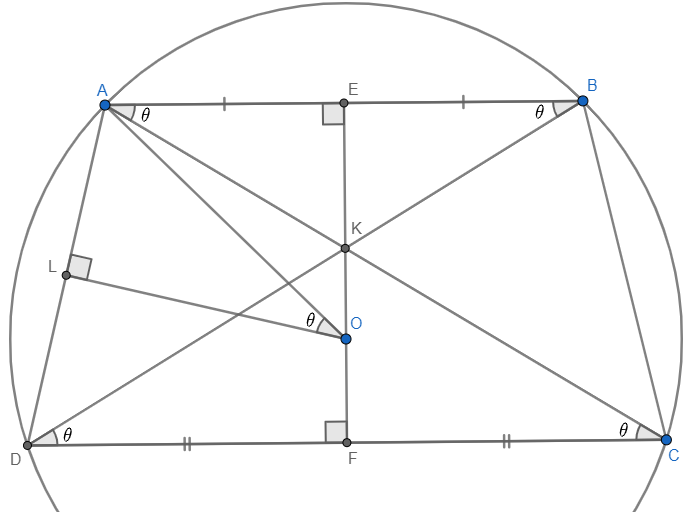
Let \(A B C D\) be a cyclic quadrilateral such that \(A B\) is parallel to \(C D\). Let \(O\) be the circumcentre of \(A B C D\), and \(L\) be the point on \(A D\) such that \(O L\) is perpendicular to \(A D\). Prove that
\(O B \cdot(A B+C D)=O L \cdot(A C+B D) \)
Solution
Let $\angle ABD=\theta\Rightarrow\angle BDC=\theta$ (since $AB||CD$). By the Inscribed angle theorem, $\angle BAC=\angle BDC=\angle ABD=\angle ACD=\theta$ (thus $ABCD$ is isoceles trapezoid). Hence, $\triangle ABK, \triangle CDK$ are isoceles and so $AB, CD$ have common perpendicular bisector through $K$ which also passes through center of circle $O$, making $E,K,O,F$ collinear as shown.
Now, by the Inscribed angle theorem, $\angle AOD=2\theta\Rightarrow\angle AOL=\theta$ since $\triangle AOD$ is isoceles. Thus, $\cos{\theta}=\frac{OL}{OA}\rightarrow\boxed{eq1}$.
In $\triangle ABK, \cos{\theta}=\frac{AE}{AK}=\frac{BE}{BK}$ and so by the componendo-dividendo rule, $\cos{\theta}=\frac{AE+BE}{AK+BK}=\frac{AB}{AK+BK}$. Similarly, in $\triangle CDK, \cos{\theta}=\frac{CF}{CK}=\frac{DF}{DK}=\frac{CF+DF}{CK+DK}=\frac{CD}{CK+DK}$. Combining these two results and applying componendo-dividendo rule once again, we get, $\cos{\theta}=\frac{AB}{AK+BK}=\frac{CD}{CK+DK}=\frac{AB+CD}{AK+BK+CK+DK}=\frac{AB+CD}{AC+BD}\rightarrow\boxed{eq2}$.
From the equations $eq1$ and $eq2$, we conclude that $\cos{\theta}=\frac{OL}{OA}=\frac{AB+CD}{AC+BD}\Rightarrow \boxed{OB \cdot(A B+C D)=O L \cdot(A C+B D)}$, since $OA=OB=radius$.
Problem 6
Let \(n \geq 2\) be a positive integer. Call a sequence \(a_1, a_2, \cdots, a_k\) of integers an \(n\)-chain if \(1=a_1<a_2<\cdots<a_k=n\), and \(a_i\) divides \(a_{i+1}\) for all \(i, 1 \leq i \leq k-1\). Let \(f(n)\) be the number of \(n\)-chains where \(n \geq 2\). For example, \(f(4)=2\) corresponding to the 4 -chains $(1, 4)$ and $(1, 2, 4)$. Prove that \(f\left(2^m \cdot 3\right)=2^{m-1}(m+2)\) for every positive integer \(m\).
Solution
Real Olympiads versus Fake Olympiads: Recommended by Cheenta
Mathematical Olympiads began with a noble objective: promote non-routine problem solving and a culture of research among school students. The real International Math Olympiad is a 9 - hour marathon examination consisting of only 6 problems. Here is an example of a problem from IMO 2023. Notice its difference from the 'multiple choice problems' found in hundreds of so called private olympiads that operate all around the world.
IMO 2023, Problem 1.
Determine all composite integers $n>1$ that satisfy the following property: if $d_1, d_2, \ldots, d_k$ are all the positive divisors of $n$ with $1=d_1<d_2<\cdots<d_k=n$, then $d_i$ divides $d_{i+1}+d_{i+2}$ for every $1 \leqslant i \leqslant k-2$.
How can I participate in the real IMO?
In order to qualify for IMO, a student goes through a rigorous, multi-step process. These steps are different in every country. For example, India has a 4 step process:
IOQM [Starts at 8th grade]
RMO [For those who qualify in IOQM]
INMO [For those who qualify in RMO]
IMO Training Camp
At the end of this 4-step process, only 6 students from India are sent to the actual International Math Olympiad.
Similarly, the United States has a 4 step process:
American Math Competition 10 or 12
AIME
USAMO / USAJMO
MOSP
What topics are tested in the real math olympiads?
Mathematical Olympiads test ingenuity and problem solving skill of young mathematicians. This is usually developed over several years, through consistent hard work. In particular, the problems are derived from the following four areas of pre-college mathematics.
Number Theory
Geometry
Algebra
Polynomials
Complex Numbers
Functional Equations
Inequalities
Combinatorics
What contests are recommended in elementary school or middle school if I am not ready for real IMO?
The rule of the thumb is: go for olympiads created by real mathematicians, who are usually part of Mathematical Teacher's Association of a particular country. Here are some of the recommended contests:
India (upto Grade 7 --> After that you should focus on IOQM)
NMTC Contests
Australian Math Competition
Math Kangaroo
American Math Competition 8
United States (upto Grade 7 --> After that you should focus on AMC 10)
Australian Math Competition
Math Kangaroo
American Math Competition 8
MOEMS
University of Waterloo Contests
United Kingdom
UKMT
American Math Competition 8
University of Waterloo Contests
Why should you avoid other private olympiads?
There are hundreds of private olympiads run by publishing houses and coaching centers who are interested in selling books and courses. They have created their own contests. They use the buzzword 'olympiad', 'imo' to lure students and parents. Unfortunately these private contests add little to no value to a student's academic development. In order to become popular they keep the difficulty level of their questions quite low. Students who do well in those poor-quality problems, are handed out with gold and silver medals (certainly if your child gets a 'gold' in so-and-so 'olympiad', chances are, you will spread the word).
In most cases the private olympiads play a negative role. Since most of the problems in a private contest requires the students to remember some extra formulae, it defeats the central philosophy of the real mathematical olympiads: to think out-of-the-box. We often hear a third grader's parent boasting, 'my child knows tenth grade math'. However when challenged with some non-routine problem from their own standard, these students fumble desperately. Indeed the private olympiads can change the focus of a student from ingenuity to rote learning.
Another issue that often comes up is this: students who received 'gold' and 'silver' in the private competitions, develop a false sense of complacency. They lose valuable time for preparation for the real contests. When faced with the real olympiads, they find themselves completely unprepared.
What books should you follow for real math olympiad preparation?
For classes 1 to 5
Math Circle by the Bay: Topics for Grades $1-5$ by Ilya Zakharevich, Laura Givental, and Maria Nemirovskaya
Math from Three to Seven: The Story of a Mathematical Circle for Preschoolers by Alexander K. Zvonkin Mathematics can be fun by Yakov Perelman
Math Circles for Elementary School Students by Natasha Rozhkovskaya
For classes 6 to 8
Mathematical Circles: (Russian Experience) by Dmitrii Vladimirovich Fomin, Ilia Itenberg, and Sergei Aleksandrovich Genkin
Algebra by Alexander Shen and Israel Gelfand
Kiselev's Geometry: Planimetry by Alexander Givental
For classes 9 to 12
Challenge and Thrill of Pre-College Mathematics by C. R. Pranesachar and V Krishnamurthy
An Excursion In Mathematics. by M. R. Modak
Trigonometry by Israel Gelfand and Mark Saul
Complex Numbers from A to …Z by Dorin Andrica and Titu Andreescu Euclidean Geometry in Mathematical Olympiads by Evan Chen Principles and Techniques in Combinatorics by Chuan Chong Chen and KOH KHEE MENG
Secrets in Inequalities by Pham Kim Hung
Functional Equations by Venkatachala Test of Mathematics at the 10+2 Level by East West Press (useful for ISI-CMI Entrances.Polynomials by Edward Barbeau
Start with these 7 steps for Math Olympiad, ISI-CMI Entrance, IOQM, AMC, INMO
What are the Real Benefits of Math Olympiad ?
14 Cheenta students cracked the Regional Math Olympiad 2023
In 2023, 14 out of 27 students from Cheenta Academy cracked the prestigious Regional Math Olympiad. In this post, we will share some of their success stories and learning strategies.
Souradip Das
Vihaan Shah
Arjun Narasimhan
Shreya Mundhada
Ahan Chakraborty
Pranit Goel
Nandagovind Anurag
Aratrik Pal
Aharshi Roy
Ashhwin Palaniyappan
Rishav Dutta
Jayaditya Gupta
Krishiv Khandelwal
Soham Pednekar
The Regional Mathematics Olympiad (RMO) and the Indian National Mathematics Olympiad (INMO) are prestigious contests in India for students under 20, aiming to identify exceptional mathematical talent. Participants solve challenging math problems in these stages, with INMO serving as a platform to recognize top problem solvers and offer opportunities for further training and representation in international competitions like the IMO.
Achieving success in the Regional Mathematics Olympiad (RMO) and aiming for the Indian National Mathematics Olympiad (INMO) is a remarkable feat, requiring dedication, strategic preparation, and a strong foundation in mathematical problem-solving. Let's learn about the RMO Success stories from Aharshi Roy and Nandagovind Anurag, students who excelled in RMO, valuable perspectives emerged on their journey, methodologies, and recommended strategies for aspirants.
Aharshi Roy's Experience and Recommendations
Aharshi, an RMO qualifier, shared his journey primarily focused on preparing for INMO. He highlighted the significance of the initial one-year period dedicated to subjective Olympiad training. His advice encompassed the following key points:
Resource Recommendations: Aharshi emphasized the importance of resource selection, particularly in Number Theory. His recommended books included:
Modern Olympiad Number Theory by Aditya Khurmi
Olympiad Treasures by Titu Andreescu and Bogdan Enescu
Number theory by Titu Andreescu and Gabriel Dospinescu for advanced studies.
Focused Preparation: His emphasis on specializing in a specific area, such as Number Theory, underlined the need to build expertise in particular domains for a more targeted approach.
Watch the full video to learn more about his experience and RMO Strategies
Nandagovind Anurag's Strategic Insights
Nandagovind's journey, starting just ten months before RMO, showcased the importance of strategic preparation and subject specialization. His key takeaways included:
Strategic Subject Focus: Nandagovind emphasized concentrating on one or two strong subjects, aligning with recent trends and paper patterns. He advocated a targeted approach to ensure scoring sufficiently in those areas to meet cutoffs.
Problem-Solving Strategies: He provided insightful strategies for tackling problems, emphasizing the necessity to approach them from multiple angles. Nandagovind highlighted the importance of perseverance and exploring different problem-solving techniques, such as using multiple mathematical concepts or taking breaks to revisit problems with a fresh perspective.
Watch the full video to learn more about his experience and RMO Strategies.
Final Thoughts
The shared experiences and insights from Aharshi Roy and Nandagovind Anurag offer a comprehensive view of successful RMO strategies. Their emphasis on strategic preparation, resource selection, specialized focus, and diverse problem-solving techniques provides aspiring Olympiad participants with valuable guidance.
In the realm of Olympiad Mathematics, beyond formulas and theorems, lies the art of thinking creatively, exploring diverse approaches, and persistently tackling problems—a fundamental aspect highlighted by these champions.
RMO 2023 Problems and Solutions
Version 1
Problem 1
Given a triangle $A B C$ with $\angle A C B=120^{\circ}$. The point $L$ is marked on the side $A B$ so that $C L$ is the bisector of $\angle A C B$. The points $N$ and $K$ are marked on the sides $A C$ and $B C$, respectively, so that $C N+C K=C L$. Prove that the triangle $K L N$ is equilateral.
Problem 2
Given a prime number $p$ such that the number $2 p$ is equal to the sum of the squares of some four consecutive positive integers. Prove that $p-7$ is divisible by 36 .
Problem 3
Let $f(x)$ be a polynomial with real coefficients of degree 2. Suppose that for some pairwise distinct real numbers $a, b, c$ we have $$ f(a)=b c ; f(b)=c a ; f(c)=a b . $$
Determine $f(a+b+c)$ in terms of $a, b, c$.
Problem 4
The set $X$ of $N$ four-digit numbers formed from the digits $1,2,3,4,5,6,7,8$ satisfies the following condition: for any two different digits from 1, 2, 3, 4, 5, 6, 7, 8 there exists a number in $X$ which contains both of them.
Determine the smallest possible value of $N$.
Problem 5
The side-lengths $a, b, c$ of a triangle $A B C$ are positive integers. Let $$ T_n=(a+b+c)^{2 n}-(a-b+c)^{2 n}-(a+b-c)^{2 n}+(a-b-c)^{2 n} $$ for any positive integer $n$. If $\frac{T_2}{2 T_1}=2023$ and $a>b>c$, determine all possible perimeters of the triangle $A B C$.
Problem 6
The diagonals $A C$ and $B D$ of a cyclic quadrilateral $A B C D$ meet at $P$. The point $Q$ is chosen on the segment $B C$ so that $P Q$ is perpendicular to $A C$. Prove that the line joining the centres of the circumcircles of triangles $A P D$ and $B Q D$ is parallel to $A D$.
Version 2
Problem 1
Let $\mathbb{N}$ be the set of all positive integers and $S={(a, b, c, d) \in \mathbb{N}^4: a^2+b^2+c^2=d^2}$. Find the largest positive integer $m$ such that $m$ divides $a b c d$ for all $(a, b, c, d) \in S$.
Problem 2
Let $\omega$ be a semicircle with $A B$ as the bounding diameter and let $C D$ be a variable chord of the semicircle of constant length such that $C, D$ lie in the interior of the $\operatorname{arc} A B$. Let $E$ be a point on the diameter $A B$ such that $C E$ and $D E$ are equally inclined to the line $A B$. Prove that (a) the measure of $\angle C E D$ is a constant; (b) the circumcircle of triangle $C E D$ passes through a fixed point.
Problem 3
For any natural number $n$, expressed in base 10 , let $s(n)$ denote the sum of all its digits. Find all natural numbers $m$ and $n$ such that $m<n$ and $$ (s(n))^2=m \quad \text { and } \quad(s(m))^2=n . $$
Problem 4
Let $\Omega_1, \Omega_2$ be two intersecting circles with centres $O_1, O_2$ respectively. Let $l$ be a line that intersects $\Omega_1$ at points $A, C$ and $\Omega_2$ at points $B, D$ such that $A, B, C, D$ are collinear in that order. Let the perpendicular bisector of segment $A B$ intersect $\Omega_1$ at points $P, Q$; and the perpendicular bisector of segment $C D$ intersect $\Omega_2$ at points $R, S$ such that $P, R$ are on the same side of $l$. Prove that the midpoints of $P R, Q S$ and $O_1 O_2$ are collinear.
Problem 5
Let $n>k>1$ be positive integers. Determine all positive real numbers $a_1, a_2, \ldots, a_n$ which satisfy $$ \sum_{i=1}^n \sqrt{\frac{k a_i^k}{(k-1) a_i^k+1}}=\sum_{i=1}^n a_i=n $$
Problem 6
Consider a set of 16 points arranged in a $4 \times 4$ square grid formation. Prove that if any 7 of these points are coloured blue, then there exists an isosceles right-angled triangle whose vertices are all blue.
How to prepare for the next IOQM?
IOQM is the first level of real Math Olympiads in India. Students in Class 8 or above are eligible to participate in it. Here are the three levels of Math Olympiads in India:
IOQM - Usually conducted in the month of September, more than 100,000 kids participate in this contest.
RMO - Usually conducted in the end of October, around 4000 kids participate in this level.
INMO - Usually conducted in the month of January, around 600 kids participates in this level.
As of 2023, the nation-widesuccess rate in IOQM is less than 4%. In the same year, Cheenta's success rate in IOQM is 21.55%.
How did Cheenta students prepare?
In 2023 around 116 Cheenta students participated in IOQM. 25 of them were successful in achieving certification or qualification in RMO. This makes the success rate of Cheenta around 21.55%. Various factors contributed to this extraordinary performance. In this post we will describe them.
5-days-a-week Problem Solving Class
Most of the successful students at Cheenta, participated in the 'Everyday Non-Routine Mathematics'. This is known as 5-days-a-week Problem Solving class. Students and faculty members discuss 4 to 5 interesting problems every day. This amounts to around 1000 - 1200 in-class problems. It is extremely important to put yourself in this regime of problem solving to achieve extraordinary problem solving skills.
Math Circles
Several successful students regularly participated in the Math Circle process. This is a unique flipped classroom experience that is available exclusively to Cheenta students. In this process, Cheenta students lead problem solving sessions with other kids (usually from rural schools). These are small groups of 5-6 kids which meet every week. They solve exciting problems together. In order to lead the problem solving classes, Cheenta students sometimes 'make problems'. They are also motivated to work extra hard to make these sessions a success.
Faculty Team who are Dedicated for Olympiads
Cheenta faculty team has been created over the last 13 years. They are dedicated mathematicians who love solving non-routine problems. They have taken the route of this sort of mathematics out sheer passion for the subject. This has a high impact on the students.
How to Start for Next IOQM
The first step is to choose great books and problem sets. IOQM - RMO - INMO preparation should not be bundled with engineering entrance preparations as these two goals require different psychological attitude.
Choose the Right Books
We suggest the following books to start your preparation for IOQM.
The goal is not to 'memorise' a lot of formulae and theorems. Instead focus on sharpening your mind by exposing yourself to a variety of non-routine problems every day.
Your bag of theorems won't help your mind to 'click' at the right time.
Mathematical Circles, Russian Experience by Fomin
Challenges and Thrills of Pre-College Mathematics by Venkatachala
Excursion in Mathematics by Bhaskaracharya Pratisthana
Mathematical Olympiad Treasures by Andreescu
Choose the Right Problem Sets
It is extremely important to practice non-routine problems every day. This can either happen in the 5-days-a-week problem solving classes (if you are a student of Cheenta) or you may try on your own. Here are a few sets of problems that are useful for the preparation of IOQM.
AMC 10 and AMC 12 problems,
American Invitational Mathematics Examination (AIME) problems
Singapore Math Olympiad (SMO) problems
Tournament of Towns Problems
Choose the Right Peer Group
What if you are stuck in a problem?
Ask your teacher. Ask your peers. Do not read solutions.
It is extremely important to have a right peer group of students and teachers who will support your journey in this exciting world of mathematics. No one has ever learnt mathematics by 'reading solutions'. Instead discuss with your peers and ask your teachers for a hint.
3000 Problems in A Year
As a rule of thumb, you should be exposing yourself to 3000 non-routine problems in a calendar year. If you are an internal student at Cheenta you will be seeing 1000 of these problems inside class. Rest of the 2000 problems should be done at home.
RMO 1994 Problems And Solutions
This post discusses the solutions of Problems from RMO 1994 Question Paper. You may find to solution to some of these.
RMO 1994Problem 1:
A leaf is torn from a paperback novel. The sum of the numbers on the remaining pages is 15000. What are the page numbers on the torn leaf.
RMO 1994Problem2:
In the △ABC, the incircle touches the sides BC,CA and AB respectively at D,E and F. If the radius of the incircle is 4 units and if BD,CE and AF are consecutive integers, find the sides of the △ABC.
RMO 1994Problem 6:
Let AC and BD be two chords of a circle with center O such that they intersect at right angles inside the circle at the point M. Suppose K and L are the mid-points of the chord AB and CD respectively. Prove that OKML is a parallelogram.
This is a work in progress. Please come back soon for more updates. We are adding problems, solutions and discussions on INMO (Indian National Math Olympiad 2021)
INMO 2021, Problem 1
Suppose $r \geq 2$ is an integer, and let $m_{1}, n_{1}, m_{2}, n_{2}, \cdots, m_{r}, n_{r}$ be $2 r$ integers such that
$$ |m_{i} n_{j}-m_{j} n_{i}|=1 $$ for any two integers $i$ and $j$ satisfying $1 \leq i<j<r$. Determine the maximum possible value of $r$.
Find all pairs of integers $(a, b)$ so that each of the two cubic polynomials $$ x^{3}+a x+b \text { and } x^{3}+b x+a $$ has all the roots to be integers.
INMO 2021, Problem 3
Betal marks 2021 points on the plane such that no three are collinear, and draws all possible line segments joining these. He then chooses any 1011 of these line segments, and marks their midpoints. Finally, he chooses a line segment whose midpoint is not marked yet, and challenges Vikram to construct its midpoint using only a straightedge. Can Vikram always complete this challenge?
Note: A straightedge is an infinitely long ruler without markings, which can only be used to draw the line joining any two given distinct points.
INMO 2021, Problem 4
A Magician and a Detective play a game. The Magician lays down cards numbered from 1 to 52 face-down on a table. On each move, the Detective can point to two cards and inquire if the numbers on them are consecutive. The Magician replies truthfully. After a finite number of moves the Detective points to two cards. She wins if the numbers on these two cards are consecutive, and loses otherwise.
Prove that the Detective can guarantee a win if and only if she is allowed to ask at least 50 questions.
INMO 2021, Problem 5
In a convex quadrilateral $A B C D, \angle A B D=30^{\circ}, \angle B C A=75^{\circ}, \angle A C D=25^{\circ}$ and $C D=C B$. Extend $C B$ to meet the circumcircle of triangle $D A C$ at $E$. Prove that $C E=B D .$
Let $\mathbb{R}[x]$ be the set of all polynomials with real coefficients, and let deg $P$ denote the degree of a nonzero polynomial $P .$ Find all functions $f: \mathbb{R}[x] \rightarrow \mathbb{R}[x]$ satisfying the following conditions:
$f$ maps the zero polynomial to itself,
for any non-zero polynomial $P \in \mathbb{R}[x]$, $\textrm{deg} f(P) \leq 1+\textrm{deg} P$, and for any two polynomials $P, Q \in \mathbb{R}[x]$, the polynomials $P-f(Q)$ and $Q-f(P)$ have the same set of real roots.
IOQM 2021 Problems & Solutions
IOQM 2021 - Problem 1
Let $ABCD$ be a trapezium in which $AB \parallel CD$ and $AB=3CD$. Let $E$ be the midpoint of the diagonal $BD$. If $[ABCD]= n \times [CDE] $, what is the value of $n$ ? (Here $[\Gamma]$ denotes the area of the geometrical figure $\Gamma$). Answer: 8
Solution:
We extend $CE$ to meet $AB$ at the point $F$.
$\angle DCE = \angle EFB$, alternate angles.
Let, $X$ and $Y$ be the feet of the perpendiculars from $E$ upon $CD$ and $AB$ respectively.
The product of the digit $N$ = $ 2$ $\times 4$ $\times 8$ =$ 64$
IOQM 2021 - Problem 3
If $\sum_{k=1}^{N} \frac{2k+1}{\left(k^{2}+k\right)^{2}}$ = $0.9999$, then determine the value of $N$. Answer: 99 Solution:
IOQM 2021 - Problem 4
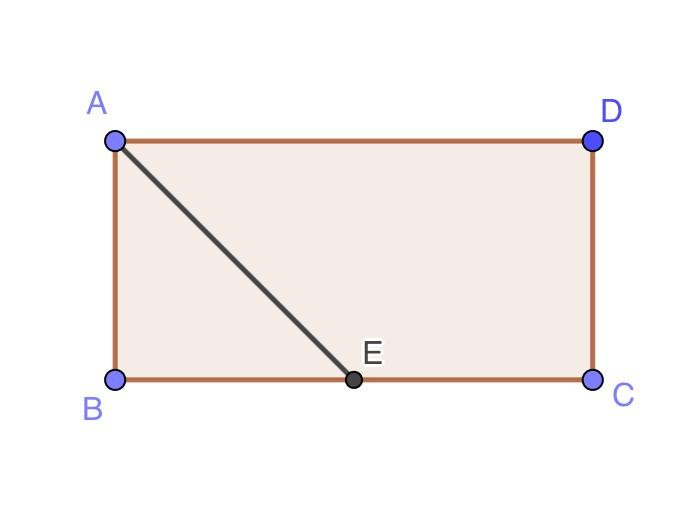
Let $A B C D$ be a rectangle in which $A B+B C+C D=20$ and $A E=9$ where $E$ is the mid-point of the side $B C$. Find the area of the rectangle. Answer: 19 Solution:
let $AB = CD= x$ & $BE = EC= y$ , $AD = 2y$
$x+y =10$, $x^2+y^2=81$
$2xy=19$
The area of a rectangle is $19$.
IOQM 2021 - Problem 5
Find the number of integer solutions to $||x|-2020|$<$5$. Answer: 18 Solution:
$||x| -2020|<5$
$-5<|x| - 2020< 5$
$2015<|x| <2025$
$x$ is lying between $(-2015,-2025)$ and $(2015,2025)$
There are $9$ integer between$(-2015,-2025)$ and $9$ integer between $(2015,2025)$.
So, The total $18$ integer solution.
IOQM 2021 - Problem 6
What is the least positive integer by which $2^{5} \cdot 3^{6} \cdot 4^{3} \cdot 5^{3} \cdot 6^{7}$ should be multiplied so that the product is a perfect square? Answer: 15 Solution:
By Fundamental theorem, $n=p_{1}^{n_{1}} p_{2}^{n_{2}} \cdots p_{k}^{n_{k}}=\prod_{i=1}^{k} p_{i}^{n_{i}}$
if $n$ is a perfect square then $n_i$ is even $\forall i $
$3$ and $5$ has odd power then $3 \times 5 = 15$ is the minimum multiplied to make $n$ is a perfect square.
IOQM 2021 - Problem 7
Let $A B C$ be a triangle with $A B=A C$. Let $D$ be a point on the segment $B C$ such that $B D=48 \frac{1}{61}$ and $D C=61$. Let $E$ be a point on $A D$ such that $C E$ is perpendicular to $A D$ and $D E=11$. Find $A E$. Answer: 25 Solution:
A $5$ -digit number (in base $10$ ) has digits $k, k+1, k+2,3 k, k+3$ in that order, from left to right. If this number is $m^{2}$ for some natural number $m$, find the sum of the digits of $m$ . Answer: 15 Solution:
$3k \leq 9$
$k = 1,2,3$
$k =1$
$\Rightarrow n = 12334$
not a perfect square as $n = 2$ (mod $4$)
$k = 2$
$\Rightarrow n = 23465$
not a perfect square as $n =15$(mod $25$)
$k = 3$
$\Rightarrow n = 34596 = 186^2$(this is a perfect square)
$\Rightarrow m = 186$
The sum of the digit $m =1 + 8 + 6 = 15$.
IOQM 2021 - Problem 9
Let $A B C$ be a triangle with $A B=5$, $A C=4$, $B C=6$. The internal angle bisector of $C$ intersects the side $A B$ at $D$. Points $M$ and $N$ are taken on sides $BC$ and $AC$, respectively, such that $D M || A C$ and $D N || B C $. If $(M N)^{2}$=$\frac{p}{q}$ where $p$ and $q$ are relatively prime positive integers then what is the sum of the digits of $|p -q|$? Answer: 2 Solution:
$DMCN$ is a parallelogram $DN||MC$ and $DM || NC$ and $DC$ bisect $\angle C$ $\angle MDC$ = $\angle DCM$ = $\angle CDN$ = $\angle NCD$ $\Rightarrow DM$ = $MC$ =$CN$ =$ND = x$(say)
by cosine law, ${MN}^2$ = $2x^2(1-cos c)$ = $\frac{126}{25}$ $\Rightarrow |p-q| =101$ In $\triangle ABC$ cos c =$\frac{BC^2+AC^2-AB^2}{2BC.AC}$ =$\frac{9}{16}$
IOQM 2021 - Problem 10
Five students take a test on which any integer score from $0$ to $100$ inclusive is possible. What is the largest possible difference between the median and the mean of the scores? (The median of a set of scores is the middlemost score when the data is arranged in increasing order, It is exactly the middle score when there are an odd number of scores and it is the avarage of the two middle scores when there are an even number of scores.) Answer: 40 Solution:
Numbers should be $0,0,0,100,100$
Median = $0$ and Mean = $40$
Difference = $40 - 0 = 40$ ( largest difference.)
IOQM 2021 - Problem 11
Let $X$ = $\{-5, -4, -3, -2, -1, 0, 1, 2, 3, 4, 5\}$ and S=$\{(a, b) \in X \times X: x^{2}+ax+ b$ and $x^{3}+bx+ a$ have at least a common real zero}. How many elements are there in $S$? Answer: 24 Solution:
The case of $a = 0 , \alpha = 1,-1$ is counted $22$
The total number of elements = $6 + 10 + 1 0 -2 = 24$.
IOQM 2021 - Problem 12
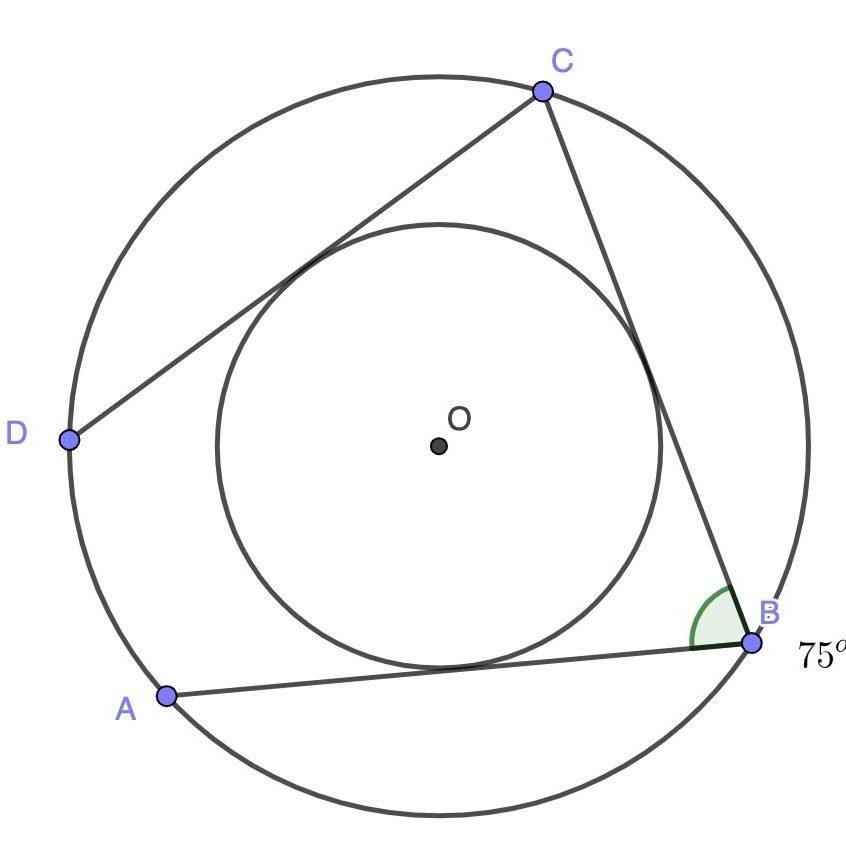
Given a pair of concentric circles, chords $A B, B C, C D, \ldots$ of the outer circle are drawn such that they all touch the inner circle. If $\angle A B C=75^{\circ},$ how many chords can be drawn before returning to the starting point.
Answer: 24 Solution:
Let the radius of big circle be $R$ and small circle be $r$ $XY =YZ=ZZ'$ Hence all the chords are of equal length. So, $XY=2\sqrt {R^2 - r^2}$ which is independent of $X,Y,Z,Z'$.
If the chords can be drawn, returning to the initial point, observe by how much angle $XY$ shifts to $YZ$, i.e. $X\rightarrow Y\rightarrow Z$ In $\triangle OYX$, $\angle OYX = \angle OXY=37.5^{\circ}$ As OY bisects $\angle ZYX$ Hence, $\angle XOY=105^{\circ}$
Suppose $n$ chords can be drawn. Every single time the chord rotates by $105^{\circ}$ Therefore, $360^{\circ}$ divides $105^{\circ} \times n$
Find the sum of all positive integers $n$ for which $|2^{n}+5^{n}-65|$ is a perfect square. Answer: 6 Solution:
$1 \leq n \leq 3$ $\Rightarrow n=2$ has a solution $\Rightarrow m=6$ $m=4 \Rightarrow \quad m=24$
For $n \leq 5$ We will see mod 10 $2^{n}$ ends with 2 or 8 if $n$ is odd $5^{n}-65 \equiv 0$ mod 10 $2^{n}+i^{n}-65 \equiv 2 / 8 \mathrm{mod} 10$ $\Rightarrow m^{2} \equiv 01,4,5,6,9 \mathrm{mod} 10$ $\Rightarrow N+$ solution.
$n \geq 5$ mod 10 $n=\mathrm{even} =2 k$ $m^{2}= 4k+5\left(5^{2 k-1}-13\right)$ $\left(m-2^{k}\right)$ $\left(m+2^{k}\right) = 5\left(5^{2 k-1}-13\right)$ $5^{2 k-1}-13 \equiv 12$ mod $100$ $5\left(5^{2 k-1}-13\right)=60$ mod $100$ $\left(m-2^{k}\right)\left(m+2^{k}\right)=60$ mod $100$ $= 36 \times2 = 10 \times 6$ $\left(m-2^{k}\right)(m+2 k)=60$ mod $100$ There will be two possible cases $6$ (mod $100$) $2$ (mod $100$ ) $\Rightarrow m \equiv 8$ mod $100$ $2^{k} \equiv 2$mod $100$ $100$ does not divide $2^{k} - 2$ as $4$ divides$2^{k} - 2$ $100$ does not divide $2^{k} - 14$ as $4$ divides$2^{k} - 14$ So, the number of solution is $2+4=6$
IOQM 2021 - Problem 14
The product $55 \times 60 \times 65$ is written as the product of five distinct positive integers. What is the least possible value of the largest of these integers? Answer: 20 Solution:
$11$ and $13$ should be taken as factor because any multiple of $11$ and $13$ will give us a bigger factor.
So, we can easily see the only way to write the given expression as a product of $5$ factor where we get the minimum value of the largest factor is the following
$13 \times 11 \times 15 \times 20 \times 5$
IOQM 2021 - Problem 15
Three couples sit for a photograph in $2$ rows of three people each such that no couple is sitting in the same row next to each other or in the same column one behind the other. How many arrangements are possible? Answer: 96 Solution:
$M_1,F_1$ and $M_2,F_2$ and $M_3,F_3$ are $3$ couples. There are $2$ cases. Case 1: All three in a row are boys or girls. case 2: $2$ boys and $1$ girl in one of the rows.
Case1. $M$ = No. of arrangements in a row = $3!$ $N$ = No. of arrangements in the other row = Derangement(3) = $2$ $P$ = No of options for the row = $2$.
Total Number of arrangements in Case 1 = $ MNP = 24$.
Case2. $M$ = No. of arrangements in a row = $3! \times 3$ $N$ = No. of arrangements in the other row = Derangement(3) = $2$ $P$ = No of options for the row = $2$.
Total Number of arrangements in Case 2 = $ MNP = 72$.
Total Number of arrangements = $24 + 72 = 96$
IOQM 2021 - Problem 16
The sides $x$ and $y$ of a scalene triangle satisfy $x+\frac{2 \Delta}{x}=y+\frac{2 \Delta}{y},$ where $\Delta$ is the area of the triangle. If $x=60, y=63$, what is the length of the largest side of the triangle? Answer: 87 Solution:
We obtain $\Delta$ = $\frac{xy}{2}$ where $x =60$ , $y = 63$
If, $\theta$ is angle between sides $x$, $y$ then $\Delta$ = $90^{\circ}$
Suppose $z$ is the third side
$z= \sqrt {x^2 + y^2}$ = $87$
IOQM 2021 - Problem 17
How many two digit numbers have exactly $4$ positive factors? (Here $1$ and the number $n$ are also considered as factors of $n$.) Answer: 30 Solution:
If $\sum_{k=1}^{40}(\sqrt{1+\frac{1}{k^{2}}$+$\frac{1}{(k+1)^{2}}})$=$a+\frac{b}{c}$ where $a, b, c \in \mathbb{N}, b<c, gcd(b, c)=1$, then what is the value of $a+b$ ? Answer: 80 Solution:
Let $A B C D$ be a parallelogram . Let $E$ and $F$ be midpoints of $A B$ and $B C$ respectively. The lines $E C$ and $F D$ intersect in $P$ and form four triangles $A P B$, $B P C$, $C P D$ and $D P A$. If the area of the parallelogram is $100 \mathrm{sq}$. units. what is the maximum area in sq. units of a triangle among these four triangles? Answer: 40 Solution:
$\triangle Q C D$ $A E || CD$ $\quad \& A E=\frac{1}{2} C D$ $\Rightarrow$ By Midpoint Theorem, $QA=AD \ QD=2 A D$
$\triangle M P C \sim \triangle$ QPN $\frac{P N}{P M}=\frac{Q D}{F C}=4$ $\Rightarrow P M+P N=M N=5 M P$
$[B P C]=\frac{1}{2} \times B C \times M P$ $[A P D]=\frac{1}{2} \times P N \times A D$ $\Rightarrow \frac{[B P]}{[A P D]}=\frac{M P}{P N}=\frac{1}{4}$ Let the areas $[E B P]=[EPA]=y$ Since E P is median. $[B P F]=[F P C]=x$ $PF$ is a median $[A P D]=a, [P D C]=b$
$[E B C]$=$\frac{1}{4} \times[A B C D]$=$2 5$=$2 x+y$ $[F D C]$=$\frac{1}{4} \times[A B C D]$=$2 5$=$2 x+b$ $[A B C D]$= $100 = 2x +2y +a +b$ Solving we get $a = 25 + 3x$ $\frac{[B P C]}{[A P D]}$ = $\frac {2x}{a}$ = $\frac 14$ $\Rightarrow a=8 x$
$[B P C]=10$ $[A B P]=15$ $[A P D]=40$ $[P C D]=35$
IOQM 2021 - Problem 20
A group of women working together at the same rate can build a wall in $45$ hours. When the work started, all the women did not start working together. They joined the work over a period of time, one by one, at equal intervals. Once at work, each one stayed till the work was complete. If the first woman worked $5$ times as many hours as the last woman, for how many hours did the first woman work? Answer: 75 Solution:
Let there are 'n' women $\Rightarrow$ Each woman's one hour work $=\frac{1}{45 \mathrm{n}}$ Also, $5[t-(n-1) d]=t$ $\Rightarrow \quad 4 t=5(n-1) d$ $\Rightarrow \quad \frac{1}{45 n}\left(\frac{n}{2}\right)[2 t-(n-1) d]=1$ $\Rightarrow \quad \frac{1}{90}\left[2 \mathrm{t}-\frac{4 \mathrm{t}}{5}\right]=1$ $\Rightarrow \quad t=75$ hours
IOQM 2021 - Problem 21
A total fixed amount of $N$ thousand rupees is given to three persons $A$. $B$. $C$ every year, each being given an amount proportional to her age. In the first year, $A$ got half the total amount. When the sixth payment was made. A got six-seventh of the amount that she had in the first year; $B$ got Rs. $1000$ less than that she had in the first year; and $C$ got twice of that she had in the first year. Find $N$. Answer: Solution:
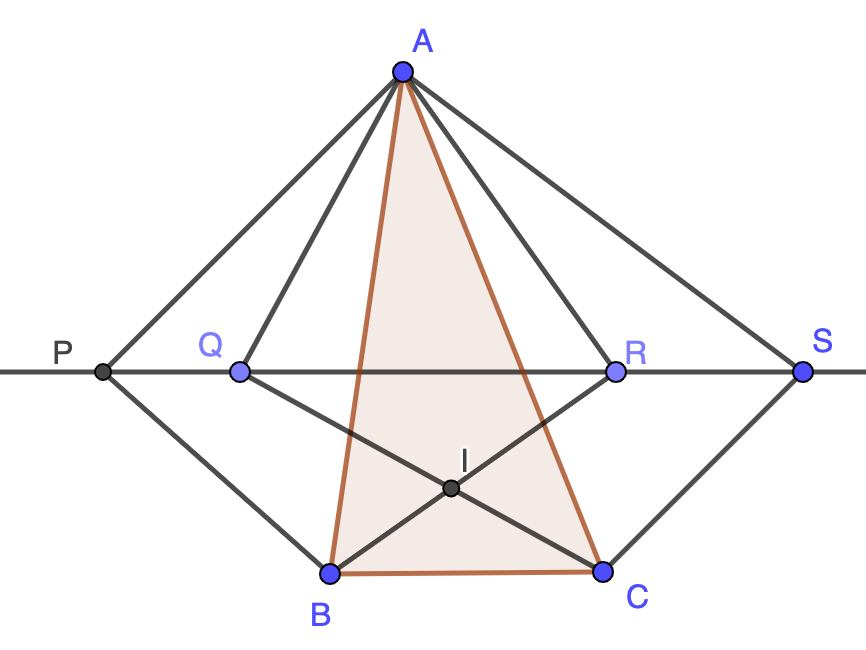
In triangle $A B C$, let $P$ and $R$ be the feet of the perpendiculars from $A$ onto the external and internal bisectors of $\angle A B C$, respectively; and let $Q$ and $S$ be the feet of the perpendiculars from $A$ onto the internal and external bisectors of $\angle A C B$ respectively. If $P Q=7$, $Q R=6$ and $R S=8$, what is the area of triangle ABC? Answer: 64 Solution :
Let us start by drawing a picture.
$PQRS$ is a collinear $ARBP$ is a rectangle
$\Rightarrow \angle P R B = \angle P A B =\frac{ B}{ 2}$=$\angle R B C$ $ \Rightarrow P R || B C$
similarity by similarly on $ASCQ \Rightarrow RS||BC$
Let, $BR$ and $QC$ meet at $I$ $\Rightarrow I$ is center.
$\Rightarrow AB = PR = 13$, $AM=MB$ (M is midpoint of $AB$)
$AQCS$ is a rectangle
$\Rightarrow AC = QS = 14$
$AN = NC$ ($N$ is a midpoint of $AC$)
By midpoint theorem,
$MN = \frac{1}{2} BC$
$PM + MR = PQ + QR =13$
$\Rightarrow PM = MR = 65$
Similarly $QN = NS = 7$
$MN = MR + QN - QR = 7.5$
$\Rightarrow BC = 15$ , $AB = 13$, $AC = 14$
Area of $\triangle ABC = 64$
IOQM 2021 - Problem 23
The incircle $\Gamma$ of a scalene triangle $A B C$ touches $B C$ at $D$, $CA$ at $E$ and $A B$ at $F$. Let $r_{A}$ be the radius of the circle inside $A B C$ which is tangent to $\Gamma$ and the sides $A B$ and $A C$. Define $r_{B}$ and $r_{C}$ similarly. If $r_{A}$=$16$, $r_{B}$=$25$ and $r_{C}$=$36,$ determine the radius of $\Gamma$. Answer: 74 Solution:
Using the formula $r =\sqrt{r_{a} \cdot r_{b}}+\sqrt{r_{b} \cdot r_{c}}+\sqrt{r_{c} \cdot r_{a}}$ =$\sqrt{16 \cdot 25}+\sqrt{25 \cdot 36}+\sqrt{36 \cdot 16}$ =$20+30+24=74$
IOQM 2021 - Problem 24
A light source at the point $(0,16)$ in the coordinate plane casts light in all directions. A disc (a circle along with its interior) of radius 2 with center at (6,10) casts a shadow on the X axis. The length of the shadow can be written in the form $m \sqrt{n}$ where $m , n$ are positive integers and $n$ is square-free. Find $m+n$. Answer: 4 Soulition:
MPB has slope -1 $\Rightarrow MBO=45^{\circ}$ $\angle A M B=\angle B M C=\alpha$
For a positive integer $n$, let $(n)$ denote the perfect square integer closest to $n$. For example, $\langle 74\rangle=81,(18)=16$ If $N$ is the smallest positive integer such that $(91) \cdot(120) \cdot\langle 143\rangle \cdot\langle 180\rangle \cdot\langle N\rangle$ =$91 \cdot 120 \cdot 143 \cdot 180 \cdot N$. Find the sum of the squares of the digits of $N$. Answer: 56
Now to make $\langle\mathrm{N}\rangle$ to be a perfect square, we can take smallest $\mathrm{N}$ to be $2 \cdot 11 \cdot 3 \cdot 7$=$162$ $\quad\langle N\rangle$=$\frac{21}{22} N$=$\frac{3 \cdot 7 \cdot 2 \cdot 11 \cdot 3 \cdot 7}{2 \cdot 11}$=$(21)^{2}$=$441$ Which is the nearest perfect square to $462$.
$\quad$ Sum of square of digits of 462 is $4^{2}+6^{2}+2^{2}$ $$ =16+36+4=56 $$
IOQM 2021 - Problem 26
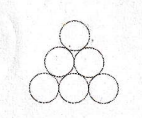
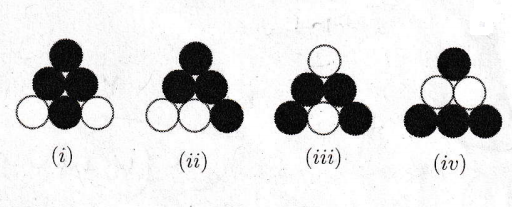
In the figure below, 4 of the 6 disks are to be colored black and 2 are to he colored white. Two coloring that can be obtained from one another by a rotation or a reflection of the entire figure are considered the same.
There are only four such colorings for the given two colors, as shown in Figure $1 .$ In how many ways can we color the 6 disks such that 2 are colored black. 2 are colored white, 2 are colored blue with the given identification condition? Answer: 24
Solution:
Try to find all the possible colorings possible using only white and black as the conditions are given
From each of these colorings generate the possible arrangements using the white, black, blue colors as per the conditions given
Eliminate the repetitions or the identical ones according to the conditions given
IOQM 2021 - Problem 27
A bug travels in the coordinate plane moving only along the lines that are parallel to the $x$ axis or $y$ axis. Let $A=(-3,2)$ and $B(3,-2)$. Consider all possible paths of the bug from $A$ to $B$ of length at most $14$ . How many points with integer coordinates lie on at least one of these paths? Answer: 87
Solution:
IOQM 2021 - Problem 28
A natural number $n$ is said to be good if $n$ is the sum of $r$ consecutive positive integers, for some $r \geq 2$. Find the number of good numbers in the set ${1,2...100}$. Answer: 93
Solution:
$k+(k+1)+\cdots+(k+r-1)$=$n$
$\Rightarrow 2 n$=$(2 k+r-1) \times r$
$n = r \times (2k + r -1)$
$ \Rightarrow $ n has two factors $r$ and $2k+r-1$
Then, $- r + (2k+r-1) = 2k-1$.
This means $n$ has two factors whose factors are of opposite parity.
Observe that powers of $2$ don't have this property.
$2^0 , 2^1, \cdots 2^6 \in \{1,2, \cdots 100 \}$
The required number is $100 - 7 = 93$
IOQM 2021 - Problem 29
Positive integers $a, b, c$ satisfy $\frac{a b}{a-b}=c$. What is the largest possible value of $a+b+c$ not exceeding $99$? Answer: 99
Solution:
Try out with example.
$b = 18, a =27 , c = 54$
IOQM 2021 - Problem 30
Find the number of pairs $(a, b)$ of natural numbers such that $b$ is a $3$ -digit number $a+1$ divides $b-1$ and $b$ divides $a^{2}+a+2$. Answer: 16