NMTC - Screening Test – Ramanujan Contest 2025

PART – A

Problem 1

If four different positive integers \(m, n, p, q\) satisfy the equation
\(7-m)(7-n)(7-p)(7-q)=4\)

then the sum \(m+n+p+q\) is equal to

A. 10
B. 24
C. 28
D. 36

Problem 2

A three member sequence \(a, b, c\) is said to be a up-down sequence if \(ac\). For example \(1,3,2\) is a up-down sequence. The sequence 1342 contains three up-down sequences: \((1,3,2),(1,4,2)\) and \((3,4,2)\). How many up-down sequences are contained in the sequence 132597684?

A. 32
B. 34
C. 36
D. 38

Problem 3

For a positive integer \(n\), let \(P(n)\) denote the product of the digits of \(n\) when \(n\) is written in base 10. For example, \(P(123)=6\) and \(P(788)=448\). If \(N\) is the smallest positive integer such that \(P(N)>1000\), and \(N\) is written as \(100 x+y\) where \(x, y\) are integers with \(0 \leq x, y<100\), then \(x+y\) equals

A. 112
B. 114
C. 116
D. 118

Problem 4

The sum of 2025 consecutive odd integers is \(2025^{2025}\). The largest of these off numbers is

A. \(2025^{2024}+2024\)
B. \(2025^{2024}-2024\)
C. \(2025^{2023}+2024\)
D. \(2025^{2023}-2024\)

Problem 5

\(A B C\) is an equilateral triangle with side length 6. \(P, Q, R\) are points on the sides \(A B, B C, C A\) respectively such that \(A P=B Q=C R=1\). The ratio of the area of the triangle \(A B C\) to the area of the triangle \(P Q R\) is

A. \(36: 25\)
B. \(12: 5\)
C. \(6: 5\)
D. \(12: 7\)

Problem 6

How many three-digit positive integers are there if the digits are the side lengths of some isosceles or equilateral triangle?

A. 45
B. 81
C. 165
D. 216

Problem 7

All the positive integers whose sum of digits is 7 are written in the increasing order. The first few are \(7,16,25,34,43, \ldots\). What is the 125 th number in this list?

A. 7000
B. 10006
C. 10024
D. 10042

Problem 8

The bisectors of the angles \(A, B, C\) of the triangle \(A B C\) meet the circum circle of the triangle again at the points \(D, E, F\) respectively. What is the value of
\(\frac{A D \cos \frac{A}{2}+B E \cos \frac{B}{2}+C F \cos \frac{C}{2}}{\sin A+\sin B+\sin C}\)

if the circum radius of \(A B C\) is 1 ?

A. 2
B. 4
C. 6
D. 8

Problem 9

For a real number \(x\), let \(\lfloor x\rfloor\) be the greatest integer less than or equal to \(x\). For example, \([1.7]=1\) and \([\sqrt{2}]=1\). Let \(N=\left\lfloor\frac{10^{93}}{10^{31}+3}\right\rfloor\). Find the remainder when \(N\) is divided by 100.

A. 1
B. 8
C. 22
D. 31

Problem 10

A point \((x, y)\) in the plane is called a lattice point if both its coordinates \(x, y\) are integers. The number of lattice points that lie on the circle with center at \((199,0)\) and radius 199 is

A. 4
B. 8
C. 12
D. 16

Problem 11

The sum of all real numbers \(p\) such that the equation

\(5 x^3-5(p+1) x^2+(71 p-1) x-(66 p-1)=0\)

has all its three roots positive integers.

A. 70
B. 74
C. 76
D. 88

Problem 12

If \(1-x+x^2-x^3+\cdots+x^{20}\) is rewritten in the form

\(a_0+a_1(x-4)+a_2(x-4)^2+\cdots+a_{20}(x-4)^{20}\), where \(a_0, a_1, \ldots, a_{20}\)

are all real numbers, the value of \(a_0+a_1+a_2+\cdots+a_{20}\) is

A. \(\frac{5^{21}+1}{6}\)
B. \(\frac{5^{21}-1}{6}\)
C. \(\frac{5^{20}+1}{6}\)
D. \(\frac{5^{20}-1}{6}\)

Problem 13

For a positive integer \(n\), a distinct 3-partition of \(n\) is a triple \( (a, b, c) \) of positive integers such that \(a<b<c\) and \(a+b+c=n\). For example, \((1,2,4)\) is a distinct 3 -partition of 7 . The number of distinct 3-partitions of 15 is

A. 10
B. 12
C. 13
D. 15

Problem 14

If \(m\) and \(n\) are positive integers such that \(30 m n-6 m-5 n=2019\), what is the value of \(30 m n-5 m-6 n ?\)

A. 1900
B. 2020
C. 1939
D. Can not be found from the given information

Problem 15

A class of 100 students takes a six question exam. For the first question, a student receives 1 point for answering correctly, -1 point for answering incorrectly or not answering at all. For the second question, the student receives 2 points for answering correctly and -2 points for answering incorrectly or not answering at all and so on. What is the minimum number of students having the same scores?

A. 6
B. 5
C. 0
D. Can not be found from the given information

Part B

Problem 16

The value of

\(\frac{1}{2}+\frac{1^2+2^2}{6}+\frac{1^2+2^2+3^2}{12}+\frac{1^2+2^2+3^2+4^2}{20}+\cdots+\frac{1^2+2^2+\cdots+60^2}{3660}\)

is ________ .

Problem 17

The largest prime divisor of \(3^{21}+1\) is _________

Problem 18

A circular garden divided into 10 equal sectors needs to be planted with flower plants that yield flowers of 3 different colors, in such a way that no two adjacent sectors will have flowers of the same color. The number of ways in which this can be done is _________

Problem 19

We call an integer special if it is positive and we do not need to use the digit 0 to write it down in base 10. For example, 2126 is special whereas 2025 is not. The first 10 special numbers are \(1,2,3,4,5,6,7,8,9,11\). The 2025th special number is _________ .

Problem 20

Let \(a, b, c\) be non zero real numbers such that \(a+b+c=0\) and \(a^3+b^3+c^3=a^5+b^5+c^5\). The value of \(\frac{5}{a^2+b^2+c^2}\) is _________ .

Problem 21

The equation \(x^3-\frac{1}{x}=4\) has two real roots \(\alpha, \beta\). The value of \((\alpha+\beta)^2\) is _________

Problem 22

If \(x, y, z\) are positive integers satisfying the system of equations

\(\begin{aligned} x y+y z+z x & =2024 \ x y z+x+y+z & =2025\end{aligned}\)

find \(\max (x, y, z)\) . ________

Problem 23

If \(p, q, r\) are primes such that \(p q+q r+r p=p q r-2025\), find \(p+q+r .\). __________

Problem 24

A cyclic quadrilateral has side lengths \(3,5,5,8\) in this order. If \(R\) is its circumradius, find \(3 R^2\). __________

Problem 25

Consider the sequence of numbers \(24,2534,253534,25353534, \ldots\). Let \(N\) be the first number in the sequence that is divisible by 99 . Find the number of digits in the base 10 representation of \(N\). _____________

Problem 26

An isosceles triangle has integer sides and has perimeter 16. Find the largest possible area of the triangle. ____________

Problem 27

Suppose that \(a, b, c\) are positive real numbers such that \(a^2+b^2=c^2\) and \(a b=c\). Find the value of

\(\frac{(a+b+c)(a-b+c)(a+b-c)(a-b-c)}{c^2}\) ______________

Problem 28

In a right angled triangle with integer sides, the radius of the inscribed circle is 12. Compute the largest possible length of the hypotenuse. _______________

Problem 29

Points \(C\) and \(D\) lie on opposite sides of the line \(A B\). Let \(M\) and \(N\) be the centroids of the triangles \(A B C\) and \(A B D\) respectively. If \(A B=25, B C=24, A C=7, A D=20\) and \(B D=15\), find \(M N\). __________

Problem 30

Let \(a_0=1\) and for \(n \geq 1\), define \(a_n=3 a_{n-1}+1\). Find the remainder when \(a_{11}\) is divided by 97. ___________
NMTC - Screening Test – KAPREKAR Contest - 2025

Part 1

Problem 1

\(A B\) is a straight road of length 400 metres. From \(A\), Samrud runs at a speed of \(6 \mathrm{~m} / \mathrm{s}\) towards \(B\) and at the same time Saket starts from \(B\) and runs towards \(A\) at a speed of \(5 \mathrm{~m} / \mathrm{s}\). After reaching their destinations, they return with the same speeds. They repeat it again and again. How many times do they meet each other in 15 minutes?

A) 25
B) 23
C) 24
D) 20

Problem 2

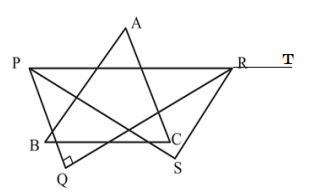
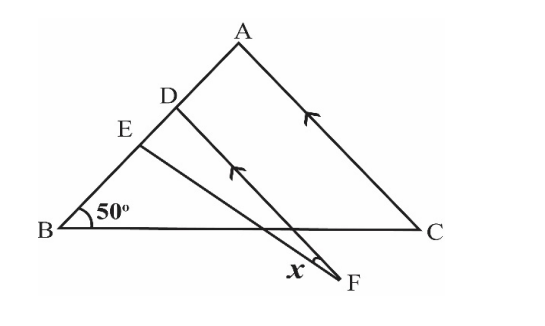
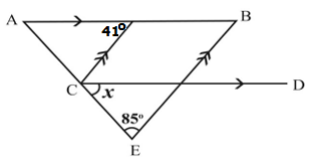
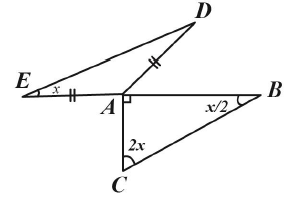
In the adjoining figure, the measure of the angle \(x\) is

A) \(84^{\circ}\)
B) \(44^{\circ}\)
C) \(64^{\circ}\)
D) \(54^{\circ}\)

Problem 3

The value of \(x\) which satisfies \(\frac{1}{x+a}+\frac{1}{x+b}=\frac{1}{x+a+b}+\frac{1}{x}\) is

A) \(\frac{a+b}{2}\)
B) \(\frac{a-b}{2}\)
C) \(\frac{b-a}{2}\)
D) \(\frac{-(a+b)}{2}\)

Problem 4

Two sides of an isosceles triangle are 23 cm and 17 cm respectively. The perimeter of the triangle (in cm ) is

A) 63
В) 57
C) 63 or 57
D) 40

Problem 5

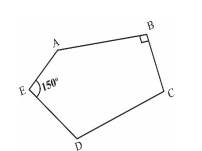
\(A B C D E\) is a pentagon with \(\angle B=90^{\circ}\) and \(\angle E=150^{\circ}\).
If \(\angle C+\angle D=180^{\circ}\) and \(\angle A+\angle D=180^{\circ}\), then the external angle \(\angle D\) is

A) \(120^{\circ}\)
B) \(110^{\circ}\)
C) \(105^{\circ}\)
D) \(115^{\circ}\)

Problem 6

The unit's digit of the product \(3^{2025} \times 7^{2024}\) is

A) 1
B) 2
C) 3
D) 6

Problem 7

The smallest positive integer \(n\) for which \(18900 \times n\) is a perfect cube is

A) 1
B) 2
C) 3
D) 6

Problem 8

Two numbers \(a\) and \(b\) are respectively \(20 \%\) and \(50 \%\) more of a third number \(c\). The percentage of \(a\) to \(b\) is

A) 120 %
В) 80 %
C) 75 %
D) 110 %

Problem 9

If \(a+b=2, \frac{1}{a}+\frac{1}{b}=18\), then \(a^3+b^3\) lies between

A) 7 and 8
B) 6 and 7
C) 8 and 9
D) 5 and 6

Problem 10

If \(\sqrt{12+\sqrt[3]{x}}=\frac{7}{2}\) and \(x=\frac{p}{q^{\prime}}, p, \mathrm{q}\) are natural numbers with G.C.D. \((p, q)=1\), then \(p+q\) is

A) 65
В) 56
C) 45
D) 54

Problem 11

The smallest number of 4-digits leaving a remainder 1 when divided by 2 or

A) 5 as its unit digit
B) Only one zero as one of the digits
C) Exactly two zeroes as its digits
D) 7 as its unit digit

Problem 12

If \(a: b=2: 3, b: c=4: 5\) and \(a+c=736\), then the value of \(b\) is

A) 392
B) 378
C) 384
D) 386

Problem 13

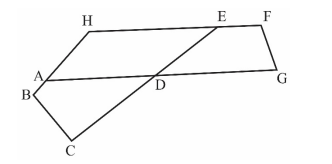
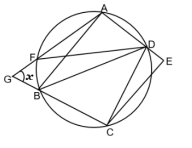
In the given figure,

\[
\begin{aligned}
& \angle B=110^{\circ} ; \quad \angle C=80^{\circ} ; \
& \angle F=120^{\circ} ; \quad \angle A D C=30^{\circ} \
& 2 \angle D G F=\angle D E F .
\end{aligned}
\]

The measure of \(\angle B H F\) is

A) \(115^{\circ}\)
B) \(135^{\circ}\)
C) \(100^{\circ}\)
D) \(130^{\circ}\)

Problem 14

If \(\frac{1}{b+c}+\frac{1}{c+a}=\frac{2}{a+b}\), then the value of \(\frac{a^2+b^2}{c^2}\) is

A) 2
B) 1
C) 1 / 2
D) 3

Problem 15

If 3 men or 4 women can do a job in 43 days, the number of days the same job is done by 7 men and 5 women is

A) 12
B) 10
C) 11
D) 13

Part B

Problem 16

The expression \(49(a+b)^2-46(a-b)^2\) is factorized into \((l a+m b)(n a+p b)\), then the numerical value of \((l+m+n+p)\) is _________________

Problem 17

The integer part of the solution of the equation in \(x\), \(\frac{1}{3}(x-3)-\frac{1}{4}(x-8)=\frac{1}{5}(x-5)\) is ______________

Problem 18

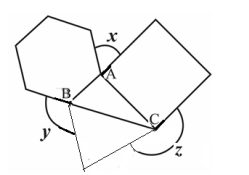
In the adjoining figure, \(A B C\) is a triangle in which \(\angle B A C=100^{\circ}\), \(\angle A C B=30^{\circ}\). An equilateral triangle, a square and a regular hexagon are drawn as shown in the figure. The measure (in degrees) of \((x+y+z)\) is ____________

Problem 19

The mean of 5 numbers is 105 . The first number is \(\frac{2}{5}\) times the sum of the other 4 numbers. The first number is ____________

Problem 20

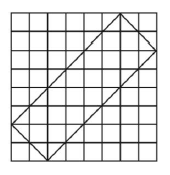
\(P Q R S\) is a square. The sides \(P Q\) and \(R S\) are increased by 30 % each and the sides \(Q R\) and \(P S\) are increased by 20 % each. The area of the quadrilateral thus obtained exceeds the area of the square by ___________ %.
Problem 21

If \(x^2+(2+\sqrt{3}) x-1=0\) and \(x^2+\frac{1}{x^2}=a+b \sqrt{c}\), then \((a+b+c)\) is _____________
Problem 22

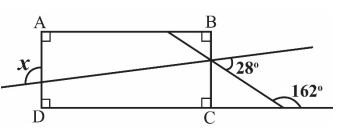
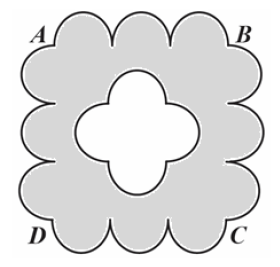
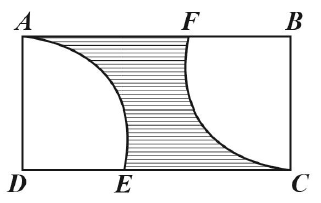
In the given figure, \(A B C D\) is a rectangle.

The measure of angle \(x\) is _________________ degrees.
Problem 23

The sum of all positive integers \(m, n\) which satisfy \(m^2+2 m n+n=44\) is __________________
Problem 24

Given \(a=2025, b=2024\), the numerical value of \(\left(a+b-\frac{4 a b}{a+b}\right) \div\left(\frac{a}{a+b}-\frac{b}{b-a}+\frac{2 a b}{b^2-a^2}\right)\) is _________________
Problem 25

In the sequence \(0,7,26,63,124, \ldots \ldots \ldots\) the \(6^{\text {th }}\) term is _____________
Problem 26

\[
\text { If } A=\sqrt{281+\sqrt{53+\sqrt{112+\sqrt{81}}}}, B=\sqrt{92+\sqrt{55+\sqrt{75+\sqrt{36}}}}
\]

then \(A-B\) is _______________________
Problem 27

The average of the numbers \(a, b, c, d\) is \((b+4)\). The average of pairs \((a, b),(b, c)\) and \((c, a)\) are respectively 16,26 and 25 . Then the average of \(d\) and 67 is ___________________
Problem 28

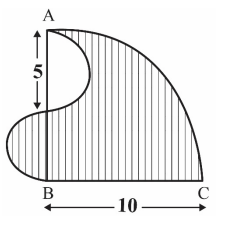
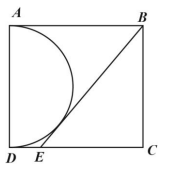
\(A B C\) is a quadrant of a circle of radius 10 cm . Two semicircles are drawn as in the figure.

The area of the shaded portion is \(k \pi\), where \(k\) is a positive integer.

The value of \(k\) is __________________
Problem 29

In the figure, \(A B C\) and \(P Q R\) are two triangles such that \(\angle \mathrm{A}: \angle \mathrm{B}: \angle \mathrm{C}=5: 6: 7\) and \(\angle P R Q=\angle B\). \(P S\) makes an angle \(\frac{\angle P}{3}\) with \(P Q\) and \(R S\) makes an angle \(\frac{\angle S R T}{5}\) with \(R Q\). Then the measure of \(\angle S\) is ______________________
Problem 30

In a two-digit positive integer, the units digit is one less than the tens digit. The product of one less than the units digit and one more than the tens digit is 40. The number of such two-digit integers is _______________
BHASKARA Contest - NMTC - Screening Test – 2025

Problem 1

The greatest 4 -digit number such that when divided by 16,24 and 36 leaves 4 as remainder in each case is
А) 9994
B) 9940
C) 9094
D) 9904

Problem 2

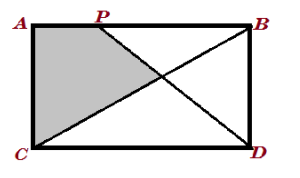
\(A B C D\) is a rectangle whose length \(A B\) is 20 units and breadth is 10 units. Also, given \(A P=8\) units. The area of the shaded region is \(\frac{p}{q}\) sq unit, where \(p, q\) are natural numbers with no common factors other than 1 . The value of \(p+q\) is
A) 167
В) 147
C) 157
D) 137

Problem 3

The solution of \(\frac{\sqrt[7]{12+x}}{x}+\frac{\sqrt[7]{12+x}}{12}=\frac{64}{3}(\sqrt[7]{x})\) is of the form \(\frac{a}{b}\) where \(a, b\) are natural numbers with \(\operatorname{GCD}(a, b)=1\); then \((b-a)\) is equal to
A) 115
B) 114
C) 113
D) 125

Problem 4

The value of \((52+6 \sqrt{43})^{3 / 2}-(52-6 \sqrt{43})^{3 / 2}\) is
A) 858
В) 918
C) 758
D) 828

Problem 5

In the adjoining figure \(\angle D C E=10^{\circ}\), \(\angle C E D=98^{\circ}, \angle B D F=28^{\circ}\)
Then the measure of angle \(x\) is
A) \(72^{\circ}\)
B) \(76^{\circ}\)
C) \(44^{\circ}\)
D) \(82^{\circ}\)

Problem 6

\(A B C\) is a right triangle in which \(\angle \mathrm{B}=90^{\circ}\). The inradius of the triangle is \(r\) and the circumradius of the triangle is R . If \(\mathrm{R}: r=5: 2\), then the value of \(\cot ^2 \frac{A}{2}+\cot ^2 \frac{C}{2}\) is
A) \(\frac{25}{4}\)
B) 17
C) 13
D) 14

Problem 7

If \((\alpha, \beta)\) and \((\gamma, \beta)\) are the roots of the simultaneous equations:

\[
|x-1|+|y-5|=1 ; \quad y=5+|x-1|
\]

then the value of \(\alpha+\beta+\gamma\) is
A) \(\frac{15}{2}\)
B) \(\frac{17}{2}\)
C) \(\frac{14}{3}\)
D) \(\frac{19}{2}\)

Problem 8

Three persons Ram, Ali and Peter were to be hired to paint a house. Ram and Ali can paint the whole house in 30 days, Ali and Peter in 40 days while Peter and Ram can do it in 60 days. If all of them were hired together, in how many days can they all three complete $50 \%$ of the work?
A) $24 \frac{1}{3}$
B) $25 \frac{1}{2}$
C) $26 \frac{1}{3}$
D) $26 \frac{2}{3}$

Problem 9

$\frac{\sqrt{a+3 b}+\sqrt{a-3 b}}{\sqrt{a+3 b}-\sqrt{a-3 b}}=x$, then the value of $\frac{3 b x^2+3 b}{a x}$ is
A) 1
B) 2
C) 3
D) 4

Problem 10

The number of integral solutions of the inequation $\left|\frac{2}{x-13}\right|>\frac{8}{9}$ is
A) 1
B) 2
C) 3
D) 4

Problem 11

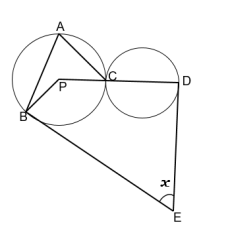
In the adjoining figure, $P$ is the centre of the first circle, which touches the other circle in C . PCD is along the diameter of the second circle. $\angle \mathrm{PBA}=20^{\circ}$ and $\angle \mathrm{PCA}=30^{\circ}$.

The tangents at B and D meet at E . The measure of the angle $x$ is
A) $75^{\circ}$
B) $80^{\circ}$
C) $70^{\circ}$
D) $85^{\circ}$

Problem 12

If $\alpha, \beta$ are the values of $x$ satisfying the equation $3 \sqrt{\log _2 x}-\log _2 8 x+1=0$, where $\alpha<\beta$, then the value of $\left(\frac{\beta}{\alpha}\right)$ is
A) 2
B) 4
C) 6
D) 8

Problem 13

When a natural number is divided by 11 , the remainder is 4 . When the square of this number is divided by 11 , the remainder is
A) 4
B) 5
C) 7
D) 9

Problem 14

The unit's digit of a 2-digit number is twice the ten's digit. When the number is multiplied by the sum of the digits the result is 144 . For another 2-digit number, the ten's digit is twice the unit's digit and the product of the number with the sum of its digits is 567 . Then the sum of the two 2 -digit numbers is
A) 68
В) 86
C) 98
D) 87

Problem 15

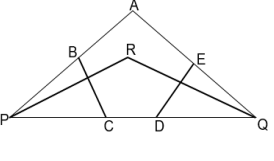
$A B C D E$ is a pentagon. $\angle A E D=126^{\circ}, \angle B A E=\angle C D E$ and $\angle A B C$ is $4^{\circ}$ less than $\angle B A E$ and $\angle B C D$ is $6^{\circ}$ less than $\angle C D E . P R, Q R$ the bisectors of $\angle B P C, \angle E Q D$ respectively, meet at $R$. Points $\mathrm{P}, \mathrm{C}, \mathrm{D}, \mathrm{Q}$ are collinear. Then measure of $\angle P R Q$ is
A) $151^{\circ}$
B) $137^{\circ}$
C) $141^{\circ}$
D) $143^{\circ}$

Problem 16

$a, b, c$ are real numbers such that $b-c=8$ and $b c+a^2+16=0$.
The numerical value of $a^{2025}+b^{2025}+c^{2025}$ is $\rule{2cm}{0.2mm}$.

Problem 17

Given $f(x)=\frac{2025 x}{x+1}$ where $x \neq-1$. Then the value of $x$ for which $f(f(x))=(2025)^2$ is $\rule{2cm}{0.2mm}$.

Problem 18

The sum of all the roots of the equation $\sqrt[3]{16-x^3}=4-x$ is $\rule{2cm}{0.2mm}$.

Problem 19

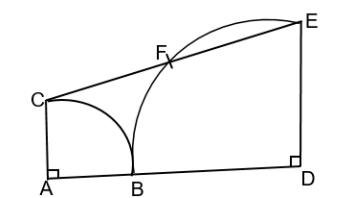
In the adjoining figure, two
Quadrants are touching at $B$.
$C E$ is joined by a straight line, whose mid-point is $F$.

The measure of $\angle C E D$ is $\rule{2cm}{0.2mm}$.

Problem 20

The value of $k$ for which the equation $x^3-6 x^2+11 x+(6-k)=0$ has exactly three positive integer solutions is $\rule{2cm}{0.2mm}$.

Problem 21

The number of 3-digit numbers of the form $a b 5$ (where $a, b$ are digits) which are divisible by 9 is $\rule{2cm}{0.2mm}$.

Problem 22

If $a=\sqrt{(2025)^3-(2023)^3}$, the value of $\sqrt{\frac{a^2-2}{6}}$ is $\rule{2cm}{0.2mm}$.

Problem 23

In a math Olympiad examination, $12 \%$ of the students who appeared from a class did not solve any problem; $32 \%$ solved with some mistakes. The remaining 14 students solved the paper fully and correctly. The number of students in the class is $\rule{2cm}{0.2mm}$.

Problem 24

When $a=2025$, the numerical value of
$\left|2 a^3-3 a^2-2 a+1\right|-\left|2 a^3-3 a^2-3 a-2025\right|$ is $\rule{2cm}{0.2mm}$.

Problem 25

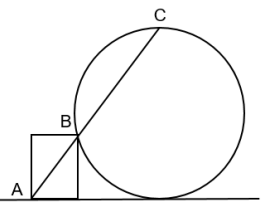
A circular hoop and a rectangular frame are standing on the level ground as shown. The diagonal $A B$ is extended to meet the circular hoop at the highest point $C$. If $A B=18 \mathrm{~cm}, B C=32 \mathrm{~cm}$, the radius of the hoop (in cm ) is $\rule{2cm}{0.2mm}$.

Problem 26

' $n$ ' is a natural number. The number of ' $n$ ' for which $\frac{16\left(n^2-n-1\right)^2}{2 n-1}$ is a natural number is $\rule{2cm}{0.2mm}$.

Problem 27

The number of solutions $(x, y)$ of the simultaneous equations $\log _4 x-\log _2 y=0, \quad x^2=8+2 y^2$ is $\rule{2cm}{0.2mm}$.

Problem 28

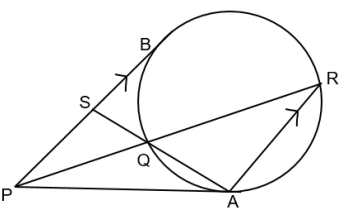
In the adjoining figure,
$P A, P B$ are tangents.
$A R$ is parallel to $P B$

$P Q=6 ; Q R=18 .$

Length $S B= \rule{2cm}{0.2mm}$.

Problem 29

A large watermelon weighs 20 kg with $98 \%$ of its weight being water. It is left outside in the sunshine for some time. Some water evaporated and the water content in the watermelon is now $95 \%$ of its weight in water. The reduced weight in kg is $\rule{2cm}{0.2mm}$.

Problem 30

In a geometric progression, the fourth term exceeds the third term by 24 and the sum of the second and third term is 6 . Then, the sum of the second, third and fourth terms is $\rule{2cm}{0.2mm}$.

NMTC - Screening Test – GAUSS Contest - 2025

Problem 1

The value of $\frac{9999+7777+5555}{8888+6666+4444}$ is
A) 1
B) $\frac{755}{448}$
C) $\frac{7}{6}$
D) $\frac{1}{6}$

Problem 2

The sum of three prime numbers is 30 . How many such sets of prime numbers are there?
A) 1
B) 2
C) 3
D) 0

Problem 3

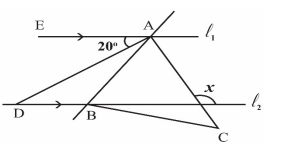
In the adjoining figure, lines $\ell_1, \ell_2$ are parallel lines. $A B C$ is an equilateral triangle.
$A D$ bisects $\angle E A B$.
Then $x=$ ?
A) $100^{\circ}$
B) $95^{\circ}$
C) $105^{\circ}$
D) $110^{\circ}$

Problem 4

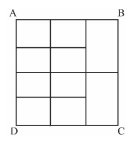
In the figure, $A B C D$ is a square. It consists of squares and rectangles of areas $1 \mathrm{~cm}^2$ and $2 \mathrm{~cm}^2$ as shown. The perimeter of the square $A B C D$ (in cm ) is
A) 17
B) 15
C) 16
D) 14

Problem 5

If $a * b=\frac{a+b}{a-b}$, then the value of $\frac{13 * 6}{5 * 2}$ is
A) $\frac{21}{4}$
B) $\frac{17}{3}$
C) $\frac{19}{39}$
D) $\frac{57}{49}$

Problem 6

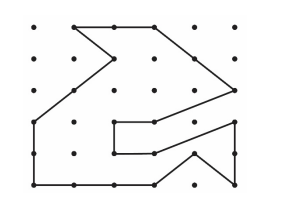
In the adjoining figure, the distance between any two adjacent dots is 1 cm . The area of the shaded region (in $\mathrm{cm}^2$ ) is
A) $\frac{31}{3}$
B) $\frac{31}{2}$
C) $\frac{33}{2}$
D) $\frac{35}{2}$

Problem 7

Three natural numbers $n_1, n_2, n_3$ are taken.
Let $n_{1<} n_{2<} n_3$ and $n_1+n_2+n_3=6$. The value of $n_3$ is
A) 1
B) 2
C) 3
D) 1 or 2 or 3

Problem 8

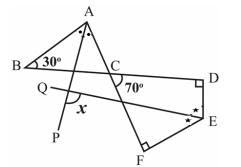
In the adjoining figure, AP and EQ are respectively the bisectors of $\angle \mathrm{BAC}$ and $\angle \mathrm{DEF}$. Then, the measure of angle $x$ is
A) $90^{\circ}$
B) $85^{\circ}$
C) $105^{\circ}$
D) $75^{\circ}$

Problem 9

The number of two-digit positive integers which have at least one 7 as a digit is
A) 17
B) 19
C) 9
D) 18

Problem 10

The fractions $\frac{1}{5}$ and $\frac{1}{3}$ are shown on the number line. In which position should $\frac{1}{4}$ be shown?

A) $p$
B) $q$
C) $r$
D) $s$

Problem 11

Samrud reads $\frac{1}{3}$ of a story book on the first day, $\frac{1}{2}$ of the remaining book on the second day and $\frac{\mathbf{1}}{\mathbf{4}}$ of the remaining book as on the end of the first day, on the third day and left with 23 pages unread. The number of pages of the book is
A) 138
В) 148
C) 128
D) 136

Problem 12

The product of four different natural numbers is 100 . What is the sum of the four numbers?
A) 20
B) 10
C) 12
D) 18

Problem 13

Peter starts from a point A in a playground and walks $100 m$ towards East. Then he walks 30 m towards North and then 70 m towards West and then finally 10 m North to reach the point B. The distance between A and B (in metres) is
A) 50
B) 42
C) 40
D) 30

Problem 14

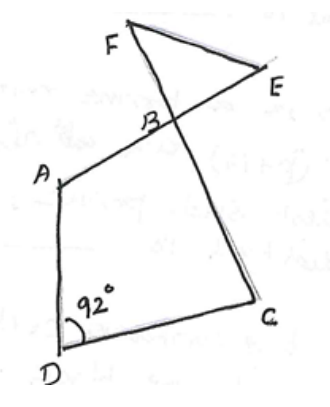
In the adjoining figure $\angle \mathrm{DAB}$ is $8^{\circ}$ more than $\angle \mathrm{ADC}$; $\angle \mathrm{BCD}$ is $8^{\circ}$ less than $\angle \mathrm{ADC}$. $\angle \mathrm{FEB}$ is half of $\angle \mathrm{FBE}$. Then the measure of $\angle \mathrm{BFE}$ is
A) $54^{\circ}$
B) $52^{\circ}$
C) $49^{\circ}$
D) $50^{\circ}$

Problem 15

The fraction to be added to the fraction $\frac{1}{2+\frac{1}{3+\frac{1}{1+\frac{1}{4}}}}$ to get 1 is
A) $\frac{26}{43}$
В) $\frac{18}{43}$
C) $\frac{24}{43}$
D) $\frac{23}{43}$

Problem 16

Some amount of money is divided among A, B and C, so that for every ₹100 A has, B has ₹ 65 and c has ₹ 40. If the share of C is ₹ 4000, the total amount of money (in ₹) is $\rule{2cm}{0.2mm}$.

Problem 17

ABCDE is a pentagon. The angles $\mathrm{A}, \mathrm{B}, \mathrm{C}, \mathrm{D}, \mathrm{E}$ are in the ratio 8:9:12:15:10. The external bisector of B and the internal bisector of C meet at P . Then the measure of $\angle \mathrm{BPC}$ is $\rule{2cm}{0.2mm}$.

Problem 18

The least number, when lessened (decreased) by 5 , to be divisible by 36,48 , 21 , and 28 is $\rule{2cm}{0.2mm}$.

Problem 19

When $10 \frac{5}{6}$ is divided by 91 , we get a fraction $\frac{a}{b}$, where $a, b$ are natural numbers with no common factors other than 1 ; then $(b-a)$ is equal to $\rule{2cm}{0.2mm}$.

Problem 20

Let $p$ be the smallest prime number such that the numbers $(p+6),(p+8)$, $(p+12)$ and $(p+14)$ are also prime. Then the remainder when $p^2$ is divided by 4 is $\rule{2cm}{0.2mm}$.

Problem 21

A bag contains certain number of black and white balls, of which $60 \%$ are black. When 9 white balls are added to the bag, the ratio of the black balls to the white balls is $4: 3$. The number of white balls in the bag at the beginning is $\rule{2cm}{0.2mm}$.

Problem 22

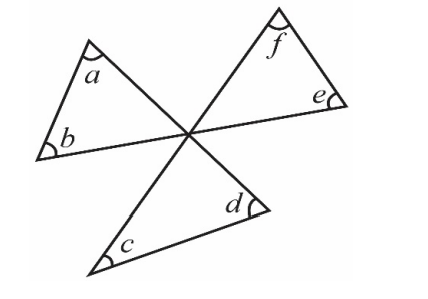
In the adjoining figure, the sum of the measures of the angles $a, b, c, d, e, f$ is $\rule{2cm}{0.2mm}$.

Problem 23

A basket contains apples, bananas, and oranges. The total number of apples and bananas is 88 . The total number of apples and oranges is 80 . The total number of bananas and oranges is 64 . Then the number of apples is $\rule{2cm}{0.2mm}$.

Problem 24

ABC is an isosceles triangle in which $\mathrm{AB}=\mathrm{AC}$ EDF is an isosceles triangle in which $\mathrm{EF}=\mathrm{DE}$. FD is parallel to AC . The degree measure of marked angle $x$ is $\rule{2cm}{0.2mm}$.

Problem 25

The length and breadth of a rectangle are both prime numbers, and its perimeter is 40 cm . Then the maximum possible area of the rectangle (in $\mathrm{cm}^2$ ) is $\rule{2cm}{0.2mm}$.

Screening Test – Ramanujan Contest NMTC at Inter Level – XI & XII Standards 2024 – 2025

PART - A

Problem 1

Let $1+\frac{1}{2}+\frac{1}{3}+\frac{1}{4}+\frac{1}{5}+\frac{1}{6}=\frac{m}{n}$, where $m$ and $n$ are positive integers with no common divisors other than 1 . The highest power of 7 that divides $m$ is

A. 0
B. 1
C. 2
D. 3

Problem 2

Five spherical balls of diameter 10 cm each fit inside a closed cylindrical tin with internal diameter 16 cms . What is the smallest height of the tin can be?

A. 39
B. 42
C. 45
D. 48

Problem 3

The expression $\frac{7 n+18}{2 n+3}$ takes integer values for certain integer values of $n$. The sum of all such values of the expression is

A. 14
B. 21
C. 24
D. 28

Problem 4

$P$ is a point inside $A B C D$ such that $P A=2, P B=4, P C=5$ and $P D=6$. The maximum area of the quadrilateral $A B C D$ is

A. 30
B. 33
C. 35
D. 38

Problem 5

The value of

$$ \left(3^{4 / 3}-3^{1 / 3}\right)^3+\left(3^{5 / 3}-3^{2 / 3}\right)^3+\left(3^{6 / 3}-3^{3 / 3}\right)^3+\cdots+\left(3^{10 / 3}-3^{7 / 3}\right)^3$$ is

A. $12\left(3^7-1\right)$
B. $12\left(3^7+1\right)$
C. $6\left(3^7-1\right)$
D. $6\left(3^7+1\right)$

Problem 6

One hundred people are standing in a line and they are required to count off in fives as "one, two, three, four, five" and so on from the first person in the line. Anyone who counts "five" walks out of the line. Those remaining repeat this procedure until only four people remain in the line. What was the original position in the line of the last person to leave?

A. 94
B. 96
C. 97
D. 98

Problem 7

The number of values of positive integers $n$ for which $1!+2!+\cdots+n$ ! is a perfect square is

A. 0
B. 1
C. 2
D. Infinitely many

Problem 8

When $2025^{2026}-2025$ is divided by $2025^2+2026$, the remainder is

A. 0
B. 2025
C. 2026
D. None of these

Problem 9

For a real number $x$, let $\lfloor x\rfloor$ denote the largest integer $\leq x$. For example, $\lfloor 3.4\rfloor=2$ and $\lfloor 4.9\rfloor=4$. Let $N=\left\lfloor(\sqrt{27}+\sqrt{23})^6\right\rfloor$. The remainder when $N$ is divided by 1000 is

A. 799
B. 599
C. 399
D. 199

Problem 10

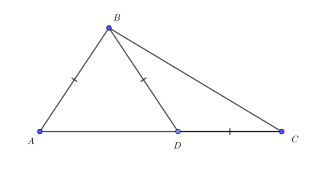
$A B C$ is a triangle. $D$ lies on $A C$ such that $A B=B D=C D$. All the angles in the diagram are a positive whole number of degrees. The largest possible size, in degrees of $\angle A B C$ is

A. 171
B. 173
C. 175
D. 177

Problem 11

The side lengths of a right angled triangle are in geometric progression and the smallest side has length 2 units. The length of the hypotenuse is

A. $1+\sqrt{5}$
B. $\sqrt{10}$
C. $3 \sqrt{2}-1$
D. $\sqrt{11}$

Problem 12

In a regular polygon there are two diagonals that intersect inside the polygon at an angle $50^{\circ}$. The least number of sides of the polygon for which this is possible is

A. 12
B. 18
C. 24
D. 36

Problem 13

In triangle $P Q R, \angle R=2 \angle P, P R=5$ and $Q R=4$. The length of $P Q$ is

A. $2 \sqrt{10}$
B. 6
C. 7
D. $2 \sqrt{7}$

Problem 14

Each of ten people around a circle chooses a number and tells it to the neighbor on each side. Thus each person gives out one number and receives two numbers. The players then announce the average of the two numbers they received. The announced numbers, in order around the circle were $1,2,3,4,5,6,7,8,9,10$. The number chosen by the person who announced the number 6 is

A. 7
B. 5
C. 3
D. 1

Problem 15

A regular octagon is formed by cutting off four equal isosceles right angled triangles from the corners of a square of side length 1 . The area of the octagon is

A. $2(\sqrt{2}-1)$
B. $4 \sqrt{2}-3$
C. $\sqrt{2}-1$
D. $3 \sqrt{2}-2$

PART - B

Problem 16

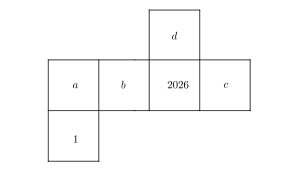
The diagram shows the net of a cube, that is, we can fold along the edges of the squares to make a cube from this net. On each face there is an integer written - $1, a, b, c, d, 2026$. If each of the four numbers $a, b, c, d$ equals the average of the numbers on the four faces of the cube adjacent to it, the value of $a$ is $\rule{2cm}{0.2mm}$

Problem 17

Let $S={1,2,3, \ldots, 15}$. The number of subsets $A$ of $S$ containing four elements such that any two elements of $A$ differ by at least 2 is $\rule{2cm}{0.2mm}$

Problem 18

Given a deck of 52 cards with numbers $1,2, \ldots, 52$ written on them, one number per card. The deck is shuffled and 13 cards are chosen at random form the shuffled deck and thrown away, without noting the numbers on them. From the remaining 39 cards, one card is chosen at random. If the probability that the number on this card is a multiple of 13 is $\frac{m}{n}$, where $m, n$ are integers with no common divisor other than 1 , then $m+n$ equals $\rule{2cm}{0.2mm}$

Problem 19

Suppose 10 objects are placed along a circle at equal distances. The number of ways can three objects be chosen from among them so that no two of the chosen objects are adjacent or diametrically opposite is $\rule{2cm}{0.2mm}$

Problem 20

For a positive integer $n$, let $n \bmod 13$ denote the remainder $r, 0 \leq r<13$ when divided by 13. If $a, b, c$ are integers such that

$$
\begin{array}{rr}
4 a+5 b+6 c=1 & \bmod 13 \
a-b-7 c=3 & \bmod 13 \
3 a-4 b+5 c=9 & \bmod 13
\end{array}
$$

then $a+b+c \bmod 13$ is $\rule{2cm}{0.2mm}$

Problem 21

The sum of all positive integers $N$ less than 2024 such that $N$ equals 13 times the sum of digits of $N$ (when $N$ is written in base 10 ) is $\rule{2cm}{0.2mm}$

Problem 22

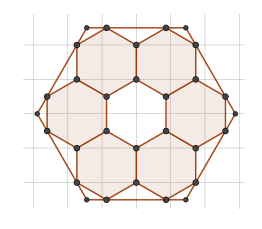
Six identical regular hexagons are arranged inside a larger hexagon as shown in the Figure. The outer hexagon has area 900 square units. The area of the shaded region (the total area contained in the smaller hexagons) is $\rule{2cm}{0.2mm}$ square units.

Problem 23

A positive integer is said to be special if the sum of the remainders obtained when it is divided by five consecutive positive integers is 32 . For example, 24 is special since when divided by $11,12,13,14,15$ the remainders are $2,0,11,10,9$ and these add up to 32 . The smallest positive integer that is special is $\rule{2cm}{0.2mm}$

Problem 24

The largest three digit number with the property that the number is equal to the sum of the hundreds digit, the square of its tens digit and the cube of its units digit is $\rule{2cm}{0.2mm}$

Problem 25

It is a surprising fact that $1 \times 2 \times 3 \times 4 \times 5 \times 6=8 \times 9 \times 10$. It is more surprising that $$8 \times 9 \times 10 \times 11 \times 12 \times 13 \times 14$$ can be written as a product of consecutive positive integers. The smallest number in the product is $\rule{2cm}{0.2mm}$

Problem 26

There are 100 points $P_1, P_2, \ldots, P_{100}$ placed on a line such that the distance between $P_i$ and $P_{i+1}$ is $\frac{1}{i}$ for $1 \leq i \leq 99$. The sum of the distances between every pair of these points is $\rule{2cm}{0.2mm}$

Problem 27

For any positive integer $n$, let $d(n)$ denote the number of divisors of $n$. For example, $d(4)=3$, since the divisors of 4 are $1,2,4$. The smallest positive integer $n$ for which $d(n-2)+d(n)+d(n+2)=21$ is $\rule{2cm}{0.2mm}$

Problem 28

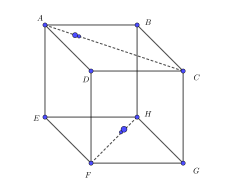
Two bugs sit at the vertices $A$ and $H$ of a cube $A B C D E F G H$ with edge length $4 \sqrt{110}$ units. The bugs start moving simultaneously along $A C$ and $H F$ with the speed of the first bug twice that of the other one. The shortest distance between the bugs is $\rule{2cm}{0.2mm}$

Problem 29

The smallest positive integer $n$ for which it is possible to draw an $n$-gon whose vertex angles all measure $163^{\circ}$ or $171^{\circ}$ is $\rule{2cm}{0.2mm}$

Problem 30

Let $P(x)=a x^3+b x^2+c x+d$ be a cubic polynomial such that $P(2)=7, P(3)=13$ and $P(5)=7$. If the sum of the three roots of $P(x)=0$ is 40 , the value of $P(35)$ is $\rule{2cm}{0.2mm}$

Screening Test – Gauss Contest - NMTC Primary Level - V and VI Grades 2024-2025

Problem 1

Saket wanted to add two 2-digit numbers. But he multiplied them and got 629 as the answer. The sum of the two 2-digit numbers is

a)56
b) 52
c) 54
d) 46

Problem 2

The sum of three integers is 1 . Their product is 36 . The greatest of these three numbers is

a) 12
b) 8
c) 4
d) 6

Problem 3

The sum of five consecutive even numbers is 150 . When written in ascending order, the fourth number is

a) 34
b) 32
c) 36
d) 38

Problem 4

The price of a cell phone is decreased by $25 \%$. What percentage increase must be done in the delivered price to get back the original price?

a) $25 \%$
b) $271 / 2 \%$
c) $30 \%$
d) $331 \frac{1}{3} \%$

Problem 5

A rectangular carpet is placed in $8 m \times 8 \mathrm{~m}$ room, as shown in the diagram. What fraction of the floor is not covered?

a) $\frac{1}{4}$
b) $\frac{5}{11}$
c) $\frac{5}{8}$
d) $\frac{13}{24}$

Problem 6

$p$ and $p+1$ are two prime numbers. Then the value of $\frac{p(p+1)}{2 p+1}$ lies between

a) $\frac{4}{5}$ and 1
b) 1 and $\frac{7}{5}$
c) $\frac{6}{5}$ and $\frac{7}{5}$
d) $\frac{7}{5}$ and $\frac{8}{5}$

Problem 7

$a, b, c, d$ are real numbers such that $a-2023=b+2024=c-2025=d+2026$. Then the greatest among $a, b, c, d$ is

b) $a$
b) $b$
c) $c$
d) $d$

Problem 8

In the adjoining figure, $A D=A E$. Then measure of $\angle E A D$ is

a) $100^{\circ}$
b) $105^{\circ}$
c) $106^{\circ}$
d) $108^{\circ}$

Problem 9

The largest 3-digit number which is exactly divisible by the H.C.F. of 24 and 36 is $n$. Then $n+4$ is equal to

a) 994
b) 996
c) 998
d) 1000

Problem 10

In the given figure, $\mathrm{AB} / / \mathrm{HG} / / \mathrm{CD} / / \mathrm{FE}$.

$$\mathrm{AB}=6, \mathrm{GH}=4, \mathrm{CD}=5, \mathrm{FE}=9 \text { and } \mathrm{BC}=8 \text {. }$$ Distance between the pair of parallel lines $(\mathrm{AB}, \mathrm{HG}),(\mathrm{BC}, \mathrm{GF})$ and $(\mathrm{CD}, \mathrm{FE})$ is the same and equal to 3 . The area of the total figure is

a) 64
b) 60
c) 45
d) 65

Problem 11

The number of pairs of two digit square numbers, the sum or difference of which are also squares is

a) 0
b) 1
c) 2
d) 3

Problem 12

There are 20 people around a table. Each of them shakes hands with the people to his (or her) immediate left and immediate right. The total number of handshakes that takes place is

a) 40
b) 30
c) 32
d) 20

Problem 13

In the adjoining figure, $\mathrm{A}, \mathrm{B}, \mathrm{C}, \mathrm{D}$ are the vertices of a square of side 3 units. All the semi-circles are equal. Then the area of the shaded region is (in sq.units)

a) $8+\pi$
b) $6+\pi$
c) $12+\pi$
d) $7+\pi$

Problem 14

There are two boxes $A$ and $B$ which can hold 38 candles and 20 candles respectively.
288 candles have to be placed to the maximum capacity of the boxes. If we require $m$ number of A-type boxes and $n$ number of B-type boxes, then the value of $\frac{m}{n}$ is

a) 1
b) 2
c) 3
d) 4

Problem 15

The divisors of 6 are $1,2,3,6$. Leaving 1 and 6 , the divisors are 2 and 3 . Let us denote \([6]=2+3=5\). Then the value of \([[[12]]]\) is $\qquad$

a) 6
b) 8
c) 5
d) 12

Section B (Fill in the blanks


Problem 16

The fraction $\frac{(2 \times 3 \times 4)+(4 \times 6 \times 8)+(6 \times 9 \times 12)+\ldots+(20 \times 30 \times 40)}{(1 \times 2 \times 3)+(2 \times 4 \times 6)+(3 \times 6 \times 9)+\ldots+(10 \times 20 \times 30)}$ reduces to $\rule{2cm}{0.2mm}$

Problem 17

In the adjoining figure, $A B C D$ is a rectangle. $A E$ and $C F$ are quadrants. The length of the rectangle is twice its breadth. Taking $\pi=\frac{22}{7}$, the area of the shaded region is $21 \mathrm{~cm}^2$. Then the area of the rectangle is $\rule{2cm}{0.2mm}$

Problem 18

The number $m$ has factors 2,5 and 6 . The number $n$ has factors 4 and 8 . The smallest value of $m+n$ is $\rule{2cm}{0.2mm}$

Problem 19

There are two bus stops on opposite sides of a road. Bus route $X$ has a frequency of 15 minutes at one stop. Bus route $Y$ has a frequency of 40 minutes in the opposite bus stop. Currently both buses arrived in the opposite stops. Again two buses will simultaneously arrive at opposite stops after $\rule{2cm}{0.2mm}$ hours.

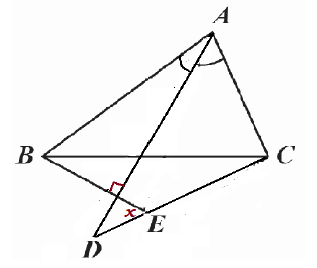
Problem 20

In the adjoining figure, $\angle A B C=60^{\circ}$ and $\angle A C B=80^{\circ}$. AD is the bisector of $\angle A$. Through C, a line making $\frac{\angle A}{2}$ with BC is drawn. This line cuts the bisector at D and the perpendicular from B to AD at E. Then the measure of $x$ (in degrees) is $\rule{2cm}{0.2mm}$

Problem 21

For two real numbers $a$ and $b$, we have $$ a * b=\left(a+\frac{b}{2}\right) \times\left(b+\frac{a}{2}\right) $$ Then the value of $(2 * 8) * 2$ is $\rule{2cm}{0.2mm}$

Problem 22

A 2-digit number has repeated digits. The number of such numbers having exactly 4 divisors is $\rule{2cm}{0.2mm}$

Problem 23

The salaries of Peter and Ali are in the ratio 3:2. Their expenditures are in the ratio 5:3 in that order. If each saves Rs. 5000 , then Peter's income (in Rs) is $\rule{2cm}{0.2mm}$

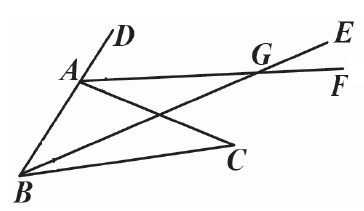
Problem 24

In the given figure, $\angle \mathrm{A}: \angle \mathrm{B}: \angle \mathrm{C}=14: 3: 1$. A line BE through B making an angle $\frac{\angle B}{3}$ with BC is drawn. A line through A, making an angle $\frac{1}{4} \angle C A D$ with $A C$ is drawn. They cut at G. Then the measure of $\angle \mathrm{EGF}$ is $\rule{2cm}{0.2mm}$ degrees

Problem 25

Ramaswamy, Krishnaswamy, Rangawamy, Gopalaswamy and Kumaraswamy have different amounts of money in rupees in their pockets, each an odd number and less than Rs. 100. The largest possible total sum of money in rupees is $\rule{2cm}{0.2mm}$

Problem 26

The cost price of 10 articles is equal to the selling price of 9 articles. The profit percent is $11 \frac{1}{a}$. Then $a=$ $\rule{2cm}{0.2mm}$

Problem 27

When $2 \frac{6}{11}$ of $1 \frac{2}{7}$ is divided by $3 \frac{3}{11}$, we get $\rule{2cm}{0.2mm}$

Problem 28

Two cell phones were sold at the same price. If there is $10 \%$ gain on the one and $10 \%$ loss on the other, then the total percent of loss is $\rule{2cm}{0.2mm}$

Problem 29

An office staff works for 4 days consecutively, then has the next day off; he works for 4 more days and has a day off on the next day; and so on. Today is his day-off and it is a Sunday. The minimum number of days the staff must work to have his off-day as Sunday is $\rule{2cm}{0.2mm}$

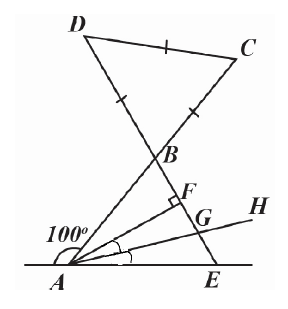
Problem 30

In the adjoining figure, triangle $B C D$ is equilateral. If $\angle \mathrm{AFB}=90^{\circ}$ and AH is the bisector of $\angle F A E$, then the measure of $\angle \mathrm{HGE}$ (in degrees) is $\rule{2cm}{0.2mm}$


Screening Test – Bhaskara Contest(NMTC JUNIOR LEVEL—IX and X Grades)2024-2025

Question 01

If $x^2+x=1$, then the value of $\frac{x^7+34}{x+2}$ is equal to

a) 7
b) 1
c) 13
d) 17

Question 02

The angle between the hour hand and the minute hand of a clock at the time $9: 38 \mathrm{pm}$ is

a) $60^{\circ}$
b) $61^{\circ}$
c) $59^{\circ}$
d) $62^{\circ}$

Question 03

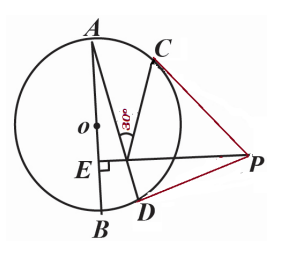
In the adjoining figure, $A O B$ is a diameter of the circle with centre O. PC and PD are two tangents. Then the measure of $\angle E P D$ is $\qquad$

a) $15^{\circ}$
b) $10^{\circ}$
c) $12^{\circ}$
d) $20^{\circ}$

Question 04

The value of $x$ satisfying $4^x-3^{x-1 / 2}=3^{x+1 / 2}-2^{2 x-1}$ is of the form $\frac{a}{b}$ where $\operatorname{gcd}(a, b)=1$. Then the value of $\left(\frac{a+b}{a-b}\right)$ is equal to

a) 7
b) -5
c) 4
d) 5

Question 05

The number of polynomials of the form $\left(x^3+a x^2+b x+c\right)$ which are divisible by $x^2+1$ where $a, b, c \in{1,2,3,4, \ldots, 12}$ is

a) $12^3$
b) $12^2$
c) 12
d) 1

Question 06

The number of real solutions of the equation $\frac{(x+2)(x+3)(x+4)(x+5)}{(x-2)(x-3)(x-4)(x-5)}=1$ is

a) 1
b) 2
c) 3
d) 0

Question 07

If $a=\sqrt{23 a+b}, b=\sqrt{23 b+a}, a \neq b$, then the value of $\sqrt{a^2+b^2+48}$ is

a) 30
b) 25
c) 24
d) 23

Question 08

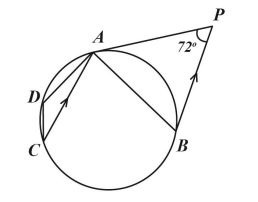
In the adjoining figure, PA and PB are tangents to the circle.
$A C$ is parallel to $P B$.
Then measure of $\angle C D A$ is

a) $118^{\circ}$
b) $108^{\circ}$
c) $98^{\circ}$
d) $88^{\circ}$

Question 09

If $\sqrt{\frac{19^8+19^x}{19^x+1}}=361$, then $x$ satisfies the equation

a) $4 x^2-7 x-15=0$
b) $2 x^2-9 x-5=0$
c) $3 x^2+11 x-4=0$
d) $3 x^2-11 x-4=0$

Question 10

If $S=4^2+2.5^2+3.6^2+\ldots \ldots \ldots+25.28^2$, then the value of $\frac{S}{325}$ is equal to

a) 436
b) 326
c) 346
d) 324

Question 11

A sequence $\{a_n\}, n \geq 1$ with $a_1=\frac{1}{2}$ and $a_n=\frac{a_{n-1}}{2 n a_{n-1}+1}$ is given. Then the value of $a_1+a_2+a_3+\ldots \ldots \ldots+a_{2024}$ is equal to

a) $\frac{2025}{2024}$
b) $\frac{2024}{2025}$
c) 2025
d) $\frac{1}{2025}$

Question 12

If $\alpha$ and $\beta(\alpha>\beta)$ satisfy the equation $x^{1+\log _{10} x}=10 x$ then the value of $\alpha+\frac{1}{\beta}$ is equal to

a) 100
b) 20
c) 10
d) $\frac{1}{100}$

Question 13

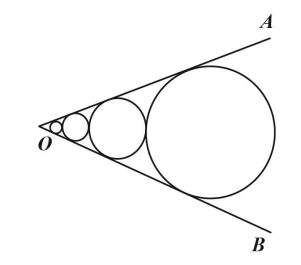
In the adjoining figure, four successively touching circles are placed in the interior of $\angle A O B$. The first (smallest) has a radius 7 cm . The third circle has a radius 28 cm . Then the radius of the largest circle (in cm ) is

a) 42
b) 48
c) 52
d) 56

Question 14

The coefficient of $x$ in the equation $x^2+p x+q=0$ was taken as 17 , in place of 13 and its roots were found to be -2 and -15 . If $\alpha, \beta$ are the roots of the original equation, then the equation whose roots are $\frac{\alpha}{\beta}$ and $\frac{\beta}{\alpha}$ is

a) $30 x^2+109 x+30=0$
b) $20 x^2-107 x+20=0$
c) $30 x^2-109 x+30=0$
d) $20 x^2+107 x+20=0$

Question 15

If $(1+x y+x+y)^2-(1-x y+x-y)^2=k y(1+x)^2$, then $k$ equals to

a) 1
b) 2
c) 3
d) 4

Section B (Fill in the blanks)

Question 16

When $x^{10}+1$ is divided by $x^2+1$, we get

$$
a x^8+b x^7+c x^6+d x^5+e x^4+f x^3+g x^2+h x+k
$$

as quotient. Then the value of $a^{2024}+b^{2024}+c^{2024}+d^{2024}+e^{2024}+f^{2024}+g^{2024}+h^{2024}+k^{2024}$ is $\rule{2cm}{0.2mm}$

Question 17

The equation $x^4-4 x^3+a x^2+b x+1=0$ has 4 positive roots. Then $a+b=$ $\rule{2cm}{0.2mm}$

Question 18

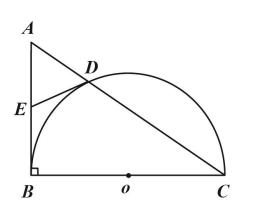
In the adjoining figure, $B O C$ is the diameter of the semicircle with centre O.
DE is the tangent at D .
If $\mathrm{AB}=k(\mathrm{AE})$, then the numerical value of $k$ is $\rule{2cm}{0.2mm}$

Question 19

In triangle $A B C$,
$\tan A: \tan B: \tan C=1: 2: 3$.
If $\frac{A C}{A B}=\frac{p \sqrt{q}}{r}$, where $q$ is Square free and $\operatorname{gcd}(p, r)=1$ then the value of $p+q+r$ is $\rule{2cm}{0.2mm}$

Question 20

Simon was given a number and asked to divide it by 120. He divided the number by 5,6 and 7 and got 3,2 and 2 as remainders respectively. The remainder when the number is divided by 120 is $\rule{2cm}{0.2mm}$ .

Question 21

The greatest number that leaves the same remainder when it divides 30,53 and 99 is$\rule{2cm}{0.2mm}$ ـ.

Question 22

If $f(x+1)=x^2-3 x+2$ and if the roots of the equation $f(x)=0$ are $\alpha$ and $\beta$, then the value of $\alpha^2+\beta^2$ is $\rule{2cm}{0.2mm}$ .

Question 23

The maximum volume of a cylinder is cut from a cube of edge $a$. The volume of the remaining solid is $k a^3$, where $k=\frac{p}{q}, \operatorname{gcd}(p, q)=1$. Taking $\pi=\frac{22}{7}$, the value of $p+q$ is $\rule{2cm}{0.2mm}$ .

Question 24

If the irreducible quadratic factor of $5 x^4+9 x^3-2 x^2-4 x-8$ is $a x^2+b x+c$, then the value of $a^2+b^2-c^2$ is $\rule{2cm}{0.2mm}$ .

Question 25

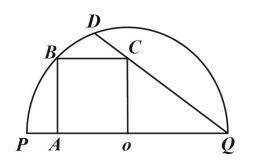
In the adjoining figure, POQ is the diameter of the semicircle with centre O.
OABC is a square whose area is $36 \mathrm{~cm}^2$. If $\mathrm{QD}=x \mathrm{~cm}$, the value of $x \sqrt{3}$ is $\rule{2cm}{0.2mm}$ .

Question 26

If $a=\sqrt{2024}, b=\sqrt{2025}$, the value of $2(a b)^{1 / 2}(a+b)^{-1}\left\{1+\frac{1}{4}\left(\sqrt{\frac{a}{b}}-\sqrt{\frac{b}{a}}\right)^2\right\}^{1 / 2}$ is $\rule{2cm}{0.2mm}$

Question 27

In a decreasing geometric progression, the $2^{\text {nd }}$ term is 6. The sum of all infinite terms of the progression is one-eighth of the sum to infinity of the squares of the terms. The sum of the $1^{\text {st }}$ and the $4^{\text {th }}$ terms is $\frac{p}{q}$ where $p, q$ are relatively prime to each other. Then the value of $\left[\frac{p}{q}\right]$, where $[x]$ represents the greatest integer not exceeding $x$ is $\rule{2cm}{0.2mm}$

Question 28

The value of $\left(\frac{\sqrt{10}}{10}\right)^{\left(\log _{10} 9\right)-2}$ is of the form $\frac{a}{b}$, where $a, b$ are relatively prime to each other. Then $a-b$ is equal to ـ.$\rule{2cm}{0.2mm}$

Question 29

ABCD is a square. BE is the tangent to the semicircle on AD as diameter. The area of the triangle BCE is $216 \mathrm{~cm}^2$. The radius of the semicircle (in cm ) is $\rule{2cm}{0.2mm}$

Question 30

$a, b, c, d$ are real constants in a $f(x)=a x^{2025}+b x^{2023}+c x^{2021}+d x^{2019}$ and $f(-4)=18$. Then the maximum value of $|f(4)|+|2 \cos x|$ is $\rule{2cm}{0.2mm}$ .

Screening Test – Kaprekar Contest(NMTC SUB-JUNIOR LEVEL—VII and VIII Grades)2024-2025

Question 01

There is a 6-digit number in which the first and the fourth digit from the first are the same, the second and the fifth digit from the first are the same and the third and the sixth digit from the first are the same. Then the number is always

a) A square number
b) Divisible by 5
c) Divisible by 11
d) An odd number.

Question 02

Starting from the number 1, Ritu generates a series of numbers as

$$
1,3,6,11,18,29,42, \ldots
$$

such that the differences of the consecutive numbers from the beginning give consecutive primes. In this series she came across a perfect square for the first time. The Square root of this perfect square is

a) 14
b) 19
c) 23
d) 21

Question 03

The expression $\frac{x\left(\frac{\sqrt{x}+\sqrt{y}}{2 y \sqrt{x}}\right)^{-1}+y\left(\frac{\sqrt{x}+\sqrt{y}}{2 x \sqrt{y}}\right)^{-1}}{\left(\frac{x+\sqrt{x y}}{2 x y}\right)^{-1}+\left(\frac{y+\sqrt{x y}}{2 x y}\right)^{-1}}$ reduces to

a) $\sqrt{x y}$
b) $\frac{\sqrt{x}+\sqrt{y}}{2}$
c) $\frac{2}{\sqrt{x}+\sqrt{y}}$
d) $\frac{\sqrt{x y}}{\sqrt{x}+\sqrt{y}}$

Question 04

The sum of the digits of a two-digit number is multiplied by 8 and the result is found to be 13 more than the number. Then the two digit number is

a) A prime number
b) An even number
c) Such that the difference of its digits is 2 .
d) Such that the sum of its digits is a composite number.

Question 05

A water tank is fitted with four different taps as outlets. If the tank is full, it takes 1 hour to empty the tank when the first tap alone is opened; it takes 2 hours to empty the tank when the second tap alone is opened; it takes 3 hours to empty the tank when the third tap alone is opened; it takes 4 hours to empty the tank when the fourth tap alone is opened. When all the taps are opened simultaneously, the full tank will be emptied in

a) More than 29 minutes
b) Between 28 and 29 minutes
c) Between 29 and 30 minutes
d) Less than 28 minutes.

Question 06

Two primes $p, q$ are such that $p+q$ is odd and $q-10 p=23$. Then $q-20 p$ equals to

a) 1
b) 3
c) 5
d) 7

Question 07

Which one of the following is a false statement?

a) Diagonals of a square bisect each other at right angles.
b) Diagonals of a rectangle bisect each other.
c) Diagonals of a rhombus bisect each other at right angles.
d) If the diagonals of a quadrilateral bisect each other, then the quadrilateral is a rectangle.

Question 08

Soham has his $23^{\text {rd }}$ birthday on $1^{\text {st }}$ January 2024 and he noticed that 2024 is divisible by 23. If he lives till 100 years of age, how many times other than the above, his age would be a divisor of the then year?

a) 2
b) 3
c) 4
d) 5

Question 09

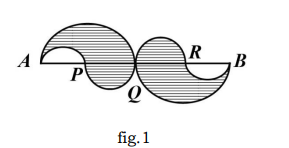
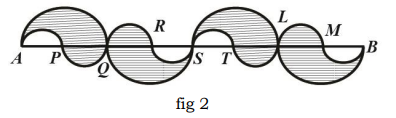
Consider the two figures shown here $\mathrm{AB}=16 \mathrm{~cm}$ in both the figures.

Points $\mathrm{P}, \mathrm{Q}, \mathrm{R}$ divide AB in equal lengths in fig. 1 Similarly $\mathrm{P}, \mathrm{Q}, \mathrm{R}, \mathrm{S}, \mathrm{T}, \mathrm{L}, \mathrm{M}$ divide AB in equal length in fig 2

All the curves are semi-circles.
If $[a]$ and $[b]$ are the areas of
the shaded figures respectively in fig 1 and fig 2 , then

a) [a] - [b] is a non-zero number.
b) $[\mathrm{a}]=\frac{5}{4}[\mathrm{~b}]$
c) $\quad[\mathrm{a}]=\frac{4}{5}[\mathrm{~b}]$
d) $[\mathrm{a}]=[\mathrm{b}]$

Question 10

The sum of 11 consecutive natural numbers is 121 . The sum of the next three numbers is

a) 54
b) 55
c) 53
d) 57

Question 11

A big ship wrecked and 1000 people landed in a remote island. The food material was available for them for 60 days. After 16 days another small ship, which had no food stock, wrecked and 100 people landed in the same island. The number of days the food material for all of them available is

a) 42
b) 35
c) 40
d) 41

Question 12

Two numbers are respectively $28 \%$ and $70 \%$ of a third number. The percentage of the first number to the second is

a) 40
b) 36
c) 45
d) 50

Question 13

The sum of two natural numbers is 150 . Their HCF is 15 . The number of pairs of such numbers is

a) 1
b) 2
c) 3
d) 4

Question 14

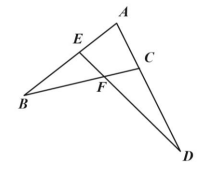
ABC and ADE are isosceles triangles.
If $\angle B F D=156^{\circ}$, then $\angle A=$

a) $68^{\circ}$
b) $70^{\circ}$
c) $66^{\circ}$
d) $70^{\circ}$

Question 15

Some students are made to stand in rows of equal number, one behind the other. Saket is in the $3^{\text {rd }}$ row from the front and $5^{\text {th }}$ row from the back. He is $4^{\text {th }}$ from the left and $6^{\text {th }}$ from right. The total number of students is

a) 45
b) 72
c) 63
d) 81

FILL IN THE BLANKS

Question 16

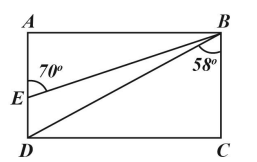
In the adjoining figure, ABCD is a rectangle. Then,
$\angle \mathrm{EBD}=$ $\rule{2cm}{0.2mm}$ degrees.

Question 17

An infinite sequence of positive numbers $x_1, x_2, x_3, \ldots, x_n, x_{n+1}, \ldots$ satisfies $x_n^2=(3 n+7)+(n-3) x_{n+1}$, where $x_n$ is the $n^{\text {th }}$ term of the sequence. Then the numerical value of $x_1$ is $\rule{2cm}{0.2mm}$

Question 18

For $n \geq 2$ and $n \in Z$, the smallest positive integer $n$ for which none of the fractions $\frac{17}{n+17}, \frac{18}{n+18}, \frac{19}{n+19}, \ldots \ldots, \frac{100}{n+100}$ can be simplified is $\rule{2cm}{0.2mm}$ .

Question 19

In triangle $\mathrm{ABC}, \mathrm{AB}=15 \mathrm{~cm}, \mathrm{BC}=20 \mathrm{~cm}$ and $\mathrm{CA}=25 \mathrm{~cm}$. Then the length of the shortest altitude of the triangle (in cm ) is $\rule{2cm}{0.2mm}$

Question 20

The units digit of $19^{2025}+999^{2023}$ is $\rule{2cm}{0.2mm}$

Question 21

$N$ is a 2-digit number. When 6 is added to the tens digit and 2 is subtracted from the units digit, we get a two digit number which is equal to $3 N$. Then $N$ is $\rule{2cm}{0.2mm}$

Question 22

$A B C D$ is a quadrilateral. $A B$ is parallel to $C D$ and $A B>C D$. If $A D=A B=B C$ and $\angle \mathrm{ADC}=140^{\circ}$, then the measure of $\angle \mathrm{CAB}$ is $\rule{2cm}{0.2mm}$ degrees.

Question 23

The product of two positive numbers $x$ and $y$ is 4 times their Sum and the same product is 8 times their difference. If $x \geq y$, then $x=$ $\rule{2cm}{0.2mm}$

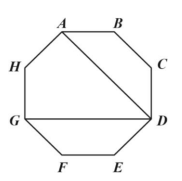
Question 24

In the adjoining figure, $A B C D E F G H$ is a regular Octagon. The measure of $\angle \mathrm{ADG}$ (in degrees) is $\rule{2cm}{0.2mm}$ .

Question 25

If $2^{3 a+2}=4^{b+7}$ and $3^{a+10}=27^{2 b+10}$ then the value of $a^2+b^2$ is $\rule{2cm}{0.2mm}$

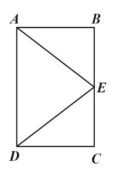
Question 26

ABCD is a rectangle. $\mathrm{AB}=6$ and $\mathrm{AD}=10$.
E is a point on BC such that $\mathrm{AE}=10$.
Then area of $\triangle \mathrm{ADE}$ (in square units) is $\rule{2cm}{0.2mm}$

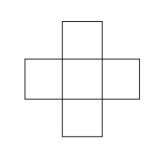
Question 27

The numbers $1,4,7,10$ and 13 are placed in each box of the figure, such that the sum of the numbers in the horizontal or vertical boxes are the same. The largest possible value of the horizontal or vertical sum is $\rule{2cm}{0.2mm}$

Question 28

The number of integer pairs $(m, n)$ such that $m\left(n^2+1\right)=48$ is $\rule{2cm}{0.2mm}$

Question 29

In the adjoining figure, $\triangle \mathrm{ABD}$ and $\triangle \mathrm{BCE}$ are equilateral triangles.

The measure of $\angle \mathrm{AFC}=$ $\rule{2cm}{0.2mm}$ degrees.

Question 30

The value of $\frac{\sqrt[4]{27 \cdot \sqrt[3]{9}}}{\sqrt[6]{9 \cdot 3^3 \cdot \sqrt{3}}}$ is $\rule{2cm}{0.2mm}$

Ramanujan Contest (NMTC Inter 2018 - XI and XII Grades) - Stage I- Problems and Solution

Part A

Problem 1

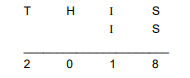
In the addition shown, each of the letters $\mathrm{T}, \mathrm{H}, \mathrm{I}, \mathrm{S}$ represents a non zero digit. What is $\mathrm{T}+\mathrm{H}+\mathrm{I}+\mathrm{S}$ ?

(A) 34
(B) 32
(C) 24
(D) 22

Problem 2

We have four sets $S_1, S_2, S_3, S_4$ each containing a number of parallel lines. The set $S_1$ contains $i+1$ parallel lines $i=1,2,3,4$. A line in $S_i$ is not parallel to lines in $S_j$ when $i \neq j$. In how many points do these lines intersect?


(A) 54
(B) 63
(C) 71
(D) 95

Problem 3

An old tanker is $100 \mathrm{~km}$ due north of a cruise liner. The tanker sails Southeast at a speed of 20 kilometers per hour and the liner sail Northwest at a speed of 10 kilometres per hour. What is the shortest distance between the two boats during the subsequent motion?


(A) $50 \sqrt{2} \mathrm{~km}$
(B) $60 \mathrm{~km}$
(C) $80 \mathrm{~km}$
(D) $100 \mathrm{~km}$

Problem 4

Volume A equals one fourth of the sum of the volumes B and C, while volume B equals one sixth of the sum of the volumes $A$ and $C$. The ratio of volume $C$ to the sum of volumes of $A$ and $B$ is


(A) $2: 3$
(B) $9: 10$
(C) $7: 12$
(D) $12: 23$

Problem 5

In the ninety-nine shop every item costs some whole number of rupees plus 99 paise. Rhea spent sixty five rupees and seventy six paise in buying some items from the shop. How many items did she buy?


(A) 23
(B) 24
(C) 65
(D) 66

Problem 6

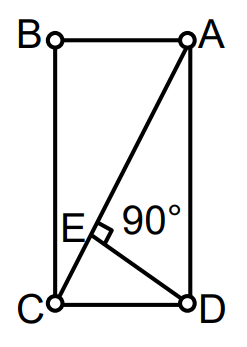
The diagram shows a rectangle $A B C D$ where $A B: A D=1: 2$. Point $E$ on $A C$ is such that $D E$ is perpendicular to $A C$. What is the ratio of the area of the triangle DCE to the rectangle ABCD?

(A) $1: 4 \sqrt{2}$
(B) $1: 6$
(C) $1: 8$
(D) $1: 10$

Problem 7

The numbers $2,3,12,14,15,20,21$ may be divided into two sets so that the product of the numbers in each set is the same. What is this product?


(A) 420
(B) 1260
(C) 2520
(D) 6720

Problem 8

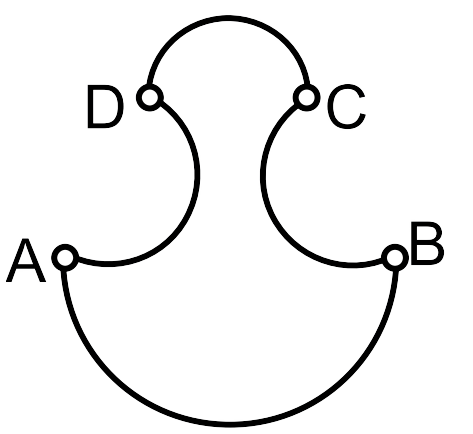
$A B C D$ is a trapezium with $A D=D C=C D=10$ units and $A B=22$ units. Semi circles are drawn as shown in the figure. The area of the region bounded by these semi circles in square units is

(A) $128+48 \pi$
(B) $128+24 \pi$
(C) $116+48 \pi$
(D) $116+24 \pi$

Problem 9

Consider the number of ways in which five girls and five boys sit in ten seats that are equally spaced around a circle. The proportion of the seating arrangements in which no two girls sit at the ends of a diameter is


(A) $\frac{1}{2}$
(B) $\frac{8}{63}$
(C) $\frac{55}{63}$
(D) None of the above

Problem 10

Let $A=1^{-4}+2^{-4}+3^{-4}+\ldots \ldots \ldots \ldots$, the sum of reciprocals of fourth powers of integers and $\mathrm{B}=1^{-4}+3^{-4}+5^{-4}+\ldots \ldots \ldots \ldots$, the sum of reciprocals of fourth powers of odd positive integers. The value of $\mathrm{A} / \mathrm{B}$ as a fraction is


(A) $\frac{16}{15}$
(B) $\frac{32}{31}$
(C) $\frac{64}{63}$
(D) $\frac{128}{127}$

Problem 11

The number $5^{\left(6^7\right)}$ is written on the board (in base 10). Gia takes two of the digits at a time, erases them but appends the sum of those digits at the end. She repeats this till she ends up with one digit on the board. What is the digit that remains on the board?


(A) 1
(B) 5
(C) 6
(D) 7

Problem 12

Seven points are marked on the circumference of a circle and all pairs of points are joined by straight lines. No three of these lines have a common point and any two intersect at a point inside the circle. Into how many regions is the interior of the circle divided by these lines?


(A) 64
(B) 63
(C) 57
(D) 56

Problem 13

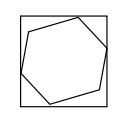
The diagram below shows a regular hexagon with side length 1 , insceibed in a square. Two of the vertices lie on the diagonal of the square and the remaining vertices lie on its sides. What is the area of the square?

(A) $\frac{7}{2}$
(B) 4
(C) $2+\sqrt{3}$
(D) $3+\sqrt{2}$

Problem 14

$\mathrm{AB}$ is a diameter of a semicircle of centre $\mathrm{O}$. C is the midpoint of the arc $\mathrm{AB}$. $\mathrm{AC}$ and the tangent at $B$ to the semicircle meet at P. D is the midpoint of $B P$. If $A C D O$ is a parallelogram and $\angle P A D=\theta$, then $\sin \theta$ is


(A) $\frac{1}{\sqrt{5}}$
(B) $\frac{1}{\sqrt{10}}$
(C) $\frac{2}{\sqrt{10}}$
(D) $\frac{3}{\sqrt{10}}$

Problem 15

The real valued function $f(x)$ satisfies the equation $2 f(1-x)+1=x f(x)$ for all $x$. Then $\left(x^2-x+4\right)$ $f(x)$ equals


(A) $x-1$
(B) $x$
(C) $x+1$
(D) $x-3$

Part B

Problem 16

The number of ways in which 26 identical chocolates be distributed between Amy, Bob, Cathy and Daniel so that each receives at least one chocolate and Amy receives more chocolates than Bob is $\rule{2cm}{0.15mm}$

Problem 17

A set $\mathrm{S}$ contains 11 numbers. The average of the numbers in $\mathrm{S}$ is 302 . The average of the six smallest numbers of $S$ is 100 and the average of the six largest of the numbers is 300 . What is the median of the numbers in $\mathrm{S}$ $\rule{2cm}{0.15mm}$

Problem 18

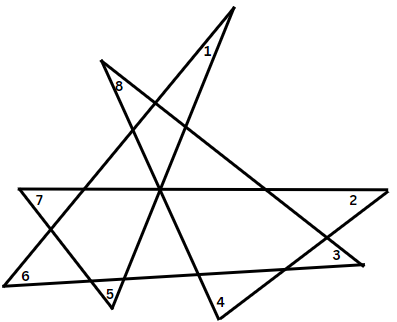
The sum of the angles $1,2,3,4,5,6,7,8$ in degrees shows in the following figure is $\rule{2cm}{0.15mm}$

Problem 19

The number of positive integers less than 2018 that are divisible by 6 but are not divisible by at least one of the numbers 4 or 9 is $\rule{2cm}{0.15mm}$

Problem 20

\[x(x+1)(x+2) \ldots \ldots(x+23)=\sum_{n=1}^{24} a_n x^n\] the number of coefficients $a_n$ that are multiples of 3 is $\rule{2cm}{0.15mm}$

Problem 21

A square is cut into 37 squares of which 36 have area 1 square $\mathrm{cms}$. The length of the side of the original square is $\rule{2cm}{0.15mm}$

Problem 22

There are 4 coins in a row and all are showing heads to start with. The coins can be flipped with the following rules :
(a) The fourth coin (from the left) can be flipped any time
(b) An intermediate coin can be changed to tail only if its immediate neighbor on the right is heads and all other coins (if any) to its right are tails.
(c) Only one coin can be flipped in one step.

The minimum number of steps required to bring all coins to show tails is $\rule{2cm}{0.15mm}$

Problem 23

A poet met a tortoise sitting under a tree. When the tortoise was the poet's age, the poet was only a quarter of his current age. When the tree was the tortoise's age, the tortoise was only a seventh of its current age. If all the ages are in whole number of years, and the sum of their ages is now 264 , the age of the tree in years is $\rule{2cm}{0.15mm}$

Problem 24

The sum of all real value of $x$ satisfying $\left(x+\frac{1}{x}-17\right)^2=x+\frac{1}{x}+17$ is $\rule{2cm}{0.15mm}$

Problem 25

On the inside of a square with side length 6 , construct four congruent isosceles triangles each with base 6 and height 5 , and each having one side coinciding with a different side of the square. The area of the octagonal region common to the interiors of all four triangles is $\rule{2cm}{0.15mm}$

Problem 26

In a triangle with integer side lengths, one side is thrice the other. The third side is $15 \mathrm{~cm}$. The greatest possible perimeter of the triangle is (in $\mathrm{cm}$ ) $\rule{2cm}{0.15mm}$

Problem 27

A cube has edge length $x$ (an integer). three faces meeting at a corner are painted blue. The cube is then cut into smaller cubes of unit length. If exactly 343 of these cubes have no faces painted blue, then the value of $x$ is $\rule{2cm}{0.15mm}$

Problem 28

If $f(x)=a x^4-b x^2+x+5$ and $f(3)=8$, the value of $f(-3)$ is $\rule{2cm}{0.15mm}$

Problem 29

Archana has to choose a three-digit code for her bike lock. The digits can be chosen from 1 to 9 . To help her remember them, she decides to choose three different digits in increasing order, for example 278 . The number of such codes she can choose is $\rule{2cm}{0.15mm}$

Problem 30

Let $\mathrm{S}$ be a set of five different positive integers, the largest of which is $\mathrm{n}$. It is impossible to construct a quadrilateral with non-zero area, whose side-lengths are all distinct elements of $\mathrm{S}$. The smallest possible value of $n$ is $\rule{2cm}{0.15mm}$

Bhaskara Contest (NMTC Junior 2018 - IX and X Grades) - Stage I- Problems and Solution

Part A

Problem 1

The value of $\frac{3+\sqrt{6}}{8 \sqrt{3}-2 \sqrt{12}-\sqrt{32}+\sqrt{50}-\sqrt{27}}$ is
(A) $\sqrt{2}$
(B) $\sqrt{3}$
(C) $\sqrt{6}$
(D) $\sqrt{18}$

Problem 2

A train moving with a constant speed crosses a stationary pole in 4 seconds and a platform $75 \mathrm{~m}$ long in 9 seconds. The length of the train is (in meters)
(A) 56
(B) 58
(C) 60
(D) 62

Problem 3

One of the factors of $9 x^2-4 z^2-24 x y+16 y^2+20 y-15 x+10$ is

(A) $3 x-4 y-2 z$
(B) $3 x+4 y-2 z$
(C) $3 x+4 y+2 z$
(D) $3 x-4 y+2 z$

Problem 4

The natural number which is subtracted from each of the four numbers $17,31,25,47$ to give four numbers in proportion is
(A) 1
(B) 2
(C*) 3
(D) 4

Problem 5

The solution to the equation $5\left(3^x\right)+3\left(5^x\right)=510$ is

(A) 2
(B) 4
(C) 5
(D) No solution

Problem 6

If $(x+1)^2=x$, the value of $11 x^3+8 x^2+8 x-2$ is
(A) 1
(B) 2
(C) 3
(D) 4

Problem 7

There are two values of $m$ for which the equation $4 x^2+m x+8 x+9=0$ has only one solution for $x$. The sum of these two value of $m$ is

(A) 1
(B) 2
(C) 3
(D) 4

Problem 8

The number of zeros in the product of the first 100 natural numbers is
(A) 12
(B) 15
(C) 18
(D) 24

Problem 9

The length of each side of a triangle in increased by $20 \%$ then the percentage increase of area is
(A) $60 \%$
(B) $120 \%$
(C) $80 \%$
(D) $44 \%$

Problem 10

The number of pairs of relatively prime positive integers $(a, b)$ such that $\frac{a}{b}+\frac{15 b}{4 a}$ is an integer is
(A) 1
(B) 2
(C) 3
(D) 4

Problem 11

The four digit number $8 a b 9$ is a perfect square. The value of $a^2+b^2$ is
(A) 52
(B) 62
(C) 54
(D) 68

Problem 12

$a, b$ are positive real numbers such that $\frac{1}{a}+\frac{9}{b}=1$. The smallest value of $a+b$ is
(A) 15
(B) 16
(C) 17
(D) 18

Problem 13

$a, b$ real numbers. The least value of $a^2+a b+b^2-a-2 b$ is
(A) 1
(B) 0
(C) -1
(D) 2

Problem 14

I is the incenter of a triangle $\mathrm{ABC}$ in which $\angle \mathrm{A}=80^{\circ} . \angle \mathrm{BIC}=$
(A) $120^{\circ}$
(B) $110^{\circ}$
(C) $125^{\circ}$
(D) $130^{\circ}$

Problem 15

In the adjoining figure $A B C D$ is a square and DFEB is a rhombus $\angle C D F=$

(A) $15^{\circ}$
(B) $18^{\circ}$
(C) $20^{\circ}$
(D) $30^{\circ}$

Part B

Problem 16

$A B C D$ is a square $E, F$ are point on $B C, C D$ respectively and $E A F=45^{\circ}$. The value of $\frac{E F}{B E+D F}$ is $\rule{1cm}{0.15mm}$

Problem 17

The average of 5 consecutive natural numbers is 10 . The sum of the second and fourth of these numbers is $\rule{1cm}{0.15mm}$

Problem 18

The number of natural number $n$ for which $n^2+96$ is a perfect square is $\rule{1cm}{0.15mm}$

Problem 19

$n$ is an integer and $\sqrt{\frac{3 n-5}{n+1}}$ is also an integer. The sum of all such $n$ is $\rule{1cm}{0.15mm}$

Problem 20

$\frac{a}{b}$ is a fraction where $a, b$ have no common factors other 1 . b exceeds a by 3 . If the numerator is increased by 7 , the fraction is increased by unity. The value of $a+b$ $\rule{1cm}{0.15mm}$

Problem 21

If $x=\sqrt[3]{2}+\frac{1}{\sqrt[3]{2}}$ then the value of $2 x^3-6 x$ is $\rule{1cm}{0.15mm}$

Problem 22

The angle of a heptagon are $160^{\circ}, 135^{\circ}, 185^{\circ}, 140^{\circ}, 125^{\circ}, x^{\circ}, x^{\circ}$. The value of $x$ is $\rule{1cm}{0.15mm}$

Problem 23

$A B C$ is a triangle and $A D$ is its altitude. If $B D=5 D C$, then the value of $\frac{3\left(A B^2-A C^2\right)}{B C^2}$ is $\rule{1cm}{0.15mm}$

Problem 24

As sphere is inscribed in a cube that has surface area of $24 \mathrm{~cm}^2$. A second cube is then inscribed within the sphere. The surface area of the inner cube $\left(\right.$ in $\left.\mathrm{cm}^2\right)$ is $\rule{1cm}{0.15mm}$

Problem 25

A positive integer $n$ is multiple of 7 . If $\sqrt{n}$ lies between 15 and 16 , the number of possible values (s) of n is $\rule{1cm}{0.15mm}$

Problem 26

The value of $x$ which satisfies the equation $\frac{\sqrt{x+5}+\sqrt{x-16}}{\sqrt{x+5}-\sqrt{x-16}}=\frac{7}{3}$ is $\rule{1cm}{0.15mm}$

Problem 27

$\mathrm{M}$ man do a work in $\mathrm{m}$ days. If there had been $\mathrm{N}$ men more, the work would have been finished $\mathrm{n}$ days earlier, then the value of $\frac{m}{n}-\frac{M}{N}$ is $\rule{1cm}{0.15mm}$

Problem 28

The sum of the digit of a two number is 15 . If the digits of the given number are reversed, the number is increased by the square of 3 . The original number is $\rule{1cm}{0.15mm}$

Problem 29

When expanded the units place of $(3127)^{173}$ is $\rule{1cm}{0.15mm}$

Problem 30

If $a:(b+c)=1: 3$ and $c:(a+b)=5: 7$, then $b:(c+a)$ is $\rule{1cm}{0.15mm}$