IOQM 2025 Questions, Answer Key, Solutions

Answer Key

Answer 1
40
Answer 2
17
Answer 3
18
Answer 4
5
Answer 5
36
Answer 6
18
Answer 7
576
Answer 8
44
Answer 9
28
Answer 10
15
Answer 11
80
Answer 12
38
Answer 13
13
Answer 14
11
Answer 15
75
Answer 16
8
Answer 17
8
Answer 18
1
Answer 19
72
Answer 20
42
Answer 21
80
Answer 22
7
Answer 23
19
Answer 24
66
Answer 25
9
Answer 26
6
Answer 27
37
Answer 28
12
Answer 29
33
Answer 30
97

Problem 1

If $60 \%$ of a number $x$ is 40 , then what is $x \%$ of 60 ?

Problem 2

Find the number of positive integers $n$ less than or equal to 100 , which are divisible by 3 but are not divisible by 2.

Problem 3

The area of an integer-sided rectangle is 20 . What is the minimum possible value of its perimeter?

Problem 4

How many isosceles integer-sided triangles are there with perimeter 23?

Problem 5

How many 3 -digit numbers $a b c$ in base 10 are there with $a \neq 0$ and $c=a+b$ ?

Problem 6

The height and the base radius of a closed right circular cylinder are positive integers and its total surface area is numerically equal to its volume. If its volume is $k \pi$ where $k$ is a positive integer, what is the smallest possible value of $k$ ?

Problem 7

A quadrilateral has four vertices $A, B, C, D$. We want to colour each vertex in one of the four colours red, blue, green or yellow, so that every side of the quadrilateral and the diagonal $A C$ have end points of different colours. In how many ways can we do this?

Problem 8

The sum of two real numbers is a positive integer $n$ and the sum of their squares is $n+1012$. Find the maximum possible value of $n$.

Problem 9

Four sides and a diagonal of a quadrilateral are of lengths $10, 20, 28, 50, 75$, not necessarily in that order. Which amongst them is the only possible length of the diagonal?

Problem 10

The age of a person (in years) in 2025 is a perfect square. His age (in years) was also a perfect square in 2012. His age (in years) will be a perfect cube $m$ years after 2025. Determine the smallest value of $m .=15$

Problem 11

There are six coupons numbered 1 to 6 and six envelopes, also numbered 1 to 6 . The first two coupons are placed together in any one envelope. Similarly, the third and the fourth are placed together in a different envelope, and the last two are placed together in yet another different envelope. How many ways can this be done if no coupon is placed in the envelope having the same number as the coupon?

Problem 12

Consider five-digit positive integers of the form $\overline{a b c a b}$ that are divisible by the two digit number $a b$ but not divisible by 13 . What is the largest possible sum of the digits of such a number?

Problem 13

A function $f$ is defined on the set of integers such that for any two integers $m$ and $n$,

$$
f(m n+1)=f(m) f(n)-f(n)-m+2
$$

holds and $f(0)=1$. Determine the largest positive integer $N$ such that $\sum_{k=1}^N f(k)<100$ .

Problem 14

Consider a fraction $\frac{a}{b} \neq \frac{3}{4}$, where $a, b$ are positive integers with $\operatorname{gcd}(a, b)=1$ and $b \leq 15$. If this fraction is chosen closest to $\frac{3}{4}$ amongst all such fractions, then what is the value of $a+b$ ?

Problem 15

Three sides of a quadrilateral are $a=4 \sqrt{3}, b=9$ and $c=\sqrt{3}$. The sides $a$ and $b$ enclose an angle of $30^{\circ}$, and the sides $b$ and $c$ enclose an angle of $90^{\circ}$. If the acute angle between the diagonals is $x^{\circ}$, what is the value of $x$ ?

Problem 16

$f(x)$ and $g(x)$ be two polynomials of degree 2 such that

$$
\frac{f(-2)}{g(-2)}=\frac{f(3)}{g(3)}=4
$$

If $g(5)=2, f(7)=12, g(7)=-6$, what is the value of $f(5)$ ?

Problem 17

The triangle $A B C, \angle B=90^{\circ}, A B=1$ and $B C=2$. On the side $B C$ there are two points $D$ and $E$ such that $E$ lies between $C$ and $D$ and $D E F G$ is a square, where $F$ lies on $A C$ and $G$ lies on the circle through $B$ with centre $A$. If the area of $D E F G$ is $\frac{m}{n}$ where $m$ and $n$ are positive integers with $\operatorname{gcd}(m, n)=1$, what is the value of $m+n$ ?

Problem 18

$M T A I$ is a parallelogram of area $\frac{40}{41}$ square units such that $M I=1 / M T$. If $d$ is the least possible length of the diagonal $M A$, and $d^2=\frac{a}{b}$, where $a, b$ are positive integers with $\operatorname{gcd}(a, b)=1$, find $|a-b|$.

Problem 19

Let $N$ be the number of nine-digit integers that can be obtained by permuting the digits of 223334444 and which have at least one 3 to the right of the right-most occurrence of 4 . What is the remainder when $N$ is divided by $100$?

Problem 20

Let $f$ be the function defined by

$$
f(n)=\text { remainder when } n^n \text { is divided by } 7,
$$

for all positive integers $n$. Find the smallest positive integer $T$ such that $f(n+T)=f(n)$ for all positive integers $n$.

Problem 21

Let $P(x)=x^{2025}, Q(x)=x^4+x^3+2 x^2+x+1$. Let $R(x)$ be the polynomial remainder when the polynomial $P(x)$ is divided by the polynomial $Q(x)$. Find $R(3)$.

Problem 22

Let $A B C D$ be a rectangle and let $M, N$ be points lying on sides $A B$ and $B C$, respectively. Assume that $M C= C D$ and $M D=M N$, and that points $C, D, M, N$ lic on a circle. If $(A B / B C)^2=m / n$ where $m$ and $n$ are positive integers with $\operatorname{gcd}(m, n)=1$, what is the value of $m+n$ ?

Problem 23

Let \(A B C D\) be a rectangle and let \(M, N\) be points lying on sides \(A B\) and \(B C\), respectively. Assume that \(M C= C D\) and \(M D=M N\), and that points \(C, D, M, N\) lie on a circle. If \((A B / B C)^2=m / n\) where \(m\) and \(n\) are positive integers with \(\operatorname{gcd}(m, n)=1\), what is the value of \(m+n\) ?

Problem 24

There are $m$ blue marbles and $n$ red marbles on a table. Armaan and Babita play a game by taking turns. In each turn the player has to pick a marble of the colour of his/her choice. Armaan starts first, and the player who picks the last red marble wins. For how many choices of $(m, n)$ with $1 \leq m, n \leq 11$ can Armaan force a win?

Problem 25

For some real numbers $m, n$ and a positive integer $a$, the list $(a+1) n^2, m^2, a(n+1)^2$ consists of three consecutive integers written in increasing order. What is the largest possible value of $m^2$ ?

Problem 26

Let $S$ be a circle of radius 10 with centre $O$. Suppose $S_1$ and $S_2$ are two circles which touch $S$ internally and intersect each other at two distinct points $A$ and $B$. If $\angle O A B=90^{\circ}$ what is the sum of the radii of $S_1$ and $S_2$ ?

Solution

Problem 27

A regular polygon with $n \geq 5$ vertices is said to be colourful if it is possible to colour the vertices using at most 6 colours such that each vertex is coloured with exactly one colour, and such that any 5 consecutive vertices have different colours. Find the largest number $n$ for which a regular polygon with $n$ vertices is not colourful.

Solution

Problem 28

Find the number of ordered triples $(a, b, c)$ of positive integers such that $1 \leq a, b, c \leq 50$ which satisfy the relation

$$
\frac{\operatorname{lcm}(a, c)+\operatorname{lcm}(b, c)}{a+b}=\frac{26 c}{27}
$$

Here, by $\operatorname{lcm}(x, y)$ we mean the LCM, that is, least common multiple of $x$ and $y$.

Problem 29

Consider a sequence of real numbers of finite length. Consecutive four term averages of this sequence are strictly increasing, but consecutive seven term averages are strictly decreasing. What is the maximum possible length of such a sequence?

Problem 30

Assume $a$ is a positive integer which is not a perfect square. Let $x, y$ be non-negative integers such that $\sqrt{x-\sqrt{x+a}}=\sqrt{a}-y$. What is the largest possible value of $a$ such that $a<100 ?$

NMTC - Screening Test – Ramanujan Contest 2025

PART – A

Problem 1

If four different positive integers \(m, n, p, q\) satisfy the equation
\(7-m)(7-n)(7-p)(7-q)=4\)

then the sum \(m+n+p+q\) is equal to

A. 10
B. 24
C. 28
D. 36

Problem 2

A three member sequence \(a, b, c\) is said to be a up-down sequence if \(ac\). For example \(1,3,2\) is a up-down sequence. The sequence 1342 contains three up-down sequences: \((1,3,2),(1,4,2)\) and \((3,4,2)\). How many up-down sequences are contained in the sequence 132597684?

A. 32
B. 34
C. 36
D. 38

Problem 3

For a positive integer \(n\), let \(P(n)\) denote the product of the digits of \(n\) when \(n\) is written in base 10. For example, \(P(123)=6\) and \(P(788)=448\). If \(N\) is the smallest positive integer such that \(P(N)>1000\), and \(N\) is written as \(100 x+y\) where \(x, y\) are integers with \(0 \leq x, y<100\), then \(x+y\) equals

A. 112
B. 114
C. 116
D. 118

Problem 4

The sum of 2025 consecutive odd integers is \(2025^{2025}\). The largest of these off numbers is

A. \(2025^{2024}+2024\)
B. \(2025^{2024}-2024\)
C. \(2025^{2023}+2024\)
D. \(2025^{2023}-2024\)

Problem 5

\(A B C\) is an equilateral triangle with side length 6. \(P, Q, R\) are points on the sides \(A B, B C, C A\) respectively such that \(A P=B Q=C R=1\). The ratio of the area of the triangle \(A B C\) to the area of the triangle \(P Q R\) is

A. \(36: 25\)
B. \(12: 5\)
C. \(6: 5\)
D. \(12: 7\)

Problem 6

How many three-digit positive integers are there if the digits are the side lengths of some isosceles or equilateral triangle?

A. 45
B. 81
C. 165
D. 216

Problem 7

All the positive integers whose sum of digits is 7 are written in the increasing order. The first few are \(7,16,25,34,43, \ldots\). What is the 125 th number in this list?

A. 7000
B. 10006
C. 10024
D. 10042

Problem 8

The bisectors of the angles \(A, B, C\) of the triangle \(A B C\) meet the circum circle of the triangle again at the points \(D, E, F\) respectively. What is the value of
\(\frac{A D \cos \frac{A}{2}+B E \cos \frac{B}{2}+C F \cos \frac{C}{2}}{\sin A+\sin B+\sin C}\)

if the circum radius of \(A B C\) is 1 ?

A. 2
B. 4
C. 6
D. 8

Problem 9

For a real number \(x\), let \(\lfloor x\rfloor\) be the greatest integer less than or equal to \(x\). For example, \([1.7]=1\) and \([\sqrt{2}]=1\). Let \(N=\left\lfloor\frac{10^{93}}{10^{31}+3}\right\rfloor\). Find the remainder when \(N\) is divided by 100.

A. 1
B. 8
C. 22
D. 31

Problem 10

A point \((x, y)\) in the plane is called a lattice point if both its coordinates \(x, y\) are integers. The number of lattice points that lie on the circle with center at \((199,0)\) and radius 199 is

A. 4
B. 8
C. 12
D. 16

Problem 11

The sum of all real numbers \(p\) such that the equation

\(5 x^3-5(p+1) x^2+(71 p-1) x-(66 p-1)=0\)

has all its three roots positive integers.

A. 70
B. 74
C. 76
D. 88

Problem 12

If \(1-x+x^2-x^3+\cdots+x^{20}\) is rewritten in the form

\(a_0+a_1(x-4)+a_2(x-4)^2+\cdots+a_{20}(x-4)^{20}\), where \(a_0, a_1, \ldots, a_{20}\)

are all real numbers, the value of \(a_0+a_1+a_2+\cdots+a_{20}\) is

A. \(\frac{5^{21}+1}{6}\)
B. \(\frac{5^{21}-1}{6}\)
C. \(\frac{5^{20}+1}{6}\)
D. \(\frac{5^{20}-1}{6}\)

Problem 13

For a positive integer \(n\), a distinct 3-partition of \(n\) is a triple \( (a, b, c) \) of positive integers such that \(a<b<c\) and \(a+b+c=n\). For example, \((1,2,4)\) is a distinct 3 -partition of 7 . The number of distinct 3-partitions of 15 is

A. 10
B. 12
C. 13
D. 15

Problem 14

If \(m\) and \(n\) are positive integers such that \(30 m n-6 m-5 n=2019\), what is the value of \(30 m n-5 m-6 n ?\)

A. 1900
B. 2020
C. 1939
D. Can not be found from the given information

Problem 15

A class of 100 students takes a six question exam. For the first question, a student receives 1 point for answering correctly, -1 point for answering incorrectly or not answering at all. For the second question, the student receives 2 points for answering correctly and -2 points for answering incorrectly or not answering at all and so on. What is the minimum number of students having the same scores?

A. 6
B. 5
C. 0
D. Can not be found from the given information

Part B

Problem 16

The value of

\(\frac{1}{2}+\frac{1^2+2^2}{6}+\frac{1^2+2^2+3^2}{12}+\frac{1^2+2^2+3^2+4^2}{20}+\cdots+\frac{1^2+2^2+\cdots+60^2}{3660}\)

is ________ .

Problem 17

The largest prime divisor of \(3^{21}+1\) is _________

Problem 18

A circular garden divided into 10 equal sectors needs to be planted with flower plants that yield flowers of 3 different colors, in such a way that no two adjacent sectors will have flowers of the same color. The number of ways in which this can be done is _________

Problem 19

We call an integer special if it is positive and we do not need to use the digit 0 to write it down in base 10. For example, 2126 is special whereas 2025 is not. The first 10 special numbers are \(1,2,3,4,5,6,7,8,9,11\). The 2025th special number is _________ .

Problem 20

Let \(a, b, c\) be non zero real numbers such that \(a+b+c=0\) and \(a^3+b^3+c^3=a^5+b^5+c^5\). The value of \(\frac{5}{a^2+b^2+c^2}\) is _________ .

Problem 21

The equation \(x^3-\frac{1}{x}=4\) has two real roots \(\alpha, \beta\). The value of \((\alpha+\beta)^2\) is _________

Problem 22

If \(x, y, z\) are positive integers satisfying the system of equations

\(\begin{aligned} x y+y z+z x & =2024 \ x y z+x+y+z & =2025\end{aligned}\)

find \(\max (x, y, z)\) . ________

Problem 23

If \(p, q, r\) are primes such that \(p q+q r+r p=p q r-2025\), find \(p+q+r .\). __________

Problem 24

A cyclic quadrilateral has side lengths \(3,5,5,8\) in this order. If \(R\) is its circumradius, find \(3 R^2\). __________

Problem 25

Consider the sequence of numbers \(24,2534,253534,25353534, \ldots\). Let \(N\) be the first number in the sequence that is divisible by 99 . Find the number of digits in the base 10 representation of \(N\). _____________

Problem 26

An isosceles triangle has integer sides and has perimeter 16. Find the largest possible area of the triangle. ____________

Problem 27

Suppose that \(a, b, c\) are positive real numbers such that \(a^2+b^2=c^2\) and \(a b=c\). Find the value of

\(\frac{(a+b+c)(a-b+c)(a+b-c)(a-b-c)}{c^2}\) ______________

Problem 28

In a right angled triangle with integer sides, the radius of the inscribed circle is 12. Compute the largest possible length of the hypotenuse. _______________

Problem 29

Points \(C\) and \(D\) lie on opposite sides of the line \(A B\). Let \(M\) and \(N\) be the centroids of the triangles \(A B C\) and \(A B D\) respectively. If \(A B=25, B C=24, A C=7, A D=20\) and \(B D=15\), find \(M N\). __________

Problem 30

Let \(a_0=1\) and for \(n \geq 1\), define \(a_n=3 a_{n-1}+1\). Find the remainder when \(a_{11}\) is divided by 97. ___________
NMTC - Screening Test – KAPREKAR Contest - 2025

Part 1

Problem 1

\(A B\) is a straight road of length 400 metres. From \(A\), Samrud runs at a speed of \(6 \mathrm{~m} / \mathrm{s}\) towards \(B\) and at the same time Saket starts from \(B\) and runs towards \(A\) at a speed of \(5 \mathrm{~m} / \mathrm{s}\). After reaching their destinations, they return with the same speeds. They repeat it again and again. How many times do they meet each other in 15 minutes?

A) 25
B) 23
C) 24
D) 20

Problem 2

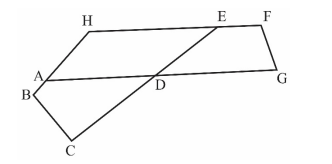
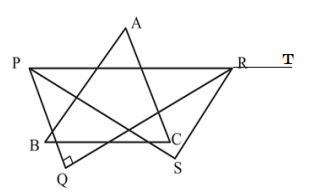
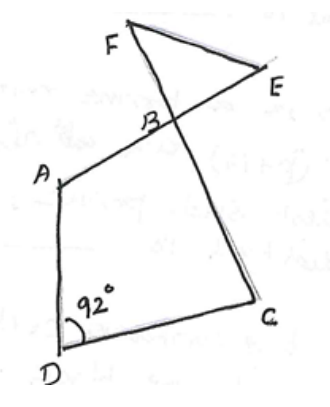
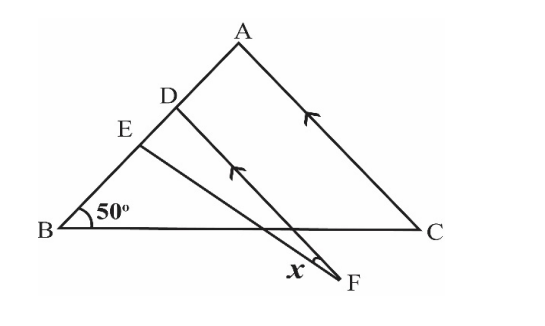
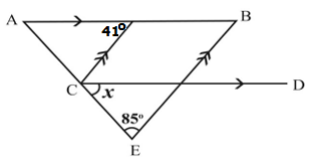
In the adjoining figure, the measure of the angle \(x\) is

A) \(84^{\circ}\)
B) \(44^{\circ}\)
C) \(64^{\circ}\)
D) \(54^{\circ}\)

Problem 3

The value of \(x\) which satisfies \(\frac{1}{x+a}+\frac{1}{x+b}=\frac{1}{x+a+b}+\frac{1}{x}\) is

A) \(\frac{a+b}{2}\)
B) \(\frac{a-b}{2}\)
C) \(\frac{b-a}{2}\)
D) \(\frac{-(a+b)}{2}\)

Problem 4

Two sides of an isosceles triangle are 23 cm and 17 cm respectively. The perimeter of the triangle (in cm ) is

A) 63
В) 57
C) 63 or 57
D) 40

Problem 5

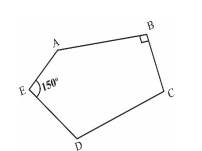
\(A B C D E\) is a pentagon with \(\angle B=90^{\circ}\) and \(\angle E=150^{\circ}\).
If \(\angle C+\angle D=180^{\circ}\) and \(\angle A+\angle D=180^{\circ}\), then the external angle \(\angle D\) is

A) \(120^{\circ}\)
B) \(110^{\circ}\)
C) \(105^{\circ}\)
D) \(115^{\circ}\)

Problem 6

The unit's digit of the product \(3^{2025} \times 7^{2024}\) is

A) 1
B) 2
C) 3
D) 6

Problem 7

The smallest positive integer \(n\) for which \(18900 \times n\) is a perfect cube is

A) 1
B) 2
C) 3
D) 6

Problem 8

Two numbers \(a\) and \(b\) are respectively \(20 \%\) and \(50 \%\) more of a third number \(c\). The percentage of \(a\) to \(b\) is

A) 120 %
В) 80 %
C) 75 %
D) 110 %

Problem 9

If \(a+b=2, \frac{1}{a}+\frac{1}{b}=18\), then \(a^3+b^3\) lies between

A) 7 and 8
B) 6 and 7
C) 8 and 9
D) 5 and 6

Problem 10

If \(\sqrt{12+\sqrt[3]{x}}=\frac{7}{2}\) and \(x=\frac{p}{q^{\prime}}, p, \mathrm{q}\) are natural numbers with G.C.D. \((p, q)=1\), then \(p+q\) is

A) 65
В) 56
C) 45
D) 54

Problem 11

The smallest number of 4-digits leaving a remainder 1 when divided by 2 or

A) 5 as its unit digit
B) Only one zero as one of the digits
C) Exactly two zeroes as its digits
D) 7 as its unit digit

Problem 12

If \(a: b=2: 3, b: c=4: 5\) and \(a+c=736\), then the value of \(b\) is

A) 392
B) 378
C) 384
D) 386

Problem 13

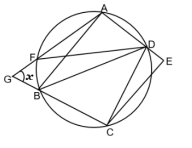
In the given figure,

\[
\begin{aligned}
& \angle B=110^{\circ} ; \quad \angle C=80^{\circ} ; \
& \angle F=120^{\circ} ; \quad \angle A D C=30^{\circ} \
& 2 \angle D G F=\angle D E F .
\end{aligned}
\]

The measure of \(\angle B H F\) is

A) \(115^{\circ}\)
B) \(135^{\circ}\)
C) \(100^{\circ}\)
D) \(130^{\circ}\)

Problem 14

If \(\frac{1}{b+c}+\frac{1}{c+a}=\frac{2}{a+b}\), then the value of \(\frac{a^2+b^2}{c^2}\) is

A) 2
B) 1
C) 1 / 2
D) 3

Problem 15

If 3 men or 4 women can do a job in 43 days, the number of days the same job is done by 7 men and 5 women is

A) 12
B) 10
C) 11
D) 13

Part B

Problem 16

The expression \(49(a+b)^2-46(a-b)^2\) is factorized into \((l a+m b)(n a+p b)\), then the numerical value of \((l+m+n+p)\) is _________________

Problem 17

The integer part of the solution of the equation in \(x\), \(\frac{1}{3}(x-3)-\frac{1}{4}(x-8)=\frac{1}{5}(x-5)\) is ______________

Problem 18

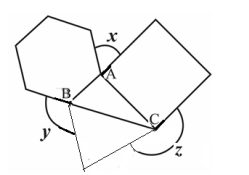
In the adjoining figure, \(A B C\) is a triangle in which \(\angle B A C=100^{\circ}\), \(\angle A C B=30^{\circ}\). An equilateral triangle, a square and a regular hexagon are drawn as shown in the figure. The measure (in degrees) of \((x+y+z)\) is ____________

Problem 19

The mean of 5 numbers is 105 . The first number is \(\frac{2}{5}\) times the sum of the other 4 numbers. The first number is ____________

Problem 20

\(P Q R S\) is a square. The sides \(P Q\) and \(R S\) are increased by 30 % each and the sides \(Q R\) and \(P S\) are increased by 20 % each. The area of the quadrilateral thus obtained exceeds the area of the square by ___________ %.

Problem 21

If \(x^2+(2+\sqrt{3}) x-1=0\) and \(x^2+\frac{1}{x^2}=a+b \sqrt{c}\), then \((a+b+c)\) is _____________

Problem 22

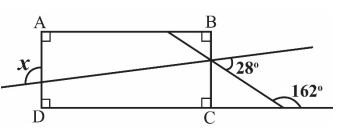
In the given figure, \(A B C D\) is a rectangle.

The measure of angle \(x\) is _________________ degrees.

Problem 23

The sum of all positive integers \(m, n\) which satisfy \(m^2+2 m n+n=44\) is __________________

Problem 24

Given \(a=2025, b=2024\), the numerical value of \(\left(a+b-\frac{4 a b}{a+b}\right) \div\left(\frac{a}{a+b}-\frac{b}{b-a}+\frac{2 a b}{b^2-a^2}\right)\) is _________________

Problem 25

In the sequence \(0,7,26,63,124, \ldots \ldots \ldots\) the \(6^{\text {th }}\) term is _____________

Problem 26

\[
\text { If } A=\sqrt{281+\sqrt{53+\sqrt{112+\sqrt{81}}}}, B=\sqrt{92+\sqrt{55+\sqrt{75+\sqrt{36}}}}
\]

then \(A-B\) is _______________________
Problem 27

The average of the numbers \(a, b, c, d\) is \((b+4)\). The average of pairs \((a, b),(b, c)\) and \((c, a)\) are respectively 16,26 and 25 . Then the average of \(d\) and 67 is ___________________

Problem 28

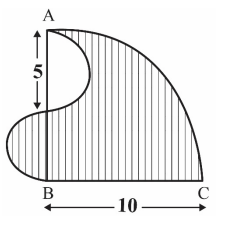
\(A B C\) is a quadrant of a circle of radius 10 cm . Two semicircles are drawn as in the figure.

The area of the shaded portion is \(k \pi\), where \(k\) is a positive integer.

The value of \(k\) is __________________

Problem 29

In the figure, \(A B C\) and \(P Q R\) are two triangles such that \(\angle \mathrm{A}: \angle \mathrm{B}: \angle \mathrm{C}=5: 6: 7\) and \(\angle P R Q=\angle B\). \(P S\) makes an angle \(\frac{\angle P}{3}\) with \(P Q\) and \(R S\) makes an angle \(\frac{\angle S R T}{5}\) with \(R Q\). Then the measure of \(\angle S\) is ______________________

Problem 30

In a two-digit positive integer, the units digit is one less than the tens digit. The product of one less than the units digit and one more than the tens digit is 40. The number of such two-digit integers is _______________
BHASKARA Contest - NMTC - Screening Test – 2025

Problem 1

The greatest 4 -digit number such that when divided by 16,24 and 36 leaves 4 as remainder in each case is
А) 9994
B) 9940
C) 9094
D) 9904

Problem 2

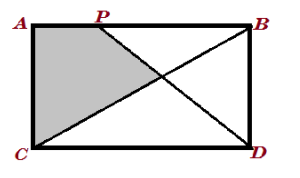
\(A B C D\) is a rectangle whose length \(A B\) is 20 units and breadth is 10 units. Also, given \(A P=8\) units. The area of the shaded region is \(\frac{p}{q}\) sq unit, where \(p, q\) are natural numbers with no common factors other than 1 . The value of \(p+q\) is
A) 167
В) 147
C) 157
D) 137

Problem 3

The solution of \(\frac{\sqrt[7]{12+x}}{x}+\frac{\sqrt[7]{12+x}}{12}=\frac{64}{3}(\sqrt[7]{x})\) is of the form \(\frac{a}{b}\) where \(a, b\) are natural numbers with \(\operatorname{GCD}(a, b)=1\); then \((b-a)\) is equal to
A) 115
B) 114
C) 113
D) 125

Problem 4

The value of \((52+6 \sqrt{43})^{3 / 2}-(52-6 \sqrt{43})^{3 / 2}\) is
A) 858
В) 918
C) 758
D) 828

Problem 5

In the adjoining figure \(\angle D C E=10^{\circ}\), \(\angle C E D=98^{\circ}, \angle B D F=28^{\circ}\)
Then the measure of angle \(x\) is
A) \(72^{\circ}\)
B) \(76^{\circ}\)
C) \(44^{\circ}\)
D) \(82^{\circ}\)

Problem 6

\(A B C\) is a right triangle in which \(\angle \mathrm{B}=90^{\circ}\). The inradius of the triangle is \(r\) and the circumradius of the triangle is R . If \(\mathrm{R}: r=5: 2\), then the value of \(\cot ^2 \frac{A}{2}+\cot ^2 \frac{C}{2}\) is
A) \(\frac{25}{4}\)
B) 17
C) 13
D) 14

Problem 7

If \((\alpha, \beta)\) and \((\gamma, \beta)\) are the roots of the simultaneous equations:

\[
|x-1|+|y-5|=1 ; \quad y=5+|x-1|
\]

then the value of \(\alpha+\beta+\gamma\) is
A) \(\frac{15}{2}\)
B) \(\frac{17}{2}\)
C) \(\frac{14}{3}\)
D) \(\frac{19}{2}\)

Problem 8

Three persons Ram, Ali and Peter were to be hired to paint a house. Ram and Ali can paint the whole house in 30 days, Ali and Peter in 40 days while Peter and Ram can do it in 60 days. If all of them were hired together, in how many days can they all three complete $50 \%$ of the work?
A) $24 \frac{1}{3}$
B) $25 \frac{1}{2}$
C) $26 \frac{1}{3}$
D) $26 \frac{2}{3}$

Problem 9

$\frac{\sqrt{a+3 b}+\sqrt{a-3 b}}{\sqrt{a+3 b}-\sqrt{a-3 b}}=x$, then the value of $\frac{3 b x^2+3 b}{a x}$ is
A) 1
B) 2
C) 3
D) 4

Problem 10

The number of integral solutions of the inequation $\left|\frac{2}{x-13}\right|>\frac{8}{9}$ is
A) 1
B) 2
C) 3
D) 4

Problem 11

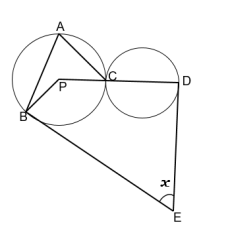
In the adjoining figure, $P$ is the centre of the first circle, which touches the other circle in C . PCD is along the diameter of the second circle. $\angle \mathrm{PBA}=20^{\circ}$ and $\angle \mathrm{PCA}=30^{\circ}$.

The tangents at B and D meet at E . The measure of the angle $x$ is
A) $75^{\circ}$
B) $80^{\circ}$
C) $70^{\circ}$
D) $85^{\circ}$

Problem 12

If $\alpha, \beta$ are the values of $x$ satisfying the equation $3 \sqrt{\log _2 x}-\log _2 8 x+1=0$, where $\alpha<\beta$, then the value of $\left(\frac{\beta}{\alpha}\right)$ is
A) 2
B) 4
C) 6
D) 8

Problem 13

When a natural number is divided by 11 , the remainder is 4 . When the square of this number is divided by 11 , the remainder is
A) 4
B) 5
C) 7
D) 9

Problem 14

The unit's digit of a 2-digit number is twice the ten's digit. When the number is multiplied by the sum of the digits the result is 144 . For another 2-digit number, the ten's digit is twice the unit's digit and the product of the number with the sum of its digits is 567 . Then the sum of the two 2 -digit numbers is
A) 68
В) 86
C) 98
D) 87

Problem 15

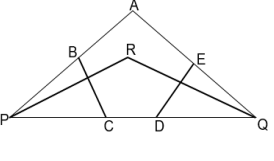
$A B C D E$ is a pentagon. $\angle A E D=126^{\circ}, \angle B A E=\angle C D E$ and $\angle A B C$ is $4^{\circ}$ less than $\angle B A E$ and $\angle B C D$ is $6^{\circ}$ less than $\angle C D E . P R, Q R$ the bisectors of $\angle B P C, \angle E Q D$ respectively, meet at $R$. Points $\mathrm{P}, \mathrm{C}, \mathrm{D}, \mathrm{Q}$ are collinear. Then measure of $\angle P R Q$ is
A) $151^{\circ}$
B) $137^{\circ}$
C) $141^{\circ}$
D) $143^{\circ}$

Problem 16

$a, b, c$ are real numbers such that $b-c=8$ and $b c+a^2+16=0$.
The numerical value of $a^{2025}+b^{2025}+c^{2025}$ is $\rule{2cm}{0.2mm}$.

Problem 17

Given $f(x)=\frac{2025 x}{x+1}$ where $x \neq-1$. Then the value of $x$ for which $f(f(x))=(2025)^2$ is $\rule{2cm}{0.2mm}$.

Problem 18

The sum of all the roots of the equation $\sqrt[3]{16-x^3}=4-x$ is $\rule{2cm}{0.2mm}$.

Problem 19

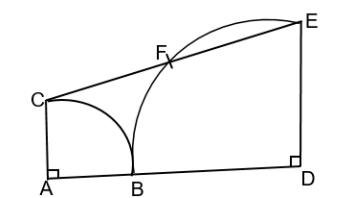
In the adjoining figure, two
Quadrants are touching at $B$.
$C E$ is joined by a straight line, whose mid-point is $F$.

The measure of $\angle C E D$ is $\rule{2cm}{0.2mm}$.

Problem 20

The value of $k$ for which the equation $x^3-6 x^2+11 x+(6-k)=0$ has exactly three positive integer solutions is $\rule{2cm}{0.2mm}$.

Problem 21

The number of 3-digit numbers of the form $a b 5$ (where $a, b$ are digits) which are divisible by 9 is $\rule{2cm}{0.2mm}$.

Problem 22

If $a=\sqrt{(2025)^3-(2023)^3}$, the value of $\sqrt{\frac{a^2-2}{6}}$ is $\rule{2cm}{0.2mm}$.

Problem 23

In a math Olympiad examination, $12 \%$ of the students who appeared from a class did not solve any problem; $32 \%$ solved with some mistakes. The remaining 14 students solved the paper fully and correctly. The number of students in the class is $\rule{2cm}{0.2mm}$.

Problem 24

When $a=2025$, the numerical value of
$\left|2 a^3-3 a^2-2 a+1\right|-\left|2 a^3-3 a^2-3 a-2025\right|$ is $\rule{2cm}{0.2mm}$.

Problem 25

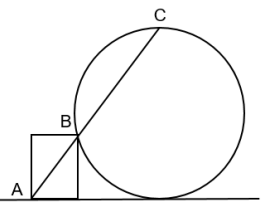
A circular hoop and a rectangular frame are standing on the level ground as shown. The diagonal $A B$ is extended to meet the circular hoop at the highest point $C$. If $A B=18 \mathrm{~cm}, B C=32 \mathrm{~cm}$, the radius of the hoop (in cm ) is $\rule{2cm}{0.2mm}$.

Problem 26

' $n$ ' is a natural number. The number of ' $n$ ' for which $\frac{16\left(n^2-n-1\right)^2}{2 n-1}$ is a natural number is $\rule{2cm}{0.2mm}$.

Problem 27

The number of solutions $(x, y)$ of the simultaneous equations $\log _4 x-\log _2 y=0, \quad x^2=8+2 y^2$ is $\rule{2cm}{0.2mm}$.

Problem 28

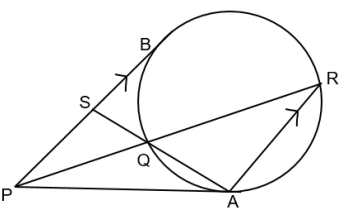
In the adjoining figure,
$P A, P B$ are tangents.
$A R$ is parallel to $P B$

$P Q=6 ; Q R=18 .$

Length $S B= \rule{2cm}{0.2mm}$.

Problem 29

A large watermelon weighs 20 kg with $98 \%$ of its weight being water. It is left outside in the sunshine for some time. Some water evaporated and the water content in the watermelon is now $95 \%$ of its weight in water. The reduced weight in kg is $\rule{2cm}{0.2mm}$.

Problem 30

In a geometric progression, the fourth term exceeds the third term by 24 and the sum of the second and third term is 6 . Then, the sum of the second, third and fourth terms is $\rule{2cm}{0.2mm}$.

NMTC - Screening Test – GAUSS Contest - 2025

Problem 1

The value of $\frac{9999+7777+5555}{8888+6666+4444}$ is
A) 1
B) $\frac{755}{448}$
C) $\frac{7}{6}$
D) $\frac{1}{6}$

Problem 2

The sum of three prime numbers is 30 . How many such sets of prime numbers are there?
A) 1
B) 2
C) 3
D) 0

Problem 3

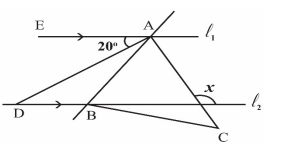
In the adjoining figure, lines $\ell_1, \ell_2$ are parallel lines. $A B C$ is an equilateral triangle.
$A D$ bisects $\angle E A B$.
Then $x=$ ?
A) $100^{\circ}$
B) $95^{\circ}$
C) $105^{\circ}$
D) $110^{\circ}$

Problem 4

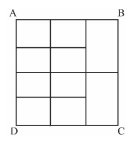
In the figure, $A B C D$ is a square. It consists of squares and rectangles of areas $1 \mathrm{~cm}^2$ and $2 \mathrm{~cm}^2$ as shown. The perimeter of the square $A B C D$ (in cm ) is
A) 17
B) 15
C) 16
D) 14

Problem 5

If $a * b=\frac{a+b}{a-b}$, then the value of $\frac{13 * 6}{5 * 2}$ is
A) $\frac{21}{4}$
B) $\frac{17}{3}$
C) $\frac{19}{39}$
D) $\frac{57}{49}$

Problem 6

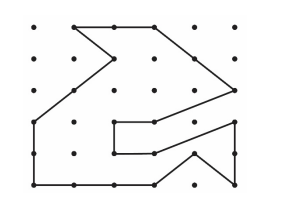
In the adjoining figure, the distance between any two adjacent dots is 1 cm . The area of the shaded region (in $\mathrm{cm}^2$ ) is
A) $\frac{31}{3}$
B) $\frac{31}{2}$
C) $\frac{33}{2}$
D) $\frac{35}{2}$

Problem 7

Three natural numbers $n_1, n_2, n_3$ are taken.
Let $n_{1<} n_{2<} n_3$ and $n_1+n_2+n_3=6$. The value of $n_3$ is
A) 1
B) 2
C) 3
D) 1 or 2 or 3

Problem 8

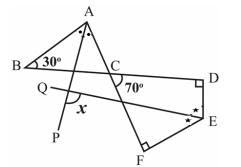
In the adjoining figure, AP and EQ are respectively the bisectors of $\angle \mathrm{BAC}$ and $\angle \mathrm{DEF}$. Then, the measure of angle $x$ is
A) $90^{\circ}$
B) $85^{\circ}$
C) $105^{\circ}$
D) $75^{\circ}$

Problem 9

The number of two-digit positive integers which have at least one 7 as a digit is
A) 17
B) 19
C) 9
D) 18

Problem 10

The fractions $\frac{1}{5}$ and $\frac{1}{3}$ are shown on the number line. In which position should $\frac{1}{4}$ be shown?

A) $p$
B) $q$
C) $r$
D) $s$

Problem 11

Samrud reads $\frac{1}{3}$ of a story book on the first day, $\frac{1}{2}$ of the remaining book on the second day and $\frac{\mathbf{1}}{\mathbf{4}}$ of the remaining book as on the end of the first day, on the third day and left with 23 pages unread. The number of pages of the book is
A) 138
В) 148
C) 128
D) 136

Problem 12

The product of four different natural numbers is 100 . What is the sum of the four numbers?
A) 20
B) 10
C) 12
D) 18

Problem 13

Peter starts from a point A in a playground and walks $100 m$ towards East. Then he walks 30 m towards North and then 70 m towards West and then finally 10 m North to reach the point B. The distance between A and B (in metres) is
A) 50
B) 42
C) 40
D) 30

Problem 14

In the adjoining figure $\angle \mathrm{DAB}$ is $8^{\circ}$ more than $\angle \mathrm{ADC}$; $\angle \mathrm{BCD}$ is $8^{\circ}$ less than $\angle \mathrm{ADC}$. $\angle \mathrm{FEB}$ is half of $\angle \mathrm{FBE}$. Then the measure of $\angle \mathrm{BFE}$ is
A) $54^{\circ}$
B) $52^{\circ}$
C) $49^{\circ}$
D) $50^{\circ}$

Problem 15

The fraction to be added to the fraction $\frac{1}{2+\frac{1}{3+\frac{1}{1+\frac{1}{4}}}}$ to get 1 is
A) $\frac{26}{43}$
В) $\frac{18}{43}$
C) $\frac{24}{43}$
D) $\frac{23}{43}$

Problem 16

Some amount of money is divided among A, B and C, so that for every ₹100 A has, B has ₹ 65 and c has ₹ 40. If the share of C is ₹ 4000, the total amount of money (in ₹) is $\rule{2cm}{0.2mm}$.

Problem 17

ABCDE is a pentagon. The angles $\mathrm{A}, \mathrm{B}, \mathrm{C}, \mathrm{D}, \mathrm{E}$ are in the ratio 8:9:12:15:10. The external bisector of B and the internal bisector of C meet at P . Then the measure of $\angle \mathrm{BPC}$ is $\rule{2cm}{0.2mm}$.

Problem 18

The least number, when lessened (decreased) by 5 , to be divisible by 36,48 , 21 , and 28 is $\rule{2cm}{0.2mm}$.

Problem 19

When $10 \frac{5}{6}$ is divided by 91 , we get a fraction $\frac{a}{b}$, where $a, b$ are natural numbers with no common factors other than 1 ; then $(b-a)$ is equal to $\rule{2cm}{0.2mm}$.

Problem 20

Let $p$ be the smallest prime number such that the numbers $(p+6),(p+8)$, $(p+12)$ and $(p+14)$ are also prime. Then the remainder when $p^2$ is divided by 4 is $\rule{2cm}{0.2mm}$.

Problem 21

A bag contains certain number of black and white balls, of which $60 \%$ are black. When 9 white balls are added to the bag, the ratio of the black balls to the white balls is $4: 3$. The number of white balls in the bag at the beginning is $\rule{2cm}{0.2mm}$.

Problem 22

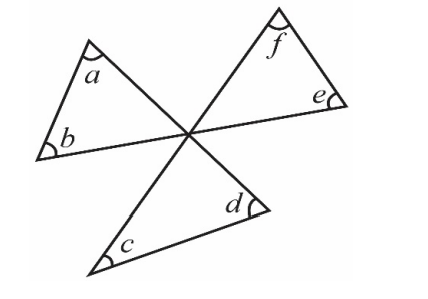
In the adjoining figure, the sum of the measures of the angles $a, b, c, d, e, f$ is $\rule{2cm}{0.2mm}$.

Problem 23

A basket contains apples, bananas, and oranges. The total number of apples and bananas is 88 . The total number of apples and oranges is 80 . The total number of bananas and oranges is 64 . Then the number of apples is $\rule{2cm}{0.2mm}$.

Problem 24

ABC is an isosceles triangle in which $\mathrm{AB}=\mathrm{AC}$ EDF is an isosceles triangle in which $\mathrm{EF}=\mathrm{DE}$. FD is parallel to AC . The degree measure of marked angle $x$ is $\rule{2cm}{0.2mm}$.

Problem 25

The length and breadth of a rectangle are both prime numbers, and its perimeter is 40 cm . Then the maximum possible area of the rectangle (in $\mathrm{cm}^2$ ) is $\rule{2cm}{0.2mm}$.

NSEJS (2020) - Problems & Solution

Problem 1

Gravitational collapse is the contraction of an astronomical object under its own gravity. This draws the matter inwards towards the centre of gravity. A neutron star is an example of the collapsed core of a giant star. A certain neutron star of radius 10 km is of mass \(1.5 M_{\odot}\). The acceleration due to gravity on the surface of the neutron star is nearly

(a) \(2.0 \times 10^8 \mathrm{~m} / \mathrm{s}^2\)
(b) \(2.0 \times 10^{12} \mathrm{~m} / \mathrm{s}^2\)
(c) \(2.6 \times 10^{16} \mathrm{~m} / \mathrm{s}^2\)
(d) \(2.6 \times 10^{20} \mathrm{~m} / \mathrm{s}^2\)

Problem 2

The tympanic membrane (ear drum) is a very delicate component of the human ear. Typically, its diameter is 1 cm . The maximum force the ear can withstand is 2.5 N . In case a diver has to enter sea water of density \(1.05 \times 10^3 \mathrm{~kg} / \mathrm{m}^3\) without any protective gear, the maximum safe depth for the diver to go into water is about

(a) 12 m
(b) 9 m
(c) 3 m
(d) 1.5 m

Problem 3

Two illuminated point objects \(\mathrm{O}_1\) and \(\mathrm{O}_2\) are placed at a distance 24 cm from each other along the principal axis of a thin convex lens of focal length 9 cm such that images of both the objects are formed at the same position. Then the respective distances of the lens from \(\mathrm{O}_1\) and \(\mathrm{O}_2\) (in cm ) are

(a) 12 and 12
(b) 18 and 6
(c) 14 and 10
(d) 16 and 8

Problem 4

A nuclear reactor is working at \(30 \%\) efficiency (i.e. conversion of nuclear energy to electrical energy). In this reactor \({ }_{92}^{235} \mathrm{U}\) nucleus undergoes fission and releases 200 MeV energy per atom. If 1000 kW of electrical power is obtained in this reactor, then the number of atoms disintegrated (undergone fission) per second in the reactor is

(a) \(1.04 \times 10^{17}\)
(b) \(6.5 \times 10^{12}\)
(c) \(3.125 \times 10^{12}\)
(d) \(3.25 \times 10^{32}\)

Problem 5

Two blocks A and B are in contact with each other and are placed on a frictionless horizontal surface. A force of 90 N is applied horizontally on block A (situation I) and the same force is applied horizontally on block B (situation II). Mass of A is 20 kg and B is 10 kg . Then the correct statement is

(a) Since both the blocks are in contact, magnitude of force by block A on B will be 90 N (situation I) and magnitude of force by block B on A will also be 90 N (situation II).
(b) Magnitude of force by block A on B is 30 N (situation I ) and magnitude of force by block B on A is 60 N (situation II).
(c) Magnitude of force by block A on B is 60 N (situation I ) and magnitude of force by block B on A is 30 N (situation II).
(d) The 90 N force will produce acceleration of different magnitudes in A and B .

Problem 6

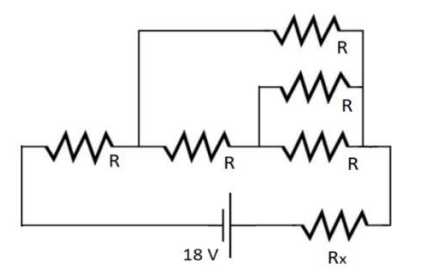
In the adjoining circuit, \(R=5 \Omega\). It is desired that the voltage across \(R_x\) should be 6 V , then the value of \(R_x\) should be

(a) \(4 \Omega\)
(b) \(12 \Omega\)
(c) \(16 \Omega\)
(d) \(20 \Omega\)

Problem 7

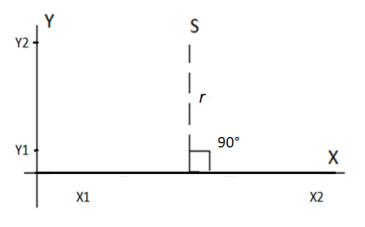
An infinitely long conductor when carrying current (I), produces a magnetic field (B) around it. If such a conductor is placed along the X-axis, then the magnitude of (B) at a distance (r) is given by the relation \(B=\frac{\mu_0}{4 \pi} \frac{2 I}{r}\), (where \(\frac{\mu_0}{4 \pi}=10^{-7} \mathrm{NA}^{-2}\) is a constant). The following figure shows such an infinitely long conductor placed along X -axis carrying current (I) and (B) at (S) is \(2 \times 10^{-4} \mathrm{~T}\), directed into the plane of the paper at S. Given \(r=1 \mathrm{~cm}\). Then, the correct statements are

(a) \(I=10 \mathrm{~A}\)
(b) The number of electrons transported across the cross section of the conductor during time 1 s is \(6.25 \times 10^{19}\)
(c) The direction of current (I) is from \(X_2\) to \(X_1\).
(d) The electrons will flow in the direction \(\mathrm{X}_2\) to \(\mathrm{X}_1\).

Problem 8

The ratio of the charge of an ion or subatomic particle to its mass \((q / m)\) is called specific charge. Then the correct options are

(a) SI unit of specific charge can be written as \(\mathrm{A} \cdot \mathrm{s} / \mathrm{kg}\).
(b) If all the isotopes of hydrogen are ionized then tritium will have least specific charge among them.
(c) specific charge of an \(\alpha\)-particle will be greater than that of an electron.
(d) specific charge ratio of an electron is \(1.75 \times 10^{11} \mathrm{C} / \mathrm{kg}\).

Problem 9

A girl (G) walks into a room along the path shown by the dashed line (see figure on right). She tries to observe images of small toys numbered 1,2 , and 3 in the plane mirror on the wall. The order in which she will see images of the toys is:

(A) 3,2,1
(B) 3,2
(C) 1, 2, 3
(D) 2, 3

Problem 10

A heating element in the form of a wire with uniform circular cross sectional area has a resistance of \(310 \Omega\), and can bear a maximum current of 5.0 A . The wire can be cut into pieces of equal length. The number of pieces, arranged suitably, so as to draw maximum power when connected to a constant voltage of 220 V , is

(A) 7
(B) 8
(C) 44
(D) 62

Problem 11

Consider the following two statements
Statement \(S_1\): If you put 100 g ice at \(0^{\circ} \mathrm{C}\) and 100 g water at \(0^{\circ} \mathrm{C}\) into a freezer, which is maintained at \(-10^{\circ} \mathrm{C}\), the ice will eventually lose the lager amount of heat.
Statement \(S_2\) : At \(0^{\circ} \mathrm{C}\), water is denser than ice
Choose the correct statement among the following.

(A) Both \(S_1\)and \(S_2\) are true and \(S_2\) is the correct explanation of \(S_1\)
(B) Both \(S_1\) and \(S_2\) are true and \(S_2\) is not the correct explanation of \(S_1\)
(C) \(S_1\) is true but \(S_2\) is false
(D) \(S_1\) is false but \(S_2\) is true

Problem 12

Consider the paths of (1) Halley's Comet near the sun, and (2) an alpha particle scattered by a nucleus. In the figures below, the dots represent the Sun/Nuclei, and the curves with arrows mark the paths of the comet/alpha particle schematically.The correct statement about the trajectories is


(A) I represents trajectory for Halley's Comet and II for the scattering of alpha particles.
(B) III represents trajectory for Halley's Comet and II for the scattering of alpha particles
(C) II represents trajectory for Halley's Comet and I for scattering of alpha particles
(D) II represents trajectory for Halley's Comet and III for scattering for scattering of alpha particles.

NSEJS [2010] Problems & Solution

Problem 1

Which one of the following statements is INCORRECT?

(A) If the net force on a body is zero, its velocity is constant or zero
(B) If the net force on a body is zero, its acceleration is constant and
(C) If the velocity of a body is constant, its acceleration is zero
(D) A body may have a varying velocity yet a constant speed

Problem 2

Two forces each of magnitude (P) act on a body placed at a point (O) as shown. The force necessary to keep the body at rest is of magnitude.

(A) P along +X axis
(B) P along - X axis
(C) 2 P along +X axis
(D) P/2 along - X axis

Problem 3

Two spheres having masses 10 g and 25 g are projected horizontally from the same height with velocities \(v_1\) and \(v_2\) and they fall to the ground in time intervals \(t_1\) and \(t_2\) respectively. If the ratio \(v_1: v_2\) is \(1: 3\), the ratio \(t_1: t_2\) will be

(A) \(10: 25\)
(B) \(25: 10\)
(C) \(1: 1\)
(D) \(1: 3\)

Problem 4

The SI unit of temperature is

(A) degree Fahrenheit \( ({ }^{\circ} \mathrm{F}) \)
(B) degree Celsius \( ({ }^{\circ} \mathrm{C}) \)
(C) degree Kelvin \( ({ }^{\circ} \mathrm{K}) \)
(D) None of the above

Problem 5

A convex lens \(L_1\) forms an image of the same size as that of the object at a distance of 24 cm . If the lens \(\mathrm{L}_1\) is replaced by another convex lens \(\mathrm{L}_2\), the image formed is magnified and erect. Therefore, the focal lenght of \(L_2\) is

(A) less than 12 cm
(B) 12 cm
(C) between 12 cm and 24 cm
(D) more than 24 cm

Problem 6

A wooden ball of density \(0.8 \mathrm{~g} / \mathrm{cm}^3\) is placed in water. The ratio of the volume above the water surface to that below the water surface is

(A) 0.25
(B) 0.20
(C) 2.0
(D) 4.0

Problem 7

A stone is released from an elevator moving upwards with an acceleration (a). The acceleration of the stone after the release is

(A) (a) upwards
(B) (\(\mathrm{g}-a)\) upwards
(C) (\(\mathrm{g}-a)\) downwards
(D) g downwards

Problem 8

A converging beam of light falls on a convex mirror of radius of curvature 20 cm , the point of convergence being 10 cm behind the mirror. The image is

(A) virtual and formed 10 cm in front of the mirror
(B) real and formed in front of the mirror
(C) formed at infinity
(D) virtual and formed 10 cm behind the mirror

Problem 9

When a sound wave moves through air along (X) axis, there is a variation in density of air in this direction. The graphical representation of this variation for two sound waves A and B is as shown. Which of the following statements is correct?

(A) Frequency of A is greater than that of B
(B) Velocity of B is greater than that of A
(C) Wavelength of B is greater than that of A
(D) Loudness of A is greater than that of B

Problem 10

In the figure shown below, each of the lenses has a focal length of 10 cm. Therefore, the image formed by the combination of lenses is

(A) virtual, erect and magnified
(B) virtual, inverted and diminished
(C) virtual, erect and diminished
(D) real, erect and diminished

Problem 11

A convex mirror used as the rear view mirror of a motor vehicle has a warning written on it - 'Objective in this mirror are nearer than they appear'. The reason for this warning is that

(A) the image is diminished
(B) the image distance is less than the focal length of the mirror
(C) the image distance is less than the object distance
(D) the image distance is more than the object distance

Problem 12

A uniform wire of resistance 36 ohm is bent into a circle. A battery is connected between points (A) and (B) as shown. The effective resistance between (A) and (B) is

(A) 36 ohm
(B) 30 ohm
(C) 6 ohm
(D) 5 ohm

Problem 13

On North Pole, when the surface of sea gets frozen due to cold weather, eskimos can still fish by cutting a portion of ice at the surface to find water underneath. This is possible because water

(A) has low thermal conductivity
(B) has high specific heat
(C) has high surface tension
(D) shows anomalous behaviour

Problem 14

A, DC current flows through a vertical wire in the downward direction. For an observer looking at the wire, the direction of magnetic field at a point between him and the wire is

(A) upward
(B) to the right
(C) to the left
(D) downward

Problem 15

A number of electric bulbs of rating 220 volt, 100 watt are to be connected in parallel to a 220 volt supply. If a 5 A fuse wire is used for this arrangement to bulbs, the maximum number of bulbs that can be included in the arrangement will be

(A) 10
(B) 11
(C) 22
(D) 44

Problem 16

In the circuit given below, AB is a thick copper wire and S is a switch. When the switch is closed, the effective resistance of the circuit will be

(A) 5 ohm
(B) \(6 / 5 \mathrm{ohm}\)
(C) 3 ohm
(D) zero

Problem 17

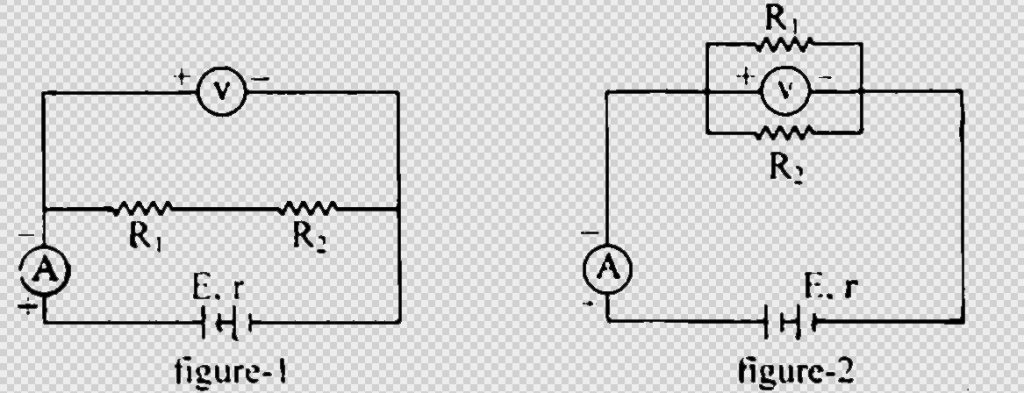
In figure (1) ammeter reads \(I_1\) and voltmeter reads \(V_1\). Similarly, in figure (2) ammeter reads \(I_2\) while voltmeter reads \(\mathrm{V}_2\). Then which of the following statements is correct?

(A) \(\mathrm{V}_1>\mathrm{V}_2\) and \(\mathrm{I}_1>\mathrm{I}_2\)
(B) \(\mathrm{V}_1>\mathrm{V}_2\) and \(\mathrm{I}_1<\mathrm{I}_2\)
(C)\(\mathrm{V}_1<\mathrm{V}_2\) and \(\mathrm{I}_1>\mathrm{I}_2\)
(D) \(\mathrm{V}_1<\mathrm{V}_2\) and \(\mathrm{I}_1<\mathrm{I}_2\)

Problem 18

The latent heat of fusion of a solid is the quantity of heat in joules required to convert

(A) 1 mg of the solid to liquid, without any change in temperature.
(B) 1 g of the solid to liquid, without any change in temperature.
(C) 100 g of the solid to liquid, without any change in temperature.
(D) 1000 g of the solid to liquid, without any change in temperature.

Problem 19

If the pressure of a given mass of a gas is reduced to half and temperature is doubled simultaneously, the volume will be-

(A) the same as above
(B) twice as before
(B) four times as before
(D) one forth as before

Problem 20

While picking up a pair of eye glasses dropped by a friend, you notice that they form an inverted image of the background and that the image is stretched horizontally as well. Your friend suffers from

(A) only myopia
(B) only hypermetropia
(C) only astigmatism
(D) hypermetropia as well as astigmatism


NSEJS – 2023 - Problems & Solution

Problem 1

Two blocks A and B of masses 1 kg and 4 kg respectively are moving with equal kinetic energies. Read the following statements \(S_1\) and \(S_2\)
Statement \(S_1\) : Ratio of speed of the block A to that of B is (1: 2)
Statement \(S_2\) : Ratio of magnitude of linear momentum of (A) to that of (B) is (1: 2)
Now choose the correct option:

(a) Both \(\mathrm{S}_1\) and \(\mathrm{S}_2\) are true
(b) Both \(\mathrm{S}_1\) and \(\mathrm{S}_2\) are false
(c) \(S_1\) is true, \(S_2\) is false
(d) \(\mathrm{S}_1\) is false, \(\mathrm{S}_2\) is true

Problem 2

The mass of a straight copper wire is 20.95 g and its electrical resistance is \(0.065 \Omega\). If the density and resistivity of copper are \(\mathrm{d}=8900 \mathrm{~kg} / \mathrm{m}^3\) and \(\rho=1.7 \times 10^{-8}\) ohm-meter respectively, the length of the copper wire is

(a) 3 m
(b) 6 m
(c) 12 m
(d) date is insufficient

Problem 3

It is known that the speed of sound in a gas is directly proportional to square root of its absolute temperature T measured in Kelvin i.e. \(v \propto \sqrt{T}\) Speed of sound in air at \(0^{\circ} \mathrm{C}\) is \(332 \mathrm{~m} / \mathrm{s}\). On a hot day, the speed of sound was measured \(360 \mathrm{~m} / \mathrm{s}\) in NCR Delhi, the temperature of air in Delhi on that very day must have been close to

(a) \(40^{\circ} \mathrm{C}\)
(b) \(42^{\circ} \mathrm{C}\)
(c) \(44^{\circ} \mathrm{C}\)
(d) \(48^{\circ} \mathrm{C}\)

Problem 4

A small bar magnet is allowed to fall vertically through a metal ring lying in a horizontal plane. During its fall, the acceleration of the magnet in the region close to the ring must be ( g is the acceleration due to gravity)

(a) equal to (g)
(b) less than (g) and uniform
(c) less than g and non-uniform
(d) greater than (g) and uniform

Problem 5

A U-tube of uniform cross section contains two different liquids in its limbs namely water (density \(1.0 \times 10^3 \mathrm{~kg} / \mathrm{m}^3) \) and Mercury (density \(13.6 \times 10^3 \mathrm{~kg} / \mathrm{m}^3) \) as shown in figure. The difference of height of mercury column in two limbs of the tube is \(\mathrm{H}=1.5 \mathrm{~cm}\). The height h of the water column in the left limb above the Mercury column must be nearly (Neglect surface tension effects)

(a) 13.6 cm
(b) 20.4 cm
(c) 27.0 cm
(d) 9.0 cm

Problem 6

An object pin is placed at a distance 10 cm from first focus of a thin convex lens on its principal axis, the lens forms a real and inverted image of this object pin at a distance 40 cm beyond the second focus. The focal length of the lens is

(a) 16 cm
(b) 20 cm
(c) 25 cm
(d) 40 cm

Problem 7

A bullet of mass 0.25 kg moving horizontally with velocity \(v(\mathrm{~m} / \mathrm{s})\) strikes a stationary block of mass 1.00 kg suspended by a long inextensible string of negligible mass and length \(\ell\). The bullet gets embedded in the block and the system rises up to maximum height \(\mathrm{h}=19.6 \mathrm{~cm}\) (as shown in the figure. The string still remains taut). The value of initial speed (v) of the bullet is

(a) \(5.9 \mathrm{~m} / \mathrm{s}\)
(b) \(7.8 \mathrm{~m} / \mathrm{s}\)
(c) \(9.8 \mathrm{~m} / \mathrm{s}\)
(d) \(11.8 \mathrm{~m} / \mathrm{s}\)

Problem 8

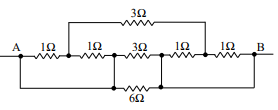
The equivalent resistance between points A and B in the following electrical network is

(a) \(\frac{3}{4} \Omega\)
(b) \(\frac{4}{3} \Omega\)
(c) \(\frac{2}{5} \Omega\)
(d) \(\frac{9}{14} \Omega\)

Problem 9

The order of magnitude of the pressure (in pascal) exerted by an adult human on the Earth when he stands bare footed on the Earth on both of his legs, is

(a) \(10^2\)
(b) \(10^4\)
(c) \(10^7\)
(d) \(10^9\)

Problem 10

On the board of an experiment, three bulbs \(\mathrm{B}_1(100 \mathrm{~W}, 200 \mathrm{~V})\), \(\mathrm{B}_2(60 \mathrm{~W}, 200 \mathrm{~V})\) and \(\mathrm{B}_3(40 \mathrm{~W}, 200 \mathrm{~V})\) are connected to a 200 V fluctuating supply with a fuse in series as shown in the figure. The electric current rating of the fuse required in the circuit to protect all the three bulbs must be

(a) 0.2 Amp
(b) 0.3 Amp
(c) 0.5 Amp
(d) 1.0 Amp

Problem 11

An ant is sitting on the principal axis of a convex mirror of focal length (f), at a distance (2 f) from the pole in front of the mirror. It starts moving on principal axis towards the mirror. During the course of motion, the distance between the ant and its image

(a) throughout increases
(b) throughout decreases
(c) first increases, then decreases
(d) first decreases, then increases

Problem 12

You are given three resistance of values \(2 \Omega, 4 \Omega\) and \(6 \Omega\). Which of the following values of equivalent resistance is not possible to get by using/arranging these three resistors in any circuit?

(a) Less than \(2 \Omega\)
(b) Equal to \(4.4 \Omega\)
(c) Equal to \(5.5 \Omega\)
(d) Equal to \(7.6 \Omega\)

Problem 13

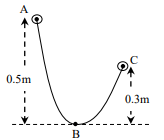
ABC is a 0.8 meter long curved wire track in a vertical plane. A bead of mass 3 g is released from rest at A . It slides along the wire and comes to rest at C . The average frictional force opposing the motion in a single trip from A to C is

(a) \(18.40 \times 10^{-3} \mathrm{~N}\)
(b) \(29.4 \times 10^{-3} \mathrm{~N}\)
(c) \(11.04 \times 10^{-3} \mathrm{~N}\)
(d) \(7.36 \times 10^{-3} \mathrm{~N}\)

Problem 14

Two long straight conductors 1 and 2 , carrying parallel currents \(I_1\) and \(I_2\) in the same direction, are lying parallel and close to each other, as shown in the figure. \(F_e\) and \(F_m\) respectively represent the electric and the magnetic forces, applied by conductor 1 on conductor 2. Choose the correct alternative regarding nature of \(\mathrm{F_e}\) and \(\mathrm{F_m}\)

(a) \(\mathrm{F_e}\) is repulsive while \(\mathrm{F_m}\) is attractive
(b) \(\mathrm{F_e}\) is repulsive and \(\mathrm{F_m}\) is repulsive too
(c) \(F_e\) is zero and \(F_m\) is repulsive
(d) \(\mathrm{F_e}\) is zero and \(\mathrm{F_m}\) is attractive

Problem 15

A doctor measures the temperature of a patient by a digital thermometer as \(37.3^{\circ} \mathrm{C}\). As a Physics student you will record his temperature in Kelvin as

(a) 310.30 K
(b) 310.45 K
(c) 310.46 K
(d) 310.31 K

Problem 16

Two planets \(P_1\) and \(P_2\) are moving around the Sun, in circular orbits of radii \(10^{13} \mathrm{~m}\) and \(10^{12} \mathrm{~m}\) respectively. The ratio of the orbital speeds of planets \(P_1\) and \(P_2\) in their respective orbits is

(a) \(\sqrt{10}\)
(b) 10
(c) \(10 \sqrt{10}\)
(d) \(\frac{1}{\sqrt{10}}\)

Problem 17

Crane A and crane B take 1 minute and 2 minute respectively to lift a car of mass 2 ton ( 2000 kg ) upward through a vertical height \(\mathrm{h}=3\) meter. If the efficiencies of the engines (defined as the ratio of work output to fuel energy input) of both the cranes are equal, your inference is that


(a) the power supplied by crane B is 1000 kW
(b) the crane A and the crane B consume equal amount of fuel
(c) the power supplied by crane A is more than the power supplied by crane B
(d) the crane A consumes more fuel in lifting the car than the crane B

Problem 18

Two tungsten filament bulbs with rating 100 watt, 200 volt and 60 watt, 200 volt are connected in series with a variable supply of \(0-400 \mathrm{~V}\) range, as shown. The supply voltage is gradually increased from 0 to 400 V . Choose the correct statement(s).

(a) When supply voltage is 200 volt, 60 W bulb glows brighter
(b) When supply voltage is 200 volt, total power dissipated in both the bulbs is greater than 37.5 W
(c) When the supply voltage is 400 V , the 100 W bulb gets fused
(d) When supply voltage becomes 400 V , none of the bulbs glow

Problem 19

A solid sphere of radius \(R=10 \mathrm{~cm}\) floats in water with \(60 \%\) of its volume submerged. In an oil, this sphere floats with \(80 \%\) of its volume submerged. If the density of water is \(1000 \mathrm{~kg} / \mathrm{m}^3\). The correct statement(s) is/are that

(a) the density of the material of sphere is \(600 \mathrm{~kg} / \mathrm{m}^3\)
(b) the density of the oil is \(750 \mathrm{~kg} / \mathrm{m}^3\)
(c) the weight of the sphere in air is close to 24.64 N
(d) the loss in weight of the sphere when floating in oil is close to 30.82 N

Problem 20

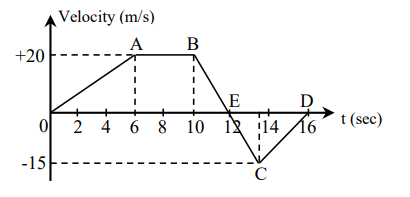
A particle starts moving from origin O along (x) axis. The velocity-time graph of motion of particle is given below. The positive values of (v) refer to direction of motion along (+x) axis, the negative values of (v) refer to direction of motion along (-x) direction. Choose the correct statement(s).

(a) Initial acceleration of the particle is \(4 \mathrm{~m} / \mathrm{s}^2\)
(b) The displacement of particle from origin is 130 m after 16 second
(c) Average speed of the moving particle during (0-16) second is \(11.88 \mathrm{~m} / \mathrm{s}\)
(d) Somewhere during the motion for (0-16) second, the retardation of the particle is \(10 \mathrm{~m} / \mathrm{s}^2\)

Indian National Mathematical Olympiad (INMO) 2025 Problem and Solution

The Indian National Mathematical Olympiad (INMO) is the third level of Math Olympiad in India.

Problem 1

Consider the sequence defined by $a_1=2, a_2=3$, and

$$ a_{2 k+2}=2+a_k+a_{k+1} \quad $$

$$ and \quad a_{2 k+1}=2+2 a_k $$

for all integers $k \geqslant 1$. Determine all positive integers $n$ such that $\frac{a_n}{n}$ is an integer.

Problem 2

Let $n \geq 2$ be a positive integer. The integers $1,2, \cdots, n$ are written on a board. In a move, Alice can pick two integers written on the board $a \neq b$ such that $a+b$ is an even number, erase both $a$ and $b$ from the board and write the number $\frac{a+b}{2}$ on the board instead. Find all $n$ for which Alice can make a sequence of moves so that she ends up with only one number remaining on the board.
Note. When $n=3$, Alice changes $(1,2,3)$ to $(2,2)$ and can't make any further moves.

Problem 3

Euclid has a tool called splitter which can only do the following two types of operations:

Suppose Euclid is only given three non-collinear marked points $A, B, C$ in the plane. Prove that Euclid can use the splitter several times to draw the centre of the circle passing through $A, B$, and $C$.

Problem 4

Let $n \geqslant 3$ be a positive integer. Find the largest real number $t_n$ as a function of $n$ such that the inequality

$$
\max \left(\left|a_1+a_2\right|,\left|a_2+a_3\right|, \ldots,\left|a_{n-1}+a_n\right|,\left|a_n+a_1\right|\right)$$

$$ \geqslant t_n \cdot \max \left(\left|a_1\right|,\left|a_2\right|, \cdots,\left|a_n\right|\right)
$$

holds for all real numbers $a_1, a_2, \cdots, a_n$.

Problem 5

Greedy goblin Griphook has a regular 2000 -gon, whose every vertex has a single coin. In a move, he chooses a vertex, removes one coin each from the two adjacent vertices, and adds one coin to the chosen vertex, keeping the remaining coin for himself. He can only make such a move if both adjacent vertices have at least one coin. Griphook stops only when he cannot make any more moves. What is the maximum and minimum number of coins that he could have collected?

Problem 6

Let $b \geqslant 2$ be a positive integer. Anu has an infinite collection of notes with exactly $b-1$ copies of a note worth $b^k-1$ rupees, for every integer $k \geqslant 1$. A positive integer $n$ is called payable if Anu can pay exactly $n^2+1$ rupees by using some collection of her notes. Prove that if there is a payable number, there are infinitely many payable numbers.

Exploring Number Theory: Understand Euclidean Algorithm with IMO 1959 Problem 1

Number Theory is one of the most fascinating and ancient branches of mathematics. In this post, we'll delve into a classic problem from the International Mathematical Olympiad (IMO) 1959, exploring fundamental concepts such as divisibility, greatest common divisors (gcd), and the Euclidean algorithm. This will serve as a strong foundation for understanding more advanced topics in Number Theory.

The Problem: Prove Irreducibility of a Fraction

The problem asks us to prove that the fraction:

$\frac{21 n+4}{14 n+3}$

is irreducible for every natural number $n$. In other words, we need to show that the greatest common divisor (gcd) of the numerator $21 n+4$ and the denominator $14 n+3$ is always 1, meaning these two terms share no common factors for any natural number $n$.

What Does "Irreducible" Mean?

A fraction is irreducible if its numerator and denominator share no common factors other than 1. For example, the fraction $\frac{10}{14}$ is reducible because both 10 and 14 share the factor 2. After dividing both by their gcd (2), we get $\frac{5}{7}$, which is the irreducible form of $\frac{10}{14}$.
In this problem, we're asked to show that no matter which $n$ is chosen, the fraction $\frac{21 n+4}{14 n+3}$ cannot be reduced, meaning the gcd of $21 n+4$ and $14 n+3$ is 1 for all $n$.

Watch the Video

Key Idea: GCD and the Euclidean Algorithm

To solve this, we can use the Euclidean algorithm, a systematic method for finding the gcd of two numbers by repeatedly applying the division lemma. Let's walk through the key steps to understand the solution.

Step 1: Division Lemma

The division lemma states that for any two integers $a$ and $b$, there exist integers $q$ and $r$ such that:

$$
b=a q+r
$$

where $r$ is the remainder when $b$ is divided by $a$. This allows us to express any number as a multiple of another, plus a remainder.

Step 2: Applying the Euclidean Algorithm

We want to compute the gcd of $21 n+4$ and $14 n+3$ by performing successive subtractions, which is at the heart of the Euclidean algorithm.

First, compute the difference between the numerator and the denominator:

$$
(21 n+4)-(14 n+3)=7 n+1
$$

So, we now need to find the gcd of $14 n+3$ and $7 n+1$. Applying the Euclidean algorithm again:

$$
(14 n+3)-2(7 n+1)=1
$$

Now, we see that the gcd of $7 n+1$ and 1 is clearly 1 . Hence, the gcd of $21 n+4$ and $14 n+3$ is also 1 . This confirms that the fraction is irreducible for any $n$.

Why This Problem Matters

This problem provides a beautiful introduction to Number Theory by illustrating how simple concepts like gcd, divisibility, and the Euclidean algorithm can be used to solve complex problems. It opens the door to deeper explorations into prime numbers, modular arithmetic, and advanced number-theoretic functions.

The Power of Number Theory

The IMO 1959 problem showcases the elegance and depth of Number Theory. By understanding the fundamental ideas of gcd and using the Euclidean algorithm, we can solve challenging problems and gain a deeper appreciation for the mathematical structures that govern numbers.

For those interested in diving deeper, there are excellent resources and courses available online to further explore Number Theory. Whether you're preparing for mathematical competitions or simply want to expand your knowledge, mastering these basic ideas will provide a strong foundation for future mathematical adventures.