Australian Mathematics Competition - 2013 - Junior years - Grade 7 & 8 - Questions and Solutions

Problem 1:

\(1999+24\) is equal to
(A) 1923
(B) 2003
(C) 2013
(D) 2023
(E) 2113

Problem 2:

\(P Q R\) is a straight line. Find the value of \(x\).

(A) 40
(B) 90
(C) 100
(D) 110
(E) 120

Problem 3:

The value of the fraction \(\frac{1}{2}\) is closest to
(A) 0.45
(B) 0.6
(C) \(\frac{1}{3}\)
(D) \(\frac{5}{8}\)
(E) \(\frac{2}{5}\)

Problem 4:

Which of the following is equal to 20 ?
(A) \(3+2 \times 4\)
(B) \((9+5) \times 2-4 \times 2\)
(C) \(10^2\)
(D) \(20+20 \div 2\)
(E) \(10 \div 2\)

Problem 5:

How many minutes are there between \(8: 37 \mathrm{am}\) and \(10: 16 \mathrm{am}\) ?
(A) 39
(B) 79
(C) 99
(D) 141
(E) 179

Problem 6:

Three squares each with an area of \(25 \mathrm{~cm}^2\) are placed side by side to form a rectangle. The perimeter, in centimetres, of the rectangle is
(A) 20
(B) 36
(C) 40
(D) 75
(E) 100

Problem 7:

If every digit of a whole number is either a 3 or a 5 , the number will always be
(A) divisible by 3
(B) divisible by 5
(C) prime
(D) even
(E) odd

Problem 8:

(P) is the point at 0.56 and \(Q\) is the point at 1.2 on a number line. The point which is halfway between \(P\) and \(Q\) is at
(A) 0.34
(B) 0.64
(C) 0.83
(D) 0.88
(E) 0.93

Problem 9:

If triangle \(A B C\) is isosceles with \(\angle A=40^{\circ}\), what are all of the possible values for \(\angle B\) ?
(A) \(40^{\circ}\)
(B) \(40^{\circ}\) and \(70^{\circ}\)
(C) \(40^{\circ}\) and \(100^{\circ}\)
(D) \(70^{\circ}\) and \(100^{\circ}\)
(E) \(40^{\circ}, 70^{\circ}\) and \(100^{\circ}\)

Problem 10:

In Gwen's classroom, the desks are arranged in a grid. Each row has the same number of desks. Gwen's desk is third from the front, second from the back and has one desk to the left and four to the right. How many desks are there?
(A) 20
(B) 24
(C) 25
(D) 28
(E) 30

Problem 11:

William travels to school in two different ways. Either he walks to school and takes the bus home, or he takes the bus to school and walks home. In each case his total travelling time is 40 minutes. If he were to take the bus both ways, his total travelling time would be 20 minutes. How many minutes would it take if he walked both ways?
(A) 30
(B) 40
(C) 50
(D) 60
(E) 80

Problem 12:

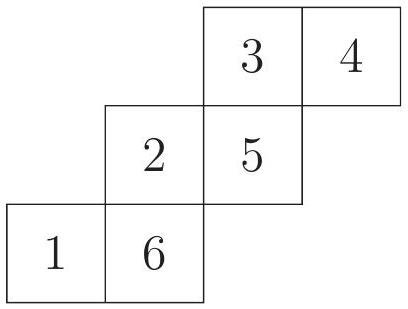
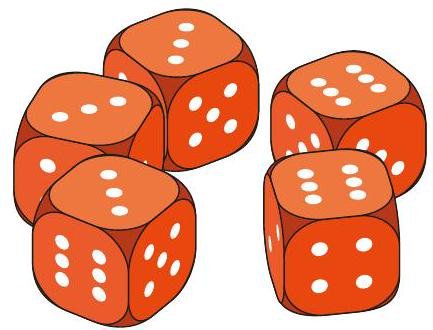
The opposite faces on a standard dice add to give a total of 7. The game of Corners is played by rolling a dice and then choosing a vertex of the dice with your eyes closed. For example, the score for the vertex chosen below would be \(4+5+6=15\).

Which of the following scores is NOT possible when playing Corners?
(A) 6
(B) 7
(C) 8
(D) 9
(E) 10

Problem 13:

A piece of paper in the shape of an equilateral triangle has one corner folded over, as shown.

What is the value of \(x\) ?
(A) 60
(B) 70
(C) 80
(D) 90
(E) 100

Problem 14:

Beginning at the point \(A\), Joel draws the spiral pattern of line segments below on a 1 cm grid. If he continues this pattern, how long, in centimetres, is the 97 th segment?

(A) 46
(B) 47
(C) 48
(D) 49
(E) 50

Problem 15:

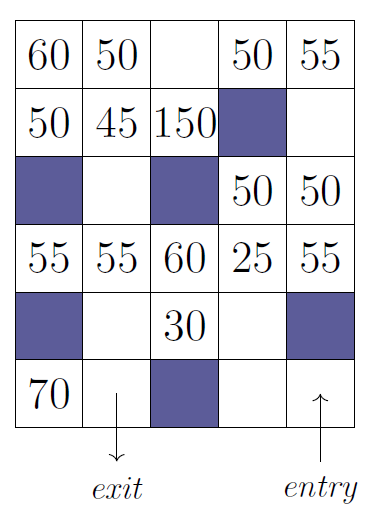
Sixteen discs are arranged in four rows of four. The discs have a number on one side and are either red or green on the other. The number shows how many discs touching that disc have green on the other side.

Which of the following statements is true?
(A) All of the rows have the same number of green discs.
(B) Row one has more green discs than any other row.
(C) Row two has more green discs than any other row.
(D) Row three has fewer green discs than any other row.
(E) Row four has fewer green discs than any other row.

Problem 16:

While shopping this week I misread my shopping list and bought 5 loaves of bread and 2 bottles of milk. So I went back to the supermarket, got a full refund, and bought 2 loaves of bread and 5 bottles of milk. This cost me \(\$ 4.20\) less than my first purchase. How do the prices of bread and milk compare?
(A) A loaf of bread costs \(\$ 1.40\) more than a bottle of milk.
(B) A loaf of bread costs \(\$ 0.60\) more than a bottle of milk.
(C) A loaf of bread costs \(\$ 0.42\) more than a bottle of milk.
(D) A loaf of bread costs \(\$ 0.60\) less than a bottle of milk.
(E) A loaf of bread costs \(\$ 1.40\) less than a bottle of milk.

Problem 17:

Starting with the number 0 on my calculator, I do a calculation in five steps. At each step, I either add 1 or multiply by 2 . What is the smallest number that cannot be the final result?
(A) 11
(B) 10
(C) 9
(D) 8
(E) 7

Problem 18:

The three squares in the figure below are the same size. Find the value, in degrees, of \(\angle A M T\).

(A) \(45^{\circ}\)
(B) \(50^{\circ}\)
(C) \(55^{\circ}\)
(D) \(60^{\circ}\)
(E) \(75^{\circ}\)

Problem 19:

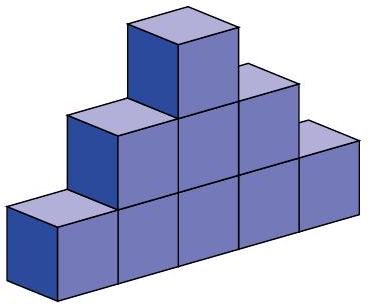
Eight \(1 \times 1\) square tiles are laid as shown.

Two more \(1 \times 1\) tiles are added, so that at least one side of each new tile is shared with a side of the original shape. Several different perimeter lengths are now possible. What is the sum of the shortest and longest possible perimeter of the modified shape?
(A) 28
(B) 30
(C) 32
(D) 34
(E) 36

Problem 20:

In the triangle \(P Q R, S\) is a point on \(P R\) such that \(P Q S\) and \(S Q R\) are both isosceles triangles (as shown). Angle \(Q P S\) is equal to angle \(S Q R\).

What is the value of \(x\) ?
(A) 30
(B) 36
(C) 40
(D) 45
(E) 48

Problem 21:

A biologist has a set of cages in a \(4 \times 4\) array. He wants to put one mouse (black or white) into each cage in such a way that each mouse has at least one neighbour of each colour (neighbouring cages share a common wall).

The black mice are more expensive, so he wants to use as few of them as possible. What is the smallest number of black mice that he needs?
(A) 4
(B) 5
(C) 6
(D) 7
(E) 8

Problem 22:

Two discs have different numbers on each side as shown.

The discs are flipped and they land on a table. The two numbers on the sides that are showing are added. If the possible sums that can be obtained in this way are \(8,9,10\) and 11 , the sum \(b+c+d\) is
(A) 8
(B) 18
(C) 20
(D) 27
(E) 30

Problem 23:

An oddie number is a 3 -digit number with all three digits odd. The number of oddie numbers divisible by 3 is
(A) 20
(B) 26
(C) 29
(D) 41
(E) 42

Problem 24:

Consider the following \(4 \times 4\) squares with a \(1 \times 1\) square deleted \(shown in black\).

Consider tiling the squares \(\mathrm{P}, \mathrm{Q}\) and R using tiles like the one below.

Which of the following statements is true?
(A) Only P can be tiled this way.
(B) Only Q can be tiled this way.
(C) Only R can be tiled this way.
(D) Only P and Q can be tiled this way.
(E) All the shapes can be tiled this way.

Problem 25:

A number is formed by writing the numbers 1 to 30 in order as shown.

\[
\text { 12345678910111213……… } 2930
\]

Simeon removed 45 of these 51 digits leaving 6 in their original order to make the largest 6-digit number possible. What is the sum of the digits of this number?
(A) 33
(B) 38
(C) 41
(D) 43
(E) 51

Problem 26:

Consider a sequence of letters where each letter is \(A\) or \(B\). We call the sequence stable if, when we tally the number of \(A\) s and the number of \(B \mathrm{~s}\) in the sequence, working from left to right, the difference is never greater than one. For example, the sequence \(A B B A B A\) is stable but the sequence \(A A B B A B\) is not, because after counting the first two letters, the difference is two. How many stable sequences with eighteen letters are there?

Problem 27:

Whenever Callum reads a date like \(1 / 8 / 2013\), he incorrectly interprets it as two divisions, with the second one evaluated before the first one:

\[
1 \div(8 \div 2013)=251 \frac{5}{8}
\]

For some dates, like this one, he does not get an integer, while for others, like \(28 / 7 / 2013\), he gets \(28 \div(7 \div 2013)=8052\), an integer. How many dates this year \(day/month/year\) give him an integer?

Problem 28:

What is the smallest positive integer that can be expressed as the sum of nine consecutive integers, the sum of ten consecutive integers and the sum of eleven consecutive integers?

Problem 29:

Each of the four circles below has a whole number value. \(X\) is the value of the top-left circle. A number written on the figure indicates the product of the values of the circles it lies within. What is the value of \(X+k\) ?

Problem 30:

Three different non-zero digits are used to form six different 3-digit numbers. The sum of five of them is 3231 . What is the sixth number?

Australian Mathematics Competition - 2023 - Middle Primary - Grade 3 & 4 - Questions and Solutions

Problem 1:

What is the total number of petals on all 5 flowers?
(A) 10
(B) 15
(C) 20
(D) 25
(E) 50

Problem 2:

\[
2+3+7+8=
\]

(A) 10
(B) 20
(C) 30
(D) 40
(E) 50

Problem 3:

Which one of these shapes is a rectangle?

Problem 4:

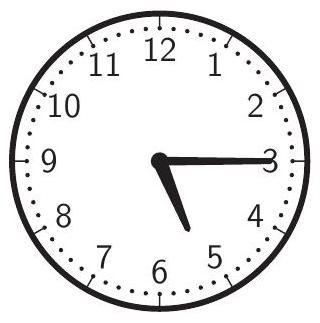
Which digital clock time matches the time shown on the clock face?

Problem 5:

Emma has a bag containing 5 red, 4 yellow, 1 black and 2 blue buttons. When she chooses 1 button at random, what colour is it most likely to be?
(A) green
(B) blue
(C) black
(D) yellow
(E) red

Problem 6:

What fraction of the circle is part A ?


(A) one-half
(B) one-third
(C) two-thirds
(D) one-quarter
(E) three-quarters

Problem 7:

In a board game, Nik rolls three standard dice, one at a time. He needs his three rolls to add to 12.
His first two dice rolls are 5 and 3 . What does he need his third roll to be?


(A) 2
(B) 3
(C) 4
(D) 5
(E) 6

Problem 8:

Which shape has only one line of symmetry?

Problem 9:

Anastasia Ant is on a sheet of wire mesh with 10 cm squares. She can only move along the wires. She moves 10 cm east, then 30 cm north and 20 cm west. What is the least possible distance she needs to move to return to her starting point?

(A) 10 cm
(B) 20 cm
(C) 30 cm
(D) 40 cm
(E) 50 cm

Problem 10:

A piece of card is cut out and labelled as shown in the diagram. It is folded along the dotted lines to make a box without a top. Which letter is on the bottom of the box?
(A) A
(B) B
(C) C
(D) D
(E) E

Problem 11:

Jiang is threading beads onto a string to make a necklace. He decides to use a sequence, starting with a red bead, then a yellow bead and a blue bead. He repeats this pattern until he has 20 beads on the necklace.
How many red beads will he use?

(A) 5
(B) 6
(C) 7
(D) 8
(E) 9

Problem 12:

How many people played tennis on the busiest day of the week at the Paradise North Tennis Club?
(A) 45
(B) 50
(C) 55
(D) 60
(E) 65

Problem 13:

When this puzzle is complete, each of the four lines will add up to 14 . What will the four missing numbers add to?
(A) 10
(B) 14
(C) 15
(D) 16
(E) 18

Problem 14:

Which one of the following could give an answer of \(25 ?\)
(A) an odd number plus an odd number
(B) an even number multiplied by an even number
(C) an even number divided by an odd number
(D) an odd number minus an even number
(E) an even number multiplied by an odd number

Problem 15:

This bottle holds 4 glasses of water.

Which one of the following holds the most water?

Problem 16:

Fido needs to be weighed at the vet, but he won't sit still. So the vet weighs himself and then weighs himself holding Fido.

How much does Fido weigh?
(A) 23 kg
(B) 26 kg
(C) 28 kg
(D) 30 kg
(E) 32 kg

Problem 17:

Grandma adds 3 spoons of sugar to the juice of 10 lemons to make lemonade. How many lemons are needed if 15 spoons of sugar are used to make Grandma's recipe?
(A) 20
(B) 22
(C) 25
(D) 30
(E) 50

Problem 18:

Janus is making patterns using square tiles.
Each pattern is made by copying the previous pattern, then adding new tiles around the outside edges.
The new tiles alternate in colours, as shown.

What will be the total number of tiles in Pattern 5?
(A) 25
(B) 33
(C) 37
(D) 40
(E) 41

Problem 19:

My laptop's battery meter tells me what fraction of the battery charge is left. I used the laptop for 4 hours and 20 minutes and it went from

What would the reading be after using the laptop for another 130 minutes?

Problem 20:

Syed's mother had some money to share with her family.
She gave one-quarter of her money to Syed.
Then she gave one-third of what was left to Ahmed.
Then she gave one-half of what was left to Raiyan.
She was left with \(\$ 15\), which she kept for herself.
How much money did Syed's mother have to start with?
(A) \(\$ 30\)
(B) \(\$ 45\)
(C) \(\$ 60\)
(D) \(\$ 90\)
(E) \(\$ 120\)

Problem 21:

In 2023, Janine's birthday is on a Thursday. Ngoc's birthday is one month later, meaning that it is on the same day-number in the next month. Ngoc's birthday is not on a Saturday or a Sunday. Which day of the week is Ngoc's birthday?
(A) Monday
(B) Tuesday
(C) Wednesday
(D) Thursday
(E) Friday

Problem 22:

Sally empties her piggy bank to see how much she has saved. She has 20 coins altogether and the total value of her coins is (\$ 3.80). She notices that she has twice as many 50 c coins as 20 c coins. The remaining coins are 10c coins. How many 10c coins does she have?
(A) 2
(B) 4
(C) 8
(D) 11
(E) 14

Problem 23:

Three different numbers from 1 to 20 are chosen. They add to 20 . Two of the numbers are 2 apart. How many possibilities are there for the largest number?
(A) 6
(B) 7
(C) 8
(D) 9
(E) 10

Problem 24:

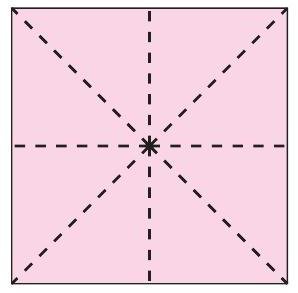
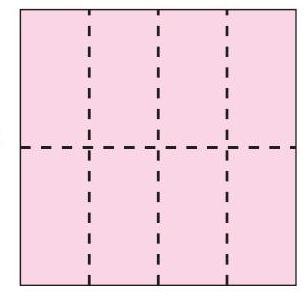
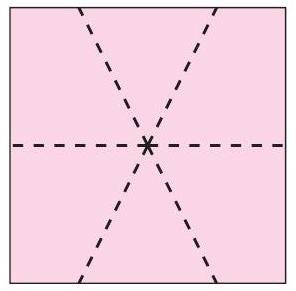
Estelle is making decorations shaped like the 8-pointed star shown. She folds a square of paper to make a triangle with 8 layers as shown.

How could she cut the triangle so that the unfolded shape is the star?

Problem 25:

Tom is digging holes in his garden for his new plants. As he is working he slows down. Each new hole takes a minute longer to dig than the last hole.
The first 5 holes have taken him 35 minutes in total. How long will it take him to dig the next 2 holes?
(A) 11 minutes
(B) 17 minutes
(C) 21 minutes
(D) 24 minutes
(E) 25 minutes

Problem 26:

To unlock a security door, Daniyal enters a code on the keypad shown. To make it easy to remember:

What are the last 3 digits in Daniyal's code?

Problem 27:

In this puzzle, \(\triangle\), \(\square\) and represent different nonzero digits. What is the three-digit number \(\triangle \square \bigcirc\) ?

Problem 28:

Ollie arranges the numbers 1 to 6 to form three 2-digit numbers.
Exactly one of his numbers divides by 3 but not divides by 4 , and exactly one other divides by 4 . None of them divide by 5 .
The three numbers add to 93 .
What is the number which does not divide by either 3 or 4 ?

Problem 29:

A table in the shape of a trapezium can seat 5 people. When two tables are put together in a row, 8 people can be seated. What is the smallest number of trapezium tables required to seat 2023 people if they are all placed in a row?

Problem 30:

Yifan has a construction set consisting of red, blue and yellow rods. All rods of the same colour are the same length, but differently coloured rods are different lengths. She wants to make quadrilaterals using these rods.

What number do you get when you multiply the lengths of one red rod, one blue rod and one yellow rod?

AMC 2021 Middle Primary – Problem 22 with Solution | Australian Mathematics Competition Explained

Let's discuss a problem from the AMC 2021 Middle Primary Category: Problem 22 which revolves around puzzle.

Question


The biscuit section in a cookbook has 6 pages. The sum of all the page numbers in this section is 147 . What is the number of the last page in this section of the book?


(A) 26
(B) 27
(C) 28
(D) 29
(E) 30

Solution


To number the pages we want $6$ consecutive numbers .

Let's try to check the nearest numbers divisible by $6$.
If we multiply $6 \times 20 = 120$ which is less than the number that we have to get : $147$.

If we multiply $6\times 30 = 180$ which is more than the number that we have to get : $147$.

So the required number will be in between $20$ and $30$.
As the number is bigger than 120 so let's try to take the first number as $20$ then rest of the 5 consecutive numbers.
Adding the numbers: $20+21+22+23+24+25 = 135$. This is less than $147$.
Let's see how much less we are getting: $147 - 135 = 12$.

So, instead of starting from $20$ if we start from $22$ we will get :
$22 + 23+ 24+ 25 +26 + 27 = 147$.

So the last page number is $27$.

What is AMC (Australian Mathematics Competition)?

The Australian Mathematics Competition (AMC) is one of Australia's largest and oldest annual mathematics competitions, aimed at fostering interest and excellence in mathematics among student

Explore Panini8 Software through this video:1

AMC 2022 Middle Primary – Problem 28 with Solution | Australian Mathematics Competition Explained

Let's discuss a problem from the AMC 2022 Middle Primary Category: Problem 28 which revolves around puzzle.

Question


On a digital display, a combination of bars light up to represent each digit as shown:

In some special numbers, the number of bars which light up in the digits is the same as the sum of the digits. For example, in 373 the number of bars is (5+3+5=13) which is the equal to (3+7+3=13). What is the largest such three-digit number?

Solution


We have to find the largest three digit number who satisfies this condition.

The largest single digit number is $9$. If we find the number of bars included in it then it will be $6$. Digit $9$ has $6$ bars in it. So to make it most largest for the 2nd digit as well we will consider the digit $9$. It is also having $6$ bars. Thus digit $99$ is having $12$ bars. But if we add $9+9$ we get $18$. Thus we are still $6$ bars behind. $0$ is the digit having $6$ bars there. Thus if we consider the largest number to be $990$ and if we add the number of bars we are using that is = $6+6+6 = 18$. Also the digit sum is $9 + 9 + 0 = 18$.

Thus the largest number to be $990$.

What is AMC (Australian Mathematics Competition)?

The Australian Mathematics Competition (AMC) is one of Australia's largest and oldest annual mathematics competitions, aimed at fostering interest and excellence in mathematics among students.

Explore this video on Prime Numbers:

AMC 2021 Middle Primary – Problem 14 with Solution | Australian Mathematics Competition Explained

Let's discuss a problem from the AMC 2021 Middle Primary Category: Problem 14 which revolves around basic algebra.

Question


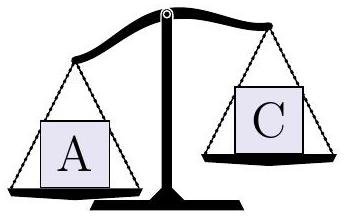
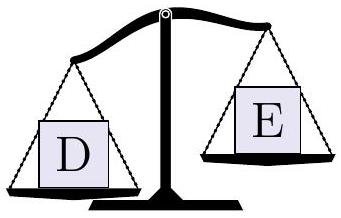
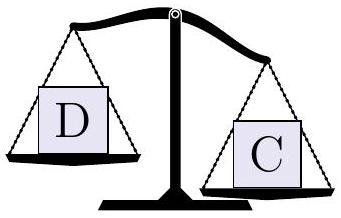
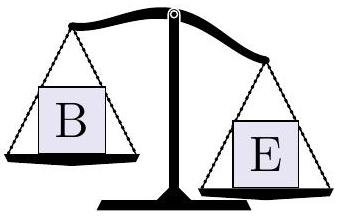
Five boxes are compared on a balance.

Which of the five boxes is lightest?

Solution


From the picture we can understand that box $C$ isd lighter than box $A$. Again box $C$ is heavier than box $D$. Thus box $C$ is not lightest.

Box $D$ is lighter than box $C$ but heavier than box $E$. So box $D$ is not lightest.

Box $E$ is lighter than box $D$ but heavier than box $B$.

Thus the relation we get is:

$A\li C \li D \li E \li B$.

Thus box $B$ is the lightest.

What is AMC (Australian Mathematics Competition)?

The Australian Mathematics Competition (AMC) is one of Australia's largest and oldest annual mathematics competitions, aimed at fostering interest and excellence in mathematics among students.

Problem 26: Australian Mathematics Competition 2021 – Middle Primary

Let's discuss a problem from the AMC 2021 Middle Primary Category: Problem 26 which revolves around basic algebra.


This is a magic square, so that all rows, columns and diagonals add up to the same sum. Some numbers are already filled in.

When we complete it and multiply the numbers in the three shaded squares, what do we get?

Solution


We know that the sum of the each row, columns and the diagonals add to the same sum.

Amc 2021

From the picture we can see apart from of the diagonals all the rows and culomns are empty in two boxes. If we add the numbers diagonally we get: $16 + 10 + 7 + 1 = 34$. Thus all the rows, columns and the diagonals will add to $34$.

Thus we check the $4th$ column we get, $x + 8 + 12 + 1 = 34$.

So, $x = 34 - (8+12+1) = 34 - 21 = 13$

If $x = 13$ then $a = 34 - (16 + 2 + 13) = 3$.

If $a = 3$ then $b = 34 - (3 + 10 + 15) = 6$.

If $b = 6$ then $z = 34 - (6 + 7 + 12) = 9$.

If $z = 9$ then $d = 34 - (16 + 9 + 4) = 5$.

If $d = 5$ then $c = 34 - (5 + 10 + 8) = 11$.

Thus the product of $a \times b \times c = 3 \times 6 \times 11 = 198$

What is AMC (Australian Mathematics Competition)?

The Australian Mathematics Competition (AMC) is one of Australia's largest and oldest annual mathematics competitions, aimed at fostering interest and excellence in mathematics among students.

Problem 20: Australian Mathematics Competition 2022 – Junior Year

Let's discuss a problem from the AMC 2022 Junior Category: Problem 20 which revolves around basic algebra.

Question

Within the square \(P Q R S\), lines are drawn from each corner to the middle of the opposite sides as shown. What fraction of \(P Q R S\) is shaded?

(A) \(\frac{1}{4}\)
(B) \(\frac{1}{3}\)
(C) \(\frac{3}{8}\)
(D) \(\frac{1}{2}\)
(E) \(\frac{2}{3}\)


Let's name all the midpoints on the lines and the other joining points.

Now if we draw a line joining the points A and C then the square will get divided into two rectangles such as :

In this picture the $\triangle PES$, the area of $\triangle PES$ is $\frac {1}{4}$ of the area of rectangle $PACS$.
As the diagonals AS and PC divide the area of rectangles $PACS$ into two equal parts.


Similarly the area of $\triangle QGR$ is also $\frac {1}{4}$ of the rectangle $AQRC$.
Now if we draw a line from $D$ to $B$ we will have the same thing over there. The area of $\triangle PFQ$ is $\frac {1}{4}$ of the rectangle $PQBD$.
The area of $\triangle QGR$ is also $\frac {1}{8}$ of the square $PQRS$.
Thus the total unshaded area is $4 \times \frac {1}{8}$ of the square $PQRS$ = $\frac {1}{2}$ of the square $PQRS$.

Thus the shaded area will also be $\frac {1}{2}$ of the square $PQRS$.

Australian Mathematics Competition - 2015 - Junior years - Grade 7 & 8 - Questions and Solutions

Problem 1:

\(2015+201.5\) equals
(A) 2036.5
(B) 2116.5
(C) 2225.5
(D) 2216.5
(E) 2115.5

Problem 2:

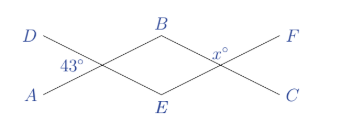
The value of \(x\) in the diagram is
(A) \(100^{\circ}\)
(B) \(130^{\circ}\)
(C) \(110^{\circ}\)
(D) \(120^{\circ}\)
(E) \(90^{\circ}\)

Problem 3:

The trip to school takes 23 minutes. I need to be at school at 9:05 am. The latest I can leave home is
(A) 8:46 am
(B) \(8: 37 \mathrm{am}\)
(C) 8:52 am
(D) 8:42 am
(E) 8:48 am

Problem 4:

What is the value of 100 twenty-cent coins?
(A) \(\$ 20\)
(B) \(\$ 10\)
(C) \(\$ 200\)
(D) \(\$ 2\)
(E) \(\$ 100\)

Problem 5:

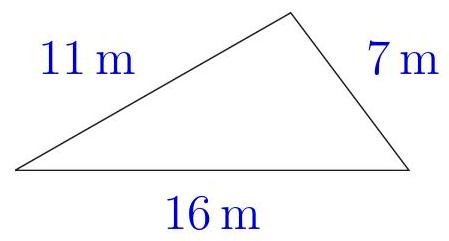
What is the area of this triangle in square centimetres?
(A) 10
(B) 12
(C) 14
(D) 7
(E) 6

Problem 6:

When the bell rang, there were 3 teachers and 6 students in the classroom. Several students arrived after the bell. Once everyone had arrived, there were 4 students for every teacher. How many students arrived after the bell?
(A) 18
(B) 12
(C) 6
(D) 3
(E) 9

Problem 7:

A movie lasts for \(2 \frac{1}{3}\) hours. The movie is shown in two equal sessions.
For how many minutes does each session last?
(A) 85
(B) 70
(C) 80
(D) 65
(E) 75

Problem 8:

Four unit squares are laid out in five different arrangements as shown below. Which one has the largest perimeter?

Problem 9:

Ari, Bryce, Cy and Eric are members of our school's basketball team. Ari is 186 cm tall. He is 14 cm taller than Bryce who in turn is 6 cm shorter than Cy. Eric is 11 cm taller than Cy . Eric's height is
(A) 183 cm
(B) 205 cm
(C) 178 cm
(D) 189 cm
(E) 177 cm

Problem 10:

Ana, Ben, Con, Dan and Eve are sitting around a table in that order. Ana calls out the number 1, then Ben calls out the number 2, then Con calls out the number 3, and so on. After a person calls out a number, the next person around the table calls out the next number.
Anyone who calls out a multiple of 7 must immediately leave the table.
Who is the last person remaining at the table?
(A) Ana
(B) Ben
(C) Con
(D) Dan
(E) Eve

Problem 11:

\(\frac{5}{19}\) of 38 is equal to
(A) 76
(B) 19
(C) \(\frac{2}{5}\)
(D) \(2 \frac{1}{2}\)
(E) 10

Problem 12:

The diagram shows a circle and a square with the same centre.
What fraction of the circle is shaded?
(A) \(\frac{5}{8}\)
(B) \(\frac{4}{7}\)
(C) \(\frac{3}{5}\)
(D) \(\frac{6}{11}\)
(E) \(\frac{2}{3}\)

Problem 13:

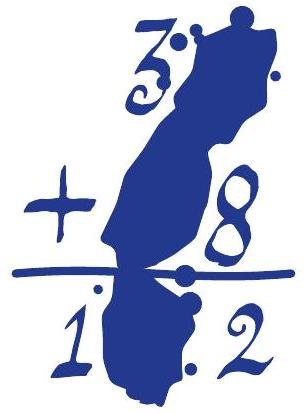
In the addition below \(x, y\) and \(z\) represent three different digits.

What is the value of \(x+y+z\) ?
(A) 9
(B) 8
(C) 10
(D) 7
(E) 6

Problem 14:

A cube has the letters \(\mathrm{A}, \mathrm{C}, \mathrm{M}, \mathrm{T}, \mathrm{H}\) and S on its six faces. Here are two views of this cube.

Which one of the following could be a third view of the same cube?

(A)

(B)

(C)

(D)

(E)

Problem 15:

Five students are to be photographed in a row with the tallest in the centre and the shortest two at the ends. If no two students are the same height, how many different arrangements are possible?
(A) 6
(B) 2
(C) 10
(D) 5
(E) 4

Problem 16:

Three boys and three girls all celebrate their birthday today, but they are each different ages. The youngest is 1 year old. The sum of the ages of the three girls is the same as the sum of the ages of the three boys. What is the smallest possible total of all six ages?
(A) 22
(B) 24
(C) 28
(D) 21
(E) 26

Problem 17:

Jenna measures three sides of a rectangle and gets a total of 80 cm . Dylan measures three sides of the same rectangle and gets a total of 88 cm . What is the perimeter of the rectangle?
(A) 112 cm
(B) 132 cm
(C) 96 cm
(D) 168 cm
(E) 156 cm

Problem 18:

Jim is running five laps of the school oval. When he is \(\frac{3}{4}\) of the way round his fourth lap, what fraction of his run has he completed?
(A) \(\frac{2}{3}\)
(B) \(\frac{1}{2}\)
(C) \(\frac{3}{4}\)
(D) \(\frac{4}{5}\)
(E) \(\frac{5}{6}\)

Problem 19:

How many two-digit numbers have the property that the sum of the digits is a perfect square?
(A) 15
(B) 18
(C) 13
(D) 19
(E) 17

Problem 20:

On this cube, opposite faces add to the same sum and all faces are prime numbers. (Note that 1 is not prime.) What is the smallest possible total of the faces which cannot be seen?
(A) 41
(B) 35
(C) 45
(D) 47
(E) 37

Problem 21:

A recipe requires 2 kg sugar, 4 kg butter, and 6 kg flour to make 8 cakes. How many cakes can you make if you have 9 kg sugar, 17 kg butter and 28 kg flour?
(A) 40
(B) 34
(C) 37
(D) 32
(E) 36

Problem 22:

Two ordinary dice are rolled. The two resulting numbers are multiplied together to create a score. The probability of rolling a score that is a multiple of six is
(A) \(\frac{1}{6}\)
(B) \(\frac{5}{12}\)
(C) \(\frac{1}{4}\)
(D) \(\frac{1}{3}\)
(E) \(\frac{1}{2}\)

Problem 23:

Jill and Jack are exercising at a beach. They both start from the car park at one end of the beach. Jill runs at a constant speed and Jack walks at a constant speed. When Jill turns at the end of the beach to run back, she notices that Jack is then halfway along the beach. How far along the beach will Jack be when Jill next passes him?
(A) Two-thirds of the way
(B) Five-sixths of the way
(C) Three-quarters of the way
(D) Five-eighths of the way
(E) Seven-eighths of the way

Problem 24:

The country of Numismatica has six coins of the following denominations: 1 cent, 2 cents, 4 cents, 10 cents, 20 cents and 40 cents.
Using the coins in my pocket, I can pay exactly for any amount up to and including 200 cents.
What is the smallest number of coins I could have?
(A) 12
(B) 10
(C) 11
(D) 9
(E) 8

Problem 25:

In the diagram, \(P T=T S=S Q=Q R\), \(\angle P Q R=90^{\circ}\) and \(\angle Q P R=x^{\circ}\).
Then (x) is equal to
(A) 20
(B) 25
(C) 27.5
(D) 22.5
(E) 30

Problem 26:

I write down three different positive whole numbers that add to 96 . The sum of any two is divisible by the third.
What is the largest of these three numbers?

Problem 27:

At a football match, one-third of spectators support the Reds and the rest support the Blues. At half-time 345 Blues supporters leave because their team is losing, and the remaining Blues supporters now make up one-third of the total. How many Reds supporters are there?

Problem 28:

A \(3 \times 2\) flag is divided into six squares, as shown. Each square is to be coloured green or blue, so that every square shares at least one edge with another square of the same colour.
In how many different ways can this be done?

Problem 29:

Zoltan has a list of whole numbers, all larger than 0 but smaller than 1000. He notices that every number in his list is either one-third of another number in the list or three times another number in the list. What is the largest number of different whole numbers that can be on Zoltan's list?

Problem 30:

In a stack of logs, each row has exactly one fewer log than the row below. With 9 logs, the tallest possible stack is shown.

With 2015 logs, how many rows are there in the tallest possible stack?

Australian Mathematics Competition - 2016 - Upper Primary - Grade 5 & 6 - Questions and Solutions

Problem 1:

Which of these numbers is the smallest?
(A) 655
(B) 566
(C) 565
(D) 555
(E) 556

Problem 2:

Two pizzas are sliced into quarters. How many slices will there be?
(A) 2
(B) 10
(C) 6
(D) 8
(E) 16

Problem 3:

Join the dots \(P, Q, R\) to form the triangle \(P Q R\).

How many dots lie inside the triangle \(P Q R\) ?
(A) 13
(B) 14
(C) 15
(D) 17
(E) 18

Problem 4:

\(0.3+0.4\) is
(A) 0.07
(B) 0.7
(C) 0.12
(D) 0.1
(E) 7

Problem 5:

Lee's favourite chocolates are 80 c each. He has five dollars to spend. How many of these chocolates can he buy?
(A) 4
(B) 5
(C) 6
(D) 7
(E) 8

Problem 6:

Ten chairs are equally spaced around a round table. They are numbered 1 to 10 in order. Which chair is opposite chair 9 ?
(A) 1
(B) 2
(C) 3
(D) 4
(E) 5

Problem 7:

In a piece of music, a note like is worth one beat, is worth half a beat, is worth
2 beats and is worth 4 beats. How many beats are in the following piece of music?

(A) 4
(B) 5
(C) 6
(D) 7
(E) 8

Problem 8:

Phoebe put her hand in her pocket and pulled out 60 cents. How many different ways could this amount be made using \(10 \mathrm{c}, 20 \mathrm{c}\) and 50 c coins?
(A) 2
(B) 3
(C) 4
(D) 5
(E) 6

Problem 9:

Which of these containers is currently holding the most water?

Problem 10:

Which of these shapes has the most axes of symmetry (mirror lines)?

Problem 11:

A sailor coiled a rope on his ship's deck, and some paint was spilled across half of it. What did the rope look like when it was uncoiled?

Problem 12:

If the area of the tangram shown is 64 square centimetres, what is the area in square centimetres of the small square?
(A) 32
(B) 24
(C) 16
(D) 8
(E) 4

Problem 13:

For each batch of 25 biscuits, Jack uses \(2 \frac{1}{2}\) packets of chocolate chips. How many packets does he need if he wants to bake 200 biscuits?
(A) 20
(B) 8
(C) 80
(D) 10
(E) 50

Problem 14:

Which one of the following is correct?
(A) Two even numbers add to an odd number.
(B) An odd number minus an odd number is always odd.
(C) Adding 2 odd numbers and an even number is always odd.
(D) Adding 3 odd numbers is always odd.
(E) An odd number multiplied by an odd number always equals an even number.

Problem 15:

The perimeter of the outer square is 36 cm , and the perimeter of the inner square is 20 cm .
If the four rectangles are all identical, what is the perimeter of the shaded rectangle in centimetres?
(A) 12
(B) 14
(C) 24
(D) 20
(E) 18

Problem 16:

George has a new lock that opens if the four numbers \(1,2,3\) and 4 are pressed once each in the correct order.
If the first number must be larger than the second number, how many combinations are possible?
(A) 10
(B) 12
(C) 15
(D) 18
(E) 20

Problem 17:

A straight cut is made through the hexagon shown to create two new shapes. Which of the following could not be made?
(A) one triangle and one hexagon
(B) two pentagons
(C) two quadrilaterals
(D) one quadrilateral and one pentagon
(E) one triangle and one quadrilateral

Problem 18:

The numbers \(3,9,15,18,24\) and 29 are divided into two groups of 3 numbers and each group is added. The difference between the two sums (totals) of 3 numbers is as small as possible. What is the smallest difference?
(A) 0
(B) 1
(C) 2
(D) 5
(E) 8

Problem 19:

Benny built a magic square using the numbers from 1 to 16 , where the numbers in each row, each column and each diagonal add up to the same total.
What number does he place at the X ?
(A) 16
(B) 15
(C) 17
(D) 11
(E) 14

Problem 20:

Andy has a number of red, green and blue counters.
He places eight counters equally spaced around a circle according to the following rules:

How many blue counters will Andy need to use?
(A) 0
(B) 1
(C) 2
(D) 3
(E) 4

Problem 21:

I have five coloured discs in a pile as shown.
I take the top two discs and put them on the bottom (with the red dise still on top of the blue disc).
Then I again take the top two discs and put them on the bottom.
If I do this until I have made a total of 21 moves, which dise will be on the bottom?

(A) red
(B) blue
(C) green
(D) yellow
(E) orange

Problem 22:

A zoo keeper weighed some of the animals at Melbourne Zoo. He found that the lion weighs 90 kg more than the leopard, and the tiger weighs 50 kg less than the lion. Altogether the three animals weigh 310 kg . How much does the lion weigh?
(A) 180 kg
(B) 150 kg
(C) 140 kg
(D) 130 kg
(E) 100 kg

Problem 23:

Adrienne, Betty and Cathy were the only three competitors participating in a series of athletic events. In each event, the winner gets 3 points, second gets 2 points and third gets 1 point. After the events, Adrienne has 8 points, Betty has 11 points and Cathy has 5 points. In how many events did Adrienne come second?
(A) 0
(B) 1
(C) 2
(D) 3
(E) 4

Problem 24:

Jane and Tom are comparing their pocket money. Jane has as many 5c coins as Tom has 10 c coins and as many 10 c coins as Tom has 20 c coins. However, Jane has as many 50c coins as Tom has 5 c coins.
They have no other coins and they find that they each have the same amount of money.
What is the smallest number of coins they each can have?
(A) 3
(B) 4
(C) 5
(D) 6
(E) 7

Problem 25:

A tuckshop has two jars of cordial mixture.
Jar A is \(30 \%\) cordial, while Jar B is \(60 \%\) cordial.
Some of Jar A is mixed with some of Jar B to make 18 litres of \(50 \%\) cordial.
How many litres from Jar A are used?
(A) 9
(B) 12
(C) 4
(D) 3
(E) 6

Problem 26:

Qiang, Rory and Sophia are each wearing a hat with a number on it. Each adds the two numbers on the other two hats, giving totals of 11,17 and 22 . What is the largest number on a hat?

Problem 27:

The number 840 is the 3 -digit number with the most factors. How many factors does it have?

Problem 28:

A class has 2016 matchsticks. Using blobs of modelling clay to join the matches together, they make a long row of cubes. This is how their row starts.

They keep adding cubes to the end of the row until they don't have enough matches left for another cube. How many cubes will they make?

Problem 29:

You have an unlimited supply of five different coloured pop-sticks, and want to make as many different coloured equilateral triangles as possible, using three sticks.
One example is shown here.
Two triangles are not considered different if they are rotations or reflections of each other.
How many different triangles are possible?

Problem 30:

Today my three cousins multiplied their ages together and it came to 2016. This day last year their ages multiplied to 1377 .
When they multiplied their ages together 2 years ago today, what was their answer?

Australian Mathematics Competition - 2015 - Upper Primary - Grade 5 & 6 - Questions and Solutions

Problem 1:

What does the digit 1 in 2015 represent?

(A) One
(B) Ten
(C) One hundred
(D) One thousand
(E) Ten thousand

Problem 2:

What is the value of 10 twenty-cent coins?
(A) \(\$ 1\)
(B) \(\$ 2\)
(C) \(\$ 5\)
(D) \(\$ 20\)
(E) \(\$ 50\)

Problem 3:

What temperature does this thermometer show?
(A) \(25^{\circ}\)
(B) \(38^{\circ}\)
(C) \(27^{\circ}\)
(D) \(32^{\circ}\)
(E) \(28^{\circ}\)

Problem 4:

Which number do you need in the box to make this number sentence true?

(A) 34
(B) 44
(C) 46
(D) 64
(E) 84

Problem 5:

Which number has the greatest value?
(A) 1.3
(B) 1.303
(C) 1.31
(D) 1.301
(E) 1.131

Problem 6:

The perimeter of a shape is the distance around the outside. Which of these shapes has the smallest perimeter?

Problem 7:

The class were shown this picture of many dinosaurs. They were asked to work out how many there were in half of the picture.

Problem 8:

In the diagram, the numbers \(1,3,5,7\) and 9 are placed in the squares so that the sum of the numbers in the row is the same as the sum of the numbers in the column.
The numbers 3 and 7 are placed as shown. What could be the sum of the row?
(A) 14
(B) 15
(C) 12
(D) 16
(E) 13

Problem 9:

To which square should I add a counter so that no two rows have the same number of counters, and no two columns have the same number of counters?
(A) A
(B) B
(C) C
(D) D
(E) E

Problem 10:

A half is one-third of a number. What is the number?
(A) three-quarters
(B) one-sixth
(C) one and a third
(D) five-sixths
(E) one and a half

Problem 11:

The triangle shown is folded in half three times without unfolding, making another triangle each time.

Which figure shows what the triangle looks like when unfolded?

Problem 12:

If \(L=100\) and \(M=0.1\), which of these is largest?
(A) \(L+M\)
(B) \(L \times M\)
(C) \(L \div M\)
(D) \(M \div L\)
(E) \(L-M\)

Problem 13:

You want to combine each of the shapes \(A\) to \(E\) shown below separately with the shaded shape on the right to make a rectangle.
You are only allowed to turn and slide the shapes, not flip them over. The finished pieces will not overlap and will form a rectangle with no holes.
For which of the shapes is this not possible?

Problem 14:

A plumber has 12 lengths of drain pipe to load on his ute. He knows that the pipes won't come loose if he bundles them so that the rope around them is as short as possible. How does he bundle them?

Problem 15:

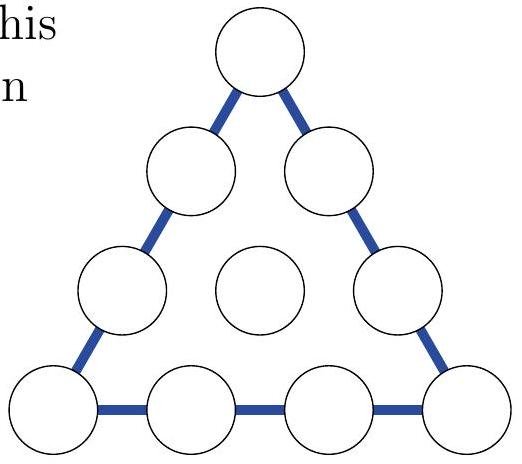
The numbers 1 to 6 are placed in the circles so that each side of the triangle has a sum of 10 . If 1 is placed in the circle shown, which number is in the shaded circle?
(A) 2
(B) 3
(C) 4
(D) 5
(E) 6

Problem 16:

Follow the instructions in this flow chart.

(A) 57
(B) 63
(C) 75
(D) 81
(E) 84

Problem 17:

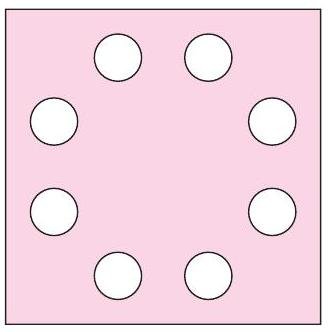
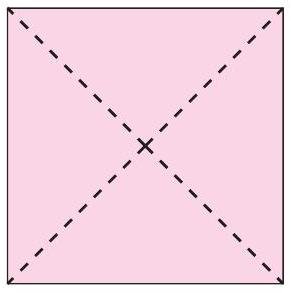
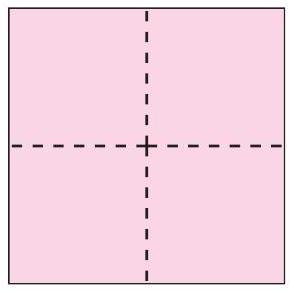
A square piece of paper is folded along the dashed lines shown and then the top is cut off.

The paper is then unfolded. Which shape shows the unfolded piece?

(A)

(B)

(C)

(D)

(E)

Problem 18:

Sally, Li and Raheelah have birthdays on different days in the week beginning Sunday 2 August. No two birthdays are on following days and the gap between the first and second birthday is less than the gap between the second and third. Which day is definitely not one of their birthdays?
(A) Monday
(B) Tuesday
(C) Wednesday
(D) Thursday
(E) Friday

Problem 19:

A square of side length 3 cm is placed alongside a square of side 5 cm .

What is the area, in square centimetres, of the shaded part?
(A) 22.5
(B) 23
(C) 23.5
(D) 24
(E) 24.5

Problem 20:

A cube has the letters \(A, C, M, T, H\) and \(S\) on its six faces. Here are two views of this cube.

Which one of the following could be a third view of the same cube?

(A)

(B)

(C)

(D)

(E)

Problem 21:

A teacher gives each of three students Asha, Betty and Cheng a card with a 'secret' number on it. Each looks at her own number but does not know the other two numbers. Then the teacher gives them this information.
All three numbers are different whole numbers and their sum is 13 . The product of the numbers is odd. Betty and Cheng now know what the numbers are on the other two cards, but Asha does not have enough information. What number is on Asha's card?
(A) 9
(B) 7
(C) 5
(D) 3
(E) 1

Problem 22:

In this multiplication, \(L, M\) and \(N\) are different digits. What is the value of \(L+M+N\) ?
(A) 13
(B) 15
(C) 16
(D) 17
(E) 20

Problem 23:

A scientist was testing a piece of metal which contains copper and zinc. He found the ratio of metals was 2 parts copper to 3 parts zinc. Then he melted this metal and added 120 g of copper and 40 g of zinc into it, forming a new piece of metal which weighs 660 g .
What is the ratio of copper and zinc in the new metal?
(A) 1 part copper to 3 parts zinc
(B) 2 parts copper to 3 parts zinc
(C) 16 parts copper to 17 parts zinc
(D) 8 parts copper to 17 parts zinc
(E) 8 parts copper to 33 parts zinc

Problem 24:

Jason had between 50 and 200 identical square cards. He tried to arrange them in rows of 4 but had one left over. He tried rows of 5 and then rows of 6 , but each time he had one card left over. Finally, he discovered that he could arrange them to form one large solid square. How many cards were on each side of this square?
(A) 8
(B) 9
(C) 10
(D) 11
(E) 12

Problem 25:

Eve has \(\$ 400\) in Australian notes in her wallet, in a mixture of 5,10 , 20 and 50 dollar notes.
As a surprise, Viv opens Eve's wallet and replaces every note with the next larger note. So, each \(\$ 5\) note is replaced by a \(\$ 10\) note, each \(\$ 10\) note is replaced by a \(\$ 20\) note, each \(\$ 20\) note is replaced by a \(\$ 50\) note and each \(\$ 50\) note is replaced by a \(\$ 100\) note.
Eve discovers that she now has \(\$ 900\). How much of this new total is in \(\$ 50\) notes?
(A) \(\$ 50\)
(B) \(\$ 100\)
(C) \(\$ 200\)
(D) \(\$ 300\)
(E) \(\$ 500\)

Problem 26:

Alex is designing a square patio, paved by putting bricks on edge using the basketweave pattern shown.
She has 999 bricks she can use, and designs her patio to be as large a square as possible. How many bricks does she use?

Problem 27:

There are many ways that you can add three different positive whole numbers to get a total of 12 . For instance, \(1+5+6=12\) is one way but \(2+2+8=12\) is not, since 2,2 and 8 are not all different.
If you multiply these three numbers, you get a number called the product.
Of all the ways to do this, what is the largest possible product?

Problem 28:

I have 2 watches with a 12 hour cycle. One gains 2 minutes a day and the other loses 3 minutes a day. If I set them at the correct time, how many days will it be before they next together tell the correct time?

Problem 29:

A \(3 \times 2\) flag is divided into six squares, as shown. Each square is to be coloured green or blue, so that every square shares at least one edge with another square of the same colour.
In how many different ways can this be done?

Problem 30:

The squares in a \(25 \times 25\) grid are painted black or white in a spiral pattern, starting with black at the centre \(\boldsymbol{*}\) and spiralling out.
The diagram shows how this starts. How many squares are painted black?