AMERICAN MATHEMATICS COMPETITION 10 A - 2018

Problem 1

What is the value of

$$
\left(\left((2+1)^{-1}+1\right)^{-1}+1\right)^{-1}+1 ?
$$

(A) $\frac{5}{8}$
(B) $\frac{11}{7}$
(C) $\frac{8}{5}$
(D) $\frac{18}{11}$
(E) $\frac{15}{8}$

Answer:

(B) $\frac{11}{7}$

Problem 2


Liliane has $50 \%$ more soda than Jacqueline, and Alice has $25 \%$ more soda than Jacqueline. What is the relationship between the amounts of soda that Liliane and Alica have?
(A) Liliane has $20 \%$ more soda than Alice. (B) Liliane has $25 \%$ more soda than Alice.
(C) Liliane has $45 \%$ more soda than Alice. (D) Liliane has $75 \%$ more soda than Alice.
(E) Liliane has $100 \%$ more soda than Alice.

Answer:

(A) Liliane has $20 \%$ more soda than Alice.

Problem 3

A unit of blood expires after $10!=10 \cdot 9 \cdot 8 \cdots 1$ seconds. Yasin donates a unit of blood at noon of January 1. On what day does his unit of blood expire?
(A) January 2
(B) January 12
(C) January 22
(D) Febuary 11
(E) Febuary 12

Answer:

(E) Febuary 12

Problem 4


How many ways can a student schedule 3 mathematics courses - algebra, geometry, and number theory - in a 6 -period day if no two mathematics courses can be taken in consecutive periods? (What courses the student takes during the other 3 periods is of no concern here.)
(A) 3
(B) 6
(C) 12
(D) 18
(E) 24

Answer:

(E) 24

Problem 5

Alice, Bob, and Charlie were on a hike and were wondering how far away the nearest town was. When Alice said, "We are at least 6 miles away," Bob replied, "We are at most 5 miles away." Charlie then remarked, "Actually the nearest town is at most 4 miles away." It turned out that none of the three statements were true. Let $d$ be the distance in miles to the nearest town. Which of the following intervals is the set of all possible values of $d$ ?
(A) $(0,4)$
(B) $(4,5)$
(C) $(4,6)$
(D) $(5,6)$
(E) $(5, \infty)$

Answer:

(D) $(5,6)$

Problem 6

Sangho uploaded a video to a website where viewers can vote that they like or dislike a video. Each video begins with a score of 0 , and the score increases by 1 for each like vote and decreases by 1 for each dislike vote. At one point Sangho saw that his video had a score of 90 , and that $65 \%$ of the votes cast on his video were like votes. How many votes had been cast on Sangho's video at that point?
(A) 200
(B) 300
(C) 400
(D) 500
(E) 600

Answer:

(B) 300

Problem 7

For how many (not necessarily positive) integer values of $n$ is the value of $4000 \cdot\left(\frac{2}{5}\right)^{n}$ an integer?
(A) 3
(B) 4
(C) 6
(D) 8
(E) 9

Answer:

(E) 9

Problem 8

Joe has a collection of 23 coins, consisting of 5 -cent coins, 10 -cent coins, and 25 -cent coins. He has 3 more 10 -cent coins than 5 -cent coins, and the total value of his collection is 320 cents. How many more 25 -cent coins does Joe have than 5 -cent coins?
(A) 0
(B) 1
(C) 2
(D) 3
(E) 4

Answer:

(C) 2

Problem 9

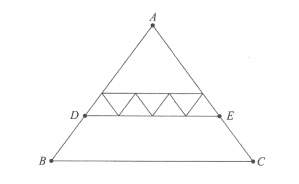
All of the triangles in the diagram below are similar to iscoceles triangle $A B C$, in which $A B=A C$. Each of the 7 smallest triangles has area 1, and $\triangle A B C$ has area 40 . What is the area of trapezoid $D B C E$ ?

(A) 16
(B) 18
(C) 20
(D) 22
(E) 24

Answer:

(E) 24

Problem 10

Suppose that real number $x$ satisfies

$$
\sqrt{49-x^{2}}-\sqrt{25-x^{2}}=3 .
$$

What is the value of $\sqrt{49-x^{2}}+\sqrt{25-x^{2}}$ ?
(A) 8
(B) $\sqrt{33}+8$
(C) 9
(D) $2 \sqrt{10}+4$
(E) 12

Answer:

(A) 8

Problem 11

When 7 fair standard 6 -sided dice are thrown, the probability that the sum of the numbers on the top faces is 10 can be written as

$$
\frac{n}{6^{7}},
$$


where $n$ is a positive integer. What is $n$ ?
(A) 42
(B) 49
(C) 56
(D) 63
(E) 84

Answer:

(E) 84

Problem 12

How many ordered pairs of real numbers $(x, y)$ satisfy the following system of equations?

$$
\begin{array}{r}
x+3 y=3 \
||x|-|y||=1
\end{array}
$$

(A) 1
(B) 2
(C) 3
(D) 4
(E) 8

Answer:

(C) 3

Problem 13

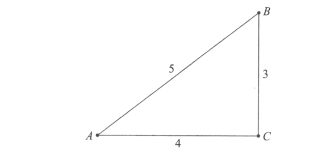
A paper triangle with sides of lengths 3,4 , and 5 inches, as shown, is folded so that point $A$ falls on point $B$. What is the length in inches of the crease?

(A) $1+\frac{1}{2} \sqrt{2}$
(B) $\sqrt{3}$
(C) $\frac{7}{4}$
(D) $\frac{15}{8}$
(E) 2

Answer:

(D) $\frac{15}{8}$

Problem 14

What is the greatest integer less than or equal to

$$
\frac{3^{100}+2^{100}}{3^{96}+2^{96}} ?
$$

(A) 80
(B) 81
(C) 96
(D) 97
(E) 625

Answer:

(A) 80

Problem 15

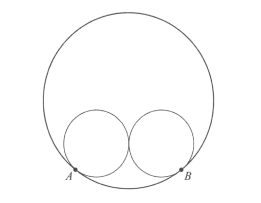
Two circles of radius 5 are externally tangent to each other and are internally tangent to a circle of radius 13 at points $A$ and $B$, as shown in the diagram. The distance $A B$ can be written in the form $\frac{m}{n}$, where $m$ and $n$ are relatively prime positive integers. What is $m+n$ ?

(A) 21
(B) 29
(C) 58
(D) 69
(E) 93

Answer:

(D) 69

Problem 16

Right triangle $A B C$ has leg lengths $A B=20$ and $B C=21$. Including $\overline{A B}$ and $\overline{B C}$, how many line segments with integer length can be drawn from vertex $B$ to a point on hypotenuse $\overline{A C}$ ?
(A) 5
(B) 8
(C) 12
(D) 13
(E) 15

Answer:

(D) 13

Problem 17

Let $S$ be a set of 6 integers taken from ${1,2, \ldots, 12}$ with the property that if $a$ and $b$ are elements of $S$ with $a<b$, then $b$ is not a multiple of $a$. What is the least possible values of an element in $S$ ?
(A) 2
(B) 3
(C) 4
(D) 5
(E) 7

Answer:

(C) 4

Problem 18

How many nonnegative integers can be written in the form


$$
a_{7} \cdot 3^{7}+a_{6} \cdot 3^{6}+a_{5} \cdot 3^{5}+a_{4} \cdot 3^{4}+a_{3} \cdot 3^{3}+a_{2} \cdot 3^{2}+a_{1} \cdot 3^{1}+a_{0} \cdot 3^{0}
$$

where $a_{i} \in{-1,0,1}$ for $0 \leq i \leq 7$ ?
(A) 512
(B) 729
(C) 1094
(D) 3281
(E) 59,048

Answer:

(D) 3281

Problem 19

A number $m$ is randomly selected from the set ${11,13,15,17,19}$, and a number $n$ is randomly selected from ${1999,2000,2001, \ldots, 2018}$. What is the probability that $m^{n}$ has a units digit of 1 ?
(A) $\frac{1}{5}$
(B) $\frac{1}{4}$
(C) $\frac{3}{10}$
(D) $\frac{7}{20}$
(E) $\frac{2}{5}$

Answer:

(E) $\frac{2}{5}$

Problem 20

A scanning code consists of a $7 \times 7$ grid of squares, with some of its squares colored black and the rest colored white. There must be at least one square of each color in this grid of 49 squares. A scanning code is called symmetric if its look does not change when the entire square is rotated by a multiple of $90^{\circ}$ counterclockwise around its center, nor when it is reflected across a line joining opposite corners or a line joining midpoints of opposite sides. What is the total number of possible symmetric scanning codes?
(A) 510
(B) 1022
(C) 8190
(D) 8192
(E) 65,534

Answer:

(B) 1022

Problem 21

Which of the following describes the set of values of $a$ for which the curves $x^{2}+y^{2}=a^{2}$ and $y=x^{2}-a$ in the real $x y$-plane intersect at exactly 3 points?
(A) $a=\frac{1}{4}$
(B) $\frac{1}{4}\frac{1}{4}$
(D) $a=\frac{1}{2}$
(E) $a>\frac{1}{2}$

Answer:

(E) $a>\frac{1}{2}$

Problem 22

Let $a, b, c$, and $d$ be positive integers such that $\operatorname{gcd}(a, b)=24, \operatorname{gcd}(b, c)=36$, $\operatorname{gcd}(c, d)=54$, and $70<\operatorname{gcd}(d, a)<100$. Which of the following must be a divisor of $a$ ?
(A) 5
(B) 7
(C) 11
(D) 13
(E) 17

Answer:

(D) 13

Problem 23

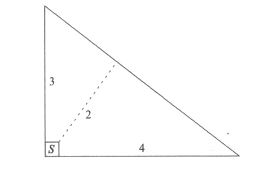
Farmer Pythagoras has a field in the shape of a right triangle. The right triangle's legs have lengths 3 and 4 units. In the corner where those sides meet at a right angle, he leaves a small unplanted square $S$ so that from the air it looks like the right angle symbol. The rest of the fiels is planted. The shortest distance from $S$ to the hypotenuse is 2 units. What fraction of the field is planted?

(A) $\frac{25}{27}$
(B) $\frac{26}{27}$
(C) $\frac{73}{75}$
(D) $\frac{145}{147}$
(E) $\frac{74}{75}$

Answer:

(D) $\frac{145}{147}$

Problem 24

Triangle $A B C$ with $A B=50$ and $A C=10$ has area 120 . Let $D$ be the midpoint of $\overline{A B}$, and let $E$ be the midpoint of $\overline{A C}$. The angle bisector of $\angle B A C$ intersects $\overline{D E}$ and $\overline{B C}$ at $F$ and $G$, respectively. What is the area of quadrilateral $F D B G$ ?
(A) 60
(B) 65
(C) 70
(D) 75
(E) 80

Answer:

(D) 75

Problem 25

For a positive integer $n$ and nonzero digits $a, b$, and $c$, let $A_{n}$ be the $n$-digit integer each of whose digits is equal to $a$; let $B_{n}$ be the $n$-digit integer each of whose digits is equal to $b$, and let $C_{n}$ be the $2 n$-digit (not $n$-digit) integer each of whose digits is equal to $c$. What is the greatest possible value of $a+b+c$ for which there are at least two values of $n$ such that $C_{n}-B_{n}=A_{n}^{2}$ ?
(A) 12
(B) 14
(C) 16
(D) 18
(E) 20

Answer:

(D) 18
AMERICAN MATHEMATICS COMPETITION 10 A - 2017

Problem 1

What is the value of $(2(2(2(2(2(2+1)+1)+1)+1)+1)+1)$
(A) 70
(B) 97
(C) 127
(D) 159
(E) 729

Answer:

(C) 127

Problem 2


Pablo buys popsicles for his friends. The store sells single popsicles for $\$ 1$ each, 3popsicle boxes for $\$ 2$ each, and 5 -popsicle boxes for $\$ 3$. What is the greatest number of popsicles that Pablo can buy with $\$ 8$ ?
(A) 8
(B) 11
(C) 12
(D) 13
(E) 15

Answer:

(D) 13

Problem 3


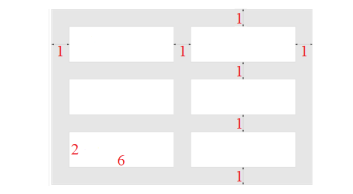
Tamara has three rows of two 6 -feet by 2 -feet flower beds in her garden. The beds are separated and also surrounded by 1 -foot-wide walkways, as shown on the diagram. What is the total area of the walkways, in square feet?


(A) 72
(B) 78
(C) 90
(D) 120
(E) 150

Answer:

(B) 78

Problem 4

Mia is "helping" her mom pick up 30 toys that are strewn on the floor. Mia's mom manages to put 3 toys into the toy box every 30 seconds, but each time immediately after those 30 seconds have elapsed, Mia takes 2 toys out of the box. How much time, in minutes, will it take Mia and her mom to put all 30 toys into the box for the first time?
(A) 13.5
(B) 14
(C) 14.5
(D) 15
(E) 15.5

Answer:

(B) 14

Problem 5


The sum of two nonzero real numbers is 4 times their product. What is the sum of the reciprocals of the two numbers?
(A) 1
(B) 2
(C) 4
(D) 8
(E) 12

Answer:

(C) 4

Problem 6


Ms. Carroll promised that anyone who got all the multiple choice questions right on the upcoming exam would receive an A on the exam. Which of of these statements necessarily follows logically?
(A) If Lewis did not receive an A , then he got all of the multiple choice questions wrong.
(B) If Lewis did not receive an A , then he got at least one of the multiple choice questions wrong.
(C) If Lewis got at least one of the multiple choice questions wrong, then he did not receive an A .
(D) If Lewis received an A , then he got all of the multiple choice questions right.
(E) If Lewis received an A , then he got at least one of the multiple choice questions right.

Answer:

(B) If Lewis did not receive an A , then he got at least one of the multiple choice questions wrong.

Problem 7


Jerry and Silvia wanted to go from the southwest corner of a square field to the northeast corner. Jerry walked due east and then due north to reach the goal, but Silvia headed northeast and reached the goal walking in a straight line. Which of the following is closest to how much shorter Silvia's trip was, compared to Jerry's trip?
(A) $30 \%$
(B) $40 \%$
(C) $50 \%$
(D) $60 \%$
(E) $70 \%$

Answer:

(A) $30 \%$

Problem 8


At a gathering of 30 people, there are 20 people who all know each other and 10 people who know no one. People who know each other hug, and people who do not know each other shake hands. How many handshakes occur?
(A) 240
(B) 245
(C) 290
(D) 480
(E) 490

Answer:

(B) 245

Problem 9


Minnie rides on a flat road at 20 kilometers per hour (kph), downhill at 30 kph , and uphill at 5 kph . Penny rides on a flat road at 30 kph , downhill at 40 kph , and uphill at 10 kph . Minnie goes from town A to town B, a distance of 10 km all uphill, then from town B to town C, a distance of 15 km all downhill, and then back to town A, a distance of 20 km on the flat. Penny goes the other way around using the same route. How many more minutes does it take Minnie to complete the $45-\mathrm{km}$ ride than it takes Penny?
(A) 45
(B) 60
(C) 65
(D) 90
(E) 95

Answer:

(C) 65

Problem 10

Joy has 30 thin rods, one each of every integer length from 1 cm through 30 cm . She places the rods with lengths $3 \mathrm{~cm}, 7 \mathrm{~cm}$, and 15 cm on a table. She then wants to choose a fourth rod that she can put with these three to form a quadrilateral with positive area. How many of the remaining rods can she choose as the fourth rod?
(A) 16
(B) 17
(C) 18
(D) 19
(E) 20

Answer:

(B) 17

Problem 11


The region consisting of all point in three-dimensional space within 3 units of line segment $A B$ has volume $216 \pi$. What is the length $A B$ ?
(A) 6
(B) 12
(C) 18
(D) 20
(E) 24

Answer:

(D) 20

Problem 12

Let $S$ be a set of points $(x, y)$ in the coordinate plane such that two of the three quantities $3, x+2$, and $y-4$ are equal and the third of the three quantities is no greater than this common value. Which of the following is a correct description for $S$
(A) a single point
(B) two intersecting lines
(C) three lines whose pairwise intersections are three distinct points
(D) a triangle
(E) three rays with a common endpoint

Answer:

(E) three rays with a common endpoint

Problem 13


Define a sequence recursively by $F_{0}=0, F_{1}=1$, and $F_{n}=$ the remainder when $F_{n-1}+ F_{n-2}$ is divided by 3 for all $n \geq 2$. Thus the sequence starts $0,1,1,2,0,2, \cdots$ What is

$$
F_{2017}+F_{2018}+F_{2019}+F_{2020}+F_{2021}+F_{2022}+F_{2023}+F_{2024} ?
$$

(A) 6
(B) 7
(C) 8
(D) 9
(E) 10

Answer:

(D) 9

Problem 14

Every week Roger pays for a movie ticket and a soda out of his allowance. Last week, Roger's allowance was $A$ dollars. The cost of his movie ticket was $20 \%$ of the difference between $A$ and the cost of his soda, while the cost of his soda was $5 \%$ of the difference between $A$ and the cost of his movie ticket. To the nearest whole percent, what fraction of $A$ did Roger pay for his movie ticket and soda?
(A) $9 \%$
(B) $19 \%$
(C) $22 \%$
(D) $23 \%$
(E) $25 \%$\[0pt]

Answer:

(D) $23 \%$

Problem 15

ChloƩ chooses a real number uniformly at random from the interval [ 0,2017 ]. Independently, Laurent chooses a real number uniformly at random from the interval $[0,4034]$. What is the probability that Laurent's number is greater than ChloƩ's number?
(A) $\frac{1}{2}$
(B) $\frac{2}{3}$
(C) $\frac{3}{4}$
(D) $\frac{5}{6}$
(E) $\frac{7}{8}$

Answer:

(C) $\frac{3}{4}$

    Problem 16

    There are 10 horses, named Horse 1, Horse 2, . . . Horse 10. They get their names from how many minutes it takes them to run one lap around a circular race track: Horse $k$ runs one lap in exactly $k$ minutes. At time 0 all the horses are together at the starting point on the track. The horses start running in the same direction, and they keep running around the circular track at their constant speeds. The least time $S>0$, in minutes, at which all 10 horses will again simultaneously be at the starting point is $S=2520$. Let $T>0$ be the least time, in minutes, such that at least 5 of the horses are again at the starting point. What is the sum of the digits of $T$ ?
    (A) 2
    (B) 3
    (C) 4
    (D) 5
    (E) 6

    Answer:

    (B) 3

    Problem 17


    Distinct points $P, Q, R, S$ lie on the circle $x^{2}+y^{2}=25$ and have integer coordinates. The distances $P Q$ and $R S$ are irrational numbers. What is the greatest possible value of the ratio $\frac{P Q}{R S}$ ?
    (A) 3
    (B) 5
    (C) $3 \sqrt{5}$
    (D) 7
    (E) $5 \sqrt{2}$

    Answer:

    (D) 7

    Problem 18


    Amelia has a coin that lands heads with probability $\frac{1}{3}$, and Blaine has a coin that lands on heads with probability $\frac{2}{5}$. Amelia and Blaine alternately toss their coins until someone gets a head; the first one to get a head wins. All coin tosses are independent. Amelia goes first. The probability that Amelia wins is $\frac{p}{q}$, where $p$ and $q$ are relatively prime positive integers. What is $q-p$ ?
    (A) 1
    (B) 2
    (C) 3
    (D) 4
    (E) 5

    Answer:

    (D) 4

    Problem 19


    Alice refuses to sit next to either Bob or Carla. Derek refuses to sit next to Eric. How many ways are there for the five of them to sit in a row of 5 chairs under these conditions?
    (A)12
    (B)16
    (C) 28
    (D) 32
    (E) 40

    Answer:

    (C) 28

    Problem 20

    Let $S(n)$ equal the sum of the digits of positive integer $n$. For example, $S(1507)=13$. For a particular positive integer $n, S(n)=1274$. Which of the following could be the value of $S(n+1)$ ?
    (A) 1
    (B) 3
    (C) 12
    (D) 1239
    (E) 1265

    Answer:

    (D) 1239

    Problem 21


    A square with side length $x$ is inscribed in a right triangle with sides of length 3,4 , and 5 so that one vertex of the square coincides with the right-angle vertex of the triangle. A square with side length $y$ is inscribed in another right triangle with sides of length 3,4 , and 5 so that one side of the square lies on the hypotenuse of the triangle. What is $\frac{x}{y}$ ?
    (A) $\frac{12}{13}$
    (B) $\frac{35}{37}$
    (C) 1
    (D) $\frac{37}{35}$
    (E) $\frac{13}{12}$

    Answer:

    (D) $\frac{37}{35}$

    Problem 22


    Sides $\overline{A B}$ and $\overline{A C}$ of triangle $A B C$ are tangent to a circle as points $B$ and $C$, respectively. What fraction of the area of $\triangle A B C$ lies outside the circle?
    (A) $\frac{4 \sqrt{3} \pi}{27}-\frac{1}{3}$
    (B) $\frac{\sqrt{3}}{2}-\frac{\pi}{8}$
    (C) $\frac{1}{2}$
    (D) $\sqrt{3}-\frac{2 \sqrt{3} \pi}{9}$
    (E) $\frac{4}{3}-\frac{4 \sqrt{3} \pi}{27}$

    Answer:

    (E) $\frac{4}{3}-\frac{4 \sqrt{3} \pi}{27}$

    Problem 23

    How many triangles with positive area have all their vertices at points ( $i, j$ ) in the coordinate plane, where $i$ and $j$ are integers between 1 and 5, inclusive?
    (A) 2128
    (B) 2148
    (C) 2160
    (D) 2200
    (E) 2300

    Answer:

    (B) 2148

    Problem 24


    For certain real numbers $a, b$, and $c$, the polynomial $g(x)=x^{3}+a x^{2}+x+10$ has three distinct roots, and each root of $g(x)$ is also a root of the polynomial
    \end{enumerate}

    $$
    f(x)=x^{4}+x^{3}+b x^{2}+100 x+c
    $$

    What is $f(1)$ ?
    (A) -9009
    (B) -8008
    (C) -7007
    (D) -6006
    (E) -5005

    Answer:

    (C) -7007

    Problem 25

    How many integers between 100 and 999, inclusive, have the property that some permutation of its digits is a multiple of 11 between 100 and 999? For example, both 121 and 211 have this property.
    (A) 226
    (B) 243
    (C) 270
    (D) 469
    (E) 486

    Answer:

    (A) 226

      2022 AMC 10A, Problem 20, Hints and Solution

      Motivation

      To find the last term in a sequence, each term formed by adding similar indexed term from an AP and a GP.

      Question

      A four-term sequence is formed by adding each term of a four-term arithmetic sequence of positive integers to the corresponding term of a four-term geometric sequence of positive integers. The first three terms of the resulting four-term sequence are 57, 60 and 91. What is the fourth of this sequence?

      Hint 1

      Use the standard forms of the terms of the progressions to obtain a system of equations.

      Hint 2

      Try to reduce the number of variables from the system by subtracting two subsequent equations at a time. 

      Let $a,ar,ar^2,ar^3$, be the first three terms of the geometric progression, and $b,b+d,b+2d,b+3d$ be the corresponding terms of the arithmetic progression.

      We are given, that

      $$a+b=57$$

      $$ar+b+d=60$$

      $$ar^2+b+2d=91.$$

      Final Solution

      These are 3 non-linear equations in 4 variables, so we can't directly conclude anything. Notice that if we subtract the first two equations we get, discarding $b$ $$3=a(r-1)+d$$ and similarly 

       $$31=ar(r-1)+d.$$

      Each of these equations contain, the same variable. So subtracting again, we get

      $$28=ar^2-2ar+a=a(r-1)^2.$$

      Now since we're dealing with sequences of positive integers, then we can only equate $(r-1)^2$ to either $4$ or $1$.

      Then we can conclude that either $a=28$ and $r=2$ or $a=7$ and $r=3$.

      If $a=28$, then we get $b=57-28=29$ and $d=-25$. But that makes the arithmetic progression $29,4,-21,-46$, which is a contradiction since the sequence is of positive integers. With $a=7$, $b=50$, and $d=-11$ we get following progressions $50,39,28,17$ and $7,21,63,189$.

      The desired number is then

      $$17+189=206$$