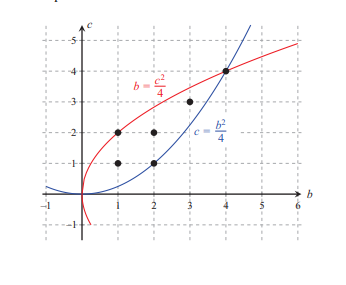
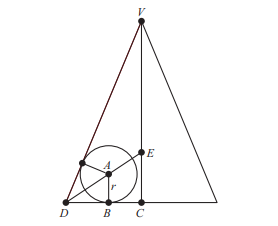
AMERICAN MATHEMATICS COMPETITION 10 A - 2018

Problem 1

What is the value of

$$
\left(\left((2+1)^{-1}+1\right)^{-1}+1\right)^{-1}+1 ?
$$

(A) $\frac{5}{8}$
(B) $\frac{11}{7}$
(C) $\frac{8}{5}$
(D) $\frac{18}{11}$
(E) $\frac{15}{8}$

Answer:

(B) $\frac{11}{7}$

Problem 2


Liliane has $50 \%$ more soda than Jacqueline, and Alice has $25 \%$ more soda than Jacqueline. What is the relationship between the amounts of soda that Liliane and Alica have?
(A) Liliane has $20 \%$ more soda than Alice. (B) Liliane has $25 \%$ more soda than Alice.
(C) Liliane has $45 \%$ more soda than Alice. (D) Liliane has $75 \%$ more soda than Alice.
(E) Liliane has $100 \%$ more soda than Alice.

Answer:

(A) Liliane has $20 \%$ more soda than Alice.

Problem 3

A unit of blood expires after $10!=10 \cdot 9 \cdot 8 \cdots 1$ seconds. Yasin donates a unit of blood at noon of January 1. On what day does his unit of blood expire?
(A) January 2
(B) January 12
(C) January 22
(D) Febuary 11
(E) Febuary 12

Answer:

(E) Febuary 12

Problem 4


How many ways can a student schedule 3 mathematics courses - algebra, geometry, and number theory - in a 6 -period day if no two mathematics courses can be taken in consecutive periods? (What courses the student takes during the other 3 periods is of no concern here.)
(A) 3
(B) 6
(C) 12
(D) 18
(E) 24

Answer:

(E) 24

Problem 5

Alice, Bob, and Charlie were on a hike and were wondering how far away the nearest town was. When Alice said, "We are at least 6 miles away," Bob replied, "We are at most 5 miles away." Charlie then remarked, "Actually the nearest town is at most 4 miles away." It turned out that none of the three statements were true. Let $d$ be the distance in miles to the nearest town. Which of the following intervals is the set of all possible values of $d$ ?
(A) $(0,4)$
(B) $(4,5)$
(C) $(4,6)$
(D) $(5,6)$
(E) $(5, \infty)$

Answer:

(D) $(5,6)$

Problem 6

Sangho uploaded a video to a website where viewers can vote that they like or dislike a video. Each video begins with a score of 0 , and the score increases by 1 for each like vote and decreases by 1 for each dislike vote. At one point Sangho saw that his video had a score of 90 , and that $65 \%$ of the votes cast on his video were like votes. How many votes had been cast on Sangho's video at that point?
(A) 200
(B) 300
(C) 400
(D) 500
(E) 600

Answer:

(B) 300

Problem 7

For how many (not necessarily positive) integer values of $n$ is the value of $4000 \cdot\left(\frac{2}{5}\right)^{n}$ an integer?
(A) 3
(B) 4
(C) 6
(D) 8
(E) 9

Answer:

(E) 9

Problem 8

Joe has a collection of 23 coins, consisting of 5 -cent coins, 10 -cent coins, and 25 -cent coins. He has 3 more 10 -cent coins than 5 -cent coins, and the total value of his collection is 320 cents. How many more 25 -cent coins does Joe have than 5 -cent coins?
(A) 0
(B) 1
(C) 2
(D) 3
(E) 4

Answer:

(C) 2

Problem 9

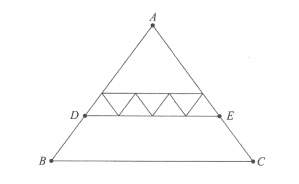
All of the triangles in the diagram below are similar to iscoceles triangle $A B C$, in which $A B=A C$. Each of the 7 smallest triangles has area 1, and $\triangle A B C$ has area 40 . What is the area of trapezoid $D B C E$ ?

(A) 16
(B) 18
(C) 20
(D) 22
(E) 24

Answer:

(E) 24

Problem 10

Suppose that real number $x$ satisfies

$$
\sqrt{49-x^{2}}-\sqrt{25-x^{2}}=3 .
$$

What is the value of $\sqrt{49-x^{2}}+\sqrt{25-x^{2}}$ ?
(A) 8
(B) $\sqrt{33}+8$
(C) 9
(D) $2 \sqrt{10}+4$
(E) 12

Answer:

(A) 8

Problem 11

When 7 fair standard 6 -sided dice are thrown, the probability that the sum of the numbers on the top faces is 10 can be written as

$$
\frac{n}{6^{7}},
$$


where $n$ is a positive integer. What is $n$ ?
(A) 42
(B) 49
(C) 56
(D) 63
(E) 84

Answer:

(E) 84

Problem 12

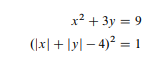
How many ordered pairs of real numbers $(x, y)$ satisfy the following system of equations?

$$
\begin{array}{r}
x+3 y=3 \
||x|-|y||=1
\end{array}
$$

(A) 1
(B) 2
(C) 3
(D) 4
(E) 8

Answer:

(C) 3

Problem 13

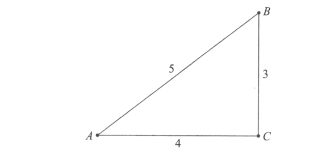
A paper triangle with sides of lengths 3,4 , and 5 inches, as shown, is folded so that point $A$ falls on point $B$. What is the length in inches of the crease?

(A) $1+\frac{1}{2} \sqrt{2}$
(B) $\sqrt{3}$
(C) $\frac{7}{4}$
(D) $\frac{15}{8}$
(E) 2

Answer:

(D) $\frac{15}{8}$

Problem 14

What is the greatest integer less than or equal to

$$
\frac{3^{100}+2^{100}}{3^{96}+2^{96}} ?
$$

(A) 80
(B) 81
(C) 96
(D) 97
(E) 625

Answer:

(A) 80

Problem 15

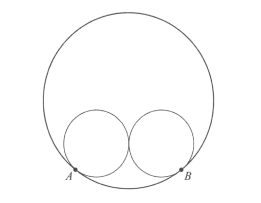
Two circles of radius 5 are externally tangent to each other and are internally tangent to a circle of radius 13 at points $A$ and $B$, as shown in the diagram. The distance $A B$ can be written in the form $\frac{m}{n}$, where $m$ and $n$ are relatively prime positive integers. What is $m+n$ ?

(A) 21
(B) 29
(C) 58
(D) 69
(E) 93

Answer:

(D) 69

Problem 16

Right triangle $A B C$ has leg lengths $A B=20$ and $B C=21$. Including $\overline{A B}$ and $\overline{B C}$, how many line segments with integer length can be drawn from vertex $B$ to a point on hypotenuse $\overline{A C}$ ?
(A) 5
(B) 8
(C) 12
(D) 13
(E) 15

Answer:

(D) 13

Problem 17

Let $S$ be a set of 6 integers taken from ${1,2, \ldots, 12}$ with the property that if $a$ and $b$ are elements of $S$ with $a<b$, then $b$ is not a multiple of $a$. What is the least possible values of an element in $S$ ?
(A) 2
(B) 3
(C) 4
(D) 5
(E) 7

Answer:

(C) 4

Problem 18

How many nonnegative integers can be written in the form


$$
a_{7} \cdot 3^{7}+a_{6} \cdot 3^{6}+a_{5} \cdot 3^{5}+a_{4} \cdot 3^{4}+a_{3} \cdot 3^{3}+a_{2} \cdot 3^{2}+a_{1} \cdot 3^{1}+a_{0} \cdot 3^{0}
$$

where $a_{i} \in{-1,0,1}$ for $0 \leq i \leq 7$ ?
(A) 512
(B) 729
(C) 1094
(D) 3281
(E) 59,048

Answer:

(D) 3281

Problem 19

A number $m$ is randomly selected from the set ${11,13,15,17,19}$, and a number $n$ is randomly selected from ${1999,2000,2001, \ldots, 2018}$. What is the probability that $m^{n}$ has a units digit of 1 ?
(A) $\frac{1}{5}$
(B) $\frac{1}{4}$
(C) $\frac{3}{10}$
(D) $\frac{7}{20}$
(E) $\frac{2}{5}$

Answer:

(E) $\frac{2}{5}$

Problem 20

A scanning code consists of a $7 \times 7$ grid of squares, with some of its squares colored black and the rest colored white. There must be at least one square of each color in this grid of 49 squares. A scanning code is called symmetric if its look does not change when the entire square is rotated by a multiple of $90^{\circ}$ counterclockwise around its center, nor when it is reflected across a line joining opposite corners or a line joining midpoints of opposite sides. What is the total number of possible symmetric scanning codes?
(A) 510
(B) 1022
(C) 8190
(D) 8192
(E) 65,534

Answer:

(B) 1022

Problem 21

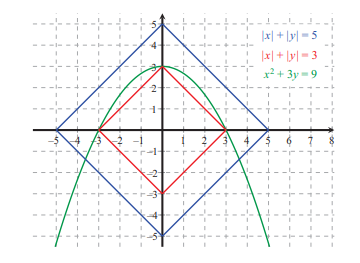
Which of the following describes the set of values of $a$ for which the curves $x^{2}+y^{2}=a^{2}$ and $y=x^{2}-a$ in the real $x y$-plane intersect at exactly 3 points?
(A) $a=\frac{1}{4}$
(B) $\frac{1}{4}\frac{1}{4}$
(D) $a=\frac{1}{2}$
(E) $a>\frac{1}{2}$

Answer:

(E) $a>\frac{1}{2}$

Problem 22

Let $a, b, c$, and $d$ be positive integers such that $\operatorname{gcd}(a, b)=24, \operatorname{gcd}(b, c)=36$, $\operatorname{gcd}(c, d)=54$, and $70<\operatorname{gcd}(d, a)<100$. Which of the following must be a divisor of $a$ ?
(A) 5
(B) 7
(C) 11
(D) 13
(E) 17

Answer:

(D) 13

Problem 23

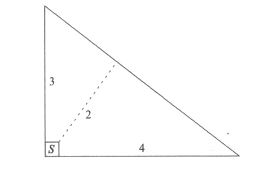
Farmer Pythagoras has a field in the shape of a right triangle. The right triangle's legs have lengths 3 and 4 units. In the corner where those sides meet at a right angle, he leaves a small unplanted square $S$ so that from the air it looks like the right angle symbol. The rest of the fiels is planted. The shortest distance from $S$ to the hypotenuse is 2 units. What fraction of the field is planted?

(A) $\frac{25}{27}$
(B) $\frac{26}{27}$
(C) $\frac{73}{75}$
(D) $\frac{145}{147}$
(E) $\frac{74}{75}$

Answer:

(D) $\frac{145}{147}$

Problem 24

Triangle $A B C$ with $A B=50$ and $A C=10$ has area 120 . Let $D$ be the midpoint of $\overline{A B}$, and let $E$ be the midpoint of $\overline{A C}$. The angle bisector of $\angle B A C$ intersects $\overline{D E}$ and $\overline{B C}$ at $F$ and $G$, respectively. What is the area of quadrilateral $F D B G$ ?
(A) 60
(B) 65
(C) 70
(D) 75
(E) 80

Answer:

(D) 75

Problem 25

For a positive integer $n$ and nonzero digits $a, b$, and $c$, let $A_{n}$ be the $n$-digit integer each of whose digits is equal to $a$; let $B_{n}$ be the $n$-digit integer each of whose digits is equal to $b$, and let $C_{n}$ be the $2 n$-digit (not $n$-digit) integer each of whose digits is equal to $c$. What is the greatest possible value of $a+b+c$ for which there are at least two values of $n$ such that $C_{n}-B_{n}=A_{n}^{2}$ ?
(A) 12
(B) 14
(C) 16
(D) 18
(E) 20

Answer:

(D) 18
AMERICAN MATHEMATICS COMPETITION 10 A - 2017

Problem 1

What is the value of $(2(2(2(2(2(2+1)+1)+1)+1)+1)+1)$
(A) 70
(B) 97
(C) 127
(D) 159
(E) 729

Answer:

(C) 127

Problem 2


Pablo buys popsicles for his friends. The store sells single popsicles for $\$ 1$ each, 3popsicle boxes for $\$ 2$ each, and 5 -popsicle boxes for $\$ 3$. What is the greatest number of popsicles that Pablo can buy with $\$ 8$ ?
(A) 8
(B) 11
(C) 12
(D) 13
(E) 15

Answer:

(D) 13

Problem 3


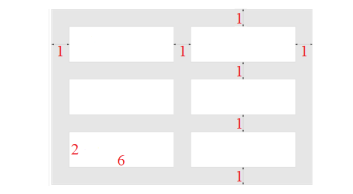
Tamara has three rows of two 6 -feet by 2 -feet flower beds in her garden. The beds are separated and also surrounded by 1 -foot-wide walkways, as shown on the diagram. What is the total area of the walkways, in square feet?


(A) 72
(B) 78
(C) 90
(D) 120
(E) 150

Answer:

(B) 78

Problem 4

Mia is "helping" her mom pick up 30 toys that are strewn on the floor. Mia's mom manages to put 3 toys into the toy box every 30 seconds, but each time immediately after those 30 seconds have elapsed, Mia takes 2 toys out of the box. How much time, in minutes, will it take Mia and her mom to put all 30 toys into the box for the first time?
(A) 13.5
(B) 14
(C) 14.5
(D) 15
(E) 15.5

Answer:

(B) 14

Problem 5


The sum of two nonzero real numbers is 4 times their product. What is the sum of the reciprocals of the two numbers?
(A) 1
(B) 2
(C) 4
(D) 8
(E) 12

Answer:

(C) 4

Problem 6


Ms. Carroll promised that anyone who got all the multiple choice questions right on the upcoming exam would receive an A on the exam. Which of of these statements necessarily follows logically?
(A) If Lewis did not receive an A , then he got all of the multiple choice questions wrong.
(B) If Lewis did not receive an A , then he got at least one of the multiple choice questions wrong.
(C) If Lewis got at least one of the multiple choice questions wrong, then he did not receive an A .
(D) If Lewis received an A , then he got all of the multiple choice questions right.
(E) If Lewis received an A , then he got at least one of the multiple choice questions right.

Answer:

(B) If Lewis did not receive an A , then he got at least one of the multiple choice questions wrong.

Problem 7


Jerry and Silvia wanted to go from the southwest corner of a square field to the northeast corner. Jerry walked due east and then due north to reach the goal, but Silvia headed northeast and reached the goal walking in a straight line. Which of the following is closest to how much shorter Silvia's trip was, compared to Jerry's trip?
(A) $30 \%$
(B) $40 \%$
(C) $50 \%$
(D) $60 \%$
(E) $70 \%$

Answer:

(A) $30 \%$

Problem 8


At a gathering of 30 people, there are 20 people who all know each other and 10 people who know no one. People who know each other hug, and people who do not know each other shake hands. How many handshakes occur?
(A) 240
(B) 245
(C) 290
(D) 480
(E) 490

Answer:

(B) 245

Problem 9


Minnie rides on a flat road at 20 kilometers per hour (kph), downhill at 30 kph , and uphill at 5 kph . Penny rides on a flat road at 30 kph , downhill at 40 kph , and uphill at 10 kph . Minnie goes from town A to town B, a distance of 10 km all uphill, then from town B to town C, a distance of 15 km all downhill, and then back to town A, a distance of 20 km on the flat. Penny goes the other way around using the same route. How many more minutes does it take Minnie to complete the $45-\mathrm{km}$ ride than it takes Penny?
(A) 45
(B) 60
(C) 65
(D) 90
(E) 95

Answer:

(C) 65

Problem 10

Joy has 30 thin rods, one each of every integer length from 1 cm through 30 cm . She places the rods with lengths $3 \mathrm{~cm}, 7 \mathrm{~cm}$, and 15 cm on a table. She then wants to choose a fourth rod that she can put with these three to form a quadrilateral with positive area. How many of the remaining rods can she choose as the fourth rod?
(A) 16
(B) 17
(C) 18
(D) 19
(E) 20

Answer:

(B) 17

Problem 11


The region consisting of all point in three-dimensional space within 3 units of line segment $A B$ has volume $216 \pi$. What is the length $A B$ ?
(A) 6
(B) 12
(C) 18
(D) 20
(E) 24

Answer:

(D) 20

Problem 12

Let $S$ be a set of points $(x, y)$ in the coordinate plane such that two of the three quantities $3, x+2$, and $y-4$ are equal and the third of the three quantities is no greater than this common value. Which of the following is a correct description for $S$
(A) a single point
(B) two intersecting lines
(C) three lines whose pairwise intersections are three distinct points
(D) a triangle
(E) three rays with a common endpoint

Answer:

(E) three rays with a common endpoint

Problem 13


Define a sequence recursively by $F_{0}=0, F_{1}=1$, and $F_{n}=$ the remainder when $F_{n-1}+ F_{n-2}$ is divided by 3 for all $n \geq 2$. Thus the sequence starts $0,1,1,2,0,2, \cdots$ What is

$$
F_{2017}+F_{2018}+F_{2019}+F_{2020}+F_{2021}+F_{2022}+F_{2023}+F_{2024} ?
$$

(A) 6
(B) 7
(C) 8
(D) 9
(E) 10

Answer:

(D) 9

Problem 14

Every week Roger pays for a movie ticket and a soda out of his allowance. Last week, Roger's allowance was $A$ dollars. The cost of his movie ticket was $20 \%$ of the difference between $A$ and the cost of his soda, while the cost of his soda was $5 \%$ of the difference between $A$ and the cost of his movie ticket. To the nearest whole percent, what fraction of $A$ did Roger pay for his movie ticket and soda?
(A) $9 \%$
(B) $19 \%$
(C) $22 \%$
(D) $23 \%$
(E) $25 \%$\[0pt]

Answer:

(D) $23 \%$

Problem 15

ChloƩ chooses a real number uniformly at random from the interval [ 0,2017 ]. Independently, Laurent chooses a real number uniformly at random from the interval $[0,4034]$. What is the probability that Laurent's number is greater than ChloƩ's number?
(A) $\frac{1}{2}$
(B) $\frac{2}{3}$
(C) $\frac{3}{4}$
(D) $\frac{5}{6}$
(E) $\frac{7}{8}$

Answer:

(C) $\frac{3}{4}$

    Problem 16

    There are 10 horses, named Horse 1, Horse 2, . . . Horse 10. They get their names from how many minutes it takes them to run one lap around a circular race track: Horse $k$ runs one lap in exactly $k$ minutes. At time 0 all the horses are together at the starting point on the track. The horses start running in the same direction, and they keep running around the circular track at their constant speeds. The least time $S>0$, in minutes, at which all 10 horses will again simultaneously be at the starting point is $S=2520$. Let $T>0$ be the least time, in minutes, such that at least 5 of the horses are again at the starting point. What is the sum of the digits of $T$ ?
    (A) 2
    (B) 3
    (C) 4
    (D) 5
    (E) 6

    Answer:

    (B) 3

    Problem 17


    Distinct points $P, Q, R, S$ lie on the circle $x^{2}+y^{2}=25$ and have integer coordinates. The distances $P Q$ and $R S$ are irrational numbers. What is the greatest possible value of the ratio $\frac{P Q}{R S}$ ?
    (A) 3
    (B) 5
    (C) $3 \sqrt{5}$
    (D) 7
    (E) $5 \sqrt{2}$

    Answer:

    (D) 7

    Problem 18


    Amelia has a coin that lands heads with probability $\frac{1}{3}$, and Blaine has a coin that lands on heads with probability $\frac{2}{5}$. Amelia and Blaine alternately toss their coins until someone gets a head; the first one to get a head wins. All coin tosses are independent. Amelia goes first. The probability that Amelia wins is $\frac{p}{q}$, where $p$ and $q$ are relatively prime positive integers. What is $q-p$ ?
    (A) 1
    (B) 2
    (C) 3
    (D) 4
    (E) 5

    Answer:

    (D) 4

    Problem 19


    Alice refuses to sit next to either Bob or Carla. Derek refuses to sit next to Eric. How many ways are there for the five of them to sit in a row of 5 chairs under these conditions?
    (A)12
    (B)16
    (C) 28
    (D) 32
    (E) 40

    Answer:

    (C) 28

    Problem 20

    Let $S(n)$ equal the sum of the digits of positive integer $n$. For example, $S(1507)=13$. For a particular positive integer $n, S(n)=1274$. Which of the following could be the value of $S(n+1)$ ?
    (A) 1
    (B) 3
    (C) 12
    (D) 1239
    (E) 1265

    Answer:

    (D) 1239

    Problem 21


    A square with side length $x$ is inscribed in a right triangle with sides of length 3,4 , and 5 so that one vertex of the square coincides with the right-angle vertex of the triangle. A square with side length $y$ is inscribed in another right triangle with sides of length 3,4 , and 5 so that one side of the square lies on the hypotenuse of the triangle. What is $\frac{x}{y}$ ?
    (A) $\frac{12}{13}$
    (B) $\frac{35}{37}$
    (C) 1
    (D) $\frac{37}{35}$
    (E) $\frac{13}{12}$

    Answer:

    (D) $\frac{37}{35}$

    Problem 22


    Sides $\overline{A B}$ and $\overline{A C}$ of triangle $A B C$ are tangent to a circle as points $B$ and $C$, respectively. What fraction of the area of $\triangle A B C$ lies outside the circle?
    (A) $\frac{4 \sqrt{3} \pi}{27}-\frac{1}{3}$
    (B) $\frac{\sqrt{3}}{2}-\frac{\pi}{8}$
    (C) $\frac{1}{2}$
    (D) $\sqrt{3}-\frac{2 \sqrt{3} \pi}{9}$
    (E) $\frac{4}{3}-\frac{4 \sqrt{3} \pi}{27}$

    Answer:

    (E) $\frac{4}{3}-\frac{4 \sqrt{3} \pi}{27}$

    Problem 23

    How many triangles with positive area have all their vertices at points ( $i, j$ ) in the coordinate plane, where $i$ and $j$ are integers between 1 and 5, inclusive?
    (A) 2128
    (B) 2148
    (C) 2160
    (D) 2200
    (E) 2300

    Answer:

    (B) 2148

    Problem 24


    For certain real numbers $a, b$, and $c$, the polynomial $g(x)=x^{3}+a x^{2}+x+10$ has three distinct roots, and each root of $g(x)$ is also a root of the polynomial
    \end{enumerate}

    $$
    f(x)=x^{4}+x^{3}+b x^{2}+100 x+c
    $$

    What is $f(1)$ ?
    (A) -9009
    (B) -8008
    (C) -7007
    (D) -6006
    (E) -5005

    Answer:

    (C) -7007

    Problem 25

    How many integers between 100 and 999, inclusive, have the property that some permutation of its digits is a multiple of 11 between 100 and 999? For example, both 121 and 211 have this property.
    (A) 226
    (B) 243
    (C) 270
    (D) 469
    (E) 486

    Answer:

    (A) 226

      Indian National Mathematical Olympiad 2026

      Problem 1. Let $x_1, x_2, x_3, \ldots$ be a sequence of positive integers defined as follows: $x_1=1$ and for each $n \geqslant 1$ we have

      $$
      x_{n+1}=x_n+\left\lfloor\sqrt{x_n}\right\rfloor
      $$

      Determine all positive integers $m$ for which $x_n=m^2$ for some $n \geqslant 1$. (Here $\lfloor x\rfloor$ denotes the greatest integer less or equal to $x$ for every real number $x$.)

      Problem 2. Let $f: \mathbb{N} \rightarrow \mathbb{N}$ be a function satisfying the following condition: for each $k>2026$, the number $f(k)$ equals the maximum number of times a number appears in the list $f(1), f(2), \ldots, f(k-1)$. Prove that $f(n)=f(n+f(n))$ for infinitely many $n \in \mathbb{N}$.
      (Here $\mathbb{N}$ denotes the set ${1,2,3, \ldots}$ of positive integers.)

      Problem 3. Let $A B C$ be an acute-angled scalene triangle with circumcircle $\Gamma$. Let $M$ be the midpoint of $B C$ and $N$ be the midpoint of the minor arc $\overparen{B C}$ of $\Gamma$. Points $P$ and $Q$ lie on segments $A B$ and $A C$ respectively such that $B P=B N$ and $C Q=C N$. Point $K \neq N$ lies on line $A N$ with $M K=M N$. Prove that $\angle P K Q=90^{\circ}$.

      Problem 4. Two integers $a$ and $b$ are called companions if every prime number $p$ either divides both or none of $a, b$. Determine all functions $f: \mathbb{N}_0 \rightarrow \mathbb{N}_0$ such that $f(0)=0$ and the numbers $f(m)+n$ and $f(n)+m$ are companions for all $m, n \in \mathbb{N}_0$.
      (Here $\mathbb{N}_0$ denotes the set of all non-negative integers.)

      Problem 5. Three lines $\ell_1, \ell_2, \ell_3$ form an acute angled triangle $\mathcal{T}$ in the plane. Point $P$ lies in the interior of $\mathcal{T}$. Let $\tau_i$ denote the transformation of the plane such that the image $\tau_i(X)$ of any point $X$ in the plane is the reflection of $X$ in $\ell_i$, for each $i \in{1,2,3}$. Denote by $P_{i j k}$ the point $\tau_k\left(\tau_j\left(\tau_i(P)\right)\right)$ for each permutation $(i, j, k)$ of $(1,2,3)$.

      Prove that $P_{123}, P_{132}, P_{213}, P_{231}, P_{312}, P_{321}$ are concyclic if and only if $P$ coincides with the orthocentre of $\mathcal{T}$.

      Problem 6. Two decks $\mathcal{A}$ and $\mathcal{B}$ of 40 cards each are placed on a table at noon. Every minute thereafter, we pick the top cards $a \in \mathcal{A}$ and $b \in \mathcal{B}$ and perform a duel.

      For any two cards $a \in \mathcal{A}$ and $b \in \mathcal{B}$, each time $a$ and $b$ duel, the outcome remains the same and is independent of all other duels. A duel has three possible outcomes:

      The process ends when both decks are empty. A process is called a game if it ends. Prove that the maximum time a game can last equals 356 hours.

      American Mathematics Competition 8 - 2026

      1 What is the value of the following expression?

      1+2-3+4+5-6+7+8-9+10+11-12

      A. 18

      B. 21

      C. 24

      D. 27

      E. 30

      Answer - A

      2 In the array shown below, three 3 s are surrounded by 2 s, which are in turn surrounded by a border of 1 s . What is the sum of the numbers in the array?

      1 & 1 & 1 & 1 & 1 & 1 & 1

      1 & 2 & 2 & 2 & 2 & 2 & 1

      1 & 2 & 3 & 3 & 3 & 2 & 1

      1 & 2 & 2 & 2 & 2 & 2 & 1

      1 & 1 & 1 & 1 & 1 & 1 & 1

      A. 49

      B. 51

      C. 53

      D. 55

      E. 57

      Answer - C

      3 Haruki has a piece of wire that is 24 centimeters long. He wants to bend it to form each of the following shapes, one at a time.

      A regular hexagon with side length 5 cm .

      A square of area $36 \mathrm{~cm}^{2}$.

      A right triangle whose legs are 6 and 8 cm long.

      Which of the shapes can Haruki make?

      A. Triangle only

      B. Hexagon and square only

      C. Hexagon and triangle only

      D. Square and triangle only

      E. Hexagon, triangle, and square

      Answer - D

      4 Brynn's savings decreased by $20 \%$ in July, then increased by $50 \%$ in August. Brynn's savings are now what percent of the original amount?

      A. 80

      B. 90

      C. 100

      D. 110

      E. 120

      Answer - E

      5 Casey went on a road trip that covered 100 miles, stopping only for a lunch break along the way. The trip took 3 hours in total and her average speed while driving was 40 miles per hour. In minutes, how long was the lunch break?

      A. 15

      B. 30

      C. 40

      D. 45

      E. 60

      Answer - B

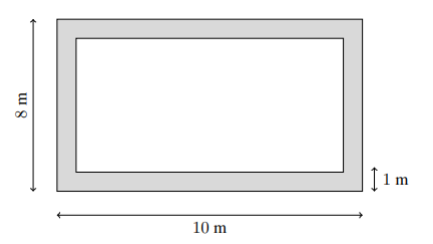
      6 Peter lives near a rectangular field that is filled with blackberry bushes. The field is 10 meters long and 8 meters wide, and Peter can reach any blackberries that are within 1 meter of an edge of the field. The portion of the field he can reach is shaded in the figure below. What fraction of the area of the field can Peter reach?

      A. $\frac{1}{6}$

      B. $\frac{1}{4}$

      C. $\frac{1}{3}$

      D. $\frac{3}{8}$

      E. $\frac{2}{5}$

      Answer - E

      7 Mika would like to estimate how far she can ride a new model of electric bike on a fully charged battery. She completed two trips totaling 40 miles. The first trip used $\frac{1}{2}$ of the total battery power, while the second trip used $\frac{3}{10}$ of the total battery power. How many miles can this electric bike go on a fully charged battery?

      A. 45

      B. 48

      C. 50

      D. 52

      E. 55

      Answer - C

      8. A poll asked a number of people if they liked solving mathematics problems. Exactly $74 \%$ answered "yes." What is the fewest possible number of people who could have been asked the question?

      A. 10

      B. 20

      C. 25

      D. 50

      E. 100

      Answer - D

      9 What is the value of this expression?

      16818116\frac{\sqrt{16 \sqrt{81}}}{\sqrt{81 \sqrt{16}}}

      A. $\frac{4}{9}$

      B. $\frac{2}{3}$

      C. 1

      D. $\frac{3}{2}$

      E. $\frac{9}{4}$

      Answer - B

      10 Five runners completed the grueling Xmarathon: Luke, Melina, Nico, Olympia, and Pedro. Nico finished 11 minutes behind Pedro.

      Olympia finished 2 minutes ahead of Melina, but 3 minutes behind Pedro.

      Olympia finished 6 minutes ahead of Luke.

      Which runner finished fourth?

      A. Luke

      B. Melina

      C. Nico

      D. Olympia

      E. Pedro

      Answer - A

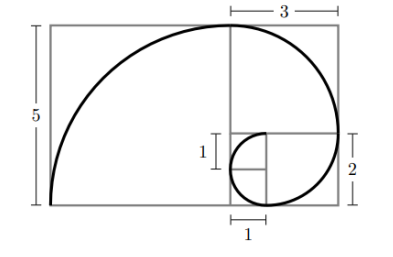
      11 Squares of side length $1,1,2,3$, and 5 are arranged to form the rectangle shown below. A curve is drawn by inscribing a quarter circle in each square and joining the quarter circles in order, from shortest to longest. What is the length of the curve?

      A. $4 \pi$

      B. $6 \pi$

      C. $\frac{13}{2} \pi$

      D. $8 \pi$

      E. $13 \pi$

      Answer - B

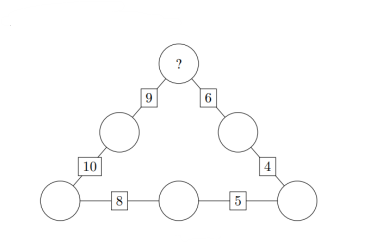
      12 In the figure below, each circle will be filled with a digit from 1 to 6 . Each digit must appear exactly once. The sum of the digits in neighboring circles is shown in the box between them. What digit must be placed in the top circle?

      A. 2

      B. 3

      C. 4

      D. 5

      E. it is impossible to fill the circles

      Answer - D

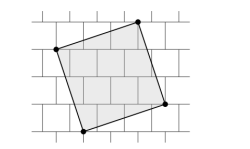
      13 The figure below shows a tiling of $1 \times 1$ unit squares. Each row of unit squares is shifted horizontally by half a unit relative to the row above it. A shaded square is drawn on top of the tiling. Each vertex of the shaded square is a vertex of one of the unit squares. In square units, what is the area of the shaded square?

      A. 10

      B. $\frac{21}{2}$

      C. $\frac{32}{3}$

      D. 11

      E. $\frac{34}{3}$

      Answer - A

      14 Jami picked three equally spaced integer numbers on the number line. The sum of the first and the second numbers is 40 , while the sum of the second and third numbers is 60 . What is the sum of all three numbers?

      A. 70

      B. 75

      C. 80

      D. 85

      E. 90

      Answer - B

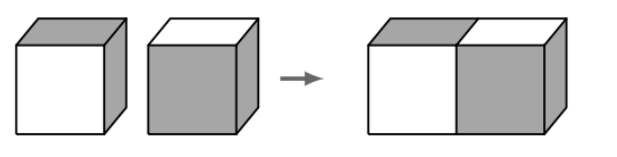
      15 Elijah has a large collection of identical wooden cubes which are white on 4 faces and gray on 2 faces that share an edge. He glues some cubes together face-to-face. The figure below shows 2 cubes being glued together, leaving 3 gray faces visible. What is the fewest number of cubes that he could glue together to ensure that no gray faces are visible, no matter how he rotates the figure?

      A. 4

      B. 6

      C. 8

      D. 9

      E. 27

      Answer - A

      16 Consider all positive four-digit integers consisting of only even digits. What fraction of these integers are divisible by 4 ?

      A. $\frac{1}{4}$

      B. $\frac{2}{5}$

      C. $\frac{1}{2}$

      D. $\frac{3}{5}$

      E. $\frac{3}{4}$

      Answer - D

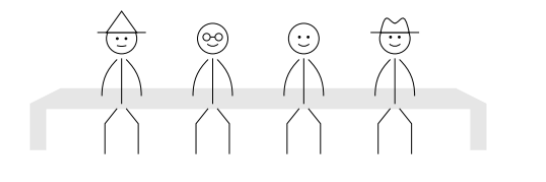
      17 Four students are seated in a row. They chat with the people sitting next to them, then rearrange themselves so that they are no longer seated next to any of the same people. How many rearrangements are possible?

      A. 2

      B. 4

      C. 9

      D. 12

      E. 24

      Answer - A

      18 In how many ways can 60 be written as the sum of two or more consecutive odd positive integers that are arranged in increasing order?

      A. 1

      B. 2

      C. 3

      D. 4

      E. 5

      Answer - B

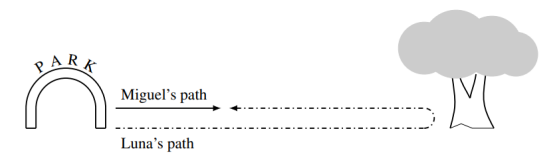
      19 Miguel is walking with his dog, Luna. When they reach the entrance to a park, Miguel throws a ball straight ahead and continues to walk at a steady pace. Luna sprints toward the ball, which stops by a tree. As soon as the dog reaches the ball, she brings it back to Miguel. Luna runs 5 times faster than Miguel walks. What fraction of the distance between the entrance and the tree does Miguel cover by the time Luna brings him the ball?

      A. $\frac{1}{6}$

      B. $\frac{1}{5}$

      C. $\frac{1}{4}$

      D. $\frac{1}{3}$

      E. $\frac{2}{5}$

      Answer - D

      20 The land of Catania uses gold coins and silver coins. Gold coins are 1 mm thick and silver coins are 3 mm thick. In how many ways can Taylor make a stack of coins that is 8 mm tall using any arrangement of gold and silver coins, assuming order matters?

      A. 3

      B. 7

      C. 10

      D. 13

      E. 16

      Answer - D

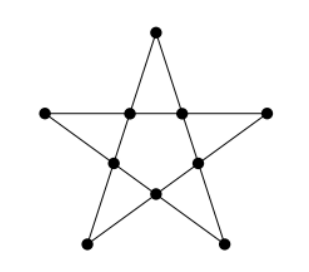
      21 Charlotte the spider is walking along a web shaped like a 5 -pointed star, shown in the figure below. The web has 5 outer points and 5 inner points. Each time Charlotte reaches a point, she randomly chooses a neighboring point and moves to that point. Charlotte starts at one of the outer points and makes 3 moves (re-visiting points is allowed). What is the probability she is now at one of the outer points?

      A. $\frac{1}{5}$

      B. $\frac{1}{4}$

      C. $\frac{2}{5}$

      D. $\frac{1}{2}$

      E. $\frac{3}{5}$

      Answer - B

      22 The integers from 1 through 25 are arbitrarily separated into five groups of 5 numbers each. The median of each group is identified. Let $M$ equal the median of the five medians. What is the least possible value of $M$ ?

      A. 9

      B. 10

      C. 12

      D. 13

      E. 14

      Answer - A

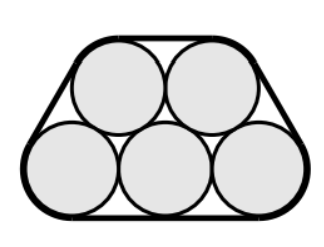
      23 Lakshmi has 5 round coins of diameter 4 centimeters. She arranges the coins in 2 rows on a table top, as shown below, and wraps an elastic band tightly around them. In centimeters, what will be the length of the band?

      A. $2 \pi+20$

      B. $\frac{5}{2} \pi+20$

      C. $4 \pi+20$

      D. $\frac{9}{2} \pi+20$

      E. $5 \pi+20$

      Answer - C

      24. The notation $n!$ (read " $n$ factorial") is defined as the product of the first $n$ positive integers. (For example, $3!=1 \cdot 2 \cdot 3=6$.) Define the superfactorial of a positive integer, denoted by $n!$, to be the product of the factorials of the first $n$ integers. (For example, $3^{!}=1!\cdot 2!\cdot 3!=12$.) How many factors of 7 appear in the prime factorization of $51^{!}$, the superfactorial of 51 ?

      A. 147

      B. 150

      C. 156

      D. 168

      E. 171

      Answer - E

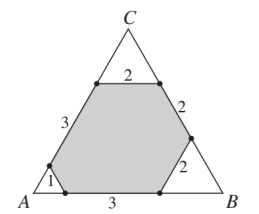
      25 In an equiangular hexagon, all interior angles measure $120^{\circ}$. An example of such a hexagon with side lengths of $2,3,1,3,2$, and 2 is shown below, inscribed in equilateral triangle $A B C$. Consider all equiangular hexagons with positive integer side lengths that can be inscribed in $\triangle A B C$, with all six vertices on the sides of the triangle. What is the total number of such hexagons? Hexagons that differ only by a rotation or a reflection are considered the same.

      A. 4

      B. 5

      C. 6

      D. 7

      E. 8

      Answer - E

      American Mathematics Competition 10A - 2021

      Problem 1
      What is the value of $\frac{(2112-2021)^{2}}{169}$ ?
      (A) 7
      (B) 21
      (C) 49
      (D) 64
      (E) 91

      Answer:

      (C) 49

      Problem 2
      Menkara has a $4 \times 6$ index card. If she shortens the length of one side of this card by 1 inch, the card would have area 18 square inches. What would the area of the card be in square inches if instead she shortens the length of the other side by 1 inch?
      (A) 16
      (B) 17
      (C) 18
      (D) 19
      (E) 20

      Answer:

      (E) 20

      Problem 3
      What is the maximum number of balls of clay with radius 2 that can completely fit inside a cube of side length 6 assuming that the balls can be reshaped but not compressed before they are packed in the cube?
      (A) 3
      (B) 4
      (C) 5
      (D) 6
      (E) 7

      Answer:

      (D) 6

      Problem 4
      Mr. Lopez has a choice of two routes to get to work. Route A is 6 miles long, and his average speed along this route is 30 miles per hour. Route B is 5 miles long, and his average speed along this route is 40 miles per hour, except for a $\frac{1}{2}$-mile stretch in a school zone where his average speed is 20 miles per hour. By how many minutes is Route B quicker than Route A?
      (A) $2 \frac{3}{4}$
      (B) $3 \frac{3}{4}$
      (C) $4 \frac{1}{2}$
      (D) $5 \frac{1}{2}$
      (E) $6 \frac{3}{4}$

      Answer:

      (B) $3 \frac{3}{4}$

      Problem 5
      The six-digit number $\underline{2} \underline{2} \underline{1} \underline{0} \underline{\mathrm{~A}}$ is prime for only one digit A . What is A ?
      (A) 1
      (B) 3
      (C) 5
      (D) 7
      (E) 9

      Answer:

      (E) 9

      Problem 6
      Elmer the emu takes 44 equal strides to walk between consecutive telephone poles on a rural road. Oscar the ostrich can cover the same distance in 12 equal leaps. The telephone poles are evenly spaced, and the 41st pole along this road is exactly one mile ( 5280 feet) from the first pole. How much longer, in feet, is Oscar's leap than Elmer's stride?
      (A) 6
      (B) 8
      (C) 10
      (D) 11
      (E) 15

      Answer:

      (B) 8

      Problem 7
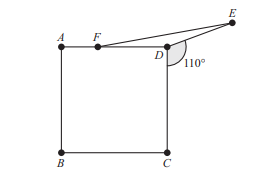
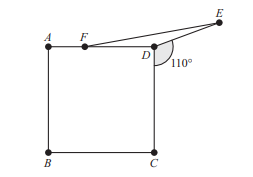
      As shown in the figure below, point $E$ lies in the opposite half-plane determined by line $C D$ from point $A$ so that $\angle C D E=110^{\circ}$. Point $F$ lies on $\overline{A D}$ so that $D E=D F$, and $A B C D$ is a square. What is the degree measure of $\angle A F E$ ?


      (A) 160
      (B) 164
      (C) 166
      (D) 170
      (E) 174

      Answer:

      (D) 170

      Problem 8
      A two-digit positive integer is said to be cuddly if it is equal to the sum of its nonzero tens digit and the square of its units digit. How many two-digit positive integers are cuddly?
      (A) 0
      (B) 1
      (C) 2
      (D) 3
      (E) 4

      Answer:

      (B) 1

      Problem 9
      When a certain unfair die is rolled, an even number is 3 times as likely to appear as an odd number. The die is rolled twice. What is the probability that the sum of the numbers rolled is even?
      (A) $\frac{3}{8}$
      (B) $\frac{4}{9}$
      (C) $\frac{5}{9}$
      (D) $\frac{9}{16}$
      (E) $\frac{5}{8}$

      Answer:

      (E) $\frac{5}{8}$

      Problem 10
      A school has 100 students and 5 teachers. In the first period, each student is taking one class, and each teacher is teaching one class. The enrollments in the classes are 50, 20, 20, 5, and 5. Let $t$ be the average value obtained if a teacher is picked at random and the number of students in their class is noted. Let $s$ be the average value obtained if a student is picked at random and the number of students in their class, including that student, is noted. What is $t-s$ ?
      (A) -18.5
      (B) -13.5
      (C) 0
      (D) 13.5
      (E) 18.5

      Answer:

      (B) -13.5

      Problem 11
      Emily sees a ship traveling at a constant speed along a straight section of a river. She walks parallel to the riverbank at a uniform rate faster than the ship. She counts 210 equal steps walking from the back of the ship to the front. Walking in the opposite direction, she counts 42 steps of the same size from the front of the ship to the back. In terms of Emily's equal steps, what is the length of the ship?
      (A) 70
      (B) 84
      (C) 98
      (D) 105
      (E) 126

      Answer:

      (A) 70

      Problem 12
      The base-nine representation of the number $N$ is $27,006,000,052_{\text {nine }}$. What is the remainder when $N$ is divided by 5 ?
      (A) 0
      (B) 1
      (C) 2
      (D) 3
      (E) 4

      Answer:

      (D) 3

      Problem 13
      Each of 6 balls is randomly and independently painted either black or white with equal probability. What is the probability that every ball is different in color from more than half of the other 5 balls?
      (A) $\frac{1}{64}$
      (B) $\frac{1}{6}$
      (C) $\frac{1}{4}$
      (D) $\frac{5}{16}$
      (E) $\frac{1}{2}$

      Answer:

      (D) $\frac{5}{16}$

      Problem 14
      How many ordered pairs $(x, y)$ of real numbers satisfy the following system of equations?

      (A) 1
      (B) 2
      (C) 3
      (D) 5
      (E) 7

      Answer:

      (D) 5

      Problem 15

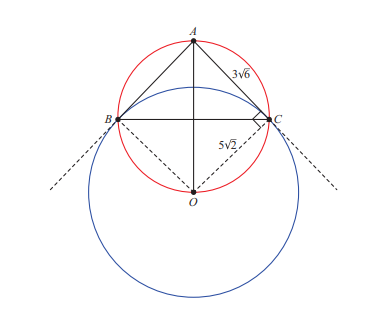
      Isosceles triangle $A B C$ has $A B=A C=3 \sqrt{6}$, and a circle with radius $5 \sqrt{2}$ is tangent to line $A B$ at $B$ and to line $A C$ at $C$. What is the area of the circle that passes through vertices $A, B$, and $C$ ?


      (A) $24 \pi$
      (B) $25 \pi$
      (C) $26 \pi$
      (D) $27 \pi$
      (E) $28 \pi$

      Answer:

      (C) $26 \pi$

      Problem 16

      The graph of $f(x)=|\lfloor x\rfloor|-|\lfloor 1-x\rfloor|$ is symmetric about which of the following?
      (A) the $y$-axis
      (B) the line $x=1$
      (C) the origin
      (D) the point $\left(\frac{1}{2}, 0\right)$
      (E) the point $(1,0)$

      Answer:

      (D) the point $\left(\frac{1}{2}, 0\right)$

      Problem 17

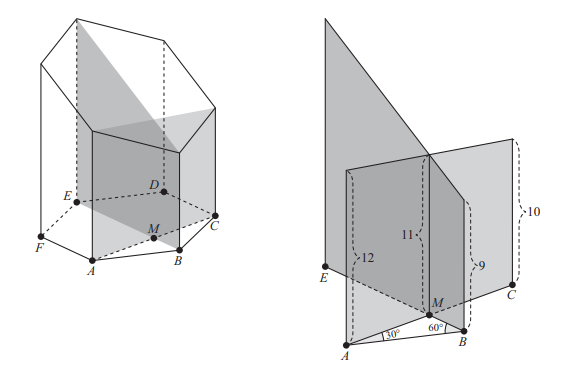
      An architect is building a structure that will place vertical pillars at the vertices of regular hexagon $A B C D E F$, which is lying horizontally on the ground. The six pillars will hold up a flat solar panel that will not be parallel to the ground. The heights of the pillars at $A, B$, and $C$ are 12, 9, and 10 meters, respectively. What is the height, in meters, of the pillar at $E$ ?


      (A) 9
      (B) $6 \sqrt{3}$
      (C) $8 \sqrt{3}$
      (D) 17
      (E) $12 \sqrt{3}$

      Answer:

      (D) 17

      Problem 18
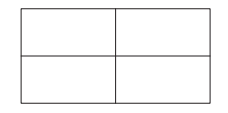
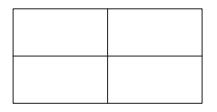
      A farmer's rectangular field is partitioned into a 2 by 2 grid of 4 rectangular sections as shown in the figure. In each section the farmer will plant one crop: corn, wheat, soybeans, or potatoes. The farmer does not want to grow corn and wheat in any two sections that share a border, and the farmer does not want to grow soybeans and potatoes in any two sections that share a border. Given these restrictions, in how many ways can the farmer choose crops to plant in each of the four sections of the field?


      (A) 12
      (B) 64
      (C) 84
      (D) 90
      (E) 144

      Answer:

      (C) 84

      Problem 19
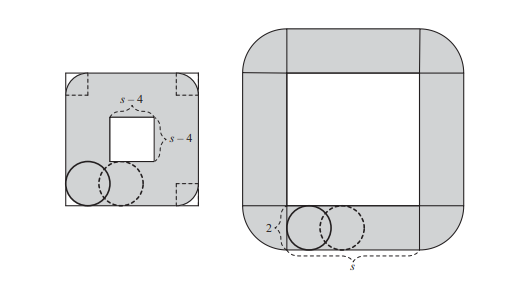
      A disk of radius 1 rolls all the way around the inside of a square of side length $s>4$ and sweeps out a region of area $A$. A second disk of radius 1 rolls all the way around the outside of the same square and sweeps out a region of area $2 A$. The value of $s$ can be written as $a+\frac{b \pi}{c}$, where $a, b$, and $c$ are positive integers and $b$ and $c$ are relatively prime. What is $a+b+c$ ?


      (A) 10
      (B) 11
      (C) 12
      (D) 13
      (E) 14

      Answer:

      (A) 10

      Problem 20

      For how many ordered pairs ( $b, c$ ) of positive integers does neither $x^{2}+ b x+c=0$ nor $x^{2}+c x+b=0$ have two distinct real solutions?


      (A) 4
      (B) 6
      (C) 8
      (D) 12
      (E) 16

      Answer:

      (B) 6

      Problem 21

      Each of 20 balls is tossed independently and at random into one of 5 bins. Let $p$ be the probability that some bin ends up with 3 balls, another with 5 balls, and the other three with 4 balls each. Let $q$ be the probability that every bin ends up with 4 balls. What is $\frac{p}{q}$ ?
      (A) 1
      (B) 4
      (C) 8
      (D) 12
      (E) 16

      Answer:

      (E) 16

      Problem 22

      Inside a right circular cone with base radius 5 and height 12 are three congruent spheres each with radius $r$. Each sphere is tangent to the other two spheres and also tangent to the base and side of the cone. What is $r$ ?


      (A) $\frac{3}{2}$
      (B) $\frac{90-40 \sqrt{3}}{11}$
      (C) 2
      (D) $\frac{144-25 \sqrt{3}}{44}$
      (E) $\frac{5}{2}$

      Answer:

      (B) $\frac{90-40 \sqrt{3}}{11}$

      Problem 23

      For each positive integer $n$, let $f_{1}(n)$ be twice the number of positive integer divisors of $n$, and for $j \geq 2$, let $f_{j}(n)=f_{1}\left(f_{j-1}(n)\right)$. For how many values of $n \leq 50$ is $f_{50}(n)=12$ ?
      (A) 7
      (B) 8
      (C) 9
      (D) 10
      (E) 11

      Answer:

      (D) 10

      Problem 24

      Each of the 12 edges of a cube is labeled 0 or 1 . Two labelings are considered different even if one can be obtained from the other by a sequence of one or more rotations and/or reflections. For how many such labelings is the sum of the labels on the edges of each of the 6 faces of the cube equal to 2 ?
      (A) 8
      (B) 10
      (C) 12
      (D) 16
      (E) 20

      Answer:

      (E) 20

      Problem 25

      A quadratic polynomial $p(x)$ with real coefficients and leading coefficient 1 is called disrespectful if the equation $p(p(x))=0$ is satisfied by exactly three real numbers. Among all the disrespectful quadratic polynomials, there is a unique such polynomial $\tilde{p}(x)$ for which the sum of the roots is maximized. What is $\tilde{p}(1)$ ?
      (A) $\frac{5}{16}$
      (B) $\frac{1}{2}$
      (C) $\frac{5}{8}$
      (D) 1
      (E) $\frac{9}{8}$

      Answer:

      (A) $\frac{5}{16}$

        American Mathematics Competition 10A - 2020

        Problem 1

        What value of $\boldsymbol{x}$ satisfies

        $$
        x-\frac{3}{4}=\frac{5}{12}-\frac{1}{3} ?
        $$

        (A) $-\frac{2}{3}$
        (B) $\frac{7}{36}$
        (C) $\frac{7}{12}$
        (D) $\frac{2}{3}$
        (E) $\frac{5}{6}$

        Answer:

        (E) $\frac{5}{6}$

        Problem 2
        The numbers $3,5,7, a$ and $b$ have an average (arithmetic mean) of 15 . What is the average of $a$ and $b$ ?
        (A) 0
        (B) 15
        (C) 30
        (D) 45
        (E) 60

        Answer:

        (C) 30

        Problem 3
        Assuming $a \neq 3, b \neq 4$, and $c \neq 5$, what is the value in simplest form of the following expression?

        $$
        \frac{a-3}{5-c} \cdot \frac{b-4}{3-a} \cdot \frac{c-5}{4-b}
        $$

        (A) -1
        (B) 1
        (C) $\frac{a b c}{60}$
        (D) $\frac{1}{a b c}-\frac{1}{60}$
        (E) $\frac{1}{60}-\frac{1}{a b c}$

        Answer:

        (A) -1

        Problem 4
        A driver travels for 2 hours at 60 miles per hour, during which her car gets 30 miles per gallon of gasoline. She is paid $\$ 0.50$ per mile, and her only expense is gasoline at $\$ 2.00$ per gallon. What is her net rate of pay, in dollars per hour, after this expense?
        (A) 20
        (B) 22
        (C) 24
        (D) 25
        (E) 26

        Answer:

        (E) 26

        Problem 5
        What is the sum of all real numbers $\boldsymbol{x}$ for which

        $$
        \left|x^{2}-12 x+34\right|=2 ?
        $$

        (A) 12
        (B) 15
        (C) 18
        (D) 21
        (E) 25

        Answer:

        (C) 18

        Problem 6
        How many 4-digit positive integers (that is, integers between 1000 and 9999, inclusive) having only even digits are divisible by 5 ?
        (A) 80
        (B) 100
        (C) 125
        (D) 200
        (E) 500

        Answer:

        (B) 100

        Problem 7
        The 25 integers from -10 to 14 inclusive, can be arranged to form a 5 -by- 5 square in which the sum of the numbers in each row, the sum of the numbers in each column, and the sum of the numbers along each of the main diagonals are all the same. What is the value of this common sum?
        (A) 2
        (B) 5
        (C) 10
        (D) 25
        (E) 50

        Answer:

        (C) 10

        Problem 8
        What is the value of

        $$
        1+2+3-4+5+6+7-8+\cdots+197+198+199-200 ?
        $$

        (A) 9,800
        (B) 9,900
        (C) 10,000
        (D) 10,100
        (E) 10,200

        Answer:

        (B) 9,900

        Problem 9
        A single bench section at a school event can hold either 7 adults or 11 children. When $N$ bench sections are connected end to end, an equal number of adults and children seated together will occupy all the bench space. What is the least possible positive integer value of $N$ ?
        (A) 9
        (B) 18
        (C) 27
        (D) 36
        (E) 77

        Answer:

        (B) 18

        Problem 10
        Seven cubes, whose volumes are $1,8,27,64,125,216$, and 343 cubic units, are stacked vertically to form a tower in which the volumes of the cubes decrease from bottom to top. Except for the bottom cube, the bottom face of each cube lies completely on top of the cube below it. What is the total surface area of the tower (including the bottom) in square units?
        (A) 644
        (B) 658
        (C) 664
        (D) 720
        (E) 749

        Answer:

        (B) 658

        Problem 11
        What is the median of the following list of 4040 numbers?

        $$
        1,2,3, \ldots, 2020,1^{2}, 2^{2}, 3^{2}, \ldots, 2020^{2}
        $$

        (A) 1974.5
        (B) 1975.5
        (C) 1976.5
        (D) 1977.5
        (E) 1978.5

        Answer:

        (C) 1976.5

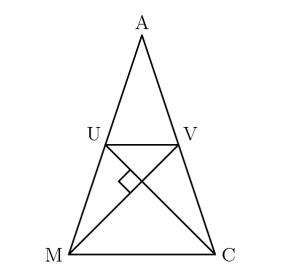
        Problem 12
        Triangle $A M C$ is isosceles with $A M=A C$. Medians $\overline{M V}$ and $\overline{C U}$ are perpendicular to each other, and $M V=C U=12$. What is the area of $\triangle A M C$ ?


        (A) 48
        (B) 72
        (C) 96
        (D) 144
        (E) 192

        Answer:

        (C) 96

        Problem 13
        A frog sitting at the point $(1,2)$ begins a sequence of jumps, where each jump is parallel to one of the coordinate axes and has length 1 , and the direction of each jump (up, down, right, or left) is chosen independently at random. The sequence ends when the frog reaches a side of the square with vertices $(0,0),(0,4),(4,4)$, and $(4,0)$. What is the probability that the sequence of jumps ends on a vertical side of the square?
        (A) $\frac{1}{2}$
        (B) $\frac{5}{8}$
        (C) $\frac{2}{3}$
        (D) $\frac{3}{4}$
        (E) $\frac{7}{8}$

        Answer:

        (B) $\frac{5}{8}$

        Problem 14
        Real numbers $\boldsymbol{x}$ and $\boldsymbol{y}$ satisfy

        $$
        x+y=4 \text { and } x \cdot y=-2 .
        $$

        What is the value of

        $$
        x+\frac{x^{3}}{y^{2}}+\frac{y^{3}}{x^{2}}+y ?
        $$

        (A) 360
        (B) 400
        (C) 420
        (D) 440
        (E) 480

        Answer:

        (D) 440

        Problem 15
        A positive integer divisor of 12 ! is chosen at random. The probability that the divisor chosen is a perfect square can be expressed as $\frac{\boldsymbol{m}}{\boldsymbol{n}}$, where $m$ and $n$ are relatively prime positive integers. What is $\boldsymbol{m}+\boldsymbol{n}$ ?
        (A) 3
        (B) 5
        (C) 12
        (D) 18
        (E) 23

        Answer:

        (E) 23

        Problem 16
        A point is chosen at random within the square in the coordinate plane whose vertices are ( 0,0 ), $(2020,0),(2020,2020)$, and $(0,2020)$. The probability that the point is within $\boldsymbol{d}$ units of a lattice point is $\frac{\mathbf{1}}{\mathbf{2}}$. (A point $(\boldsymbol{x}, \boldsymbol{y})$ is a lattice point if $\boldsymbol{x}$ and $\boldsymbol{y}$ are both integers.) What is $\boldsymbol{d}$ to the nearest tenth?
        (A) 0.3
        (B) 0.4
        (C) 0.5
        (D) 0.6
        (E) 0.7

        Answer:

        (B) 0.4

        Problem 17
        Define

        $$
        P(x)=\left(x-1^{2}\right)\left(x-2^{2}\right) \cdots\left(x-100^{2}\right) .
        $$

        How many integers $\boldsymbol{n}$ are there such that

        $$
        P(n) \leq 0 ?
        $$

        (A) 4900
        (B) 4950
        (C) 5000
        (D) 5050
        (E) 5100

        Answer:

        (E) 5100

        Problem 18
        Let ( $a, b, c, d$ ) be an ordered quadruple of not necessarily distinct integers, each one of them in the set ${0,1,2,3}$. For how many such quadruples is it true that $a \cdot d-b \cdot c$ is odd? (For example, ( $0,3,1,1$ ) is one such quadruple, because $0 \cdot 1-3 \cdot 1=-3$ is odd.)
        (A) 48
        (B) 64
        (C) 96
        (D) 128
        (E) 192

        Answer:

        (C) 96

        Problem 19
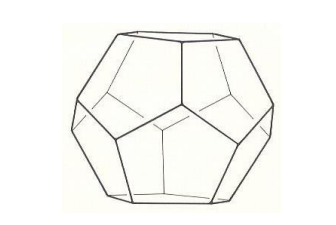
        As shown in the figure below a regular dodecahedron (the polyhedron consisting of 12 congruent regular pentagonal faces) floats in space with two horizontal faces. Note that there is a ring of five slanted faces adjacent to the top face, and a ring of five slanted faces adjacent to the bottom face. How many ways are there to move from the top face to the bottom face via a sequence of adjacent faces so that each face is visited at most once and moves are not permitted from the bottom ring to the top ring?


        (A) 125
        (B) 250
        (C) 405
        (D) 640
        (E) 810

        Answer:

        (E) 810

        Problem 20
        Quadrilateral $A B C D$ satisfies

        $$
        \angle A B C=\angle A C D=90^{\circ}, A C=20, \text { and } C D=30 .
        $$

        Diagonals $\overline{A C}$ and $\overline{B D}$ intersect at point $E$, and $A E=5$. What is the area of quadrilateral $A B C D$ ?
        (A) 330
        (B) 340
        (C) 350
        (D) 360
        (E) 370

        Answer:

        (D) 360

        Problem 21
        There exists a unique strictly increasing sequence of nonnegative integers

        $$
        a_{1}<a_{2}<\ldots<a_{k}
        $$

        such that

        $$
        \frac{2^{289}+1}{2^{17}+1}=2^{a_{1}}+2^{a_{2}}+\ldots+2^{a_{k}}
        $$

        \section*{American Mathematics Competitions}
        What is $\boldsymbol{k}$ ?
        (A) 117
        (B) 136
        (C) 137
        (D) 273
        (E) 306

        Answer:

        (C) 137

        Problem 22
        For how many positive integers $n \leq 1000$ is

        $$
        \left\lfloor\frac{998}{n}\right\rfloor+\left\lfloor\frac{999}{n}\right\rfloor+\left\lfloor\frac{1000}{n}\right\rfloor
        $$

        not divisible by 3 ? (Recall that $\lfloor x\rfloor$ is the greatest integer less than or equal to $x$.)
        (A) 22
        (B) 23
        (C) 24
        (D) 25
        (E) 26

        Answer:

        (A) 22

        Problem 23
        Let $T$ be the triangle in the coordinate plane with vertices $(0,0),(4,0)$, and $(0,3)$. Consider the following five isometries (rigid transformations) of the plane: rotations of $90^{\circ}, 180^{\circ}$, and $270^{\circ}$ counterclockwise around the origin, reflection across the $x$-axis, and reflection across the $y$-axis. How many of the 125 sequences of three of these transformations (not necessarily distinct) will return $T$ to its original position? (For example, a $180^{\circ}$ rotation, followed by a reflection across the $x$-axis, followed by a reflection across the $y$-axis will return $T$ to its original position, but a $90^{\circ}$ rotation, followed by a reflection across the $x$-axis, followed by another reflection across the $x$-axis will not return $T$ to its original position.)
        (A) 12
        (B) 15
        (C) 17
        (D) 20
        (E) 25

        Answer:

        (A) 12

        Problem 24
        Let $\boldsymbol{n}$ be the least positive integer greater than 1000 for which

        $$
        \operatorname{gcd}(63, n+120)=21 \quad \text { and } \quad \operatorname{gcd}(n+63,120)=60 .
        $$

        What is the sum of the digits of $\boldsymbol{n}$ ?
        (A) 12
        (B) 15
        (C) 18
        (D) 21
        (E) 24

        Answer:

        (C) 18

        Problem 25
        Jason rolls three fair standard six-sided dice. Then he looks at the rolls and chooses a subset of the dice (possibly empty, possibly all three dice) to reroll. After rerolling, he wins if and only if the sum of the numbers face up on the three dice is exactly 7 . Jason always plays to optimize his chances of winning. What is the probability that he chooses to reroll exactly two of the dice?
        (A) $\frac{7}{36}$
        (B) $\frac{5}{24}$
        (C) $\frac{2}{9}$
        (D) $\frac{17}{72}$
        (E) $\frac{1}{4}$

        Answer:

        (A) $\frac{7}{36}$

        American Mathematics Competition 10A - 2019

        Problem 1

        (A) 0
        (B) 1
        (C) 2
        (D) 3
        (E) 4

        Answer:

        (C) 2

        Problem 2
        What is the hundreds digit of $(20!-15!)$ ?
        (A) 0
        (B) 1
        (C) 2
        (D) 4
        (E) 5

        Answer:

        (A) 0

        Problem 3
        Ana and Bonita were born on the same date in different years, $n$ years apart. Last year Ana was 5 times as old as Bonita. This year Ana's age is the square of Bonita's age. What is $n$ ?
        (A) 3
        (B) 5
        (C) 9
        (D) 12
        (E) 15

        Answer:

        (D) 12

        Problem 4
        A box contains 28 red balls, 20 green balls, 19 yellow balls, 13 blue balls, 11 white balls, and 9 black balls. What is the minimum number of balls that must be drawn from the box without replacement to guarantee that at least 15 balls of a single color will be drawn?
        (A) 75
        (B) 76
        (C) 79
        (D) 84
        (E) 91

        Answer:

        (B) 76

        Problem 5
        What is the greatest number of consecutive integers whose sum is 45 ?
        (A) 9
        (B) 25
        (C) 45
        (D) 90
        (E) 120

        Answer:

        (D) 90

        Problem 6
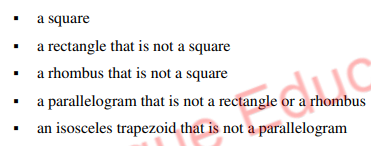
        For how many of the following types of quadrilaterals does there exist a point in the plane of the quadrilateral that is equidistant from all four vertices of the quadrilateral?


        (A) 1
        (B) 2
        (C) 3
        (D) 4
        (E) 5

        Answer:

        (C) 3

        Problem 7
        Two lines with slopes $\frac{1}{2}$ and 2 intersect at $(2,2)$. What is the area of the triangle enclosed by these two lines and the line $x+y=10$ ?
        (A) 4
        (B) $4 \sqrt{2}$
        (C) 6
        (D) 8
        (E) $6 \sqrt{2}$

        Answer:

        (C) 6

        Problem 8
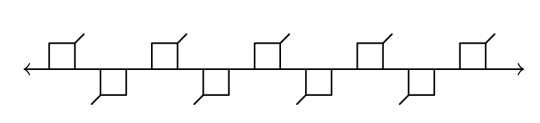
        The figure below shows line $\ell$ with a regular, infinite, recurring pattern of squares and line segments.

        How many of the following four kinds of rigid motion transformations of the plane in which this figure is drawn, other than the identity transformation, will transform this figure into itself?


        (A) 0
        (B) 1
        (C) 2
        (D) 3
        (E) 4

        Answer:

        (C) 2

        Problem 9
        What is the greatest three-digit positive integer $n$ for which the sum of the first $n$ positive integers is not a divisor of the product of the first $n$ positive integers?
        (A) 995
        (B) 996
        (C) 997
        (D) 998
        (E) 999

        Answer:

        (B) 996

        Problem 10
        A rectangular floor that is 10 feet wide and 17 feet long is tiled with 170 one-foot square tiles. A bug walks from one corner to the opposite corner in a straight line. Including the first and the last tile, how many tiles does the bug visit?
        (A) 17
        (B) 25
        (C) 26
        (D) 27
        (E) 28

        Answer:

        (C) 26

        Problem 11
        How many positive integer divisors of $201^{9}$ are perfect squares or perfect cubes (or both)?
        (A) 32
        (B) 36
        (C) 37
        (D) 39
        (E) 41

        Answer:

        (C) 37

        Problem 12
        Melanie computes the mean $\mu$, the median $M$, and the modes of the 365 values that are the dates in the months of 2019 . Thus her data consist of $121 \mathrm{~s}, 122 \mathrm{~s}$, . . . $, 1228 \mathrm{~s}, 1129 \mathrm{~s}, 1130 \mathrm{~s}$, and 731 s . Let $d$ be the median of the modes. Which of the following statements is true?
        (A) $\mu<d<M$
        (B) $M<d<\mu$
        (C) $d=M=\mu$
        (D) $d<M<\mu$
        (E) $d<\mu<M$

        Answer:

        (E) $d<\mu<M$

        Problem 13
        Let $\triangle A B C$ be an isosceles triangle with $B C=A C$ and $\angle A C B=40^{\circ}$. Contruct the circle with diameter $\overline{B C}$, and let $D$ and $E$ be the other intersection points of the circle with the sides $\overline{A C}$ and $\overline{A B}$, respectively. Let $F$ be the intersection of the diagonals of the quadrilateral $B C D E$. What is the degree measure of $\angle B F C$ ?
        (A) 90
        (B) 100
        (C) 105
        (D) 110
        (E) 120

        Answer:

        (D) 110

        Problem 14
        For a set of four distinct lines in a plane, there are exactly $N$ distinct points that lie on two or more of the lines. What is the sum of all possible values of $N$ ?
        (A) 14
        (B) 16
        (C) 18
        (D) 19
        (E) 21

        Answer:

        (D) 19

        Problem 15
        A sequence of numbers is defined recursively by $a_{1}=1, a_{2}=\frac{3}{7}$, and

        for all $n \geq 3$ Then $a_{2019}$ can be written as $\frac{p}{q}$, where $p$ and $q$ are relatively prime positive inegers. What is $p+q$ ?
        (A) 2020
        (B) 4039
        (C) 6057
        (D) 6061
        (E) 8078

        Answer:

        (E) 8078

        Problem 16
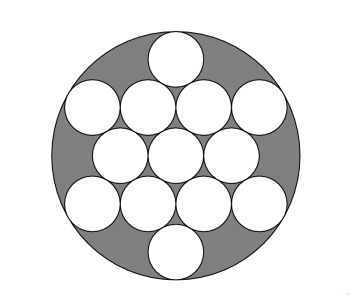
        The figure below shows 13 circles of radius 1 within a larger circle. All the intersections occur at points of tangency. What is the area of the region, shaded in the figure, inside the larger circle but outside all the circles of radius 1 ?


        (A) $4 \pi \sqrt{3}$
        (B) $7 \pi$
        (C) $\pi(3 \sqrt{3}+2)$
        (D) $10 \pi(\sqrt{3}-1)$
        (E) $\pi(\sqrt{3}+6)$

        Answer:

        (A) $4 \pi \sqrt{3}$

        Problem 17
        A child builds towers using identically shaped cubes of different color. How many different towers with a height 8 cubes can the child build with 2 red cubes, 3 blue cubes, and 4 green cubes? (One cube will be left out.)
        (A) 24
        (B) 288
        (C) 312
        (D) 1, 260
        (E) 40,320

        Answer:

        (D) 1, 260

        Problem 18
        For some positive integer $k$, the repeating base- $k$ representation of the (base-ten) fraction $\frac{7}{51}$ is $0 . \overline{23}_{k}=0.232323 \ldots k$. What is $k$ ?
        (A) 13
        (B) 14
        (C) 15
        (D) 16
        (E) 17

        Answer:

        (D) 16

        Problem 19
        What is the least possible value of

        $$
        (x+1)(x+2)(x+3)(x+4)+2019
        $$

        where $x$ is a real number?
        (A) 2017
        (B) 2018
        (C) 2019
        (D) 2020
        (E) 2021

        Answer:

        (B) 2018

        Problem 20
        The numbers $1,2, \ldots, 9$ are randomly placed into the 9 squares of a $3 \times 3$ grid. Each square gets one number, and each of the numbers is used once. What is the probability that the sum of the numbers in each row and each column is odd?
        (A) $1 / 21$
        (B) $1 / 14$
        (C) $5 / 63$
        (D) $2 / 21$
        (E) $1 / 7$

        Answer:

        (B) $1 / 14$

        Problem 21
        A sphere with center $O$ has radius 6 . A triangle with sides of length 15, 15, and 24 is situated in space so that each of its sides is tangent to the sphere. What is the distance between $O$ and the plane determined by the triangle?
        (A) $2 \sqrt{3}$
        (B) 4
        (C) $3 \sqrt{2}$
        (D) $2 \sqrt{5}$
        (E) 5

        Answer:

        (D) $2 \sqrt{5}$

        Problem 22
        Real numbers between 0 and 1 , inclusive, are chosen in the following manner. A fair coin is flipped. If it lands heads, then it is flipped again and the chosen number is 0 if the second flip is heads and 1 if the second flip is tails. On the other hand, if the first coin flip is tails, then the number is chosen uniformly at random from the closed interval $[0,1]$. Two random numbers $x$ and $y$ are chosen independently in this manner. What is the probability that

        $$
        |x-y|>\frac{1}{2} ?
        $$

        (A) $\frac{1}{3}$
        (B) $\frac{7}{16}$
        (C) $\frac{1}{2}$
        (D) $\frac{9}{16}$
        (E) $\frac{2}{3}$

        Answer:

        (B) $\frac{7}{16}$

        Problem 23
        Travis has to babysit the terrible Thompson triplets. Knowing that they love big numbers, Travis devises a counting game for them. First Tadd will say the number 1, then Todd must say the next two numbers ( 2 and 3 ), then Tucker must say the next three numbers $(4,5,6)$, then Tadd must say the next four numbers $(7,8,9,10)$, and the process continues to rotate through the three children in order, each saying one more number than the previous child did, until the number 10,000 is reached. What is the 2019th number said by Tadd?
        (A) 5743
        (B) 5885
        (C) 5979
        (D) 6001
        (E) 6011

        Answer:

        (C) 5979

        Problem 24
        Let $p, q$, and $r$ be the distinct roots of the polynomial $x^{3}-22 x^{2}+80 x-67$. It is given that there exist real numbers $A, B$, and $C$ such that

        $$
        \frac{1}{s^{3}-22 s^{2}+80 s-67}=\frac{A}{s-p}+\frac{B}{s-q}+\frac{C}{s-r}
        $$

        for all $s \notin{p, q, r}$. What is $\frac{1}{A}+\frac{1}{B}+\frac{1}{C}$ ?
        (A) 243
        (B) 244
        (C) 245
        (D) 246
        (E) 247

        Answer:

        (B) 244

        Problem 25
        For how many integers $n$ between 1 and 50 , inclusive, is

        $$
        \frac{\left(n^{2}-1\right)!}{(n!)^{n}}
        $$

        an integer? (Recall that $0!=1$.)
        (A) 31
        (B) 32
        (C) 33
        (D) 34
        (E) 35

        Answer:

        (D) 34

        American Mathematics Competition 10A - 2024

        Problem 1
        What is the value of $9901 \cdot 101-99 \cdot 10101$ ?
        (A) 2
        (B) 20
        (C) 200
        (D) 202
        (E) 2020

        Answer:

        (A) 2

        Problem 2
        A model used to estimate the time it will take to hike to the top of the mountain on a trail is of the form $T=a L+b G$, where $a$ and $b$ are constants, $T$ is the time in minutes, $L$ is the length of the trail in miles, and $G$ is the altitude gain in feet. The model estimates that it will take 69 minutes to hike to the top if a trail is 1.5 miles long and ascends 800 feet, as well as if a trail is 1.2 miles long and ascends 1100 feet. How many minutes does the model estimate it will take to hike to the top if the trail is 4.2 miles long and ascends 4000 feet?
        (A) 240
        (B) 246
        (C) 252
        (D) 258
        (E) 264

        Answer:

        (B) 246

        Problem 3
        What is the sum of the digits of the smallest prime that can be written as a sum of 5 distinct primes?
        (A) 5
        (B) 7
        (C) 9
        (D) 10
        (E) 13

        Answer:

        (B) 7

        Problem 4
        The number 2024 is written as the sum of not necessarily distinct two-digit numbers. What is the least number of two-digit numbers needed to write this sum?
        (A) 20
        (B) 21
        (C) 22
        (D) 23
        (E) 24

        Answer:

        (B) 21

        Problem 5

        What is the least value of $n$ such that $n!$ is a multiple of 2024 ?
        (A) 11
        (B) 21
        (C) 22
        (D) 23
        (E) 253

        Answer:

        (D) 23

        Problem 6
        What is the minimum number of successive swaps of adjacent letters in the string ABCDEF that are needed to change the string to FEDCBA ?
        (For example, 3 swaps are required to change ABC to CBA ; one such sequence of swaps is $\mathrm{ABC} \rightarrow \mathrm{BAC} \rightarrow \mathrm{BCA} \rightarrow \mathrm{CBA}$.)
        (A) 6
        (B) 10
        (C) 12
        (D) 15
        (E) 24

        Answer:

        (D) 15

        Problem 7
        The product of three integers is 60 . What is the least possible positive sum of the three integers?
        (A) 2
        (B) 3
        (C) 5
        (D) 6
        (E) 13

        Answer:

        (B) 3

        Problem 8
        Amy, Bomani, Charlie, and Daria work in a chocolate factory. On Monday Amy, Bomani, and Charlie started working at 1:00 PM and were able to pack 4, 3 , and 3 packages, respectively, every 3 minutes. At some later time, Daria joined the group, and Daria was able to pack 5 packages every 4 minutes. Together, they finished packing 450 packages at exactly 2:45 PM. At what time did Daria join the group?
        (A) 1:25 PM
        (B) 1:35 PM
        (C) 1:45 PM
        (D) 1:55 PM
        (E) 2:05 PM

        Answer:

        (A) 1:25 PM

        Problem 9
        In how many ways can 6 juniors and 6 seniors form 3 disjoint teams of 4 people so that each team has 2 juniors and 2 seniors?
        (A) 720
        (B) 1350
        (C) 2700
        (D) 3280
        (E) 8100

        Answer:

        (B) 1350

        Problem 10
        Consider the following operation. Given a positive integer $n$, if $n$ is a multiple of 3 , then you replace $n$ by $\frac{n}{3}$. If $n$ is not a multiple of 3 , then you replace $n$ by $n+10$ . Then continue this process. For example, beginning with $n=4$, this procedure gives $\quad 4 \rightarrow 14 \rightarrow 24 \rightarrow 8 \rightarrow 18 \rightarrow 6 \rightarrow 2 \rightarrow 12 \rightarrow \cdots$. Suppose you start with $n=100$. What value results if you perform this operation exactly 100 times?
        (A) 10
        (B) 20
        (C) 30
        (D) 40
        (E) 50

        Answer:

        (C) 30

        Problem 11
        How many ordered pairs of integers $(m, n)$ satisfy

        $$
        \sqrt{n^{2}-49}=m \text { ? }
        $$

        (A) 1
        (B) 2
        (C) 3
        (D) 4
        (E) Infinitely many

        Answer:

        (D) 4

        Problem 12

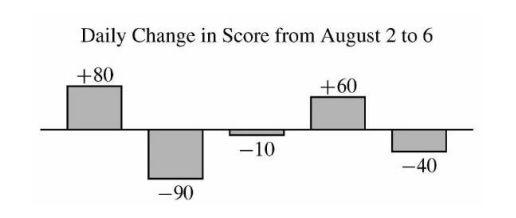
        Zelda played the Adventures of Math game on August 1 and scored 1700 points. She continued to play daily over the next 5 days. The bar chart below shows the daily change in her score compared to the day before. (For example, Zelda's score on August 2 was $1700+80=1780$ points.) What was Zelda's average score in points over the 6 days?


        (A) 1700
        (B) 1702
        (C) 1703
        (D) 1713
        (E) 1715

        Answer:

        (E) 1715

        Problem 13

        Two transformations are said to commute if applying the first followed by the second gives the same result as applying the second followed by the first. Consider these four transformations of the coordinate plane:

        Of the 6 pairs of distinct transformations from this list, how many commute?
        (A) 1
        (B) 2
        (C) 3
        (D) 4
        (E) 5

        Answer:

        (C) 3

        Problem 14
        One side of an equilateral triangle of height 24 lies on line $\ell$. A circle of radius 12 is tangent to $\ell$ and is externally tangent to the triangle. The area of the region exterior to the triangle and the circle and bounded by the triangle, the circle, and line $\ell$ can be written as $a \sqrt{b}-c \pi$, where $a, b$, and $c$ are positive integers and $b$ is not divisible by the square of any prime. What is $a+b+c$ ?
        (A) 72
        (B) 73
        (C) 74
        (D) 75
        (E) 76

        Answer:

        (D) 75

        Problem 15
        Let $M$ be the greatest integer such that both $M+1213$ and $M+3773$ are perfect squares. What is the units digit of $M$ ?
        (A) 1
        (B) 2
        (C) 3
        (D) 6
        (E) 8

        Answer:

        (E) 8

        Problem 16

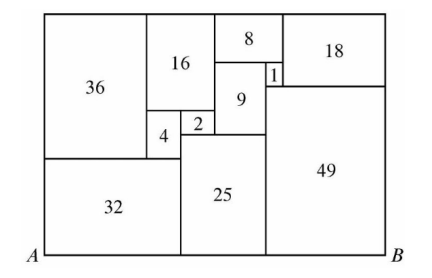
        All of the rectangles in the figure below, which is drawn to scale, are similar to the enclosing rectangle. Each number represents the area of the rectangle. What is length $A B$ ?


        (A) $4+4 \sqrt{5}$
        (B) $10 \sqrt{2}$
        (C) $5+5 \sqrt{5}$
        (D) $10 \sqrt[4]{8}$
        (E) 20

        Answer:

        (D) $10 \sqrt[4]{8}$

        Problem 17
        Two teams are in a best-two-out-of-three playoff: the teams will play at most 3 games, and the winner of the playoff is the first team to win 2 games. The first game is played on Team A's home field, and the remaining games are played on Team B's home field. Team A has a $\frac{2}{3}$ chance of winning at home, and its\
        probability of winning when playing away from home is $p$. Outcomes of the games are independent. The probability that Team A wins the playoff is $\frac{1}{2}$. Then $p$ can be written in the form $\frac{1}{2}(m-\sqrt{n})$, where $m$ and $n$ are positive integers. What is $m+n$ ?
        (A) 10
        (B) 11
        (C) 12
        (D) 13
        (E) 14

        Answer:

        (E) 14

        Problem 18
        There are exactly $K$ positive integers $b$ with $5 \leq b \leq 2024$ such that the base$b$ integer $2024_{b}$ is divisible by 16 (where 16 is in base ten). What is the sum of the digits of $K$ ?
        (A) 16
        (B) 17
        (C) 18
        (D) 20
        (E) 21

        Answer:

        (D) 20

        Problem 19
        The first three terms of a geometric sequence are the integers $a, 720$, and $b$, where $a<720<b$. What is the sum of the digits of the least possible value of $b$ ?
        (A) 9
        (B) 12
        (C) 16
        (D) 18
        (E) 21

        Answer:

        (E) 21

        Problem 20
        Let $S$ be a subset of ${1,2,3, \ldots, 2024}$ such that the following two conditions hold:

        What is the maximum possible number of elements in $S$ ?
        (A) 436
        (B) 506
        (C) 608
        (D) 654
        (E) 675

        Answer:

        (C) 608

        Problem 21
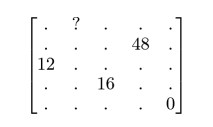
        The numbers, in order, of each row and the numbers, in order, of each column of a $5 \times 5$ array of integers form an arithmetic progression of length 5 . The numbers in positions $(5,5),(2,4),(4,3)$, and $(3,1)$ are $0,48,16$, and 12 , respectively. What number is in position $(1,2)$ ?

        (A) 19
        (B) 24
        (C) 29
        (D) 34
        (E) 39

        Answer:

        (C) 29

        Problem 22
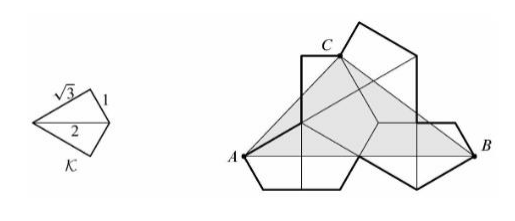
        Let $\mathcal{K}$ be the kite formed by joining two right triangles with legs 1 and $\sqrt{3}$ along a common hypotenuse. Eight copies of $\mathcal{K}$ are used to form the polygon shown below. What is the area of triangle $\triangle A B C$ ?


        (A) $2+3 \sqrt{3}$
        (B) $\frac{9}{2} \sqrt{3}$
        (C) $\frac{10+8 \sqrt{3}}{3}$
        (D) 8
        (E) $5 \sqrt{3}$

        Answer:

        (B) $\frac{9}{2} \sqrt{3}$

        Problem 23
        The first three terms of a geometric sequence are the integers $a, 720$, and $b$, where $a<720<b$. What is the sum of the digits of the least possible value of $b$ ?
        (A) 9
        (B) 12
        (C) 16
        (D) 18
        (E) 21

        Answer:

        (D) 18
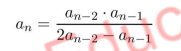
        Problem 24
        A bee is moving in three-dimensional space. A fair six-sided die with faces labeled $A^{+}, A^{-}, B^{+}, B^{-}, C^{+}$, and $C^{-}$is rolled. Suppose the bee occupies the point $(a, b, c)$. If the die shows $A^{+}$, then the bee moves to the point $(a+1, b, c)$ and if the die shows $A^{-}$, then the bee moves to the point $(a-1, b, c)$. Analogous moves are made with the other four outcomes. Suppose the bee starts at the
        point $(0,0,0)$ and the die is rolled four times. What is the probability that the bee traverses four distinct edges of some unit cube?
        (A) $\frac{1}{54}$
        (B) $\frac{7}{54}$
        (C) $\frac{1}{6}$
        (D) $\frac{5}{18}$
        (E) $\frac{2}{5}$

        Answer:

        (B) $\frac{7}{54}$

        Problem 25
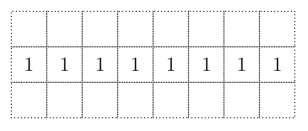
        The figure below shows a dotted grid 8 cells wide and 3 cells tall consisting of $1^{\prime \prime} \times 1^{\prime \prime}$ squares. Carl places 1 -inch toothpicks along some of the sides of the squares to create a closed loop that does not intersect itself. The numbers in the cells indicate the number of sides of that square that are to be covered by toothpicks, and any number of toothpicks are allowed if no number is written. In how many ways can Carl place the toothpicks?


        (A) 130
        (B) 144
        (C) 146
        (D) 162
        (E) 196

        Answer:

        (C) 146

        American Mathematics Competition 12A - 2025

        Problem 1

        Andy and Betsy both live in Mathville. Andy leaves Mathville on his bicycle at $1: 30$, traveling due north at a steady 8 miles per hour. Betsy leaves on her bicycle from the same point at 2:30, traveling due east at a steady 12 miles per hour. At what time will they be exactly the same distance from their common starting point?
        (A) 3:30
        (B) $3: 45$
        (C) $4: 00$
        (D) $4: 15$
        (E) 4:30

        Solution :

        Let $h$ be the number of hours after Andy starts. Andy travels $8 h$ miles, and Betsy has traveled $12(h-1)$ miles since she started one hour later. Setting them equal:

        $$
        8 h=12(h-1) \Rightarrow 8 h=12 h-12 \Rightarrow 4 h=12 \Rightarrow h=3
        $$

        Since Andy started at 1:30, the catch-up time is 4:30. Answer: (E).
        Alternatively, from Betsy's perspective: $8(h+1)=12 h \Rightarrow 8 h+8=12 h \Rightarrow h=2$ Same result: (E) $4: 30$.

        Problem 2

        A box contains 10 pounds of a nut mix that is 50 percent peanuts, 20 percent cashews, and 30 percent almonds. A second nut mix containing 20 percent peanuts, 40 percent cashews, and 40 percent almonds is added to the box resulting in a new nut mix that is 40 percent peanuts. How many pounds of cashews are now in the box?
        (A) 3.5
        (B) 4
        (C) 4.5
        (D) 5
        (E) 6

        Solution :

        We are given $0.2(10)=2$ pounds of cashews in the first box.
        Denote the pounds of nuts in the second nut mix as $x$.

        $$
        \begin{gathered}
        5+0.2 x=0.4(10+x) \
        0.2 x=1 \
        x=5
        \end{gathered}
        $$

        Thus, we have 5 pounds of the second mix.

        $$
        0.4(5)+2=2+2=\text { (B) } 4
        $$

        Problem 3

        A team of students is going to compete against a team of teachers in a trivia contest. The total number of students and teachers is 15 . Ash, a cousin of one of the students, wants to join the contest. If Ash plays with the students, the average age on that team will increase from 12 to 14 . If Ash plays with the teachers, the average age on that team will decrease from 55 to 52 . How old is Ash?
        (A) 28
        (B) 29
        (C) 30
        (D) 32
        (E) 33

        Solution :

        When Ash joins a team, the team's average is pulled towards his age. Let $A$ be Ash's age and $N$ be the number of people on the student team. This means that there are $15-N$ people in the teacher team. Let us write an expression for the change in the average for each team.

        The students originally had an average of 12 , which became 14 when Ash joined, so there was an increase of 2 . The term $A-12$ represents how much older Ash is compared to the average of the students'. If we divide this by $N+1$, which is the number of people on the student team when Ash joins, we get the average change per team member once Ash is added. Therefore,

        $$
        \frac{A-12}{N+1}=2 .
        $$

        Similarly, for teachers, the average was originally 55 , which decreased by 3 to become 52 when Ash joined. Intuitively, $55-A$ represents how much younger Ash is than the average age of the teachers. Dividing this by the expression $(15-N)+1$, which is the new total number of people on the teacher team, represents the average change per team member once Ash joins. We can write the equation

        $$
        \frac{55-A}{16-N}=3 .
        $$

        To solve the system, multiply equation (1) by $N+1$, and similarly multiply equation (2) by $16-N$. Then add the equations together, canceling $A$, leaving equation $43=50-N$. From this we get $N=7$ and $A=28$.

        Problem 4:

        Agnes writes the following four statements on a blank piece of paper.

        Each statement is either true or false. How many false statements did Agnes write on the paper?
        (A) 0
        (B) 1
        (C) 2
        (D) 3
        (E) 4

        Solution

        We first number all the statements:
        1) At least one of these statements is true. 2) At least two of these statements are true. 3) At least two of these statements are false. 4) At least one of these statements is false.

        We can immediately see that statement 4 must be true, as it would contradict itself if it were false. Similarly, statement 1 must be true, as all the other statements must be false if it were false, which is contradictory because statement 4 is true. Since both 1 and 4 are true, statement 2 has to be true. Therefore, statement 3 is the only false statement, making the answer (B) 1.

        Problem 5

        Solution:

        Problem 6:

        Solution:

        AMERICAN MATHEMATICS COMPETITION 8 - 2020