Let $\alpha$ and $\beta$ be the roots of $x^{2}-5 x+3=0$ with $\alpha>\beta$. If $a_{n}=\alpha^{n}-\beta^{n}$ for $n \geq 1$ then the value of $\frac{3 a_{6}+a_{8}}{a_{7}}$ is
(a) 2
(b) 3
(c) 4
(d) 5
Question 2
The number of triples $(x, y, z)$ such that any one of these numbers is added to the product of the other two, the result is 2 , is
(a) 1
(b) 2
(c) 4
(d) infinitely many
Question 3
In rectangle $\mathrm{ABCD}, \mathrm{AB}=5$ and $\mathrm{BC}=3$. Points F and G are on the line segment CD so that $\mathrm{DF}=1$ and $\mathrm{GC}=2$. Lines AF and BG intersect at E . What is the area of AEB ?
(a) 10 sq. units
(b) $15 / 2$ sq. units
(c) $25 / 2$ sq. units
(d) 20 sq. units
Question 4
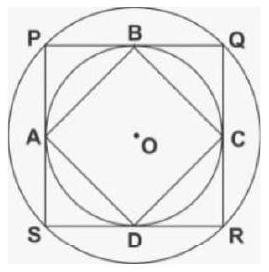
In the given figure, two concentric circles are shown with centre O . PQRS is a square inscribed in the outer circle. It also circumscribes the inner circle, touching it at points $\mathrm{B}, \mathrm{C}, \mathrm{D}$ and A . What is the ratio of the perimeter of the outer circle to that of quadrilateral ABCD ?
(a) $\frac{\pi}{4}$
(b) $\frac{3 \pi}{2}$
(c) $\frac{\pi}{2}$
(d) $\pi$
Question 5
How many positive integers N give a remainder 8 when 2008 is divided by N.
(a) 12
(b) 13
(c) 14
(d) 15
Question 6
What is the product of all the roots of the equation $\sqrt{5|x|+8}=\sqrt{x^{2}-16}$ ?
(a) - 64
(b) - 24
(c) 576
(d) 24
Question 7
LCM of two numbers is 5775 . Which of the following cannot be their HCF?
(a) 175
(b) 231
(c) 385
(d) 455
Question 8
If $a, b, c$ are distinct real numbers such that $a+\frac{1}{b}=b+\frac{1}{c}=c+\frac{1}{a}$ evaluate $a b c$.
(a) $\pm \sqrt{2}$
(b) $\sqrt{2}-1$
(c) $\sqrt{3}$
(d) $\pm 1$
Question 9
If the equation $\left(\alpha^{2}-5 \alpha+6\right) x^{2}+\left(\alpha^{2}-3 \alpha+2\right) x+\left(\alpha^{2}-4\right)=0$ has more than two roots, then the value of $\alpha$ is
(a) 2
(b) 3
(c) 1
(d) none of these
Question 10
Mr. X with his eight children of different ages is on a family trip. His oldest child, who is 9 years old saw a license plate with a 4-digit number in which each of two digits appear two times. "Look daddy!" she exclaims. "That number is evenly divisible by the age of each of us kids!" "That's right," replies Mr. X, "and the last two digits just happen to be my age". Which of the following is not the age of one of Mr. X's children?
(a) 4
(b) 5
(c) 6
(d) 7
Question 11
How many numbers lie between 11 and 1111 which divided by 9 leave a remainder 6 and when divided by 21 leave a remainder 12 ?
(a) 18
(b) 28
(c) 8
(d) None of these
Question 12
Two unbiased dice are rolled. What is the probability of getting a sum which is neither 7 nor 11 ?
(a) $7 / 9$
(b) $7 / 18$
(c) $2 / 9$
(d) $11 / 18$
Question 13
The solution of the equation $1+4+7+\ldots \ldots+x=925$ is
(a) 73
(b) 76
(c) 70
(d) 74
Question 14
If $\tan \theta+\sec \theta=1.5$, then value of $\sin \theta$ is
(a) $\frac{5}{13}$
(b) $\frac{12}{13}$
(c) $\frac{3}{5}$
(d) $\frac{2}{3}$
Question 15
An observer standing at the top of a tower, finds that the angle of elevation of a red bulb on the top of a light house of height H is $\alpha$. Further, he finds that the angle of depression of reflection of the bulb in the ocean is $\beta$. Therefore, the height of the tower is
The sum of the roots of $\frac{1}{x+a}+\frac{1}{x+b}=\frac{1}{c}$ is zero. The product of roots is
(a) 0
(b) $\frac{a+b}{2}$
(c) $-\frac{1}{2}\left(a^{2}+b^{2}\right)$
(d) $2\left(a^{2}+b^{2}\right)$
Question 17
In the convex quadrilateral ABCD , the diagonals AC and BD meet at O and the measure of angle AOB is $30^{\circ}$. If the areas of triangle $\mathrm{AOB}, \mathrm{BOC}, \mathrm{COD}$ and AOD are $1,2,8$ and 4 square units respectively, what is the product of the lengths of the diagonals AC and DB in sq. units?
(a) 60
(b) 56
(c) 54
(d) 64
Question 18
If $\sin ^{2} x+\sin ^{2} y+\sin ^{2} z=0$, then which of the following is NOT a possible value of $\cos x+\cos y+\cos z ?$
(a) 3
(b) -3
(c) -1
(d) -2
Question 19
Find the remainder when $x^{51}$ is divided by $x^{2}-3 x+2$.
(a) $x$
(b) $\left(2^{51}-2\right) x+2-2^{51}$
(c) $\left(2^{51}-1\right) x+2-2^{51}$
(d) 0
Question 20
In an equilateral triangle, three coins of radii 1 unit each are kept so that they touch each other and also sides of the triangle. The area of triangle ABC (in sq. units) is
(a) $4+2 \sqrt{3}$
(b) $4 \sqrt{3}+6$
(c) $12+\frac{7 \sqrt{3}}{4}$
(d) $3+\frac{7 \sqrt{3}}{4}$
Question 21
Apples dropping from apple trees were observed by many people before Newton. But why they fall, was explained by Isaac Newton postulating the law of universal gravitation. Which of the following statements best describes the situation?
(a) The force of gravity acts only on the apple
(b) The apple is attracted towards the surface of the earth
(c) Both earth and apple experience the same force of attraction towards each other
(d) Apple falls due to earth's gravity and hence only (a) is true and (c) is absurd
Question 22
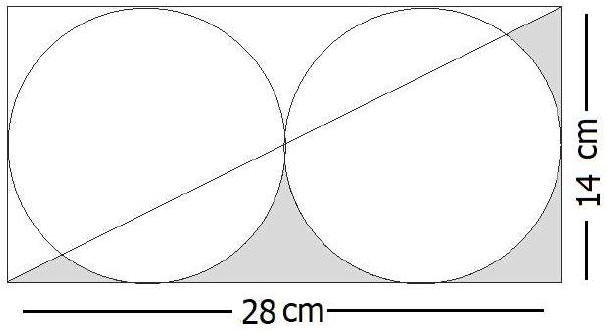
A rectangular metal plate, shown in the adjacent figure has a charge of $420 \mu \mathrm{C}$ assumed to be uniformly distributed over it. Then how much is the charge over the shaded area? No part of metal plate is cut. (Circles and the diagonal are shown for clarity only. $\pi=22 / 7$ )
(a) $45 \mu \mathrm{C}$
(b) $450 \mu \mathrm{C}$
(c) $15 \mu \mathrm{C}$
(d) $150 \mu \mathrm{C}$
Question 23
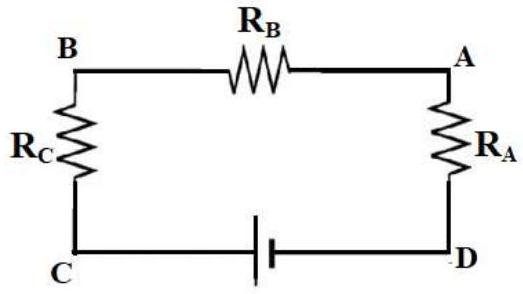
In the adjacent circuit, the voltages across AD , BD and CD are $2 \mathrm{ V}, 6 \mathrm{ V}$ and 8 V respectively. If resistance $R_{A}=1 \mathrm{k} \Omega$, then the values of resistances $\mathrm{R}_{\mathrm{B}}$ and $\mathrm{R}_{\mathrm{C}}$ are ____ and ____ respectively.
(a) $4 \mathrm{k} \Omega$ and $6 \mathrm{k} \Omega$
(b) $2 \mathrm{k} \Omega$ and $1 \mathrm{k} \Omega$
(c) $1 \mathrm{k} \Omega$ and $2 \mathrm{k} \Omega$
(d) data insufficient as battery voltage is not given
Question 24
A new linear scale of temperature measurement is to be designed. It is called a ' Z scale' on which the freezing and boiling points of water are 20 Z and 220 Z respectively. What will be the temperature shown on the ' Z scale' corresponding to a temperature of $20^{\circ} \mathrm{C}$ on the Celsius scale?
(a) 10 Z
(b) 20 Z
(c) 40 Z
(d) 60 Z
Question 25
Consider the motion of a small spherical steel body of mass $m$, falling freely through a long column of a fluid that opposes its motion with a force proportional to its speed. Initially the body moves down fast, but after some time attains a constant velocity known as terminal velocity. If weight $m g$, opposing force ( $F_{v}$ ) and buoyant force ( $F_{b}$ ) act on the body, then the correct equation relating these forces, after the terminal velocity is reached, is:
(a) $m g+F_{v}=F_{b}$
(b) $m g=F_{v}-F_{b}$
(c) $m g=F_{v}+F_{b}$
(d) none
Question 26
A piece of wire $P$ and three identical cells are connected in series. An amount of heat is generated in a certain time interval in the wire due to passage of current. Now the circuit is modified by replacing P with another wire Q and $N$ identical cells, all connected in series. Q is four times longer in length than P . The wire P and Q are of same material and have the same diameter. If the heat generated in second situation is also same as before in the same time interval, then find $N$.
(a) 4
(b) 6
(c) 16
(d) 36
Question 27
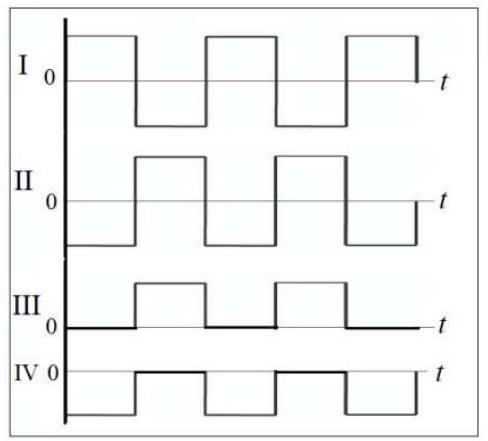
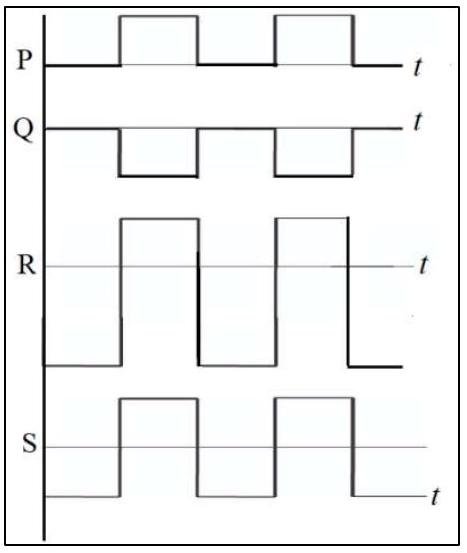
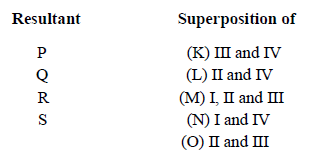
Some waveforms among I, II, III and IV superpose (add graphically) to produce the waveforms P, Q, R and S. Among the following, match the pairs that give the correct combinations:
At any instant of time, the total energy ( $E$ ) of a simple pendulum is equal to the sum of its kinetic energy $\left(\frac{1}{2} m v^{2}\right)$ and potential energy $\left(\frac{1}{2} k x^{2}\right)$, where, $m$ is the mass, $v$ is the velocity, $x$ is the displacement of the bob and $k$ is a constant for the pendulum. The amplitude of oscillation of the pendulum is 10 cm and its total energy is 4 mJ . Find $k$.
(a) $1.8 \mathrm{Nm}^{-1}$
(b) $0.8 \mathrm{Nm}^{-1}$
(c) $0.5 \mathrm{Nm}^{-1}$
(d) data insufficient
Question 29
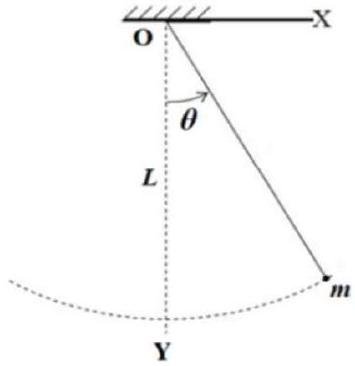
A rigid body of mass $m$ is suspended from point O using an inextensible string of length $L$. When it is displaced through an angle $\theta$, what is the change in the potential energy of the mass? (Refer adjacent figure.)
(a) $m g L(1-\cos \theta)$
(b) $m g L(\cos \theta-1)$
(c) $m g L \cos \theta$
(d) $m g L(1-\sin \theta)$
Question 30
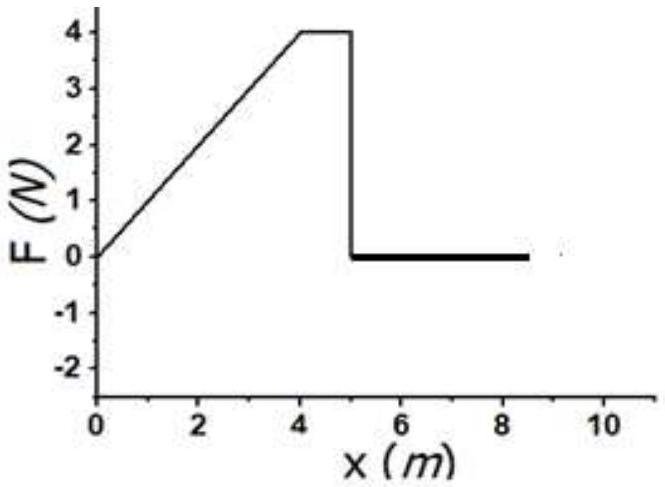
Refer to the adjacent figure. A variable force F is applied to a body of mass 6 kg at rest. The body moves along $x$ - axis as shown. The speed of the body at $x=5 \mathrm{ m}$ and $x=6 \mathrm{ m}$ is ____ and ____ respectively.
When a charged particle with charge $q$ and mass $m$ enters uniform magnetic field $B$ with velocity $v$ at right angles to $B$, the force on the moving particle is given by $q v B$. This force acts as the centripetal force making the charged particle go in a uniform circular motion with radius $r=\frac{m v}{B q}$. Now if a hydrogen ion and a deuterium ion enter the magnetic field with velocities in the ratio $2: 1$ respectively, then the ratio of their radii will be ____
(a) $1: 2$
(b) $2: 1$
(c) $1: 4$
(d) $1: 1$
Question 32
A piece of ice is floating in water at $4^{\circ} \mathrm{C}$ in a beaker. When the ice melts completely, the water level in the beaker will
(a) rise
(b) fall
(c) remains unchanged
(d) unpredictable
Question 33
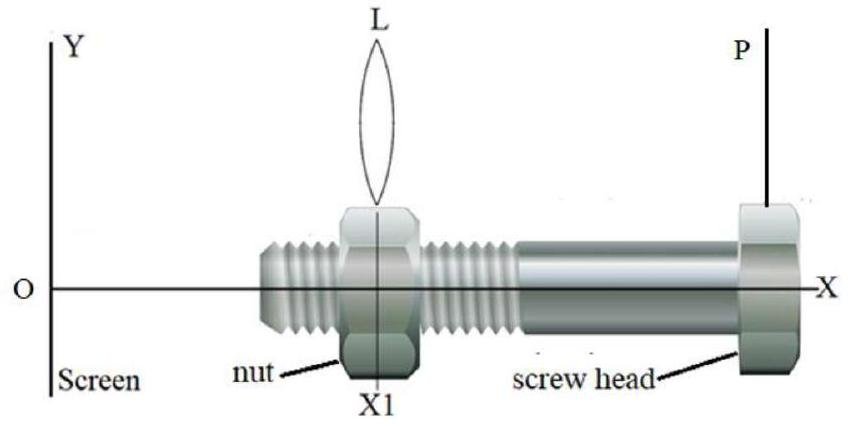
In a screw-nut assembly (shown below) the nut is held fixed in its position and the screw is allowed to rotate inside it. A convex lens $(\mathrm{L})$ of focal length 6.0 cm is fixed on the nut. An object pin $(\mathrm{P})$ is attached to the screw head. The image of the object is observed on a screen Y. When the screw head is rotated through one rotation, the linear distance moved by the screw tip is 1.0 mm . The observations are made only when the image is obtained in the same orientation on the screen. At a certain position of P , the image formed is three times magnified as that of the pin height. Through how many turns should the screw head be rotated so that the image is two times magnified?
(a) 8
(b) 10
(c) 12
(d) 14
Question 34
A school is located between two cliffs. When the metal bell is struck by school attendant, first echo is heard by him after 2.4 s and second echo follows after 2.0 s for him at the same position near the bell. If the velocity of sound in air is $340 \mathrm{ ms}^{-1}$ at the temperature of the surroundings, then the distance between the cliffs is approximately ____
(a) 0.488 km
(b) 0.751 km
(c) 1.16 km
(d) 1.41 km
Question 35
The triangular face of a crown glass prism ABC is isosceles. Length $\mathrm{AB}=$ length AC and the rectangular face with edge AC is silvered. A ray of light is incident normally on rectangular face with edge AB . It undergoes reflections at AC and AB internally and it emerges normally through the rectangular base with edge BC . Then angle BAC of the prism is ____
(a) $24^{\circ}$
(b) $30^{\circ}$
(c) $36^{\circ}$
(d) $42^{\circ}$
Question 36
The radius of curvature of a convex mirror is ' $x$ '. The distance of an object from focus of this mirror is ' $y$ '. Then what is the distance of image from the focus?
(a) $y^{2} / 4 x$
(b) $x^{2} / y$
(c) $x^{2} / 4 y$
(d) $4 y^{2} / x$
Question 37
A physics teacher and his family are travelling in a car on a highway during a severe lightning storm. Choose the correct option:
(a) Safest place will be inside the car as the charges due to lightning tend to remain on the metal sheet / skin of the vehicle if struck by lightning.
(b) It's too dangerous to be inside the car. As the car has a metal body the charges tend to accumulate on the surface and will generate a strong electric field inside the car.
(c) Safest place is under a tree. It's better to get drenched under a tree as the wet tree will provide a path to the charges for earthing.
(d) It is safer to exit the car and stand on open ground
Question 38
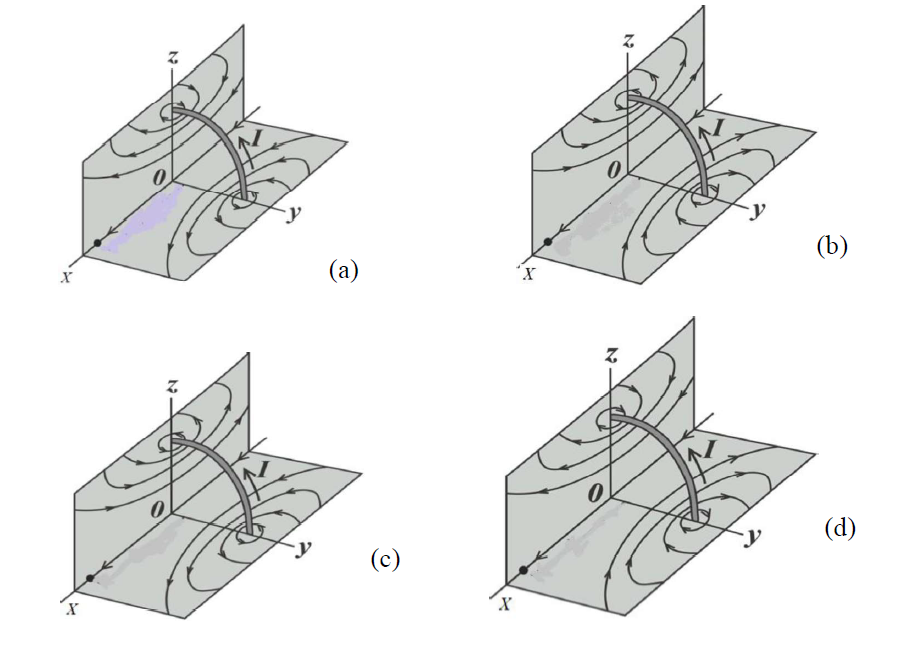
A conductor in the form of a circular loop is carrying current $I$. The direction of the current is as shown. Then which figure represents the correct direction of magnetic field lines on the surfaces of the planes XY and XZ . (Consider those surfaces of the XY and XZ planes which are seen in the figure.)
Question 39
A particle experiences constant acceleration for 20 s after starting from rest. If it travels a distance $S_{1}$ in the first 10 s and distance $S_{2}$ in the next 10 s , the relation between $S_{1}$ and $S_{2}$ is:
(a) $\mathrm{S}_{2}=3 \mathrm{ S}_{1}$
(b) $\mathrm{S}_{1}=3 \mathrm{ S}_{2}$
(c) $\mathrm{S}_{2}=2 \mathrm{ S}_{1}$
(d) $\mathrm{S}_{1}=10 \mathrm{ S}_{2}$
Question 40
A sound wave is produced by a vibrating metallic string stretched between its ends. Four statements are given below. Some of them are correct.
(P) Sound wave is produced inside the string.
(Q) Sound wave in the string is transverse.
(R) Wavelength of the sound wave in surrounding air is equal to the wavelength of the transverse wave on the string.
(S) Loudness of sound is proportional to the square of the amplitude of the vibrating string.
Choose the correct option.
(a) P
(b) R and S
(c) P and Q
(d) S
NSEJS 2018 Question Paper
Question 1
A tiny ball of mass $m$ is initially at rest at height $H$ above a cake of uniform thickness $h$. At some moment the particle falls freely, touches the cake surface and then penetrates in it at such a constant rate that its speed becomes zero on just reaching the ground (bottom of the cake). Speed of the ball at the instant it touches the cake surface and its retardation inside the cake are respectively
(a) $\sqrt{2 g h}$ and $g\left(\frac{H}{h}-1\right)$
(b) $\sqrt{2 g(H-h)}$ and $g\left(\frac{H}{h}-1\right)$
(c) $\sqrt{2 g h}$ and $g\left(\frac{h}{H}-1\right)$
(d) $\sqrt{2 g(H-h)}$ and $g\left(\frac{h}{H}-1\right)$
Question 2
Two sound waves in air have wavelengths differing by 2 m at a certain temperature $T$. Their notes have musical interval 1.4. Period of the lower pitch note is 20 ms . Then, speed of sound in air at this temperature ( $T$ ) is
(a) $350 \mathrm{ m} / \mathrm{s}$
(b) $342 \mathrm{ m} / \mathrm{s}$
(c) $333 \mathrm{ m} / \mathrm{s}$
(d) $330 \mathrm{ m} / \mathrm{s}$
Question 3
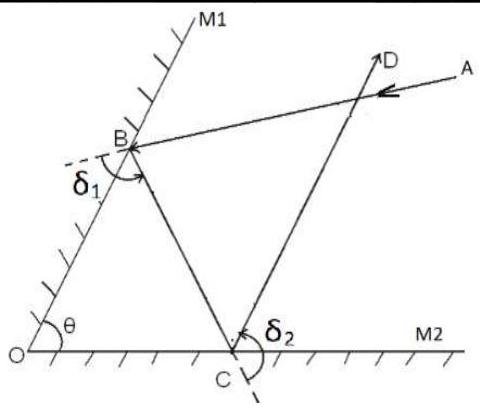
Two plane mirrors $\mathrm{M}_{1}$ & $\mathrm{M}_{2}$ have their reflecting faces inclined at $\theta$. Mirror $\mathrm{M}_{1}$ receives a ray $A B$, reflects it at $B$ and sends it as BC . It is now reflected by mirror $\mathrm{M}_{2}$ along CD, as shown in the figure. Total angular deviation $\delta$ suffered by the incident ray AB is:
(a) $\delta=90^{\circ}+2 \theta$
(b) $\delta=180^{\circ}+2 \theta$
(c) $\delta=270^{\circ}-2 \theta$
(d) $\delta=360^{\circ}-2 \theta$
Question 4
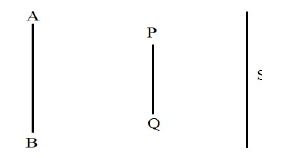
In the adjacent figure, line AB is parallel to screen S . A linear obstacle PQ between the two is also parallel to both. $\mathrm{AB}, \mathrm{PQ}$ and screen S are coplanar. A point source is carried from A to B , along the line AB . What will happen to the size of the shadow of PQ (cast due to the point source) on the screen S ?
(a) It will first increase and then decrease.
(b) It will first decrease and then increase.
(c) It will be of the same size for any position of the point source on the line AB .
(d) Umbra will increase and penumbra will decrease till central position.
Question 5
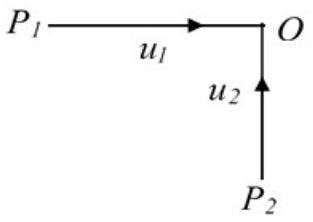
Two particles $\mathrm{P}_{1}$ and $\mathrm{P}_{2}$ move towards origin O , along X and Y -axes at constant speeds $u_{1}$ and $u_{2}$ respectively as shown in the figure. At $t=0$, the particles $\mathrm{P}_{1}$ and $\mathrm{P}_{2}$ are at distances $a$ and $b$ respectively from O . Then the instantaneous distance $s$ between the two particles is given by the relation:
An electric generator consumes some oil fuel and generates output of 25 kW . Calorific value (amount of heat released per unit mass) of the oil fuel is $17200 \mathrm{kcal} / \mathrm{kg}$ and efficiency (output to input ratio) of the generator is 0.25 . Then, mass of the fuel consumed per hour and electric energy generated per ton of fuel burnt are respectively
(a) $0.5 \mathrm{ kg}, 20000 \mathrm{kWh}$
(b) $0.5 \mathrm{ kg}, 5000 \mathrm{kWh}$
(c) $5 \mathrm{ kg}, 5000 \mathrm{kWh}$
(d) $5 \mathrm{ kg}, 20000 \mathrm{kWh}$
Question 7
Image is obtained on a screen by keeping an object at 25 cm and at 40 cm in front of a concave mirror. Image in the former case is four times bigger than in the latter. Focal length of the mirror must be ____
(a) 12 cm .
(b) 20 cm .
(c) 24 cm .
(d) 36 cm .
Question 8
A glass cube of refractive index 1.5 and edge 1 cm has a tiny black spot at its center. A circular dark sheet is to be kept symmetrically on the top surface so that the central spot is not visible from the top. Minimum radius of the circular sheet should be (Given: $\frac{1}{\sqrt{2}}=0.707, \frac{1}{\sqrt{3}}=0.577, \frac{1}{\sqrt{5}}=0.447$ )
(a) 0.994 cm
(b) 0.447 cm
(c) 0.553 cm
(d) 0.577 cm
Question 9
A metal rod of length $L$ at temperature $T$, when heated to temperature $T^{\prime}$, expands to new length $L^{\prime}$. These quantities are related as $L^{\prime}=L\left(1+\alpha\left[T^{\prime}-T\right]\right)$ where $\alpha$ is a constant for that material and called as coefficient of linear expansion. Correct SI unit of $\alpha$ is ____
(a) $\mathrm{m}-\mathrm{K}^{-1}$
(b) $\mathrm{m}-\mathrm{K}$
(c) $\mathrm{K}^{-1}$
(d) $\alpha$ is a pure number
Question 10
A paramedical staff nurse improvises a second's pendulum (time period 2 s ) by fixing one end of a string of length $L$ to a ceiling and the other end to a heavy object of negligible size. Within 60 oscillations of this pendulum, she finds that the pulse of a wounded soldier beats 110 times. A symptom of bradycardia is pulse $<60$ per minute and that of tachycardia is $>100$ per minute. Then the length of the string is nearly ____ and soldier has symptoms of ____
(a) 1 m , bradycardia
(b) 4 m , bradycardia
(c) 1 m , tachycardia
(d) 4 m , tachycardia
Question 11
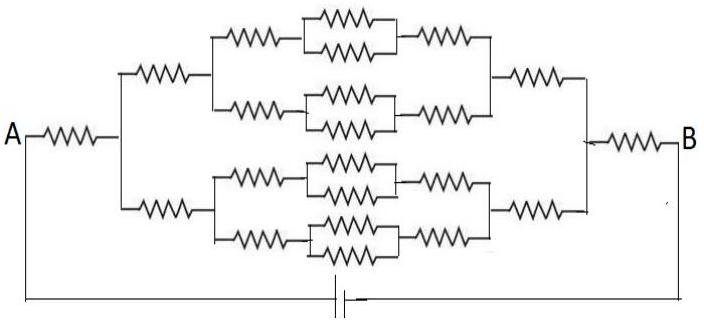
Each resistance in the adjacent circuit is $R \Omega$. In order to have an integral value for equivalent resistance between $\mathrm{A}$ & $\mathrm{ B}$, the minimum value of $R$ must be:
(a) $4 \Omega$
(b) $8 \Omega$
(c) $16 \Omega$
(d) $29 \Omega$
Question 12
A block of wood floats on water with $\left(\frac{3}{8}\right)^{\text {th }}$ of its volume above water. It is now made to float on a salt solution of relative density 1.12 . The fraction of its volume that remains above the salt solution now, is nearly ____
(a) 0.33
(b) 0.44
(c) 0.67
(d) 0.56
Question 13
Suppose our scientific community had chosen force, speed and time as the fundamental mechanical quantities instead of length, mass and time respectively and they chose the respective units of magnitudes $10 \mathrm{ N}, 100 \mathrm{ m} / \mathrm{s}$ and $\frac{1}{100} \mathrm{ s}$. Then the unit of mass in their system is equivalent to ____ in our system.
(a) $10^{3} \mathrm{ kg}$
(b) $10^{-3} \mathrm{ kg}$
(c) 10 kg
(d) $10^{-1} \mathrm{ kg}$
Question 14
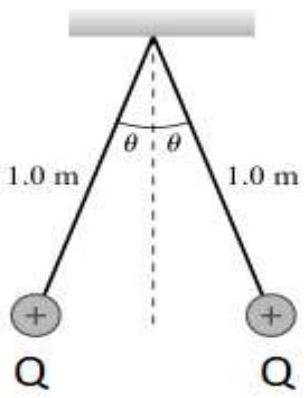
Two equally charged identical pith balls are suspended by identical massless strings as shown in the adjacent figure. If this set up is on Mercury ( $g=3.7 \mathrm{ m} / \mathrm{s}^{2}$ ), Earth ( $g=9.8 \mathrm{ m} / \mathrm{s}^{2}$ ) and Jupiter ( $g=24.5 \mathrm{ m} / \mathrm{s}^{2}$ ), then angle $2 \theta$ will be ____
(a) maximum on Mercury
(b) maximum on Earth, as it has atmosphere
(c) maximum on Jupiter
(d) the same on any planet as Coulomb force is independent of gravity
Question 15
Three objects of the same material coloured white, blue and black can withstand temperatures up to $2000^{\circ} \mathrm{C}$. All these are heated to $1500^{\circ} \mathrm{C}$ and viewed in dark. Which option is correct?
(a) White object will appear brightest
(b) Blue object will appear brightest
(c) Black object will appear brightest
(d) Being at the same temperature, all will look equally bright
Question 16
A car running with a velocity of $30 \mathrm{ m} / \mathrm{s}$ reaches midway between two vertical parallel walls separated by 360 m , when the driver sounds the horn for a moment. Speed of sound in air is $330 \mathrm{ m} / \mathrm{s}$. After blowing horn, the first three echoes will be heard by the driver respectively at ____
Choose correct option from the following statements from electrostatics:
(I) If two copper spheres of same radii, one hollow and the other solid are charged to the same electrical potential, the solid sphere will have more charge. (II) A charged body can attract another uncharged body. (III) Electrical lines of force originating from like charges will exert a lateral force on each other, while those originating from opposite charges can intersect each other.
(a) Only (I) is correct.
(b) Only (II) is correct.
(c) Only (I) & (II) are correct.
(d) All (I), (II) & (III) are correct. Q18.
Question 18
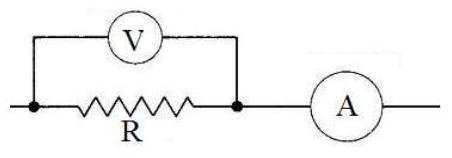
Refer the adjacent circuit. The voltmeter reads 117 V and ammeter reads 0.13 A . If the resistance of voltmeter and ammeter are $9 \mathrm{k} \Omega$ and $0.015 \Omega$ respectively, the value of $R$ is ____
(a) $500 \Omega$
(b) $1 \mathrm{k} \Omega$
(c) $1.5 \mathrm{k} \Omega$
(d) $2 \mathrm{k} \Omega$
Question 19
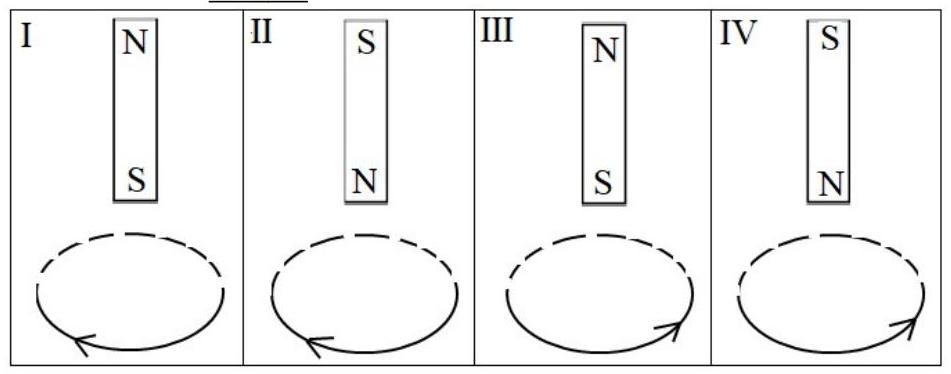
A bar magnet is allowed to fall freely from the same height towards a current carrying loop along its axis, as shown in the four situations I to IV. Arrows show direction of conventional current. Choose the situations in which the potential energy of the magnet coil interaction is maximum _____
(a) I, III
(b) I, IV
(c) II, IV
(d) II, III
Question 20
A beaker is completely filled with water at $4^{\circ} \mathrm{C}$. Consider the following statements: (I) Water will overflow if the beaker is cooled for some time. (II) Water will overflow if the beaker is heated for some time. Select correct option regarding (I) and (II).
(a) Only (I) is correct
(b) Only (II) is correct
(c) Both (I) and (II) are correct
(d) Neither (I) nor (II) is correct
Question 21
When a surface tension experiment with capillary tube is performed, water rises up to 0.1 m . If the experiment is carried out in space, water will rise in capillary tube ____
(a) up to height of 0.1 m
(b) up to height of 0.2 m
(c) up to height of 0.98 m
(d) along its full length
Question 22
Let AB be a diameter of a circle $\mathrm{C}_{1}$ of radius 30 cm and with center O . Two circles $\mathrm{C}_{2}$ and $\mathrm{C}_{3}$ of radii 15 cm and 10 cm touch $\mathrm{C}_{1}$ internally at A and B respectively. A fourth circle $\mathrm{C}_{4}$ touches $\mathrm{C}_{1}, \mathrm{C}_{2}$ and $\mathrm{C}_{3}$. What is the largest possible radius of $\mathrm{C}_{4}$ ?
(a) 12 cm
(b) 15 cm
(c) 20 cm
(d) 30 cm
Question 23
A $5 \times 5 \times 5$ cube is built using unit cubes. How many different cuboids (that differ in at least one unit cube) can be formed using the same number of unit cubes?
(a) 1000
(b) 1728
(c) 2730
(d) 3375
Question 24
What is the largest value of the positive integer $k$ such that $k$ divides $n^{2}\left(n^{2}-1\right)\left(n^{2}-n-2\right)$ for every natural number $n$ ?
(a) 6
(b) 12
(c) 24
(d) 48
Question 25
A person kept rolling a regular (six faced) die until one of the numbers appeared third time on the top. This happened in $12^{\text {th }}$ throw and the sum of all the numbers in 12 throws was 46 . Which number appeared least number of times?
(a) 6
(b) 4
(c) 2
(d) 1
Question 26
In a square ABCD , a point P is inside the square such that ABP is an equilateral triangle. The segment AP cuts the diagonal BD in E . Suppose $\mathrm{AE}=2$. The area of ABCD is
(a) $4+2 \sqrt{3}$
(b) $5+2 \sqrt{3}$
(c) $4+4 \sqrt{3}$
(d) $5+4 \sqrt{3}$
Question 27
Let $n$ be a positive integer not divisible by 6 . Suppose $n$ has 6 positive divisors. The number of positive divisors of $9 n$ is
(a) 54
(b) 36
(c) 18
(d) 12
Question 28
The value of $\frac{\sqrt{a+x}-\sqrt{a-x}}{\sqrt{a+x}+\sqrt{a-x}}$, when $x=\frac{2 a}{b^{2}+1}$ is:
(a) $a$
(b) $b$
(c) $x$
(d) 0
Question 29
Two regular polygons of different number of sides are taken. In one of them, its sides are coloured red and diagonals are coloured green; in the other, sides are coloured green and diagonals are coloured red. Suppose there are 103 red lines and 80 green lines. The total number of sides the two polygons together have is:
(a) 23
(b) 28
(c) 33
(d) 38
Question 30
A box contains some red and some yellow balls. If one red ball is removed, one seventh of the remaining balls would be red; if one yellow ball is removed, one-sixth of the remaining balls would be red. If $n$ denotes the total number of balls in the box, then the sum of the digits of $n$ is
(a) 6
(b) 7
(c) 8
(d) 9
Question 31
Let $A B C D$ be a rectangle. Let $X$ and $Y$ be points respectively on $A B$ and $C D$ such that $\mathrm{AX}: \mathrm{XB}=1: 2=\mathrm{CY}: \mathrm{YD}$. Join AY and CX ; let BY intersect CX in K ; let DX intersect AY in L . If $m / n$ denotes the ratio of the area of XKYL to that of ABCD , then $m+n$ equals
(a) 9
(b) 11
(c) 13
(d) 15
Question 32
Let ABC be an equilateral triangle. The bisector of $\angle \mathrm{BAC}$ meets the circumcircle of ABC in D . Suppose $\mathrm{DB}+\mathrm{DC}=4$. The diameter of the circumcircle of ABC is
(a) 4
(b) $3 \sqrt{3}$
(c) $2 \sqrt{3}$
(d) 2
Question 33
Let $T_{k}$ denote the $k$-th term of an arithmetic progression. Suppose there are positive integers $m \neq n$ such that $T_{m}=1 / n$ and $T_{n}=1 / m$. Then $T_{m n}$ equals
(a) $\frac{1}{m n}$
(b) $\frac{1}{m}+\frac{1}{n}$
(c) 1
(d) 0
Question 34
In a triangle ABC , let AD be the median from A ; let E be a point on AD such that $\mathrm{AE}: \mathrm{ED}=1: 2$; and let BE extended meets AC in F . The ratio of $\mathrm{AF} / \mathrm{FC}$ is
(a) $1 / 6$
(b) $1 / 5$
(c) $1 / 4$
(d) $1 / 3$
Question 35
If $\sin \theta$ and $\cos \theta$ are roots of the equation $p x^{2}+q x+r=0$, then:
(a) $p^{2}-q^{2}+2 p r=0$
(b) $(p+r)^{2}=q^{2}-r^{2}$
(c) $p^{2}+q^{2}-2 p r=0$
(d) $(p-r)^{2}=q^{2}+r^{2}$
Question 36
For a regular $k$-sided polygon, let $\alpha(k)$ denotes its interior angle. Suppose $\mathrm{n}>4$ is such that $\alpha(n-2), \alpha(n), \alpha(n+3)$ forms an arithmetic progression. The sum of digits of $n$ is
(a) 2
(b) 3
(c) 4
(d) 5
Question 37
The sum of 5 numbers in geometric progression is 24 . The sum of their reciprocals is 6 . The product of the terms of the geometric progression is
(a) 36
(b) 32
(c) 24
(d) 18
Question 38
Digits $a$ and $b$ are such that the product $\overline{4 a 1} \times \overline{25 b}$ is divisible by 36 (in base 10). The number of ordered pairs ( $a, b$ ) is
(a) 15
(b) 8
(c) 6
(d) 4
Question 39
The integer closest to $\sqrt{111 \ldots 1-222 \ldots 2}$, where there are 2018 ones and 1009 twos, is
(a) $\frac{10^{1009}-1}{3}$
(b) $\frac{10^{1009}-1}{9}$
(c) $\frac{10^{2018}-1}{3}$
(d) $\frac{10^{2018}-1}{9}$
Question 40
In a triangle ABC , a point D on AB is such that $\mathrm{AD}: \mathrm{AB}=1: 4$ and DE is parallel to BC with E on AC . Let M and N be the mid points of DE and BC respectively. What is the ratio of the area of the quadrilateral BNMD to that of triangle ABC ?
(a) $1 / 4$
(b) $9 / 32$
(c) $7 / 32$
(d) $15 / 32$
Question 41
The number of distinct integers in the collection $\left[\frac{10^{2}}{1}\right],\left[\frac{10^{2}}{2}\right],\left[\frac{10^{2}}{3}\right], \ldots \ldots,\left[\frac{10^{2}}{20}\right]$, where $[x]$ denotes the largest integer not exceeding $x$, is
(a) 20
(b) 18
(c) 17
(d) 15
ISI M.Stat Entrance Success Story 2026
In 2026, the following Cheenta students have been successful for Indian Statistical Institute's M.Stat Entrance. They ranked within the first 50 in the entire country in these entrances.
I.S.I. M.Stat Entrance
Darsh Jain (AIR 1)
Lavanis A (AIR 2)
Sudeep Singh (AIR 9)
Abhay Choudhary (AIR 16)
Shibanjan Mukherjee (AIR 18)
Vaibhav Srinivas R (AIR 46)
Arya Biswas (AIR SC 3)
ISI B.Stat-B.Math and CMI BSc. Math Entrance Success Story 2026
In 2026, the following Cheenta students have been successful for Indian Statistical Institute's B.Stat Entrance and Chennai Mathematical Institute's B.Sc. Math Entrance. They ranked within the first 200 in the entire country in these entrances. Most of these students attended the problem solving workshops regularly, which happen 5 days every week.
CMI B.Sc. Math Entrance
Juan Samuel (with full scholarship and stipend)
Pradyun Ravishankar (with full scholarship and stipend)
Manan Kumath
I.S.I. B.Stat Entrance
Ritam Das (AIR 91)
I.S.I. B.Math Entrance
Manan Kumath (AIR 82)
Samarth T K (AIR 145)
ISI BStat-BMath UGA & UGB 2025 Problem and Solution
UGA
1. (A)
2. (C)
3. (B)
4. (B)
5. (A)
6. (D)
7. (D)
8. (D)
9. (B)
10. (B)
11. (C)
12. (D)
13. (C)
14. (D)
15. (B)
16. (D)
17. (D)
18. (C)
19. (C)
20. (A)
21. (A)
22. (C)
23. (B)
24. (A)
25. (C)
26. (B)
27. (A)
28. (B)
29. (D)
30. (B)
Problem 1
In the \(x y\)-plane, the curve \(3 x^3 y+6 x y+2 x y^3=0\) represents
(A) a pair of straight lines (B) an ellipse (C) a pair of straight lines and an ellipse (D) a hyperbola
(A) \(\alpha \leq \beta\) but not necessarily \(\alpha=\beta\) (B) \(\beta \leq \alpha\) but not necessarily \(\alpha=\beta\) (C) \(\alpha=\beta\) (D) nothing can be said in general
Solution
Problem 7
Consider the cyclic quadrilateral \(A B C D\) given below.
Assume that \(A B=B C, A D=C D\), and \(\frac{A B}{A D}=\frac{1}{3}\). Let \(\theta=\angle A D C\). Then \(\cos \theta\) is equal to
Let \(A={(x, y): x, y \in[0,1]}\) and \(B={(x, y): x, y \in[0,2]}\). Define \(f: A \rightarrow B\) by \(f(x, y)=\left(x^2+y, x+y^2\right)\). Then \(f\) is
(A) one-to-one but not onto (B) onto but not one-to-one (C) both one-to-one and onto (D) neither one-to-one nor onto
Solution
\(A={(x, y): x, y \in[0,1]}\)
\(B={(x, y): x, y \in[0,2]}\)
\(f: A \rightarrow B\)
\(f(x, y)=\left(x^2+y ; x+y^2\right)\)
Not one -on - one
as \(\begin{array}{r}(1,0) \ (0,1)\end{array}\) --> both map to \((1,1)\)
Twelve boxes are placed along a circle. In each box, \(1,2,3\) or 4 balls are put such that the total number of balls in any 4 consecutive boxes is same. The number of ways this can be done is
(A) 4 ! (B) \(4^4\) (C) \((4!)^3\) (D) \((4!)^4\)
Solution
once we choose number of balls in first 4 boxes, the remaining choices become fixed.
For each of the four boxes, we have four choices,
\(\therefore 4^4\) cases in total
Problem 11
Let \(a_0=0, a_1=1\) and \(a_n=5 a_{n-1}+a_{n-2}\) for \(n \geq 2\). Then the value of the determinant
is
(A) -1 (B) \(-5^{101}\) (C) 1 (D) \(5^{101}\)
Solution
Watch the video
Problem 12
The lengths of the three sides of a right angled triangle are geometric progression. The smallest angle of the triangle is
Consider the following statements about two similar triangles \(\Delta_1), and (\Delta_2\).
\(S_1\): Lengths of the sides of \(\Delta_1\) are in arithmetic progression \(S_2\). Lengths of the sides of \(\Delta_1\) are in geometric progression.
\(S_3\). Lengths of the sides of \(\Delta_2\) are in arithmetic progression.
\(S_4\). Lengths of the sides of \(\Delta_2\) are in geometric progression.
Then
(A) \(S_1\) implies \(S_3\), but \(S_2\) does not imply \(S_4\) (B) \(S_1\) does not imply \(S_3\), but \(S_2\) implies \(S_4\) (C) \(S_1\) implies \(S_3\), and \(S_2\) implies \(S_4\) (D) \(S_1\) does not imply \(S_3\), and \(S_2\) does not imply \(S_4\)
Solution
Let \((\sigma, b, c)\) and \(\left(a^{\prime}, b^{\prime}, c^{\prime}\right)\) are
The lengths of the two adjacent sides of a parallelogram are 2 cm and 3 cm . The length of one diagonal is \(\sqrt{19} \mathrm{~cm}\). Then the length of the other diagonal is
Let \(f\) \((x) = \frac{1}{1+|x-1|}+\frac{1}{1+|x+1|}\). Then the function \(f\) has (A) neither a local maximum nor a local minimum (B) a local minimum at \(x=0\), but no local maximum (C) local maxima at \(x= \pm 1\), but no local minimum (D) a local minimum at \(x=0\) and local maxima at \(x= \pm 1\)
Let \(a, b, c, d\) be positive integers such that the product abcd (=999). Then the number of different ordered 4 -tuples \((a, b, c, d)\) is
(A) 20 (B) 48 (C) 80 (D) 84
Solution
\(999=3^3 \times 27\)
Hence the number of non-negetive integer solution
\(\binom{3+4-1}{4-1}\binom{1+4-1}{4-1}\)
\(=20 \times 4\)
\(=80\)
Problem 20
Let \(|x|\) denote the greatest integer less than or equal to \(x \in \mathbb{R}\) and \(|x|\) has its usual meaning, that is, \(|x|=x\) if \(x \geq 0\), and \(|x|=-x\), if \(x<0\). Then the value of the integral
\(\int_{-2}^1([x]+2)^{|x|} d x\)
is (A) \(1+\frac{1}{\log _e 2}\) (B) \(1+\log _e \frac{1}{2}\) (C) \(2-\log _e 2\) (D) none of the above
Solution
\(\int_{-2}^1([x]+2)^{|x|} d x\)
\(=\int_0^1 2^x d x+\int_{-1}^0 1^{-x} d x\)
\(f \int_{-2}^{-1} 0 \cdot d x\)
\(=\left[\frac{2 x}{\ln 2}\right]_0^1+1.1\)
\(\left(\frac{1}{\ln^2}+1\right)\)
Problem 21
For a real number \(x\), let \(f(x)=\int_{-20}^{20} g(t) g(x-t) d t\), where \(g(x)= \begin{cases}1, & \text { if } x \in[0,1] \ 0, & \text { otherwise }\end{cases}\)
Then \(f(x)\) is equal to (A) \(\begin{cases}x, & \text { if } x \in[0,1], \ 2-x, & \text { if } x \in[1,2], \ 0, & \text { otherwise }\end{cases}\) (B) \(\begin{cases}1+x, & \text { if } x \in[0,1), \ 1-x, & \text { if } x \in[1,2), \ 0, & \text { otherwise }\end{cases}\) (C) \(\begin{cases}1, & \text { if } x \in(-20,20), \ 0, & \text { otherwise }\end{cases}\) (D) none of the above
Solution
Now, if \(x<0\) or \(x>2\)then the integration becomes 0 .
if \(\quad 0 \leq x \leq 1\)
Then \(f(x)\)
\(=\int_{x-1}^x g(t) d t\)
\(=\int_0^x d t=x\)
\(=\int_{-20}^{20} \theta(t) g(x-t) d t\)
\(=\int_0^1 g(x-t) d t\)
\(=\int_0^1 g(t+x-1) d t\)
\(=\int_{x-1}^x g(t) d t\)
it \(10 \leqslant x \leqslant 2\)
\(f(x): \int_{x-1}^x g(t) d t\)
\(=\int_{x-1}^1 d t=(2-x)\)
Problem 22
Let \(n \geq 3\). There are \(n\) straight lines in a plane, no two of which are parallel and no three pass through a common point. Their points of intersection are joined. Then the number of fresh line segments thus created is (A) \(\frac{n(n-1)(n-2)}{8}\) (B) \(\frac{n(n-1)(n-2)(n-3)}{6}\) (C) \(\frac{n(n-1)(n-2)(n-3)}{8}\) (D) none of the above
Solution
The lines intersect at \(\binom{n}{2}\) different points But there are also \((n-1)\) points in part of line
In a certain test there are \(n\) questions. At least \(i\) questions were wrongly answered by \(2^{n-i}\) students, where \(i=1,2, \ldots, n\). If the total number of wrong answers given by all students is 2047 , then (n) is equal to (A) 10 (B) 11 (C) 12 (D) 13
Solution
At least \(i\) questions were wrongly answered by \(2^{n-i}\) students.
Let \(n\) be a positive integer. The value of \(\sum_{k=0}^n \tan ^{-1} \frac{1}{k^2+k+1}\) is (A) \(\tan ^{-1}(n+1)\) (B) \(\tan ^{-1}\left(\frac{1}{n+1}\right)\) (C) \(\tan ^{-1} n\) (D) \(\tan ^{-1}\left(\frac{1}{n}\right)\)
Let \(d\) be the side length of the largest possible equilateral triangle that can be put inside a square of side length 1 . Then (A) \(d<1\) (B) \(d=1\) (C) \(1<d<\frac{2}{3^{1 / 4}}\) (D) \(d \geq \frac{2}{3^{1 / 4}}\)
Problem 26
Let \(f(x)=\left(x^2+18\right)(x-4) x(x+4)-2\). Then (A) \(f\) has exactly one real root (B) \(\int\) has exactly 3 distinct real roots (C) \(f\) has 5 distinct real roots (D) \(f\) has a repeated root
Solution
\(f(x)=\left(x^2+18\right) x(x-4)(x+4)-2\)
\(f^{\prime}(x)=5 x^4+6 x^2-288\)
\(f^{\prime}\) has two real roots
But \(f\) can have at most three real roots. But \(f(-4)<0 \quad f(-3)>0 \quad f(0)<0 \quad f(4)<0 \quad f(5)>0\)
\( \therefore \) it has 3 real roots (B).
Problem 27
Yet \(k\) be a positive integer and \(f(x)=e^x-1\). Then
A subset ${u_1, u_2, u_3, u_4, u_5}$ of the first 90 positive integers can be selected in $\binom{90}{5}$ ways. Let $u_{\text{max}} = \max{u_1, u_2, u_3, u_4, u_5}$ and $u_{\text{min}} = \min{u_1, u_2, u_3, u_4, u_5}$. Then the arithmetic mean of $u_{\text{max}} + u_{\text{min}}$ over all such subsets is
(A) 45 (B) 46 (C) 89 (D) 91
Solution
No. of subsets whose max element 90 is \(\quad 90\binom{89}{4}\)
When \(u_{\text {max }}=89 \rightarrow 89\binom{88}{4}\)
When \(u_{\text {max }}^{\text {max }}=88 \rightarrow 88\binom{87}{4}\)
" " "
" " "
" " "
when \(u_{\max }=5 \rightarrow 5\binom{4}{4}\)
Now, when \(u_{\min }=1 \rightarrow 1\binom{89}{4}\).
when \(u_{\min }^{\min }=2 \rightarrow 2\binom{88}{4}\)
when \(u_{\text {min }}=3 \rightarrow 3\binom{87}{4}\)
Suppose \(f: \mathbb{R} \rightarrow \mathbb{R}\) is differentiable and \(\left|f^{\prime}(x)\right|<\frac{1}{2}\) for all \(x \in \mathbb{R}\). Show that for some \(x_0 \in \mathbb{R}, f\left(x_0\right)=x_0\).
Solution
Watch the video
Problem 2
If the interior angles of a triangle (A B C) satisfy the equality,
Suppose \(f:[0,1] \rightarrow \mathbb{R}\) is differentiable with \(f(0)=0\). If \(\left|f^{\prime}(x)\right| \leq f(x)\) for all \(x \in[0,1]\), then show that \(f(x)=0\) for all \(x\).
Problem 4
Let \(S^1={\{z \in \mathbb{C}| | z \mid=1}\}\) be the unit circle in the complex plane. Let Let \(f: S^1 \rightarrow S^1\) be the map given by \( f(z)=z^2 \). We define \(f^{(1)}:=f\) and \(f^{(k+1)}:=f \circ f^{(k)}\) for \(k \geq 1\). The smallest positive integer \(n\) such that \(f^{(n)}(z)=z\) is called the period of \(z\). Determine the total number of points in \(S^1\) of period 2025. (Hint: \(2025=3^4 \times 5^2) \)
Problem 5
Let \(a, b, c\) be nonzero real numbers such that \(a+b+c \neq 0\). Assume that
Let \(\mathbb{N}\) denote the set of natural numbers, and let \(\left(a_i, b_i\right)\), \(1 \leq i \leq 9\), be nine distinct tuples in \(\mathbb{N} \times \mathbb{N}\). Show that there are three distinct elements in the set \({2^{a_i} 3^{b_i}: 1 \leq i \leq 9}\) whose product is a perfect cube.
Problem 7
Consider a ball that moves inside an acute-angled triangle along a straight line, until it hits the boundary, which is when it changes direction according to the mirror law, just like a ray of light (angle of incidence (=) angle of reflection). Prove that there exists a triangular periodic path for the ball, as pictured below.
Problem 8
Let \(n \geq 2\) and let \(a_1 \leq a_2 \leq \cdots \leq a_n\) be positive integers such that \(\sum_{i=1}^n a_i=\Pi_{i=1}^n a_i\). Prove that \(\sum_{i=1}^n a_i \leq 2 n\) and determine when equality holds.
Exploring the Chinese Remainder Theorem for Polynomials: CMI B.Sc. Entrance 2016- Subjective Problem 5
In today's discussion, we delve into a fascinating problem from the 2016 CMI B.Sc. entrance exam that draws on key concepts from number theory, specifically the Chinese Remainder Theorem (CRT), but applies them in the context of polynomials. The problem asks us to find a polynomial $P(x)$ that satisfies two conditions:
When $P(x)$ is divided by $x^{100}$, the remainder is a constant.
When $P(x)$ is divided by $(x-2)^3$, the remainder is also a constant.
This setup mirrors the CRT for integers but applies it to the algebraic framework of polynomials.
The video walks through the similarities between integer and polynomial division and emphasizes how techniques like the Euclidean algorithm can be extended to polynomials. Using polynomial differentiation and integration, we solve the given conditions, ultimately arriving at a general form for $P(x)$ by adjusting constants.
A key takeaway is the parallel between solving congruences for integers using the Euclidean algorithm and doing the same for polynomials, underscoring the algebraic unity between these two domains.
Watch the Video
Key Findings and Explanations:
Chinese Remainder Theorem for Polynomials: The problem presents a polynomial version of the Chinese Remainder Theorem (CRT), requiring the polynomial $P(x)$ to satisfy congruences:
This highlights the deep connection between the two fields.
Polynomial Division and Remainders: Just like integer division, polynomial division leaves a quotient and remainder. The task is to find a polynomial $P(x)$ that satisfies the given remainder conditions.
Differentiation and Divisibility: If a polynomial $F(x)$ leaves a constant remainder when divided by $(x-c)^k$, its derivative is divisible by $(x-c)^{k-1}$. For example, the condition:
$$ P^{\prime}(x) \text { must be divisible by } x^{99} \text { and } \quad(x-2)^2 $$
Integration for Polynomial Construction: Using integration, the form of $P(x)$ is constructed by integrating terms involving $x^{99}(x-2)^2$. This allows for the introduction of constants $a$ and $b$, which are later adjusted based on the remainder conditions:
Euclidean Algorithm for Polynomials: The Euclidean algorithm, traditionally used for integers, also applies to polynomials. Running the algorithm backwards allows us to solve polynomial congruences in a manner analogous to integer CRT. For instance, finding polynomials $P_1(x)$ and $P_2(x)$ such that:
$$ P_1(x) \cdot x^{100}+P_2(x) \cdot(x-2)^3=1 $$
Polynomial and Integer Analogy: The parallel between integer and polynomial division is a powerful concept, showing that techniques like the Euclidean algorithm, remainder theorem, and CRT can be seamlessly transferred between these domains.
ISI BStat BMath Entrance 2018 - Objective Problems and Answers
ISI BStat BMath Entrance 2018 Objective
I.S.I - 2018 ANSWER KEY
1.[A]
2.[D]
3.[D]
4.[D]
5.[B]
6.[B]
7.[A]
8.[A]
9.[A]
10.[B]
11.[B]
12.[A]
13.[C]
14.[B]
15.[C]
16.[C]
17.[A]
18.[C]
19.[B]
20.[B]
21.[B]
22.[C]
23.[B]
24.[B]
25.[C]
26.[B]
27.[A]
28.[D]
29.[D]
30.[C]
Question : 01
Let $0<x<\frac{1}{6}$ be a real number. When a certain biased dice is rolled, a particular face $F$ occurs with probability $\frac{1}{6}-x$ and its opposite face occurs with probability $\frac{1}{6}+x$; the other four faces occur with probability $\frac{1}{6}$. Recall that opposite faces sum to 7 in any dice. Assume that the probability of obtaining the sum 7 when two such dice are rolled is $\frac{13}{96}$. Then, the value of $x$ is:
An office has 8 officers including two who are twins. Two teams, Red and Blue, of 4 officers each are to be formed randomly. What is the probability that the twins would be together in the Red team?
Suppose Roger has 4 identical green tennis balls and 5 identical red tennis balls. In how many ways can Roger arrange these 9 balls in a line so that no two green balls are next to each other and no three red balls are together
(A) 8 (B) 9 (C) 11 (D) 12
Question : 04
The number of permutations $\sigma$ of $1,2,3,4$ such that $|\sigma(i)-i|<2$ for every $1 \leq i \leq 4$ is
(A) 2 (B) 3 (C) 4 (D) 5
Question : 05
Let $f(x)$ be a degree 4 polynomial with real coefficients. Let $z$ be the number of real zeroes of $f$. and $e$ be the number of local extrema (i.e., local maxima or Minima ) of $f$. Which of the following is a possible $(z, e)$ pairs?
(A) $(4,4)$ (B) $(3,3)$ (C) $(2,2)$ (D) $(0,0)$
Question : 06
A number is called a palindrome if it reads the same backward or forward. For example, 112211 is a palindrome. How many 6-digit palindromes are divisible by 495 ?
(A) 10 (B) 11 (C) 30 (D) 45
Question : 07
Let $A$ be a square matrix of real numbers such that $A^4=A$. Which of the following is true for every such A ?
(A) $\quad \operatorname{det}(A) \neq-1$ (B) $A$ must be invertiible. (C) $A$ can not be invertiible. (D) $A^2+A+I=0$ where $I$ denotes the identity matrix.
Question : 08
Consider the real-valued function $h:{0,1, \ldots, 100} \rightarrow R$ such that $h(0)=5, h(100)=20$ and satisfying $h(i)=\frac{1}{0}(h(i+1)+h(i-1))$, for every $i=1,2, \ldots, 99$. Then, the value of $h(1)$ is :
(A) 5.15 (B) 5.5 (C) 6 (D) 6.15
Question : 09
An up-right path is a sequence of points $a_0=\left(x_0, y_0\right), a_1=\left(x_1, y_1\right), \cdots$ such that $a_{i+1}-a_i$ is either $(1,0)$ or $(0,1)$. The number of up-right paths from $(0,0)$ to $(100,100)$ which pass through $(1,2)$ is
Let $f(x)=\frac{1}{2} x \sin x-(1-\cos x)$. The smallest positive integer $k$ such that $\lim _{x \rightarrow 0} \frac{f(x)}{x^k} \neq 0$ is :
(A) 3 (B) 4 (C) 5 (D) 6
Question : 11
Nine students in a class gave a test for 50 marks. Let $S_1 \leq S_2 \leq \ldots \leq S_5 \leq \ldots \leq S_8 \leq S_9$ denote their ordered scores. Given that $S_1=20$ and $\sum_{i=1}^9 S_1=250$, let $m$ be the smallest value that $S_5$ can take and $M$ be the largest value that $S_5$ can take. Then the pair $(m, M)$ is given by?
Let 10 red balls and 10 white balls be arranged in a straight line such that 10 each are on either side of a central mark. The number of such symmetrical arrangements about the central mark is
In a factory, 20 workers start working on a project of packing consignments. They need exactly 5 hours to pack one consignment. Every hour 4 new workers joint the existing workforce. It is mandatory to would relive a worker after 10 hours. Then the number of consignments that would be packed in the initial 113 hours is
(A) 40 (B) 50 (C) 45 (D) 52
Question : 16
Let $A B C D$ be a rectangle with its shorter side $a>0$ units and perimeter $2 s$ units. Let $P Q R S$ be any rectangle such that vertices $A, B, C$ and $D$ respectively lie on the lines $P Q, Q R, R S$ and $S P$. Then the maximum area of such a rectangle $P Q R S$ in square units is given by
The number of pairs of integers $(x, y)$ satisfying the equation $x y(x+y+1)=5^{2018}+1$ is
(A) 0 (B) 2 (C) 1009 (D) 2018
Question : 18
Let $p(n)$ be the number of digits when $8^n$ is written in base 6 , and let $q(n)$ be the number of digits when $6^n$ is written in base 4 . For example, $8^2$ in base 6 is 144 , hence $p(2)=3$. Then $\lim _{n \rightarrow \infty} \frac{p(n) q(n)}{n^2}$ equals:
(A) 1 (B) $\frac{4}{3}$ (C) $\frac{3}{2}$ (D) 2
Question : 19
For a real number $\alpha$, let $S_\alpha$ denote the set of those real numbers $\beta$ that satisfy $\alpha \sin (\beta)=\beta \sin (\alpha)$. Then which of the following statements is true?
(A) For any $\alpha, S_\alpha$ is an infinite set (B) $\quad S_\alpha$ is finite set if and only if $\alpha$ is not an integer multiple of $\pi$ (C) There are infinitely many numbers $\alpha$ for which $S_\alpha$ is the set of all real numbers (D) $\quad S_\alpha$ is always finite
Question : 20
If $A=\left(\begin{array}{ll}1 & 1 \ 0 & i\end{array}\right)$ and $A^{2018}=\left(\begin{array}{ll}a & b \ c & d\end{array}\right)$, then $a+d$ equals :
(A) $1+i$ (B) 0 (C) 2 (D) 2018
Question : 21
Let $f: R \rightarrow R$ and $g: R \rightarrow R$ be two functions. Consider the following two statements : $P(1)$ : If $\lim_{x \rightarrow 0} f(x)$ exists and $\lim{x \rightarrow 0} f(x) g(x)$ exists, then $\lim _{x \rightarrow 0} g(x)$ must exist. $P(2)$ : If $f, g$ are differentiable with $f(x)<g(x)$ for every real number $x$, then $f^{\prime}(x)<g^{\prime}(x)$ for all $x$ Then, which one of the following is a correct statement?
(A) Both $P(1)$ and $P(2)$ are true. (B) Both $P(1)$ and $P(2)$ are false. (C) $\quad P(1)$ is true and $P(2)$ is false. (D) $\quad P(1)$ is false and $P(2)$ is true.
Question : 22
The number of solutions of the equation $\sin (7 x)+\sin (3 x)=0$ with $0 \leq x \leq 2 \pi$ is :
(A) 9 (B) 12 (C) 15 (D) 18
Question : 23
A bag contains some candies, $\frac{2}{5}$ of them are made of white chocolate and remaining $\frac{3}{5}$ are made of dark chocolate. Out of the white chocolate candies, $\frac{1}{3}$ are wrapped in red paper, the rest are wrapped in blue paper. Out of the dark chocolate candles, $\frac{2}{3}$ are wrapped in red paper, the rest wrapped in blue paper. If a randomly selected candy from the bag is found to be wrapped in red paper, then what is the probability that it is made up of dark chocolate?
A party is attended by twenty people. In any subset of four people, there is at least one person who knows the other three (we assume that if $X$ knows $Y$, then $Y$ knows $X$ ). Suppose there are three people in the party who do not know each other. How many people in the party know everyone?
(A) 16 (B) 17 (C) 18 (D) Cannot be determined from the given data.
Question : 25
The sum of all natural numbers $a$ such that $a^2-16 a+67$ is a perfect square is :
(A) 10 (B) 12 (C) 16 (D) 22
Question : 26
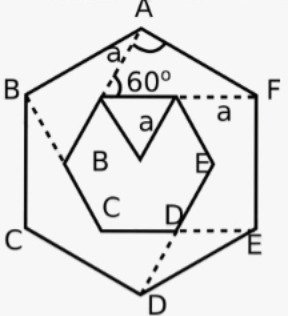
The sides of a regular hexagon $A B C D E F$ are extended by doubling them (for example, $B A$ extends to $B A^{\prime}$ with $\left.B A^{\prime}=2 B A\right)$ to form a bigger regular hexagon $A^{\prime} B^{\prime} C^{\prime} D^{\prime} F^{\prime} F^{\prime}$ as in the figure
Then the ratio of the areas of the bigger to the smaller hexagon is:
(A) 2 (B) 3 (C) $2 \sqrt{3}$ (D) $\pi$
Question : 27
Between 12 noon and 1 PM, there are two instants when the hour hand and the minute hand of a clock are at right angles. The difference in minutes between these two instants is:
For which values of $\theta$, with $0<\theta<\frac{\pi}{2}$, does the quadratic polynomial in $t$ given by $t^2+4 t \cos \theta+\cot \theta$ have repeated roots?
(A) $\frac{\pi}{6}$ or $\frac{5 \pi}{18}$ (B) $\frac{\pi}{6}$ or $\frac{5 \pi}{12}$ (C) $\frac{\pi}{12}$ or $\frac{5 \pi}{18}$ (D) $\frac{\pi}{12}$ or $\frac{5 \pi}{12}$
Question : 29
Let $\alpha, \beta, \gamma$ be complex numbers which are the vertices of an equilateral triangle. Them, we must have :
Assume that $n$ copies of unit cubes are glued together side by side to form a rectangular solid block. If the number of unit cubes that are completely invisible is 30 , then the minimum possible value of $n$ is :
(A) 204 (B) 180 (C) 140 (D) 84
Exploring Locus Problems in Math Olympiad Geometry
Welcome to a thrilling exploration of locus problems in geometry, a crucial concept for anyone preparing for math competitions like the IOQM, American Math Competition, and GMD. Whether you're aiming for ISI, CMI, or just looking to sharpen your mathematical skills, understanding loci will give you a solid edge.
What is a Locus?
In simpler terms, a locus is the path traced by a moving point that follows a specific rule.Imagine you have a fixed point, O, and a moving point, P. Point P doesn't move randomly; it follows a specific rule. Our goal is to find out the path that point P traces as it moves according to this rule. This path is known as the locus of point P.
Example 1: Drawing a Circle
Let’s start with a simple rule: point P is always 3 units away from point O. What happens then? P traces out a circle!
Dynamic View: Picture point P moving around point O, always keeping a distance of 3 units. As P moves, a circle forms. This helps you see how the circle is created step-by-step.
Static View: Think of the circle as all points that are 3 units away from O. This gives you a complete picture of the circle at once.
Both views are important and help you understand the circle in different ways.
Example 2: Creating an Ellipse
Next, let’s try a different rule. Suppose you have two fixed points, O1 and O2, and a moving point, P. The rule is that the sum of the distances from P to O1 and O2 is always 5 units. What shape does P trace out? The answer is an ellipse!
To understand this, imagine P moving so that the distances to O1 and O2 always add up to 5. Visualizing this movement helps you see how the ellipse forms.
Example 3: Rolling Circles
For our final example, imagine a big fixed circle with a diameter of 4 cm and a small moving circle with a diameter of 1 cm. If the small circle rolls around the big circle, what path does a point on the edge of the small circle trace? This path is called a hypocycloid.
As the small circle rolls, the point on its edge creates a unique and interesting path. Visualizing this helps you understand the movement and the resulting shape.
Try It Yourself!
You have two fixed points, A and B, and a moving point, P. The sum of the distances from P to A and B is constant. What path does P trace out?
Share your answers in the comments!
How to Solve Locus Problems | Math Olympiad Geometry Concept | Cheenta
ISI and CMI Entrance 2024
In 2024, the following Cheenta students are successful for Indian Statistical Institute's BStat-BMath Entrance and Chennai Mathematical Institute's B.Sc. Math Entrance. They ranked within the first 100 in the entire country in these entrances.
Most of these students attended the problem solving workshops regularly, which happen 5 times every week.
CMI B.Sc. Math Entrance
Ahan Chakraborty
Mohak Chugh
Krish Agrawal
Piyush Kumar Jha
Agastya Agarwal
Vrajishnu Chakraborty
I.S.I. B.Stat Entrance
Ahan Chakraborty (AIR 12)
Vrajishnu Chakraborty (AIR 74)
I.S.I. B.Math Entrance
Mohak Chugh (AIR 43)
Success Meet-Up
In this video we talk to the successful candidates and learn from their strategies. We also have a virtual award ceremony. The students presented with books and access to Cheenta Research Programs.
ISI B.Stat/B.Math 2024 Subjective Problem and Solution
Problem 1
Find, with proof, all possible values of $t$ such that $$\lim _{n \rightarrow \infty}{\frac{1+2^{1 / 3}+3^{1 / 3}+\cdots+n^{1 / 3}}{n^t}}=c$$
for some real number $c>0$. Also find the corresponding values of $c$.
Show that the equation $Q_n(x)=0$ has only two real roots, namely 0 and 1.
Solution
Watch the explanation of this solution here and subscribe for more
Problem 3
Let $A B C D$ be a quadrilateral with all internal angles $<\pi$. Squares are drawn on each side as shown in the picture below. Let $\Delta_1, \Delta_2, \Delta_3$ and $\Delta_4$ denote the areas of the shaded triangles shown. Prove that $$ \Delta_1-\Delta_2+\Delta_3-\Delta_4=0 $$
Solution
Watch the explanation of this solution here and subscribe for more
Problem 4
Let $f: \mathbb{R} \rightarrow \mathbb{R}$ be a function which is differentiable at 0 . Define another function $g: \mathbb{R} \rightarrow \mathbb{R}$ as follows: $$ g(x)= \begin{cases}f(x) \sin \left(\frac{1}{x}\right) & \text { if } x \neq 0 \\ 0 & \text { if } x=0\end{cases} $$
Suppose that $g$ is also differentiable at 0 . Prove that $$ g^{\prime}(0)=f^{\prime}(0)=f(0)=g(0)=0 . $$
Problem 5
Let $P(x)$ be a polynomial with real coefficients. Let $\alpha_1, \ldots, \alpha_k$ be the distinct real roots of $P(x)=0$. If $P^{\prime}$ is the derivative of $P$ show that for each $i=1,2, \ldots, k$, $$ \lim _{x \rightarrow a_i} \frac{\left(x-\alpha_i\right) P^{\prime}(x)}{P(x)}=r_i, $$ for some positive integer $r_i$.
Problem 6
Q6. Let $x_1, \ldots, x_{2024}$ be non-negative real numbers with $\sum_{i=1}^{2024} x_i=1$. Find, with proof, the minimum and maximum possible values of the expression $$ \sum_{i=1}^{1012} x_i+\sum_{i=1013}^{2024} x_i^2 . $$
Problem 7
Consider a container of the shape obtained by revolving a segment of the parabola $x=1+y^2$ around the $y$-axis as shown below. The container is initially empty. Water is poured at a constant rate of $1 \mathrm{~cm}^3 / \mathrm{s}$ into the container. Let $h(t)$ be the height of water inside the container at time $t$. Find the time $t$ when the rate of change of $h(t)$ is maximum.
Problem 8
In a sports tournament involving $N$ teams, each team plays every other team exactly once. At the end of every match, the winning team gets 1 point and the losing team gets 0 points. At the end of the tournament, the total points received by the individual teams are arranged in decreasing order as follows: $$ x_1 \geq x_2 \geq \cdots \geq x_N . $$
Prove that for any $1 \leq k \leq N$, $$ \frac{N-k}{2} \leq x_k \leq N-\frac{k+1}{2} $$