Kankinara Faculty Training Week 22 Report (8th March 2026)
The 22nd week of the Kankinara Faculty and Training Programme, held on March 8th, 2026, focused on establishing a strong foundation in core academic competencies. The week’s sessions were designed to help faculty assess and reinforce fundamental skills through structured testing and consistent verbal practice, ensuring that the learning journey remains both measurable and progressive.
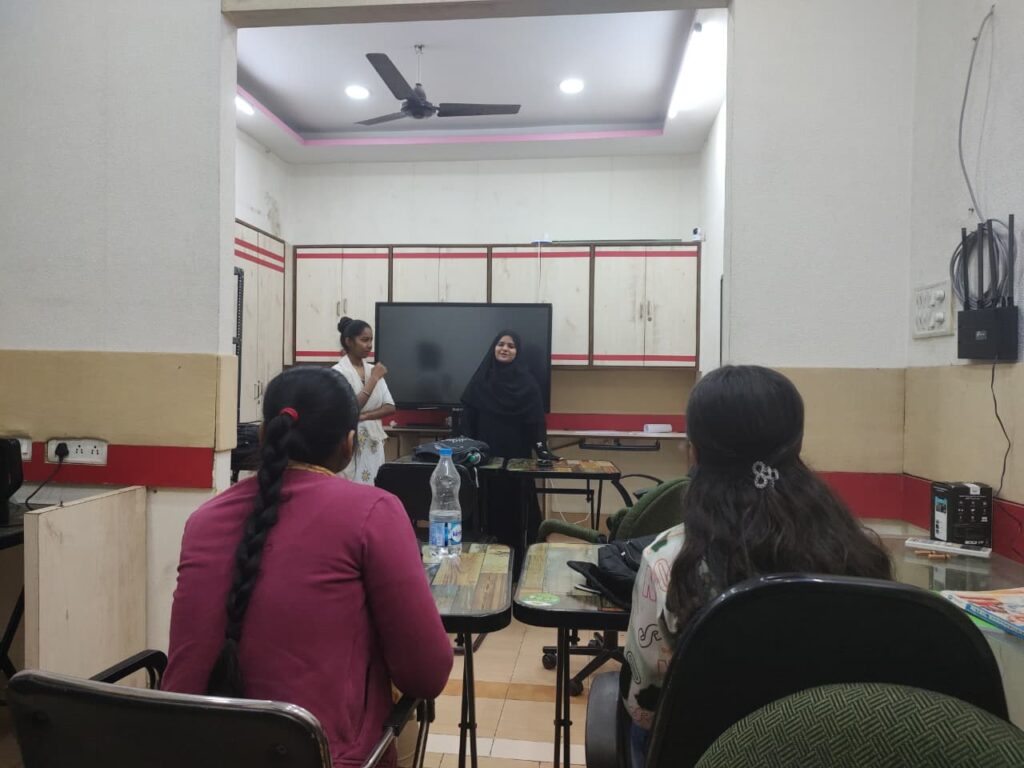
All participants engaged in a daily English introductory session to begin the day. This recurring practice is designed to build verbal fluency and confidence through repetition, creating a lively and interactive environment. By normalizing English conversation as a daily habit, the programme helps students and teachers alike overcome communication barriers, keeping them actively involved and motivated to express their ideas.
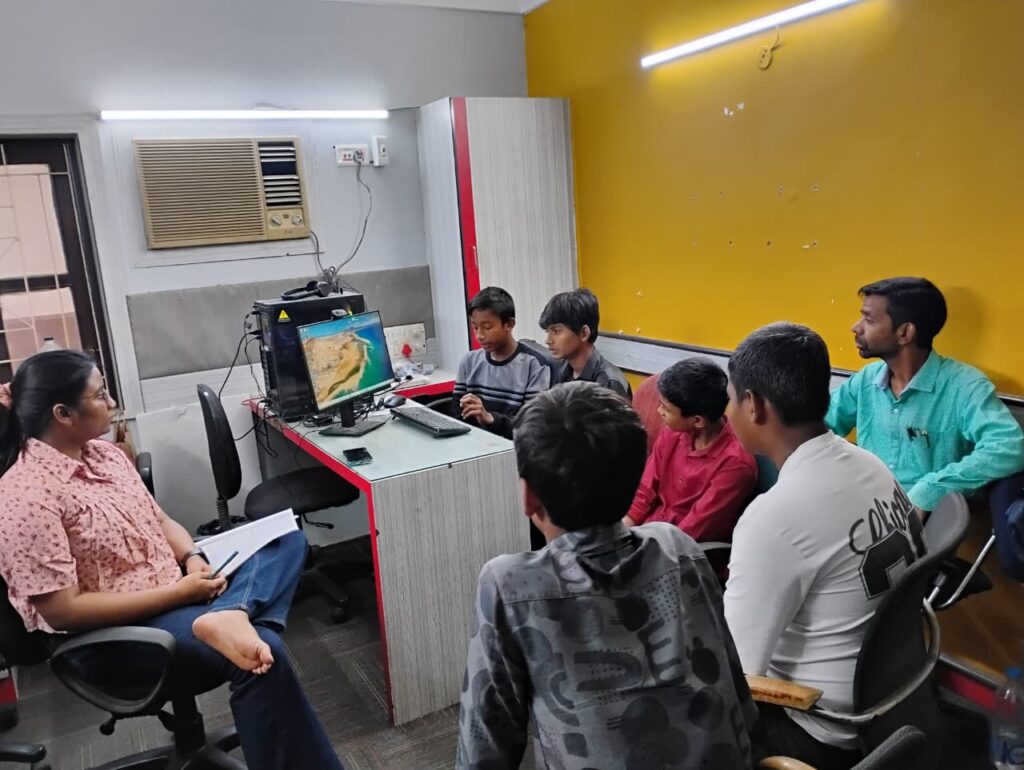
A key highlight of the week was the comprehensive Literacy and Numeracy Assessment. Both students and teachers from Kankinara participated in this evaluation, which utilized a formally structured question paper to gauge proficiency levels. This session was crucial for reinforcing the importance of foundational knowledge, demonstrating how complex progress can be tracked through contextual understanding and data-driven evaluation. It provided faculty with a clear roadmap for future teaching strategies while encouraging students to take pride in their academic growth.
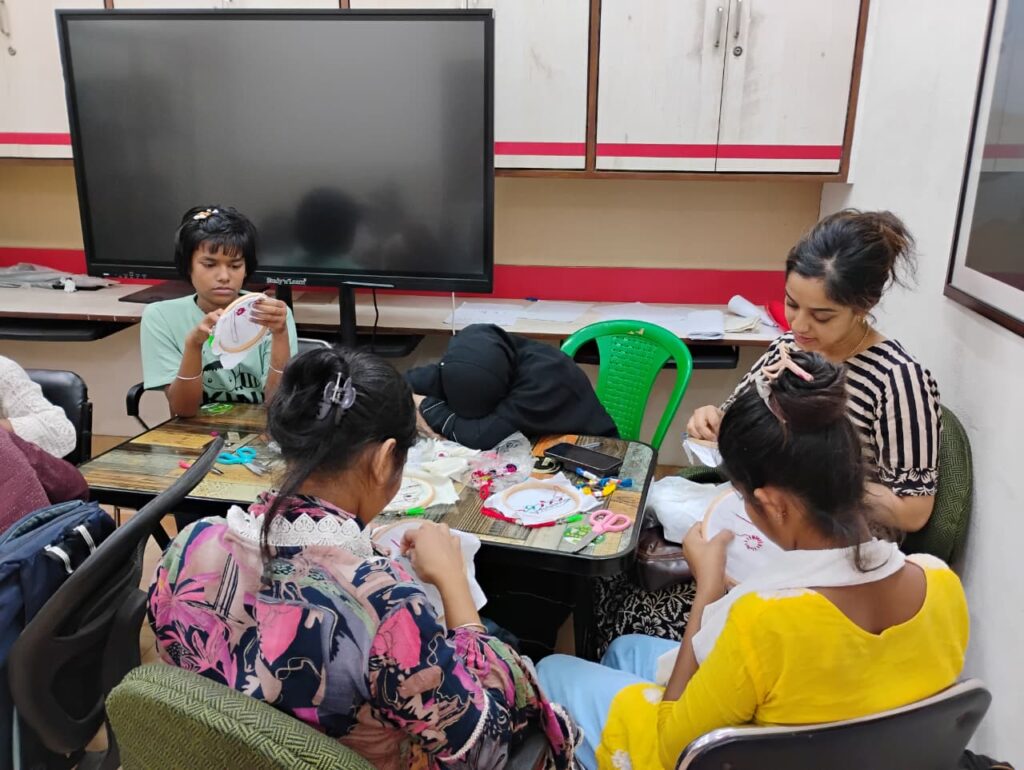
Following the academic evaluation, the participants returned to their basic embroidery training. Continuing the established tradition of craft-based learning, this session allowed students to further refine their needlework skills. The repetition of these stitching techniques encourages patience, creativity, and fine motor precision. By integrating this manual craft alongside rigorous testing, the programme shows how needlework can be used as a calming and productive balance to academic pressure.
Overall, the 22nd week of the Kankinara Faculty Training Programme was a period of focused evaluation and steady refinement. The participants felt a sense of purpose through the literacy and numeracy challenges, and the atmosphere remained energetic and positive throughout the day. The week successfully supported faculty development by proving that consistent testing, combined with creative practice, makes for a well-rounded and effective classroom experience.
Kankinara Faculty training week 18 report (8th Feb 2026)
The 18th week of the Kankinara Faculty and Training Programme focused on collaborative classroom engagement and creative learning through activity-based sessions. The week’s sessions were designed to help faculty experience how to conduct integrated classes where language learning and hands-on activities go together, keeping students actively involved and motivated.
Two faculty members from Kankinara attended the session and brought two of their students as well. All participants attended the class together, creating a lively and interactive learning environment. During the session, they selected a short English story, prepared a set of question–answer items from it, and conducted a light grammar-focused discussion. This helped reinforce how reading comprehension can be effectively linked with structured Q&A practice and basic grammatical understanding.
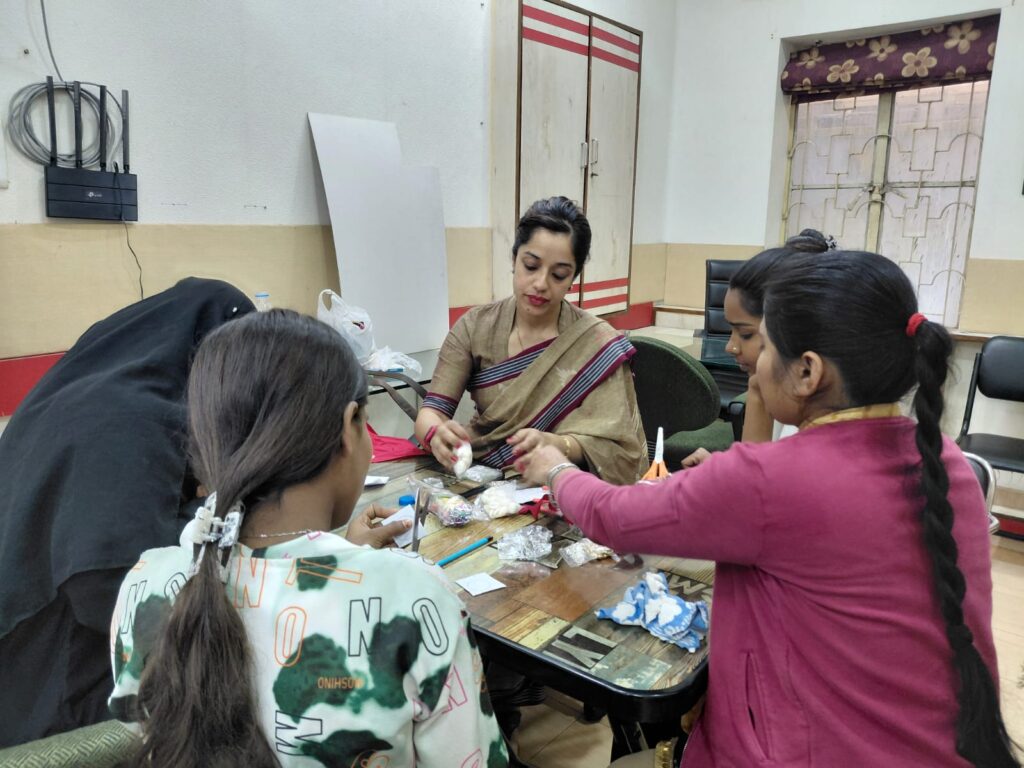
A key highlight of the week was the special session conducted by Ms. Ujjoyini, who introduced participants to simple handcraft activities. Students were guided to create jewellery using ghoongroos and other decorative materials, along with colourful paper-based craft work. The session encouraged creativity, patience, and fine motor skills, while also showing how craft-based learning can be incorporated into classroom engagement.
Overall, the 18th week of the Kankinara Faculty Training Programme brought a refreshing blend of academic and creative learning. The participants, especially the students, felt joyful and happy during the sessions, and the atmosphere remained energetic and positive throughout. The week supported faculty development by demonstrating how innovative activities and interactive teaching can make classroom learning more enjoyable and effective.
Kankinara Faculty training week 17 report (25th Jan 2026)
The 17th week of the Kankinara Faculty and Training Programme focused on strengthening digital documentation skills through practical training on Google Docs. The sessions were designed to help participants create structured academic materials for classroom use in an organised and professional manner.
Participants were guided on how to use Google Docs to prepare question–answer papers for their students. The training covered document formatting, typing and editing text, inserting headings, and organising content clearly. Special emphasis was placed on creating well-structured Q&A papers that are easy for students to understand and follow.
The sessions also included guidance on setting appropriate question paper patterns. Participants learned how to design balanced question papers by including different types of questions, such as short answers, descriptive questions, and grammar-based exercises. This helped them understand how to align question patterns with learning objectives and student levels.
Overall, the 17th week of the Kankinara Faculty Training Programme contributed to participants’ ability to design effective academic resources. By learning to use Google Docs for question paper creation and understanding question-setting patterns, the sessions supported their professional growth and classroom readiness.
Kankinara Faculty training week 16 report (18th Jan 2026)
The 16th week of the Kankinara Faculty and Training Programme focused on developing social awareness, values, and language skills through lessons on basic etiquette and moral learning. The sessions were designed to help participants understand appropriate behaviour in everyday and professional settings while strengthening their reading and comprehension abilities.
Participants were introduced to basic etiquette, including respectful communication, polite language use, and appropriate conduct in academic and social environments. These discussions encouraged reflection on how manners and behaviour influence personal growth, relationships, and workplace interactions.
The programme also included the study of moral stories from the prescribed textbook. Through guided reading and discussion, participants explored the central messages of the stories and reflected on values such as honesty, responsibility, and empathy. This activity supported the development of reading comprehension while also promoting ethical thinking and self-awareness.
In addition, trainers conducted a review of students’ notebooks to assess regular practice, understanding, and handwriting. This copy-checking exercise helped identify learning gaps, reinforce discipline, and encourage consistent effort among participants.
Overall, the 16th week of the Kankinara Faculty Training Programme was centred on character development, language practice, and learning discipline. By combining etiquette lessons, moral storytelling, and academic review, the sessions contributed to the participants’ holistic growth and continued progress.
ISI BStat-BMath UGA & UGB 2025 Problem and Solution
UGA
1. (A)
2. (C)
3. (B)
4. (B)
5. (A)
6. (D)
7. (D)
8. (D)
9. (B)
10. (B)
11. (C)
12. (D)
13. (C)
14. (D)
15. (B)
16. (D)
17. (D)
18. (C)
19. (C)
20. (A)
21. (A)
22. (C)
23. (B)
24. (A)
25. (C)
26. (B)
27. (A)
28. (B)
29. (D)
30. (B)
Problem 1
In the \(x y\)-plane, the curve \(3 x^3 y+6 x y+2 x y^3=0\) represents
(A) a pair of straight lines (B) an ellipse (C) a pair of straight lines and an ellipse (D) a hyperbola
(A) \(\alpha \leq \beta\) but not necessarily \(\alpha=\beta\) (B) \(\beta \leq \alpha\) but not necessarily \(\alpha=\beta\) (C) \(\alpha=\beta\) (D) nothing can be said in general
Solution
Problem 7
Consider the cyclic quadrilateral \(A B C D\) given below.
Assume that \(A B=B C, A D=C D\), and \(\frac{A B}{A D}=\frac{1}{3}\). Let \(\theta=\angle A D C\). Then \(\cos \theta\) is equal to
Let \(A={(x, y): x, y \in[0,1]}\) and \(B={(x, y): x, y \in[0,2]}\). Define \(f: A \rightarrow B\) by \(f(x, y)=\left(x^2+y, x+y^2\right)\). Then \(f\) is
(A) one-to-one but not onto (B) onto but not one-to-one (C) both one-to-one and onto (D) neither one-to-one nor onto
Solution
\(A={(x, y): x, y \in[0,1]}\)
\(B={(x, y): x, y \in[0,2]}\)
\(f: A \rightarrow B\)
\(f(x, y)=\left(x^2+y ; x+y^2\right)\)
Not one -on - one
as \(\begin{array}{r}(1,0) \ (0,1)\end{array}\) --> both map to \((1,1)\)
Twelve boxes are placed along a circle. In each box, \(1,2,3\) or 4 balls are put such that the total number of balls in any 4 consecutive boxes is same. The number of ways this can be done is
(A) 4 ! (B) \(4^4\) (C) \((4!)^3\) (D) \((4!)^4\)
Solution
once we choose number of balls in first 4 boxes, the remaining choices become fixed.
For each of the four boxes, we have four choices,
\(\therefore 4^4\) cases in total
Problem 11
Let \(a_0=0, a_1=1\) and \(a_n=5 a_{n-1}+a_{n-2}\) for \(n \geq 2\). Then the value of the determinant
is
(A) -1 (B) \(-5^{101}\) (C) 1 (D) \(5^{101}\)
Solution
Watch the video
Problem 12
The lengths of the three sides of a right angled triangle are geometric progression. The smallest angle of the triangle is
Consider the following statements about two similar triangles \(\Delta_1), and (\Delta_2\).
\(S_1\): Lengths of the sides of \(\Delta_1\) are in arithmetic progression \(S_2\). Lengths of the sides of \(\Delta_1\) are in geometric progression.
\(S_3\). Lengths of the sides of \(\Delta_2\) are in arithmetic progression.
\(S_4\). Lengths of the sides of \(\Delta_2\) are in geometric progression.
Then
(A) \(S_1\) implies \(S_3\), but \(S_2\) does not imply \(S_4\) (B) \(S_1\) does not imply \(S_3\), but \(S_2\) implies \(S_4\) (C) \(S_1\) implies \(S_3\), and \(S_2\) implies \(S_4\) (D) \(S_1\) does not imply \(S_3\), and \(S_2\) does not imply \(S_4\)
Solution
Let \((\sigma, b, c)\) and \(\left(a^{\prime}, b^{\prime}, c^{\prime}\right)\) are
The lengths of the two adjacent sides of a parallelogram are 2 cm and 3 cm . The length of one diagonal is \(\sqrt{19} \mathrm{~cm}\). Then the length of the other diagonal is
Let \(f\) \((x) = \frac{1}{1+|x-1|}+\frac{1}{1+|x+1|}\). Then the function \(f\) has (A) neither a local maximum nor a local minimum (B) a local minimum at \(x=0\), but no local maximum (C) local maxima at \(x= \pm 1\), but no local minimum (D) a local minimum at \(x=0\) and local maxima at \(x= \pm 1\)
Let \(a, b, c, d\) be positive integers such that the product abcd (=999). Then the number of different ordered 4 -tuples \((a, b, c, d)\) is
(A) 20 (B) 48 (C) 80 (D) 84
Solution
\(999=3^3 \times 27\)
Hence the number of non-negetive integer solution
\(\binom{3+4-1}{4-1}\binom{1+4-1}{4-1}\)
\(=20 \times 4\)
\(=80\)
Problem 20
Let \(|x|\) denote the greatest integer less than or equal to \(x \in \mathbb{R}\) and \(|x|\) has its usual meaning, that is, \(|x|=x\) if \(x \geq 0\), and \(|x|=-x\), if \(x<0\). Then the value of the integral
\(\int_{-2}^1([x]+2)^{|x|} d x\)
is (A) \(1+\frac{1}{\log _e 2}\) (B) \(1+\log _e \frac{1}{2}\) (C) \(2-\log _e 2\) (D) none of the above
Solution
\(\int_{-2}^1([x]+2)^{|x|} d x\)
\(=\int_0^1 2^x d x+\int_{-1}^0 1^{-x} d x\)
\(f \int_{-2}^{-1} 0 \cdot d x\)
\(=\left[\frac{2 x}{\ln 2}\right]_0^1+1.1\)
\(\left(\frac{1}{\ln^2}+1\right)\)
Problem 21
For a real number \(x\), let \(f(x)=\int_{-20}^{20} g(t) g(x-t) d t\), where \(g(x)= \begin{cases}1, & \text { if } x \in[0,1] \ 0, & \text { otherwise }\end{cases}\)
Then \(f(x)\) is equal to (A) \(\begin{cases}x, & \text { if } x \in[0,1], \ 2-x, & \text { if } x \in[1,2], \ 0, & \text { otherwise }\end{cases}\) (B) \(\begin{cases}1+x, & \text { if } x \in[0,1), \ 1-x, & \text { if } x \in[1,2), \ 0, & \text { otherwise }\end{cases}\) (C) \(\begin{cases}1, & \text { if } x \in(-20,20), \ 0, & \text { otherwise }\end{cases}\) (D) none of the above
Solution
Now, if \(x<0\) or \(x>2\)then the integration becomes 0 .
if \(\quad 0 \leq x \leq 1\)
Then \(f(x)\)
\(=\int_{x-1}^x g(t) d t\)
\(=\int_0^x d t=x\)
\(=\int_{-20}^{20} \theta(t) g(x-t) d t\)
\(=\int_0^1 g(x-t) d t\)
\(=\int_0^1 g(t+x-1) d t\)
\(=\int_{x-1}^x g(t) d t\)
it \(10 \leqslant x \leqslant 2\)
\(f(x): \int_{x-1}^x g(t) d t\)
\(=\int_{x-1}^1 d t=(2-x)\)
Problem 22
Let \(n \geq 3\). There are \(n\) straight lines in a plane, no two of which are parallel and no three pass through a common point. Their points of intersection are joined. Then the number of fresh line segments thus created is (A) \(\frac{n(n-1)(n-2)}{8}\) (B) \(\frac{n(n-1)(n-2)(n-3)}{6}\) (C) \(\frac{n(n-1)(n-2)(n-3)}{8}\) (D) none of the above
Solution
The lines intersect at \(\binom{n}{2}\) different points But there are also \((n-1)\) points in part of line
In a certain test there are \(n\) questions. At least \(i\) questions were wrongly answered by \(2^{n-i}\) students, where \(i=1,2, \ldots, n\). If the total number of wrong answers given by all students is 2047 , then (n) is equal to (A) 10 (B) 11 (C) 12 (D) 13
Solution
At least \(i\) questions were wrongly answered by \(2^{n-i}\) students.
Let \(n\) be a positive integer. The value of \(\sum_{k=0}^n \tan ^{-1} \frac{1}{k^2+k+1}\) is (A) \(\tan ^{-1}(n+1)\) (B) \(\tan ^{-1}\left(\frac{1}{n+1}\right)\) (C) \(\tan ^{-1} n\) (D) \(\tan ^{-1}\left(\frac{1}{n}\right)\)
Let \(d\) be the side length of the largest possible equilateral triangle that can be put inside a square of side length 1 . Then (A) \(d<1\) (B) \(d=1\) (C) \(1<d<\frac{2}{3^{1 / 4}}\) (D) \(d \geq \frac{2}{3^{1 / 4}}\)
Problem 26
Let \(f(x)=\left(x^2+18\right)(x-4) x(x+4)-2\). Then (A) \(f\) has exactly one real root (B) \(\int\) has exactly 3 distinct real roots (C) \(f\) has 5 distinct real roots (D) \(f\) has a repeated root
Solution
\(f(x)=\left(x^2+18\right) x(x-4)(x+4)-2\)
\(f^{\prime}(x)=5 x^4+6 x^2-288\)
\(f^{\prime}\) has two real roots
But \(f\) can have at most three real roots. But \(f(-4)<0 \quad f(-3)>0 \quad f(0)<0 \quad f(4)<0 \quad f(5)>0\)
\( \therefore \) it has 3 real roots (B).
Problem 27
Yet \(k\) be a positive integer and \(f(x)=e^x-1\). Then
A subset ${u_1, u_2, u_3, u_4, u_5}$ of the first 90 positive integers can be selected in $\binom{90}{5}$ ways. Let $u_{\text{max}} = \max{u_1, u_2, u_3, u_4, u_5}$ and $u_{\text{min}} = \min{u_1, u_2, u_3, u_4, u_5}$. Then the arithmetic mean of $u_{\text{max}} + u_{\text{min}}$ over all such subsets is
(A) 45 (B) 46 (C) 89 (D) 91
Solution
No. of subsets whose max element 90 is \(\quad 90\binom{89}{4}\)
When \(u_{\text {max }}=89 \rightarrow 89\binom{88}{4}\)
When \(u_{\text {max }}^{\text {max }}=88 \rightarrow 88\binom{87}{4}\)
" " "
" " "
" " "
when \(u_{\max }=5 \rightarrow 5\binom{4}{4}\)
Now, when \(u_{\min }=1 \rightarrow 1\binom{89}{4}\).
when \(u_{\min }^{\min }=2 \rightarrow 2\binom{88}{4}\)
when \(u_{\text {min }}=3 \rightarrow 3\binom{87}{4}\)
Suppose \(f: \mathbb{R} \rightarrow \mathbb{R}\) is differentiable and \(\left|f^{\prime}(x)\right|<\frac{1}{2}\) for all \(x \in \mathbb{R}\). Show that for some \(x_0 \in \mathbb{R}, f\left(x_0\right)=x_0\).
Solution
Watch the video
Problem 2
If the interior angles of a triangle (A B C) satisfy the equality,
Suppose \(f:[0,1] \rightarrow \mathbb{R}\) is differentiable with \(f(0)=0\). If \(\left|f^{\prime}(x)\right| \leq f(x)\) for all \(x \in[0,1]\), then show that \(f(x)=0\) for all \(x\).
Problem 4
Let \(S^1={\{z \in \mathbb{C}| | z \mid=1}\}\) be the unit circle in the complex plane. Let Let \(f: S^1 \rightarrow S^1\) be the map given by \( f(z)=z^2 \). We define \(f^{(1)}:=f\) and \(f^{(k+1)}:=f \circ f^{(k)}\) for \(k \geq 1\). The smallest positive integer \(n\) such that \(f^{(n)}(z)=z\) is called the period of \(z\). Determine the total number of points in \(S^1\) of period 2025. (Hint: \(2025=3^4 \times 5^2) \)
Problem 5
Let \(a, b, c\) be nonzero real numbers such that \(a+b+c \neq 0\). Assume that
Let \(\mathbb{N}\) denote the set of natural numbers, and let \(\left(a_i, b_i\right)\), \(1 \leq i \leq 9\), be nine distinct tuples in \(\mathbb{N} \times \mathbb{N}\). Show that there are three distinct elements in the set \({2^{a_i} 3^{b_i}: 1 \leq i \leq 9}\) whose product is a perfect cube.
Problem 7
Consider a ball that moves inside an acute-angled triangle along a straight line, until it hits the boundary, which is when it changes direction according to the mirror law, just like a ray of light (angle of incidence (=) angle of reflection). Prove that there exists a triangular periodic path for the ball, as pictured below.
Problem 8
Let \(n \geq 2\) and let \(a_1 \leq a_2 \leq \cdots \leq a_n\) be positive integers such that \(\sum_{i=1}^n a_i=\Pi_{i=1}^n a_i\). Prove that \(\sum_{i=1}^n a_i \leq 2 n\) and determine when equality holds.
Exploring the Chinese Remainder Theorem for Polynomials: CMI B.Sc. Entrance 2016- Subjective Problem 5
In today's discussion, we delve into a fascinating problem from the 2016 CMI B.Sc. entrance exam that draws on key concepts from number theory, specifically the Chinese Remainder Theorem (CRT), but applies them in the context of polynomials. The problem asks us to find a polynomial $P(x)$ that satisfies two conditions:
When $P(x)$ is divided by $x^{100}$, the remainder is a constant.
When $P(x)$ is divided by $(x-2)^3$, the remainder is also a constant.
This setup mirrors the CRT for integers but applies it to the algebraic framework of polynomials.
The video walks through the similarities between integer and polynomial division and emphasizes how techniques like the Euclidean algorithm can be extended to polynomials. Using polynomial differentiation and integration, we solve the given conditions, ultimately arriving at a general form for $P(x)$ by adjusting constants.
A key takeaway is the parallel between solving congruences for integers using the Euclidean algorithm and doing the same for polynomials, underscoring the algebraic unity between these two domains.
Watch the Video
Key Findings and Explanations:
Chinese Remainder Theorem for Polynomials: The problem presents a polynomial version of the Chinese Remainder Theorem (CRT), requiring the polynomial $P(x)$ to satisfy congruences:
This highlights the deep connection between the two fields.
Polynomial Division and Remainders: Just like integer division, polynomial division leaves a quotient and remainder. The task is to find a polynomial $P(x)$ that satisfies the given remainder conditions.
Differentiation and Divisibility: If a polynomial $F(x)$ leaves a constant remainder when divided by $(x-c)^k$, its derivative is divisible by $(x-c)^{k-1}$. For example, the condition:
$$ P^{\prime}(x) \text { must be divisible by } x^{99} \text { and } \quad(x-2)^2 $$
Integration for Polynomial Construction: Using integration, the form of $P(x)$ is constructed by integrating terms involving $x^{99}(x-2)^2$. This allows for the introduction of constants $a$ and $b$, which are later adjusted based on the remainder conditions:
Euclidean Algorithm for Polynomials: The Euclidean algorithm, traditionally used for integers, also applies to polynomials. Running the algorithm backwards allows us to solve polynomial congruences in a manner analogous to integer CRT. For instance, finding polynomials $P_1(x)$ and $P_2(x)$ such that:
$$ P_1(x) \cdot x^{100}+P_2(x) \cdot(x-2)^3=1 $$
Polynomial and Integer Analogy: The parallel between integer and polynomial division is a powerful concept, showing that techniques like the Euclidean algorithm, remainder theorem, and CRT can be seamlessly transferred between these domains.
ISI BStat BMath Entrance 2018 - Objective Problems and Answers
ISI BStat BMath Entrance 2018 Objective
I.S.I - 2018 ANSWER KEY
1.[A]
2.[D]
3.[D]
4.[D]
5.[B]
6.[B]
7.[A]
8.[A]
9.[A]
10.[B]
11.[B]
12.[A]
13.[C]
14.[B]
15.[C]
16.[C]
17.[A]
18.[C]
19.[B]
20.[B]
21.[B]
22.[C]
23.[B]
24.[B]
25.[C]
26.[B]
27.[A]
28.[D]
29.[D]
30.[C]
Question : 01
Let $0<x<\frac{1}{6}$ be a real number. When a certain biased dice is rolled, a particular face $F$ occurs with probability $\frac{1}{6}-x$ and its opposite face occurs with probability $\frac{1}{6}+x$; the other four faces occur with probability $\frac{1}{6}$. Recall that opposite faces sum to 7 in any dice. Assume that the probability of obtaining the sum 7 when two such dice are rolled is $\frac{13}{96}$. Then, the value of $x$ is:
An office has 8 officers including two who are twins. Two teams, Red and Blue, of 4 officers each are to be formed randomly. What is the probability that the twins would be together in the Red team?
Suppose Roger has 4 identical green tennis balls and 5 identical red tennis balls. In how many ways can Roger arrange these 9 balls in a line so that no two green balls are next to each other and no three red balls are together
(A) 8 (B) 9 (C) 11 (D) 12
Question : 04
The number of permutations $\sigma$ of $1,2,3,4$ such that $|\sigma(i)-i|<2$ for every $1 \leq i \leq 4$ is
(A) 2 (B) 3 (C) 4 (D) 5
Question : 05
Let $f(x)$ be a degree 4 polynomial with real coefficients. Let $z$ be the number of real zeroes of $f$. and $e$ be the number of local extrema (i.e., local maxima or Minima ) of $f$. Which of the following is a possible $(z, e)$ pairs?
(A) $(4,4)$ (B) $(3,3)$ (C) $(2,2)$ (D) $(0,0)$
Question : 06
A number is called a palindrome if it reads the same backward or forward. For example, 112211 is a palindrome. How many 6-digit palindromes are divisible by 495 ?
(A) 10 (B) 11 (C) 30 (D) 45
Question : 07
Let $A$ be a square matrix of real numbers such that $A^4=A$. Which of the following is true for every such A ?
(A) $\quad \operatorname{det}(A) \neq-1$ (B) $A$ must be invertiible. (C) $A$ can not be invertiible. (D) $A^2+A+I=0$ where $I$ denotes the identity matrix.
Question : 08
Consider the real-valued function $h:{0,1, \ldots, 100} \rightarrow R$ such that $h(0)=5, h(100)=20$ and satisfying $h(i)=\frac{1}{0}(h(i+1)+h(i-1))$, for every $i=1,2, \ldots, 99$. Then, the value of $h(1)$ is :
(A) 5.15 (B) 5.5 (C) 6 (D) 6.15
Question : 09
An up-right path is a sequence of points $a_0=\left(x_0, y_0\right), a_1=\left(x_1, y_1\right), \cdots$ such that $a_{i+1}-a_i$ is either $(1,0)$ or $(0,1)$. The number of up-right paths from $(0,0)$ to $(100,100)$ which pass through $(1,2)$ is
Let $f(x)=\frac{1}{2} x \sin x-(1-\cos x)$. The smallest positive integer $k$ such that $\lim _{x \rightarrow 0} \frac{f(x)}{x^k} \neq 0$ is :
(A) 3 (B) 4 (C) 5 (D) 6
Question : 11
Nine students in a class gave a test for 50 marks. Let $S_1 \leq S_2 \leq \ldots \leq S_5 \leq \ldots \leq S_8 \leq S_9$ denote their ordered scores. Given that $S_1=20$ and $\sum_{i=1}^9 S_1=250$, let $m$ be the smallest value that $S_5$ can take and $M$ be the largest value that $S_5$ can take. Then the pair $(m, M)$ is given by?
Let 10 red balls and 10 white balls be arranged in a straight line such that 10 each are on either side of a central mark. The number of such symmetrical arrangements about the central mark is
In a factory, 20 workers start working on a project of packing consignments. They need exactly 5 hours to pack one consignment. Every hour 4 new workers joint the existing workforce. It is mandatory to would relive a worker after 10 hours. Then the number of consignments that would be packed in the initial 113 hours is
(A) 40 (B) 50 (C) 45 (D) 52
Question : 16
Let $A B C D$ be a rectangle with its shorter side $a>0$ units and perimeter $2 s$ units. Let $P Q R S$ be any rectangle such that vertices $A, B, C$ and $D$ respectively lie on the lines $P Q, Q R, R S$ and $S P$. Then the maximum area of such a rectangle $P Q R S$ in square units is given by
The number of pairs of integers $(x, y)$ satisfying the equation $x y(x+y+1)=5^{2018}+1$ is
(A) 0 (B) 2 (C) 1009 (D) 2018
Question : 18
Let $p(n)$ be the number of digits when $8^n$ is written in base 6 , and let $q(n)$ be the number of digits when $6^n$ is written in base 4 . For example, $8^2$ in base 6 is 144 , hence $p(2)=3$. Then $\lim _{n \rightarrow \infty} \frac{p(n) q(n)}{n^2}$ equals:
(A) 1 (B) $\frac{4}{3}$ (C) $\frac{3}{2}$ (D) 2
Question : 19
For a real number $\alpha$, let $S_\alpha$ denote the set of those real numbers $\beta$ that satisfy $\alpha \sin (\beta)=\beta \sin (\alpha)$. Then which of the following statements is true?
(A) For any $\alpha, S_\alpha$ is an infinite set (B) $\quad S_\alpha$ is finite set if and only if $\alpha$ is not an integer multiple of $\pi$ (C) There are infinitely many numbers $\alpha$ for which $S_\alpha$ is the set of all real numbers (D) $\quad S_\alpha$ is always finite
Question : 20
If $A=\left(\begin{array}{ll}1 & 1 \ 0 & i\end{array}\right)$ and $A^{2018}=\left(\begin{array}{ll}a & b \ c & d\end{array}\right)$, then $a+d$ equals :
(A) $1+i$ (B) 0 (C) 2 (D) 2018
Question : 21
Let $f: R \rightarrow R$ and $g: R \rightarrow R$ be two functions. Consider the following two statements : $P(1)$ : If $\lim_{x \rightarrow 0} f(x)$ exists and $\lim{x \rightarrow 0} f(x) g(x)$ exists, then $\lim _{x \rightarrow 0} g(x)$ must exist. $P(2)$ : If $f, g$ are differentiable with $f(x)<g(x)$ for every real number $x$, then $f^{\prime}(x)<g^{\prime}(x)$ for all $x$ Then, which one of the following is a correct statement?
(A) Both $P(1)$ and $P(2)$ are true. (B) Both $P(1)$ and $P(2)$ are false. (C) $\quad P(1)$ is true and $P(2)$ is false. (D) $\quad P(1)$ is false and $P(2)$ is true.
Question : 22
The number of solutions of the equation $\sin (7 x)+\sin (3 x)=0$ with $0 \leq x \leq 2 \pi$ is :
(A) 9 (B) 12 (C) 15 (D) 18
Question : 23
A bag contains some candies, $\frac{2}{5}$ of them are made of white chocolate and remaining $\frac{3}{5}$ are made of dark chocolate. Out of the white chocolate candies, $\frac{1}{3}$ are wrapped in red paper, the rest are wrapped in blue paper. Out of the dark chocolate candles, $\frac{2}{3}$ are wrapped in red paper, the rest wrapped in blue paper. If a randomly selected candy from the bag is found to be wrapped in red paper, then what is the probability that it is made up of dark chocolate?
A party is attended by twenty people. In any subset of four people, there is at least one person who knows the other three (we assume that if $X$ knows $Y$, then $Y$ knows $X$ ). Suppose there are three people in the party who do not know each other. How many people in the party know everyone?
(A) 16 (B) 17 (C) 18 (D) Cannot be determined from the given data.
Question : 25
The sum of all natural numbers $a$ such that $a^2-16 a+67$ is a perfect square is :
(A) 10 (B) 12 (C) 16 (D) 22
Question : 26
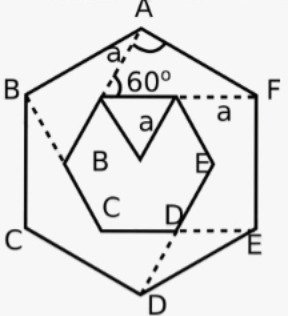
The sides of a regular hexagon $A B C D E F$ are extended by doubling them (for example, $B A$ extends to $B A^{\prime}$ with $\left.B A^{\prime}=2 B A\right)$ to form a bigger regular hexagon $A^{\prime} B^{\prime} C^{\prime} D^{\prime} F^{\prime} F^{\prime}$ as in the figure
Then the ratio of the areas of the bigger to the smaller hexagon is:
(A) 2 (B) 3 (C) $2 \sqrt{3}$ (D) $\pi$
Question : 27
Between 12 noon and 1 PM, there are two instants when the hour hand and the minute hand of a clock are at right angles. The difference in minutes between these two instants is:
For which values of $\theta$, with $0<\theta<\frac{\pi}{2}$, does the quadratic polynomial in $t$ given by $t^2+4 t \cos \theta+\cot \theta$ have repeated roots?
(A) $\frac{\pi}{6}$ or $\frac{5 \pi}{18}$ (B) $\frac{\pi}{6}$ or $\frac{5 \pi}{12}$ (C) $\frac{\pi}{12}$ or $\frac{5 \pi}{18}$ (D) $\frac{\pi}{12}$ or $\frac{5 \pi}{12}$
Question : 29
Let $\alpha, \beta, \gamma$ be complex numbers which are the vertices of an equilateral triangle. Them, we must have :
Assume that $n$ copies of unit cubes are glued together side by side to form a rectangular solid block. If the number of unit cubes that are completely invisible is 30 , then the minimum possible value of $n$ is :
(A) 204 (B) 180 (C) 140 (D) 84
Exploring Locus Problems in Math Olympiad Geometry
Welcome to a thrilling exploration of locus problems in geometry, a crucial concept for anyone preparing for math competitions like the IOQM, American Math Competition, and GMD. Whether you're aiming for ISI, CMI, or just looking to sharpen your mathematical skills, understanding loci will give you a solid edge.
What is a Locus?
In simpler terms, a locus is the path traced by a moving point that follows a specific rule.Imagine you have a fixed point, O, and a moving point, P. Point P doesn't move randomly; it follows a specific rule. Our goal is to find out the path that point P traces as it moves according to this rule. This path is known as the locus of point P.
Example 1: Drawing a Circle
Let’s start with a simple rule: point P is always 3 units away from point O. What happens then? P traces out a circle!
Dynamic View: Picture point P moving around point O, always keeping a distance of 3 units. As P moves, a circle forms. This helps you see how the circle is created step-by-step.
Static View: Think of the circle as all points that are 3 units away from O. This gives you a complete picture of the circle at once.
Both views are important and help you understand the circle in different ways.
Example 2: Creating an Ellipse
Next, let’s try a different rule. Suppose you have two fixed points, O1 and O2, and a moving point, P. The rule is that the sum of the distances from P to O1 and O2 is always 5 units. What shape does P trace out? The answer is an ellipse!
To understand this, imagine P moving so that the distances to O1 and O2 always add up to 5. Visualizing this movement helps you see how the ellipse forms.
Example 3: Rolling Circles
For our final example, imagine a big fixed circle with a diameter of 4 cm and a small moving circle with a diameter of 1 cm. If the small circle rolls around the big circle, what path does a point on the edge of the small circle trace? This path is called a hypocycloid.
As the small circle rolls, the point on its edge creates a unique and interesting path. Visualizing this helps you understand the movement and the resulting shape.
Try It Yourself!
You have two fixed points, A and B, and a moving point, P. The sum of the distances from P to A and B is constant. What path does P trace out?
Share your answers in the comments!
How to Solve Locus Problems | Math Olympiad Geometry Concept | Cheenta
ISI and CMI Entrance 2024
In 2024, the following Cheenta students are successful for Indian Statistical Institute's BStat-BMath Entrance and Chennai Mathematical Institute's B.Sc. Math Entrance. They ranked within the first 100 in the entire country in these entrances.
Most of these students attended the problem solving workshops regularly, which happen 5 times every week.
CMI B.Sc. Math Entrance
Ahan Chakraborty
Mohak Chugh
Krish Agrawal
Piyush Kumar Jha
Agastya Agarwal
Vrajishnu Chakraborty
I.S.I. B.Stat Entrance
Ahan Chakraborty (AIR 12)
Vrajishnu Chakraborty (AIR 74)
I.S.I. B.Math Entrance
Mohak Chugh (AIR 43)
Success Meet-Up
In this video we talk to the successful candidates and learn from their strategies. We also have a virtual award ceremony. The students presented with books and access to Cheenta Research Programs.
ISI B.Stat/B.Math 2024 Subjective Problem and Solution
Problem 1
Find, with proof, all possible values of $t$ such that $$\lim _{n \rightarrow \infty}{\frac{1+2^{1 / 3}+3^{1 / 3}+\cdots+n^{1 / 3}}{n^t}}=c$$
for some real number $c>0$. Also find the corresponding values of $c$.
Show that the equation $Q_n(x)=0$ has only two real roots, namely 0 and 1.
Solution
Watch the explanation of this solution here and subscribe for more
Problem 3
Let $A B C D$ be a quadrilateral with all internal angles $<\pi$. Squares are drawn on each side as shown in the picture below. Let $\Delta_1, \Delta_2, \Delta_3$ and $\Delta_4$ denote the areas of the shaded triangles shown. Prove that $$ \Delta_1-\Delta_2+\Delta_3-\Delta_4=0 $$
Solution
Watch the explanation of this solution here and subscribe for more
Problem 4
Let $f: \mathbb{R} \rightarrow \mathbb{R}$ be a function which is differentiable at 0 . Define another function $g: \mathbb{R} \rightarrow \mathbb{R}$ as follows: $$ g(x)= \begin{cases}f(x) \sin \left(\frac{1}{x}\right) & \text { if } x \neq 0 \\ 0 & \text { if } x=0\end{cases} $$
Suppose that $g$ is also differentiable at 0 . Prove that $$ g^{\prime}(0)=f^{\prime}(0)=f(0)=g(0)=0 . $$
Problem 5
Let $P(x)$ be a polynomial with real coefficients. Let $\alpha_1, \ldots, \alpha_k$ be the distinct real roots of $P(x)=0$. If $P^{\prime}$ is the derivative of $P$ show that for each $i=1,2, \ldots, k$, $$ \lim _{x \rightarrow a_i} \frac{\left(x-\alpha_i\right) P^{\prime}(x)}{P(x)}=r_i, $$ for some positive integer $r_i$.
Problem 6
Q6. Let $x_1, \ldots, x_{2024}$ be non-negative real numbers with $\sum_{i=1}^{2024} x_i=1$. Find, with proof, the minimum and maximum possible values of the expression $$ \sum_{i=1}^{1012} x_i+\sum_{i=1013}^{2024} x_i^2 . $$
Problem 7
Consider a container of the shape obtained by revolving a segment of the parabola $x=1+y^2$ around the $y$-axis as shown below. The container is initially empty. Water is poured at a constant rate of $1 \mathrm{~cm}^3 / \mathrm{s}$ into the container. Let $h(t)$ be the height of water inside the container at time $t$. Find the time $t$ when the rate of change of $h(t)$ is maximum.
Problem 8
In a sports tournament involving $N$ teams, each team plays every other team exactly once. At the end of every match, the winning team gets 1 point and the losing team gets 0 points. At the end of the tournament, the total points received by the individual teams are arranged in decreasing order as follows: $$ x_1 \geq x_2 \geq \cdots \geq x_N . $$
Prove that for any $1 \leq k \leq N$, $$ \frac{N-k}{2} \leq x_k \leq N-\frac{k+1}{2} $$