Triangle and Trigonometry | AIME I, 1999 Question 14
Try this beautiful problem from the American Invitational Mathematics Examination I, AIME I, 1999 based on Triangle and Trigonometry.
Triangle and Trigonometry - AIME 1999
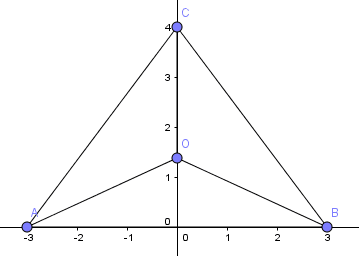
Point P is located inside triangle ABC so that angles PAB,PBC and PCA are all congruent. The sides of the triangle have lengths AB=13, BC=14, CA=15, and the tangent of angle PAB is \(\frac{m}{n}\), where m and n are relatively prime positive integers, find m+n.
is 107
is 463
is 840
cannot be determined from the given information
Key Concepts
Triangles
Angles
Trigonometry
Check the Answer
Answer: is 463.
AIME, 1999, Question 14
Geometry Revisited by Coxeter
Try with Hints
Let y be the angleOAB=angleOBC=angleOCA then from three triangles within triangleABC we have \(b^{2}=a^{2}+169-26acosy\) \(c^{2}=b^{2}+196-28bcosy\) \(a^{2}=c^{2}+225-30ccosy\) adding these gives cosy(13a+14b+15c)=295
[ABC]=[AOB]+[BOC]+[COA]=\(\frac{siny(13a+14b+15c)}{2}\)=84 then (13a+14b+15c)siny=168
Try this beautiful problem from American Invitational Mathematics Examination I, AIME I, 1999 based on Probability in games.
Probability in Games - AIME I, 1999 Question 13
Forty teams play a tournament in which every team plays every other team exactly once. No ties occur,and each team has a 50% chance of winning any game it plays.the probability that no two team win the same number of games is \(\frac{m}{n}\) where m and n are relatively prime positive integers, find \(log_{2}n\)
10
742
30
11
Key Concepts
Probability
Theory of equations
Combinations
Check the Answer
Answer: 742.
AIME, 1999 Q13
Course in Probability Theory by Kai Lai Chung .
Try with Hints
\({40 \choose 2}\)=780 pairings with \(2^{780}\) outcomes
no two teams win the same number of games=40! required probability =\(\frac{40!}{2^{780}}\)
the number of powers of 2 in 40!=[\(\frac{40}{2}\)]+[\(\frac{40}{4}\)]+[\(\frac{40}{8}\)]+[\(\frac{40}{16}\)]+[\(\frac{40}{32}\)]=20+10+5+2+1=38 then 780-38=742.
Least Positive Integer Problem | AIME I, 2000 | Question 1
Try this beautiful problem from the American Invitational Mathematics Examination, AIME, 2000 based on Least Positive Integer.
Least Positive Integer Problem - AIME I, 2000
Find the least positive integer n such that no matter how \(10^{n}\) is expressed as the product of any two positive integers, at least one of these two integers contains the digit 0.
Equations and Complex numbers | AIME I, 2019 Question 10
Try this beautiful problem from the American Invitational Mathematics Examination I, AIME I, 2019 based on Equations and Complex numbers.
Equations and Complex numbers - AIME 2019
For distinct complex numbers \(z_1,z_2,......,z_{673}\) the polynomial \((x-z_1)^{3}(x-z_2)^{3}.....(x-z_{673})^{3}\) can be expressed as \(x^{2019}+20x^{2018}+19x^{2017}+g(x)\), where g(x) is a polynomial with complex coefficients and with degree at most 2016. The value of \(|\displaystyle\sum_{1 \leq j\leq k \leq 673}(z_j)(z_k)|\) can be expressed in the form \(\frac{m}{n}\), where m and n are relatively prime positive integers, find m+n
is 107
is 352
is 840
cannot be determined from the given information
Key Concepts
Equations
Complex Numbers
Integers
Check the Answer
Answer: is 352.
AIME, 2019, Question 10
Complex Numbers from A to Z by Titu Andreescue
Try with Hints
here \(|\displaystyle\sum_{1 \leq j\leq k \leq 673}(z_j)(z_k)|\)=s=\((z_1z_2+z_1z_3+....z_1z_{673})+(z_2z_3+z_2z_4+...+z_2z_{673})\)
with Vieta's formula,\(z_1+z_1+z_1+z_2+z_2+z_2+.....+z_{673}+z_{673}+z_{673}\)=-20 then \(z_1+z_2+.....+z_{673}=\frac{-20}{3}\) the first equation and \({z_1}^{2}+{z_1}^{2}+{z_1}^{2}+{z_1z_2}+{z_1z_2}+{z_1z_2}+.....\)=\(3({z_1}^{2}+{z_2}^{2}+.....+{z_{673}}^{2})\)+\(9({z_1z_2}+{z_1z_3}+....+{z_{672}z_{673}})\)=\(3({z_1}^{2}+{z_2}^{2}+.....+{z_{673}}^{2})\)+9s which is second equation
here \((z_1+z_2+.....+z_{673})^{2}=\frac{400}{9}\) from second equation then \(({z_1}^{2}+{z_2}^{2}+.....+{z_{673}}^{2})+2({z_1z_2}+{z_1z_3}+....+{z_{672}z_{673}})=\frac{400}{9}\) then \(({z_1}^{2}+{z_2}^{2}+.....+{z_{673}}^{2})+2s=\frac{400}{9}\) then \(({z_1}^{2}+{z_2}^{2}+.....+{z_{673}}^{2})=\frac{400}{9}\)-2s then with second equation and with vieta s formula \(3(\frac{400}{9}-2s)+9s\)=19 then s=\(\frac{-343}{9}\) then |s|=\(\frac{343}{9}\) where 343 and 9 are relatively prime then 343+9=352.
Area of Equilateral Triangle | AIME I, 2015 | Question 4
Try this beautiful problem from the American Invitational Mathematics Examination, AIME, 2015 from Geometry, based on Area of Equilateral Triangle (Question 4).
Area of Triangle - AIME I, 2015
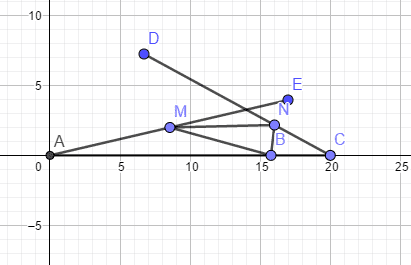
Point B lies on line segment AC with AB =16 and BC =4. Points D and E lie on the same side of line AC forming equilateral triangle ABD and traingle BCE. Let M be the midpoint of AE, and N be the midpoint of CD. The area of triangle BMN is x. Find \(x^{2}\).
is 107
is 507
is 840
cannot be determined from the given information
Key Concepts
Algebra
Theory of Equations
Geometry
Check the Answer
Answer: is 507.
AIME, 2015, Question 4
Geometry Revisited by Coxeter
Try with Hints
Let A(0,0), B(16,0),C(20,0). let D and E be in first quadrant. then D =\((8,8\sqrt3)\), E=\((18,2\sqrt3\)).
M=\((9,\sqrt3)\), N=(\(14,4\sqrt3\)), where M and N are midpoints
since BM, BN, MN are all distance, BM=BN=MN=\(2\sqrt13\). Then, by area of equilateral triangle, x=\(13\sqrt3\) then\(x^{2}\)=507.
Probability Problem | Combinatorics | AIME I, 2015 - Question 5
Try this beautiful problem from the American Invitational Mathematics Examination I, AIME I, 2015 based on Probability.
Probability Problem - AIME I, 2015
In a drawer Sandy has 5 pairs of socks, each pair a different color. on monday sandy selects two individual socks at random from the 10 socks in the drawer. On tuesday Sandy selects 2 of the remaining 8 socks at random and on wednesday two of the remaining 6 socks at random. The probability that wednesday is the first day Sandy selects matching socks is \(\frac{m}{n}\), where m and n are relatively prime positive integers, find m+n.
is 107
is 341
is 840
cannot be determined from the given information
Key Concepts
Algebra
Theory of Equations
Probability
Check the Answer
Answer: is 341.
AIME, 2015, Question 5
Geometry Revisited by Coxeter
Try with Hints
Wednesday case - with restriction , select the pair on wednesday in \(5 \choose 1 \) ways
Tuesday case - four pair of socks out of which a pair on tuesday where a pair is not allowed where 4 pairs are left,the number of ways in which this can be done is \(8 \choose 2\) - 4
Monday case - a total of 6 socks and a pair not picked \(6 \choose 2\) -2
by multiplication and principle of combinatorics \(\frac{(5)({5\choose 2} -4)({6 \choose 2}-2)}{{10 \choose 2}{8 \choose 2}{6 \choose 2}}\)=\(\frac{26}{315}\). That is 341.
Probability of tossing a coin | AIME I, 2009 | Question 3
Try this beautiful problem from American Invitational Mathematics Examination I, AIME I, 2009 based on Probability of tossing a coin.
Probability of tossing a coin - AIME I, 2009 Question 3
A coin that comes up heads with probability p>0and tails with probability (1-p)>0 independently on each flip is flipped eight times. Suppose the probability of three heads and five tails is equal to \(\frac{1}{25}\) the probability of five heads and three tails. Let p=\(\frac{m}{n}\) where m and n are relatively prime positive integers. Find m+n.
10
20
30
11
Key Concepts
Probability
Theory of equations
Polynomials
Check the Answer
Answer: 11.
AIME, 2009
Course in Probability Theory by Kai Lai Chung .
Try with Hints
here \(\frac{8!}{3!5!}p^{3}(1-p)^{5}\)=\(\frac{1}{25}\frac{8!}{5!3!}p^{5}(1-p)^{3}\)
then \((1-p)^{2}\)=\(\frac{1}{25}p^{2}\) then 1-p=\(\frac{1}{5}p\)
Equations with number of variables | AIME I, 2009 | Question 14
Try this beautiful problem from the American Invitational Mathematics Examination, AIME, 2009 based on Equations with a number of variables.
Equations with number of variables - AIME 2009
For t=1,2,3,4, define \(S^{t}=a^{t}_1+a^{t}_2+...+a^{t}_{350}\), where \(a_{i}\in\){1,2,3,4}. If \(S_{1}=513, S_{4}=4745\), find the minimum possible value for \(S_{2}\).
is 905
is 250
is 840
cannot be determined from the given information
Key Concepts
Series
Theory of Equations
Number Theory
Check the Answer
Answer: is 905.
AIME, 2009, Question 14
Polynomials by Barbeau
Try with Hints
j=1,2,3,4, let \(m_{j}\) number of \(a_{i}\) s = j then \(m_{1}+m{2}+m{3}+m{4}=350\), \(S_{1}=m_{1}+2m_{2}+3m_{3}+4m_{4}=513\) \(S_{4}=m_{1}+2^{4}m_{2}+3^{4}m_{3}+4^{4}m_{4}=4745\)
Subtracting first from second, then first from third yields \(m_{2}+2m_{3}+3m_{4}=163,\) and \(15m_{2}+80m_{3}+255m_{4}=4395\) Now subtracting 15 times first from second gives \(50m_{3}+210m_{4}=1950\) or \(5m_{3}+21m_{4}=195\) Then \(m_{4}\) multiple of 5, \(m_{4}\) either 0 or 5
If \(m_{4}=0\) then \(m_{j}\) s (226,85,39,0) and if \(m_{4}\)=5 then \(m_{j}\) s (215,112,18,5) Then \(S_{2}=1^{2}(226)+2^{2}(85)+3^{2}(39)+4^{2}(0)=917\) and \(S_{2}=1^{2}(215)+2^{2}(112)+3^{2}(18)+4^{2}(5)=905\) Then min 905.
Probability of divisors | AIME I, 2010 | Question 1
Try this beautiful problem from the American Invitational Mathematics Examination, AIME, 2010 based on Probability of divisors.
Probability of divisors - AIME I, 2010
Ramesh lists all the positive divisors of \(2010^{2}\), she then randomly selects two distinct divisors from this list. Let p be the probability that exactly one of the selected divisors is a perfect square. The probability p can be expressed in the form \(\frac{m}{n}\), where m and n are relatively prime positive integers. Find m+n.
is 107
is 250
is 840
cannot be determined from the given information
Key Concepts
Series
Probability
Number Theory
Check the Answer
Answer: is 107.
AIME I, 2010, Question 1
Elementary Number Theory by Sierpinsky
Try with Hints
\(2010^{2}=2^{2}3^{2}5^{2}67^{2}\)
\((2+1)^{4}\) divisors, \(2^{4}\) are squares
probability is \(\frac{2.2^{4}.(3^{4}-2^{4})}{3^{4}(3^{4}-1)}=\frac{26}{81}\) implies m+n=107