A Math Conversation - I

Inspired by the book of Precalculus written in a dialogue format by L.V.Tarasov, I also wanted to express myself in a similar fashion when I found that the process of teaching and sharing knowledge in an easy way is nothing but the output of a lucid conversation between a student and a teacher inside the person only.

Instead of presenting in paragraphs, I will express that discussion in the raw format of conversation to you.

Student: Do you think problem - solving is so important in learning math?

Teacher: Yes, surely without problem-solving, you will not at all enjoy the process of learning of mathematics. If you learn math without problem-solving is like charging the phone without the battery.

S: But why is it so important?

T: Math is nothing but layers of answers to a large number of Whys, Hows, Can We, etc. All the thoughts, questions and answers are refined into something called theorems and lemmas to make them look concise. Theory develops in this way only. Often someone gives a new way of looking into things or connecting two different fields of study, that becomes the definitions, but that was actually done to solve a new problem or question that occurred in their minds or make the things precise. Problems and Theory are the two sides of the same coin.

S: Interesting! So, a student how can we build our own new theory?

T: That's a good question. As I told you, it is about not developing a new theory, it is about solving a new problem always. So find your own problems or existing ones and start spending time with them.

S: What if I couldn't solve a problem?

T: That is the best part when you solve problems. You try to understand what doesn't work. You have to understand why it doesn't work. Then only you can engineer an alternate pathway, and that is eventually called a new theory if it is too influential. But whatever you have thought you can call it your own theory. Even if you cannot develop a full alternated pathway, something new you have thought will help you solve another problem you were pondering upon for sometime. This actually happenned with me.

S: Wow! This problem solving path seems to be quite adventurous. I never thought it this way.

T: Yes, it is. Infact human beings think and behave in this way only, when their rational and logical part of the brain work. Only they have to conscious of the steps they are taking and they have to take the opportunity to learn at every failure.

S: So, are there any problem solving tips for me?

T: I really don't believe in tricks while learning, tricks are important for quick problem solving that is only required in the exam. But those are temporary. Once you develop your own strategies, first of all we will get to know something new from you and also you will never forget those strategies. But yes, from my experience I can help you in approaching problems.

S: Surely, what are they?

T: First of all, you need to understand the working principle of problem-solving. It works like whenever you think or see some problem, you are either blank or you have some ideas to approach based on your previous experiences and knowledge.

S: Yes, then?

T: Well, if you have some ideas, you approach along that path till you can't proceed further. You have to find everytime where is the problem occurring and how to bypass it. This is why different people have different solutions to a problem because they create different bypasses.

S: What if I am blank?

T: You have to learn how to bring in ideas into you.

S: But how?

T: First of all, without knowledge or past experience ideas will rarely come, because that is how humans think using past data. Do you that our visual memory is the maximum memory among all the senses?

S: I felt that was true, but I knew that. But how is it related to math and problem-solving?

T: well, try to draw a picture in your mind or your copy. Try to draw a mindmap, some flowcharts to get some visual aspect of the theory or the problems. Now your visual memory comes into play automatically. That's why, the important step when you learn something new or try to solve something, ALWAYS TRY TO DRAW DIAGRAMS AND PICTURES WHENEVER IT IS POSSIBLE.

S: That's seems quite satisfying. I will start doing it from today only. What else?

T: Actually this is the first and important step. Also, intuition is also gained by the method of HIT AND TRIAL. When you have a problem, you play with the numbers in the problem or the expressions and often it happened to me that something interesting came out. So, also whenever you are blank, you can follow this HIT AND TRIAL methodology to start your idea engines and this helps you in recognizing patterns.

S: Hit and Trial seems exciting and adventurous too. What did you mean by pattern recognition?

T: Pattern recognition is the most important part of math. You have to observe a pattern and justify it with logic in a new problem. The first step to problem-solving is to find the pattern. Then comes the next part of logically justifying the pattern. To help you see the pattern and proceeding through you are guided by DRAWING PICTURES and HIT AND TRIAL methodologies.

S: What about logically justifying a problem?

T: This is the most difficult part and rewarding part of mathematics. Often people are not being properly trained in this domain that's why they find it uninteresting. The method of proofs depends on the pattern you see and observe and that varies from person to person. But proving that the pattern actually holds requires some serious training. Isn't it so beautiful, when you show that what you observe actually works? It is like painting your patterns by the brush of logic.

S: How do I develop that?

T: That is solely practice and you must enjoy that process. That process requires some knowledge and how people approached on similar ideas and patterns. Once you develop that habit, you will find it super rewarding. It is also a continuously learning path.

S: How do we learn like that that interesting way?

T: Yes, that is a really nice question and those who can impart this knowledge into you very fluidly and interestingly are good teachers. If you want to be a good teacher, you have to start practicing that too. You have to understand and question why every step works and are there any other ways to do it? Then only you will learn out of a problem, or a solution you have learned. Even if you are learning, you have to question WHY THIS WAY AND NOT THAT WAY. Develop the habit of questioning at every step of your learning process, then only you will enjoy.

S: Nice! I learnt a lot of new things today. Let me put that into action. See you later. Have a nice day.

T: Yes, you must put them into action. Yes see ya later. Have a nice day. Bye.

S: Bye.

The 3n+1 Problem | Learn Collatz Conjecture

The 3n+1 Problem is known as Collatz Conjecture.
Consider the following operation on an arbitrary positive integer:

The conjecture is that no matter what value of the starting number, the sequence will always reach 1.
Observe that once it reaches 1, it will do like the following oscillation

1 -> 4 -> 2 -> 1-.> 4 ->2 ....

So, we see when it converges to 1, or does it?

We will investigate the problem in certain details as much as possible with occasional exercises and some computer problems ( python ).

Let's start!

Let's start by playing with some numbers and observe what is happening actually.

We will need this frequently. So let's make a little piece of code to do this.

n = 12
print(n)
while n > 1:
    if n % 2 == 0 :
        n = n//2
        print (n)
    else:
        n = 3*n+1
        print (n)

This will give the output :

12 6 3 10 5 16 8 4 2 1

Now depending on the input of "n" you can get different sequences.

Exercise: Please copy this code and changing the input value of "n", play around with the sequences here. (Warning: Change it to python before implementing the code.) Eg: Do it for 7.

3n+1 Problem - sequence

If you observe that different numbers requires different time to converge and that is the unpredictable which makes the problem so hard.

There are in total two possibilities:

Exercise: Find out the length of the sequence for all the numbers from 1 to 100 by a computer program. I will provide you the code. Your job is to find a pattern among the numbers.

c = 1
for n in range(2,101):
    i = n 
    while i > 1:
        if (i % 2 == 0):
            i = i//2
            c = c + 1
            if i == 1 :
                print( "The length of the sequence of {} is {}".format(n, c) )
                c = 1
        else:
            i = 3*i+1
            c = c + 1 

Exercise: Consider the length of a sequence corresponding to a starting number "n' as L(n). Consider numbers of the form n = (8k+4) and n+1 = (8k+5), then find the relationship between L(n) and L(n+1). Try to observe the sequence of lengths for the numbers till 100 and predict the conjecture..

Exercise: Prove the conjecture that you discovered.

Hint:

8k+4 -> 2k+1 -> 6k+4 -> 3k+2

8k+5 -> 24k+ 16 -> 3k+2

Exercise: Prove that if n = 128k + 28, then L(n) = L(n+1) =L(n+2)

Hint:

128k+28 -> 48k+11 -> 81k+20

128k+29 -> 48k+11 -> 81k+20

128k+30 -> 81k+20

Exercise: Try to generalize the result for general k consecutive elements. Maybe you can take help of the computer to observe the pattern. Modify the code as per your choice.


You can try to do an easier problem and get the intuition as an exercise.

Exercise: Try to understand the behavior and the terminating number of the sequence if the rule is the following:

Consider the following operation on an arbitrary positive integer:


1. If the number is even, divide it by two.
2. If the number is odd, add 1.


Exercise: Try to understand the behavior and the terminating number of the sequence if the rule is the following:
Consider the following operation on an arbitrary positive integer:

1. If the number is even, divide it by two.
2. If the number is odd, add any 3.


Exercise: Try to understand the behavior and the terminating number of the sequence if the rule is the following:
Consider the following operation on an arbitrary positive integer:

1. If the number is even, divide it by two.
2. If the number is odd, add ANY ODD NUMBER.

Eager to hear your approaches and ideas. Please mention them in the comments.

Other useful links:-

The Dhaba Problem | ISI and CMI Entrance

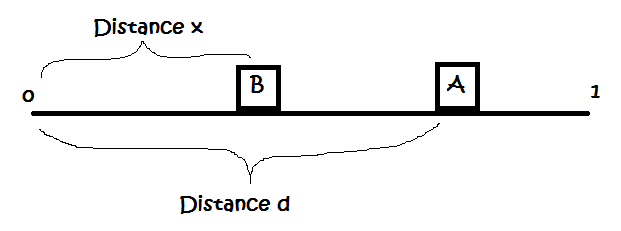
Suppose on a highway, there is a Dhaba. Name it by Dhaba A.

You are also planning to set up a new Dhaba. Where will you set up your Dhaba?

Model this as a Mathematical Problem. This is an interesting and creative part of the BusinessoMath-man in you.

You have to assume something for Mathematical simplicity to model a real life phenomenon via math.

Assumptions:

Observe that the assumptions are valid and are actually followed in real life. Just sit and think for some time placing yourself in that position.

The Explicit Mathematical Problem

distance of the dhaba
dhaba problem distance

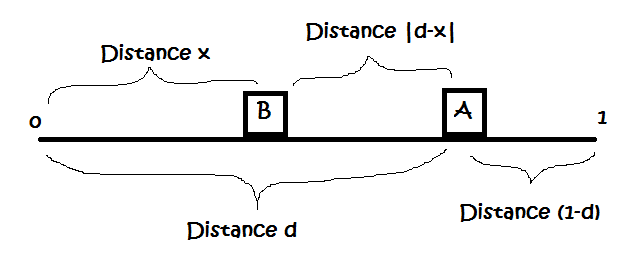
Profit Calculation of your Dhaba B

Now based on the lengths of the roads above and the assumptions made, we have to calculate the profit of Dhaba B.

solution of the dhaba problem
solution

So the profit made by B = c.R , where R is the length of the road on which B has monopoly. Here, as shown R = \c.( x + \frac{|d-x|}{2}\).

We have assumed in this case that \(0 \leq x \leq d\) by the diagram.

So, the profit for the Dhaba B is c.\(\frac{d+x}{2}\) .

Hence as \(0 \leq x \leq d\), the profit is maximized if x = d.

Exercise: Show that the profit of Dhaba B as a function of x is c.(\( 1 - \frac{d+x}{2}\)) if \(d \leq x \leq 1\) .

Also, observe that in this case the profit is maximized at x = d.

Exercise: Calculate the maximum profit in both cases. Do you observe something fishy? What steps and what arguments will you give to understand the fishiness?

Please share your views in the comments section.

Eager to listen to your beautiful ideas.

Other useful links:-

The Organic Math of Origami

Did you know that there exists a whole set of seven axioms of Origami Geometry just like that of the Euclidean Geometry?

Related image
The Origami in building the solar panel maximizing the input of Solar Power and minimizing the Volume of the satellite

Instead of being very mathematically strict, today we will go through a very elegant result that arises organically from Origami.

Before that, let us travel through some basic terminologies. Be patient for a few more minutes and wait for the gem to arrive.

In case you have forgotten what Origami is, the following pictures will remove the dust from your memories.

Origami Dinosaurs
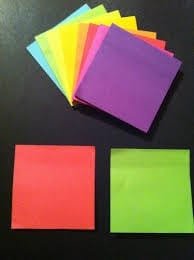
Origami Papers

Origami (from the Japanese oru, “to fold,” and kami, “paper”) is a traditional Japanese art of folding a sheet of paper, usually square, into a representation of an object such as a bird or flower.

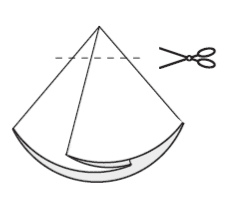
Flat origami refers to configurations that can be pressed flat, say between the pages of a book, without adding any new folds or creases.

Non- Flat Origami
Image result for flat origami
Flat Origami

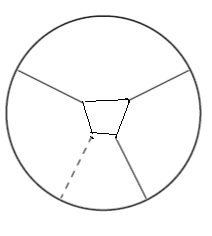
When an origami object is unfolded, the resulting diagram of folds or creases on the paper square is called a crease pattern.

We denote mountain folds by unbroken lines and valley folds by dashed
lines. A vertex of a crease pattern is a point where two or more folds intersect, and a flat vertex fold is a crease pattern with just one vertex.

The Origami and the Crease Pattern

In a crease pattern, we see two types of folds, called mountain folds and valley folds.


Related image

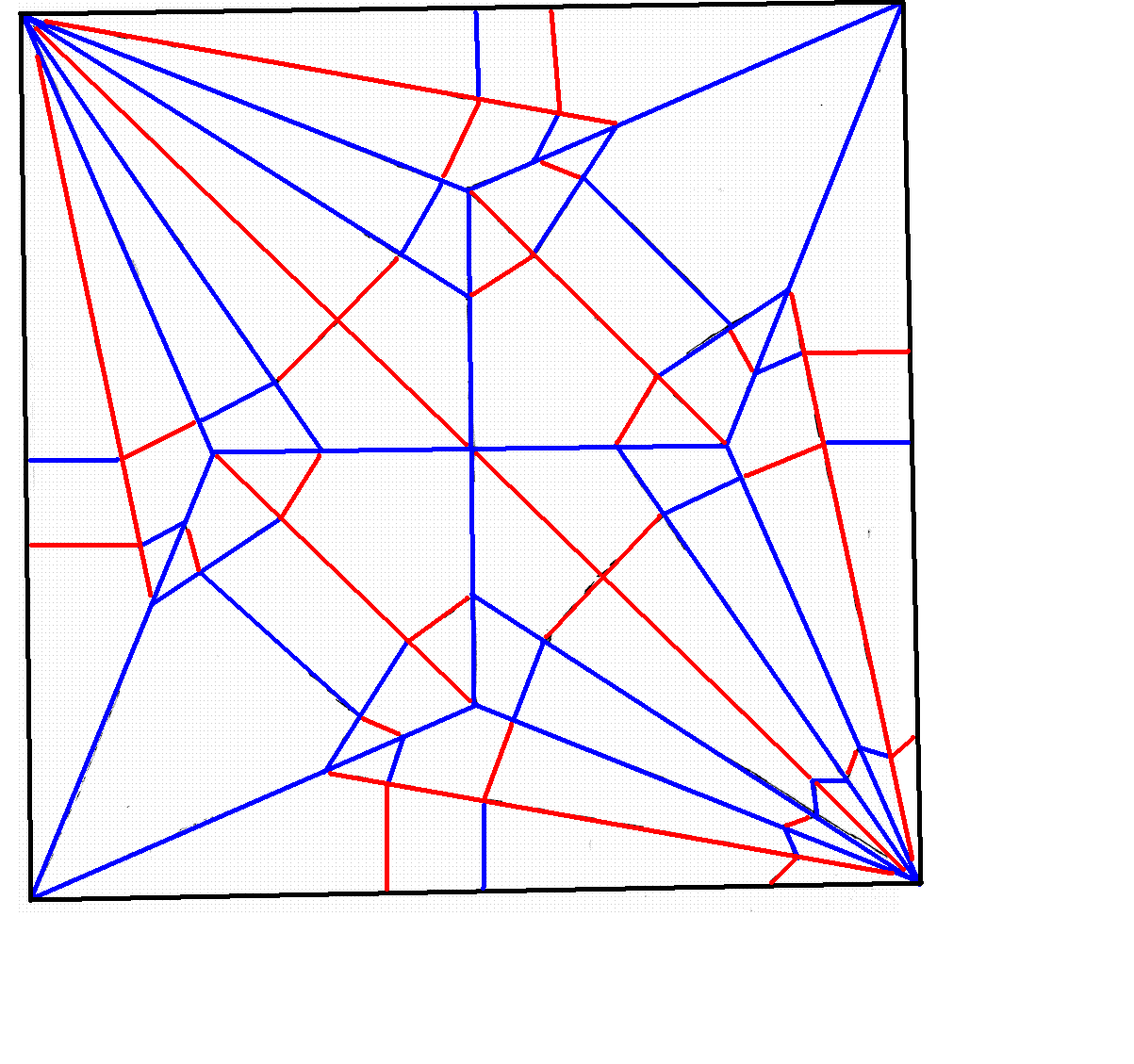
Now, if you get to play with your hands, you will get to discover a beautiful pattern.

Related image
The blue lines denotes the mountain folds and the red lines indicate the valley folds.

The positive difference between the dotted lines and the full lines is always 2 at a given vertex. The dotted line denotes the mountain fold and the full line denotes the valley fold.

This is encoded in the following theorem.

Maekawa's Theorem: The difference between the number of mountain
folds and the number of valley folds in a flat vertex fold is two.

Isn't it strange ?

Those who are familiar graph theory may think it is related to the Euler Number.

We will do the proof step by step but you will weave together the steps to understand it yourself. The proof is very easy.

Step 1:

Let n denote the number of folds that meet at the vertex, m of which
are mountain folds and v that are valley folds, so that n = m + v. (m for mountain folds and v for valley folds.)

Step 2:

Consider the cross section of a flat vertex.

Cross Section of a Flat Vertex

Step 3:

Consider the creases as shown and fold it accordingly depending on the type of fold - mountain or valley.

Folding the Cross Section of a Flat Vertex along the creases

Step 4:

Now observe that we get the following cross section. Observe that the number of sides of the formed polygon is n = m + v.


Step 5:

We will also count the angle sum of the n sided polygon in the following way. Consider the polygon formed.

We get a four sided polygon here with internal angles 0 degree and 360 degrees.
An upper view of the four sided triangle formed.

Observe that the vertex 2 is the Valley Fold and other vertices are Mountain Fold. Also the angle subtended the vertex due to valley fold is 360 degrees and that of due to the mountain fold is 0 degrees.

Therefore, the sum of the internal angles is v.360 degrees.

Step 6:

Now we also know that the sum of internal angles formed by n vertices is 180.(n-2), which is = v.360.

Hence we get by replacing n by m+v, that m - v = 2.

QED

So simple and yet so beautiful and magical right?

But it is just the beginning!

There are lot more to discover ...

Do you observe any pattern or any different symmetry about the creases or even in other geometry while playing with just paper and folding them?

We will love to hear it from you in the comments.

Do you know Cheenta is bringing out their third issue of the magazine "Reason, Debate and Story" this summer?

Do you want to write an article for us?

Email us at babinmukherjee08@gmail.com.


Natural Geometry of Natural Numbers

[et_pb_section admin_label="section"] [et_pb_row admin_label="row"] [et_pb_column type="4_4"][et_pb_text admin_label="Text"]

How does this sound?

The numbers 18 and 30 together looks like a chair. 

The Natural Geometry of Natural Numbers is something that is never advertised, rarely talked about. Just feel how they feel!

Let's revise some ideas and concepts to understand the natural numbers more deeply.

We know by Unique Prime Factorization Theorem that every natural number can be uniquely represented by the product of primes.

So, a natural number is entirely known by the primes and their powers dividing it.

Also if you think carefully the entire information of a natural number is also entirely contained in the set of all of its divisors as every natural number has a unique set of divisors apart from itself.

We will discover the geometry of a natural number by adding lines between these divisors to form some shape and we call that the natural geometry corresponding to the number.

Let's start discovering by playing a game.

Take a natural number n and all its divisors including itself.

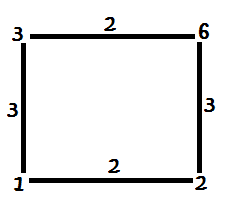
Consider two divisors a < b of n. Now draw a line segment between a and b based on the following rules:

Also write the number \(\frac{b}{a}\) over the line segment joining a and b.

Let's draw for number 6.

Number 6 has the shape like a square

Now, whatever shape we get, we call it the natural geometry of that particular number. Here we call that 6 has a natural geometry of a square or a rectangle. I prefer to call it a square because we all love symmetry.

What about all the numbers? Isn't interesting to know the geometry of all the natural numbers?

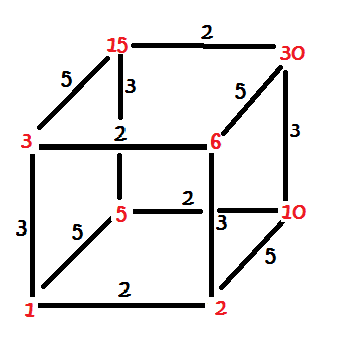
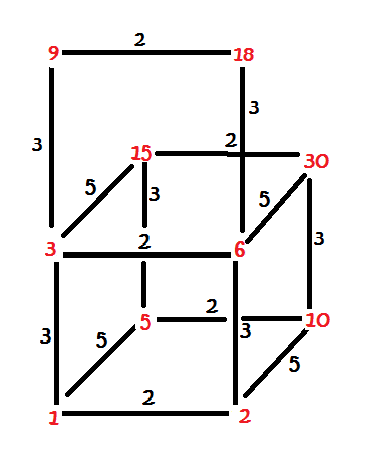
Let's draw for some other number say 30.


The Natural Geometry of 30 - A Cube

Observe this carefully, 30 has a complicated structure if seen in two dimensions but its natural geometrical structure is actually like a cube right?

The red numbers denote the divisors and the black numbers denote the numbers to be written on the line segment.

Beautiful right!

Have you observed something interesting?

Actually, it shows that to build this shape the requirement of the line segments is as important as the prime numbers to build the number.

Exercise: Prove from the rules of the game that the numbers on the line segment always correspond to prime numbers.

Did you observe this?

Exercise: Prove that the numbers corresponding to the parallel lines always have the same prime number on it.

Actually each prime number corresponds to a different direction. If you draw it perpendicularly we get the natural geometry of the number.

Let's observe the geometry of other numbers.

Try to draw the geometry of the number 210. It will look like the following:

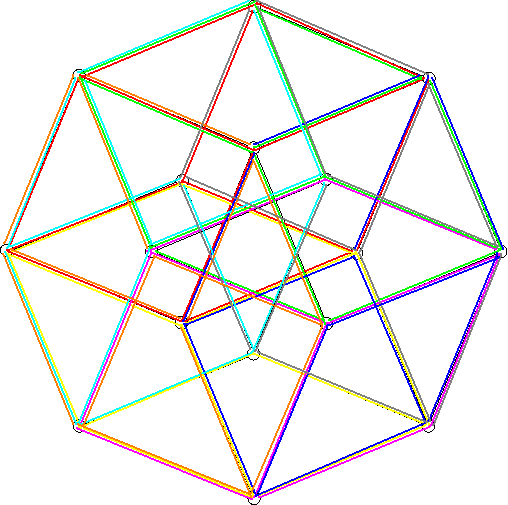
Image result for Is four dimensional hyper cube graph

The natural geometry of the number 210 - Tesseract
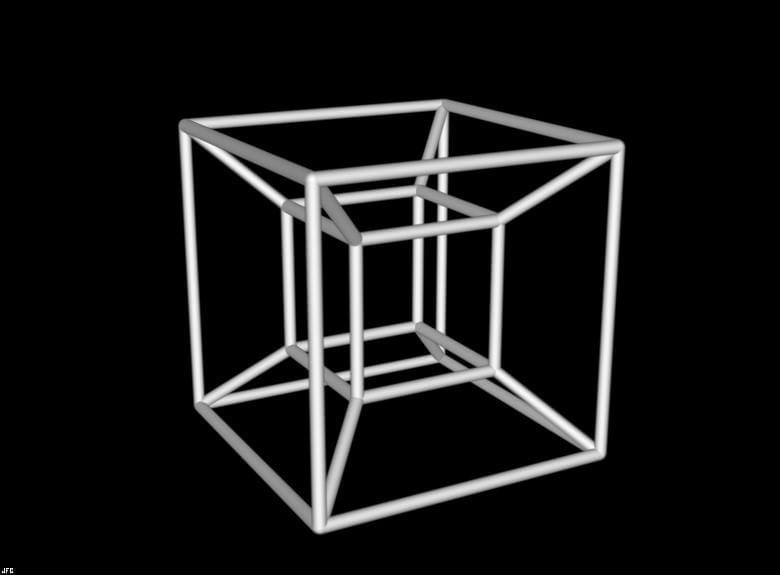
Image result for tesseract cube
This is the three dimensional projection of the structure of the Tesseract.

Obviously, this is not the natural geometry as shown. But neither we can visualize it. The number 210 lies in four dimensions. If you try to discover this structure, you will find that it has four different directions corresponding to four different primes dividing it. Also, you will see that it is actually a four-dimensional cube, which is called a tesseract. What you see above is a two dimensional projection of the tesseract, we call it a graph.

A person acquainted with graph theory can understand that the graph of a number is always k- regular where k is the number of primes dividing the number.

Now it's time for you to discover more about the geometry of all the numbers.

I leave some exercises to help you along the way.

Exercise: Show that the natural geometry of \(p^k\) is a long straight line consisting of k small straight lines, where p is a prime number and k is a natural number.

Exercise: Show that all the numbers of the form \(p.q\) where p and q are two distinct prime numbers always have the natural geometry of a square.

Exercise: Show that all the numbers of the form \(p.q.r\) where p, q and r are three distinct prime numbers always have the natural geometry of a cube.

Research Exercise: Find the natural geometry of the numbers of the form \(p^2.q\) where p and q are two distinct prime numbers. Also, try to generalize and predict the geometry of \(p^k.q\) where k is any natural number.

Research Exercise: Find the natural geometry of \(p^a.q^b.r^c\) where p,
q, and r are three distinct prime numbers and a,b and c are natural numbers.

Let's end with the discussion with the geometry of {18, 30}. First let us define what I mean by it.

We define the natural geometry of two natural numbers quite naturally as a natural extension from that of a single number.

Take two natural numbers a and b. Consider the divisors of both a and b and follow the rules of the game on the set of divisors of both a and b. The shape that we get is called the natural geometry of {a, b}.

You can try it yourself and find out that the natural geometry of {18, 30} looks like the following:

Looks like a chair indeed!

Sit on this chair, grab a cup of coffee and set off to discover.

The numbers are eagerly waiting for your comments. 🙂

Please mention your observations and ideas and the proofs of the exercises in the comments section. Also think about what type of different shapes can we get from the numbers.

Also visit: Thousand Flowers Program

[/et_pb_text][/et_pb_column] [/et_pb_row] [/et_pb_section]

Dudeney Puzzle: A Tale from Pythagoras to Dehn - Part II

(Remember the Dudeney puzzle introduced in the last post. We have ended with the question "Why four?"...We will be revealing the reason in this post.)

Obviously, by the way, we have given the algorithm, there is an upper bound to the number of pieces required.

The next natural question is Do there exist a lower bound?

What is the minimum number of cuts required to convert an equilateral triangle into a square?

Dudeney proved that 4 is the least he can reduce it to by the following elegant construction:

Now, this seems to arise the following question:

(1). Do there exist dissections with three pieces?

(2). Do there exist dissections with two pieces?

(1) is still unsolved, but (2) cannot take place and is obvious!

A Square \(\Leftrightarrow \) An Equilateral Triangle in two cuts is not possible:

The possible types of cuts are drawn above. Observe S3 cannot give rise to any of the T cuts as it gives rise to 2 quadrilaterals. S2 can give rise to T2 which is not possible S2 gives rise to a quadrilateral with 2 right angles. S1 can give rise to T1 but it is possible if T1 is the median cut but in that case, it will not be right-angled isosceles.

What about three pieces? Please share your ideas in the comments!

Let’s dive deep into the Four Piece Cut: A lot of work has been done in the past.

These are the details and yet ugly looking but it reveals how to do the cut.

Let me provide the math and measurements of one angle as it consists of one parameter only.

\(\alpha =\)arc\(\sin (\frac{\sqrt{\sqrt{3}}}{2}) \approx 41.150335^\circ\)

Well,  you will observe while solving this you will get a four-degree polynomial which has the shown above the real root. Also, perhaps, I am not sure this angle is not constructable, but for practical purposes to enjoy this six decimal place precision is perfect.

Since then these have become a good way for math entertainment in class to show the magical beauty of math.

Hey, this is not over!  We have more questions to ask and seek an answer to!

What is a general good lower bound on the number of pieces required to transform any polygon to another of the same area by the above method?

Alfred Tarski proved that if P is convex and the diameters of P and Q are respectively given by d(P)and d(Q), then the minimum number n of pieces required to compose polygon Q from another polygon P \(\geq \) d(P)/d(Q)

Can You prove it?

Think of this, it is very intuitive it means that for P \(\rightarrow \) Q with an increase in the maximum distance between two points in P and a decrease in that of Q we have to increase the number of pieces as we have to make triangles with a lesser diameter in a larger diameter polygon.

Thus for two convex polygons P and Q such that P \(\Leftrightarrow \) Q. Then the minimum number n of pieces required to compose polygon Q from another polygon P \(\geq \) max {d(P)/d(Q), d(Q)/d(P)}.

Since Alfred Tarski has arrived into the picture, we can’t help but sharing the idea about his dissection of a circle into a square.

Circle to Square Dissection Problem

The Problem:  Can you cut the circle into a finite number of pieces and reassemble them to get a square?[equidissectability]

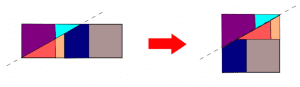
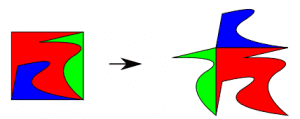
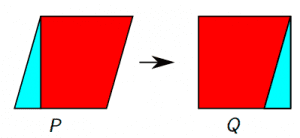
Yes! They are not possible with scissor cut only! Even if curved edges are considered by scissor cuts. The proof requires a bit of playing around with pictures a beautiful observation. Remember the picture for Scissor Congruence:

Observe that the In scissors congruence, any time a section of the convex circular perimeter is created or destroyed it cancels with a corresponding pieces of concave circular perimeter. So convex circular perimeter − concave circular perimeter is an invariant of scissors congruence.


A 1964 publication by Dubins, Hirsch, and Karush informs us that a circular disk is “scissor congruent” to no other strictly convex body. We can never physically achieve a solution to the circle-squaring problem with scissors and paper. The proof used the above idea.

Now the beauty of something outside of Human Imagination comes into the question:

Can you decompose the circle into a finite number of pieces and reassemble them to get square?[equidecomposability, it means it may not be cut be scissors but yes it can be done somehow]

Miklós Laczkovich, however, shocked mathematicians around the world with an affirmative response to Tarski’s question. In 1990, Laczkovich proved that any circle in the plane is equidecomposable with a square of equal area. He succeeded because he allowed pieces that are difficult to imagine—dustings of points that are selected using the controversial Axiom of Choice. Laczkovich’s proof shows that such a decomposition is theoretically possible, but there is no picture to help us understand how this is accomplished. He gives an upper bound of \(10^{50}\) for the number of pieces that are required in this decomposition, and he shows that the rearrangement of the pieces can be accomplished using translations alone. None of the pieces require a rotation or a reflection.

Now, how about transcending into the third dimension?

Hilbert’s 3rd Problem exactly deals with this problem:

Given any two polyhedra of equal volume, is it always possible to cut the first into finitely many polyhedral pieces which can be reassembled to yield the second?

Max Dehn proved that it is false providing a counterexample using some Mathematical Idea called Dehn Invariant, which remains same under dissections and reassembling.

He proved that A cube and a regular tetrahedron are not dissection congruent.

In fact, the following result is true: Two polyhedra are dissection congruent if and only if they have the same volume and Dehn invariant.

Banach Tarski’s Paradox is worth mentioning and also is the child of Alfred Tarski, which is also based on the “decomposability” of the Sphere and is the starting point of measure theory and something out of human imagination and intuition:

Given a solid ball in 3‑dimensional space, there exists a decomposition of the ball into a finite number of disjoint subsets, which can then be put back together in a different way to yield two identical copies of the original ball. Indeed, the reassembly process involves only moving the pieces around and rotating them without changing their shape. However, the pieces themselves are not "solids" in the usual sense, but infinite scatterings of points. The reconstruction can work with as few as five pieces.

A Dream, An IMO 2018 Problem and A Why

[et_pb_section][et_pb_row][et_pb_column type="4_4"][et_pb_text]

Cheenta, with the zeal of a child, has a dream of training a perfect IMO team someday in the recent future.
Also, the day, 22nd December is very special to Mathematics, which saw the birth of Ramanujan and is a very romantic day for every math-loving person.

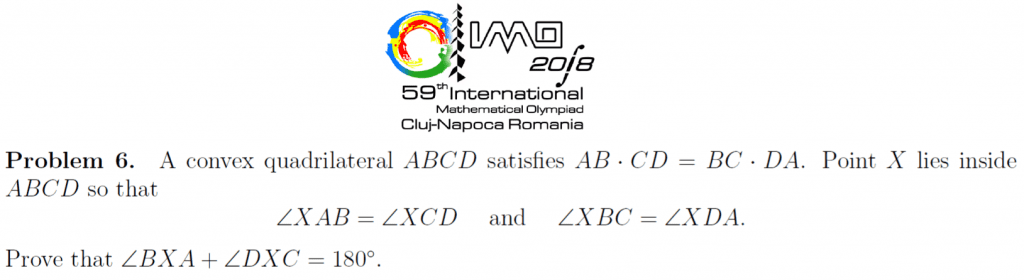
With that romanticism and the zeal, I took the challenge of solving the Problem 6 of IMO, 2018.

Also Visit: Math Olympiad Program

Let's go straight to the problem first.

For some time, remove the tag "problem 6 of IMO" and focus on the problem only.

There are two pieces of information:

A Simple "WHY"

The first two natural questions that occurred are "Why such an X exists?" and "Even if such an X exists, then why is it unique?".
Aren't these questions natural?

I absolutely love this journey in Mathematics, where by the art of simple questioning we discover new things with new perspectives. Believe me this is as beautiful and mesmerizing as listening to your favorite Ragas.

Let's discover the answers to these questions. But I prefer you to think about this problem before you scroll down. We would love to hear your way of approach and thought.

Let's Proceed

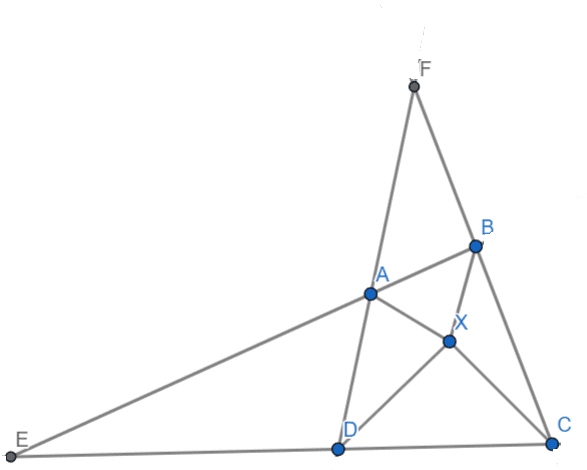
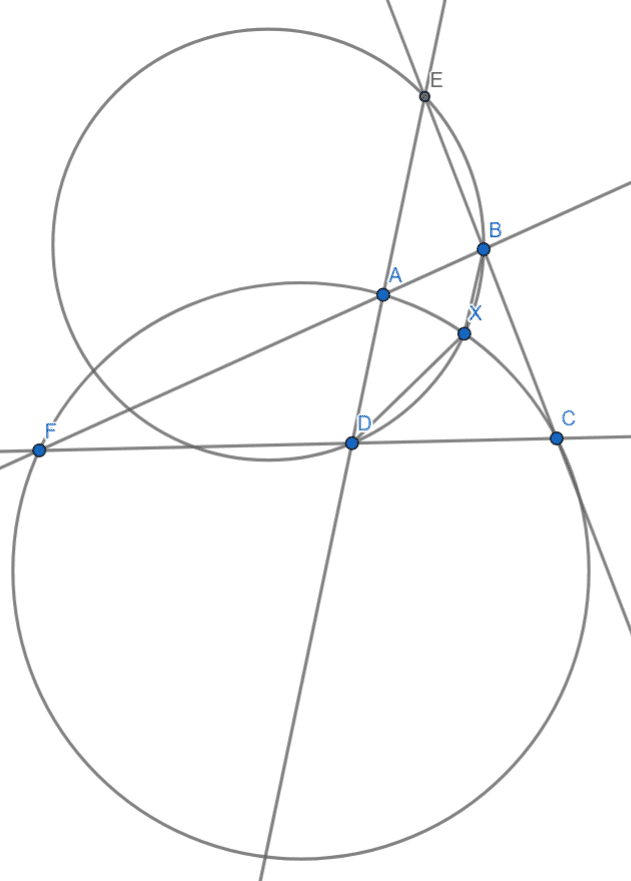
Geometry without Diagrams is like Cheenta without Mathematics. So, let's talk through pictures.

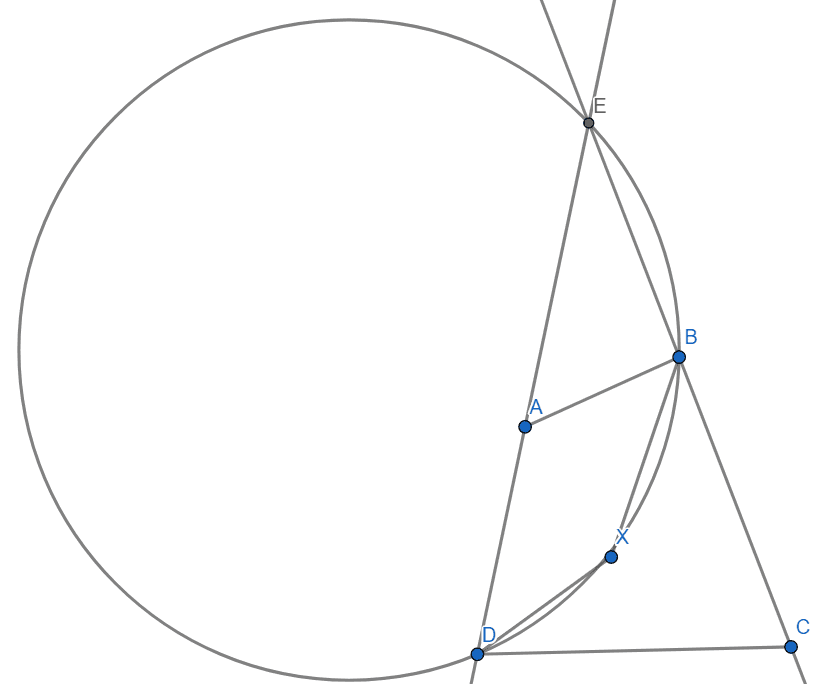
Ok, that looks like a promising picture. Let's get back to the given condition that \(\angle XAB = \angle XCD\) and \(\angle XBC = \angle XDA\)

Before diving into complicacy, we want to answer a simple question as follows:

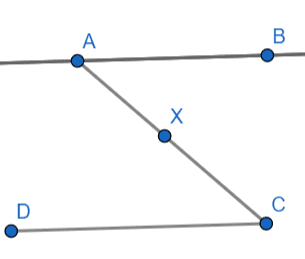
Given two line segments AB and CD, what is the locus of all such points X such that \(\angle XAB = \angle XCD \)?

What if AB and CD are parallel?

That looks easy if AB and CD are parallel to each other. Then the Locus of such X is AC due to the Alternate Angle Theorem.

Now let's explore what happens if AB and CD are not parallel. Already at the back of the mind questions started to crop up!

Will it be so simple? Will it be a straight line? No, No it can't be a straight line. Will it be a circle then? A circle isn't that too simple? ... A parabola may be! Who knows ? ...

"Let's draw!" my mind exclaimed!

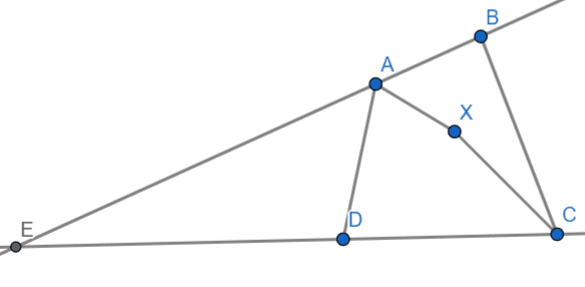
If AB and CD are not parallel then they must be intersecting somewhere. Yes, let's draw that keeping that in mind. Let me borrow the diagram I have used before for the actual problem.

AB and CD are not parallel. Let's see what turns out?

Observe that we have assumed \(\angle XAB = \angle XCD\). Something seems familiar? Huh! Yes, you are right! Cyclic Quadrilaterals!

Observe that \(\angle XAE + \angle XAB = 180^\circ\) and if X is such a special point, then \(\angle XAE + \angle XCE = 180^\circ\). Yaay! Cyclic Quadrilateral!

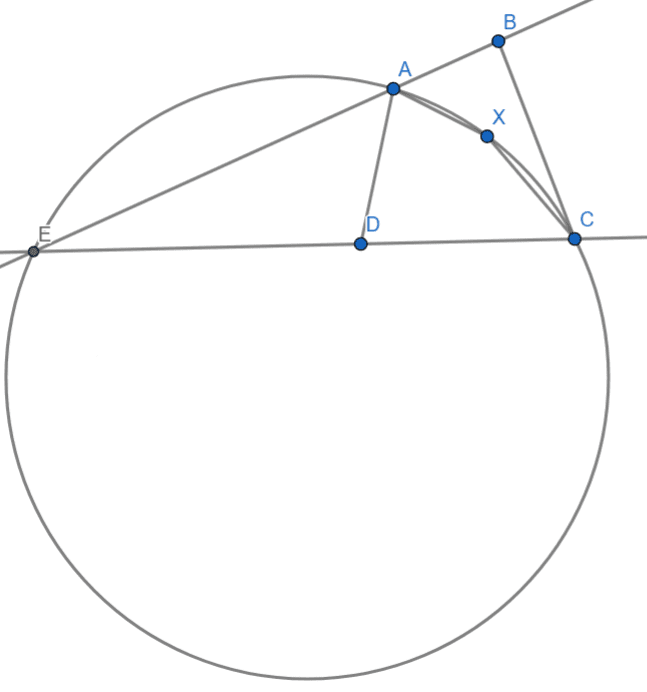
So, the locus of such X is a circle, seriously that simple? Oh! yes, the math doesn't lie. We got that XAEC will form a cyclic quadrilateral for X to be a special point. Let's see how it looks!

Construction: So, given AB and CD pair we extend them to meet each other at E and then form the circumcircle of \(\triangle AEC \) and the corresponding part inside the quadrilateral is the locus of X as we require.

Nice! Let's return to the actual question if that special property holds both for the pairs (AB, CD) and also for (CB, DA).

Till now, we have learned how to find X for one pair (AB, CD) with the given property. Let's do the same for (CB, DA) too.

Ok, now we want both of these to happen, right? Let's see, what we get, in fact we will get the intersection point of these two circles. Let's see this for the above example.

Observe that X is the intersection point of the two circles formed.

Booyah! So, we got the required point. There always exist such a point and it is always unique, right because it is the intersection of two circles.

So, see how long we came from the actual problem to discover some beautiful truth to a beautiful simple question!

But, the next obvious question is:
'Does this understanding really help in solving the actual problem?'

Let's leave it to the second part of this post to discover the power of such simple questions!

Remember there is one more information, which we haven't used. We surely need that piece of information to solve the problem!

Now I leave the thoughts and ideas to you. See you in the next post. Till then, we would love to hear from your side, your ideas, your approach, your way of thought, Your Own Mathematics.

Please mention them in the comments. See you soon!

[/et_pb_text][/et_pb_column][/et_pb_row][/et_pb_section]

2016 ISI Objective Solution Problem 1

Understand the Problem:

The polynomial \(x^7+x^2+1\) is divisible by

Solution

The problem is easy to understand. Your first task is to try the problem yourself.

Try to factorize \(x^7 + x^2 + 1\).

Observe that  \(\omega\) and \(\omega^2 \) are the roots of \(x^7 + x^2 + 1\).

\(x^7 + x^2 + 1\) =  (\(x^2 + x + 1\)).(\(x^5 - x^4 + x^2 -x + 1\))

A shorter solution or approach can always exist. Think about it. If you find an alternative solution or approach, mention it in the comments. We would love to hear something different from you.

Also Visit: I.S.I. & C.M.I Entrance Program

Dudeney Puzzle : A Tale from Pythagoras to Dehn

" Take care of yourself, you're not made of steel.
The fire has almost gone out and it is winter.
It kept me busy all night.
Excuse me, I will explain it to you.
You play this game, which is said to hail from China.
And I tell you that what Paris needs right now is to
welcome that which comes from far away. "

et's travel back 2 Millenia to the Land of the Greeks where Plato, Pythagoras, Archimedes devoted their life to Math and Science to understand and enjoy nature. Math was a Puzzle to them and they enjoyed doing it as we do it now. Pythagoras gave birth to the beautiful proof of Pythagoras Theorem just using pictures.

This approach of dissection and rearrangement was not new to him as the tradition of these sort of puzzles can be traced back to Plato and also continued by Archimedes.

Square trisection: Three squares to One square

       Square trisection: Three squares to One square

Two equal squares are turned into one square in fourteen pieces by subdivisions of the previous four pieces by Archimedes

Let’s Fast Forward to 20th Century

A puzzle became famous in 1903 as Henry Ernest Dudeney solved the Haberdasher's Puzzle.

The Puzzle:
Cut an equilateral triangle into four pieces that can be rearranged to make a square [Cut means by scissors so the result will be a set of  polygons]

An Obvious Question:

Wallace–Bolyai–Gerwien theorem: A Polygon can be cut into a finite number of pieces and then by rotations, reflections and translations(isometric transformations) can be reassembled into another Polygon iff both the polygons have the same area. We call this equidecomposability of two polygons of the same area. [Actually, it is called equidissectabilty, but then it is equidecomposability]

Well, this seems to be a beautiful piece of truth!

Let’s think about it a bit more!

Suppose you are given two polygons of the same area made of paper and a pair of scissors. You have in some sense no limit of cuts. How will you start cutting one of them?

First, observe that the intersection of two polygons is a polygon. Also, Union of polygons along the edges is also a polygon.

Now, you take two of them, place on above another, cut out the common portion by scissors and then reassemble the remaining pieces again and assemble them to form two different polygons of the same area and the problem reduces to the same problem, now if you are sure this process is going to end after some time, then we are done. This sort of congruence has a name “scissor congruence”.

Pause here for a moment!

Let’s snip the scissor on our thought and try to understand what’s the matter in reality.

[A and B are scissors congruent if A can be cut into finitely pieces–each of which is homeomorphic to a disc and bounded by a curve of finite length–which can be rearranged to form B (ignoring boundaries).]

We are essentially cutting out congruent pieces of a polygon from both the polygons each time, right! Will this process ever end?  Is so, why? Or how?
Also, observe if a polygon P can be transformed into Q in this way denote it by P  Q to avoid too much clumsiness. Now,

P \(\rightarrow\) Q means Q \(\rightarrow\) P 

P \(\rightarrow\) Q, Q \(\rightarrow\) R means P \(\rightarrow\) R

P  \(\rightarrow\) P

It is easy right

Now, this sort of relationship is called Equivalence Relation which has a nice use that is if we can show that any polygon can be transformed a certain central figure of the same area then the theorem will be proved true. We want that central figure to have a minimum of parameters(why) defining it. Hence an easy choice is any regular polygon with one parameter as it is always fixed with a given area.

Ok, before proceeding let’s adventure through the basic and simple examples of dissection of basic figures: Triangles, Squares, and Rectangles to get some ideas and maybe it can be reduced to these cases only.

Triangle \(\rightarrow\) A Rectangle (Not Predefined):

Rectangle  \(\rightarrow\) A Square (Always fixed given an area):

2 Rectangles \(\rightarrow\) A Square (Always fixed given an area):

Ok, due to the rigidity of the square structure, let us consider converting the two rectangles to their corresponding squares by the method described above.

Now observe that we need to change the sum of two square areas to a single square area, Hey that is exactly the Pythagoras Theorem type. Do we know a dissection proof Pythagoras Theorem? Let’s do it in a separate way.

2 Squares \(\rightarrow\) A Square (Always fixed given an area):

n rectangles \(\rightarrow\) A Square (Always fixed given an area):

Simple like induction, add a rectangle every time after transforming two rectangles into a square and follow the previous steps.

                        Have you seen the usefulness of the Rigidity of the Square Structure and also the hunch of the theorem?

Steps of Proof:

    1. Triangulate the Polygon

    1. Each Triangle -> Rectangle

  1. Set of Rectangles -> A Square by the method described above.

Now given that every polygon with the same area can be transformed into a square with the same area as those of the triangle. QED!

Yaaayy, we proved it! It wasn’t too difficult right!

Now, let’s return to the original question!

Why four?

Let's keep this suspense till the next post, while in the meantime you get hands-on experience with scissors and paper and enjoy your own journey and tickle your brain to think about "Why Four?" and also "How Four?".

Please share your experiences and thoughts in the comments, which will make the math become alive with Paper, Scissors and You.