Let  be a twice differentiable function such that
 Show that there exist
  such that
  for all
  .
.
be a twice differentiable function such thatShow that there exist such that for all .Suppose $P(x)$ is a polynomial with real coefficients satisfying the condition
$$
P(\cos \theta+\sin \theta)=P(\cos \theta-\sin \theta),
$$
for every real $\theta$. Prove that $P(x)$ can be expressed in the form
$$
P(x)=a_0+a_1\left(1-x^2\right)^2+a_2\left(1-x^2\right)^4+\cdots+a_n\left(1-x^2\right)^{2 n},
$$
for some real numbers $a_0, a_1, a_2, \ldots, a_n$ and nonnegative integer (n).
Using a very standard trigometric identity, we can easily convert the following ,
$$
\begin{aligned}
P(\cos \theta+\sin \theta) & =P(\cos \theta-\sin \theta
\Longrightarrow P\left(\sqrt{2} \sin \left(\frac{\pi}{4}+\theta\right)\right) & =P\left(\sqrt{2} \cos \left(\frac{\pi}{4}+\theta\right)\right) \
\Longrightarrow P(\sqrt{2} \sin x) & =P(\sqrt{2} \cos x)
\end{aligned}
$$
⟹ \(P(\sqrt{2} \sin x)=P(\sqrt{2} \cos x) \quad\)
Assuming,
$\left(\frac{\pi}{4}+\theta\right)=x$ for all reals $x$. So,
$P(-\sqrt{2} \sin (x))=P(\sqrt{2} \sin (-x))=P(\sqrt{2} \cos (-x))=P(\sqrt{2} \cos (x))=P(\sqrt{2} \sin (x))$ for all $x \in \mathbb{R}$. Since $P(x)=P(-x)$ holds for infinitely many $x$, it must hold for all $x$ (since $P(x)$ is a polynomial). so we get that, $P(x)$ is a even polynomial.
$P(\sqrt{2} \cos (x))=P(\sqrt{2} \sin (x))$ implies that
$$
P(t)=P\left(\sqrt{2} \sin \left(\cos ^{-1}(t / \sqrt{2})\right) \text { putting }, x=\cos ^{-1}(t / \sqrt{2})\right.
$$
for infinitely many $t \in[-\sqrt{2}, \sqrt{2}]$.
$$
\sqrt{2} \sin \left(\cos ^{-1}(t / \sqrt{2})\right)=\sqrt{2-t^2} \text { so we get, } P(x)=P\left(\sqrt{2-t^2}\right)
$$
Again as it is a polynomial function we can extend it all $\mathbb{R}$. And we get, $P(x)=P\left(\sqrt{2-x^2}\right)$ for all reals (x)
Since $P(x)$ is even, we can choose an even polynomial $Q(x)$ such that, $Q(x)=P(\sqrt{x+1}) \cdot P(\sqrt{1+x}$=$Q(x)=a_0+a_1 x^2+a_2 x^4+\cdots+a_n x^{2 n}$ now take, $\sqrt{1+x}=y$ and you get the polynomial of required form.
Outstanding mathematics for brilliant school students. Work with great problems from Mathematics Olympiads, Physics, Computer Science, Chemistry Olympiads and I.S.I. C.M.I. Entrance.
Problem
Let ABCD be a convex cyclic quadrilateral . Suppose P is a point in the plane of the quadrilateral such that the sum of its distances from the vertices of ABCD is the least .If {PA,PB,PC,PD} = {3,4,6,8}.What is the maximum possible area of ABCD?
Topic
Geometry
Contest
Pre Regional Math Olympiad
2019
Reading
Mathematical circle .
Sequential Hints
The first step is very clear, you have to some how locate the point P .
claim : The intersection of the diagonal is the required point .
Proof : suppose that there is a point P' other than P (the intersection of diagonal) .
now try to apply triangular inequality in \(\triangle\)PBD & \(\triangle\)APC.
(do the rest yourself , and complete the proof)
so , the area of [ABCD]=\(\frac{1}{2}\)\(\sin\theta\)(PA*PB+PB*PC+PC*PD+PD*PA)
now, the area will maximum when \(\sin\theta\)=1
so , just put the value of PA, PB, PC,PD
You get the answer 55
Watch video
I.S.I. (Indian Statistical Institute) B.Stat/B.Math Entrance Examination 2013. Subjective Problem no. 2.
Medium
[/et_pb_accordion_item][et_pb_accordion_item title="Suggested Book" open="off" _builder_version="3.22.4" title_text_shadow_horizontal_length="0em" title_text_shadow_vertical_length="0em" title_text_shadow_blur_strength="0em" closed_title_text_shadow_horizontal_length="0em" closed_title_text_shadow_vertical_length="0em" closed_title_text_shadow_blur_strength="0em"]by
[/et_pb_accordion_item][/et_pb_accordion][et_pb_text _builder_version="3.22.4" text_font="Raleway|300|||||||" text_text_color="#ffffff" header_font="Raleway|300|||||||" header_text_color="#e2e2e2" background_color="#0c71c3" border_radii="on|5px|5px|5px|5px" box_shadow_style="preset3" custom_margin="48px||48px" custom_padding="20px|20px|20px|20px"]Do you really need a hint? Try it first!
[/et_pb_tab][et_pb_tab title="Hint 1" _builder_version="3.22.4"]This problem simply ask for the range of the function defined by f(x)=$latex \frac {1}{x+2cosx}$ compute the derivative of the function = $latex \frac {2sinx-1}{(x+2cosx)^2}$
[/et_pb_tab][et_pb_tab title="Hint 2" _builder_version="3.22.4"]First extrema occurs at $latex x$= $latex \frac{\pi}{6}$ The first derivative is negetive in the interval [ 0, $latex \frac{\pi}{6}$] hence the function is decreasing in this interval f(0)=$latex \frac{1}{2}$ ; f($latex \frac{\pi}{6}$)=$latex \frac{1}{\frac{\pi}{6}+ {\sqrt{3}}}$
[/et_pb_tab][et_pb_tab title="Hint 3" _builder_version="3.22.4"]For x>$latex \frac{\pi}{6}$ the derivative becomes positive , and remain so upto x=$latex \frac{5\pi}{6}$ after which it becomes negative thus we have minima at x= $latex \frac{\pi}{6}$ and maxima at x= $latex \frac{5\pi}{6}$ f($latex \frac{5\pi}{6}$)= $latex \frac{1}{\frac{5\pi}{6}+\sqrt{3}}$ note that as $latex x\rightarrow \infty$the denominator of the function increases
[/et_pb_tab][et_pb_tab title="Hint 4" _builder_version="3.22.4"]Hence we can conclude that $latex f(x)\rightarrow0$ clearly x=$latex \frac{5\pi}{6}$ gives the global maxima so , the range is (0,$latex \frac{1}{\frac{5\pi}{6}+\sqrt{3}}$]
[/et_pb_tab][/et_pb_tabs][et_pb_text _builder_version="3.22.4" text_font="Raleway|300|||||||" text_text_color="#ffffff" header_font="Raleway|300|||||||" header_text_color="#e2e2e2" background_color="#0c71c3" border_radii="on|5px|5px|5px|5px" box_shadow_style="preset3" min_height="12px" custom_margin="50px||50px" custom_padding="20px|20px|20px|20px"]Indian Statistical Institute and Chennai Mathematical Institute offer challenging bachelor’s program for gifted students. These courses are B.Stat and B.Math program in I.S.I., B.Sc. Math in C.M.I.
The entrances to these programs are far more challenging than usual engineering entrances. Cheenta offers an intense, problem-driven program for these two entrances.
[/et_pb_blurb][et_pb_button button_url="https://cheenta.com/isicmientrance/" button_text="Learn More" button_alignment="center" _builder_version="3.22.4" custom_button="on" button_text_color="#ffffff" button_bg_color="#e02b20" button_border_color="#e02b20" button_border_radius="0px" button_font="Raleway||||||||" button_icon="%%3%%" button_text_shadow_style="preset1" box_shadow_style="preset1" box_shadow_color="#0c71c3" background_layout="dark"][/et_pb_button][et_pb_text _builder_version="3.22.4" text_font="Raleway|300|||||||" text_text_color="#ffffff" header_font="Raleway|300|||||||" header_text_color="#e2e2e2" background_color="#0c71c3" border_radii="on|5px|5px|5px|5px" box_shadow_style="preset3" custom_margin="50px||50px" custom_padding="20px|20px|20px|20px"]I.S.I. (Indian Statistical Institute) B.Stat/B.Math Entrance Examination 2013. Subjective Problem no. 4.
7.5 out of 10
[/et_pb_accordion_item][et_pb_accordion_item title="Suggested Book " open="off" _builder_version="3.23.3" title_text_shadow_horizontal_length="0em" title_text_shadow_vertical_length="0em" title_text_shadow_blur_strength="0em" closed_title_text_shadow_horizontal_length="0em" closed_title_text_shadow_vertical_length="0em" closed_title_text_shadow_blur_strength="0em"][/et_pb_accordion_item][/et_pb_accordion][et_pb_text _builder_version="3.22.4" text_font="Raleway|300|||||||" text_text_color="#ffffff" header_font="Raleway|300|||||||" header_text_color="#e2e2e2" background_color="#0c71c3" border_radii="on|5px|5px|5px|5px" box_shadow_style="preset3" custom_margin="48px||48px" custom_padding="20px|20px|20px|20px"]
Do you know what is Well-ordering principle ? it says that Every nonempty set A of nonnegative integers has a minimal element and a maximal element , which need not to be unique . now some time this simple property help us to get very nice solution to a problem , can you some how apply this property .
[/et_pb_tab][et_pb_tab title="Hint 2" _builder_version="3.22.4"]Use the method of contradiction , first of all assume that there is no player which have the given property . Now try to use the property of hint 1 .
[/et_pb_tab][et_pb_tab title="Hint 3" _builder_version="3.22.4"]If there is no such list , A's list has the maximum no. of players Now , if A does not have the certain property then there exist another another player B , who has won against A . Now B's list contain the name of A [ by the 1st condition ] and all the names of the players defeated by A [ by the 2nd condition]
[/et_pb_tab][et_pb_tab title="Hint 4" _builder_version="3.22.4"]Now , can you find out some contradiction , yes exactly ..... B's list contain more number of element than A So, A's list must have the certain property .
[/et_pb_tab][/et_pb_tabs][et_pb_text _builder_version="3.22.4" text_font="Raleway|300|||||||" text_text_color="#ffffff" header_font="Raleway|300|||||||" header_text_color="#e2e2e2" background_color="#0c71c3" border_radii="on|5px|5px|5px|5px" box_shadow_style="preset3" min_height="12px" custom_margin="50px||50px" custom_padding="20px|20px|20px|20px"]Indian Statistical Institute and Chennai Mathematical Institute offer challenging bachelor’s program for gifted students. These courses are B.Stat and B.Math program in I.S.I., B.Sc. Math in C.M.I.
The entrances to these programs are far more challenging than usual engineering entrances. Cheenta offers an intense, problem-driven program for these two entrances.
[/et_pb_blurb][et_pb_button button_url="https://cheenta.com/isicmientrance/" button_text="Learn More" button_alignment="center" _builder_version="3.22.4" custom_button="on" button_text_color="#ffffff" button_bg_color="#e02b20" button_border_color="#e02b20" button_border_radius="0px" button_font="Raleway||||||||" button_icon="%%3%%" button_text_shadow_style="preset1" box_shadow_style="preset1" box_shadow_color="#0c71c3" background_layout="dark"][/et_pb_button][et_pb_text _builder_version="3.22.4" text_font="Raleway|300|||||||" text_text_color="#ffffff" header_font="Raleway|300|||||||" header_text_color="#e2e2e2" background_color="#0c71c3" border_radii="on|5px|5px|5px|5px" box_shadow_style="preset3" custom_margin="50px||50px" custom_padding="20px|20px|20px|20px"]Do you know Pick’s theorem ? NO! then read this post first and return to the problem again https://cheenta.com/a-proof-from-my-book/
[/et_pb_tab][et_pb_tab title="Hint 2" _builder_version="3.23.3"]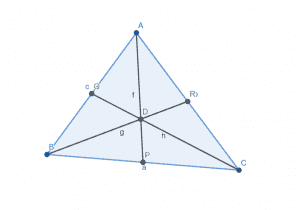 Join AD , BD , & CD
NOW , can you do it ?
Join AD , BD , & CD
NOW , can you do it ?
To prove D is centroid it is suficient to prove that [ ABD] = [ BDC] = [ ADC ] where [.] denotes the bounded area . but why ? { think yourslfe , use the fact that medians devide the triagle in six equal part }
[/et_pb_tab][et_pb_tab title="Hint 4" _builder_version="3.22.4"]Now applying pick's theorem we get , [ABD]= [ BDC] = [ ADC ] = 0.5
Because in each of these three triangle , three are 3 lattice vertex and lattice point is inside the triangle . so area = 0 + 3/2 - 1 = 0.5
[/et_pb_tab][/et_pb_tabs][et_pb_text _builder_version="3.22.4" text_font="Raleway|300|||||||" text_text_color="#ffffff" header_font="Raleway|300|||||||" header_text_color="#e2e2e2" background_color="#0c71c3" border_radii="on|5px|5px|5px|5px" box_shadow_style="preset3" min_height="12px" custom_margin="50px||50px" custom_padding="20px|20px|20px|20px"]Indian Statistical Institute and Chennai Mathematical Institute offer challenging bachelor’s program for gifted students. These courses are B.Stat and B.Math program in I.S.I., B.Sc. Math in C.M.I.
The entrances to these programs are far more challenging than usual engineering entrances. Cheenta offers an intense, problem-driven program for these two entrances.
[/et_pb_blurb][et_pb_button button_url="https://cheenta.com/isicmientrance/" button_text="Learn More" button_alignment="center" _builder_version="3.22.4" custom_button="on" button_text_color="#ffffff" button_bg_color="#e02b20" button_border_color="#e02b20" button_border_radius="0px" button_font="Raleway||||||||" button_icon="%%3%%" button_text_shadow_style="preset1" box_shadow_style="preset1" box_shadow_color="#0c71c3" background_layout="dark"][/et_pb_button][et_pb_text _builder_version="3.22.4" text_font="Raleway|300|||||||" text_text_color="#ffffff" header_font="Raleway|300|||||||" header_text_color="#e2e2e2" background_color="#0c71c3" border_radii="on|5px|5px|5px|5px" box_shadow_style="preset3" custom_margin="50px||50px" custom_padding="20px|20px|20px|20px"]I.S.I. (Indian Statistical Institute) B.Stat/B.Math Entrance Examination 2016. Subjective Problem no.1.
7 out of 10[/et_pb_accordion_item][et_pb_accordion_item title="Suggested Book" _builder_version="3.23.3" open="off"][/et_pb_accordion_item][/et_pb_accordion][et_pb_text _builder_version="3.27.4" text_font="Raleway|300|||||||" text_text_color="#ffffff" header_font="Raleway|300|||||||" header_text_color="#e2e2e2" background_color="#0c71c3" custom_margin="48px||48px" custom_padding="20px|20px|20px|20px" border_radii="on|5px|5px|5px|5px" box_shadow_style="preset3"]
we define a sequence \(p_1\)>\(p_2\)>\(p_3\)...........>\(p_n\) . such that \(p_i>p_{i+1}\) implies \(p_i\) has beaten \(p_{i+1}\)
[/et_pb_tab][et_pb_tab title="Hint 2" _builder_version="3.22.4"]let assume that the statement is true for n=k i.e \(p_1> p_2>p_3.........p_k\) now look into the case of \(p_{k+1}\)
[/et_pb_tab][et_pb_tab title="Hint 3" _builder_version="3.23.3"]if \(p_{k+1}\) > \(p_1\) or \(p_k\)>\(p_{k+1}\) we are done (why?)[/et_pb_tab][et_pb_tab title="Hint 4" _builder_version="3.22.4"] if \(p_k\)<\(p_{k+1}\) or \(p_{k+1}\)<\(p_1\) then we can find out at least one pair \(p_i\) >\(p_{i+1}\) such that \(p_i\)> \(p_{k+1}\) >\(p_{i+1}\) , we can just find it by shifting \(p_{k+1}\) term by term [ you can make some small experiment ]. other wise it contradict our initial assumption that \(p_k\)<\(p_{k+1}\) or \(p_{k+1}\)<\(p_1\) [ why?] hence we are done
[/et_pb_tab][/et_pb_tabs][et_pb_text _builder_version="3.27.4" text_font="Raleway|300|||||||" text_text_color="#ffffff" header_font="Raleway|300|||||||" header_text_color="#e2e2e2" background_color="#0c71c3" min_height="12px" custom_margin="50px||50px" custom_padding="20px|20px|20px|20px" border_radii="on|5px|5px|5px|5px" box_shadow_style="preset3"]Indian Statistical Institute and Chennai Mathematical Institute offer challenging bachelor’s program for gifted students. These courses are B.Stat and B.Math program in I.S.I., B.Sc. Math in C.M.I.
The entrances to these programs are far more challenging than usual engineering entrances. Cheenta offers an intense, problem-driven program for these two entrances.
[/et_pb_blurb][et_pb_button button_url="https://cheenta.com/isicmientrance/" button_text="Learn More" button_alignment="center" _builder_version="3.22.4" custom_button="on" button_text_color="#ffffff" button_bg_color="#e02b20" button_border_color="#e02b20" button_border_radius="0px" button_font="Raleway||||||||" button_icon="%%3%%" background_layout="dark" button_text_shadow_style="preset1" box_shadow_style="preset1" box_shadow_color="#0c71c3"][/et_pb_button][et_pb_text _builder_version="3.27.4" text_font="Raleway|300|||||||" text_text_color="#ffffff" header_font="Raleway|300|||||||" header_text_color="#e2e2e2" background_color="#0c71c3" custom_margin="50px||50px" custom_padding="20px|20px|20px|20px" border_radii="on|5px|5px|5px|5px" box_shadow_style="preset3"] be a polynomial with integer coefficients. Define
 and
and  for
for  .
. such that
  , then prove that either
  or
or  .
[/et_pb_text][/et_pb_column][/et_pb_row][et_pb_row _builder_version="3.25"][et_pb_column type="4_4" _builder_version="3.25" custom_padding="|||" custom_padding__hover="|||"][et_pb_accordion open_toggle_text_color="#0c71c3" _builder_version="3.22.4" toggle_font="||||||||" body_font="Raleway||||||||" text_orientation="center" custom_margin="10px||10px" hover_enabled="0"][et_pb_accordion_item title="Source of the problem" open="off" _builder_version="3.22.4"]
.
[/et_pb_text][/et_pb_column][/et_pb_row][et_pb_row _builder_version="3.25"][et_pb_column type="4_4" _builder_version="3.25" custom_padding="|||" custom_padding__hover="|||"][et_pb_accordion open_toggle_text_color="#0c71c3" _builder_version="3.22.4" toggle_font="||||||||" body_font="Raleway||||||||" text_orientation="center" custom_margin="10px||10px" hover_enabled="0"][et_pb_accordion_item title="Source of the problem" open="off" _builder_version="3.22.4"]8 out of 10
[/et_pb_accordion_item][et_pb_accordion_item title="Suggested Book" _builder_version="4.3.4" hover_enabled="0" open="on"]Polynomials - Edward Barbeau [/et_pb_accordion_item][/et_pb_accordion][et_pb_text _builder_version="3.27.4" text_font="Raleway|300|||||||" text_text_color="#ffffff" header_font="Raleway|300|||||||" header_text_color="#e2e2e2" background_color="#0c71c3" custom_margin="48px||48px" custom_padding="20px|20px|20px|20px" border_radii="on|5px|5px|5px|5px" box_shadow_style="preset3" inline_fonts="Aclonica"]
Do you really need a hint? Try it first!
[/et_pb_tab][et_pb_tab title="Hint 1" _builder_version="3.22.4"]Do you know this lemma ,
Lemma: If  and
and  , then
  .
.
To prove this,
let  . Then
 Each bracket is divisible by
  , proving the statement.
We use the fact that the sequence  consists of only integers.
We'll first prove that we cannot have three distinct integers  ,
,  , and
, and  such that
  ,
,  , and
, and  (In other words, the variables cannot come in a cycle of 3). Assume that there does exist such numbers. Then we should have
  , which means
  . Similarly we can get
  , which implies equality. Ultimately, it leads to two equal variables, contradiction. In a similar manner we can prove that these variables cannot come in cycles of more than 3.
Therefore, we conclude that the variables of can only come in cycles of most two.
We realize that since  ,
we have a cycle
,
we have a cycle  . Since the minimal cycle has length at most 2, one of
  or
or  must be equal to 0, and we are done.
Indian Statistical Institute and Chennai Mathematical Institute offer challenging bachelor’s program for gifted students. These courses are B.Stat and B.Math program in I.S.I., B.Sc. Math in C.M.I.
The entrances to these programs are far more challenging than usual engineering entrances. Cheenta offers an intense, problem-driven program for these two entrances.
[/et_pb_blurb][et_pb_button button_url="https://cheenta.com/isicmientrance/" button_text="Learn More" button_alignment="center" _builder_version="3.22.4" custom_button="on" button_text_color="#ffffff" button_bg_color="#e02b20" button_border_color="#e02b20" button_border_radius="0px" button_font="Raleway||||||||" button_icon="%%3%%" background_layout="dark" button_text_shadow_style="preset1" box_shadow_style="preset1" box_shadow_color="#0c71c3"][/et_pb_button][et_pb_text _builder_version="3.27.4" text_font="Raleway|300|||||||" text_text_color="#ffffff" header_font="Raleway|300|||||||" header_text_color="#e2e2e2" background_color="#0c71c3" custom_margin="50px||50px" custom_padding="20px|20px|20px|20px" border_radii="on|5px|5px|5px|5px" box_shadow_style="preset3" inline_fonts="Aclonica"]C.M.I (Chennai mathematical institute ) U.G- 2019 entrance
Challenges and Thrills of Pre-College Mathematics by University Press[/et_pb_accordion_item][/et_pb_accordion][et_pb_tabs active_tab_background_color="#0c71c3" inactive_tab_background_color="#000000" _builder_version="3.22.7" tab_text_color="#ffffff" tab_font="||||||||" background_color="#ffffff"][et_pb_tab title="Hint 0" _builder_version="3.22.4"]Do you really need a hint? Try it first!
[/et_pb_tab][et_pb_tab title="Hint 1" _builder_version="3.22.4"]DO you know how to start working backward
[/et_pb_tab][et_pb_tab title="Hint 2" _builder_version="3.22.4"]working backward means that when you press A is makes -1 from the result and pressing B you can divide 2
[/et_pb_tab][et_pb_tab title="Hint 3" _builder_version="3.22.4"]strategies are like this , divide the no. as many step you can , when the result it not divisible by 2 just -1
[/et_pb_tab][et_pb_tab title="Hint 4" _builder_version="3.22.7"]\(260\rightarrow130\rightarrow65\rightarrow64\rightarrow32\rightarrow16\rightarrow8\rightarrow4\rightarrow2\rightarrow1\)
[/et_pb_tab][/et_pb_tabs][et_pb_text _builder_version="3.27.4" text_font="Raleway|300|||||||" text_text_color="#ffffff" header_font="Raleway|300|||||||" header_text_color="#e2e2e2" background_color="#0c71c3" min_height="12px" custom_margin="50px||50px" custom_padding="20px|20px|20px|20px" border_radii="on|5px|5px|5px|5px" box_shadow_style="preset3" inline_fonts="Aclonica"]Indian Statistical Institute and Chennai Mathematical Institute offer challenging bachelor’s program for gifted students. These courses are B.Stat and B.Math program in I.S.I., B.Sc. Math in C.M.I.
The entrances to these programs are far more challenging than usual engineering entrances. Cheenta offers an intense, problem-driven program for these two entrances.
[/et_pb_blurb][et_pb_button button_url="https://cheenta.com/isicmientrance/" button_text="Learn More" button_alignment="center" _builder_version="3.22.4" custom_button="on" button_text_color="#ffffff" button_bg_color="#e02b20" button_border_color="#e02b20" button_border_radius="0px" button_font="Raleway||||||||" button_icon="%%3%%" background_layout="dark" button_text_shadow_style="preset1" box_shadow_style="preset1" box_shadow_color="#0c71c3"][/et_pb_button][et_pb_text _builder_version="3.27.4" text_font="Raleway|300|||||||" text_text_color="#ffffff" header_font="Raleway|300|||||||" header_text_color="#e2e2e2" background_color="#0c71c3" custom_margin="50px||50px" custom_padding="20px|20px|20px|20px" border_radii="on|5px|5px|5px|5px" box_shadow_style="preset3" inline_fonts="Aclonica"] [/et_pb_text][/et_pb_column][/et_pb_row][et_pb_row _builder_version="3.25"][et_pb_column type="4_4" _builder_version="3.25" custom_padding="|||" custom_padding__hover="|||"][et_pb_accordion open_toggle_text_color="#0c71c3" _builder_version="3.22.4" toggle_font="||||||||" body_font="Raleway||||||||" text_orientation="center" custom_margin="10px||10px"][et_pb_accordion_item title="Source of the problem" open="on" _builder_version="4.3.4"]
C.M.I (Chennai mathematical institute ) U.G-2019
Excursion in Mathematics by Bhaskaracharya Pratisthana[/et_pb_accordion_item][/et_pb_accordion][et_pb_text _builder_version="3.27.4" text_font="Raleway|300|||||||" text_text_color="#ffffff" header_font="Raleway|300|||||||" header_text_color="#e2e2e2" background_color="#0c71c3" custom_margin="48px||48px" custom_padding="20px|20px|20px|20px" border_radii="on|5px|5px|5px|5px" box_shadow_style="preset3" inline_fonts="Aclonica"]
It is of the the form of
 .
Do you observe ?
where a=\(2^x\)
b=\(3^x\)
.
Do you observe ?
where a=\(2^x\)
b=\(3^x\)
\(\frac{a^3+b^3+a^2b+b^2a}{a^2b+b^2a}\)=\(\frac{13}{6}\) \(\Rightarrow\frac{a^2+b^2}{ab}=\frac{13}{6}\) \(\frac{a}{b}+\frac{b}{a}=\frac{13}{6}\) let x=a/b then it is a quadratic equation
[/et_pb_tab][et_pb_tab title="Hint 3" _builder_version="3.22.7"]\(6x^2-13x+6=0\) on solving we get x=3/2 or 2/3 now replace x by a/b
[/et_pb_tab][et_pb_tab title="Hint 4" _builder_version="3.22.7"]so again putting value of a and b we get final ans is +1 and -1
[/et_pb_tab][/et_pb_tabs][et_pb_text _builder_version="3.27.4" text_font="Raleway|300|||||||" text_text_color="#ffffff" header_font="Raleway|300|||||||" header_text_color="#e2e2e2" background_color="#0c71c3" min_height="12px" custom_margin="50px||50px" custom_padding="20px|20px|20px|20px" border_radii="on|5px|5px|5px|5px" box_shadow_style="preset3" inline_fonts="Aclonica"]Indian Statistical Institute and Chennai Mathematical Institute offer challenging bachelor’s program for gifted students. These courses are B.Stat and B.Math program in I.S.I., B.Sc. Math in C.M.I.
The entrances to these programs are far more challenging than usual engineering entrances. Cheenta offers an intense, problem-driven program for these two entrances.
[/et_pb_blurb][et_pb_button button_url="https://cheenta.com/isicmientrance/" button_text="Learn More" button_alignment="center" _builder_version="3.22.4" custom_button="on" button_text_color="#ffffff" button_bg_color="#e02b20" button_border_color="#e02b20" button_border_radius="0px" button_font="Raleway||||||||" button_icon="%%3%%" background_layout="dark" button_text_shadow_style="preset1" box_shadow_style="preset1" box_shadow_color="#0c71c3"][/et_pb_button][et_pb_text _builder_version="3.27.4" text_font="Raleway|300|||||||" text_text_color="#ffffff" header_font="Raleway|300|||||||" header_text_color="#e2e2e2" background_color="#0c71c3" custom_margin="50px||50px" custom_padding="20px|20px|20px|20px" border_radii="on|5px|5px|5px|5px" box_shadow_style="preset3" inline_fonts="Aclonica"] be a twice differentiable function such thatShow that there exist such that for all .Problems In CALCULUS OF ONE VARIABLE-i.a maron
[/et_pb_accordion_item][/et_pb_accordion][et_pb_text _builder_version="3.27.4" text_font="Raleway|300|||||||" text_text_color="#ffffff" header_font="Raleway|300|||||||" header_text_color="#e2e2e2" background_color="#0c71c3" custom_margin="48px||48px" custom_padding="20px|20px|20px|20px" border_radii="on|5px|5px|5px|5px" box_shadow_style="preset3" inline_fonts="Aclonica"]Do you really need a hint? Try it first!
[/et_pb_tab][et_pb_tab title="Hint 1" _builder_version="3.22.4"]Do you know Taylor series expansion good then see..... \(f(x+h) = f(x) + f'(x)h+f''(x)\frac{h^2}{2} + f'''(x)\frac{h^3}{3!}+\cdots\) \(f(x-h) = f(x) - f'(x)h+f''(x)\frac{h^2}{2} - f'''(x)\frac{h^3}{3!}+\cdots\)
[/et_pb_tab][et_pb_tab title="Hint 2" _builder_version="3.22.4"]adding previous expression we get \(\frac{f(x+h) - 2f(x) + f(x-h)}{h^2} = f''(x) + 2\frac{f''''(x)}{4!}h^2+\cdots\) taking the limit of the above equation as h goes to zero gives \(\Rightarrow f''(x) = \lim_{h\to0} \frac{f(x+h) - 2f(x) + f(x-h)}{h^2} \,.\)
[/et_pb_tab][et_pb_tab title="Hint 3" _builder_version="3.22.4"]. Since is continuous, there exists  such that
  The given identity becomes
 Fix
Fix  and differentiate the above identity with respect to
  and get

now we already get ,
If is twice differentiable at  then
then
 by rearranging our given problem we get that
  Therefore , for some
Indian Statistical Institute and Chennai Mathematical Institute offer challenging bachelor’s program for gifted students. These courses are B.Stat and B.Math program in I.S.I., B.Sc. Math in C.M.I.
The entrances to these programs are far more challenging than usual engineering entrances. Cheenta offers an intense, problem-driven program for these two entrances.
[/et_pb_blurb][et_pb_button button_url="https://cheenta.com/isicmientrance/" button_text="Learn More" button_alignment="center" _builder_version="3.22.4" custom_button="on" button_text_color="#ffffff" button_bg_color="#e02b20" button_border_color="#e02b20" button_border_radius="0px" button_font="Raleway||||||||" button_icon="%%3%%" background_layout="dark" button_text_shadow_style="preset1" box_shadow_style="preset1" box_shadow_color="#0c71c3"][/et_pb_button][et_pb_text _builder_version="3.27.4" text_font="Raleway|300|||||||" text_text_color="#ffffff" header_font="Raleway|300|||||||" header_text_color="#e2e2e2" background_color="#0c71c3" custom_margin="50px||50px" custom_padding="20px|20px|20px|20px" border_radii="on|5px|5px|5px|5px" box_shadow_style="preset3" inline_fonts="Aclonica"]