Meditation in Mathematics - PHP, Bose Olympiad, Gravity in Mars
Your Math-Mail from Cheenta
Dear students,
Let the world engage in rat race. We will focus on deep and beautiful learning.
Here is a beautiful problem that we worked on this week.
Suppose there are 5 points spread in 1 by 1 square field. The points can be at the corners, on the edges or inside the square. Show that the two nearest points are 1/rt 2 or less distance apart.
Can you try this problem? It uses the Pigeon Hole Principle (PHP) which says:
If you want to put n+1 pigeons in n boxes then there is at least one box with more than one pigeon in it.
Do not be fooled by the simplicity of PHP. Using it we can do some really challenging problems.
Another interesting idea that came up in the Physics Olympiad Program.
This is the velocity versus time graph of a particle moving in straight line. Can you draw the graph of its acceleration (versus time)?
In the Physics Virtual Lab a few kids are simulating gravity of Mars. They hope to create projects leading up to Google Science Fair.
We want kids to break free from rote-learning and formula-cramming. Mathematical Science, be it Mathematics, Physics, or Informatics should be fun and problem-focussed. Moreover the problems should inivite curiosity and imagination.
One such book, that a few of our Bose Olympiad Awardees received is One two three.. infinity by Gammow. If you like the wonderful world of mathematics, you will surely fall in love with this book.
The Bose Spring Olympiad is coming up in April. If you want to do some real fun problems in teams (and individually), you may try it here:
All the best!
Dr. Ashani Dasgupta
Cheenta Passion for Mathematics
INMO 2021 Problem 5 - Solution and Discussion
In a convex quadrilateral $A B C D, \angle A B D=30^{\circ}, \angle B C A=75^{\circ}, \angle A C D=25^{\circ}$ and $C D=C B$. Extend $C B$ to meet the circumcircle of triangle $D A C$ at $E$. Prove that $C E=B D .$
Hint and Solution for INMO 2021 Problem 5
What is Stirling Number of First Kind
We will learn about a combinatorics tool: Stirling Numbers of First Kind. Here is a video to get you started.
Problem 1
Show that $$ s(r, n)=s(r-1, n-1)+(r-1) s(r-1, n) $$ where $r, n \in \mathbf{N}$ with $n \leq r$
Problem 2
Show the following:
$$ s(r, 0)=0 \text { if } r \geq 1 $$
$$ s(r, r)=1 \text { if } r \geq 0 $$
$$ s(r, 1)=(r-1)! \text { for } r \geq 2 $$
$$ s(r, r-1)={{r} \choose {2}} $$
INMO 2021 - Problems, Solutions and Discussion
This is a work in progress. Please come back soon for more updates. We are adding problems, solutions and discussions on INMO (Indian National Math Olympiad 2021)
INMO 2021, Problem 1
Suppose $r \geq 2$ is an integer, and let $m_{1}, n_{1}, m_{2}, n_{2}, \cdots, m_{r}, n_{r}$ be $2 r$ integers such that
$$ |m_{i} n_{j}-m_{j} n_{i}|=1 $$ for any two integers $i$ and $j$ satisfying $1 \leq i<j<r$. Determine the maximum possible value of $r$.
Find all pairs of integers $(a, b)$ so that each of the two cubic polynomials $$ x^{3}+a x+b \text { and } x^{3}+b x+a $$ has all the roots to be integers.
INMO 2021, Problem 3
Betal marks 2021 points on the plane such that no three are collinear, and draws all possible line segments joining these. He then chooses any 1011 of these line segments, and marks their midpoints. Finally, he chooses a line segment whose midpoint is not marked yet, and challenges Vikram to construct its midpoint using only a straightedge. Can Vikram always complete this challenge?
Note: A straightedge is an infinitely long ruler without markings, which can only be used to draw the line joining any two given distinct points.
INMO 2021, Problem 4
A Magician and a Detective play a game. The Magician lays down cards numbered from 1 to 52 face-down on a table. On each move, the Detective can point to two cards and inquire if the numbers on them are consecutive. The Magician replies truthfully. After a finite number of moves the Detective points to two cards. She wins if the numbers on these two cards are consecutive, and loses otherwise.
Prove that the Detective can guarantee a win if and only if she is allowed to ask at least 50 questions.
INMO 2021, Problem 5
In a convex quadrilateral $A B C D, \angle A B D=30^{\circ}, \angle B C A=75^{\circ}, \angle A C D=25^{\circ}$ and $C D=C B$. Extend $C B$ to meet the circumcircle of triangle $D A C$ at $E$. Prove that $C E=B D .$
Let $\mathbb{R}[x]$ be the set of all polynomials with real coefficients, and let deg $P$ denote the degree of a nonzero polynomial $P .$ Find all functions $f: \mathbb{R}[x] \rightarrow \mathbb{R}[x]$ satisfying the following conditions:
$f$ maps the zero polynomial to itself,
for any non-zero polynomial $P \in \mathbb{R}[x]$, $\textrm{deg} f(P) \leq 1+\textrm{deg} P$, and for any two polynomials $P, Q \in \mathbb{R}[x]$, the polynomials $P-f(Q)$ and $Q-f(P)$ have the same set of real roots.
Diameter of Incircle Lemma and Dilation of Incircle
Suppose we have a triangle $ABC$. Let us extend the sides $BA$ and $BC$. We will draw the incircle of this triangle.
How to draw the incircle?
Here is the construction.
Draw any two angle bisectors, say of angle $A$ and angle $B$
Mark the intersection point $I$.
Drop a perpendicular line from I to one of the sides, say $AC$ in this picture.
Suppose the perpendicular intersects $AC$ at $E$.
The incircle is drawn centred at $I$ and with radius $IE$
Suppose EI intersects the incircle at F.
How to draw the excircle?
Now let us draw the excircle.
To do that we will need the angle bisector of external angle A and external angle C. Suppose they intersect at $I_A$. Drop a perpendicular from $I_A $ to extended $BA$ or extended $BC$ or $AC$. In this picture we drop it on extended $BA$ Suppose $J$ is the point of intersection of extended $BA$ and the perpendicular.
Draw a circle centred at $I_A$ and radius $I_A J$. This is the excircle.
Dilating the incircle to excircle
The incircle can be dilated or blown up with respect to point $B$ into the excircle. The center $I$ is sent to the center $I_A$ under dilation $FE$ which is perpendicular to $AC$ is sent to another segment perpendicular to $AC$ as angles are preserved under dilation
Questions:
What is the ratio of dilation?
How can you rigorously show that the center $I$ goes to the center $I_A$ under this dilation?
Where do the point $F$ go under this dilation?
Show that $AN = CE$
Geogebra workbook
INTRODUCING 5-days a week practice classes on olympiad and ISI Entrance problems
For Internal Students: If you want access to the 5-days-a-week practice sessions, please contact with Cheenta Support
support@cheenta.com
In 2021, Cheenta is proud to introduce 5-days-a-week problem solving sessions for Math Olympiad and ISI Entrance.
Over the last 10 years, we noticed that students often do not get enough practice of advanced Math Olympiad and ISI Entrance problems. They attend the regular classes and then usually fall out of practice for the rest of the week.
In order to fix this problem, we added 5-days-a-week problem solving sessions to the regular program.
This is how it works:
Students receive forerunner problems before the class (a PDF file). They are requested to try these problems before attending the session.
A concept-overview video is also added to review the key concepts related to the problems. Note that the problem solving classes are not for learning new concepts. New concepts are taught in usual group classes. These are extra sessions where the concepts are applied to beautiful problems.
A 1-hour live class follows where both the forerunner problems and new problems are discussed.
The process repeats for 5-days a week.
The output of the process has been very exciting so far. The active students are participating in these sessions every day. Hundreds of beautiful problems are being solved improving the problem solving skills of the students.
Therefore the Cheenta advanced programs now contain the following components:
Group Concept Class - once a week
One-on-One Class - once a week
5-days-a-week Problem Solving Session
Cheenta Genius App for problem solving, doubts and mock tests
IOQM 2021 Problems & Solutions
IOQM 2021 - Problem 1
Let $ABCD$ be a trapezium in which $AB \parallel CD$ and $AB=3CD$. Let $E$ be the midpoint of the diagonal $BD$. If $[ABCD]= n \times [CDE] $, what is the value of $n$ ? (Here $[\Gamma]$ denotes the area of the geometrical figure $\Gamma$). Answer: 8
Solution:
We extend $CE$ to meet $AB$ at the point $F$.
$\angle DCE = \angle EFB$, alternate angles.
Let, $X$ and $Y$ be the feet of the perpendiculars from $E$ upon $CD$ and $AB$ respectively.
The product of the digit $N$ = $ 2$ $\times 4$ $\times 8$ =$ 64$
IOQM 2021 - Problem 3
If $\sum_{k=1}^{N} \frac{2k+1}{\left(k^{2}+k\right)^{2}}$ = $0.9999$, then determine the value of $N$. Answer: 99 Solution:
IOQM 2021 - Problem 4
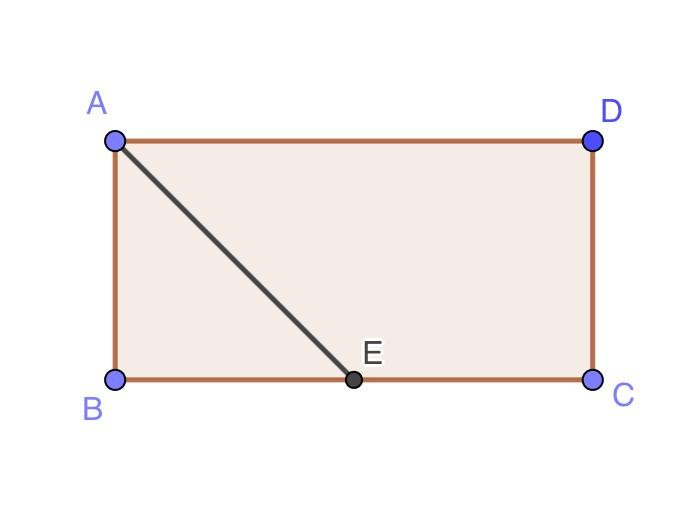
Let $A B C D$ be a rectangle in which $A B+B C+C D=20$ and $A E=9$ where $E$ is the mid-point of the side $B C$. Find the area of the rectangle. Answer: 19 Solution:
let $AB = CD= x$ & $BE = EC= y$ , $AD = 2y$
$x+y =10$, $x^2+y^2=81$
$2xy=19$
The area of a rectangle is $19$.
IOQM 2021 - Problem 5
Find the number of integer solutions to $||x|-2020|$<$5$. Answer: 18 Solution:
$||x| -2020|<5$
$-5<|x| - 2020< 5$
$2015<|x| <2025$
$x$ is lying between $(-2015,-2025)$ and $(2015,2025)$
There are $9$ integer between$(-2015,-2025)$ and $9$ integer between $(2015,2025)$.
So, The total $18$ integer solution.
IOQM 2021 - Problem 6
What is the least positive integer by which $2^{5} \cdot 3^{6} \cdot 4^{3} \cdot 5^{3} \cdot 6^{7}$ should be multiplied so that the product is a perfect square? Answer: 15 Solution:
By Fundamental theorem, $n=p_{1}^{n_{1}} p_{2}^{n_{2}} \cdots p_{k}^{n_{k}}=\prod_{i=1}^{k} p_{i}^{n_{i}}$
if $n$ is a perfect square then $n_i$ is even $\forall i $
$3$ and $5$ has odd power then $3 \times 5 = 15$ is the minimum multiplied to make $n$ is a perfect square.
IOQM 2021 - Problem 7
Let $A B C$ be a triangle with $A B=A C$. Let $D$ be a point on the segment $B C$ such that $B D=48 \frac{1}{61}$ and $D C=61$. Let $E$ be a point on $A D$ such that $C E$ is perpendicular to $A D$ and $D E=11$. Find $A E$. Answer: 25 Solution:
A $5$ -digit number (in base $10$ ) has digits $k, k+1, k+2,3 k, k+3$ in that order, from left to right. If this number is $m^{2}$ for some natural number $m$, find the sum of the digits of $m$ . Answer: 15 Solution:
$3k \leq 9$
$k = 1,2,3$
$k =1$
$\Rightarrow n = 12334$
not a perfect square as $n = 2$ (mod $4$)
$k = 2$
$\Rightarrow n = 23465$
not a perfect square as $n =15$(mod $25$)
$k = 3$
$\Rightarrow n = 34596 = 186^2$(this is a perfect square)
$\Rightarrow m = 186$
The sum of the digit $m =1 + 8 + 6 = 15$.
IOQM 2021 - Problem 9
Let $A B C$ be a triangle with $A B=5$, $A C=4$, $B C=6$. The internal angle bisector of $C$ intersects the side $A B$ at $D$. Points $M$ and $N$ are taken on sides $BC$ and $AC$, respectively, such that $D M || A C$ and $D N || B C $. If $(M N)^{2}$=$\frac{p}{q}$ where $p$ and $q$ are relatively prime positive integers then what is the sum of the digits of $|p -q|$? Answer: 2 Solution:
$DMCN$ is a parallelogram $DN||MC$ and $DM || NC$ and $DC$ bisect $\angle C$ $\angle MDC$ = $\angle DCM$ = $\angle CDN$ = $\angle NCD$ $\Rightarrow DM$ = $MC$ =$CN$ =$ND = x$(say)
by cosine law, ${MN}^2$ = $2x^2(1-cos c)$ = $\frac{126}{25}$ $\Rightarrow |p-q| =101$ In $\triangle ABC$ cos c =$\frac{BC^2+AC^2-AB^2}{2BC.AC}$ =$\frac{9}{16}$
IOQM 2021 - Problem 10
Five students take a test on which any integer score from $0$ to $100$ inclusive is possible. What is the largest possible difference between the median and the mean of the scores? (The median of a set of scores is the middlemost score when the data is arranged in increasing order, It is exactly the middle score when there are an odd number of scores and it is the avarage of the two middle scores when there are an even number of scores.) Answer: 40 Solution:
Numbers should be $0,0,0,100,100$
Median = $0$ and Mean = $40$
Difference = $40 - 0 = 40$ ( largest difference.)
IOQM 2021 - Problem 11
Let $X$ = $\{-5, -4, -3, -2, -1, 0, 1, 2, 3, 4, 5\}$ and S=$\{(a, b) \in X \times X: x^{2}+ax+ b$ and $x^{3}+bx+ a$ have at least a common real zero}. How many elements are there in $S$? Answer: 24 Solution:
The case of $a = 0 , \alpha = 1,-1$ is counted $22$
The total number of elements = $6 + 10 + 1 0 -2 = 24$.
IOQM 2021 - Problem 12
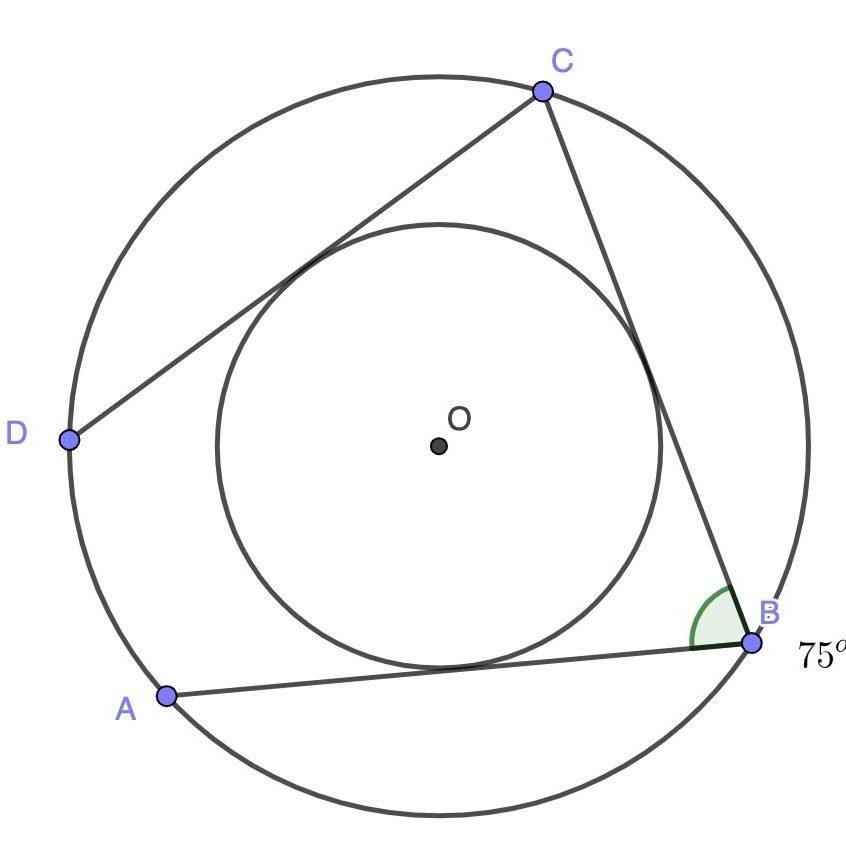
Given a pair of concentric circles, chords $A B, B C, C D, \ldots$ of the outer circle are drawn such that they all touch the inner circle. If $\angle A B C=75^{\circ},$ how many chords can be drawn before returning to the starting point.
Answer: 24 Solution:
Let the radius of big circle be $R$ and small circle be $r$ $XY =YZ=ZZ'$ Hence all the chords are of equal length. So, $XY=2\sqrt {R^2 - r^2}$ which is independent of $X,Y,Z,Z'$.
If the chords can be drawn, returning to the initial point, observe by how much angle $XY$ shifts to $YZ$, i.e. $X\rightarrow Y\rightarrow Z$ In $\triangle OYX$, $\angle OYX = \angle OXY=37.5^{\circ}$ As OY bisects $\angle ZYX$ Hence, $\angle XOY=105^{\circ}$
Suppose $n$ chords can be drawn. Every single time the chord rotates by $105^{\circ}$ Therefore, $360^{\circ}$ divides $105^{\circ} \times n$
Find the sum of all positive integers $n$ for which $|2^{n}+5^{n}-65|$ is a perfect square. Answer: 6 Solution:
$1 \leq n \leq 3$ $\Rightarrow n=2$ has a solution $\Rightarrow m=6$ $m=4 \Rightarrow \quad m=24$
For $n \leq 5$ We will see mod 10 $2^{n}$ ends with 2 or 8 if $n$ is odd $5^{n}-65 \equiv 0$ mod 10 $2^{n}+i^{n}-65 \equiv 2 / 8 \mathrm{mod} 10$ $\Rightarrow m^{2} \equiv 01,4,5,6,9 \mathrm{mod} 10$ $\Rightarrow N+$ solution.
$n \geq 5$ mod 10 $n=\mathrm{even} =2 k$ $m^{2}= 4k+5\left(5^{2 k-1}-13\right)$ $\left(m-2^{k}\right)$ $\left(m+2^{k}\right) = 5\left(5^{2 k-1}-13\right)$ $5^{2 k-1}-13 \equiv 12$ mod $100$ $5\left(5^{2 k-1}-13\right)=60$ mod $100$ $\left(m-2^{k}\right)\left(m+2^{k}\right)=60$ mod $100$ $= 36 \times2 = 10 \times 6$ $\left(m-2^{k}\right)(m+2 k)=60$ mod $100$ There will be two possible cases $6$ (mod $100$) $2$ (mod $100$ ) $\Rightarrow m \equiv 8$ mod $100$ $2^{k} \equiv 2$mod $100$ $100$ does not divide $2^{k} - 2$ as $4$ divides$2^{k} - 2$ $100$ does not divide $2^{k} - 14$ as $4$ divides$2^{k} - 14$ So, the number of solution is $2+4=6$
IOQM 2021 - Problem 14
The product $55 \times 60 \times 65$ is written as the product of five distinct positive integers. What is the least possible value of the largest of these integers? Answer: 20 Solution:
$11$ and $13$ should be taken as factor because any multiple of $11$ and $13$ will give us a bigger factor.
So, we can easily see the only way to write the given expression as a product of $5$ factor where we get the minimum value of the largest factor is the following
$13 \times 11 \times 15 \times 20 \times 5$
IOQM 2021 - Problem 15
Three couples sit for a photograph in $2$ rows of three people each such that no couple is sitting in the same row next to each other or in the same column one behind the other. How many arrangements are possible? Answer: 96 Solution:
$M_1,F_1$ and $M_2,F_2$ and $M_3,F_3$ are $3$ couples. There are $2$ cases. Case 1: All three in a row are boys or girls. case 2: $2$ boys and $1$ girl in one of the rows.
Case1. $M$ = No. of arrangements in a row = $3!$ $N$ = No. of arrangements in the other row = Derangement(3) = $2$ $P$ = No of options for the row = $2$.
Total Number of arrangements in Case 1 = $ MNP = 24$.
Case2. $M$ = No. of arrangements in a row = $3! \times 3$ $N$ = No. of arrangements in the other row = Derangement(3) = $2$ $P$ = No of options for the row = $2$.
Total Number of arrangements in Case 2 = $ MNP = 72$.
Total Number of arrangements = $24 + 72 = 96$
IOQM 2021 - Problem 16
The sides $x$ and $y$ of a scalene triangle satisfy $x+\frac{2 \Delta}{x}=y+\frac{2 \Delta}{y},$ where $\Delta$ is the area of the triangle. If $x=60, y=63$, what is the length of the largest side of the triangle? Answer: 87 Solution:
We obtain $\Delta$ = $\frac{xy}{2}$ where $x =60$ , $y = 63$
If, $\theta$ is angle between sides $x$, $y$ then $\Delta$ = $90^{\circ}$
Suppose $z$ is the third side
$z= \sqrt {x^2 + y^2}$ = $87$
IOQM 2021 - Problem 17
How many two digit numbers have exactly $4$ positive factors? (Here $1$ and the number $n$ are also considered as factors of $n$.) Answer: 30 Solution:
If $\sum_{k=1}^{40}(\sqrt{1+\frac{1}{k^{2}}$+$\frac{1}{(k+1)^{2}}})$=$a+\frac{b}{c}$ where $a, b, c \in \mathbb{N}, b<c, gcd(b, c)=1$, then what is the value of $a+b$ ? Answer: 80 Solution:
Let $A B C D$ be a parallelogram . Let $E$ and $F$ be midpoints of $A B$ and $B C$ respectively. The lines $E C$ and $F D$ intersect in $P$ and form four triangles $A P B$, $B P C$, $C P D$ and $D P A$. If the area of the parallelogram is $100 \mathrm{sq}$. units. what is the maximum area in sq. units of a triangle among these four triangles? Answer: 40 Solution:
$\triangle Q C D$ $A E || CD$ $\quad \& A E=\frac{1}{2} C D$ $\Rightarrow$ By Midpoint Theorem, $QA=AD \ QD=2 A D$
$\triangle M P C \sim \triangle$ QPN $\frac{P N}{P M}=\frac{Q D}{F C}=4$ $\Rightarrow P M+P N=M N=5 M P$
$[B P C]=\frac{1}{2} \times B C \times M P$ $[A P D]=\frac{1}{2} \times P N \times A D$ $\Rightarrow \frac{[B P]}{[A P D]}=\frac{M P}{P N}=\frac{1}{4}$ Let the areas $[E B P]=[EPA]=y$ Since E P is median. $[B P F]=[F P C]=x$ $PF$ is a median $[A P D]=a, [P D C]=b$
$[E B C]$=$\frac{1}{4} \times[A B C D]$=$2 5$=$2 x+y$ $[F D C]$=$\frac{1}{4} \times[A B C D]$=$2 5$=$2 x+b$ $[A B C D]$= $100 = 2x +2y +a +b$ Solving we get $a = 25 + 3x$ $\frac{[B P C]}{[A P D]}$ = $\frac {2x}{a}$ = $\frac 14$ $\Rightarrow a=8 x$
$[B P C]=10$ $[A B P]=15$ $[A P D]=40$ $[P C D]=35$
IOQM 2021 - Problem 20
A group of women working together at the same rate can build a wall in $45$ hours. When the work started, all the women did not start working together. They joined the work over a period of time, one by one, at equal intervals. Once at work, each one stayed till the work was complete. If the first woman worked $5$ times as many hours as the last woman, for how many hours did the first woman work? Answer: 75 Solution:
Let there are 'n' women $\Rightarrow$ Each woman's one hour work $=\frac{1}{45 \mathrm{n}}$ Also, $5[t-(n-1) d]=t$ $\Rightarrow \quad 4 t=5(n-1) d$ $\Rightarrow \quad \frac{1}{45 n}\left(\frac{n}{2}\right)[2 t-(n-1) d]=1$ $\Rightarrow \quad \frac{1}{90}\left[2 \mathrm{t}-\frac{4 \mathrm{t}}{5}\right]=1$ $\Rightarrow \quad t=75$ hours
IOQM 2021 - Problem 21
A total fixed amount of $N$ thousand rupees is given to three persons $A$. $B$. $C$ every year, each being given an amount proportional to her age. In the first year, $A$ got half the total amount. When the sixth payment was made. A got six-seventh of the amount that she had in the first year; $B$ got Rs. $1000$ less than that she had in the first year; and $C$ got twice of that she had in the first year. Find $N$. Answer: Solution:
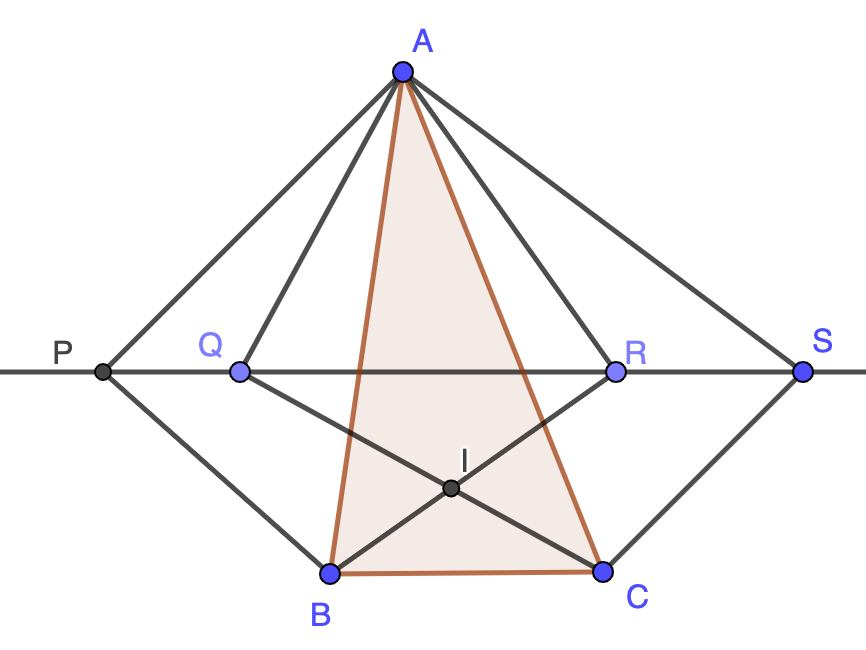
In triangle $A B C$, let $P$ and $R$ be the feet of the perpendiculars from $A$ onto the external and internal bisectors of $\angle A B C$, respectively; and let $Q$ and $S$ be the feet of the perpendiculars from $A$ onto the internal and external bisectors of $\angle A C B$ respectively. If $P Q=7$, $Q R=6$ and $R S=8$, what is the area of triangle ABC? Answer: 64 Solution :
Let us start by drawing a picture.
$PQRS$ is a collinear $ARBP$ is a rectangle
$\Rightarrow \angle P R B = \angle P A B =\frac{ B}{ 2}$=$\angle R B C$ $ \Rightarrow P R || B C$
similarity by similarly on $ASCQ \Rightarrow RS||BC$
Let, $BR$ and $QC$ meet at $I$ $\Rightarrow I$ is center.
$\Rightarrow AB = PR = 13$, $AM=MB$ (M is midpoint of $AB$)
$AQCS$ is a rectangle
$\Rightarrow AC = QS = 14$
$AN = NC$ ($N$ is a midpoint of $AC$)
By midpoint theorem,
$MN = \frac{1}{2} BC$
$PM + MR = PQ + QR =13$
$\Rightarrow PM = MR = 65$
Similarly $QN = NS = 7$
$MN = MR + QN - QR = 7.5$
$\Rightarrow BC = 15$ , $AB = 13$, $AC = 14$
Area of $\triangle ABC = 64$
IOQM 2021 - Problem 23
The incircle $\Gamma$ of a scalene triangle $A B C$ touches $B C$ at $D$, $CA$ at $E$ and $A B$ at $F$. Let $r_{A}$ be the radius of the circle inside $A B C$ which is tangent to $\Gamma$ and the sides $A B$ and $A C$. Define $r_{B}$ and $r_{C}$ similarly. If $r_{A}$=$16$, $r_{B}$=$25$ and $r_{C}$=$36,$ determine the radius of $\Gamma$. Answer: 74 Solution:
Using the formula $r =\sqrt{r_{a} \cdot r_{b}}+\sqrt{r_{b} \cdot r_{c}}+\sqrt{r_{c} \cdot r_{a}}$ =$\sqrt{16 \cdot 25}+\sqrt{25 \cdot 36}+\sqrt{36 \cdot 16}$ =$20+30+24=74$
IOQM 2021 - Problem 24
A light source at the point $(0,16)$ in the coordinate plane casts light in all directions. A disc (a circle along with its interior) of radius 2 with center at (6,10) casts a shadow on the X axis. The length of the shadow can be written in the form $m \sqrt{n}$ where $m , n$ are positive integers and $n$ is square-free. Find $m+n$. Answer: 4 Soulition:
MPB has slope -1 $\Rightarrow MBO=45^{\circ}$ $\angle A M B=\angle B M C=\alpha$
For a positive integer $n$, let $(n)$ denote the perfect square integer closest to $n$. For example, $\langle 74\rangle=81,(18)=16$ If $N$ is the smallest positive integer such that $(91) \cdot(120) \cdot\langle 143\rangle \cdot\langle 180\rangle \cdot\langle N\rangle$ =$91 \cdot 120 \cdot 143 \cdot 180 \cdot N$. Find the sum of the squares of the digits of $N$. Answer: 56
Now to make $\langle\mathrm{N}\rangle$ to be a perfect square, we can take smallest $\mathrm{N}$ to be $2 \cdot 11 \cdot 3 \cdot 7$=$162$ $\quad\langle N\rangle$=$\frac{21}{22} N$=$\frac{3 \cdot 7 \cdot 2 \cdot 11 \cdot 3 \cdot 7}{2 \cdot 11}$=$(21)^{2}$=$441$ Which is the nearest perfect square to $462$.
$\quad$ Sum of square of digits of 462 is $4^{2}+6^{2}+2^{2}$ $$ =16+36+4=56 $$
IOQM 2021 - Problem 26
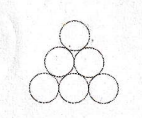
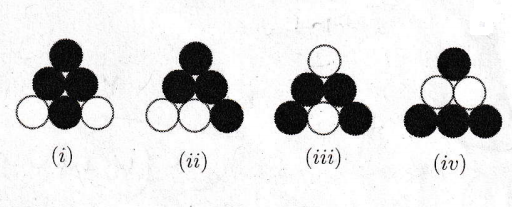
In the figure below, 4 of the 6 disks are to be colored black and 2 are to he colored white. Two coloring that can be obtained from one another by a rotation or a reflection of the entire figure are considered the same.
There are only four such colorings for the given two colors, as shown in Figure $1 .$ In how many ways can we color the 6 disks such that 2 are colored black. 2 are colored white, 2 are colored blue with the given identification condition? Answer: 24
Solution:
Try to find all the possible colorings possible using only white and black as the conditions are given
From each of these colorings generate the possible arrangements using the white, black, blue colors as per the conditions given
Eliminate the repetitions or the identical ones according to the conditions given
IOQM 2021 - Problem 27
A bug travels in the coordinate plane moving only along the lines that are parallel to the $x$ axis or $y$ axis. Let $A=(-3,2)$ and $B(3,-2)$. Consider all possible paths of the bug from $A$ to $B$ of length at most $14$ . How many points with integer coordinates lie on at least one of these paths? Answer: 87
Solution:
IOQM 2021 - Problem 28
A natural number $n$ is said to be good if $n$ is the sum of $r$ consecutive positive integers, for some $r \geq 2$. Find the number of good numbers in the set ${1,2...100}$. Answer: 93
Solution:
$k+(k+1)+\cdots+(k+r-1)$=$n$
$\Rightarrow 2 n$=$(2 k+r-1) \times r$
$n = r \times (2k + r -1)$
$ \Rightarrow $ n has two factors $r$ and $2k+r-1$
Then, $- r + (2k+r-1) = 2k-1$.
This means $n$ has two factors whose factors are of opposite parity.
Observe that powers of $2$ don't have this property.
$2^0 , 2^1, \cdots 2^6 \in \{1,2, \cdots 100 \}$
The required number is $100 - 7 = 93$
IOQM 2021 - Problem 29
Positive integers $a, b, c$ satisfy $\frac{a b}{a-b}=c$. What is the largest possible value of $a+b+c$ not exceeding $99$? Answer: 99
Solution:
Try out with example.
$b = 18, a =27 , c = 54$
IOQM 2021 - Problem 30
Find the number of pairs $(a, b)$ of natural numbers such that $b$ is a $3$ -digit number $a+1$ divides $b-1$ and $b$ divides $a^{2}+a+2$. Answer: 16
The following topics in number theory are useful for the Senior round:
Bezout’s Theorem and Euclidean Algorithm
Theory of congruence
Number Theoretic Functions
Theorems of Fermat, Euler, and Wilson
Pythagorean TriplesChinese Remainder Theorem
Here is an example of a Number Theory problem that may appear in Seinor Bose Olympiad:
Suppose $a, b, c$ are the side lengths of an integer sided right-angled triangle such that $GCD(a, b, c) = 1$. If $c$ is the length of the hypotenuse, then what is the largest value of the $GCD (b, c)$?
Key idea: Pythagorean Triples
Geometry
The following topics in geometry are useful for the Senior Bose Olympiad round:
Synthetic geometry of triangles, circles
Barycentric Coordinates
Miquel Point Configuration
Translation
Rotation
Screw Similarity
Here is an example of a geometry problem that may appear in the Senior Bose Olympiad:
Suppose the river Basumoti is 25 meters wide and its banks are parallel straight lines. Sudip's house 10 meters away from the bank of Basumoti. Apu's house is on the other side of the river, 15 meter away from the bank. If you are allowed to construct a bridge perpendicular to the banks of Basumoti, what is the shortest distance from Sudip to Apu's house.
Key idea: Reflection
Algebra
The following topics in Algebra are useful for Intermediate Bose Olympiad:
Screw similarity, Cyclotomic Polynomials using Complex Numbers
AM, GM, and Cauchy Schwarz Inequality
Rational Root Theorem, Remainder Theorem
Roots of a polynomial
Here is an example of an algebra problem that may appear in Senior Bose Olympiad:
The following sum is greater than which integer: $$ \frac{2}{3} + \frac{3}{4} \cdots + \frac{2019}{2020} + \frac{2020}{2} $$
(A) $2019$ (B) $2020$ (C) $2021$ (D) $2022$
Key idea: inequality
Bose Olympiad Previous Year Paper
Reference Books
Elementary Number Theory by David Burton
Principles and Techniques in Combinatorics by Chen Chuan Chong and Koh Khee Meng
Polynomials by Barbeau
Secrets in Inequalities by Pham Kim Hung
Complex Numbers from A to Z by Titu Andreescu
Challenges and Thrills of Pre College Mathematics
Lines and Curves by Vasiliyev (something else)
Geometric Transformation by Yaglom
Notes by Yufei Zhao
Trigonometric Delights by El Maor
Trigonometry by S.L. Loney
101 Problems in Trigonometry by Titu Andreescu
Bose Olympiad Intermediate - Resources
Bose Olympiad Intermediate is suitable for kids in Grade 5, 6, and 7.
The following topics in number theory are useful for the Intermediate round:
Primes and Composites
Arithmetic of Remainders
Divisibility
Number Theoretic Functions
Here is an example of a Number Theory problem that may appear in Bose Olympiad:
How many positive integer solutions are there of the equation $x^3 - y^3 = 121$ ?
Key idea: Primes
Geometry
The following topics in geometry are useful for the Intermediate round:
Locus problems
Geometry of lines (angles, parallels)
Geometry of triangles (centroid, circumcenter, orthocenter)
Geometry of circles (tangents, chords, cyclic quadrilaterals)
Conic sections (ellipse, parabola, hyperbola).
Triangular Inequality
Here is an example of an geometry problem that may appear in Bose Olympiad:
There are two trees A and B on a field such that distance between A and B is 5 meter. Ayesha is continuously running on the field such that sum of her distances from A and B is always 5 meters. How many times does she visit the midpoint of A and B?
Key idea: Locus
Algebra
The following topics in Algebra are useful for Intermediate Bose Olympiad:
Factorization
Linear equations
Quadratic Equations
Inequality
Here is an example of an algebra problem that may appear in Bose Olympiad:
Consider all rectangles of perimeter 40 cm. What is the largest area that can be enclosed by any such rectangle?
Key idea: inequality
Bose Olympiad Previous Year Paper
Reference Books
Mathematical Circles by Fomin
Lines and Curves by Vasiliyev
Challenges and Thrills of Pre College Mathematics
Bose Olympiad Junior Level: Resources
Bose Olympiad Junior is suitable for kids in Grade 1, 2, 3 and 4.
Basic skills of addition, subtraction and multiplication and division will be sufficient for attending arithmetic problems. Fundamental ideas about place-value system and ratios could be useful for Mains level.
Here is an example of an arithmetic problem that may appear in Bose Olympiad:
Suppose Ajit has 35 cheese sticks. Ajit makes Red Packs containing 3 sticks in each packet. Then Ajit makes Green packs containing 3 Red Packs each. Finally he makes Blue packs, each containing 3 Green Packs. How many unpacked sticks are there at the end of this process?
Key idea: Place Value System
Geometry
A basic understanding is of shapes like triangle, circle, square is sufficient for prelims. Locus (path traced out by a moving point) is another key geometry topic that may appear. At the Mains level, the student may need notions of Area and Perimeter.
Here is an example of an geometry problem that may appear in Bose Olympiad:
Ayesha is running on a field such that his distances from two trees A and B are always equal. That is the distance of the position of Manoj from tree A is equal to the distance of the position of Manoj from tree B at any point of time. Then what is the shape of the path along which Ayesha is running?
Key idea: Locus
Mathematical Puzzles
Mathematical puzzles may involve parallel channels, back tracking, greedy algorithm and recursive logic.
Here is an example of an puzzle problem that may appear in Bose Olympiad:
2019248 teams are playing in a knockout galactic football tournament. In this tournament no match ends in a draw and if you lose a match then you are out of the tournament. In the first round of the tournament the teams are paired up. In each subsequent round if even number of teams remain then they are again paired up, if odd number of teams remain then the highest scoring team is allowed to rest and directly go to the next round. How many matches are played in this tournament?