Power and Acceleration

Let's discuss a beautiful problem useful for Physics Olympiad based on Power and Acceleration.

The Problem: Power and Acceleration

Assume that a constant power P is supplied to an electric train and it is fully used in accelerating the train. Obtain relation giving the velocity of the train and distance traveled by it as functions of time.

Solution:

We know, power (P)= force(F)*velocity (v).

Therefore,

m dv/dt=P/v

or, vdv=P/m dt

Integrating both sides, we have

∫vdv= P/m ∫dt

v2/2=P/m t+c

where c is a constant of integration.

Now, at t=0, v=0 so c=0.

Therefore,

Or, v = √(2Pt/m)……… (i)

We know, v= dx/dt

So, from equation (i)

dx/dt= √(2Pt/m)

Integrating both sides,

∫dx= √(2Pt/m) dt

or, x= (2/3)√(2P/m)t3/2

Instantaneous Acceleration

Let's discuss a problem useful for Physics Olympiad based on Instantaneous Acceleration.

The Problem:

Velocity-displacement curve of a particle moving in a straight line is as shown

velocity displacement curve

Discussion:

Acceleration a=v dv/ds

From, the graph, we can see a=vtanθ

tanθ=1/4

Putting the values, we get acceleration a= 1m/s2

Projectile Inside a Liquid

Let's discuss a problem useful for Physics Olympiad, based on Projectile Inside a Liquid.

The Problem: Projectile Inside a Liquid

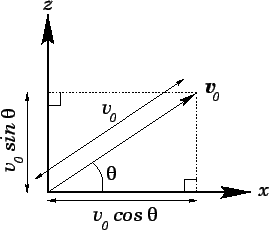
A body of mass m is projected inside a liquid at an angle θ0 with the horizontal at an initial velocity v0. If the liquid develops a velocity-dependent force F= -kv where k is a positive constant, determine the x and y components of the velocity at any instant.

Solution:

A body of mass m is projected inside a liquid at an angle θ0 with the horizontal at an initial velocity v0. The liquid develops a velocity-dependent force F= -kv where k is a positive constant.

Hence,

m dv/dt= -kv

or, dv/dt= -k/m v

or, dv/v= -k/m dt

Integrating both sides,

∫dv/v = -k/m ∫dt

ln|v|= -kt/m+c (where c is a constant of integration)….. (i)

Now, for the x component of velocity,

ln vx=  -kt/m+ c

From the given problem, we have

vx=v0 cosθ0 at t=0

Applying the above condition in eqn.(i), we get

ln (vx/ v0 cosθ0 )= -kt/m

or vx=v0cosθ0e-kt/m

For the y component, we have to consider the acceleration due to gravity g.

Hence,

m dvy/dt= -kvy-mg

or, dvy/(kvy+mg)= -k/m dt

Integrating both sides,

ln|kvy+mg|=-kt/m+c

At t=0, vy=v0sinθ0

Hence,

kvy+mg=(kv0sinθ0+mg) e-kt


Some Useful Links:

Motion under Constant Gravity

Let's discuss a beautiful problem useful for Physics Olympiad based on Motion under Constant Gravity.

The Problem: Motion under Constant Gravity

A person throws vertically up n balls per second with the same velocity. He throws a ball whenever the previous one is at its highest point. The height to which the balls rise is

(a) g/n2

(b) 2gn

(c) g/2n2

(d) 2gn2

Solution:

We know v=u-gt. v is zero at the highest point. Time t taken by one ball to reach maximum height is 1/n.

Hence, we have

u=gt

or, u=g/n……. (i)

now, from the relation v2=u2-2gh. Again, v=0

u2=2gh……. (ii)

Putting the value of u from equation (i) in above relation (ii), we get

h=g/2n2.

Velocity and Acceleration

Let's discuss a beautiful problem from Physics Olympiad based on Velocity and Acceleration.

The Problem: Velocity and Acceleration

A particle is moving in positive x-direction with its velocity varying as v= α√x. Assume that at t=0, the particle was located at x=0. Determine the

Discussion:

v=α√x.

Squaring both sides

v22x

=2(α2/2)x

Acceleration= α2/2

The initial velocity u is therefore zero and the acceleration is constant.

Average velocity=(0+v)/2=α√s/2

Understanding the Infinitesimal

Understanding the Infinitesimal 
Cheenta Notes in Mathematics
 
Let's discuss a beautiful idea related to progress in mathematics and understanding the infinitesimal.
Adding infinitely many positive quantities, you may end up having something finite. Greeks did not understand this very well. Archimedes had some ideas. Kerala school of mathematics under the leadership of Madhavacharya made real progress in refining this notion. They created the necessary groundwork for the advent of calculus later in Germany and Britain.
 
Indian Statistical Institute's 2017 entrance for B.Stat and B.Math had a very simple problem based on infinitesimals. Adding little things, can you end up having more than 'little'? 
 
Here is the problem:
 
Given f : ℝ → ℝ be a continuous function such that for any two real numbers x and y,
|f(x) - f(y)| ≤ 7|x-y|201
 
Then:
 
(A) f(101) = f(202) + 8; 
(B) f(101) = f(201) +1; 
(C) f(101) = f(200) + 2; 
(D) None of the above;
 
Before we solve the actual problem, lets have a fun detour. What if f is differentiable (the problem does not say that)? Then take y = x + δ where δ > 0 Clearly, by the given condition:
 
| f(x) - f(x + δ) | ≤ 7 |x - (x + δ) |201 = 7δ201 
⇒ |f(x) - f(x+δ) |/δ ≤ 7 δ200 
⇒ limδ → 0 |f(x) - f(x+δ) |/δ ≤ limδ → 0  7δ200 =  0 
⇒ |f'(x)| = 0
 
That means, if f is differentiable, then it's derivative is 0, or in other words, it is a constant function. In that case f(x) = f(y) = c (a constant for all x and y). Hence none of the first three options would hold. (Interestingly enough this is sufficient to choose (D) as the correct option as differentiable functions are an important subclass of continuous functions). 
 
However, we cannot assume differentiability as it is not mentioned in the problem. But now we have a hunch! We are already guessing that maybe f is not changing much. 
 
Suppose we want to check:
| f(101) - f(202) |
 
Chop off the distance between 101 to 202 into intervals of 0.1 unit long. There are 1010 such intervals (this is the 'adding the little' part). Why did I choose 0.1 length? Well, that is because it is a fractional length and raising a fraction to large powers will make it even smaller. 
 
Now note that: 
 
|f(101) - f(202)|
 = |f(101) - f(101.1) + f(101.1) - f(101.2) + ... + f(201.9) - f(202)|  
≤  |f(101) - f(101.1)| + |f(101.1) - f(101.2)| + ... + |f(201.9) - f(202)| 
≤ 7|101-101.1|201 + ... + 7|201.9-202|201 
= 7 ( 0.1201 + ... + 0.1201
= 7 × 1010 × 0.1201 
= 7070/10201

But that implies |f(101) - f(202)| is much smaller 1 let alone 8. Using this same technique you can make |f(101)  -  f(202| smaller than 1 and f(101) - f(200)| smaller than 2. Hence the answer is option (D).
 
More interestingly, can you make the difference between f(x) and f(y) arbitrarily small? If you can do that then f(x) will be a constant function! This is something for you to think about this week.
 
Here is a possible way to think about it:
 
Taking smaller intervals. For example, for integers x and y chop off |x-y| into intervals of length 1/n. There will be |x-y|/(1/n) = n|x-y| intervals. Then you can use the above algorithm to compute:
 
|f(x) - f(y)|
 ≤ 7 × n|x-y|/n201
 = 7 × |x-y|/n200
 
No matter how large |x-y| is, (by the archimedean property) we can find a positive integer k such that

|x-y| < k × n


Try to finish it off from here. Let me know if you get anything. 

Dimensional Analysis

The distance travelled by an object is given by x=(at+bt2)/(c+a) where t is time and a,b,c are constants. The dimension of b and c respectively are:

Solution:

The dimension of x is L. Hence, the dimension of a must be LT-1.

Dimension of c and a are the same.

Dimension of b therefore is L2T-3.

Motion of an Elevator


Try this problem useful for the Physics Olympiad based on Motion of an Elevator.

The Problem: Motion of an Elevator

An elevator of mass M is accelerated upwards by applying a force F. A mass m initially situated at a height

of 1m above the floor of the elevator is falling freely. It will hit the floor of the elevator after a time equal to

Discussion:

Acceleration of elevator ae= F/M ( in upward direction)

Acceleration due to gravity is in downward direction so acceleration of mass as= -g

Acceleration of mass with respect to elevator

= as-ae

=(F/M)+g

=(F+Mg)/M

We know,

s=ut+(1/2)at2

From the given problem, we have s=1m

so,

1=(F+Mg)t2/M

t=√2M/(F+Mg)

Some Useful Links:

Differentiability at origin | I.S.I. B.Stat, B.Math Subjective 2017

Try this problem from ISI B.Stat, B.Math Subjective Entrance Exam, 2017 Problem no. 3 based on Differentiability at origin.

Problem: Differentiability at origin

Suppose \( f : \mathbb{R} \to \mathbb{R} \) is a function given by $$
f(x) = \left\{\def\arraystretch{1.2}%
\begin{array}{@{}c@{\quad}l@{}}
1 & \text{if x=1}\\ e^{(x^{10} -1)} + (x-1)^2 \sin \left (\frac {1}{x-1} \right ) & \text{if} x \neq 1\ \end{array}\right.
$$

Discussion:

a)First of all we need to check whether \(f'(1)\) exists or not.

We will proceed with the first principle.

Let us check the Right hand derivative(RHD) and Left hand derivative(LHD) of \(f\) at \(x=1\).

RHD at \(x=1\) is

\(\lim_{h\to0}\frac{f(1+h)-f(1)}{h}\\=\lim_{h\to0}\frac{e^{((1+h)^{10}-1)}+h^2\sin( \frac{1}{h})-1}{h}\\=\lim_{h\to0}\frac{e^{((1+h)^{10}-1)}-1}{h}+\lim_{h\to0}h\sin( \frac{1}{h})\\=\lim_{h\to0}\frac{e^{((1+h)^{10}-1)}-1}{(1+h)^{10}-1}\frac{(1+h)^{10}-1}{h}+0=10\)

LHD at \(x=1\) is

\(\lim_{h\to0}\frac{f(1-h)-f(1)}{-h}\\=\lim_{h\to0}\frac{e^{((1-h)^{10}-1)}+h^2\sin( \frac{1}{-h})-1}{-h}\\=\lim_{h\to0}\frac{e^{((1-h)^{10}-1)}-1}{-h}+\lim_{h\to0}(-h)\sin( \frac{1}{-h})\\=\lim_{h\to0}\frac{e^{((1-h)^{10}-1)}-1}{(1-h)^{10}-1}\frac{(1-h)^{10}-1}{-h}+0=10\)

Thus,LHD=RHD.

Hence \(f'(1)\) exists and it is equal to \(10\).

(b)

\( \displaystyle{\lim_{u \to \infty } \left [ 100 u - u \sum_{k=1}^{100} f \left (1 + \frac {k}{u} \right ) \right ] }\)

As u becomes infinitely large k/u becomes arbitrarily small for finite value of k (clearly k is finite as we are interested in k=1 to 100).

Hence \( f \left ( 1 + \frac {k}{u} \right )\) is nothing but f of (1 plus an infinitesimal positive quantity). This tells us \( f \left ( 1 + \frac {k}{u} \right )\) is almost waiting to become the derivative of f at x=1. And we already know that such a derivative exists from part (a).

With this motivation, divide and multiply by \( \frac{k}{u} \).

\( \displaystyle{\lim_{u \to \infty } \left [ 100 u - u \sum_{k=1}^{100} f \left (1 + \frac {k}{u} \right ) \right ] \\ =\lim_ {u \to \infty} \left [ 100 u -\sum_{k=1}^{100} k \frac{f\left (1+\frac{k}{u} \right ) } {\frac{k}{u}} \right ]\\=\lim_ {u \to \infty} \left [ \sum_{k=1}^{100} k \frac{1-f\left (1+\frac{k}{u} \right ) } {\frac{k}{u}} \right ]\\ =\sum_{k=1}^{100} k \lim_ {u \to \infty}\frac{f(1)-f\left (1+\frac{k}{u} \right ) } {\frac{k}{u}} \\ =\sum_{k=1}^{100} k \times(- f'(1)) \\ = -10\times \left(\frac{100\times101}{2} \right )\\ =-50500 }\)

Back to the question paper

Some Useful Links:

Impulse and Momentum | Physics Olympiad Problem

Let's discuss a beautiful problem useful for Physics Olympiad based on Impulse and Momentum.

The Problem: 

A particle of mass m is made to move with uniform speed v along the perimeter of a regular hexagon. Magnitude of impulse applied at each corner of the hexagon is

(a) mv

(b) mv√3

(b) mv/2

(d) zero

Discussion:

The velocity v is resolved into two components vcos60° and vsin60°

There will be no change of velocity along the sine component since they are all in same direction. Hence, the change of momentum will only be along the cosine component.

Change in momentum= mvcos60°-(-mvcos60°)=2mvcos60°=mv.

Since, magnitude of impulse is  the change in momentum,  the answer will be (a).